Cardano Founder Says ‘Leios Is Coming’ As Proposal Heads To DReps

bitcoinistPubblicato 2026-05-15Pubblicato ultima volta 2026-05-15

Introduzione

Cardano founder Charles Hoskinson announced progress on the Leios consensus upgrade as a ₳27.7 million funding proposal moves toward DRep approval. The proposal seeks to advance Leios from a public testnet prototype to a mainnet-ready release candidate, aiming to increase Cardano's transaction capacity by 10–65x to support its 2030 scaling goals of handling over 27 million monthly transactions. The upgrade enhances, rather than replaces, the existing Ouroboros Praos protocol. The six to nine-month project is structured around development, rigorous testing, and hard-fork enablement, with funding managed via milestone-based disbursements. The proposal acknowledges risks including community readiness, governance dependencies, and potential operational impacts on stake pool operators.

Cardano founder Charles Hoskinson signaled renewed momentum behind Leios, the network’s next major consensus upgrade, as Input Output moved a ₳27.7 million funding proposal toward DRep approval. The proposal seeks to mature Leios from an early public testnet prototype into a mainnet-ready release candidate, positioning the upgrade as a central piece of Cardano’s 2030 scaling strategy.

“Leios is coming,” Hoskinson wrote on X, quoting Sebastian Nagel, who said: “Cardano, if your governance permits, we’ll ship Leios.” The short exchange framed the next phase of Cardano’s scaling roadmap as both a technical delivery question and a governance decision.

Cardano’s Biggest Scaling Bet

The proposal, authored by Carlos Lopez de Lara and Nagel, asks DReps to approve a treasury withdrawal of ₳27,714,342 to fund six to nine months of development. The work is intended to move Leios from its current prototype and testnet phase toward a release candidate suitable for mainnet integration. According to the proposal, each milestone would be independently assured, while undisbursed ada would be returned to the treasury.

Leios is designed to enhance, rather than replace, Ouroboros Praos, Cardano’s existing consensus protocol. The proposal says the upgrade introduces endorser blocks and committee-based validation to increase transaction capacity while preserving Praos’s security model. IO frames the design as a way to scale Cardano without undermining decentralization or making stake pool operations economically unviable.

“Cardano needs a step change in throughput to meet its 2030 ambitions, and Leios is how it gets there. This proposal funds the path from public testnet to a mainnet-ready release candidate — delivering a 10–65x increase in transaction capacity,” the proposal states. “Why this scale matters: Cardano’s 2030 strategy targets growth from roughly 800,000 monthly transactions to over 27 million.”

That 2030 target is a key justification for the funding request. The proposal argues that sustainable utilization at that level would require at least 6x current capacity, while Leios is expected to deliver 10x or more under validated parameter settings. Elsewhere, the accompanying IO article says Leios could support a phased throughput increase from 2x to 30x current capacity on mainnet, with full capacity demonstrated on testnet before broader rollout.

The work is organized around three objectives. The first is a release candidate, including a substantial rewrite of consensus components, implementation of the Leios block structure for the Dijkstra era, conformance testing against the Agda formal specification, and integration into the primary node by the fourth quarter of 2026.

The second is “high confidence,” built through parameter exploration, continuous load testing, adversarial testing, red-team exercises, and an updated threat model. The third is hard-fork enablement, covering client interfaces, technical documentation, SPO and developer workshops, support for adjacent infrastructure such as DB-Sync, Mithril and Blockfrost, testnet hard forks, governance artifacts and contingency procedures.

The proposal is careful to separate work within IO’s control from external dependencies. A mainnet hard fork would still depend on broader ecosystem readiness, governance action submission and a community vote. The document explicitly describes those as risks rather than promises.

Funding would be administered through Intersect’s treasury reserve smart contract framework, with milestone-based disbursements and third-party assurance. The budget allocates ₳23.83 million, or 86%, to development, with smaller portions assigned to infrastructure, security and audits, legal and compliance, ecosystem support, operations, governance and other costs.

The risk section is direct. It identifies community readiness, hard-fork timing, final cardano-node integration and possible governance constraints as factors that could delay or limit activation. It also notes technical limitations, including potential higher operational costs for SPOs, greater chain growth, and high-throughput assumptions tied to adversarial stake conditions.

At press time, ADA traded at $0.2661.
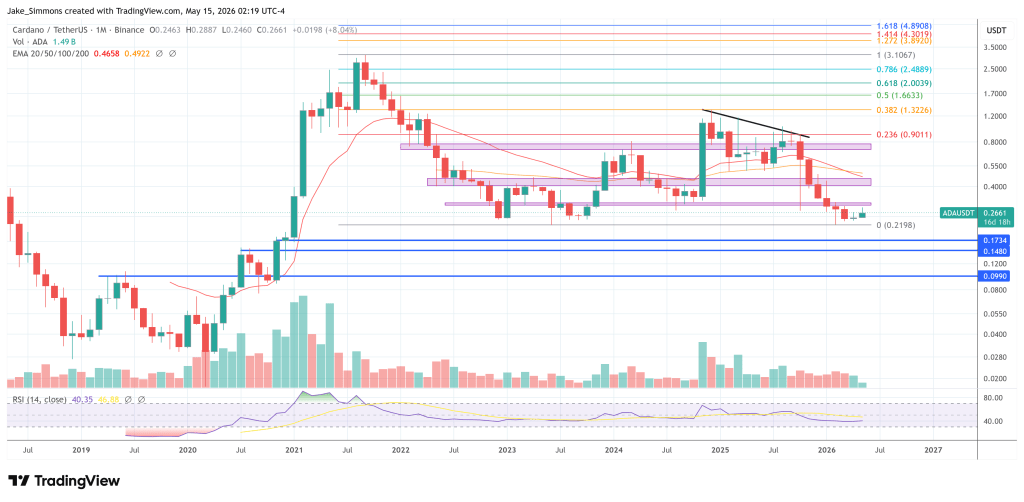
ADA remains below key resistance, 1-monthly chart | Source: ADAUSDT on TradingView.com

Domande pertinenti

QWhat is the purpose of the 27.7 million ADA funding proposal submitted to the DReps for Leios?

AThe purpose of the 27.7 million ADA funding proposal is to mature Leios from an early public testnet prototype into a mainnet-ready release candidate, funding six to nine months of development work to achieve this goal.

QHow does the Leios upgrade aim to improve Cardano's transaction capacity according to the proposal?

AThe Leios upgrade aims to increase Cardano's transaction capacity by 10x to 65x, introducing endorser blocks and committee-based validation to enhance throughput while preserving the security model of the existing Ouroboros Praos consensus protocol.

QWhat are the three main objectives of the Leios development work outlined in the proposal?

AThe three main objectives are: 1) Delivering a release candidate with a rewritten consensus, 2) Building high confidence through extensive testing and security exercises, and 3) Enabling the hard fork through client interfaces, documentation, workshops, and ecosystem support.

QWhat are some of the key risks associated with the Leios activation mentioned in the proposal?

AKey risks include community readiness, hard-fork timing dependencies, final node integration, potential governance constraints, higher operational costs for SPOs, increased chain growth, and high-throughput assumptions tied to adversarial stake conditions.

QWhat is the target for Cardano's monthly transactions by 2030 as cited in the article, and why does it necessitate the Leios upgrade?

ACardano's 2030 strategy targets growth from roughly 800,000 to over 27 million monthly transactions. This necessitates the Leios upgrade because sustainable utilization at that level requires at least a 6x increase in capacity, which Leios is designed to provide (10x or more).

Letture associate

STRC Breaks Below $95: Why Does It Continue to Depeg? Is There Default Risk?

"STRC Falls Below $95: Why the Persistent Depegging and Is There Default Risk?" The article discusses the recent decline in the price of STRC, a perpetual preferred stock issued by Strategy (MSTR) designed to trade around a $100 par value. As of publication, STRC traded at $94.65, raising market concerns. STRC is described as a high-yield cash flow product, offering an 11.50% annual dividend paid monthly. Its "preferred" status grants it priority over common stock for dividends and in liquidation. Key reasons cited for the price depegging include: 1. **Bitcoin's Price Drop:** MSTR's assets are heavily tied to Bitcoin (BTC), which fell over 21% from its recent high, pressuring all Strategy-related products. 2. **Competitive Pressure:** Rival Strive Asset Management's similar product, SATA, offers daily dividends and has maintained its $100 par value with a ~13% yield. In response, Strategy has proposed changing STRC's dividend frequency from monthly to bi-weekly, pending shareholder vote. 3. **Technical Selling:** A break below $100 may have triggered algorithmic selling and stop-losses, exacerbating the decline. Regarding default risk, the analysis suggests it is currently low. Strategy founder Michael Saylor confirmed the June 2026 dividend rate remains at 11.50% with no cuts or suspensions. The company's massive reserve of 843,706 BTC provides a significant backstop for its obligations. Industry opinions are mixed. Some analysts view the BTC holdings as reliable support for dividends, while critics like Peter Schiff warn of potential dividend cuts leading to price crashes and lawsuits. Others highlight inflation risk and the company's ability to reduce dividends without a formal default. In summary, STRC's drop is attributed to BTC volatility, competition, and technical factors. While immediate default risk appears contained, the product faces challenges from market conditions and competitive dynamics.

marsbit30 min fa

STRC Breaks Below $95: Why Does It Continue to Depeg? Is There Default Risk?

marsbit30 min fa

AI Trading Cools, South Korean Stocks Plunge 1.8%, Spot Gold Rises 1%, Bitcoin Dives

A sell-off in AI-related stocks, triggered by Broadcom's disappointing earnings forecast, sent shockwaves through global markets. South Korea's KOSPI led Asia's decline, plunging 1.8% as the risks from concentrated chip stock gains and surging leveraged investments came to the fore. The tech-heavy Nasdaq 100 futures fell 0.5% following Broadcom's 14% after-hours plunge, which signaled a slower-than-expected transition to AI clients. This pullback extended Wall Street's weakness, halting the S&P 500's nine-day rally amid hawkish Fed signals and renewed Middle East tensions. South Korean authorities convened an emergency meeting, pledging "immediate measures" against market volatility and warning of record-high stock margin debt. The adjustment rippled across assets: Bitcoin fell to around $64,000, its lowest since February, while safe-haven gold rose 1% on bargain hunting. Oil prices dipped on Middle East ceasefire news. Market analysts noted the sell-off was driven by profit-taking after massive gains, particularly in chip stocks like Samsung and SK Hynix, which now dominate the KOSPI. Wall Street banks are divided on Korea's outlook, with Goldman Sachs raising its target while Citigroup and others warn of overvaluation and a potential bubble. Bridgewater's Ray Dalio noted that great technological shifts often create bubbles. Meanwhile, Fed officials' hints at potential future rate hikes added to the cautious mood ahead of key U.S. jobs data.

华尔街日报56 min fa

AI Trading Cools, South Korean Stocks Plunge 1.8%, Spot Gold Rises 1%, Bitcoin Dives

华尔街日报56 min fa

Seeking Alpha's Hot Article: Why Might the U.S. Stock Market Crash in June?

In a recent Seeking Alpha article, financial professor and analyst Damir Tokic argues that the US stock market may be poised for a significant crash in June 2026. The core thesis centers on a "mega-bubble" in equities, particularly within the technology sector, which has driven the S&P 500 to near-record valuations, with a Shiller P/E ratio exceeding 40—a level comparable to the 2000 dot-com bubble. Tokic identifies two primary catalysts for a potential collapse. First, he points to unsustainable market exuberance fueled by what he terms the "Trump Stimulus"—massive AI capital expenditure by tech giants, which he believes is politically driven and cannot last. Second, and more urgently, he highlights the escalating Iran war as a critical threat. The ongoing closure of the Strait of Hormuz has created a severe global energy supply crunch. Strategic petroleum reserves are projected to hit critically low operational levels by June, potentially causing oil prices to spike above $200 per barrel and triggering a severe, supply-driven inflationary shock. This scenario, Tokic warns, would force the Federal Reserve's hand. Despite currently maintaining a dovish bias, the Fed would likely be compelled to officially pivot to a hawkish stance at its June FOMC meeting to combat soaring inflation and bond yields. He contends that such a shift—or even a failure to act, which would destroy Fed credibility—could be the trigger that punctures the market bubble. The resulting downturn, he concludes, could rival the bear markets of 2000 and 2008, advising investors to prepare for a major correction.

marsbit1 h fa

Seeking Alpha's Hot Article: Why Might the U.S. Stock Market Crash in June?

marsbit1 h fa

Trading

Spot
Futures

Articoli Popolari

Come comprare ADA

Benvenuto in HTX.com! Abbiamo reso l'acquisto di Cardano (ADA) semplice e conveniente. Segui la nostra guida passo passo per intraprendere il tuo viaggio nel mondo delle criptovalute.Step 1: Crea il tuo Account HTXUsa la tua email o numero di telefono per registrarti il tuo account gratuito su HTX. Vivi un'esperienza facile e sblocca tutte le funzionalità,Crea il mio accountStep 2: Vai in Acquista crypto e seleziona il tuo metodo di pagamentoCarta di credito/debito: utilizza la tua Visa o Mastercard per acquistare immediatamente CardanoADA.Bilancio: Usa i fondi dal bilancio del tuo account HTX per fare trading senza problemi.Terze parti: abbiamo aggiunto metodi di pagamento molto utilizzati come Google Pay e Apple Pay per maggiore comodità.P2P: Fai trading direttamente con altri utenti HTX.Over-the-Counter (OTC): Offriamo servizi su misura e tassi di cambio competitivi per i trader.Step 3: Conserva Cardano (ADA)Dopo aver acquistato Cardano (ADA), conserva nel tuo account HTX. In alternativa, puoi inviare tramite trasferimento blockchain o scambiare per altre criptovalute.Step 4: Scambia Cardano (ADA)Scambia facilmente Cardano (ADA) nel mercato spot di HTX. Accedi al tuo account, seleziona la tua coppia di trading, esegui le tue operazioni e monitora in tempo reale. Offriamo un'esperienza user-friendly sia per chi ha appena iniziato che per i trader più esperti.

1.3k Totale visualizzazioniPubblicato il 2024.12.10Aggiornato il 2026.06.02

Come comprare ADA

Discussioni

Benvenuto nella Community HTX. Qui puoi rimanere informato sugli ultimi sviluppi della piattaforma e accedere ad approfondimenti esperti sul mercato. Le opinioni degli utenti sul prezzo di ADA ADA sono presentate come di seguito.

活动图片













