Cardano Founder Reacts As NIGHT Token Crashes From $150 To $0.02

bitcoinistPubblicato 2025-12-11Pubblicato ultima volta 2025-12-11

Introduzione

Cardano founder Charles Hoskinson reacted to the extreme volatility of the newly launched NIGHT token, which surged to $150 before crashing to $0.02. Despite the sharp drop, Hoskinson defended the launch as Cardano’s strongest ever, highlighting its $1.5 billion fully diluted valuation and immediate listings on major exchanges like Binance Alpha and Kraken. He attributed the price plunge to speculative traders dumping tokens, not a structural failure, and emphasized that NIGHT’s retail-focused, fair launch—without VC involvement—was a return to crypto’s original principles. Hoskinson also positioned Midnight as Cardano’s first "partner chain" and a key competitive advantage for multi-ecosystem growth, aiming to expand the ecosystem to a $10 billion valuation.

Cardano founder Charles Hoskinson has hailed the launch of Midnight and its native token NIGHT as the strongest in the network’s history, arguing that it proves Cardano can now host and distribute multi-billion-dollar assets at scale.

NIGHT Token Plunges After Midnight Launch

In his December 10 livestream “Midnight Launch AAR,” Hoskinson opened with the volatile price action that dominated social media. NIGHT initially spiked to what he called an “insane” level: “It launched at almost a $150, which is just insane [...] it just went way, way, way up.” Once trading opened on Binance Alpha, the move reversed violently. “As soon as it got on Binance Alpha – oh god, why, why, oh why – all the way down to two cents. They dumped on us. That’s what they do. That’s what the DGENs over in that market do.”

He framed this as typical exchange-distribution dynamics, not a structural failure: recipients with no real connection to the ecosystem “regardless of the price, they just dump the token. They probably didn’t even know what NIGHT was.”

According to Hoskinson, such launches usually endure 48–72 hours of “high volatility” before a stable range emerges. He reiterated that he had expected NIGHT to trade in a “5 cents to 15 cents” band and said it was sitting around 6–6.5 cents with a fully diluted valuation of roughly $1.5 billion and around $150 million in trading volume. For a brand-new Cardano-native asset in current conditions, he called that “a really solid launch.”

What made the debut historically significant in his view was the combination of tier-one listings and on-chain metrics. “This is the first time in history that Cardano right out the gate can launch a $1.5 billion product, be listed on Binance Alpha and Kraken and OKX and everybody else at the start,” he said, stressing that much of the required infrastructure “wasn’t there” and had to be built during the run-up.

Cardano’s Best Launch Ever

On Cardano itself, he highlighted that Midnight immediately became the dominant token by trading activity. Citing TapTools, he said NIGHT was “sitting [at] an overwhelming level of volume, and it’s actually greater than the volume of every other Cardano native token combined,” adding that its FDV is “worth more than all the other CNTs combined as well.”

For the first time, he argued, DEXs such as Minswap and SundaeSwap carried a “meaningful percentage of trading volume [...] with respect to large exchanges,” helping “prime the pump on Cardano DEXes” and pull more stablecoins into the ecosystem.

Distribution was another focal point. Hoskinson praised the Glacier Drop mechanism and its gradual “thawing,” saying it creates “a nice steady emission and a nice steady flow for the system as opposed to a jagged thing where the insiders all dump.”

He contrasted Midnight’s retail-heavy, exchange-plus-airdrop distribution with VC-led launches elsewhere: “This is the first time since Bitcoin that a launch has been done the way that Midnight did it. It was complete retail, completely fair, and none of those damn VCs got their grubby hands on it. Instead, it went right to you, the people.”

He tied that to a broader “return to first principles,” arguing that 2026 should reward projects with fair launches and fixed-supply, deflationary monetary policies: “There’s a fixed supply NIGHT, by the way [...] it’s going to be a good year for everybody who’s betting on you, the consumer, and not betting on the banks.”

Looking forward, Hoskinson positioned Midnight as Cardano’s first “partner chain” and the “tip of the spear” for a hybrid DApp model spanning multiple ecosystems: “You talk about Midnight Cardano, Midnight Ethereum, Midnight Solana, Midnight Avalanche, Midnight Binance.” He said that after the first four phases of the roadmap, “every two months a new ecosystem gets activated,” with recurring feature drops “every six to eight weeks.”

He also cast Midnight as a competitive wedge for Cardano DApps. With tier-one integrations and privacy-preserving capabilities, he argued, “we have privacy before [Ethereum and Solana] do,” giving Cardano–Midnight hybrid apps a differentiator that can help grow TVL, MAU and transaction volume.

Hoskinson insisted that the launch pressure-tested and validated the base protocol: “Cardano network handled it. The exchanges handled it. And Midnight is here to stay.” The ambition from here is explicit. “We’re going to march Midnight up as an ecosystem to that $10 billion mark. That’s the goal. Let’s keep going. Let’s get her done,” he said, adding that “these are the best numbers we’ve ever seen in the history of Cardano” – and, in his view, only the beginning.

At press time, ADA traded at $0.4325.
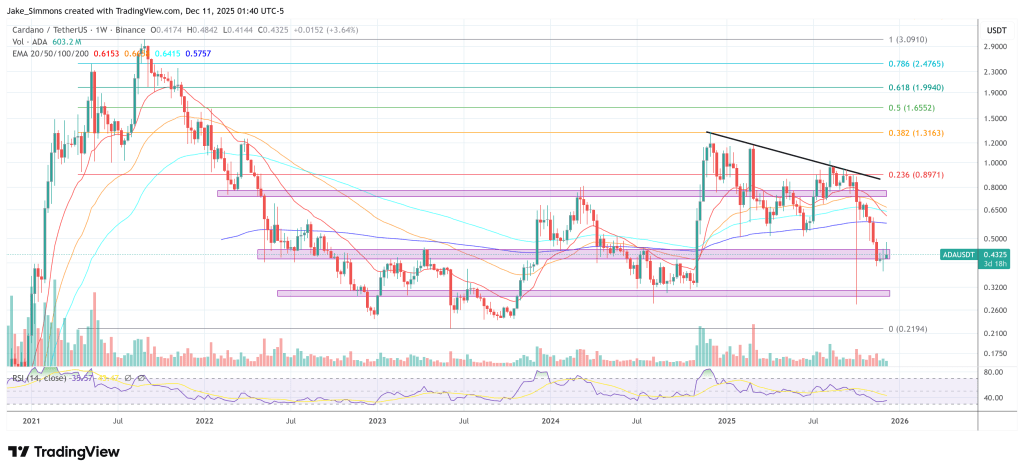
ADA bounces from key support, 1-week chart | Source: ADAUSDT on TradingView.com

Crypto di tendenza

Letture associate

The Eternal Fragments of Money: Third-Party Payment Has No First Principle

"The Enduring Fragments of Money: Third-Party Payments Lack a First Principle" Stripe is reportedly attempting to acquire PayPal, marking a significant shift reminiscent of PayPal's merger with the original X.com 30 years ago. The article analyzes Stripe's strategic challenges and the broader payments industry landscape. Despite its initial success with a developer-friendly API model, Stripe missed its optimal IPO window during the pandemic and has since seen its valuation decline. Its attempts to expand through acquisitions and new ventures, particularly in stablecoins (like its OUSD project) and Agent-focused payments (ACP/MPP protocols), have faced headwinds. The author argues that the payment industry remains highly fragmented and is ultimately an adjunct to the traditional banking system. This structure limits the potential for any single player, including Stripe, to achieve complete dominance. While stablecoins and the future rise of autonomous Agent economies present potential growth avenues, they are not yet mainstream and still require integration with the existing financial system. For now, Agent-based transactions are largely used for speculative "volume boosting" rather than substantive business applications. Stripe's current move to acquire PayPal is seen as an attempt to bolster its weak consumer-facing (C-side) business after its stablecoin-focused strategies faltered. Meanwhile, PayPal is described as structurally outdated, unable to revive itself through new products like Venmo or PYUSD. The future of payments may lie not in payments themselves but in value-added services like more efficient settlement networks. The author suggests that companies like Stripe and Circle, which are building their own blockchains (Tempo, Arc) and stablecoins, are positioning themselves to eventually profit from high-efficiency settlement systems. These new networks could potentially bypass some traditional banking layers. In conclusion, the article posits that third-party payment is a perpetually fragmented battlefield where scale alone cannot ensure victory. Players must find new models, focusing on efficiency to compete with the entrenched banking system. Stripe's acquisition of PayPal represents a bet on this uncertain future.

链捕手4 min fa

The Eternal Fragments of Money: Third-Party Payment Has No First Principle

链捕手4 min fa

9.42 Million Retail Investors Compete for Changxin Technology, Who Got Allotted?

Evergreen Technology's IPO subscription results are now available. On July 20, the domestic memory chip giant announced the offline preliminary allotment results and online lottery results for its IPO. A total of approximately 9.43 million retail investors participated in the online subscription, generating 770,000 winning lots with a final winning rate of about 0.4714%, setting a record for new shares on the STAR Market. After triggering a clawback mechanism from institutional to retail investors, the online retail allocation was significantly increased to 3.851 billion shares. Simultaneously, 285 institutional investors participated in the offline subscription, ultimately receiving 2.173 billion shares at an allotment rate of approximately 0.1756%. Leading insurers and public funds were among the major recipients. Notably, Liang Wenfeng, founder of the major AI model company DeepSeek, through his quantitative investment firms Ningbo Huanfang Quantitative and Zhejiang Jiuzhang Asset, secured the largest share among private funds, with a total allotment worth approximately 175 million yuan. Estimates suggest potential profits could reach 730 million yuan if Evergreen Technology's market capitalization reaches 3 trillion yuan post-listing. The company is expected to list on July 27 and could become the highest-valued tech stock on the A-share market, with various brokerages providing valuations ranging from 1 trillion to over 4 trillion yuan. However, recent significant corrections in global tech stocks may impact its post-listing performance. (Character count: 1,196)

marsbit1 h fa

9.42 Million Retail Investors Compete for Changxin Technology, Who Got Allotted?

marsbit1 h fa

Trading

Spot

Articoli Popolari

Come comprare ADA

Benvenuto in HTX.com! Abbiamo reso l'acquisto di Cardano (ADA) semplice e conveniente. Segui la nostra guida passo passo per intraprendere il tuo viaggio nel mondo delle criptovalute.Step 1: Crea il tuo Account HTXUsa la tua email o numero di telefono per registrarti il tuo account gratuito su HTX. Vivi un'esperienza facile e sblocca tutte le funzionalità,Crea il mio accountStep 2: Vai in Acquista crypto e seleziona il tuo metodo di pagamentoCarta di credito/debito: utilizza la tua Visa o Mastercard per acquistare immediatamente CardanoADA.Bilancio: Usa i fondi dal bilancio del tuo account HTX per fare trading senza problemi.Terze parti: abbiamo aggiunto metodi di pagamento molto utilizzati come Google Pay e Apple Pay per maggiore comodità.P2P: Fai trading direttamente con altri utenti HTX.Over-the-Counter (OTC): Offriamo servizi su misura e tassi di cambio competitivi per i trader.Step 3: Conserva Cardano (ADA)Dopo aver acquistato Cardano (ADA), conserva nel tuo account HTX. In alternativa, puoi inviare tramite trasferimento blockchain o scambiare per altre criptovalute.Step 4: Scambia Cardano (ADA)Scambia facilmente Cardano (ADA) nel mercato spot di HTX. Accedi al tuo account, seleziona la tua coppia di trading, esegui le tue operazioni e monitora in tempo reale. Offriamo un'esperienza user-friendly sia per chi ha appena iniziato che per i trader più esperti.

1.4k Totale visualizzazioniPubblicato il 2024.12.10Aggiornato il 2026.06.02

Come comprare ADA

Discussioni

Benvenuto nella Community HTX. Qui puoi rimanere informato sugli ultimi sviluppi della piattaforma e accedere ad approfondimenti esperti sul mercato. Le opinioni degli utenti sul prezzo di ADA ADA sono presentate come di seguito.

活动图片