Cardano Founder Praises ShieldUSD Milestone On Midnight

bitcoinistPubblicato 2026-03-17Pubblicato ultima volta 2026-03-17

Introduzione

Cardano founder Charles Hoskinson highlights the significance of privacy-preserving stablecoins, particularly praising the recent deployment of a minimum-viable ShieldUSD contract on Midnight's preview environment. Developed by W3i, ShieldUSD is a private stablecoin designed for confidential financial use cases like payroll and institutional DeFi, while supporting regulatory compliance through selective disclosure. This aligns with Midnight's core vision of a privacy-first blockchain using zero-knowledge proofs. Hoskinson's endorsement echoes his previous support for Moneta's USDM stablecoin, positioning ShieldUSD as an extension of regulated, privacy-focused digital dollars. The project remains in development, serving as an early proof-of-concept for Midnight's upcoming production phase.

Charles Hoskinson is again spotlighting privacy-preserving stablecoins as one of Cardano’s most consequential bets, this time tying his praise directly to fresh progress on Midnight.

In a post on X on March 16, the Cardano founder called the effort “one of the most exciting initiatives” and said it was “a bellwether for the growing utility of Midnight as a development platform.” That matters because Midnight has been positioned by its builders as a privacy-first chain built around zero-knowledge proofs and selective disclosure, with production-grade financial applications viewed as one of its core targets.

Why The Cardano Founder Is Bullish On ShieldUSD

The immediate trigger was an update from CTO at W3i Andrew Westberg, who said, “A minimum-viable shieldUSD contract has been deployed to the Midnight preview environment,” and added: “Right now, the constraints on contract size are limiting what we can do and requires a lot of consolidation transactions. We’re working closely with Midnight Foundation. We are able to successfully perform private transfers with selective disclosure for regulatory auditors.”

For Midnight, that is not some secondary feature. The network’s own documentation describes selective disclosure as a core design principle, allowing builders to prove validity or compliance without exposing the full underlying data on-chain. In practice, the idea is straightforward: transactions, balances, or identities can remain confidential to the public, while authorized parties can be shown only the information they are entitled to see. Midnight has framed that balance as essential for real-world financial use cases rather than purely crypto-native privacy experiments.

The stablecoin effort itself has been taking shape in public for months. In January, W3i Software announced shieldUSD, a privacy-preserving USD stablecoin for the Midnight Network, saying it would be co-issued by Moneta Digital and Norwegian Block Exchange. According to that announcement, shieldUSD is being built for financial workflows where confidentiality matters, including payroll, B2B settlement and institutional DeFi, while still supporting “compliance, auditability, and selective disclosure.” Midnight repeated that positioning in its January network update, presenting shieldUSD as one of the ecosystem projects intended to bring privacy-preserving finance into practical use.

That also helps explain why Hoskinson’s latest comment echoes his earlier rhetoric around Moneta’s USDM. Back in July 2025, he wrote that “Moneta’s USDM is becoming the most advanced stablecoin ever built.” Moneta describes USDM as a Cardano-native, fiat-backed stablecoin backed 1:1 by US dollar reserves, with Moneta Digital acting as issuer and redeemer. The latest Midnight work appears to extend that broader push from a regulated Cardano dollar into a privacy-preserving environment designed for more sensitive transaction flows.

Still, Westberg’s post made clear that the project is not presenting a finished product. The contract is only in Midnight’s Preview environment, which the network documents position as a development stage for builders migrating applications and testing new tooling rather than a live production venue. Midnight’s January roadmap update said the network is moving through its Hilo phase toward Kūkolu, the stage meant to introduce the first wave of production applications on a federated mainnet. In that context, the ShieldUSD deployment looks less like a launch and more like an early proof that Midnight’s compliance-friendly privacy model can be made concrete.

At press time, Cardano traded at $0.287.
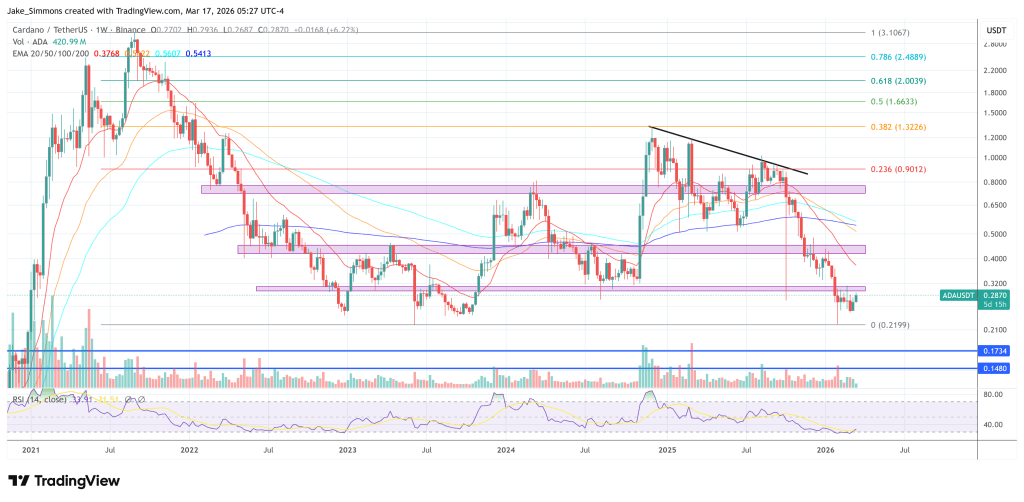
ADA hovers below key resistance, 1-week chart | Source: ADAUSDT on TradingView.com

Crypto di tendenza

Domande pertinenti

QWhat is the Cardano founder praising in his recent post on X?

ACharles Hoskinson is praising the progress on ShieldUSD, a privacy-preserving stablecoin, as a significant milestone for the Midnight development platform.

QAccording to the article, what is a core design principle of the Midnight network?

AA core design principle of the Midnight network is selective disclosure, which allows builders to prove compliance without exposing all the underlying on-chain data.

QWhich companies are co-issuing the shieldUSD stablecoin?

AThe shieldUSD stablecoin is being co-issued by Moneta Digital and Norwegian Block Exchange (NBX).

QIn what environment was the minimum-viable shieldUSD contract deployed?

AThe minimum-viable shieldUSD contract was deployed to the Midnight preview environment, which is a development stage for testing, not a live production venue.

QHow does the article describe the broader significance of ShieldUSD for Midnight?

AThe article describes ShieldUSD as a bellwether for Midnight's growing utility and a key project intended to bring privacy-preserving finance into practical use for real-world financial workflows.

Letture associate

New Fire Research Institute: Inflation May Become a Stubborn Problem, Can Cryptocurrencies Achieve Independent Performance in the Short Term?

New Fire Research Institute argues that despite the recent U.S. June CPI decline to 3.5% year-on-year—primarily driven by energy—core goods inflation remains persistent, with core PCE likely showing slight growth. Federal Reserve Chairman Wash has emphasized the Fed's independence and a "zero tolerance" stance on inflation, suggesting a continued hawkish posture that will pressure risk assets, especially if energy prices rise again. Concurrently, the semiconductor memory sector faces structural pressures, as seen in significant sell-offs for Micron and SK Hynix. High leverage in markets like South Korea is triggering deleveraging, amplifying volatility. Investors are also questioning the sustainability of AI-related capital expenditures. In contrast, the crypto market showed relative stability last week, with BTC and ETH gaining slightly. Positive developments include a shift to net inflows for U.S. Bitcoin spot ETFs, a narrowing Coinbase discount, and strong activity on the Robinhood Chain ecosystem. The potential advancement of the U.S. CLARITY Act provides a policy catalyst. Overall, the probability of an independent crypto bull run in the short term is low, given overarching macro pressures. However, fundamentals are improving with ETF inflows and robust on-chain activity, providing solid support. Technically, BTC and ETH show strong support at key moving averages. New Fire Research maintains that Bitcoin around $60,000 represents a high-value allocation zone, with limited downside risk near current levels. The true bull market catalyst awaits a confirmed market bottom combined with a macro policy shift and legislative progress.

marsbit21 min fa

New Fire Research Institute: Inflation May Become a Stubborn Problem, Can Cryptocurrencies Achieve Independent Performance in the Short Term?

marsbit21 min fa

Base Under Pressure

**Title: The Pressure Mounts for Base** Base, the Ethereum Layer 2 scaling solution backed by Coinbase, is facing significant pressure and public scrutiny from its leadership following the launch of Robinhood Chain. Base co-founder Jesse Pollak recently acknowledged strategic missteps, admitting that the chain's past focus on social and creator tokens (e.g., through Farcaster, Zora) failed to deliver sustainable adoption. He has refocused on core infrastructure, handing leadership of the Base App back to Coinbase's Cobie. While Base remains a top L2 contender alongside OP Mainnet and Arbitrum, and boasts the highest TVL (nearly $12B), its weaknesses are being highlighted by the new competitor. Key criticisms include its slow progress on decentralization. Base has faced issues with its single sequencer causing block production halts, and L2BEAT is reportedly considering downgrading its decentralization rating from Stage 1 to Stage 0. This contrasts sharply with the rapid initial success of Robinhood Chain, whose DEX quickly entered the top five by volume. The leadership styles of the parent companies are also being compared: Robinhood's CEO actively engages with new projects, while a recent incident where Coinbase's Brian Armstrong briefly changed his profile picture—sparking and then crashing a related meme token—drew community ire and mockery. Pollak stated Base is working with Coinbase on tokenized stocks backed 1:1 by real equity, differentiating it from Robinhood's derivatives model. However, the article argues that Base's most urgent task is to address its long-standing technical and trust issues. With more traditional finance players likely to emulate Robinhood's path, Base must use this competitive pressure to solidify its position as long-term financial infrastructure.

Foresight News37 min fa

Base Under Pressure

Foresight News37 min fa

White House Concession Removes Ethical Hurdle, Clarity Act Races Against Final Window Before Recess?

On July 21st, industry sources reported that the Trump administration has agreed to include an ethics provision in the "Clarity Act" (Digital Asset Market Clarity Act of 2025). This concession addresses the long-standing conflict-of-interest concerns regarding government officials and the crypto industry, potentially removing the final major obstacle to the bill's progress. Additionally, Patrick Witt, the executive director of the White House's Digital Asset Advisory Committee, confirmed he will remain in his role to help finalize the bill, alleviating previous concerns about his potential departure. The Clarity Act aims to establish a unified federal regulatory framework for the U.S. digital asset market. Its core objective is to resolve regulatory ambiguity by defining different types of digital assets (digital commodities, investment contract assets, and permitted payment stablecoins) and clarifying the respective oversight roles of the SEC and CFTC. This would end the long-running jurisdictional dispute between the two agencies and provide clearer compliance paths for the industry. With the ethics issue moving toward resolution, the most urgent challenge now is time. The U.S. Congress is set to begin its August recess in mid-August, leaving only a few working weeks to finalize the text and advance the bill through the Senate. Industry advocates, like the Blockchain Association's Kristin Smith, stress that this is a critical moment. If negotiations conclude successfully in the coming weeks, the Clarity Act could pass a key hurdle before the recess; otherwise, it may face significant delays. If enacted, the Clarity Act could mark a historic turning point in crypto regulation. By providing a clearer and more predictable legal framework, it aims to reduce uncertainty for businesses, developers, and traditional financial institutions looking to enter the digital asset space, potentially setting a global benchmark for market structure regulation.

Odaily星球日报43 min fa

White House Concession Removes Ethical Hurdle, Clarity Act Races Against Final Window Before Recess?

Odaily星球日报43 min fa

Trading

Spot

Articoli Popolari

Come comprare ADA

Benvenuto in HTX.com! Abbiamo reso l'acquisto di Cardano (ADA) semplice e conveniente. Segui la nostra guida passo passo per intraprendere il tuo viaggio nel mondo delle criptovalute.Step 1: Crea il tuo Account HTXUsa la tua email o numero di telefono per registrarti il tuo account gratuito su HTX. Vivi un'esperienza facile e sblocca tutte le funzionalità,Crea il mio accountStep 2: Vai in Acquista crypto e seleziona il tuo metodo di pagamentoCarta di credito/debito: utilizza la tua Visa o Mastercard per acquistare immediatamente CardanoADA.Bilancio: Usa i fondi dal bilancio del tuo account HTX per fare trading senza problemi.Terze parti: abbiamo aggiunto metodi di pagamento molto utilizzati come Google Pay e Apple Pay per maggiore comodità.P2P: Fai trading direttamente con altri utenti HTX.Over-the-Counter (OTC): Offriamo servizi su misura e tassi di cambio competitivi per i trader.Step 3: Conserva Cardano (ADA)Dopo aver acquistato Cardano (ADA), conserva nel tuo account HTX. In alternativa, puoi inviare tramite trasferimento blockchain o scambiare per altre criptovalute.Step 4: Scambia Cardano (ADA)Scambia facilmente Cardano (ADA) nel mercato spot di HTX. Accedi al tuo account, seleziona la tua coppia di trading, esegui le tue operazioni e monitora in tempo reale. Offriamo un'esperienza user-friendly sia per chi ha appena iniziato che per i trader più esperti.

1.4k Totale visualizzazioniPubblicato il 2024.12.10Aggiornato il 2026.06.02

Come comprare ADA

Discussioni

Benvenuto nella Community HTX. Qui puoi rimanere informato sugli ultimi sviluppi della piattaforma e accedere ad approfondimenti esperti sul mercato. Le opinioni degli utenti sul prezzo di ADA ADA sono presentate come di seguito.

活动图片