Cardano Founder Hoskinson Accused Of Selling 1.5 Billion ADA In 2021 Rally

bitcoinistPubblicato 2026-06-10Pubblicato ultima volta 2026-06-10

Introduzione

Cardano founder Charles Hoskinson faces new allegations from NFT creator Masato Alexander, who claims on-chain tracing reveals large ADA transactions linked to Hoskinson during the 2021 rally. Alexander's analysis suggests a 925 million ADA transaction and nine 20 million ADA payments had a closer common ancestor to IOG's funds than previously known, reducing intermediary hops. He published transaction graphs but noted this traces funding paths, not proving control or sales. This follows prior claims Hoskinson used "genesis keys" to move ~318 million unclaimed ADA into reserves. Hoskinson and a Cardano report denied this, stating most vouchers were redeemed. Separately, Thomas Braziel raised governance questions using Isle of Man filings, inquiring about foundation control and fund allocation during Cardano's early ICO period. Both sets of claims revisit debates over Cardano's early allocation and governance transparency.

Cardano founder Charles Hoskinson is facing a new round of allegations after NFT creator Masato Alexander published additional on-chain tracing work tied to large ADA movements during the 2021 market rally. The claims add another layer to an already contentious debate over Cardano’s early allocation history, governance structure, and voucher redemption process.

Large Cardano Flows To IOG-Linked Pool Pledges

Alexander, who previously became a central figure in the Cardano ADA voucher controversy, said on X that IOG’s on-chain footprint extended beyond its original Genesis UTxO and included several stake pools operated over the years. According to him, those pools required owners and pledged ADA, creating additional paths for tracing funds through Cardano’s UTxO model.

“However, IOG had a larger onchain footprint than just their Genesis UTxO, they operated a number of stake pools over the years,” Alexander wrote. “Each pool requires an owner and pledge ADA to be put up.”

The latest allegation is framed around large ADA transactions that critics claim were linked to Hoskinson and occurred during the 2021 rally. Alexander said his updated tracing work shows that both a 925 million ADA transaction and nine 20 million ADA payments had a closer common ancestor than IOG’s original genesis ADA. In his telling, that reduces the number of intermediary hops between IOG and the transactions from roughly 40 to between one and seven transactions.

“Turns out both the 925m AND the x9 20m payments have a closer common ancestor than IOG’s genesis ADA, which cuts the # of intermediary hops between IOG and these Txs from ~40 to ~1 to 7 Txs,” Alexander wrote. “They gather up ~21 of the 64m ADA pledge’s from IOG’s private pools.”

Alexander also published a dedicated transaction graph and a broader report containing what he described as a hop-by-hop trace, an interactive flow graph, and raw identifiers linked to Cardanoscan. He presented the work cautiously, saying it was not a final adjudication of intent or legal responsibility.

“This is best effort attempt at looking into what transpired on chain, draw your own conclusions,” he wrote. “If you find any errors in the data or methodology, please feel free to reach out and i’ll update it.”

The distinction matters. The material cited by Alexander focuses on tracing transaction ancestry and common funding paths. It does not, on its own, prove who controlled every wallet, whether funds were sold on exchanges, or what contractual obligations may have applied. It does, however, revive questions about Cardano’s early distribution and the transparency of large ADA movements during one of the asset’s most significant bull-market periods.

Isle Of Man Filings Add Another Governance Question

Alexander’s renewed claims follow his earlier allegation that Hoskinson used Cardano “genesis keys” during the 2021 Allegra hard fork to alter or sweep old ICO and voucher-related UTxOs, moving roughly 318 million ADA into Cardano reserves or treasury rather than leaving them directly claimable by original voucher holders.

Hoskinson denied that allegation, saying IOG did not give itself hundreds of millions of unclaimed ADA and that most vouchers were eventually redeemed.

A later Cardano redemption transparency report said the allegations had “no basis.” According to the report, 99.2% of vouchers representing 99.7% of ADA sold through the voucher program were redeemed. It also stated that after Byron-era on-chain redemption ended, 390 vouchers representing 318 million ADA remained unredeemed and were swept into the reserve while a post-sweep redemption process continued.

The scrutiny is not limited to Alexander’s on-chain work. Thomas Braziel of 117 Partners separately said he had collected original Isle of Man filings related to Cardano’s earliest foundation structure. Braziel said the documents appeared to show an early foundation involving Hoskinson, Jeremy Wood, Ken Kodama, and a corporate services provider, while later filings showed Hoskinson serving as the foundation’s “Enforcer.”

Under Isle of Man foundation law, Braziel argued, an Enforcer is not simply a passive observer but a key oversight role meant to ensure that the council follows the foundation’s purposes and governing documents. He linked that question to the timing of Cardano’s ICO, which began in September 2015, before the Swiss Cardano Foundation was established in September 2016.

“The question is not whether development companies should be compensated,” Braziel wrote. “The question is: who negotiated those arrangements on behalf of ICO participants and the Isle of Man Foundation?”

Braziel said he was “not alleging wrongdoing” but asking for documentation on who controlled the Isle of Man Foundation, what happened to roughly 1,090 BTC historical materials indicate were allocated to it, how development agreements were negotiated, and what governance protections existed for ADA purchasers.

At press time, ADA traded at $0.16.
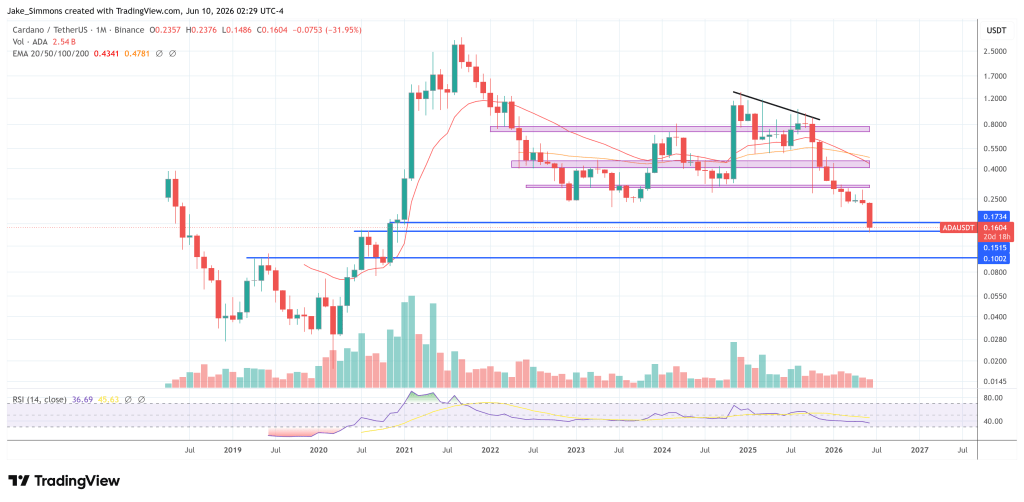
ADA hovers above key support, 1-month chart | Source: ADAUSDT on TradingView.com

Domande pertinenti

QWho published the on-chain tracing work that forms the basis of the new allegations against Charles Hoskinson?

AThe on-chain tracing work was published by NFT creator Masato Alexander.

QAccording to the article, what was the approximate total amount of ADA transactions that Alexander's tracing work focused on from the 2021 rally?

AThe tracing work focused on a 925 million ADA transaction and nine separate 20 million ADA payments, for an approximate total of 1.105 billion ADA.

QWhat does the article state was the outcome of the 318 million ADA in unredeemed vouchers after the Byron-era redemption ended?

AAccording to a later Cardano redemption transparency report cited in the article, the 318 million ADA from 390 unredeemed vouchers was swept into the Cardano reserve, while a post-sweep redemption process continued.

QWhat role in the early Isle of Man Foundation does Thomas Braziel claim Charles Hoskinson served, according to the filings he collected?

AThomas Braziel claims that later filings show Charles Hoskinson served as the "Enforcer" of the early Isle of Man Foundation.

QWhat is the core governance question Thomas Braziel raises based on the Isle of Man foundation documents and the timing of the ICO?

AThe core governance question he raises is: "who negotiated those arrangements [development agreements] on behalf of ICO participants and the Isle of Man Foundation?" given that the ICO began before the Swiss Cardano Foundation was established.

Letture associate

CFTC Proposes New Rules for Prediction Markets, Redefining Which Events Can Be Listed and Who Can Participate

The U.S. Commodity Futures Trading Commission (CFTC) has proposed new rules to establish a clearer regulatory framework for prediction markets. The proposal aims to modify how "event contracts" are reviewed, creating a structured process to determine if contracts involving terrorism, assassination, war, or illegal activities violate the public interest. This moves away from a blanket ban toward a case-by-case assessment of whether a contract's subject matter is acceptable for financial trading. A key focus is distinguishing between predicting the impact of risks and predicting the occurrence of harm. The proposal suggests that many sports-based prediction markets—such as those on game outcomes, scores, or season standings—may be permissible as they can provide price discovery and meaningful information. However, markets on easily manipulated events like specific player injuries, referee calls, or outcomes of youth sports would face stricter scrutiny. The rules directly target insider trading and manipulation risks, highlighting cases where individuals with non-public information or the ability to influence an event's outcome could unfairly profit. This underscores a shift toward ensuring market fairness. The proposal does not end the regulatory debate, particularly with state gambling regulators who argue that sports prediction markets are essentially sports betting and should fall under state jurisdiction. Nonetheless, the CFTC's action signals a move toward formalizing prediction markets, pushing the industry from a phase of rapid, often unregulated expansion into a more institutionalized, rule-based environment that more closely resembles traditional financial markets.

marsbit11 min fa

CFTC Proposes New Rules for Prediction Markets, Redefining Which Events Can Be Listed and Who Can Participate

marsbit11 min fa

CFTC Proposes New Rules for Prediction Markets, Redefining Which Events and Who Can Participate

The U.S. Commodity Futures Trading Commission (CFTC) has proposed new rules to establish a regulatory framework for prediction markets, aiming to define which event contracts can be traded and who can participate. The 267-page proposal seeks to amend regulations to create a structured review process for "event contracts." The core goal is to determine whether contracts involving sensitive topics like terrorism, assassination, war, or illegal activities are contrary to the "public interest." The CFTC's approach is not an outright ban but a case-by-case assessment, focusing on whether a contract predicts harmful acts themselves or merely their commercial or risk-related impacts. The proposal suggests that most mainstream sports prediction markets—based on final scores, winners, or season outcomes—may be permissible as they provide price discovery and informational value. However, markets on easily manipulated granular events (e.g., player injuries, specific referee calls) or those encouraging harm/cheating would face stricter scrutiny. A primary regulatory target is insider trading and market manipulation, where individuals with non-public knowledge or influence over an event's outcome could unfairly profit. Recent alleged incidents involving military personnel, former politicians, and corporate insiders highlight this risk. The move clarifies federal oversight but does not end the debate. State regulators and gambling associations argue that many prediction markets, especially on sports, constitute gambling and should fall under state, not federal, jurisdiction. This sets up a potential conflict over regulatory authority. Overall, the CFTC's proposal signals a shift for prediction markets from rapid, less-regulated expansion toward a more institutionalized, rules-based model resembling traditional financial markets. Growth will increasingly depend on demonstrating market fairness, transparent settlement, and controlled risks.

Odaily星球日报20 min fa

CFTC Proposes New Rules for Prediction Markets, Redefining Which Events and Who Can Participate

Odaily星球日报20 min fa

Trading

Spot
Futures

Articoli Popolari

Come comprare ADA

Benvenuto in HTX.com! Abbiamo reso l'acquisto di Cardano (ADA) semplice e conveniente. Segui la nostra guida passo passo per intraprendere il tuo viaggio nel mondo delle criptovalute.Step 1: Crea il tuo Account HTXUsa la tua email o numero di telefono per registrarti il tuo account gratuito su HTX. Vivi un'esperienza facile e sblocca tutte le funzionalità,Crea il mio accountStep 2: Vai in Acquista crypto e seleziona il tuo metodo di pagamentoCarta di credito/debito: utilizza la tua Visa o Mastercard per acquistare immediatamente CardanoADA.Bilancio: Usa i fondi dal bilancio del tuo account HTX per fare trading senza problemi.Terze parti: abbiamo aggiunto metodi di pagamento molto utilizzati come Google Pay e Apple Pay per maggiore comodità.P2P: Fai trading direttamente con altri utenti HTX.Over-the-Counter (OTC): Offriamo servizi su misura e tassi di cambio competitivi per i trader.Step 3: Conserva Cardano (ADA)Dopo aver acquistato Cardano (ADA), conserva nel tuo account HTX. In alternativa, puoi inviare tramite trasferimento blockchain o scambiare per altre criptovalute.Step 4: Scambia Cardano (ADA)Scambia facilmente Cardano (ADA) nel mercato spot di HTX. Accedi al tuo account, seleziona la tua coppia di trading, esegui le tue operazioni e monitora in tempo reale. Offriamo un'esperienza user-friendly sia per chi ha appena iniziato che per i trader più esperti.

1.3k Totale visualizzazioniPubblicato il 2024.12.10Aggiornato il 2026.06.02

Come comprare ADA

Discussioni

Benvenuto nella Community HTX. Qui puoi rimanere informato sugli ultimi sviluppi della piattaforma e accedere ad approfondimenti esperti sul mercato. Le opinioni degli utenti sul prezzo di ADA ADA sono presentate come di seguito.

活动图片