Cardano Foundation Advances Decentralized Governance With New ADA Delegations To 11 Community DReps

bitcoinistPubblicato 2026-01-22Pubblicato ultima volta 2026-01-22

Introduzione

Cardano Foundation has significantly advanced its decentralization efforts by delegating over 220 million ADA to 11 community Delegated Representatives (DReps). This move strengthens on-chain governance and broadens community participation in decision-making. Additionally, the Foundation self-delegated 171 million ADA to actively engage in governance rather than auto-abstaining. Currently, 36.9% of circulating ADA is delegated to DReps, reflecting growing trust in Cardano’s community-driven model. A recent governance vote saw 67.8% of participants (representing 3.77 billion ADA) supporting the network’s direction, signaling strong community confidence in its future.

Cardano and its vibrant ecosystem are becoming more decentralized as several moves are consistently being made to improve the leading blockchain network. One of these efforts is clearly indicated by the steady expansion of ADA delegation to multiple community DReps across the sector.

More Cardano Delegation To DReps

In a bold and exciting move, the Cardano Foundation has taken another step forward toward deeper and robust decentralization. The Foundation’s goal for deeper decentralization is being carried by expanding its ADA delegation to about 11 community DReps, which strengthens on-chain governance and community participation.

The recent delegation activity was disclosed on Cexplorer, the biggest and most featured OG blockchain explorer, via the social media platform X. The action is in line with Cardano’s changing governance structure, where elected representatives hold a growing amount of decision-making authority instead of fundamental entities.
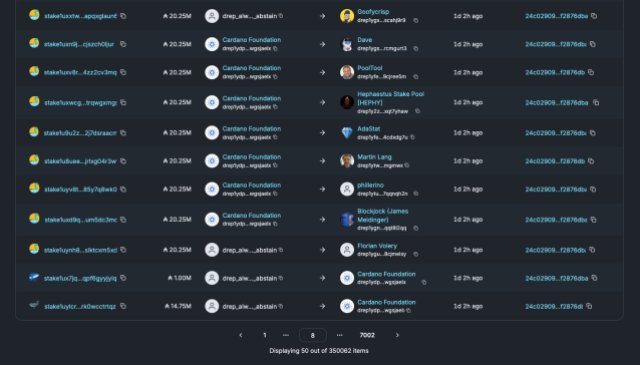
ADA delegations to 11 communities | Source: Chart from Cexplorer on X

As reported by the popular explorer, the Cardano Foundation has delegated over 220 million ADA to the 11 community DReps. By expanding its ADA delegation, the foundation is reaffirming its dedication to openness, diversity, and long-term network resilience, thereby making Cardano more decentralized.

These are the most crucial pillars in the move as the network persistently shifts toward a full community-driven ecosystem. According to the explorer, the Foundation has also self-delegated about 171 million ADA, moving it from an auto-abstain in order for all funds to actively participate in governance.

Delegation Operations Snags A Notable Supply

Following the move, the amount of ADA that has been utilized for delegation activity has increased sharply. A massive wave of ADA delegation signals a growing acceptance of on-chain governance across the broader Cardano ecosystem.

Cexplorer reported that the number has seen steady growth over the past several months. Current data shows that over 36.9% of circulating ADA has been delegated to Cardano DReps, which reflects mounting conviction in the network’s model.

Furthermore, it is a sign that more participants are willing to play a crucial role in shaping the blockchain’s future. Thus, decision-making power is shifting from concentrated entities to community voices as more holders pledge their tokens to designated representatives.

When compared to the stake pool, the explorer data shows that roughly 56% of ADA in circulation is delegated to the area. In the meantime, for delegators to be able to take out their staking rewards, they are expected to delegate to a DRep.

After a recent voting operation, Cardano’s future direction is now quite clear. Over 700 community members and 200 DReps participated in the voting process to decide where the ecosystem should be by 2030.

At the end, 67.80%, representing over 3.77 billion ADA, voted yes to the proposal that the network is moving in the right direction. Meanwhile, the rest, representing 491 million ADA, voted No to the proposal.

ADA trading at $0.36 on the 1D chart | Source: ADAUSDT on Tradingview.com

Domande pertinenti

QWhat is the Cardano Foundation's recent move to advance decentralized governance?

AThe Cardano Foundation has expanded its ADA delegation to 11 community DReps, delegating over 220 million ADA to strengthen on-chain governance and community participation.

QHow much ADA has been delegated to DReps in total according to current data?

ACurrent data shows that over 36.9% of circulating ADA has been delegated to Cardano DReps.

QWhat percentage of ADA in circulation is delegated to stake pools compared to DReps?

ARoughly 56% of circulating ADA is delegated to stake pools, while 36.9% is delegated to DReps.

QWhat was the outcome of the recent voting operation regarding Cardano's future direction?

A67.80% of voters, representing over 3.77 billion ADA, voted 'Yes' that the network is moving in the right direction, while 491 million ADA voted 'No'.

QHow did the Cardano Foundation adjust its own ADA holdings for governance participation?

AThe Foundation self-delegated about 171 million ADA, moving it from an auto-abstain to ensure all funds actively participate in governance.

Letture associate

From Banning Doubao to Embracing Honor: Why Did WeChat Suddenly 'Change Its Face'?

The article explores the sudden shift in WeChat's strategy towards AI assistants from mobile phone manufacturers, transitioning from strict opposition to active collaboration. For over a year, WeChat fiercely resisted attempts by phone AI assistants (like ByteDance's Doubao in late 2025) to control its features via GUI automation ("simulated clicking"), citing security and data control concerns. This stance created a significant barrier for system-level AI integration. Now, Tencent has initiated A2A (Agent-to-Agent) partnerships with major phone brands like Honor, Xiaomi, OPPO, and vivo. This model allows a phone's system AI (e.g., Honor's YOYO) to parse a user's voice command and send a structured request directly to WeChat's own internal AI agent via secure APIs. WeChat then executes the action (e.g., sending a message) and returns the result. The article attributes Tencent's "change of face" to strategic pressure. While leading in social app usage, Tencent trails rivals like ByteDance and Alibaba in standalone AI app popularity. WeChat, with its vast mini-program ecosystem, is Tencent's key asset for an AI comeback. The upcoming WeChat AI agent aims to handle tasks like booking and payments within the app. However, phone system assistants remain the primary AI entry point for most users. The A2A collaboration allows Tencent to extend WeChat's AI reach to this crucial system layer while maintaining control over its core functions and data. For phone manufacturers, embracing A2A is a pragmatic move. The GUI route proved unviable due to WeChat's blocks. A2A offers a compliant path to integrate a vital service, enhancing their AI assistants' usefulness. It allows them to focus on developing their own AI ecosystems for other services while cooperating on WeChat access. The collaboration is framed as a mutual, strategic necessity: Tencent gains a distribution channel, and manufacturers gain a key functionality. The partnership relies on a "dual authorization" mechanism for security, requiring both user and app consent for each action. While questions about long-term data privacy practices remain, experts note A2A is more secure and compliant than GUI automation. Ultimately, this cooperation is seen as a tentative, calculated truce. Tencent's long-term goal is to make WeChat an AI-powered "service OS." Phone manufacturers aim to make their system AI the central user interface. Their paths may converge or clash in the future, but for now, the A2A deal represents the opening chapter in the battle for the AI-era user入口, driven by necessity and strategic calculus on both sides.

marsbit27 min fa

From Banning Doubao to Embracing Honor: Why Did WeChat Suddenly 'Change Its Face'?

marsbit27 min fa

On-Chain Figures on the Eve of Kickoff: 1.6 Billion Traded Before the World Cup Even Begins

"On-Chain Numbers on the Eve of the World Cup: $1.6 Billion Traded Before Kick-off" Analysis of on-chain markets before the 2026 FIFA World Cup reveals significant crypto integration into football. The most striking figure is the approximately **$1.6 billion** in total trading volume on the single "World Cup Winner" contract on the Polymarket prediction market platform, accumulated before a single match was played. This represents explosive growth for a sector whose annual volume surged from ~$16B in 2024 to ~$64B in 2025. The ecosystem is maturing beyond speculation. Key developments include: 1) **Infrastructure upgrades** like Polymarket's migration to native, regulated USDC stablecoin for settlements; 2) **Reliable data oracles**, such as Chainlink, being used to resolve real-world match outcomes on-chain; and 3) **Official recognition**, with FIFA appointing its first-ever "Prediction Markets" partner. Over 100 contracts now cover everything from the outright winner to individual match results and even non-sporting risks like venue relocation. This evolution marks a fundamental shift. While crypto firms are absent from FIFA's top-tier sponsor list, the technology has deeply penetrated the tournament's financial and predictive infrastructure through regulated stablecoin settlements, decentralized oracles, and new official partnership categories. The regulatory landscape remains complex and varies by jurisdiction, but on-chain markets for the World Cup are already a multi-billion-dollar reality.

marsbit1 h fa

On-Chain Figures on the Eve of Kickoff: 1.6 Billion Traded Before the World Cup Even Begins

marsbit1 h fa

From SpaceX's IPO to the Future of Crypto: Which Crypto Sectors Will Host the Trillion-Dollar Narrative?

From the SpaceX IPO, which targets a $750 billion raise at a $1.77 trillion valuation, we can extrapolate capital flow trends relevant to crypto. The focus shifts from speculative narratives to foundational infrastructure and real-world asset (RWA) integration. Key crypto sectors poised to benefit include: 1. **AI Infrastructure**: The narrative is moving from consumer-facing AI applications to underlying, scarce resources like compute power and decentralized GPU networks (e.g., TAO, RENDER, AKT, IO). These protocols are positioning as the essential "picks and shovels" providers for the AI economy. 2. **Real-World Assets (RWA)**: Beyond tokenized treasury bonds, RWA's future lies in on-chain equity and pre-IPO assets like SpaceX. This could democratize access to high-growth assets and reshape global capital flows, benefiting infrastructure projects like ONDO, LINK, and Plume that facilitate issuance, data, and liquidity. 3. **Core Financial Infrastructure**: Stablecoins, payment networks, and DePIN (Decentralized Physical Infrastructure Networks) are critical for settling the future on-chain economy. Their role expands from internal trading tools to foundational layers for global finance, AI systems, and real-world asset networks, leading to potential value reassessment. In summary, the next cycle may prioritize long-term infrastructure value—AI compute, asset tokenization networks, and settlement layers—over short-lived application hype, mirroring the broader market's shift towards funding the foundational systems of the future.

marsbit1 h fa

From SpaceX's IPO to the Future of Crypto: Which Crypto Sectors Will Host the Trillion-Dollar Narrative?

marsbit1 h fa

Trading

Spot
Futures

Articoli Popolari

Come comprare ADA

Benvenuto in HTX.com! Abbiamo reso l'acquisto di Cardano (ADA) semplice e conveniente. Segui la nostra guida passo passo per intraprendere il tuo viaggio nel mondo delle criptovalute.Step 1: Crea il tuo Account HTXUsa la tua email o numero di telefono per registrarti il tuo account gratuito su HTX. Vivi un'esperienza facile e sblocca tutte le funzionalità,Crea il mio accountStep 2: Vai in Acquista crypto e seleziona il tuo metodo di pagamentoCarta di credito/debito: utilizza la tua Visa o Mastercard per acquistare immediatamente CardanoADA.Bilancio: Usa i fondi dal bilancio del tuo account HTX per fare trading senza problemi.Terze parti: abbiamo aggiunto metodi di pagamento molto utilizzati come Google Pay e Apple Pay per maggiore comodità.P2P: Fai trading direttamente con altri utenti HTX.Over-the-Counter (OTC): Offriamo servizi su misura e tassi di cambio competitivi per i trader.Step 3: Conserva Cardano (ADA)Dopo aver acquistato Cardano (ADA), conserva nel tuo account HTX. In alternativa, puoi inviare tramite trasferimento blockchain o scambiare per altre criptovalute.Step 4: Scambia Cardano (ADA)Scambia facilmente Cardano (ADA) nel mercato spot di HTX. Accedi al tuo account, seleziona la tua coppia di trading, esegui le tue operazioni e monitora in tempo reale. Offriamo un'esperienza user-friendly sia per chi ha appena iniziato che per i trader più esperti.

1.3k Totale visualizzazioniPubblicato il 2024.12.10Aggiornato il 2026.06.02

Come comprare ADA

Discussioni

Benvenuto nella Community HTX. Qui puoi rimanere informato sugli ultimi sviluppi della piattaforma e accedere ad approfondimenti esperti sul mercato. Le opinioni degli utenti sul prezzo di ADA ADA sono presentate come di seguito.

活动图片