Cardano Brings Pyth Oracles On-Chain In First Pentad Integration

bitcoinistPubblicato 2025-12-12Pubblicato ultima volta 2025-12-12

Introduzione

Cardano has announced its first major integration under the new "Pentad" governance structure, bringing Pyth's Lazer oracle to the blockchain by early 2026. This marks a strategic shift from building in-house oracle solutions to adopting established external infrastructure. Pyth provides ultra-low latency, institutional-grade market data across thousands of price feeds, which is used by hundreds of DeFi applications globally. Charles Hoskinson emphasized that this integration connects Cardano to broader cryptocurrency information networks and is just the first of many planned critical integrations—including bridges, stablecoins, and analytics—aimed at making Cardano a more viable DeFi platform. The move signals a focus on execution and infrastructure readiness as Cardano positions itself for growth in 2026.

Cardano is finally doing the unsexy but absolutely necessary plumbing work: getting serious, external oracle infrastructure wired in, with a governance wrapper that looks a lot more like “adult supervision” than the old ad-hoc ecosystem scramble.

On a Dec. 11 livestream, Charles Hoskinson said the ecosystem’s new “Pentad” structure — the coordination bloc spanning Input Output, the Cardano Foundation, EMURGO, the Midnight Foundation, and Intersect — has approved its first major integration under the “critical integrations” framework: bringing Pyth’s Lazer oracle to Cardano, with deployment targeted for early 2026.

Pyth Deal Kicks Off Cardano’s Critical Integrations Push

“This is the appetizer announcement,” Hoskinson said, framing Pyth as the first of what he expects to be a broader menu: bridges, stablecoins, analytics, custodians — the stuff that turns a chain into a DeFi venue people actually build on, not just a community that argues about roadmaps.

Hoskinson didn’t really sugarcoat why this matters. “Oracles are really the first part of major integrations,” he said, because you need reliable data coming in and you need credible pathways to the rest of the industry. He also admitted the in-house approach hasn’t landed the way it should’ve: Cardano “tried to build an indigenous oracle solution and it hasn’t worked out as well as it should.” So [...] Pyth. That’s the pivot.

Pyth, in its own marketing, has been pushing Lazer as an ultra-low latency product designed for speed-sensitive trading use cases — basically, price updates fast enough that perps and other twitchy DeFi apps don’t feel like they’re operating on last cycle’s data. Hoskinson called Pyth “one of the most advanced Oracle solutions on market,” and emphasized the practical angle: lots of feeds, lots of publishers, and broad distribution across chains.

Intersect’s announcement (the one Hoskinson pulled up mid-stream) from X states: “One of the first concrete outcomes of the Critical Cardano Integrations workstream is now in place! The Steering Committee [...] has approved the first major integration under this framework: bringing Pyth Lazer oracle to Cardano. Pyth provides low-latency, institutional-grade market data across thousands of price feeds spanning crypto, equities, FX, commodities and ETFs, already used by hundreds of DeFi applications across 100+ blockchains to power trading, lending and risk management.”

Hoskinson argued, “[Pyth] effectively attaches Cardano now to the information networks of the entire cryptocurrency space.” He said the team is already exploring whether it can switch parts of the ecosystem — including Djed — over to Pyth, and he wants Cardano dapp teams to seriously evaluate the integration once it’s available.

“Pyth is just the appetizer in the Cardano critical integrations,” he said. “There are many more things to come.”

The broader context is that Cardano’s new “Pentad” has been positioning “critical integrations” as a coordinated, treasury-backed effort to “prime Cardano for 2026,” including a budget proposal tied to ecosystem-wide enablers. If Pyth is the first concrete output, it’s also a signal the Pentad model is going to be judged on execution, not vibes.

Hoskinson, closing out, put it in his usual rally language: “Cardano is not an island anymore [...] the cavalry has come.” The market can do what it wants in the short term. But getting credible oracle rails in place is the kind of boring upgrade that tends to matter later — when teams are deciding where to deploy, and where liquidity is willing to live.

At press time, ADA traded at $0.4253.
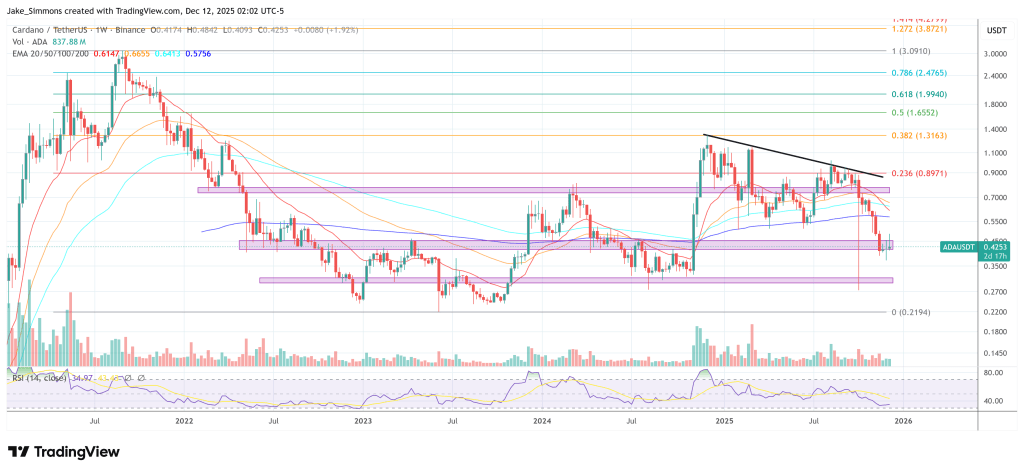
ADA bounces from key support, 1-week chart | Source: ADAUSDT on TradingView.com

Crypto di tendenza

Letture associate

Chipsea Turns from A-share to H-share: Riding the Price Surge Trend, or Gambling on the Cycle?

Xintianxia Technology, a Chinese flash memory chipmaker, is making its second attempt to list on the Hong Kong Stock Exchange after withdrawing its application for a mainland China IPO in late 2023. This move coincides with an upcycle in the memory chip sector. Ranked fifth among global fabless code-type flash memory suppliers in 2025, Xintianxia specializes in NOR Flash and SLC NAND chips. However, it holds a small 1.3% global market share in this niche segment. The company is highly dependent on a concentrated group of suppliers, with its top five accounting for over 80% of procurement in Q1 2026. After posting losses in 2023 and 2024, the company's fortunes reversed sharply in Q1 2026. Revenue grew 77.4% year-over-year to RMB 224 million, with net profit reaching RMB 75.89 million. This dramatic turnaround was primarily driven by strategic inventory stockpiling and significant price increases for its core products, leading to a gross margin surge to 55.63%. However, this aggressive strategy carries major risks. Inventory days have risen significantly, and the company's operating cash flow turned negative in Q1 2026 due to high stockpiling costs. The memory industry's cyclical nature means the current price boom may not last. If a downturn arrives, Xintianxia's high-cost inventory could become a financial burden, a scenario that previously derailed its A-share listing ambitions. Further complicating its IPO journey are corporate governance concerns. The company paid substantial dividends during loss-making years, and several major shareholders, including state-backed funds and the founder, cashed out significant stakes shortly before the Hong Kong listing application. Chinese regulators have requested details on past equity transfers, questioning pricing fairness. In essence, Xintianxia's Hong Kong listing bid is a high-stakes gamble on the sustainability of the current chip price cycle. Its future hinges not just on favorable market conditions but on its ability to withstand the inevitable downturn and prove its long-term operational resilience.

marsbit9 min fa

Chipsea Turns from A-share to H-share: Riding the Price Surge Trend, or Gambling on the Cycle?

marsbit9 min fa

BlackRock Launches Stablecoin Reserve Fund BRSRV: Bringing Short-Term US Treasuries to Solana, Ethereum, and Tempo

BlackRock Launches Tokenized Stablecoin Reserve Fund BRSRV, Expands to Solana and Tempo Global asset management giant BlackRock has introduced BRSRV (BlackRock Daily Reinvestment Stablecoin Reserve Vehicle), a tokenized money market fund specifically designed for stablecoin reserves. Concurrently, the firm is issuing tokenized, on-chain shares of its existing BSTBL (BlackRock Select Treasury-Based Liquidity Fund). A key development is the expansion of supported blockchains beyond Ethereum to include Solana and Stripe-affiliated chain Tempo for recording share ownership. The transfer agent Securitize will manage the process through approved, whitelisted wallets requiring verified identity, with a minimum initial investment of $3 million. The fund will invest solely in cash, short-term U.S. Treasuries, and overnight repurchase agreements backed by U.S. government securities, explicitly avoiding any crypto assets. BlackRock states the structure aims to qualify as a compliant reserve asset under the U.S. GENIUS Act for payment stablecoins. This launch builds upon BlackRock's broader tokenization strategy, notably following its BUIDL fund introduced in March 2024, which now holds over $26 billion in assets. The move places BlackRock alongside other major institutions like Morgan Stanley and Fidelity in offering products tailored for the stablecoin reserve market, signaling a deepening institutional push into tokenized real-world assets (RWA) and on-chain finance infrastructure.

marsbit10 min fa

BlackRock Launches Stablecoin Reserve Fund BRSRV: Bringing Short-Term US Treasuries to Solana, Ethereum, and Tempo

marsbit10 min fa

Wall Street Morning Report: AI + Cloud Computing Takes Over the Market Again, Amazon Knocks on the Door of $3 Trillion

Wall Street's August began with a strong rally, driven by easing Middle East tensions as President Trump signaled progress on U.S.-Iran talks, prompting a sharp drop in oil prices. Major indices hit record or near-record highs, with the Dow Jones Industrial Average up 1.32%, the Nasdaq Composite surging 2.13%, and the S&P 500 rising 1.48%. The energy sector was the sole decliner. The AI and cloud computing narrative dominated the tech rally. The "Magnificent Seven" index jumped 3.6%. Amazon's market cap surpassed $3 trillion for the first time following robust AWS results, while Nvidia regained a $5 trillion valuation. Meta, Google, and Microsoft also posted significant gains. Other AI-related stocks like Palantir, CoreWeave, and various semiconductor and infrastructure companies saw strong advances. In other markets, gold held above $4,000, supported by central bank buying. Treasury yields fell as oil prices dropped. The U.S. dollar remained stable despite strong manufacturing data. Japan's substantial currency intervention raised concerns, but U.S. officials reassured markets about the mechanism used. Key events ahead include major industry conferences (Ai4 2026, FMS Summit) and earnings reports from companies like SpaceX, AMD, and Pfizer. The White House is also set to host a meeting with leading AI firms to discuss regulatory frameworks.

marsbit1 h fa

Wall Street Morning Report: AI + Cloud Computing Takes Over the Market Again, Amazon Knocks on the Door of $3 Trillion

marsbit1 h fa

The July Tech Stock Pullback: Which Funds Are Paying the Price for Buying High?

In July, China's technology stocks experienced a sharp correction, causing significant pain for actively managed mutual funds that aggressively increased their holdings in the sector during the second quarter. The sell-off saw major indices like the ChiNext and STAR 50 fall over 25% and 28% for the month, respectively. Funds that piled into tech at its June peak faced steep losses. Notably, several veteran "value investor" fund managers, known for long-term holdings in consumer staples, made dramatic shifts. Star managers like Zhang Kun (E Fund Blue Chip Selected) and Liu Yanchun (Invesco Great Wall Dingyi) drastically reduced positions in liquor stocks like Kweichow Moutai, switching instead to semiconductor and AI hardware companies like SMIC and Ingenic International. Data shows active equity funds' allocation to the electronics sector reached a historical high of 42.64% by end-Q2. Around 67 funds saw their TMT (Technology, Media, Telecom) weighting surge from an average of 6.75% to 54.99%. The consequences were severe in July: these high-TMT funds fell an average of over 20%, with 12 plunging more than 40%. Examples include Jinhua High-Quality Growth and Guoshou Anbao Wenhui, which fell 26.34% and nearly 40% respectively after raising TMT weights above 70%. The article also highlights issues of "style drift," where funds with names like "high-dividend" held high-P/E tech stocks instead, confusing investors. Newly launched funds suffered even more. For instance, Guotai Haitong New Energy RuiXuan Hybrid, launched in mid-June, saw its net asset value plummet to 0.5509 yuan by July 30, a loss of nearly 45%. Analysts note the extreme sector concentration mirrored past bubbles (e.g., 2021 new energy). The intense, crowded trade itself became a major risk. While tech stocks rebounded sharply on July 31, the funds that chased the high face a longer-term market test.

marsbit1 h fa

The July Tech Stock Pullback: Which Funds Are Paying the Price for Buying High?

marsbit1 h fa

Trading

Spot

Articoli Popolari

Come comprare PYTH

Benvenuto in HTX.com! Abbiamo reso l'acquisto di PYTH (Pyth) (PYTH) semplice e conveniente. Segui la nostra guida passo passo per intraprendere il tuo viaggio nel mondo delle criptovalute.Step 1: Crea il tuo Account HTXUsa la tua email o numero di telefono per registrarti il tuo account gratuito su HTX. Vivi un'esperienza facile e sblocca tutte le funzionalità,Crea il mio accountStep 2: Vai in Acquista crypto e seleziona il tuo metodo di pagamentoCarta di credito/debito: utilizza la tua Visa o Mastercard per acquistare immediatamente PYTH (Pyth)PYTH.Bilancio: Usa i fondi dal bilancio del tuo account HTX per fare trading senza problemi.Terze parti: abbiamo aggiunto metodi di pagamento molto utilizzati come Google Pay e Apple Pay per maggiore comodità.P2P: Fai trading direttamente con altri utenti HTX.Over-the-Counter (OTC): Offriamo servizi su misura e tassi di cambio competitivi per i trader.Step 3: Conserva PYTH (Pyth) (PYTH)Dopo aver acquistato PYTH (Pyth) (PYTH), conserva nel tuo account HTX. In alternativa, puoi inviare tramite trasferimento blockchain o scambiare per altre criptovalute.Step 4: Scambia PYTH (Pyth) (PYTH)Scambia facilmente PYTH (Pyth) (PYTH) nel mercato spot di HTX. Accedi al tuo account, seleziona la tua coppia di trading, esegui le tue operazioni e monitora in tempo reale. Offriamo un'esperienza user-friendly sia per chi ha appena iniziato che per i trader più esperti.

192 Totale visualizzazioniPubblicato il 2024.12.12Aggiornato il 2026.06.02

Come comprare PYTH

Discussioni

Benvenuto nella Community HTX. Qui puoi rimanere informato sugli ultimi sviluppi della piattaforma e accedere ad approfondimenti esperti sul mercato. Le opinioni degli utenti sul prezzo di PYTH PYTH sono presentate come di seguito.

活动图片