Cardano Breaks Governance Deadlock With New Constitutional Committee

bitcoinistPubblicato 2025-12-18Pubblicato ultima volta 2025-12-18

Introduzione

Cardano has resolved a governance deadlock by ratifying a new Constitutional Committee (CC) member through an on-chain vote. The CC, essential for evaluating constitutionality and approving upgrades, budgets, and parameter changes, had been left without a quorum after a mid-term departure. This stalled key governance actions, including treasury withdrawals, budget approvals, and protocol upgrades. The newly elected member, Cardano Curia, was selected off-chain and ratified with over 80% support from delegate representatives (DReps) and sufficient stake pool operator (SPO) backing. The restoration reactivates the CC, allowing Cardano's governance processes to resume normal operation and preventing further delays in network upgrades.

Cardano has moved to resolve a governance bottleneck by ratifying an on-chain vote to restore its Constitutional Committee (CC) to functional capacity, a procedural step that matters because the CC is required to evaluate constitutionality and ratify many categories of governance actions, including upgrades, budgets, and parameter changes.

Intersect, which coordinates parts of Cardano’s governance process, said on X: “On the 7th day of GA... We hit the Epoch’s end. DReps at 80%. Stake pools supporting- It looks like we have a new CC. Ratified. Thank you to everyone who reviewed, voted, and wrote rationales,Santa has been notified.”

Why The Cardano Governance Was Stuck

Cardano’s governance model is tripartite: delegate representatives (DReps), stake pool operators (SPOs), and the Constitutional Committee. The CC plays a gatekeeping role: it judges whether on-chain actions are constitutional and ratifies decisions needed for the network to adapt.

That mechanism stalled after an unexpected mid-term departure left the CC below its minimum operational size. The Cardano Atlantic Council retired mid-term in epoch 597, opening a seat and reducing the committee below quorum. The consequence was that the Cardano CC could not ratify key actions, even as the chain continued to operate normally at the protocol level.

The vote asked DReps and SPOs to ratify a newly elected CC member and restore the committee to full capacity. The candidate, Cardano Curia, was selected off-chain through a DRep vote using the Ekklesia tool, with on-chain ratification required to formalize the result.

The governance materials described the restoration as bringing the CC back to seven members and activating a clarified alternate-member process to handle future vacancies with less disruption. Approval thresholds were set at 67% from DReps and 51% support from SPOs. Intersect’s update indicates those thresholds were met as the epoch ended.

Why This Was Treated As Urgent

The vote was framed as more than housekeeping because an undersized CC effectively blocks major governance flows. Without quorum: Treasury withdrawals couldn’t proceed, the Critical Integrations Budget could not pass, hard forks could not be ratified, delaying network upgrades and several categories of governance actions were blocked, leaving only a limited subset able to move forward.

There was also a timing element: delays risk actions expiring, which would force a repeat of the voting process and extend the governance backlog. With the restoration ratified, Cardano’s governance process can resume normal throughput — reopening the path for upgrades, budget approvals, and protocol changes that depend on a functioning Constitutional Committee.

At press time, Cardano traded at $0.38.
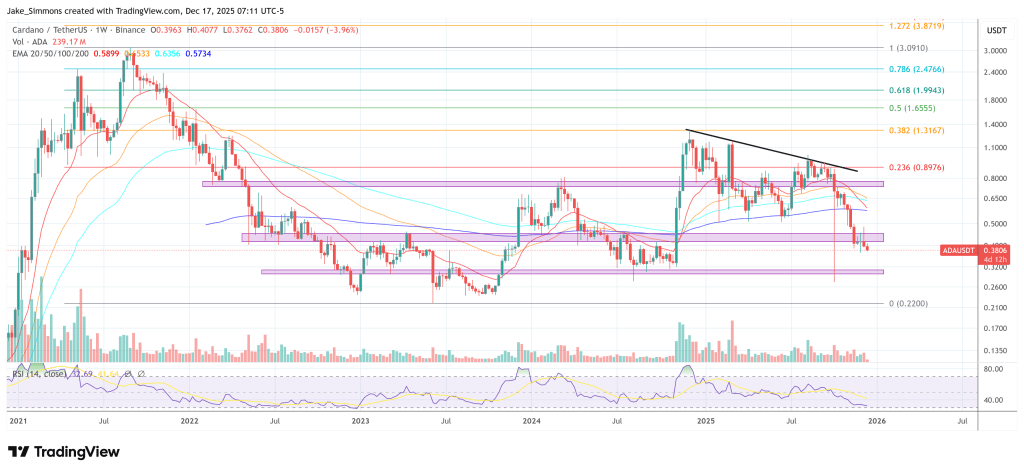
ADA falls below key support, 1-week chart | Source: ADAUSDT on TradingView.com

Letture associate

GitHub, Transfixed by AI

On the night of February 9th, GitHub suffered a major outage caused by a simple configuration change—reducing a cache refresh interval from 12 to 2 hours—that triggered a cascade of failures. This was not an isolated event, but part of a broader pattern. In early 2026, GitHub experienced at least 8 major incidents, failing to meet its promised 99.9% availability. These outages stemmed from structural issues: explosive growth in load, tight service coupling, and insufficient protection against abnormal traffic. This unprecedented load is driven by AI Agents. In 2025, GitHub handled ~1 billion commits. By 2026, weekly commits reached 275 million, projecting to ~14 billion for the year—a 14x increase. AI tools like Claude Code now contribute 4.5% of all public repository commits, with weekly submissions surging 25x in just three months. AI-generated pull requests jumped from 4 million to 17 million per month in half a year. Unlike human developers, AI Agents work continuously, generating commits at a scale that overwhelms infrastructure designed for human rhythms. The surge also shattered GitHub's business model. Copilot's flat-rate pricing, based on assisting human developers, became unsustainable as Agentic AI sessions consumed resources worth hundreds of dollars for a few dollars in fees. In response, GitHub imposed usage limits and, by June 1st, shifted to a pay-per-use "AI Credits" system. Facing this new reality, GitHub realized a 10x scaling plan was insufficient. It announced a need to *redesign* its architecture for 30x current scale—decoupling services, adding fault isolation, and improving change management to prevent cascading failures. Other platforms like Stripe and AWS are facing similar challenges with AI Agents. Fundamentally, GitHub is transitioning from a human collaboration platform to an "exhaust pipe" for automated AI workflows. Its detailed post-mortem reports aim to maintain trust during this turbulent rebuild. The February outage was not just a technical glitch, but a signal of the software industry's entry into a new, AI-driven era.

marsbit30 min fa

GitHub, Transfixed by AI

marsbit30 min fa

Both Suffer Massive Losses Exceeding $90 Billion, Which Is in Greater Peril: Strategy or Bitmine?

Facing massive paper losses exceeding $90 billion each amidst a sharp market downturn, "Digital Asset Treasury" (DAT) giants Strategy and Bitmine find themselves in a precarious position, but with different underlying risks. Strategy, heavily invested in Bitcoin (BTC), faces significant financial strain. Its strategy relies heavily on debt, including convertible notes and preferred stock (STRC) requiring substantial dividend payments. With its cash reserves dwindling and BTC offering no staking yield for cash flow, Strategy's high leverage makes it vulnerable. A continued price decline could force asset sales to meet obligations, potentially creating a negative feedback loop. Its market value has already fallen sharply. In contrast, Bitmine, an Ethereum (ETH) holder, appears on firmer financial ground. It primarily funds its purchases through equity offerings (like ATM programs), avoiding debt pressure. It also generates income by staking a large portion of its ETH holdings. While not immune to market drops and shareholder dilution concerns, Bitmine maintains more flexibility, recently announcing a new preferred share offering to raise further capital. The core divergence lies in their financing: Bitmine uses equity (investor money), while Strategy uses debt (borrowed money). Consequently, Bitmine currently faces less immediate liquidity pressure than Strategy, which must navigate the dual challenge of servicing debt/dividends and a declining core asset (BTC) price.

marsbit37 min fa

Both Suffer Massive Losses Exceeding $90 Billion, Which Is in Greater Peril: Strategy or Bitmine?

marsbit37 min fa

Trading

Spot
Futures

Articoli Popolari

Come comprare ADA

Benvenuto in HTX.com! Abbiamo reso l'acquisto di Cardano (ADA) semplice e conveniente. Segui la nostra guida passo passo per intraprendere il tuo viaggio nel mondo delle criptovalute.Step 1: Crea il tuo Account HTXUsa la tua email o numero di telefono per registrarti il tuo account gratuito su HTX. Vivi un'esperienza facile e sblocca tutte le funzionalità,Crea il mio accountStep 2: Vai in Acquista crypto e seleziona il tuo metodo di pagamentoCarta di credito/debito: utilizza la tua Visa o Mastercard per acquistare immediatamente CardanoADA.Bilancio: Usa i fondi dal bilancio del tuo account HTX per fare trading senza problemi.Terze parti: abbiamo aggiunto metodi di pagamento molto utilizzati come Google Pay e Apple Pay per maggiore comodità.P2P: Fai trading direttamente con altri utenti HTX.Over-the-Counter (OTC): Offriamo servizi su misura e tassi di cambio competitivi per i trader.Step 3: Conserva Cardano (ADA)Dopo aver acquistato Cardano (ADA), conserva nel tuo account HTX. In alternativa, puoi inviare tramite trasferimento blockchain o scambiare per altre criptovalute.Step 4: Scambia Cardano (ADA)Scambia facilmente Cardano (ADA) nel mercato spot di HTX. Accedi al tuo account, seleziona la tua coppia di trading, esegui le tue operazioni e monitora in tempo reale. Offriamo un'esperienza user-friendly sia per chi ha appena iniziato che per i trader più esperti.

1.3k Totale visualizzazioniPubblicato il 2024.12.10Aggiornato il 2026.06.02

Come comprare ADA

Discussioni

Benvenuto nella Community HTX. Qui puoi rimanere informato sugli ultimi sviluppi della piattaforma e accedere ad approfondimenti esperti sul mercato. Le opinioni degli utenti sul prezzo di ADA ADA sono presentate come di seguito.

活动图片