Cardano Approves Critical Integrations Budget In Key Governance Vote

bitcoinistPubblicato 2025-12-31Pubblicato ultima volta 2025-12-31

Introduzione

Cardano's governance body has approved the "Critical Integrations Budget Info Action" with strong support, a key step to fund and execute priority ecosystem integrations. The proposal received 6 out of 7 Constitutional Committee approvals and over 85% DRep support. This approval shifts focus to the Treasury Withdrawal Action, where the proposal moves from intent to on-chain execution. Two major integrations were confirmed under this framework: Pyth Network will provide real-time market data to support DeFi applications like lending and derivatives, while Dune will integrate Cardano data into a shared analytics platform for easier analysis and comparison. EMURGO emphasized that this governance milestone reflects strong ecosystem alignment and sets the stage for 2026 execution. The next critical test will be maintaining this support during the treasury withdrawal phase, transitioning consensus into actual spending.

Cardano’s governance process closed out 2025 with a tangible green light: the “Critical Integrations Budget Info Action” has been ratified, a step EMURGO framed as foundational to getting priority ecosystem integrations funded and executed.

In a post on X late Tuesday, EMURGO said the action cleared with “6 out of 7 Constitutional Committee approval and over 85% DRep support,” positioning the proposal to move into its next, more consequential phase. “With the BIA complete, focus now shifts to the Treasury Withdrawal Action,” EMURGO wrote. “This next step transitions the proposal from intent to execution which requires continued active review and support from the CC and DReps.”

Why This Is Crucial For Cardano

The distinction matters in Cardano’s post-Voltaire governance flow. The Budget Info Action signals alignment around scope and direction, while the Treasury Withdrawal Action is the point at which the ecosystem’s intent is translated into an on-chain withdrawal, meaning governance scrutiny typically intensifies as the discussion moves from principle to disbursement.

EMURGO also used the moment to emphasize that the process is already yielding concrete outputs under what it called the “Critical Integrations framework,” describing coordination across the “Pentad” that includes Input Output (IOG), the Cardano Foundation, EMURGO, Intersect, and the Midnight Foundation.

Two integrations were highlighted as already confirmed. The first is Pyth Network, which EMURGO described as “real time, institutional-grade market data coming to Cardano,” aimed at supporting DeFi primitives that depend on robust price feeds. EMURGO pointed to use cases including “lending, derivatives, stablecoins, and onchain risk management,” underscoring that oracle availability remains a gating factor for more complex on-chain markets.

The second is Dune, which EMURGO said will bring “Cardano data integrated into a shared analytics platform used across the industry,” making on-chain activity “easier to analyze, compare, and build on.” For builders and funds that already rely on common analytics tooling across ecosystems, the pitch is straightforward: lower friction for monitoring Cardano activity alongside other chains, and less bespoke infrastructure work to get dashboards, queries, and reporting into production.

EMURGO cast the vote outcome as an indicator of governance maturity and ecosystem alignment, explicitly thanking Constitutional Committee members and DReps for participation “even during the holiday period.” It also framed the timing as a setup for 2026 execution, writing that “this momentum reflects an ecosystem working together with a shared goal” and that Cardano is “positioned to enter 2026 stronger, more capable, and ready to support the next phase of ecosystem growth with these critical integrations in place.”

The near-term question now shifts to whether the Treasury Withdrawal Action maintains similar levels of support as the conversation moves from approvals to actual treasury spend, an inflection point that will test not just consensus, but the community’s appetite for follow-through on what “critical integrations” should look like in practice.

At press time, ADA traded at $0.351.
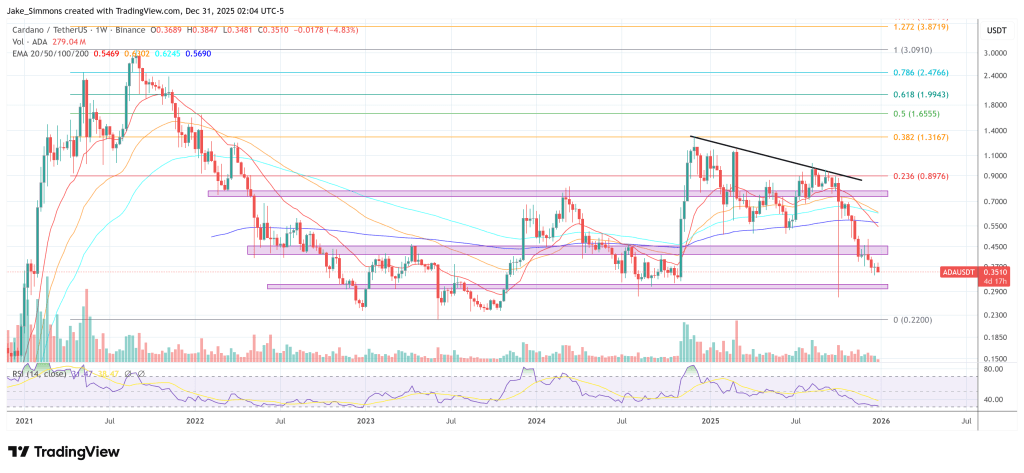
ADA fell below key support, 1-week chart | Source: ADAUSDT on TradingView.com

Crypto di tendenza

Domande pertinenti

QWhat was the outcome of the Cardano governance vote on the 'Critical Integrations Budget Info Action'?

AThe 'Critical Integrations Budget Info Action' was ratified with 6 out of 7 Constitutional Committee approval and over 85% DRep support.

QAccording to EMURGO, what is the next step after the completion of the Budget Info Action?

AThe next step is the Treasury Withdrawal Action, which transitions the proposal from intent to execution and requires continued review and support from the Constitutional Committee and DReps.

QWhich two specific integrations were highlighted as already confirmed under the Critical Integrations framework?

AThe two confirmed integrations are Pyth Network, which will provide real-time market data to Cardano, and Dune, which will integrate Cardano data into a shared analytics platform.

QHow did EMURGO describe the significance of the vote outcome for Cardano's ecosystem?

AEMURGO described the vote outcome as an indicator of governance maturity and ecosystem alignment, positioning Cardano to enter 2026 stronger and more capable with these critical integrations in place.

QWhat is the key distinction between the Budget Info Action and the Treasury Withdrawal Action in Cardano's governance process?

AThe Budget Info Action signals alignment around scope and direction, while the Treasury Withdrawal Action is the ecosystem's intent translated into an on-chain withdrawal, where governance scrutiny typically intensifies.

Letture associate

The Encryption Bill Clarity's Challenge: A Thorny Path of Bipartisan Compromise in the U.S.

U.S. lawmakers are attempting to advance the Clarity Act, a significant crypto market structure bill, but its path is fraught with partisan hurdles. The process has been rocky since January, when a prior bipartisan deal in the Senate Banking Committee was upended. A key compromise in May on "yield" issues allowed the bill to move forward in committee, but only with the conditional support of two Democratic senators, Angela Alsobrooks and Ruben Gallego. They emphasized that their final vote depends on reaching an agreement on ethics provisions for elected officials. Ultimately, the Senate Agriculture Committee passed its version along party lines without Democratic support. As Republicans push for a full Senate vote in July, the demand for strong ethics language has expanded beyond Democrats. Additional controversies surround provisions related to yields (aligning some Republicans with large banks) and developer protections (opposed by enforcement agencies). Core concerns about illicit finance and consumer protection remain central to the debate. Despite consensus on the need for legislation, achieving the necessary bipartisan compromise is proving difficult. While momentum exists—including recent meetings between senators and White House officials—a reconciled bill text faces skepticism. Senator Gallego has stated that without ethics terms acceptable to Democrats, they will not provide the needed votes. The immediate goals for the crypto community in Congress are unclear: a symbolic Senate vote before the August recess, eventual passage into law by 2026, or forging a final compromise framework. The arduous, vote-by-vote effort to build bipartisan support continues, mirroring the traditional legislative grind the industry must now navigate.

Foresight News48 min fa

The Encryption Bill Clarity's Challenge: A Thorny Path of Bipartisan Compromise in the U.S.

Foresight News48 min fa

Kalshi and Polymarket Founders at Odds? This Business War Is Far More Brutal Than You Imagine

The New York Times details the fierce, personal rivalry between Kalshi CEO Tarek Mansour and Polymarket founder Shayne Coplan, which has escalated beyond typical business competition into a conflict marked by legal complaints, regulatory battles, and public hostilities. The feud intensified in late 2024 when FBI agents raided Coplan's New York apartment. While Coplan publicly blamed political motives, sources indicate his team privately suspected Mansour, noting that Kalshi's lawyers had previously reported Polymarket's operational model to federal prosecutors, highlighting that U.S. users could still access its offshore platform despite a ban. The animosity extends through their companies' operations. Kalshi positions itself as a compliance-focused, fully licensed U.S. operator, while Polymarket has historically operated its core platform offshore without a U.S. license, offering more anonymity and controversial betting markets. Mansour has publicly called Polymarket's model "illegal and immoral," while Coplan privately dismisses Kalshi as a copycat. Their competition has played out in Washington lobbying, attempts to sabotage each other's major deals (such as Kalshi's efforts to dissuade Intercontinental Exchange from investing in Polymarket), competing sponsorships, and poaching staff. The rivalry continues as both platforms experience massive growth, with Kalshi currently holding a valuation and trading volume edge, but facing ongoing regulatory scrutiny alongside Polymarket.

Foresight News1 h fa

Kalshi and Polymarket Founders at Odds? This Business War Is Far More Brutal Than You Imagine

Foresight News1 h fa

Trading

Spot

Articoli Popolari

Come comprare ADA

Benvenuto in HTX.com! Abbiamo reso l'acquisto di Cardano (ADA) semplice e conveniente. Segui la nostra guida passo passo per intraprendere il tuo viaggio nel mondo delle criptovalute.Step 1: Crea il tuo Account HTXUsa la tua email o numero di telefono per registrarti il tuo account gratuito su HTX. Vivi un'esperienza facile e sblocca tutte le funzionalità,Crea il mio accountStep 2: Vai in Acquista crypto e seleziona il tuo metodo di pagamentoCarta di credito/debito: utilizza la tua Visa o Mastercard per acquistare immediatamente CardanoADA.Bilancio: Usa i fondi dal bilancio del tuo account HTX per fare trading senza problemi.Terze parti: abbiamo aggiunto metodi di pagamento molto utilizzati come Google Pay e Apple Pay per maggiore comodità.P2P: Fai trading direttamente con altri utenti HTX.Over-the-Counter (OTC): Offriamo servizi su misura e tassi di cambio competitivi per i trader.Step 3: Conserva Cardano (ADA)Dopo aver acquistato Cardano (ADA), conserva nel tuo account HTX. In alternativa, puoi inviare tramite trasferimento blockchain o scambiare per altre criptovalute.Step 4: Scambia Cardano (ADA)Scambia facilmente Cardano (ADA) nel mercato spot di HTX. Accedi al tuo account, seleziona la tua coppia di trading, esegui le tue operazioni e monitora in tempo reale. Offriamo un'esperienza user-friendly sia per chi ha appena iniziato che per i trader più esperti.

1.4k Totale visualizzazioniPubblicato il 2024.12.10Aggiornato il 2026.06.02

Come comprare ADA

Discussioni

Benvenuto nella Community HTX. Qui puoi rimanere informato sugli ultimi sviluppi della piattaforma e accedere ad approfondimenti esperti sul mercato. Le opinioni degli utenti sul prezzo di ADA ADA sono presentate come di seguito.

活动图片