Cardano (ADA) Could Launch New Bull Phase With Investor Confidence On The Rise

bitcoinistPubblicato 2026-05-16Pubblicato ultima volta 2026-05-16

Introduzione

Cardano (ADA) has broken above $0.25, showing signs of a potential new bullish phase. Analyst Ali Martinez highlights a buy signal from the SuperTrend Indicator on the daily chart, suggesting the end of a corrective period. He predicts a surge toward $0.33, with a secondary target of $0.42, provided ADA holds the $0.25 support level. On-chain data reveals key stakeholders, or "sharks and whales," have been accumulating ADA since December 2023, with addresses holding over 1 million ADA now controlling 67.47% of the supply. This accumulation during a period of discounted prices is seen as a boost for investor confidence and could support a sustained upward price movement.

Following a broader cryptocurrency market bounce on Thursday, Cardano (ADA) has flipped into an upward direction again, breaking past the $0.25 barrier. While the ADA’s price has turned positive, the altcoin’s current structure and on-chain signals are starting to align, raising its potential for a major rally.

Improving Cardano Investor Outlook Collides With Bullish Momentum

Several optimistic predictions from analysts are starting to show up for Cardano as its price makes a bounce back above key resistance levels. A seasoned market expert and trader, Ali Martinez, has outlined a highly bullish outlook for ADA, in which the altcoin could continue its upward trajectory.

In the post shared on the X platform, Ali Martinez has predicted that Cardano’s price could be getting ready to kickstart a new bull rally, suggesting that the current sideways performance will come to an end. Numerous indications are starting to suggest that confidence in the altcoin’s prospects is growing after a period of consolidation and muted price movement.

Martinez’s forecast is mainly backed by the SuperTrend Indicator, which appears to have been a reliable tool for predicting ADA’s shifts in the long term. The indicator has been on the analyst’s radar since it flashed a sell signal on September 25, 2025, that perfectly identified the start of a 73% price decline.
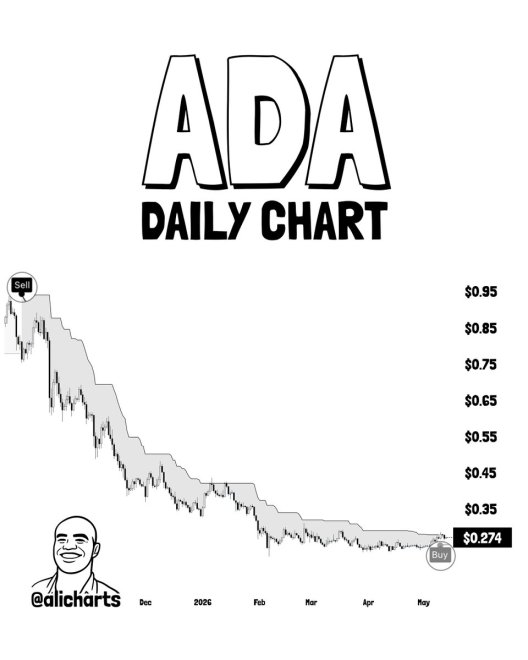
Source: Chart from Ali Charts on X

Following months of this heavy correction, the key indicator has just flipped on the daily chart. This flip simply means that the indicator is signaling a buy signal once again. In the expert’s view, this shift points to the conclusion of a local exhaustion phase and a trend reversal finally taking place.

As a result of the setup, Martinez is confident that a surge toward the $0.33 resistance is likely to occur soon. If ADA is able to maintain this momentum, the rally is expected to continue toward the $0.42, which Martinez labels the secondary target. As long as the $0.25 support holds, this bullish prediction remains valid. However, if it falls below the level, the optimistic outlook is not lost, only delayed.

Key Stakeholders Are Slowly Scooping Up The Altcoin

Amid the price flip toward the upward direction, investors’ sentiment around Cardano has clearly shifted. On-chain activity suggests that confidence seems to be steadily returning after months of erratic market performance.

A report from Santiment reveals that Cardano’s key stakeholders have slowly but surely accumulated. These investors have consistently added more of the existing supply to their portfolio since December 2023. With this accumulation, wallet addresses holding at least 1 million ADA have now acquired over 25.09 billion ADA, which represents 67.47% of the current existing supply.

Although the asset has lost -71% of its market cap within a 9-month period, the millionaire” tier of sharks and whales appear to be content with adding more ADA while prices are at a discount. Should this trend continue, it is likely to influence and shape ADA’s momentum, potentially triggering a steady upward move.

ADA trading at $0.26 on the 1D chart | Source: ADAUSDT on Tradingview.com

Domande pertinenti

QWhat key indicator does analyst Ali Martinez cite to predict Cardano (ADA) could be entering a new bull phase?

AAli Martinez cites the SuperTrend Indicator on the daily chart, which has flipped to a buy signal, suggesting the conclusion of a local exhaustion phase and a potential trend reversal.

QAccording to the analyst's prediction, what is the primary price target for ADA's potential rally?

AAccording to the analyst, the primary target for ADA's potential rally is a surge toward the $0.33 resistance level.

QWhat is the secondary price target mentioned in the article for ADA's upward move?

AThe secondary price target mentioned for ADA's upward move is $0.42.

QWhat on-chain activity suggests growing investor confidence in Cardano (ADA) according to the article?

AOn-chain activity from Santiment shows that key stakeholders (wallet addresses holding at least 1 million ADA) have been consistently accumulating ADA since December 2023, now holding over 67% of the existing supply.

QWhat condition does the analyst say must hold for the bullish ADA price prediction to remain valid?

AThe analyst states that as long as the $0.25 support level holds, the bullish prediction remains valid. If it falls below, the optimistic outlook is delayed but not lost.

Letture associate

AI PC Battle: Bet on the Toll Booth, Not the Camp

**Title:** The AI PC Battle: Don't Bet on Sides, Bet on the Tollbooth **Summary:** The AI PC competition is moving beyond simple "x86 vs. Arm" narratives. The core investment thesis should focus on identifying which players can sustain margins, cash flow, and pricing power throughout the upgrade cycle, rather than backing a particular architecture. The opportunity is analyzed in three layers: 1. **The Advanced Foundry Tollbooth:** TSMC is positioned to collect "tolls" regardless of which chip designer wins, due to its dominant ~70% share in advanced semiconductor manufacturing, which is essential for high-end AI PC chips. 2. **Compute & Platform Spillover:** AMD represents an offensive in the x86 CPU+GPU space, while NVIDIA leverages its GPU and CUDA software stack dominance. Both benefit from the demand for increased local AI compute. 3. **Architecture Diffusion & Turnaround Plays:** ARM and Intel offer potential for significant upside (elasticity), but investments here require stricter discipline due to higher execution risks and competitive challenges. The industry is transitioning from concept to shipment validation. While short-term forecasts for AI PC adoption have been revised down slightly due to tariffs and procurement delays, the long-term trend towards AI becoming a standard PC feature remains intact. The key driver for upgrade cycles will be whether compelling enterprise applications (e.g., privacy-sensitive computing, low-latency inference) emerge beyond consumer-focused features like meeting summarization. Investment strategy should prioritize companies with platform-level advantages and recurring revenue streams. TSMC offers high certainty as the foundational tollbooth. AMD presents a strong offensive play within the established ecosystem. ARM and Intel are higher-risk, higher-potential-reward turnaround bets. The report cautions against chasing short-term hype and emphasizes a disciplined, long-term approach focused on buying ecosystem strength and cash-flow certainty after market enthusiasm subsides. **Key Risks:** Underwhelming AI PC applications slowing upgrade cycles; slow improvement in Windows on Arm compatibility; macro/tariff impacts on PC demand; potential advanced node supply-demand mismatches affecting TSMC; high overall AI sector valuations making stocks vulnerable to a risk-off shift in markets.

marsbit13 min fa

AI PC Battle: Bet on the Toll Booth, Not the Camp

marsbit13 min fa

Ten-Thousand-Word Analysis: From $10 to $290, MRVL Wins the Entire AI Era by 'Not Making GPUs'

Marvell Technology's stock price surged from under $10 in 2016 to a record $290 in June 2026, fueled not by making GPUs, but by dominating AI infrastructure connectivity. This analysis argues the market misvalues MRVL as merely a smaller Broadcom in custom AI chips, overlooking its true, unique position. Marvell's core strength lies in enabling high-speed data flow for AI clusters through three interconnected businesses. First, it holds a commanding ~70% market share in high-speed optical DSPs (essential for data center light modules), a deep-moat business with accelerating growth. Second, its custom AI chip design business serves hyperscalers like AWS, Microsoft, and Google, with a significant revenue pipeline despite lower margins. Third, stable cash flows come from Ethernet switch chips and enterprise storage controllers. Together, they form a full-stack "AI data movement" platform. CEO Matt Murphy's transformative leadership since 2016, involving strategic divestments, key acquisitions (like Inphi for optical DSPs), and securing long-term agreements with major cloud providers, repositioned the company. A pivotal $2 billion strategic investment from NVIDIA in 2026 underscored Marvell's critical role in the AI ecosystem, particularly through collaborations like NVLink Fusion. While Marvell faces risks—including client concentration (losing the Amazon Trainium3 design), lower-margin business mix, competitive threats, insider selling, and complex supply chains—its fundamentals remain strong. The optical interconnect moat is widening with the acquisition of Celestial AI (photonics fabric), and financial metrics show accelerating revenue growth and operating leverage. With a PEG ratio suggesting undervaluation relative to its growth, the thesis is that the market undervalues Marvell's monopolistic position in AI "plumbing" while overemphasizing its competitive custom chip segment. The story transcends investing, symbolizing how in any complex system—from the internet to AI—the value of "connection" ultimately surpasses that of individual "nodes."

marsbit43 min fa

Ten-Thousand-Word Analysis: From $10 to $290, MRVL Wins the Entire AI Era by 'Not Making GPUs'

marsbit43 min fa

AI Relay Stations Spark Heated Debate on Zhihu: Behind Cheap Tokens, What Are Users Really Worried About?

A discussion on Zhihu about "AI relay stations" shifted the niche developer topic of "cheap tokens" into broader user awareness. Users moved beyond simply questioning the legitimacy of these services to focus on practical concerns: Where do cheap tokens truly come from? Is the model being accessed the real one? Can relay stations see prompts, code, and API keys? For occasional users, are the risks worth it? The core debate centered less on price and more on trust. A primary worry is model authenticity—the risk of "model swapping," where users paying for a premium model might be routed to a cheaper one, creating an information asymmetry. Others argued that cost comparisons matter; while cheaper than official pay-as-you-go APIs, relay stations may not be the lowest-cost option versus subscriptions, domestic models, or free tiers, making user needs assessment crucial. Speculation about token sources ranged from legitimate bulk discounts to gray-area methods like account sharing or exploiting regional pricing. This opacity makes risk assessment difficult for users. Data security emerged as a critical concern, especially for enterprise use. When processing sensitive information like code, contracts, or client data, the inability to verify a relay station's data handling, retention, or access policies poses significant compliance and confidentiality risks. The evolving consensus suggests relay stations can be used cautiously for low-sensitivity, disposable tasks (e.g., summarizing public info, simple translation). However, they should not be the default for sensitive, professional, or production workflows involving proprietary data, Agents, or automated systems. Recommendations include avoiding large prepayments, not relying on a single service, using test prompts to monitor quality, anonymizing data where possible, and keeping official channels as backups. Ultimately, the discussion framed tokens not just as a billing unit but as a measure of real cost encompassing price, model integrity, data security, and service stability. The popularity of relay stations highlights user demand for affordable access, but the debate underscores a key trade-off: the savings from cheap tokens may come at the price of trust, transparency, and control over one's data and AI experience.

marsbit1 h fa

AI Relay Stations Spark Heated Debate on Zhihu: Behind Cheap Tokens, What Are Users Really Worried About?

marsbit1 h fa

In-Depth Research Report on TradFi: The Convergence Wave of Crypto and Traditional Finance

In 2026, the crypto industry is undergoing a profound infrastructure-level transformation—TradFi assets are migrating on-chain at an unprecedented pace. According to CoinGecko's Q1 2026 report, the total value locked (TVL) of tokenized real-world assets (RWA) has surpassed $31 billion, a nearly 4x increase from $7.8 billion at the beginning of 2025, with the sector’s aggregate market capitalization reaching $19.3 billion. Among these, the market cap of tokenized stocks surged from $2 million to $486 million, with Q1 spot trading volume reaching $15.1 billion—a single quarter already surpassing the entire second half of 2025. RWA perpetual contract Q1 trading volume reached a staggering $524.8 billion, far exceeding the $313 billion for all of 2025. Meanwhile, BlackRock's BUIDL fund has reached $2.3 billion in scale and has filed for two new tokenized funds, signaling that the world's largest asset manager's tokenization strategy is evolving from pilot to product suite expansion. HTX, as a core participant in the crypto exchange sector, officially launched TradFi perpetual futures products including NVDA, AAPL, MSFT, META, and SPY in 2026, enabling crypto users to gain 24/7 trading access to core U.S. equities. Boston Consulting Group predicts that global tokenized asset scale could reach $16 trillion by 2030, while McKinsey offers a conservative estimate of approximately $2 trillion. The on-chain migration of TradFi assets is no longer a "future narrative" but a structural transformation unfolding in real time, as crypto exchanges evolve from single crypto asset trading platforms toward "multi-asset-class trading infrastructure."

HTX Learn1 h fa

In-Depth Research Report on TradFi: The Convergence Wave of Crypto and Traditional Finance

HTX Learn1 h fa

Trading

Spot
Futures

Articoli Popolari

Come comprare ADA

Benvenuto in HTX.com! Abbiamo reso l'acquisto di Cardano (ADA) semplice e conveniente. Segui la nostra guida passo passo per intraprendere il tuo viaggio nel mondo delle criptovalute.Step 1: Crea il tuo Account HTXUsa la tua email o numero di telefono per registrarti il tuo account gratuito su HTX. Vivi un'esperienza facile e sblocca tutte le funzionalità,Crea il mio accountStep 2: Vai in Acquista crypto e seleziona il tuo metodo di pagamentoCarta di credito/debito: utilizza la tua Visa o Mastercard per acquistare immediatamente CardanoADA.Bilancio: Usa i fondi dal bilancio del tuo account HTX per fare trading senza problemi.Terze parti: abbiamo aggiunto metodi di pagamento molto utilizzati come Google Pay e Apple Pay per maggiore comodità.P2P: Fai trading direttamente con altri utenti HTX.Over-the-Counter (OTC): Offriamo servizi su misura e tassi di cambio competitivi per i trader.Step 3: Conserva Cardano (ADA)Dopo aver acquistato Cardano (ADA), conserva nel tuo account HTX. In alternativa, puoi inviare tramite trasferimento blockchain o scambiare per altre criptovalute.Step 4: Scambia Cardano (ADA)Scambia facilmente Cardano (ADA) nel mercato spot di HTX. Accedi al tuo account, seleziona la tua coppia di trading, esegui le tue operazioni e monitora in tempo reale. Offriamo un'esperienza user-friendly sia per chi ha appena iniziato che per i trader più esperti.

1.3k Totale visualizzazioniPubblicato il 2024.12.10Aggiornato il 2026.06.02

Come comprare ADA

Discussioni

Benvenuto nella Community HTX. Qui puoi rimanere informato sugli ultimi sviluppi della piattaforma e accedere ad approfondimenti esperti sul mercato. Le opinioni degli utenti sul prezzo di ADA ADA sono presentate come di seguito.

活动图片













