Cardano (ADA) Attracts Fresh Institutional Capital As Grayscale Expands Holdings

bitcoinistPubblicato 2026-02-20Pubblicato ultima volta 2026-02-20

Introduzione

Despite a declining price in a weak crypto market, Cardano (ADA) is attracting renewed institutional investment. Grayscale Investments has significantly increased its ADA holdings, raising its allocation in the Smart Contract Fund from 19.50% to over 20.12%. This consecutive growth signals strong confidence in the altcoin's long-term fundamentals. The move is seen as strategic positioning, potentially linked to Cardano's recent push into Bitcoin DeFi, aiming to restore external BTC liquidity through non-custodial collateral and stablecoin-based lending. While overall network activity has decreased since 2021, the ecosystem is now advancing with long-term, privacy-focused projects like Midnight, separating speculative projects from substantive ones. ADA was trading at $0.27 at the time of reporting.

Cardano’s price may be in a downward action due to a weakening crypto environment, but there has been a resurgence in buying activity from both retail and institutional investors across the sector. This resurgence in buying activity is indicated by the steady purchase by Grayscale, one of the leading treasury companies in the world.

Grayscale Makes More Cardano Allocations

Despite its persistent pullback in price over the past few months, institutional interest in Cardano (ADA) appears to be strengthening once again. According to a recent report from Dave, a crypto enthusiast, Grayscale Investments has increased its exposure to ADA after a fresh purchase.

With its steady allocation move, the ADA weighting in the company’s Smart Contract Fund now sits at over 20.12% from its prior level of 19.50%. This marks another consecutive rise and signals that investors are once again confident in the altcoin’s long-term fundamentals, as they attentively examine high-conviction holdings in the cryptocurrency market.

As ADA secures a larger share within the firm’s holdings, the allocation can also be seen as strategic positioning for what’s ahead. It is worth noting that the latest allocation was conducted just a week after the previous one.
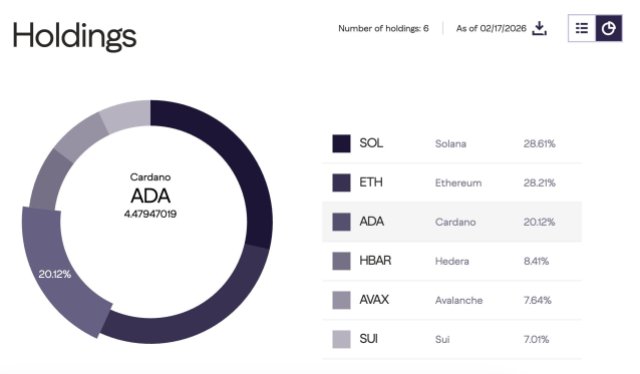
Grayscale adds to its ADA holdings | Source: Chart from Dave on X

During the period, the firm’s ADA allocation moved from 19.50% to 19.55% in the smart contract fund. There are speculations that the move could be linked to recent rapid momentum and integration work around Bitcoin Decentralized Finance (DeFi) within the Cardano ecosystem.

Dave highlighted that this is taking place as Cardano bolsters its push into the Bitcoin DeFi ecosystem. The purpose of his move is to restore external BTC liquidity on the network via non-custodial Collateral, stablecoin-based credit, and lending structures built to avoid fragility driven by liquidation.

Furthermore, Cardano’s smart contract layer makes this possible, and this approach clarifies why large asset managers would be covertly expanding their exposure. Thus, institutions that need predictable, non-liquidating borrowing, and retail users looking for high-quality yield on idle Bitcoin could be able to utilize the network.

The Projects On The Leading Network Are Just Real Ones

Currently, the activity across the Cardano ecosystem is decreasing at a remarkable pace. Mintern, a market expert and Chief Meme Officer (CMO) of Minswap, has reported a sharp drop in the number of projects launched on the network since 2021.

In 2021, the number of projects on the network skyrocketed with more than 100 projects within the year, signaling confidence in the network’s scalability, governance model, and long-term roadmap. Meanwhile, in 2026, the projects have fallen, leaving only the real ones.

Mintern noted that the network is now advancing with Midnight building privacy-focused rails for long-term adoption, not short-term speculation. Amid the reduced network activity, the main question circulating across the community is who is still building in 2026.

ADA trading at $0.27 on the 1D chart | Source: ADAUSDT on Tradingview.com

Domande pertinenti

QWhat is the main reason for the resurgence in buying activity for Cardano (ADA) despite its price decline?

AThe resurgence in buying activity is due to increased purchases by both retail and institutional investors, notably Grayscale Investments, which has been steadily increasing its ADA holdings.

QHow much has Grayscale's ADA weighting in its Smart Contract Fund increased to after the recent purchase?

AGrayscale's ADA weighting in its Smart Contract Fund has increased to over 20.12% from its prior level of 19.50%.

QWhat recent development in the Cardano ecosystem might be linked to Grayscale's increased allocation to ADA?

AThe move could be linked to Cardano's recent rapid momentum and integration work around Bitcoin Decentralized Finance (DeFi), which aims to restore external BTC liquidity via non-custodial collateral and stablecoin-based credit structures.

QWhat trend has been observed regarding the number of projects launched on the Cardano network since 2021?

AThe number of projects launched on the Cardano network has sharply decreased since 2021, with only the 'real ones' remaining, as the network focuses on long-term adoption rather than short-term speculation.

QWhat is the current price of ADA mentioned in the article, and on which chart is it referenced?

AThe current price of ADA mentioned is $0.27, as shown on the 1D chart sourced from ADAUSDT on Tradingview.com.

Letture associate

The AI Agent Era Accelerates Its Arrival: Questflow Defines a New Paradigm of Financial Intelligence with On-Chain AI Brokerage

The AI Agent era is accelerating, with the CB Insights AI 100 list highlighting global investment confidence. The focus has shifted from whether AI works to its speed of deployment and ability to manage complex workflows, with autonomous AI Agents driving this transformation. At the forefront is Questflow, a Singapore-based startup redefining financial intelligence through its on-chain AI brokerage. Unlike tools that merely provide data dashboards, Questflow deploys AI Agents that proactively scan markets, form judgments, and execute trades via a conversational interface—operating 24/7 without requiring manual confirmation for each decision. This embodies the new AI paradigm of agents capable of executing multi-step workflows autonomously. Questflow's mission is to democratize institutional-grade trading intelligence. Historically reserved for the ultra-wealthy, this capability is now accessible starting from just $1 through Questflow's "AI Clone + Copy Trade" model. The platform charges only a 1% execution fee, aligning its incentives directly with users and eliminating traditional management or performance fees. The timing is opportune, aligning with key trends identified by CB Insights: the scalable deployment of AI Agents, accelerated AI adoption in financial services, and the maturation of on-chain infrastructure. With robust liquidity on platforms like Hyperliquid and Polymarket, alongside advancements in AI reasoning and non-custodial wallet security, Questflow is positioned to merge the roles of broker, fund, and exchange into a single, accessible platform for millions.

链捕手29 min fa

The AI Agent Era Accelerates Its Arrival: Questflow Defines a New Paradigm of Financial Intelligence with On-Chain AI Brokerage

链捕手29 min fa

Why Pricing Social Interactions is Doomed to Fail?

Titled "Why Putting a Price on Social Interaction Is Doomed to Fail," this article critiques attempts to monetize social networks directly through SocialFi models, arguing their inevitable failure stems from a fundamental misunderstanding of media dynamics. Using Marshall McLuhan's theory of "hot" and "cold" media, the author posits that social networks are inherently "cold" media. Their value isn't contained in individual posts but is co-created through user participation, interpretation, and fragmented, ongoing interaction (e.g., replies, shares). This ambiguity and need for user involvement are core to their function. The article asserts that SocialFi projects like Friend.tech failed because introducing real-time, tradable financial pricing (a definitive "hot" signal) into this "cold" environment doesn't add a layer—it replaces the medium's essence. The unambiguous price signal overshadows and nullifies the nuanced, participatory social signal. Users become traders, not participants, and when speculative profits vanish, the underlying social ecosystem—never genuinely cultivated—collapses entirely. This principle extends beyond crypto. The author argues platforms like Twitter have gradually "heated up" through metrics (likes, retweets counts, algorithmically defined value), shifting users from participants to performers and eroding organic engagement. The solution isn't to abandon capital but to manage its entry point. Successful models like Substack, Patreon, or Bandcamp allow capital to "condense" at specific, isolated nodes (e.g., subscriptions, one-time payments) without permeating and "heating" every social interaction. They preserve the core "cold," participatory medium while enabling monetization at designated boundaries. The NFT boom and bust serves as a stark parallel: the ancient "cold" medium of collecting (valued for story, community, gradual accumulation) was rapidly destroyed by platforms that introduced real-time floor prices, rarity scores, and trading dashboards, transforming collectors into speculators and vaporizing cultural value when prices fell. The core lesson: "Liquidity equals heat." Injecting high liquidity and definitive pricing into a "cold" participatory medium doesn't optimize it; it fundamentally alters and destroys its value-creating mechanism. The future lies not in pricing every social gesture but in finding precise, non-invasive points for capital to condense without overheating the entire ecosystem.

marsbit37 min fa

Why Pricing Social Interactions is Doomed to Fail?

marsbit37 min fa

Trading

Spot
Futures

Articoli Popolari

Come comprare ADA

Benvenuto in HTX.com! Abbiamo reso l'acquisto di Cardano (ADA) semplice e conveniente. Segui la nostra guida passo passo per intraprendere il tuo viaggio nel mondo delle criptovalute.Step 1: Crea il tuo Account HTXUsa la tua email o numero di telefono per registrarti il tuo account gratuito su HTX. Vivi un'esperienza facile e sblocca tutte le funzionalità,Crea il mio accountStep 2: Vai in Acquista crypto e seleziona il tuo metodo di pagamentoCarta di credito/debito: utilizza la tua Visa o Mastercard per acquistare immediatamente CardanoADA.Bilancio: Usa i fondi dal bilancio del tuo account HTX per fare trading senza problemi.Terze parti: abbiamo aggiunto metodi di pagamento molto utilizzati come Google Pay e Apple Pay per maggiore comodità.P2P: Fai trading direttamente con altri utenti HTX.Over-the-Counter (OTC): Offriamo servizi su misura e tassi di cambio competitivi per i trader.Step 3: Conserva Cardano (ADA)Dopo aver acquistato Cardano (ADA), conserva nel tuo account HTX. In alternativa, puoi inviare tramite trasferimento blockchain o scambiare per altre criptovalute.Step 4: Scambia Cardano (ADA)Scambia facilmente Cardano (ADA) nel mercato spot di HTX. Accedi al tuo account, seleziona la tua coppia di trading, esegui le tue operazioni e monitora in tempo reale. Offriamo un'esperienza user-friendly sia per chi ha appena iniziato che per i trader più esperti.

1.2k Totale visualizzazioniPubblicato il 2024.12.10Aggiornato il 2025.03.21

Come comprare ADA

Discussioni

Benvenuto nella Community HTX. Qui puoi rimanere informato sugli ultimi sviluppi della piattaforma e accedere ad approfondimenti esperti sul mercato. Le opinioni degli utenti sul prezzo di ADA ADA sono presentate come di seguito.

活动图片