Can the Open-Source AI Platform Sentient Truly Challenge OpenAI's Dominance?

比推Pubblicato 2025-12-19Pubblicato ultima volta 2025-12-19

Introduzione

The open-source AI platform Sentient is positioning itself as a direct challenger to OpenAI and other AI giants. Backed by $85 million in seed funding from prominent investors like Founders Fund and Pantera Capital, Sentient advocates for a decentralized, open-source path to AGI, contrasting with the closed, centralized models of companies like OpenAI and Anthropic. Its core advantages include ensuring AI diversity and interoperability, avoiding centralized censorship and single points of failure, disintermediating AI development, and providing a native monetization model via its SENT token. Sentient has built an ecosystem called GRID, which includes over 110 partners, ranging from AI agents and data providers to computational infrastructure. A key product highlight is SERA-Crypto, an open-source AI research agent that reportedly outperformed models like GPT-5 in real-time crypto market analysis. The SENT token acts as the economic engine for this ecosystem, incentivizing developers and users. Recently listed on major exchanges, it fuels a flywheel where better AI models attract more users and developers, fostering a self-sustaining, community-driven AI network. Sentient’s vision is a more transparent, equitable, and evolutionary future for AI.

Author: Wenser

Original Title: Taking Down OpenAI? The Ambitions of Open-Source AI Platform Sentient Go Beyond That


AI is devouring the world at an unprecedented pace, but the timeline has quietly diverged into two distinct paths.

One path is the expansion of the AI landscape monopolized by tech giants: NVIDIA, leveraging its chip and graphics card resources, has become the world's first publicly traded company with a market capitalization of $5 trillion; Google and Amazon have successively entered the chip manufacturing arena, striving to secure advantageous positions; OpenAI, Anthropic, and other AI giants have seen their valuations soar to hundreds of billions of dollars. The other path is the rapid development at the micro-level of the AI industry: NVIDIA founder Jensen Huang's mention at CES 2025 earlier this year that "AI Agents are poised to become the next robotics industry, with a market scale reaching trillions of dollars" is gradually coming to fruition. Tens of millions of AI Agents are permeating every aspect of human society daily, which also means that tech giants are gradually becoming the "key holders to the gates of the AI world." Based on the development trajectory of the internet industry, many might wonder: Is AI about to become "just another game for tech giants?"

To this, Sentient's answer is—"No."

As an open-source AI platform adhering to internet fundamentalism, it previously secured $85 million in seed funding, led by prominent institutions including Peter Thiel's Founders Fund, Pantera Capital, and Framework Ventures. On the inevitable path of AI consuming the world, Sentient has chosen a route starkly different from that of the giant corporations. And this is precisely the "Prologue to Open-Source AGI" that Odaily Planet Daily will systematically deconstruct today.

First Look at Sentient: Raising the Banner of Open-Source AI, Challenging Trillion-Dollar Monopoly Giants Head-On

Last July, Sentient announced the completion of an $85 million seed funding round, with its backing investors堪称豪华 (can be described as豪华 -豪华 means luxurious/impressive here, implying a very strong lineup) — lead investors included Peter Thiel's Founders Fund, Pantera Capital, and Framework Ventures; participating investors则包括 (then included) Ethereal Ventures, Robot Ventures, Symbolic Capital, Delphi Ventures, Hack VC, Arrington Capital, HashKey Capital, Canonical Crypto, LD Capital, and Foresight Ventures, among a series of well-known VC investment institutions in the crypto industry.

It's important to note that crypto projects securing this amount in seed funding have always been few and far between, let alone with the strong backing of such a series of star capital behind this investment. Previously, only a few top-tier L1 public chain projects could receive such powerful support. For a time, "What did Sentient possess to gain such favor from capital?" became one of the hot topics in the crypto circle. Soon, the answer emerged.

Targeting OpenAI, Sentient Team Faces Giant Competition Head-On

In subsequent media interviews, several partners from Sentient's lead investment institutions provided their answers—

Founders Fund partner Joey Krug stated that the primary reason for investing in Sentient was its team, praising the technical acumen of co-founders Sandeep (founder of Polygon) and Pramod (professor at Princeton University), among others; Pantera Capital managing partner Paul Veradittakit expressed that if AI development remains closed-source, many critical aspects of society will be vulnerable to the集中效应 (centralized effects) of censorship and rent-seeking. Sentient's open, monetizable, and loyal (OML) AI model "has enormous potential to disrupt the AI development industry"; Framework Ventures partner Brandon Potts also gave high praise regarding the team and technology,直言 (stating bluntly) that "the Sentient team is the most capable team to solve the economic problems of open-source AI."

In Sentient's impressive seed funding round, the golden rule of "investing in people" was vividly demonstrated, and the team members behind the Sentient project can indeed be called a "founding dream team" (compiled from Grok)—
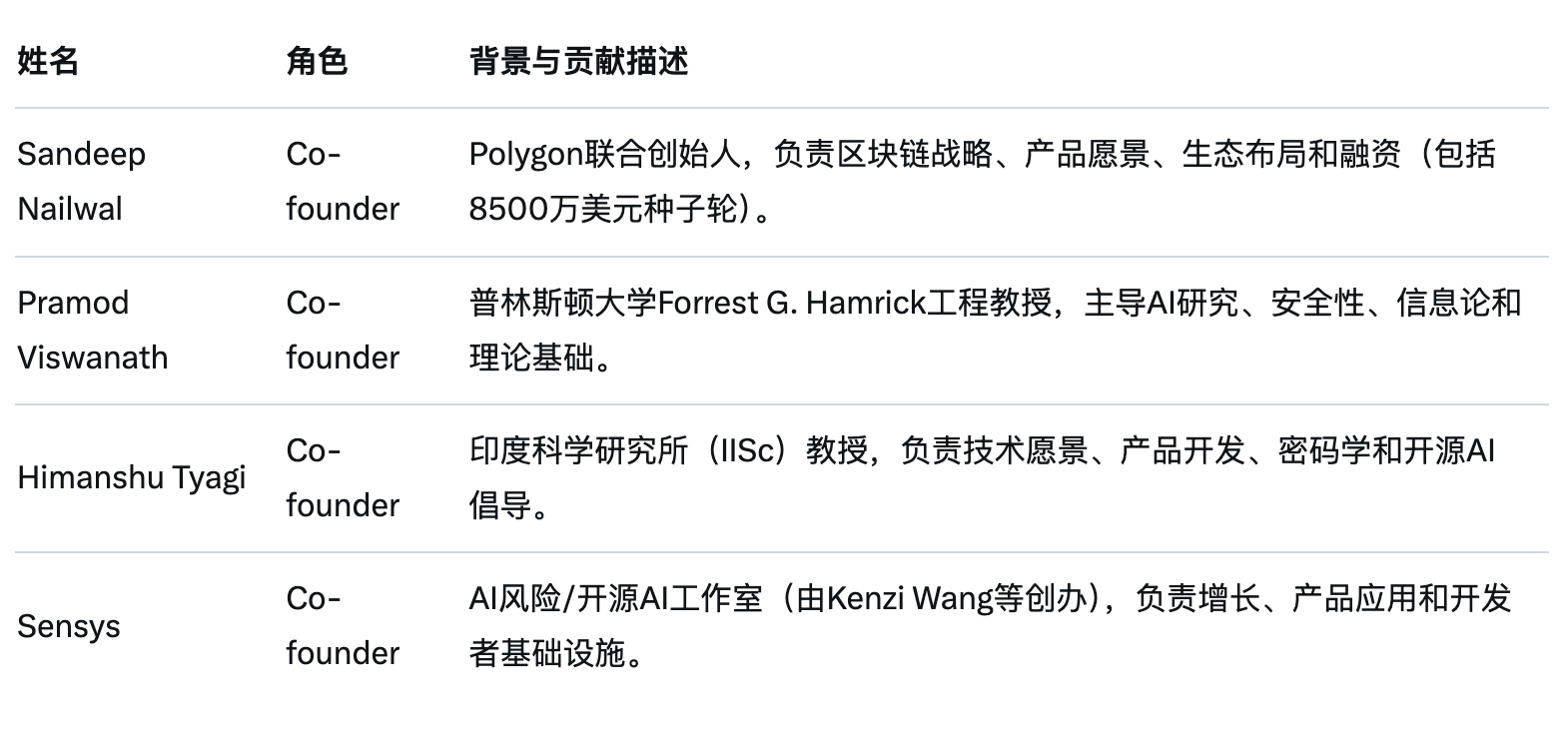
Sentient's 4 Co-Founders

More importantly, during this interview, Sentient's ambition was emphasized once again—to compete head-on with the AI giant, OpenAI, the company behind ChatGPT, with its main competitive strategy being to build open-source AI models leveraging community contributions.

The Universal Value of an Open-Source AI Platform: Decentralization, Censorship Resistance, Monetary Quantification

Different from the closed-source models of AI giants like OpenAI, Anthropic, and Google, Sentient has chosen a "difficult yet correct" path for AGI development—an open-source AI platform.

Using "hailing a ride" as an analogy, the AI models and applications provided by commercial companies like OpenAI and Anthropic are like "centralized AI platforms" that put a hood over the passenger's head. Users, as passengers, don't know the route, let alone whether the charges are reasonable; everything is subject to the "black box arrangements" of the commercial company. In contrast, Sentient's open-source AI approach chooses to lay out the route, specific costs, and diverse options in front of users for them to choose freely. Users can even "join the platform" to provide corresponding "solutions" for more users. Specifically, compared to the products of existing AI monopoly giants on the market, Sentient's open-source AI platform possesses the following advantages:

1. Ensures diversity and interoperability of AI products. Unlike the single AI models of various giant companies, the Sentient platform offers users more AI models to choose from, and various AI models can achieve a certain level of collaborative effect and interoperability, allowing users to enjoy a one-stop AI experience.

2. Avoids downtime and malicious behavior issues of centralized AI applications and models. Previously, OpenAI's model training data involved copyright infringement issues with news media. It's also an indisputable fact that AI models avoid sensitive information of their parent companies and are subject to centralized censorship mechanisms. The recent Cloudflare outage that caused ChatGPT to go offline also reflects the "fragility" of centralized AI models from the side. In these aspects, Sentient's open-source AI can provide certain technical guarantees for the censorship resistance and security redundancy of output content, as well as stable service.

3. Disintermediation and efficiency improvement in the AI field. The main advantage of an open-source AI platform comes from "from the masses, to the masses." A decentralized architecture builds a multi-sided network that can directly connect developers and users, matching supply and demand more efficiently, allowing AI models to truly serve real market needs.

4. Monetization platform tools for the AI application and development process. Sentient's OML (Open, Monetizable, Loyal) AI model and the already launched open-source AGI network GRID can help AI models and applications use the SENT token economy to reward development, feedback the ecosystem, and quantify growth. While ensuring ownership, control, and alignment, Sentient has thus established a monetized platform network that balances AI development and commercial operation.

Based on the above unique advantages,时至今日 (to this day), Sentient has already established a mature open-source AI ecosystem network.

Entering Sentient: Starting with Applications, Going Beyond Applications, Using Ecology to Fuel Network Growth

After about a year of development, Sentient has successively launched a series of self-developed products like Dobby, the Model Fingerprinting library, and Open Deep Search; the open-source AGI network GRID (Global Research & Intelligence Directory); ROMA (Recursive Open Meta AI Agent); and diverse network applications like the开源 AI research agent SERA-Crypto.

Not only that, with the emergence of GRID and the construction and gradual improvement of the SENT token economic model, the "AI Ecosystem Map" built around the Sentient open-source AI platform is also rapidly taking shape.
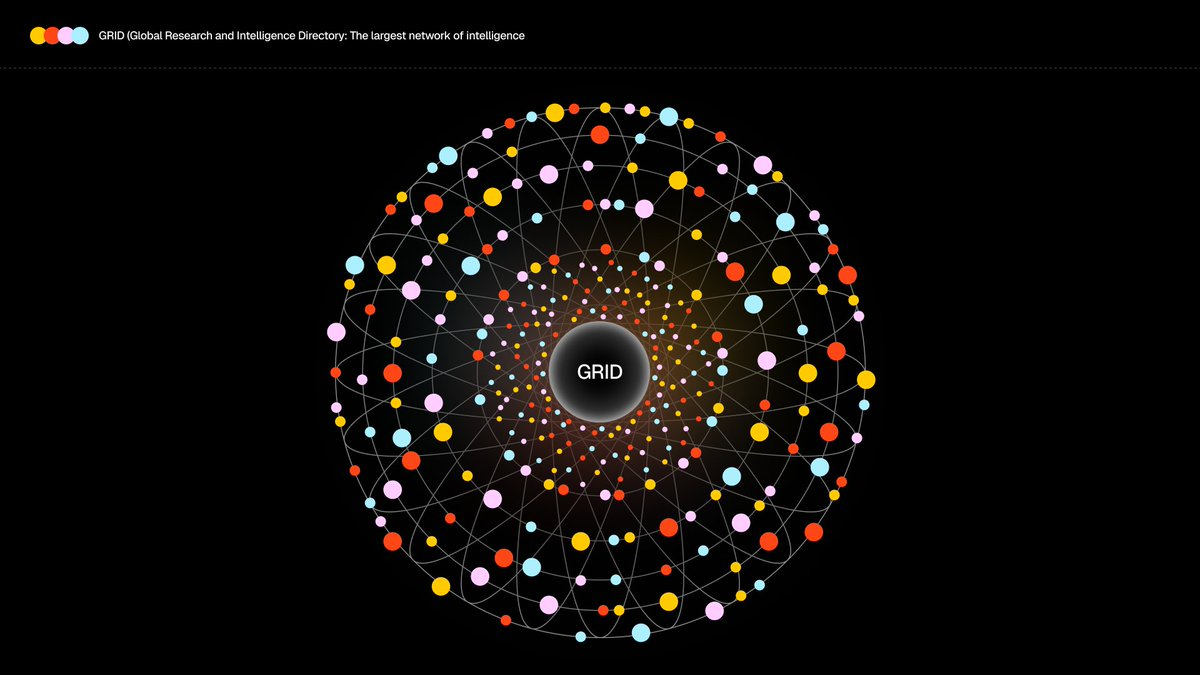
According to official news, the open-source AGI network GRID currently includes over 110 partners,其中包括 (including):

  • Over 50 specialized AI agents;

  • Over 50 specialized data providers;

  • 6 AI models;

  • Over 10 computing and verifiable AI infrastructure suppliers.
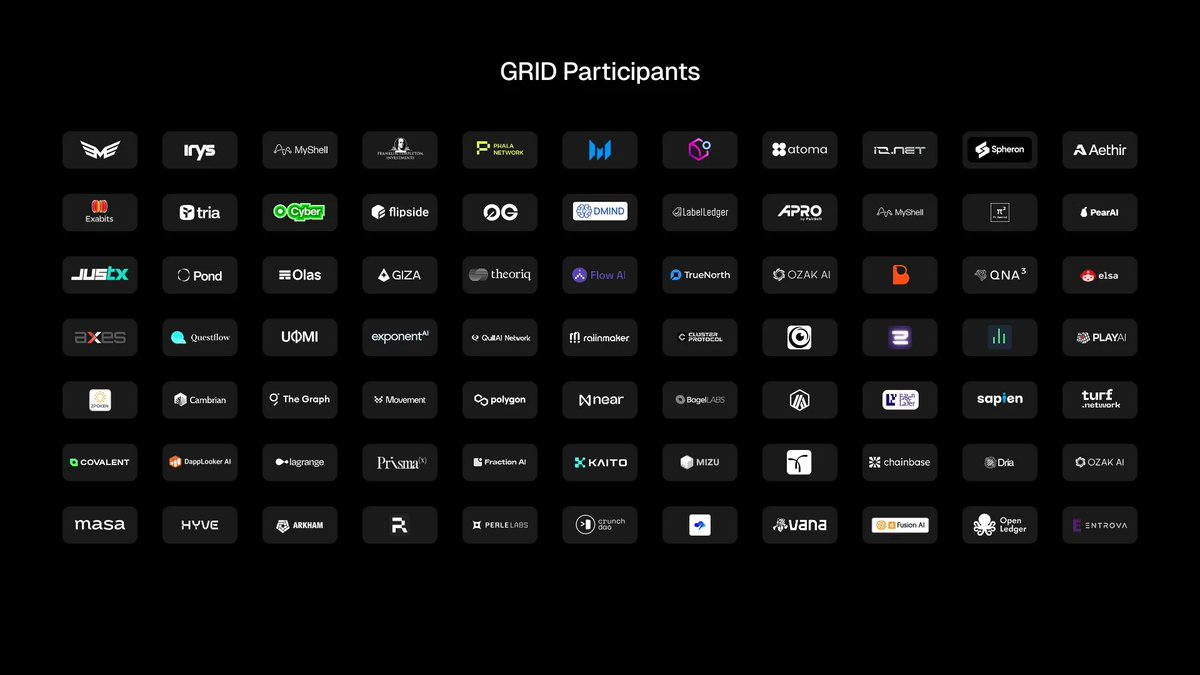
Overview of GRID Network Partners

Representative partners include the following projects: AI chart generation project Napkin, LLM (Large Language Model) search engine Exa, AI-driven people search platform Caldo, on-chain data tracking platform Arkham, enterprise-grade decentralized computing power platform Aethir,加密社交数据平台 (encrypted social data platform) Kaito,加密洞察代理平台 (crypto insights agent platform) Messari Co-Pilot, blockchain indexing data platform The Graph, cryptocurrency exchange Crypto.com, Polygon public chain, and the Dobby Judge AI arbitration system EigenLayer network, etc. Based on the development of ecological synergy effects, the value of Sentient as an open-source AI platform is mainly reflected in two aspects: first, it can attract builders such as developers, computing power, and data to participate in ecological construction; second, through token incentives and staking models, it can feedback the development of the open-source AI ecosystem, especially vertical AI models and applications closely integrated with the needs of the cryptocurrency industry, which are expected to experience a period of explosive growth.

The recently launched open-source AI research agent SERA-Crypto by Sentient is a prime example. Here we有必要多展开一下 (it's necessary to elaborate a bit more)—For a long time, combining AI with cryptocurrency market conditions to assist trading decisions has been a real need for countless people and a direction many developers have been striving to research. However, limited by the hallucinations of large models, difficulty in real-time market data updates, and the complexity of querying on-chain status and operating wallet accounts, "the AI Agent born for crypto research and investment" has always been absent.

SERA Crypto emerged in response to this need. This AI Agent,主打 (focusing on) "Semantic Embedding & Reasoning Agent Architecture," upon its debut, won the accolade of "the number one open-source agent on DMind"; in real-time crypto benchmark tests包含 (including) temporal relevance, data consistency, research depth, and relevance, SERA Crypto ranked first with a score of 34.3 points,其整体表现甚至优于 (its overall performance even surpassed) GPT-5, Grok 4, Gemini 3 Pro, and Perplexity Finance and other mainstream AI models, with all operations completed within 45 seconds.

After integrating advantages such as routing definition, data clarity, architectural optimization, and structured reasoning, SERA can筛选出 (filter out) real-time, usable, and instructive reasoning information from the flood of "large and comprehensive but useless" and "small and beautiful but虚假 (false)" information. Thus, the Sentient team successfully created an "AI Agent that understands cryptocurrency better," rather than the previous assistants that seemed more like rigid machines incapable of thought, only capable of summarizing clichés. Of course, the creation of SERA also离不开 (could not be separated from) the nearly 300,000 users of the Sentient community and over 22 million user queries.
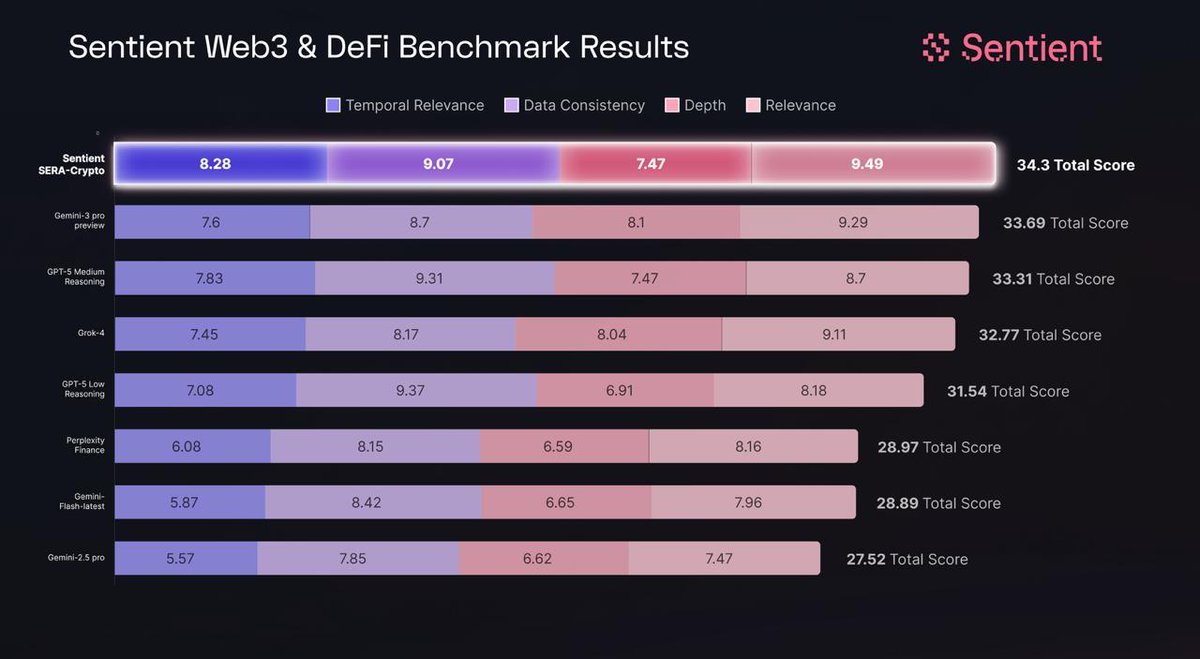
SERA Crypto Model Ranks First in Comprehensive Performance

From now on, users can use SENT tokens to access various AI applications (including various platform agent units) through the Sentient open-source platform to meet their real AI application reasoning needs; Sentient生态开发者 (ecosystem developers) can receive SENT token incentives through user-paid fees; additionally, the SENT token staking model can, to a certain extent, ensure the smooth operation of the economic循环体系 (circulation system) within the ecosystem.
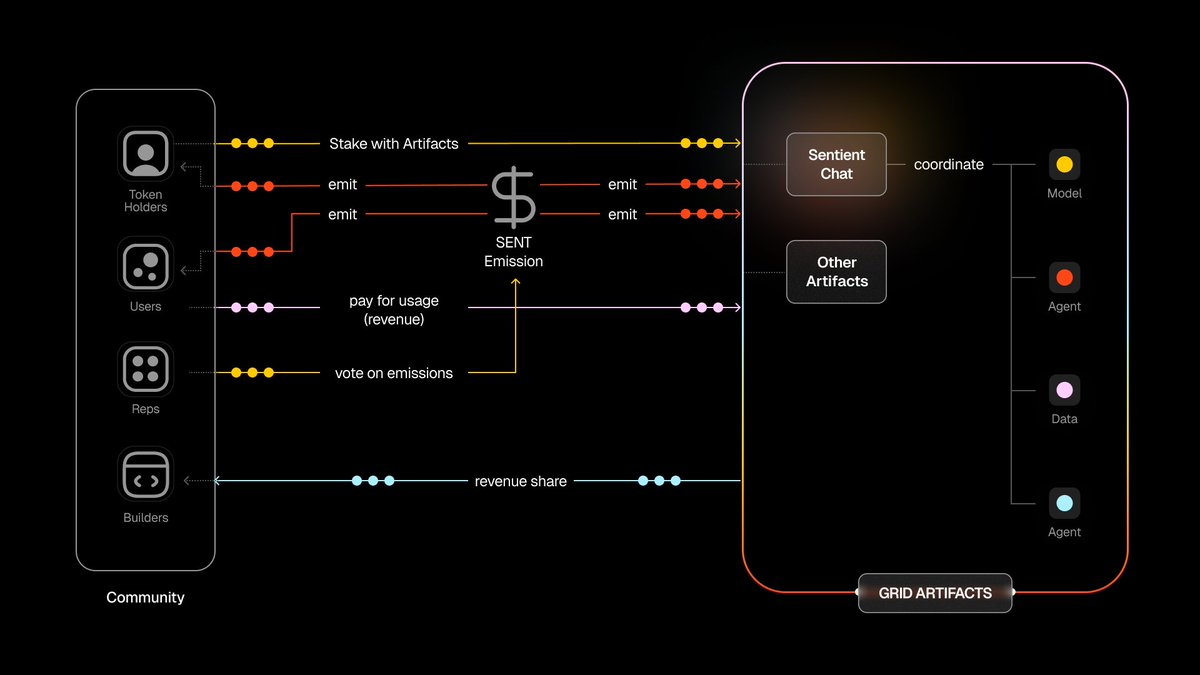
GRID Network and Sentient Community Ecological Flywheel Diagram

Ultimately, the monetized AI ecological economy built on the Sentient open-source AI platform takes full form. The subsequent optimization direction evolves into—better AI models and applications attract more AI users and developers to participate and join, which in turn催生 (catalyzes) the generation of more high-quality AI models and applications,共同构筑起 (jointly building) a development flywheel integrating "users-tokens-developers-products" into one.

SENT Token Introduction: The "Core Energy" Driving the Open-Source AI Platform

As the "engine fuel" supporting the continuous operation of Sentient's vast ecosystem, the role of the SENT token is crucial.

Previously, the SENT token was listed on OKX Pre-Market and Binance Futures; on December 6th, Coinbase officially announced adding SENT to its listing roadmap. Since then, as the core token of the Sentient ecosystem, SENT successfully achieved the feat of "listing on 3 major CEXs."

Previously, Sentient官方曾于 (officially had on) November 17th announced the official end of the first season activity. At that time, the token airdrop was mainly面向 (targeted at) Sentient community members (including Discord community members), AI chat users, crypto KOLs, open-source researchers, etc. On November 18th, its official airdrop registration link officially opened, with the original planned deadline of November 29th. Subsequently, the official delayed the registration deadline to December 5th.

According to subsequently released official information and messages from official personnel, more SENT token incentives for the community will be closely related to content contributions on social media platforms like X and the AI mind share占比份额 (proportion share) on加密社交数据平台 (encrypted social data platforms) like Kaito.

Apart from常规的 (conventional) paths like participating in Sentient Chat platform and application usage, AI model, AI Agent, and application development, helping the Sentient ecosystem expand its宣传营销 (promotion and marketing) might be the main theme of the SENT token second season airdrop activity. For more detailed information, you can follow the official X account or check the official website.
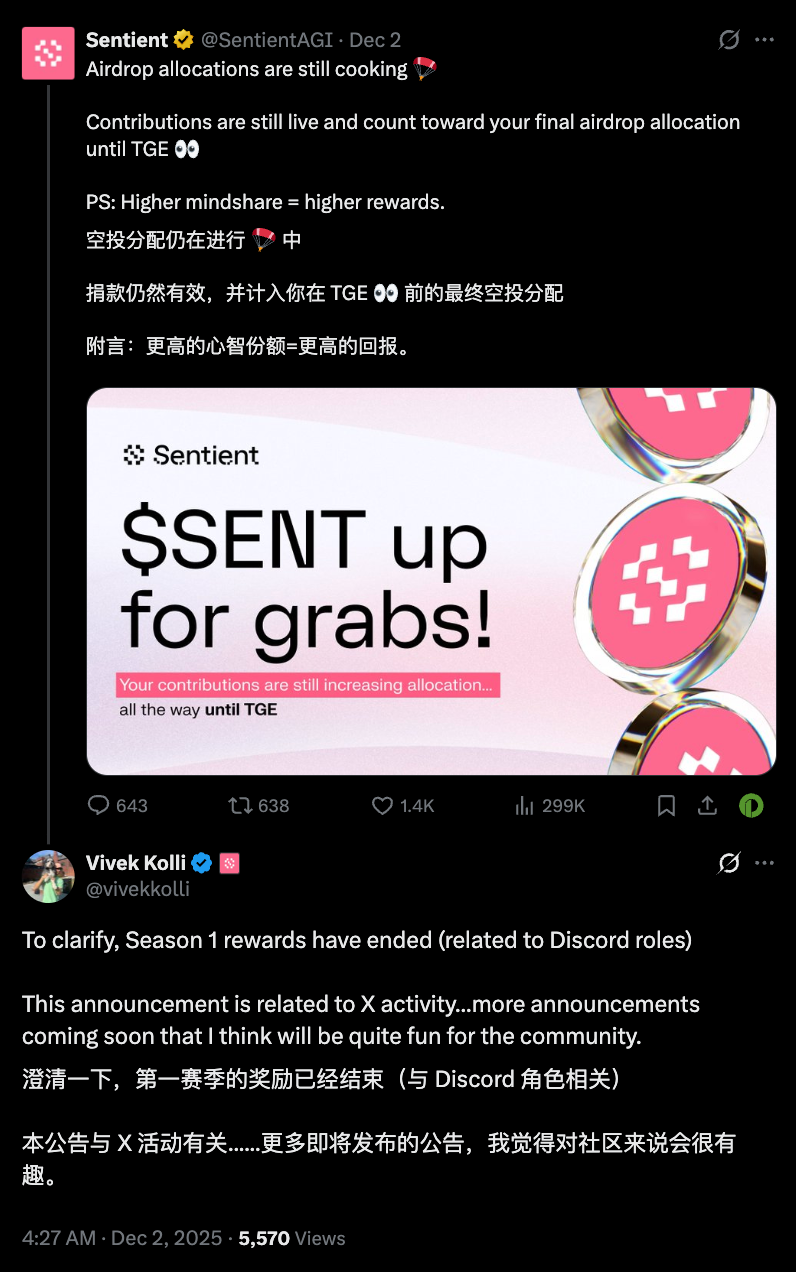
Official Personnel Hinting Clearly

Conclusion: The Limits of Open-Source AI's Self-Evolution Far Exceed Human Imagination

As the development of closed-source large AI models gradually陷入同质化僵局 (falls into a homogenization僵局 -僵局 means deadlock/impasse), open-source AI may become an important force pushing artificial intelligence into deeper waters. Just as the open-source Android system once led to the rapid development of smartphone devices and the advent of the mobile internet, open-source AI platforms represented by Sentient are not merely creating an AI chat application, but an entire open-source AI ecosystem—including underlying protocols, system architecture, as well as specific models and AI Agent applications.

More importantly, unlike the closed-door development of closed-source AI models and applications, open-source AI can achieve a certain degree of "self-evolution," which was the direction Sentient decided upon from the very beginning when it chose this "difficult yet correct" path.

While OpenAI is still troubled by the endless stream of new products from competitors and不得不 (has to) shut down Sora, Sentient is determined to forge a more universal AI development path that aligns with the pursuit of the open-source community. In the哨兵时代 (vanguard era) of carbon-based life guiding silicon-based life, the open-source AI platform brings not only the dawn of an AGI network but also an open-source AI ecological network that places greater emphasis on loyalty, monetary incentives, consistent service, and fewer "AI hallucinations."


Twitter:https://twitter.com/BitpushNewsCN

BitPush TG Discussion Group:https://t.me/BitPushCommunity

BitPush TG Subscription: https://t.me/bitpush

Original Article Link:https://www.bitpush.news/articles/7597075

Domande pertinenti

QWhat is Sentient and how does it aim to challenge OpenAI?

ASentient is an open-source AI platform that aims to challenge OpenAI's dominance by building community-contributed, open-source AI models. It focuses on decentralization, anti-censorship, and monetization through its token economy, offering an alternative to the closed-source models of giants like OpenAI and Anthropic.

QWhat are the key advantages of Sentient's open-source AI platform compared to closed-source models?

ASentient's open-source platform ensures AI product diversity and interoperability, avoids centralization issues like downtime and censorship, enhances efficiency through disintermediation, and provides monetization tools via its OML (Open, Monetizable, Loyal) AI models and SENT token economy.

QWhat significant funding did Sentient receive, and which investors were involved?

ASentient raised $85 million in seed funding, led by Peter Thiel's Founders Fund, Pantera Capital, and Framework Ventures. Other investors included Ethereal Ventures, Robot Ventures, Symbolic Capital, Delphi Ventures, Hack VC, Arrington Capital, HashKey Capital, Canonical Crypto, LD Capital, and Foresight Ventures.

QWhat is SERA-Crypto, and how does it perform compared to other AI models?

ASERA-Crypto is an open-source AI research agent developed by Sentient, designed for cryptocurrency market analysis. It ranked first in real-time crypto benchmarks with a score of 34.3, outperforming models like GPT-5, Grok 4, Gemini 3 Pro, and Perplexity Finance, while completing tasks in under 45 seconds.

QHow does the SENT token function within the Sentient ecosystem?

AThe SENT token is the core currency of the Sentient ecosystem, used to access AI applications, incentivize developers, and support the platform's economy through staking and rewards. It has been listed on major exchanges like OKX, Binance Futures, and Coinbase, facilitating broader adoption and utility.

Letture associate

Trading

Spot
Futures

Articoli Popolari

Cosa è $S$

Comprendere SPERO: Una Panoramica Completa Introduzione a SPERO Mentre il panorama dell'innovazione continua a evolversi, l'emergere delle tecnologie web3 e dei progetti di criptovaluta gioca un ruolo fondamentale nel plasmare il futuro digitale. Un progetto che ha attirato l'attenzione in questo campo dinamico è SPERO, denotato come SPERO,$$s$. Questo articolo mira a raccogliere e presentare informazioni dettagliate su SPERO, per aiutare gli appassionati e gli investitori a comprendere le sue basi, obiettivi e innovazioni nei domini web3 e crypto. Che cos'è SPERO,$$s$? SPERO,$$s$ è un progetto unico all'interno dello spazio crypto che cerca di sfruttare i principi della decentralizzazione e della tecnologia blockchain per creare un ecosistema che promuove l'impegno, l'utilità e l'inclusione finanziaria. Il progetto è progettato per facilitare interazioni peer-to-peer in modi nuovi, fornendo agli utenti soluzioni e servizi finanziari innovativi. Al suo interno, SPERO,$$s$ mira a responsabilizzare gli individui fornendo strumenti e piattaforme che migliorano l'esperienza dell'utente nello spazio delle criptovalute. Questo include la possibilità di metodi di transazione più flessibili, la promozione di iniziative guidate dalla comunità e la creazione di percorsi per opportunità finanziarie attraverso applicazioni decentralizzate (dApps). La visione sottostante di SPERO,$$s$ ruota attorno all'inclusività, cercando di colmare le lacune all'interno della finanza tradizionale mentre sfrutta i vantaggi della tecnologia blockchain. Chi è il Creatore di SPERO,$$s$? L'identità del creatore di SPERO,$$s$ rimane piuttosto oscura, poiché ci sono risorse pubblicamente disponibili limitate che forniscono informazioni dettagliate sul suo fondatore o fondatori. Questa mancanza di trasparenza può derivare dall'impegno del progetto per la decentralizzazione—un ethos che molti progetti web3 condividono, dando priorità ai contributi collettivi rispetto al riconoscimento individuale. Centrando le discussioni attorno alla comunità e ai suoi obiettivi collettivi, SPERO,$$s$ incarna l'essenza dell'empowerment senza mettere in evidenza individui specifici. Pertanto, comprendere l'etica e la missione di SPERO rimane più importante che identificare un creatore singolo. Chi sono gli Investitori di SPERO,$$s$? SPERO,$$s$ è supportato da una varietà di investitori che vanno dai capitalisti di rischio agli investitori angelici dedicati a promuovere l'innovazione nel settore crypto. Il focus di questi investitori generalmente si allinea con la missione di SPERO—dando priorità a progetti che promettono avanzamenti tecnologici sociali, inclusività finanziaria e governance decentralizzata. Queste fondazioni di investitori sono tipicamente interessate a progetti che non solo offrono prodotti innovativi, ma contribuiscono anche positivamente alla comunità blockchain e ai suoi ecosistemi. Il supporto di questi investitori rafforza SPERO,$$s$ come un concorrente degno di nota nel dominio in rapida evoluzione dei progetti crypto. Come Funziona SPERO,$$s$? SPERO,$$s$ impiega un framework multifunzionale che lo distingue dai progetti di criptovaluta convenzionali. Ecco alcune delle caratteristiche chiave che sottolineano la sua unicità e innovazione: Governance Decentralizzata: SPERO,$$s$ integra modelli di governance decentralizzati, responsabilizzando gli utenti a partecipare attivamente ai processi decisionali riguardanti il futuro del progetto. Questo approccio favorisce un senso di proprietà e responsabilità tra i membri della comunità. Utilità del Token: SPERO,$$s$ utilizza il proprio token di criptovaluta, progettato per servire varie funzioni all'interno dell'ecosistema. Questi token abilitano transazioni, premi e la facilitazione dei servizi offerti sulla piattaforma, migliorando l'impegno e l'utilità complessivi. Architettura Stratificata: L'architettura tecnica di SPERO,$$s$ supporta la modularità e la scalabilità, consentendo un'integrazione fluida di funzionalità e applicazioni aggiuntive man mano che il progetto evolve. Questa adattabilità è fondamentale per mantenere la rilevanza nel panorama crypto in continua evoluzione. Coinvolgimento della Comunità: Il progetto enfatizza iniziative guidate dalla comunità, impiegando meccanismi che incentivano la collaborazione e il feedback. Nutrendo una comunità forte, SPERO,$$s$ può affrontare meglio le esigenze degli utenti e adattarsi alle tendenze di mercato. Focus sull'Inclusione: Offrendo basse commissioni di transazione e interfacce user-friendly, SPERO,$$s$ mira ad attrarre una base utenti diversificata, inclusi individui che potrebbero non aver precedentemente interagito nello spazio crypto. Questo impegno per l'inclusione si allinea con la sua missione generale di empowerment attraverso l'accessibilità. Cronologia di SPERO,$$s$ Comprendere la storia di un progetto fornisce preziose intuizioni sulla sua traiettoria di sviluppo e sui traguardi. Di seguito è riportata una cronologia suggerita che mappa eventi significativi nell'evoluzione di SPERO,$$s$: Fase di Concettualizzazione e Ideazione: Le idee iniziali che formano la base di SPERO,$$s$ sono state concepite, allineandosi strettamente con i principi di decentralizzazione e focus sulla comunità all'interno dell'industria blockchain. Lancio del Whitepaper del Progetto: Dopo la fase concettuale, è stato rilasciato un whitepaper completo che dettaglia la visione, gli obiettivi e l'infrastruttura tecnologica di SPERO,$$s$ per suscitare interesse e feedback dalla comunità. Costruzione della Comunità e Prime Interazioni: Sono stati effettuati sforzi attivi di outreach per costruire una comunità di early adopters e potenziali investitori, facilitando discussioni attorno agli obiettivi del progetto e ottenendo supporto. Evento di Generazione del Token: SPERO,$$s$ ha condotto un evento di generazione del token (TGE) per distribuire i propri token nativi ai primi sostenitori e stabilire una liquidità iniziale all'interno dell'ecosistema. Lancio della Prima dApp: La prima applicazione decentralizzata (dApp) associata a SPERO,$$s$ è stata attivata, consentendo agli utenti di interagire con le funzionalità principali della piattaforma. Sviluppo Continuo e Partnership: Aggiornamenti e miglioramenti continui alle offerte del progetto, inclusi partnership strategiche con altri attori nello spazio blockchain, hanno plasmato SPERO,$$s$ in un concorrente competitivo e in evoluzione nel mercato crypto. Conclusione SPERO,$$s$ rappresenta una testimonianza del potenziale del web3 e delle criptovalute di rivoluzionare i sistemi finanziari e responsabilizzare gli individui. Con un impegno per la governance decentralizzata, il coinvolgimento della comunità e funzionalità progettate in modo innovativo, apre la strada verso un panorama finanziario più inclusivo. Come per qualsiasi investimento nello spazio crypto in rapida evoluzione, si incoraggiano potenziali investitori e utenti a ricercare approfonditamente e a impegnarsi in modo riflessivo con gli sviluppi in corso all'interno di SPERO,$$s$. Il progetto mostra lo spirito innovativo dell'industria crypto, invitando a ulteriori esplorazioni delle sue innumerevoli possibilità. Mentre il percorso di SPERO,$$s$ è ancora in fase di sviluppo, i suoi principi fondamentali potrebbero effettivamente influenzare il futuro di come interagiamo con la tecnologia, la finanza e tra di noi in ecosistemi digitali interconnessi.

75 Totale visualizzazioniPubblicato il 2024.12.17Aggiornato il 2024.12.17

Cosa è $S$

Cosa è AGENT S

Agent S: Il Futuro dell'Interazione Autonoma in Web3 Introduzione Nel panorama in continua evoluzione di Web3 e criptovalute, le innovazioni stanno costantemente ridefinendo il modo in cui gli individui interagiscono con le piattaforme digitali. Uno di questi progetti pionieristici, Agent S, promette di rivoluzionare l'interazione uomo-computer attraverso il suo framework agentico aperto. Aprendo la strada a interazioni autonome, Agent S mira a semplificare compiti complessi, offrendo applicazioni trasformative nell'intelligenza artificiale (AI). Questa esplorazione dettagliata approfondirà le complessità del progetto, le sue caratteristiche uniche e le implicazioni per il dominio delle criptovalute. Cos'è Agent S? Agent S si presenta come un innovativo framework agentico aperto, progettato specificamente per affrontare tre sfide fondamentali nell'automazione dei compiti informatici: Acquisizione di Conoscenze Specifiche del Dominio: Il framework apprende in modo intelligente da varie fonti di conoscenza esterne ed esperienze interne. Questo approccio duale gli consente di costruire un ricco repository di conoscenze specifiche del dominio, migliorando le sue prestazioni nell'esecuzione dei compiti. Pianificazione su Lungo Orizzonte di Compiti: Agent S impiega una pianificazione gerarchica potenziata dall'esperienza, un approccio strategico che facilita la suddivisione e l'esecuzione efficiente di compiti complessi. Questa caratteristica migliora significativamente la sua capacità di gestire più sottocompiti in modo efficiente ed efficace. Gestione di Interfacce Dinamiche e Non Uniformi: Il progetto introduce l'Interfaccia Agente-Computer (ACI), una soluzione innovativa che migliora l'interazione tra agenti e utenti. Utilizzando Modelli Linguistici Multimodali di Grandi Dimensioni (MLLM), Agent S può navigare e manipolare senza sforzo diverse interfacce grafiche utente. Attraverso queste caratteristiche pionieristiche, Agent S fornisce un framework robusto che affronta le complessità coinvolte nell'automazione dell'interazione umana con le macchine, preparando il terreno per innumerevoli applicazioni nell'AI e oltre. Chi è il Creatore di Agent S? Sebbene il concetto di Agent S sia fondamentalmente innovativo, informazioni specifiche sul suo creatore rimangono elusive. Il creatore è attualmente sconosciuto, il che evidenzia sia la fase embrionale del progetto sia la scelta strategica di mantenere i membri fondatori sotto anonimato. Indipendentemente dall'anonimato, l'attenzione rimane sulle capacità e sul potenziale del framework. Chi sono gli Investitori di Agent S? Poiché Agent S è relativamente nuovo nell'ecosistema crittografico, informazioni dettagliate riguardanti i suoi investitori e sostenitori finanziari non sono documentate esplicitamente. La mancanza di approfondimenti pubblicamente disponibili sulle fondazioni di investimento o sulle organizzazioni che supportano il progetto solleva interrogativi sulla sua struttura di finanziamento e sulla roadmap di sviluppo. Comprendere il supporto è cruciale per valutare la sostenibilità del progetto e il suo potenziale impatto sul mercato. Come Funziona Agent S? Al centro di Agent S si trova una tecnologia all'avanguardia che gli consente di funzionare efficacemente in contesti diversi. Il suo modello operativo è costruito attorno a diverse caratteristiche chiave: Interazione Uomo-Computer Simile a Quella Umana: Il framework offre una pianificazione AI avanzata, cercando di rendere le interazioni con i computer più intuitive. Mimando il comportamento umano nell'esecuzione dei compiti, promette di elevare le esperienze degli utenti. Memoria Narrativa: Utilizzata per sfruttare esperienze di alto livello, Agent S utilizza la memoria narrativa per tenere traccia delle storie dei compiti, migliorando così i suoi processi decisionali. Memoria Episodica: Questa caratteristica fornisce agli utenti una guida passo-passo, consentendo al framework di offrire supporto contestuale mentre i compiti si sviluppano. Supporto per OpenACI: Con la capacità di funzionare localmente, Agent S consente agli utenti di mantenere il controllo sulle proprie interazioni e flussi di lavoro, allineandosi con l'etica decentralizzata di Web3. Facile Integrazione con API Esterne: La sua versatilità e compatibilità con varie piattaforme AI garantiscono che Agent S possa adattarsi senza problemi agli ecosistemi tecnologici esistenti, rendendolo una scelta attraente per sviluppatori e organizzazioni. Queste funzionalità contribuiscono collettivamente alla posizione unica di Agent S all'interno dello spazio crittografico, poiché automatizza compiti complessi e multi-fase con un intervento umano minimo. Man mano che il progetto evolve, le sue potenziali applicazioni in Web3 potrebbero ridefinire il modo in cui si svolgono le interazioni digitali. Cronologia di Agent S Lo sviluppo e le tappe di Agent S possono essere riassunti in una cronologia che evidenzia i suoi eventi significativi: 27 Settembre 2024: Il concetto di Agent S è stato lanciato in un documento di ricerca completo intitolato “Un Framework Agentico Aperto che Usa i Computer Come un Umano”, mostrando le basi per il progetto. 10 Ottobre 2024: Il documento di ricerca è stato reso pubblicamente disponibile su arXiv, offrendo un'esplorazione approfondita del framework e della sua valutazione delle prestazioni basata sul benchmark OSWorld. 12 Ottobre 2024: È stata rilasciata una presentazione video, fornendo un'idea visiva delle capacità e delle caratteristiche di Agent S, coinvolgendo ulteriormente potenziali utenti e investitori. Questi indicatori nella cronologia non solo illustrano i progressi di Agent S, ma indicano anche il suo impegno per la trasparenza e il coinvolgimento della comunità. Punti Chiave su Agent S Man mano che il framework Agent S continua a evolversi, diversi attributi chiave si distinguono, sottolineando la sua natura innovativa e il potenziale: Framework Innovativo: Progettato per fornire un uso intuitivo dei computer simile all'interazione umana, Agent S porta un approccio nuovo all'automazione dei compiti. Interazione Autonoma: La capacità di interagire autonomamente con i computer attraverso GUI segna un passo avanti verso soluzioni informatiche più intelligenti ed efficienti. Automazione di Compiti Complessi: Con la sua metodologia robusta, può automatizzare compiti complessi e multi-fase, rendendo i processi più veloci e meno soggetti a errori. Miglioramento Continuo: I meccanismi di apprendimento consentono ad Agent S di migliorare dalle esperienze passate, migliorando continuamente le sue prestazioni e la sua efficacia. Versatilità: La sua adattabilità attraverso diversi ambienti operativi come OSWorld e WindowsAgentArena garantisce che possa servire un'ampia gamma di applicazioni. Man mano che Agent S si posiziona nel panorama di Web3 e delle criptovalute, il suo potenziale per migliorare le capacità di interazione e automatizzare i processi segna un significativo avanzamento nelle tecnologie AI. Attraverso il suo framework innovativo, Agent S esemplifica il futuro delle interazioni digitali, promettendo un'esperienza più fluida ed efficiente per gli utenti in vari settori. Conclusione Agent S rappresenta un audace passo avanti nell'unione tra AI e Web3, con la capacità di ridefinire il modo in cui interagiamo con la tecnologia. Sebbene sia ancora nelle sue fasi iniziali, le possibilità per la sua applicazione sono vaste e coinvolgenti. Attraverso il suo framework completo che affronta sfide critiche, Agent S mira a portare le interazioni autonome al centro dell'esperienza digitale. Man mano che ci addentriamo nei regni delle criptovalute e della decentralizzazione, progetti come Agent S giocheranno senza dubbio un ruolo cruciale nel plasmare il futuro della tecnologia e della collaborazione uomo-computer.

401 Totale visualizzazioniPubblicato il 2025.01.14Aggiornato il 2025.01.14

Cosa è AGENT S

Come comprare S

Benvenuto in HTX.com! Abbiamo reso l'acquisto di Sonic (S) semplice e conveniente. Segui la nostra guida passo passo per intraprendere il tuo viaggio nel mondo delle criptovalute.Step 1: Crea il tuo Account HTXUsa la tua email o numero di telefono per registrarti il tuo account gratuito su HTX. Vivi un'esperienza facile e sblocca tutte le funzionalità,Crea il mio accountStep 2: Vai in Acquista crypto e seleziona il tuo metodo di pagamentoCarta di credito/debito: utilizza la tua Visa o Mastercard per acquistare immediatamente SonicS.Bilancio: Usa i fondi dal bilancio del tuo account HTX per fare trading senza problemi.Terze parti: abbiamo aggiunto metodi di pagamento molto utilizzati come Google Pay e Apple Pay per maggiore comodità.P2P: Fai trading direttamente con altri utenti HTX.Over-the-Counter (OTC): Offriamo servizi su misura e tassi di cambio competitivi per i trader.Step 3: Conserva Sonic (S)Dopo aver acquistato Sonic (S), conserva nel tuo account HTX. In alternativa, puoi inviare tramite trasferimento blockchain o scambiare per altre criptovalute.Step 4: Scambia Sonic (S)Scambia facilmente Sonic (S) nel mercato spot di HTX. Accedi al tuo account, seleziona la tua coppia di trading, esegui le tue operazioni e monitora in tempo reale. Offriamo un'esperienza user-friendly sia per chi ha appena iniziato che per i trader più esperti.

806 Totale visualizzazioniPubblicato il 2025.01.15Aggiornato il 2025.03.21

Come comprare S

Discussioni

Benvenuto nella Community HTX. Qui puoi rimanere informato sugli ultimi sviluppi della piattaforma e accedere ad approfondimenti esperti sul mercato. Le opinioni degli utenti sul prezzo di S S sono presentate come di seguito.

活动图片