Can crypto recover from its $2.6T market cap wipeout? If not, what’s next?

ambcryptoPubblicato 2026-06-29Pubblicato ultima volta 2026-06-29

Introduzione

Cryptocurrency markets are entering Q3 under significant pressure, with the total market cap falling from a record $4.7 trillion to around $2.05 trillion. Macroeconomic uncertainty, a strengthening U.S. dollar, and rising Treasury yields are driving a flight to safety, dampening investor appetite for risk assets like crypto. This negative backdrop is compounded by weak crypto-specific fundamentals, including a sharp decline in DeFi Total Value Locked (TVL) from $115 billion to $70 billion and a record number of hacks resulting in major losses. With technical indicators and market performance lagging behind other asset classes like the NASDAQ, the outlook for a recovery in Q3 appears increasingly bearish.

As the market heads into Q3, the timing couldn’t be more volatile.

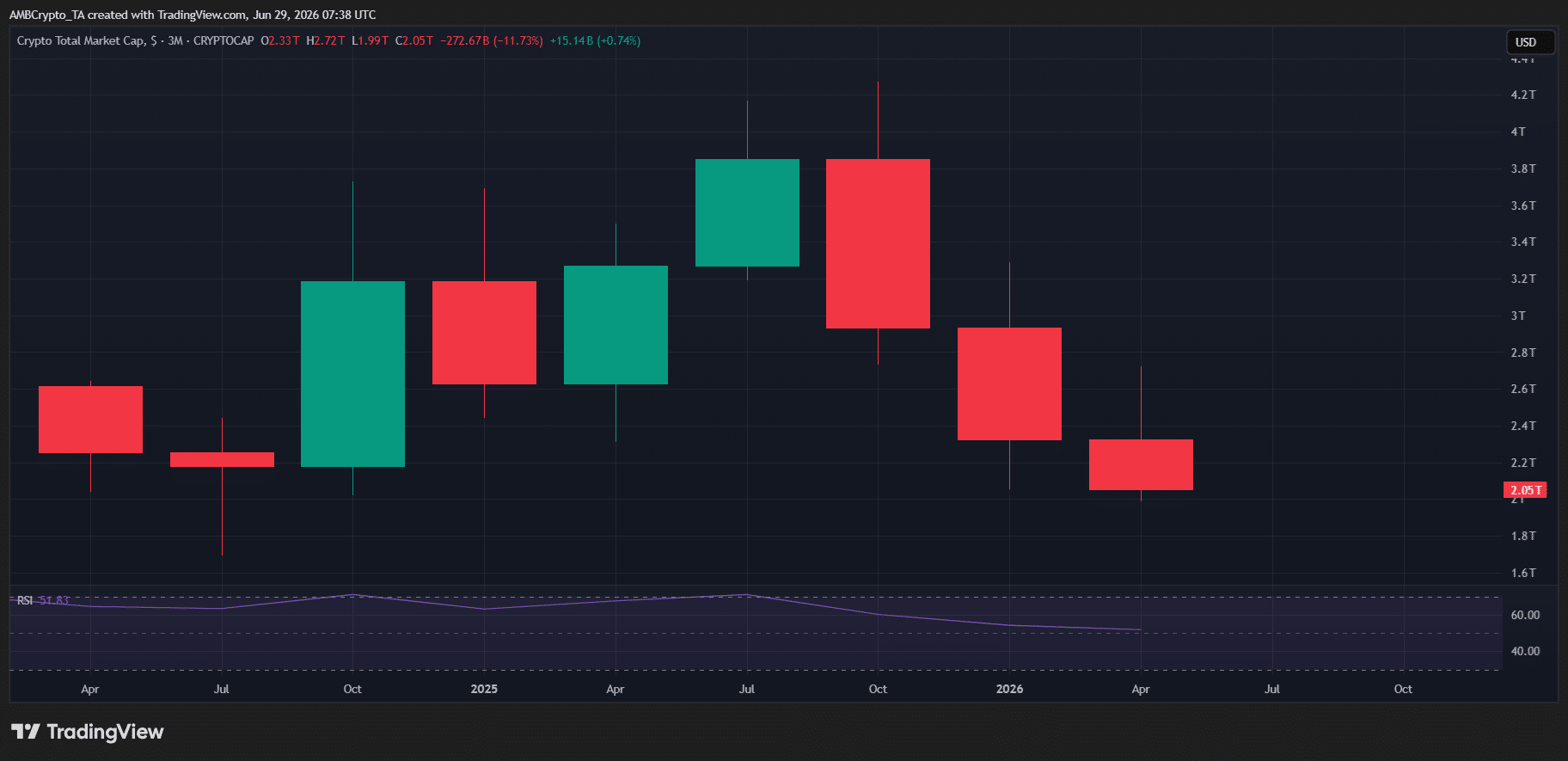
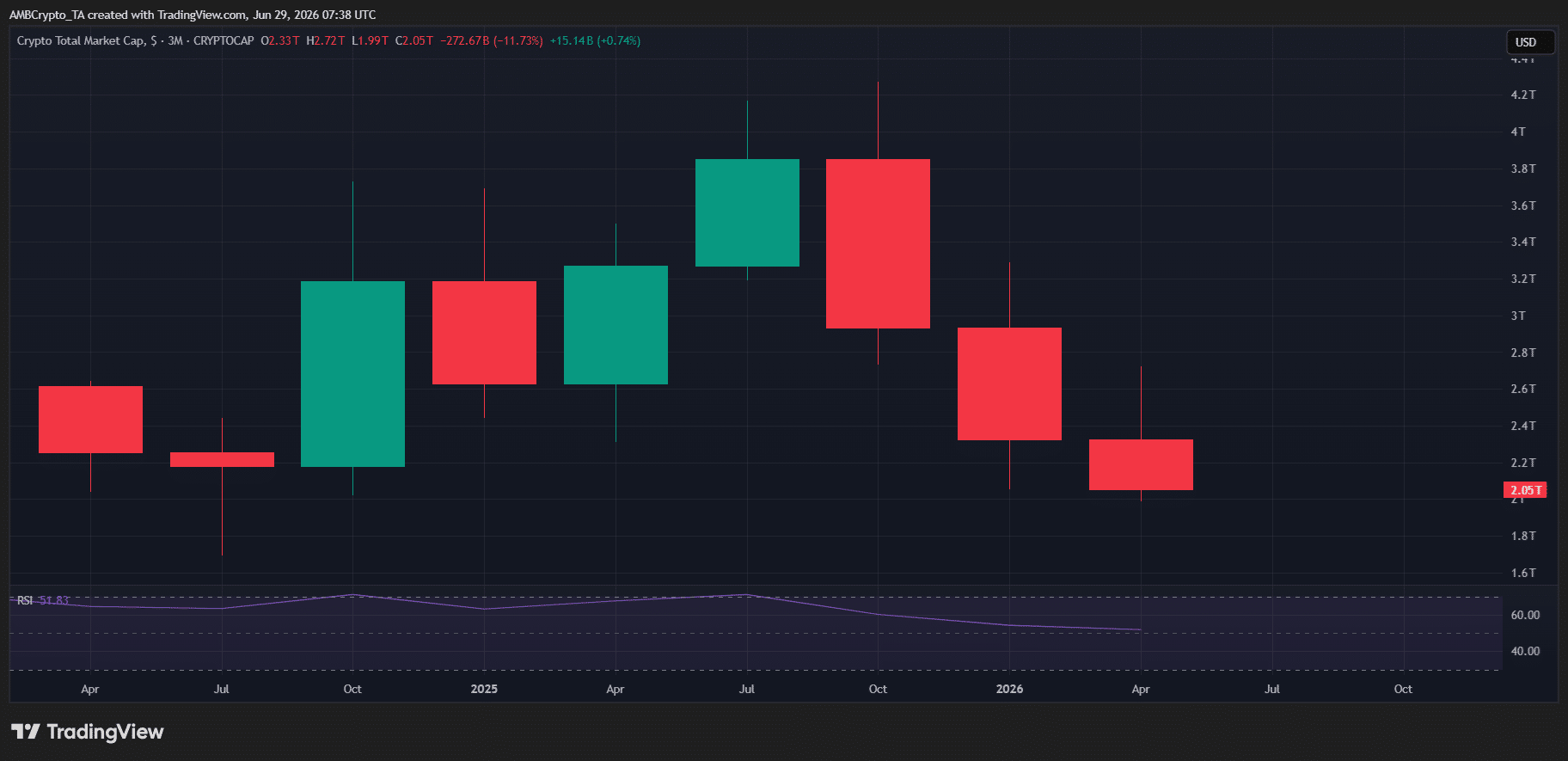
On the macro side, FUD hasn’t fully faded, with geopolitical uncertainty still keeping investors on edge. That continues to weigh on crypto, especially as the market has been in a steady QoQ pullback since the October peak, when total market cap hit a record $4.7 trillion and has now slid to around $2.05 trillion.

That pressure continues to show up in positioning.

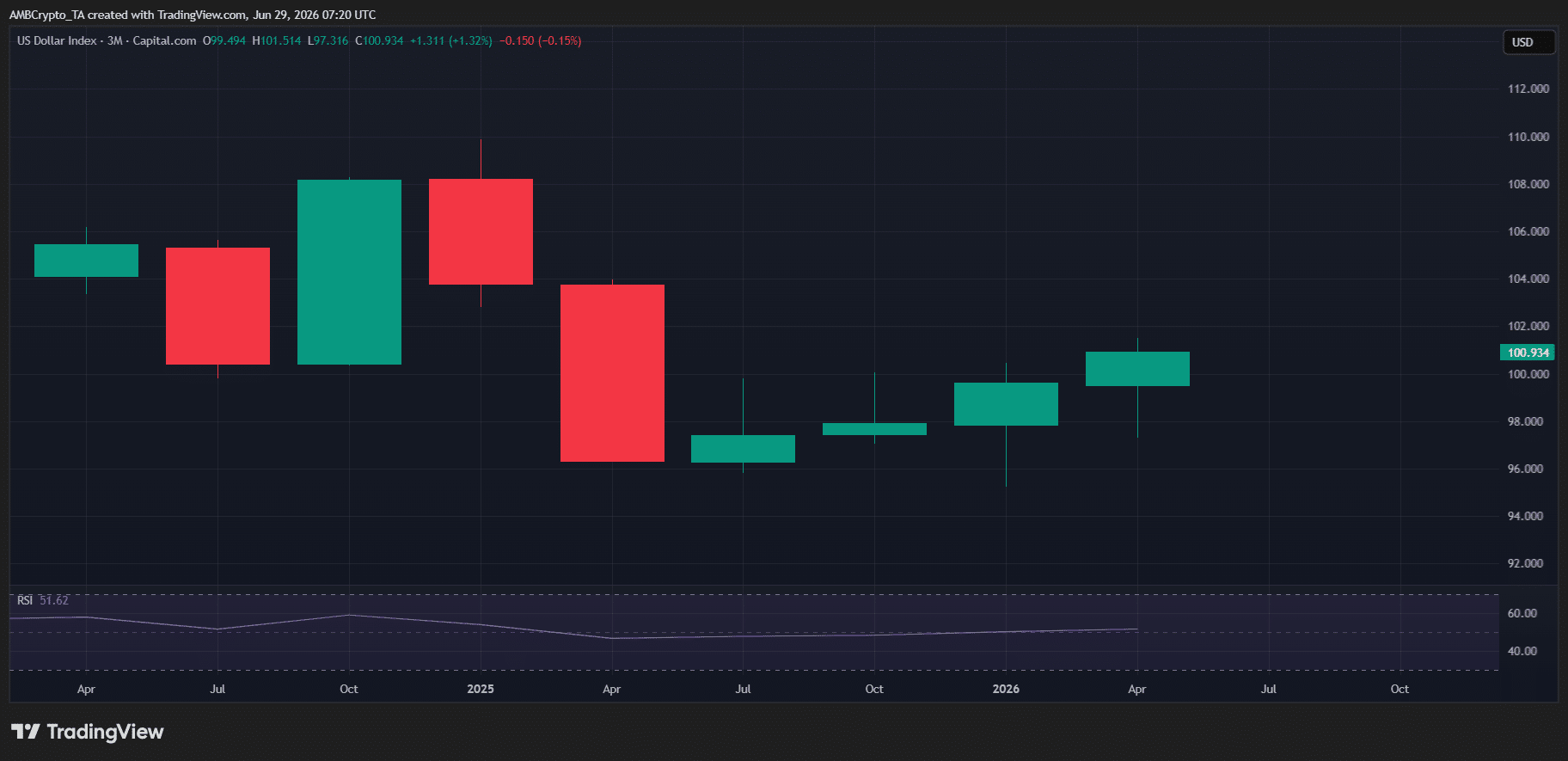
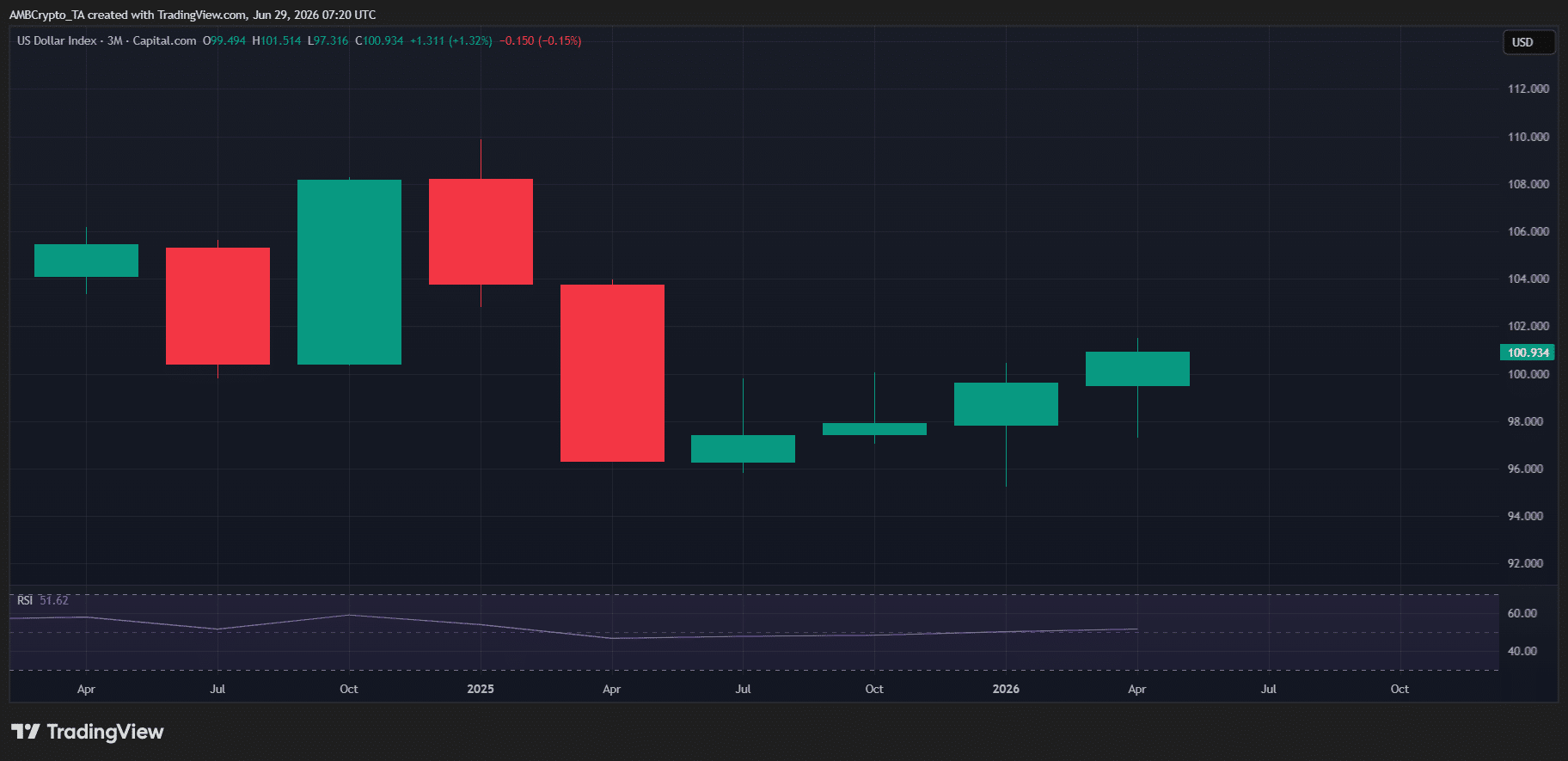
As the chart below highlights, the U.S. Dollar Index (DXY) has pushed above the 100 level for the first time since early Q2 2025. More importantly, this move comes after four consecutive quarters of upside, creating a divergence that’s hard to ignore.
Source: TradingView (DXY)

Technically, it’s showing a textbook flight-to-safety move, with investors rotating capital into safe-haven assets instead of risk assets. This is largely being driven by ongoing macro uncertainty around geopolitics, regulatory clarity, and expectations around Fed rate cuts.

But this backdrop isn’t just technical. Instead, the fundamentals are looking shaky as well.

According to CryptoRank, DeFi platforms have suffered 121 hacks this year, with $942 million stolen. Moreover, Q2 alone recorded 85 exploits and $775 million in losses, making it the most active quarter ever for crypto hacks.

Meanwhile, DeFi TVL has dropped from $115 billion in January to around $70 billion by late June.

Taken together, it points to weakening confidence across both capital flows and on-chain fundamentals. Against this backdrop, it’s fair to say crypto is heading into Q3 with a setup that’s already leaning bearish.

Crypto faces renewed macro pressure in early Q3

Q3 is set to kick off, and macro pressure is already building on crypto.

According to the Kobeissi Letter, there are six key macro releases scheduled this week, with the main focus on inflation and employment data that will help set the tone for rate cuts in the months ahead.

However, investors are already leaning less dovish, with nearly 30% odds now pricing in a rate hike instead.

Against this backdrop, the rising DXY doesn’t look like a short-term move.

Supporting this further, the 30-year Treasury yield has climbed from 4.82% to 4.86% in under a month, reinforcing a stronger yield-driven environment.

Meanwhile, the NASDAQ is up over 23%, clearly showing that crypto has lagged in attracting capital, making its recent breakdown look less market-driven and more crypto-specific, as both technicals and fundamentals remain weak.
Source: TradingView (TOTAL/USDT)

In essence, the upcoming macro setup isn’t favoring crypto so far.

Hence, the timing could hardly be worse for digital assets. With Bitcoin [BTC] already posting 22% and 11% corrections in Q1 and Q2, respectively, another downside leg in Q3 looks increasingly likely as investors continue rotating into other assets, especially as macro FUD continues to intensify.


Final Summary

  • Q3 is starting with strong macro pressure on crypto, as DXY rises, yields stay elevated, and rate-cut expectations weaken.
  • Crypto is already weak on its own fundamentals, with falling TVL, rising hacks, and lagging performance vs other markets.


Crypto di tendenza

Domande pertinenti

QWhat is the current total market capitalization of the crypto market and how much has it fallen from its peak?

AThe current total crypto market cap is around $2.05 trillion. It has fallen from its peak of $4.7 trillion in October 2025, representing a wipeout of approximately $2.65 trillion.

QWhat are the two main technical and fundamental factors contributing to the bearish outlook for crypto entering Q3?

ATechnically, a strong U.S. Dollar Index (DXY) above 100 signals a flight to safety, diverting capital away from risk assets like crypto. Fundamentally, the DeFi sector is weakening with falling Total Value Locked (TVL) and a record number of hacks, eroding investor confidence.

QAccording to the article, how does the performance of the NASDAQ contrast with the crypto market, and what does this indicate?

AThe NASDAQ is up over 23%, while the crypto market has been in a steady decline. This indicates that capital is flowing into traditional tech stocks but not into crypto, suggesting the crypto downturn is more specific to its own weaknesses rather than a broad market issue.

QWhat key macro data releases are expected in early Q3 that could impact the crypto market?

AThere are six key macro releases scheduled, with the main focus on inflation and employment data. This data will help set the tone for future Federal Reserve interest rate decisions.

QWhat is the market's current expectation regarding Federal Reserve interest rate moves, according to the article?

AInvestors are leaning less dovish. Nearly 30% of market odds are now pricing in a potential interest rate hike instead of a cut, indicating a shift towards tighter monetary policy expectations.

Letture associate

In Such a Crowded Cross-border Payment Track, Where Does the Next Stop Lie in the Future?

The crowded cross-border payments industry faces a paradox: intense competition above water with financing and narratives, while beneath, price wars and shrinking margins in basic PSP services are common. The path forward lies not in simple "cross-border" solutions but in deep **localization**. Success requires mastering the fragmented and tightening regulations of fiat currencies in each market—the "last mile" of compliance, banking, and settlement. Many Chinese PSPs have succeeded by following Chinese merchants overseas but have not deeply penetrated mainstream local merchant ecosystems abroad. Their strong product capabilities need to be applied to new, complex markets. The future belongs to companies that evolve from single-channel providers to **cross-border capital network operators**. This means moving beyond competing on transaction fees to creating internal networks that optimize capital efficiency through multi-directional matching, netting, and position reuse across countries and currencies. For Web3 and stablecoins, the key is integration, not replacement. Stablecoins offer efficiency gains but cannot bypass the foundational trust, compliance, and legal frameworks of traditional finance. The realistic path is the gradual adoption and "taming" of Web3 technologies by established financial institutions. The ultimate solution is a **dual clearing infrastructure** combining deep local fiat capabilities (local accounts, compliance, banking) with lightweight stablecoin-native capabilities (on-chain settlement, wallets). The biggest opportunity lies not in oversaturated mainstream corridors but in complex, underserved regional corridors (e.g., specific CIS, Middle East-Southeast Asia, or Latin American trade pairs). The winners will be those who build hard-to-replicate, deep capabilities in these areas—acting as the essential "clearing shovels" or infrastructure providers. The future keywords are **more local, more networked, and more stablecoin-native**. High-profit opportunities remain in the non-standardized, difficult-to-replicate deep waters of the industry, requiring genuine on-the-ground presence and long-term patience.

链捕手5 h fa

In Such a Crowded Cross-border Payment Track, Where Does the Next Stop Lie in the Future?

链捕手5 h fa

Trading

Spot

Articoli Popolari

Come comprare CAP

Benvenuto in HTX.com! Abbiamo reso l'acquisto di Cap (CAP) semplice e conveniente. Segui la nostra guida passo passo per intraprendere il tuo viaggio nel mondo delle criptovalute.Step 1: Crea il tuo Account HTXUsa la tua email o numero di telefono per registrarti il tuo account gratuito su HTX. Vivi un'esperienza facile e sblocca tutte le funzionalità,Crea il mio accountStep 2: Vai in Acquista crypto e seleziona il tuo metodo di pagamentoCarta di credito/debito: utilizza la tua Visa o Mastercard per acquistare immediatamente CapCAP.Bilancio: Usa i fondi dal bilancio del tuo account HTX per fare trading senza problemi.Terze parti: abbiamo aggiunto metodi di pagamento molto utilizzati come Google Pay e Apple Pay per maggiore comodità.P2P: Fai trading direttamente con altri utenti HTX.Over-the-Counter (OTC): Offriamo servizi su misura e tassi di cambio competitivi per i trader.Step 3: Conserva Cap (CAP)Dopo aver acquistato Cap (CAP), conserva nel tuo account HTX. In alternativa, puoi inviare tramite trasferimento blockchain o scambiare per altre criptovalute.Step 4: Scambia Cap (CAP)Scambia facilmente Cap (CAP) nel mercato spot di HTX. Accedi al tuo account, seleziona la tua coppia di trading, esegui le tue operazioni e monitora in tempo reale. Offriamo un'esperienza user-friendly sia per chi ha appena iniziato che per i trader più esperti.

5 Totale visualizzazioniPubblicato il 2026.06.26Aggiornato il 2026.06.26

Come comprare CAP

Discussioni

Benvenuto nella Community HTX. Qui puoi rimanere informato sugli ultimi sviluppi della piattaforma e accedere ad approfondimenti esperti sul mercato. Le opinioni degli utenti sul prezzo di CAP CAP sono presentate come di seguito.

活动图片