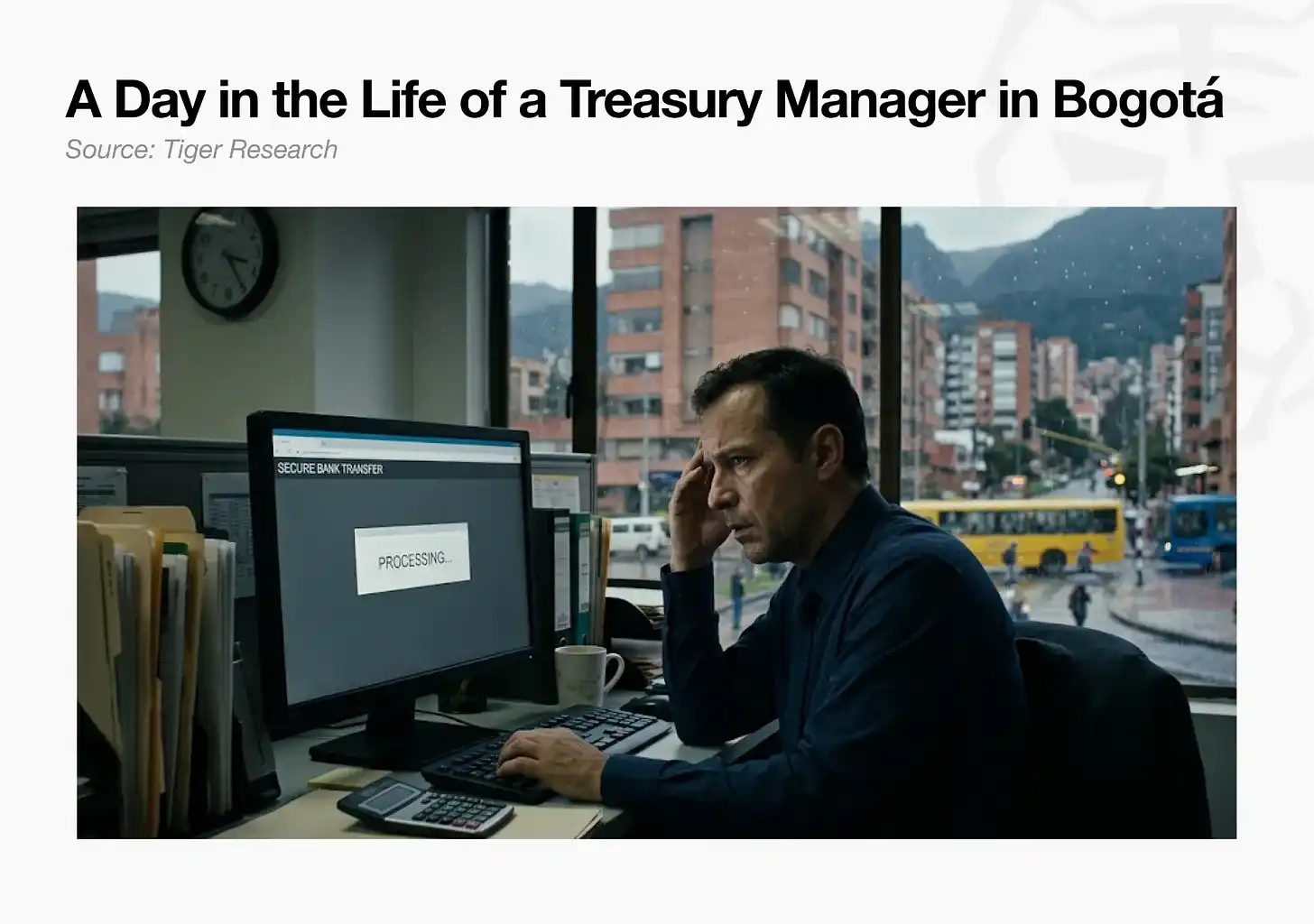
On Friday afternoon, a funds manager at an export company in Bogotá made a payment to a US supplier. The screen returned only a dry, single-line message: "Processing."
Behind every cross-border transfer lies a complex process. Qualification review, foreign currency account verification, currency exchange, final settlement—each step is necessary. To this day, the global financial infrastructure still revolves around various inefficiencies: different operating hours for banks across countries, disparate regulatory systems.
News from the other side of the globe can reach our eyes in real-time. Technology has long dissolved the boundaries of information and culture, yet the financial infrastructure underpinning economic operations remains cumbersome.
This structure weighs even heavier on emerging market countries. Their local currencies hold a relatively low status internationally, making it difficult to obtain liquidity instantly. Each transaction stage consequently accumulates delays and costs. In some trades, dollar liquidity is insufficient to absorb the quoted local currency volume, significantly driving up conversion costs and completion time.
The problem is defined. The next question is: which parts of it can the on-chain structure actually solve?
2. A Solution from OTC Practitioners
KiiChain's founders, Danyel Arenas and Alex Cavallero, previously ran digital asset OTC desks and managed the market-making fund Inmersion Capital in Latin America. They had to bridge the naturally thin liquidity between local currencies and the US dollar, while completing two-way transactions amidst inconsistent bank operating hours and strict capital controls. The cost of this inefficiency was borne by their own capital, which determined their later entry angle.
KiiChain positions itself as an on-chain foreign exchange layer for stablecoins and real-world assets (RWA). The core idea is simple: aggregate the liquidity of USD stablecoins and various national local currency stablecoins onto the same chain, allowing conversion and settlement to continue uninterrupted even when the banking system is closed. The company has raised a total of $26 million, with investors including Nimbus Capital.
The boundary of this positioning is noteworthy. It aims to solve settlement time and friction, not the source of the liquidity itself. These two matters will be repeatedly separated in the following discussion.
3. Four Components: What They Solve and What They Don't
According to official descriptions, this vision is supported by four components: The KiiChain App handles cross-asset, cross-currency trade execution; the Kii Oracle provides decentralized real-time price data; the RWA Protocol handles compliant tokenization; and KiiChain Pay bridges the channel between fiat and on-chain assets.
A list of components itself doesn't explain much. What truly needs examining is which layer of constraints each one structurally touches.
3.1. KiiChain App: Moving RFQ Price Discovery On-Chain
Emerging market currencies occupy a marginal position in the global financial system, enduring both thin liquidity and settlement delays. Existing foreign exchange methods, whether RFQ (Request-for-Quote) or CLOB (Central Limit Order Book), have not solved this.
The Automated Market Maker (AMM) model commonly used in DeFi is also unsuitable. The core of foreign exchange trading is currency conversion and genuine arbitrage needs, not value storage or investment. Liquidity providers are thus exposed to loss from price volatility, yet find it difficult to earn returns from daily trading flow. This is a flaw inherent in the model itself.
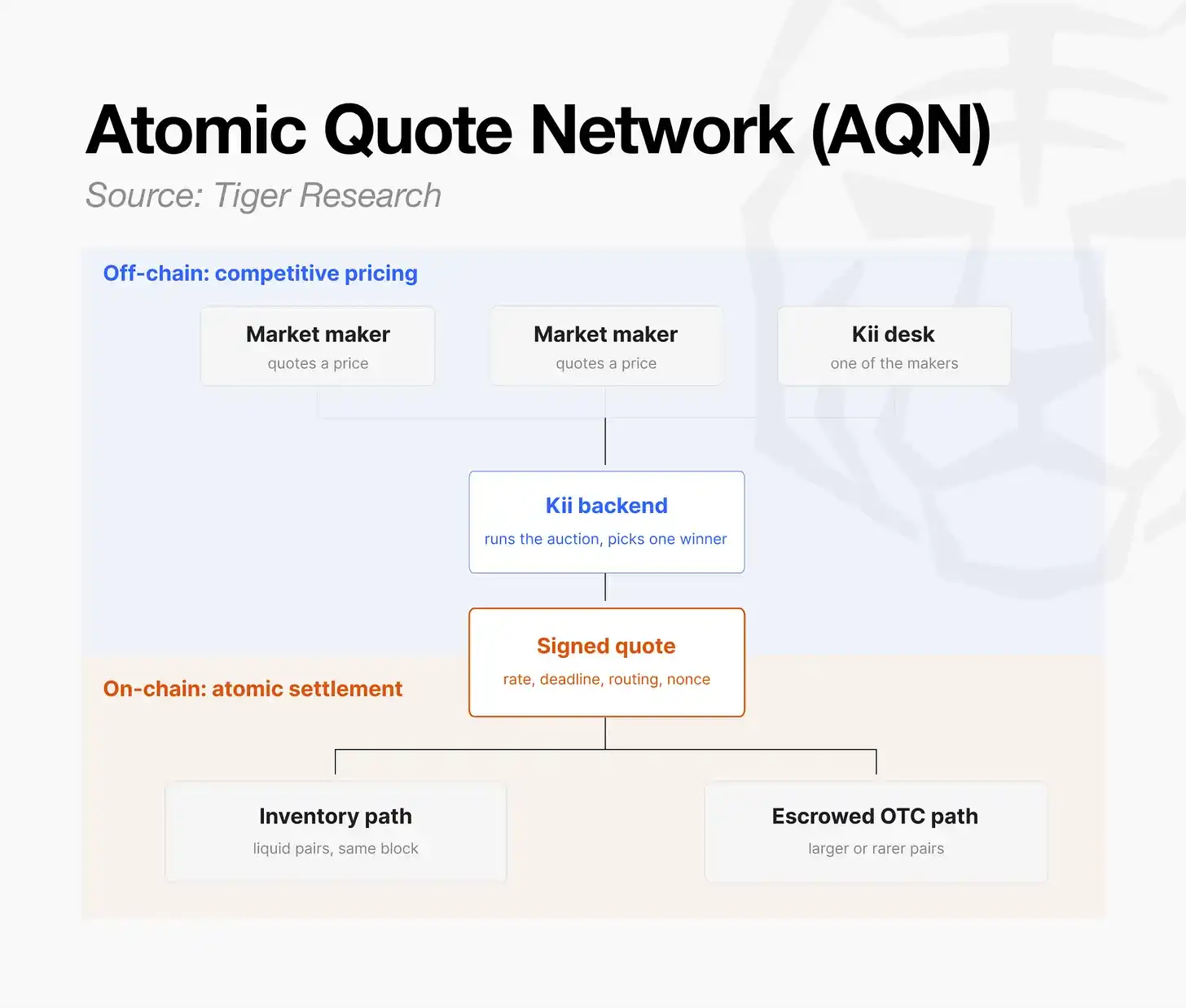
The KiiChain App adopts a model it calls the Atomic Quote Network (AQN): the step of finding the optimal exchange rate retains the traditional financial RFQ approach, while the actual movement of funds is completed instantly on-chain. Price competitiveness comes from the former, settlement speed and transparency from the latter.
This design indeed addresses settlement delays. But liquidity risk lies outside the model's scope; it's an external variable. Whether AQN can prove effective ultimately depends on the number and capacity of institutional market-maker partners, which requires long-term accumulation.
3.2. RWA Protocol: Shifting Trust from Bank Relationships to Code
Traditional foreign exchange trading cannot directly verify collateral, relying instead on trust substitutes between banks like letters of credit and nostro accounts.
KiiChain's alternative is to tokenize the collateral itself on-chain. The T-REX standard (ERC-3643) programmatically embeds identity and eligibility rules into the token, directly blocking transfers to ineligible addresses. Sensitive identity verification is handled by licensed off-chain operators, while the chain only records revocable cryptographic attestation credentials.
Eligible assets cover real estate, bonds, and commodities, but regulated financial products can only be distributed through licensed issuers. The form of trust changes, but its source does not: the entity issuing attestation credentials remains bound by regulation and jurisdictional authority.
3.3. Kii Oracle: Consensus Can't Solve Source Thinness
Traditional foreign exchange price discovery occurs in the interbank market, dominated by a few large dealer banks. Restricted access ensures trust, at the cost of opaque pricing determined by a handful of quotes for currencies not deeply embedded in this network, especially emerging market currencies.
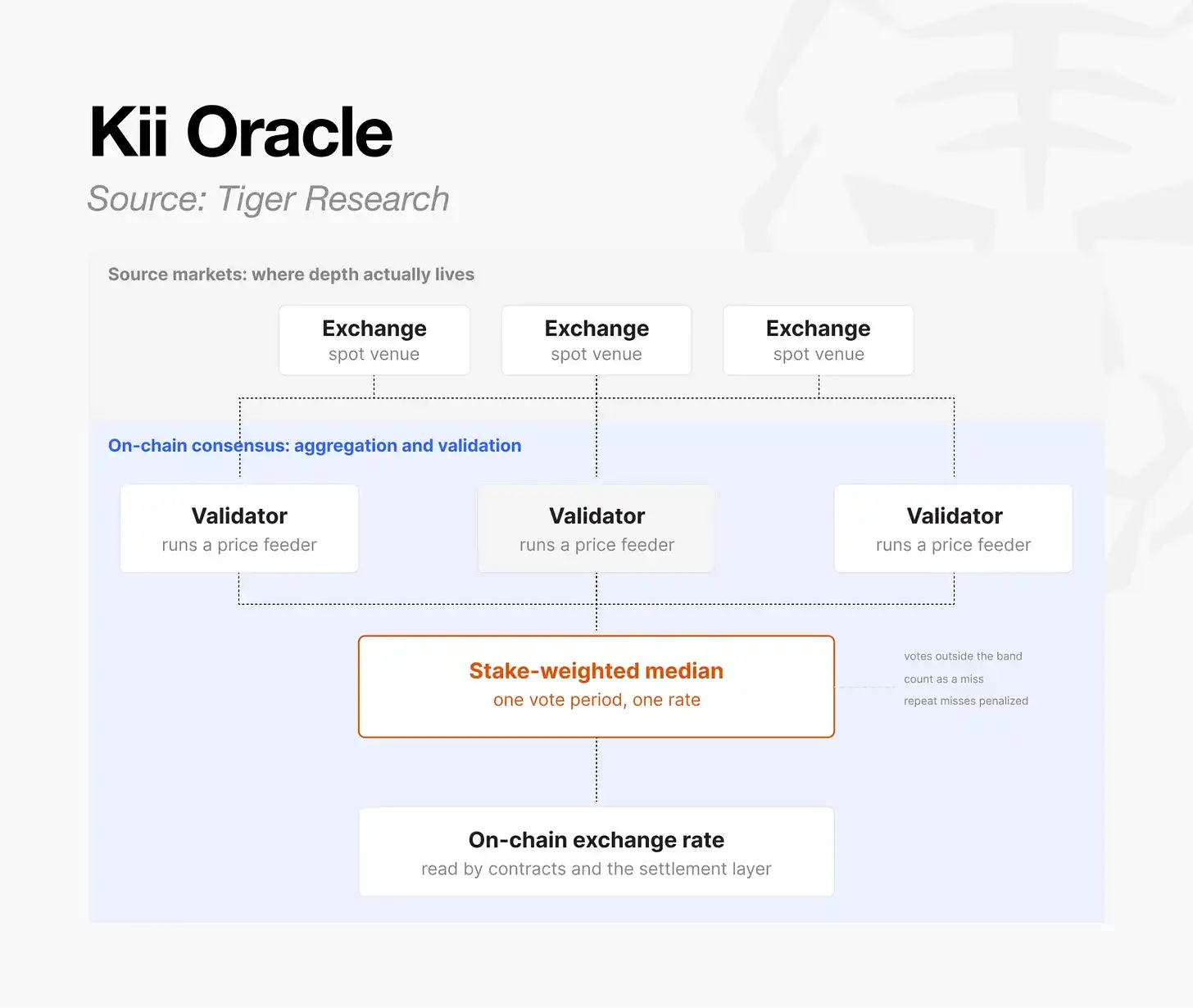
The Kii Oracle's approach is to replace closed interbank trust with open consensus among validators. Trusted validators independently gather prices from multiple exchanges, calculate a weighted median based on their staked shares to reach consensus, and automatically discard values that deviate beyond a preset standard deviation, preventing manipulation by a few actors with extreme quotes.
This mechanism addresses data fragmentation, a technical remedy, but cannot generate the liquidity depth possessed by the interbank market. When the source market of the quoted local currency stablecoin is itself thin, no matter how sophisticated the calculation logic, quote distortions and sharp volatility persist. An oracle can make dispersed prices more credible, but cannot make a thin market thick.
3.4. KiiChain Pay: Integrating Entry Points, Not Removing Bottlenecks
The bottlenecks in traditional foreign exchange settlement concentrate at the nodes where funds enter and exit the banking system: account opening, compliance checks, operating hour limits. If a transaction gets stuck at the very first step, speeding up the middle process is meaningless.
KiiChain Pay bundles four channels into a unified API. On-ramps convert fiat to digital assets after KYC; off-ramps withdraw digital assets to bank accounts after KYC; FX swaps are custodial, completed via contracts or service providers; DEX swaps require no KYC, executed via the LiFi router for on-chain exchange.
Of these four channels, the first three still rely on external licensed operators, KYC processes, and the operating hours of off-chain service providers. Integration improves accessibility; the bottlenecks themselves are not moved. Only DEX swaps truly bypass banking links because they don't involve fiat.
Pricing has similar limitations. The Market API adds a spread on top of quotes from external liquidity providers, essentially marking up for resale, not independent price discovery.
4. Among Eight Steps, Only Three Truly Vanish
Looking at the four components together, what KiiChain has built is not finance without intermediaries, but a settlement layer where intermediaries can meet unconstrained by national borders or operating hours.
Building a system that completely eliminates all intermediaries was never realistic. Funds moving within regulatory boundaries necessarily require operators that bear KYC obligations and hold licenses.
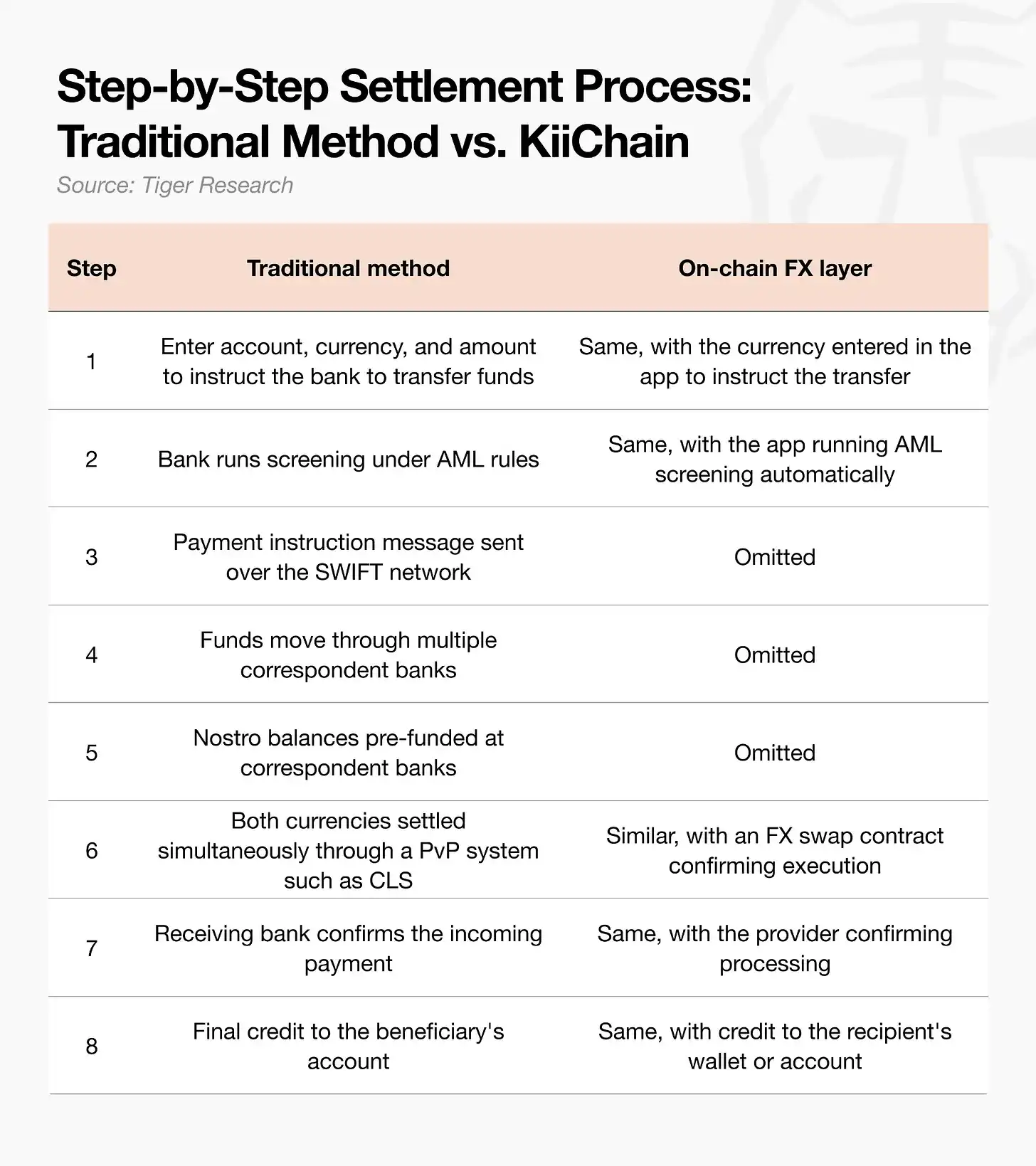
The extent of process compression is therefore limited. Among the aforementioned eight steps, only three completely vanish. The remaining five retain their basic structure; what changes is the executing entity and the terminology, while the procedures themselves persist.
A more apt analogy is gathering dispersed exchange points into one location. Previously, converting pesos to dollars required running around and queuing at different exchange houses in different countries, each with its own operating hours. What KiiChain does is gather these intermediaries onto the same on-chain platform, not drive them away. The operational capacity for settlement remains, but convenience and speed improve because all parties interact in the same space, where physical distance and time differences no longer matter.
This still has practical value. The liquidity of multiple national local currency stablecoins is concentrated on one chain, and the exchange between digital assets within the platform is executed automatically around the clock by smart contracts. However, those nodes where real fiat enters and exits are still constrained by the operating conditions of off-chain service providers.
Therefore, rather than dismantling the intermediary structure, this is more about moving the underlying infrastructure on-chain to polish the stubborn inefficiencies of the traditional financial system. Judging the value of this endeavor should be based on the degree of optimization, not a narrative of disruption.
5. The Numbers at the Starting Line
The officially disclosed figures are: cumulative transaction volume exceeding $500 million, approximately 350 B2B2C enterprise clients, a user base exceeding 350,000, with user growth maintained at around 10% monthly. These numbers come from the company itself, with no independent sources for cross-verification yet available.
Weightier items on the roadmap remain at the conceptual stage: an on-chain debit card, a payment network covering 50 countries, stablecoin deposit products, unsecured lending, US virtual accounts, AI-driven automatic settlement systems. What's actually running today is concentrated on the initial function of foreign exchange settlement infrastructure.
Transitioning from a payment tool to an on-chain financial hub hinges on whether ecosystem participants can gather together. Network effects emerge only when liquidity partners, multinational corporations, and individual users interact within the same network, and this is a prerequisite for the leap to the next generation of financial functions.
Returning to the question posed at the beginning of this article: which part of emerging market foreign exchange can on-chain structures solve? The current answer is settlement time and friction, not liquidity depth. The former can be tackled through architectural design; the latter can only be achieved by securing market-maker partners one by one and expanding market by market. KiiChain has demonstrated it can do the former; the latter remains unanswered.
The path of on-chain foreign exchange is worth walking. But how far it goes is determined by execution, not by architectural diagrams.