The 'Big Short' Burry: Now is an Excellent Time to Bottom-Fish in Hong Kong Stocks

marsbitPubblicato 2026-07-17Pubblicato ultima volta 2026-07-17

Introduzione

The article discusses growing optimism towards Hong Kong stocks, led by prominent investor Michael Burry of "The Big Short" fame. Burry recently stated it is an "excellent time" to find cheap stocks in the Hong Kong market. His bullish view is based on the prediction that as the global AI chip stock frenzy cools, capital will flow out of markets like South Korea and Japan and seek undervalued opportunities, positioning Hong Kong as a potential beneficiary. Supporting this view, Goldman Sachs' Asia equity capital markets head, Wang Yajun, argues the Hong Kong market has already entered the AI era, but major indices have not yet reflected this reality. He points to active AI-related IPOs and transactions as evidence of underlying market vitality, contrasting with the weak performance of key indices like the Hang Seng. Data highlights Hong Kong's underperformance: the Hang Seng Index is down about 7% year-to-date, while markets in South Korea and Japan and semiconductor ETFs have seen significant gains. This disparity is seen by Burry and others as creating a valuation gap and a potential buying opportunity. The article notes Burry has acted on his view by increasing holdings in Chinese e-commerce firm JD.com. Morgan Stanley has also recently advocated buying Hong Kong stocks, citing positive corporate earnings expectations. However, challenges remain, including persistent concerns over Chinese consumer spending and e-commerce profitability, which continue to weigh on the ma...

Author: Zhao Ying

A battle between bulls and bears, epitomized by Michael Burry, is playing out in the Hong Kong stock market, with bullish sentiment steadily gathering.

Investor Michael Burry, who gained fame for accurately predicting the 2008 U.S. subprime mortgage crisis and served as the prototype for the film 'The Big Short,' recently stated publicly that now is an 'excellent time' to look for cheap stocks in the Hong Kong market. His bullish logic is based on the expectation that the global AI chip stock frenzy will cool down, leading capital to flow out of South Korea, Japan, and the semiconductor sector in search of undervalued opportunities.

Simultaneously, Wang Yajun, Head of Asia (ex-Japan) Equity Capital Markets at Goldman Sachs, also noted that the Hong Kong market has in fact entered the AI era, though this reality is not yet reflected in the major indices.

Both perspectives point to the same conclusion from different angles: there is a significant divergence between Hong Kong stocks' current weak performance and the underlying vitality within the market. This divergence itself may constitute an investment opportunity. For investors seeking value, the attractiveness of Hong Kong stocks is on the rise.

Burry Bullish on HK Stocks: A Value Play Post-AI Frenzy

Michael Burry, founder of Scion Asset Management, posted on X on July 17, stating, 'It is an excellent time to look for cheap stocks in Hong Kong. They should do well as the shine comes off Korea, Japan, and SOXX (a semiconductor ETF).'

Burry's statement has its market context. Global chip stocks have recently faced massive sell-offs, as doubts persist about whether AI companies can translate technological investments into actual profits. Coupled with high capital expenditure pressures, this has weighed on the semiconductor sector, which previously led global gains. In contrast, Hong Kong stocks' decline this year has made their valuations relatively more attractive.

Notably, Burry had already taken action earlier this month. According to Bloomberg, he increased his stake in Chinese e-commerce giant JD.com and opened new positions in DraftKings and Flutter, indicating his bullish stance on Hong Kong stocks and related Chinese tech stocks is not merely verbal.

Hong Kong Stocks Lag Far Behind Global Major Markets This Year

The relative weakness of Hong Kong stocks is clear from the data. The Hang Seng Index has fallen about 7% year-to-date, and the Hang Seng Tech Index has dropped even more deeply by 15.22%. Major drags include weak consumer spending and insufficient market confidence in the outlook for China's e-commerce industry.
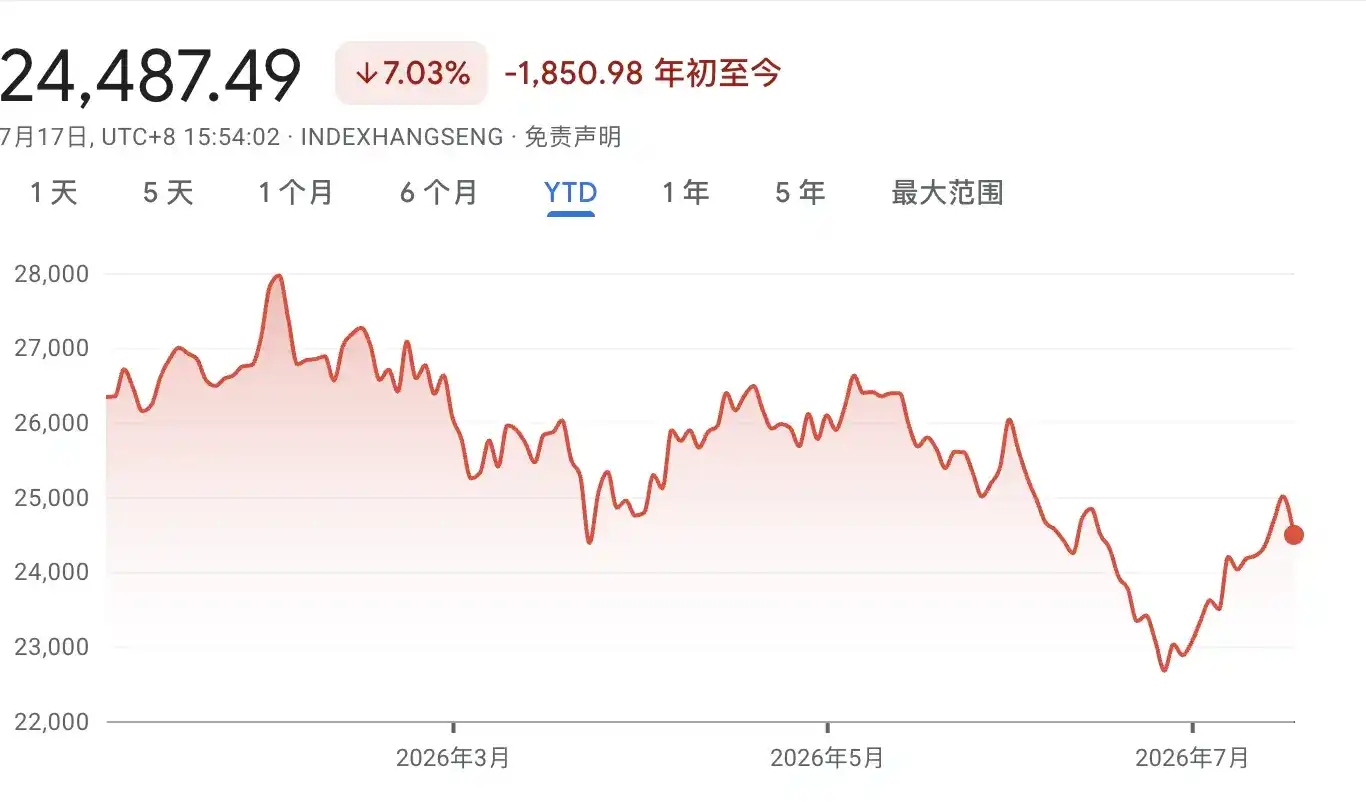
This stands in stark contrast to the strong performance of other major global markets. According to Bloomberg data, South Korea's benchmark index has surged 62% year-to-date, benefiting from the robust performance of two major chip giants; Japan's Nikkei 225 has risen 26%; and the iShares SOXX ETF tracking the semiconductor sector has skyrocketed 76%.

It is precisely this significant underperformance that leads Burry to believe Hong Kong stocks present a 'bargain-hunting' condition—when global capital begins to reassess the sustainability of the AI frenzy, previously overlooked Hong Kong stocks may usher in a catch-up opportunity.

Goldman Sachs: Index Distortion, HK Market Already in AI Era

Goldman Sachs' perspective offers another dimension of interpretation—the sluggishness of Hong Kong stocks is, to some extent, a 'false impression' caused by the structural lag of the indices.

Wang Yajun, Goldman Sachs' Head of Asia (ex-Japan) Equity Capital Markets, bluntly stated at a recent media briefing, the Hong Kong market has entered the AI era, but the major stock indices have not yet been able to reflect this reality. This is the fundamental reason for the 'hot IPO market vs. weak index performance' dichotomy.

Wang pointed out that the hottest topic in the Hong Kong stock market this year is AI. The most actively traded, best performing, and largest fundraising stocks are all AI-related. However, adjustments to index components take a relatively long time, leading to a mismatch between the indices and the true market landscape. He expects total equity financing volume in the Hong Kong market this year could hit a record high, with full-year IPO proceeds potentially surpassing the historical peak of 2021. More AI companies are also expected to list in Hong Kong in the second half of the year.

Regarding fundamental judgment, Wang believes that supported by end-demand growth, capital expenditure by AI companies will continue, providing a basis for the long-term performance of related sectors.

Multiple Bullish Voices Converge, Divergence Remains

Burry is not alone. According to Bloomberg, Morgan Stanley recently also urged investors to buy Hong Kong stocks, citing optimism about corporate earnings prospects and the belief that the impact of restricted share sales will be relatively limited.

However, the bullish logic for Hong Kong stocks is not without challenges. The Hang Seng Index's decline this year reflects persistent market concerns about the pace of China's consumption recovery and the profitability of the e-commerce sector. These structural pressures are difficult to dissipate completely in the short term. The 'index-market mismatch' described by Goldman's Wang also means that ordinary investors, referencing only the indices, may both underestimate the structural opportunities within Hong Kong stocks and overlook the pressures still facing traditional heavyweights.

For investors, Burry's bottom-fishing signal and Goldman's AI narrative together sketch a picture of opportunity for Hong Kong stocks. Yet, the core challenge facing the market remains how to precisely position between overall index pressure and structural bright spots.


Domande pertinenti

QWhy does Michael Burry believe that now is a 'great time' to look for bargains in the Hong Kong stock market?

AMichael Burry believes it's a great time to look for bargains in Hong Kong stocks because he anticipates a cooling off of the global AI chip stock frenzy, which would cause capital to flow out of markets like South Korea and Japan and out of semiconductor sectors. This shift would make the currently underperforming and more attractively valued Hong Kong market a potential destination for that capital.

QWhat supporting action has Michael Burry taken regarding his bullish view on Hong Kong/Chinese stocks?

AAccording to Bloomberg, Michael Burry has taken action by increasing his holdings in the Chinese e-commerce company JD.com and establishing new positions in DraftKings and Flutter, indicating his view extends beyond just verbal statements.

QHow has the performance of the Hong Kong stock market compared to other major global markets in 2024, according to the article?

AThe Hong Kong stock market has significantly underperformed other major global markets in 2024. The Hang Seng Index is down about 7% and the Hang Seng Tech Index is down over 15%. In contrast, South Korea's benchmark index is up 62%, Japan's Nikkei 225 is up 26%, and the iShares Semiconductor ETF (SOXX) has surged 76%.

QWhat is Goldman Sachs' Wang Yajun's argument regarding the perceived disconnect between Hong Kong's market activity and its main stock indices?

AGoldman Sachs' Wang Yajun argues that while the Hong Kong market has already entered the AI era, its main stock indices have not yet reflected this reality. He states that AI-related stocks are the most active, best-performing, and largest in fundraising, but index composition lags, creating a mismatch between the index performance and the market's true dynamism.

QAccording to the article, what are some of the key challenges or risks that remain for the Hong Kong stock market despite the bullish views presented?

AKey challenges include persistent concerns about the pace of China's consumption recovery and the profitability of the e-commerce sector, which have weighed on the market. Additionally, the 'mismatch' between index performance and market reality means that while there are structural opportunities in AI, traditional heavyweights in the index may continue to face pressure.

Letture associate

Stable Vaults Are the Final Piece in Aave's Mass Commercialization Puzzle

Aave's introduction of "Stable Vaults" aims to bridge the gap between complex DeFi protocols and mainstream users by offering a simplified, predictable savings product. The core innovation is a fixed-yield layer built atop Aave's volatile underlying lending pools. Partnering platforms (like digital banks or wallets) can offer users a guaranteed interest rate (e.g., 4%), shielding them from market fluctuations. The partner absorbs the risk and profit/loss from the difference between this fixed rate and Aave's variable rate. From the user's perspective, Stable Vaults provide ease of use, predictable returns, and familiar services like customer support and account recovery, addressing key barriers like wallet management and volatility. However, users pay a price: they cap their potential earnings (forgoing higher market yields), add counterparty risk from the partner platform, and may lack transparency into the true spread being captured. For partners, Stable Vaults turn idle user funds into a revenue stream via the yield spread. For Aave, this strategy attracts sticky, "sticky" capital from mass-market applications, providing a stable fee revenue stream crucial for its tokenomics (e.g., buyback mechanisms), especially in bear markets. The article contrasts this approach with direct DeFi interaction, where users keep all yield but face complexity and volatility. It argues that Stable Vaults align with proven consumer behavior: most users prioritize convenience, safety, and predictability over maximizing returns, willingly paying a "peace of mind" premium. Examples like Coinbase and Robinhood offering similar "savings" products validate this demand. Thus, Stable Vaults represent Aave's strategic move to commercialize by catering to fundamental human preferences for simplicity and stability in finance.

marsbit16 min fa

Stable Vaults Are the Final Piece in Aave's Mass Commercialization Puzzle

marsbit16 min fa

Support Rate Less Than 1%, BIP-110 Still Pushes Bitcoin Towards a Soft Fork?

Title: BIP-110 Pushes Bitcoin Towards a Soft Fork Despite Less Than 1% Approval With its August mandatory activation window approaching, the controversial BIP-110 proposal is back in the spotlight. Proposed in December 2025 by Dathon Ohm and supported by Bitcoin Core developer Luke Dashjr, BIP-110 aims to impose a one-year limit on arbitrary/non-monetary data in Bitcoin transactions, primarily targeting large data storage like Ordinals and Bitcoin NFTs, to reduce network "spam" and refocus Bitcoin on its monetary function. However, the proposal faces overwhelming opposition. To activate, BIP-110 requires a 55% threshold, yet current miner support is below 1%. Of the 102,674 network nodes, only 14.64% (15,035) signal readiness to enforce it. Despite this lack of consensus, BIP-110 has a contentious "mandatory window" mechanism: if the threshold isn't met by block height 961,632, supporting nodes will begin rejecting non-compliant blocks from height 961,632 to 963,647, attempting to force activation by block 965,664. This could lead to a chain split in early August between a minority chain enforcing BIP-110 and the main chain. Proponents, led by Luke Dashjr (founder of Ocean mining pool), argue that inscriptions constitute an "attack" on Bitcoin, congesting block space and raising transaction fees, thereby undermining Bitcoin's primary use as money. They view BIP-110 not as a change but as a reversal of a harmful change. Opponents, including figures like Adam Back, Jameson Lopp, and Michael Saylor, contend that BIP-110 fails to solve the spam problem while creating new risks. They warn it could stifle future innovation (e.g., impacting BitVM), introduce transaction censorship—eroding Bitcoin's neutrality—and potentially cause a damaging chain split that fragments developer resources, hash power, and monetary consensus. They argue market-based fee pressure and block size limits already manage congestion effectively. Potential outcomes post-activation include: 1) The BIP-110 chain stalling due to insufficient hash power; 2) The BIP-110 chain becoming the longest chain if it gains majority miner support (though currently, Ocean holds only 2.6% of hash power vs. opponents like F2Pool at 13.6%); or 3) A persistent minority chain that remains economically unviable, potentially leading to a permanent fork. Most analysts and prediction markets deem BIP-110's success unlikely, with one market giving only a 10% probability that it will become the accepted longest chain by September 2026.

marsbit21 min fa

Support Rate Less Than 1%, BIP-110 Still Pushes Bitcoin Towards a Soft Fork?

marsbit21 min fa

Mining Stocks Are Moving Further Away from Crypto

Title: Mining Stocks Are Drifting Away from Crypto Summary: Despite Bitcoin (BTC) falling approximately 46% over the past year, leading Bitcoin mining stocks (e.g., HUT, WULF, IREN) have surged significantly. This divergence stems from a fundamental shift in how the market values these companies. Their stock prices are no longer tied primarily to crypto prices, mining output, or hash rates. Instead, investors are now pricing them as AI infrastructure plays. Mining companies possess critical assets for AI data centers: pre-permitted land, grid-connected power capacity, and operational expertise for high-load facilities—resources facing severe shortages and long lead times for new entrants. For example, CleanSpark signed a 20-year, ~$6.6 billion infrastructure lease for an AI data center, while Marathon Digital acquired a project with up to 2 GW of planned power capacity. Analysts note a strong correlation between a mining company's market valuation and its contracted or potential AI power capacity in North America. CoinShares predicts that by year-end, up to 70% of revenue for listed miners could come from AI/HPC, compared to about 30% at the start of 2026. However, this re-rating introduces new risks: 1) Valuation volatility linked to the broader AI/semiconductor sector, 2) Potentially low baseline return rates (estimated at 4-5% for some firms), and 3) Execution risks including massive financing needs, regulatory permits, and tenant quality. This strategic pivot is also changing miner behavior. They are selling BTC holdings more aggressively to fund AI capex, meaning selling pressure may persist regardless of Bitcoin's price. Furthermore, once power and sites are locked into long-term AI contracts, they are unlikely to return to Bitcoin mining, potentially altering the network's hash rate dynamics long-term. In essence, mining firms are being valued for what they are becoming—AI infrastructure providers—rather than pure-play crypto miners.

链捕手27 min fa

Mining Stocks Are Moving Further Away from Crypto

链捕手27 min fa

Trading

Spot
活动图片