BTC on a Roller Coaster, HYPE Hits New Highs | Guest Analysis

marsbitPubblicato 2026-05-18Pubblicato ultima volta 2026-05-18

Introduzione

**Market Analysis: BTC Volatility and HYPE's New Highs** This week, markets experienced significant volatility. Macro pressures intensified with a bond market sell-off, rising rate hike expectations, and oil surpassing $110. Bitcoin (BTC) broke below $78K and is currently testing a critical range. The core debate centers on the nature of BTC's rally from its February low: Is it the start of a new uptrend (Path 1: bullish) or merely a B-wave rally within a larger monthly corrective structure (Path 2: bearish)? The outcome of the battle in the $78,500-$79,500 zone is key this week. * **For BTC:** * **Mid-term:** Maintain a neutral, cash position. * **Short-term:** Two contingency plans with ≤30% position size and strict stop-losses: * **Plan A (Bearish):** Sell if price rebounds but faces resistance in the $78,500-$79,500 zone. * **Plan B (Bearish):** Sell if price convincingly breaks below the $73,500-$75,000 support. * A break above $90,000-$93,100 would strongly favor the bullish Path 1 scenario. * **For HYPE:** HYPE continues its independent rally, hitting new highs with over 10% gains this week. The trend remains bullish as long as price holds above the key support at $38.41. * **Short-term Strategies (≤30% position):** * **Plan A (Bullish):** Buy on a confirmed break above $45.76. * **Plan B (Bearish):** Sell short on a confirmed break below $45.76. * **Plan C (Bullish):** Buy on a pullb...

Having experienced this week, it feels like being on a roller coaster.

This week saw a concentrated release of macro pressures - bond market crash, rising rate hike expectations, oil prices breaking $110, BTC falling below $78K, currently hovering in a critical range.

Structurally, I have focused on analyzing two path projections since the February low: Has a new uptrend already started, or is this a B-wave rally within a monthly-level major correction? This judgment is currently inconclusive, but the outcome of the multi/empty battle in the $78,500-$79,500 region is the most important observation window this week.

In terms of trading, for medium-term positions, continue to hold no position and observe. For short-term trading, A/B contingency plans have been prepared around support and resistance levels, with positions controlled within 30%, strictly adhering to stop-loss.

Summary of Core Trading Views for This Week:

• BTC Multi-cycle Price Structure Analysis (Comparison of two subsequent path projections) (Details in Part 1)

• BTC Market Forecast and Medium/Short-term Trading Strategies for This Week (Details in Part 2)

• HYPE Daily Chart Price Structure Analysis (Details in Part 3)

• HYPE Market Forecast and Short-term Trading Strategy for This Week (Details in Part 4)

Market Verification of Last Week's Trading Strategy and Core Views:

• BTC Short-term Trade Performance: Bitcoin completed one short-term long position trade last week (1x leverage), successfully achieving a profit of approximately 2.02%. (Details in Table 1)

• Market Verification of BTC Price Trend Forecast: In last week's article, we pointed out: The probability is high that the market will experience high-level wide-range fluctuations around the $79,500~$80,600 region. The current market movement verifies our previous forecast.

I. First, Let's Look at BTC's Projections

1. Analysis of BTC's Price Structure Since the February Low: Two Key Path Projections and Multi/Empty Battle

In previous weekly review articles, when analyzing Bitcoin's daily chart correction structure since the October 2025 high ($126,200), we proposed three main Elliott Wave structure projections. Currently, due to the D-wave rally cycle in Projection Two (complex five-wave correction structure) significantly exceeding the previous B-wave in terms of duration, excessively extending in the time dimension and disrupting the equilibrium of the wave structure, its probability of occurrence has greatly decreased. Therefore, the core market divergence and future directional choice will focus on the two other projections. This section will provide an in-depth analysis and probability comparison of these two projection paths.

1. Path One: Correction Ended, New Uptrend Has Begun (Bullish Mindset)

Bitcoin _ Daily Chart:
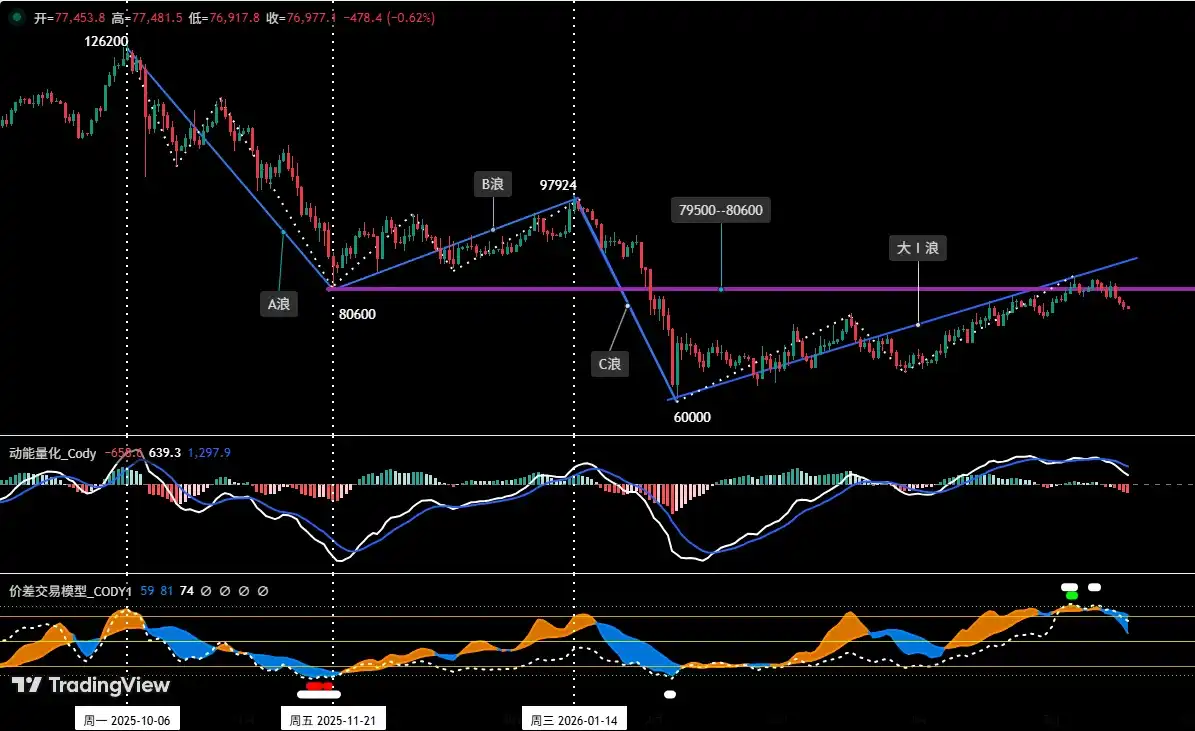
Figure 1

As shown in (Figure 1), this view holds that: The daily-level correction starting from the previous high of $126,200 has completed an A-B-C three-wave structure, where the C-wave ended at $60,000 (low on Feb 6th), and the market has shifted from a downtrend to an uptrend. It is currently running the major Wave I (i.e., the initial rally wave). (This content has been detailed in previous articles and will not be elaborated here)

• Major Wave I (Initial Rally Wave): From $60,000 (2026-02-06) to present, running for about 100 days, with a maximum gain of about 38.1%, and still ongoing.

• Potential Major Wave II (Corrective Wave): The correction wave about to run after the end of Major Wave I's rally, its low point will not break below $60,000.

2. Path Two: Monthly-level Correction Structure, Currently in a B-wave Rally (Bearish Mindset)

Bitcoin _ Monthly Chart:
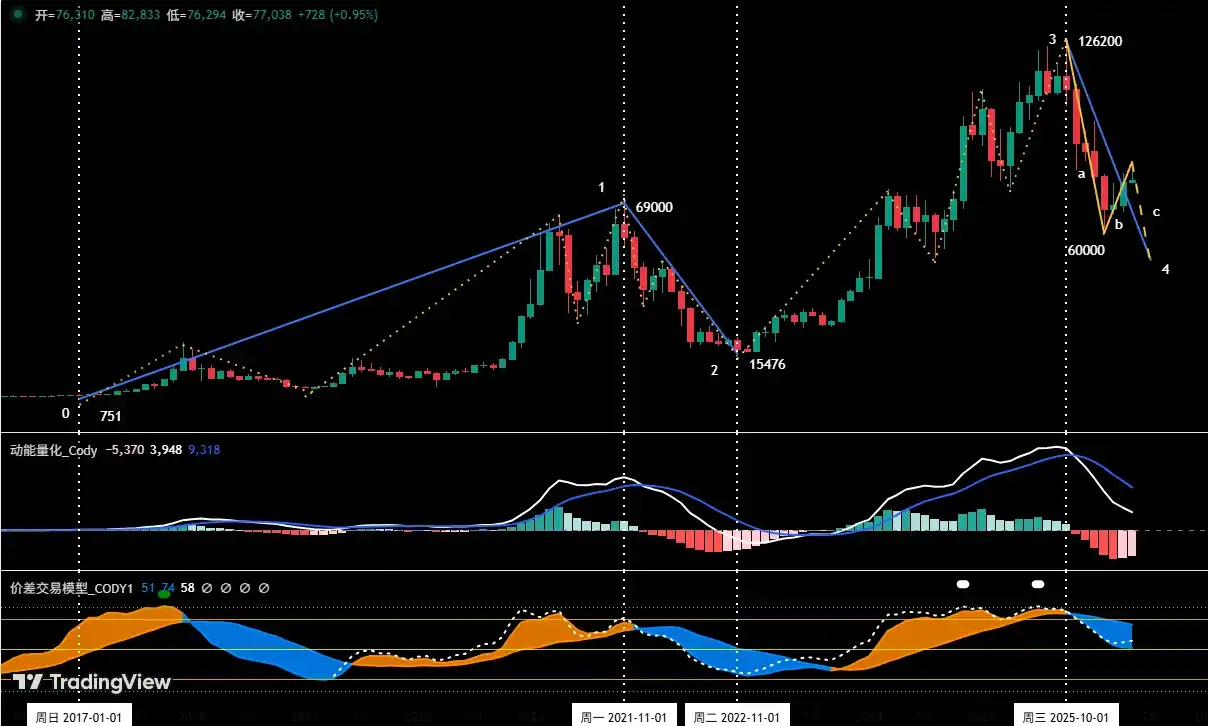
Figure 2

As shown in (Figure 2), this view holds that: The correction starting from the previous high of $126,200 may present a monthly-level a-b-c three-wave correction structure, and it is currently running the b-wave rally.

• a-wave (Decline Wave): From $126,200 (2025-10-06) to $60,000 (2026-02-06), lasting about 4 months (approx. 122 days), with a maximum decline of about 52.5%.

• b-wave (Rally Wave): From $60,000 (2026-02-06) to present, lasting over 3 months (approx. 100 days), with a maximum gain of about 38.1%, and still ongoing.

• Potential c-wave (Decline Wave): The correction wave about to run after the end of the b-wave rally, its low point may break below the $60,000 mark.

3. Assessing the Possibility of "Path Two" from a Monthly Chart Perspective

The Bitcoin monthly chart shows: From January 1, 2017, to present (only this segment of complete trading data is extracted), it can be subdivided into a 4-segment structure;

• Segment 0-1 (Rally Cycle): From $751 (2017-01-01) to $69,000 (2021-11-10), lasting about 59 months (approx. 1774 days).

• Segment 1-2 (Correction Cycle): From $69,000 (2021-11-10) to $15,476 (2022-11-21), lasting about 13 months (approx. 376 days). A deep correction against the previous rally phase (i.e., Segment 0-1), with a maximum decline of about 77.57%.

• Segment 2-3 (Rally Cycle): From $15,476 (2022-11-21) to $126,200 (2025-10-06), lasting about 35 months (1050 days). The main uptrend wave that reached new historical highs, with a maximum gain of about 715.46%.

• Segment 3-4 (Correction Cycle): From $126,200 (2025-10-06) to present, running for about 7 months (approx. 223 days), with a maximum decline of 52.46%, and still ongoing. A correction against the previous main uptrend (i.e., Segment 2-3).

• From a monthly chart perspective, the current market is in the Segment 3-4 correction cycle. If it follows principles of cycle alternation and time symmetry, and there is some proportional relationship in amplitude and duration with "Segment 1-2 (correction)" and "Segment 2-3 (rally)", then the probability of the correction structure described in "Path Two" occurring will increase significantly. This means the current rally since the February 6th low is only part of a large-scale correction.

4. Based on the above analysis of the two path projections, both possess realistic possibilities in the current macro and technical environment. To study their relative probability, the core lies in examining the nature of the rally initiated from the February 6th low; its running duration and spatial amplitude have become key criteria for judgment.

5. Our core view is as follows:

• If this rally becomes exhausted and ends in the near term, the probability of the market choosing "Path Two" will significantly rise.

• Conversely, if the rally continues to extend in time and space, the likelihood of the market choosing "Path One" will increase accordingly.

To this end, we propose an observable quantitative threshold: If this rally can break through the $90,000 to $93,100 region, it may become a crucial factor in confirming whether a fundamental shift in market structure has occurred.

Simultaneously, we believe that, regardless of which path the market chooses, by analyzing historical cycle patterns and macro liquidity expectations, a relatively reliable bottoming structure is more likely to gradually form and be confirmed in the fourth quarter of this year.

2. In-depth Analysis of BTC's Hourly Chart Price Structure: (Using the 4-hour chart as the analysis timeframe)

Bitcoin _ 4-hour Chart
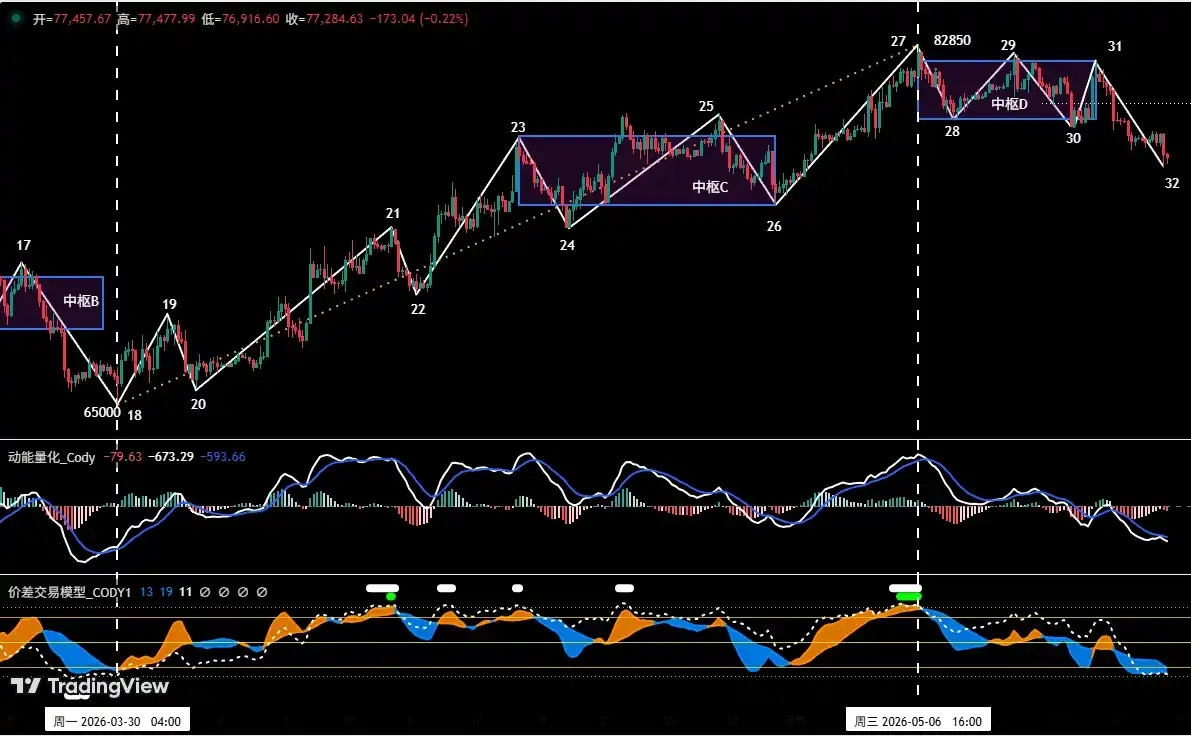
Figure 3

As shown in (Figure 3), since the departure segment from "Central C" (26-27) to present;

• On the 4-hour chart, it can be subdivided into: 26-27, 27-28, 28-29, 29-30, 30-31, 31-32, totaling 6 segments. Among them, because segments 27-28, 28-29, 29-30, and 30-31 overlap, they constitute Central D.

• Currently, the departure segment (31-32) is moving downward and has already broken below the support of the lower boundary of "Central D" ($79,200) and the upper boundary of "Central C" ($78,500). If the price subsequently confirms an effective break below the $78,500~$79,200 region, the daily-level correction structure may initiate.

II. Next, How to Operate

1. BTC Market Trend Forecast for This Week:

Core view for this week: The key lies in observing the outcome of the multi/empty battle over the $78,500~$79,500 region. The gain or loss of this region can serve as an important basis for judging whether the price can maintain high-level fluctuations or turn downward for a correction.

2. Key Resistance Levels:

• First Resistance Zone: $78,500~$79,500 region (around the upper/lower boundaries of the two centers)

• Second Resistance Zone: $83,500~$84,500 region (previous multi/empty concentrated trading area)

3. Key Support Levels:

• First Support Level: $73,500~$75,000 region (previous significant support)

• Second Support Level: $69,500~$70,500 region (previous significant support)

4. Trading Strategy for This Week (excluding impact of sudden news)

1. Medium-term Strategy:

Bitcoin _ Daily Chart: (Position Monitoring Model)
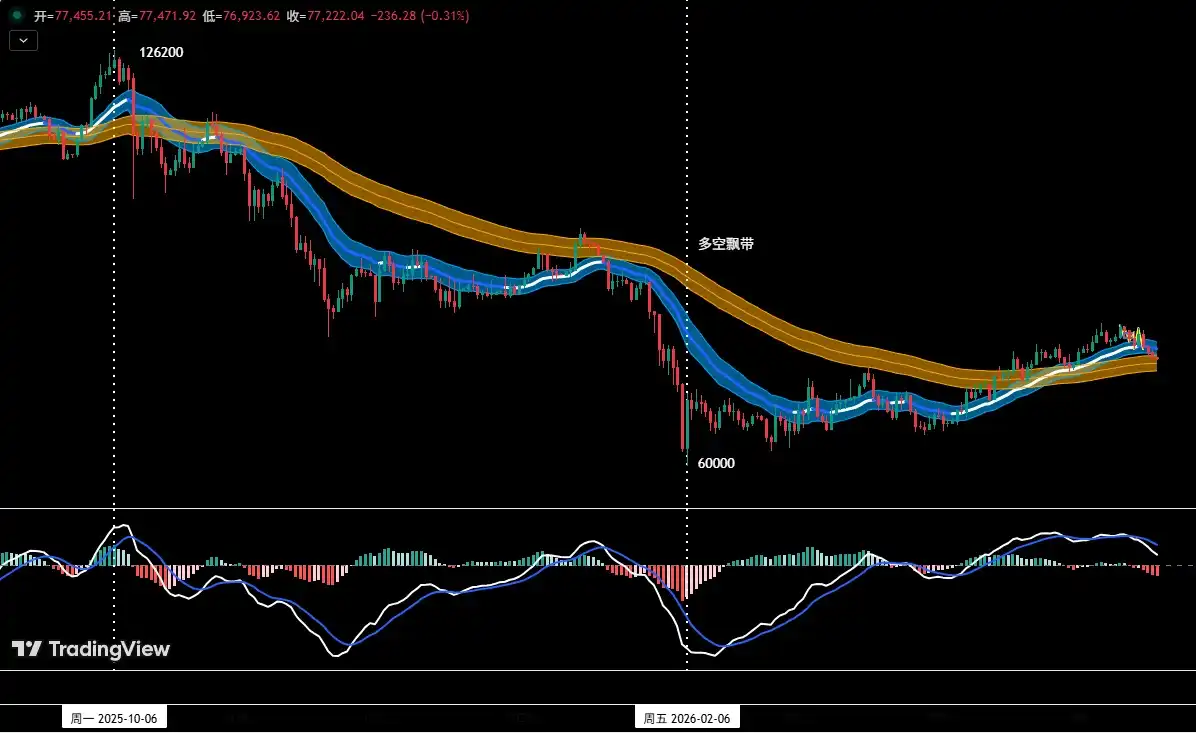
Figure 4

Position Monitoring Model: As shown in (Figure 4), based on trading rules, the medium-term market direction is not yet clear. This week, maintain a no-position observation strategy for medium-term.

2. Short-term Strategy: Use 30% position, set stop-loss points, and look for "price difference" opportunities based on support and resistance levels. (Using 30-minute/60-minute charts as the operation timeframe).

3. In short-term operations, to dynamically cope with the complex evolution of the market, we have pre-formulated A/B two sets of specific operational contingency plans.

Plan A: Rally meets resistance, go short on highs.

• Entry: When the price rallies to the $78,500~$79,500 region and meets resistance, combined with the quantitative model's topping signal, a short position below 30% can be established.

• Risk Control: Initial stop-loss set above $80,600.

• Exit: When adjusting near important resistance levels and combined with model signals, gradually close positions to take profits.

Plan B: Effectively breaks support, follow the trend to go short.

• Entry: When the price effectively breaks below the $73,500~$75,000 support region and combines with the model's topping signal, a short position below 30% can be established.

• Risk Control: Initial stop-loss set above $76,500.

• Exit: When falling to important support levels and combined with model signals, gradually close positions to take profits.

III. After Discussing BTC, Let's Look at HYPE

BTC is still in a tug-of-war within the $78K-$82K range, with neither bulls nor bears gaining much advantage. HYPE, on the other hand, has been hitting new highs independently, rising over 10% this week.

HYPE_ Daily Chart
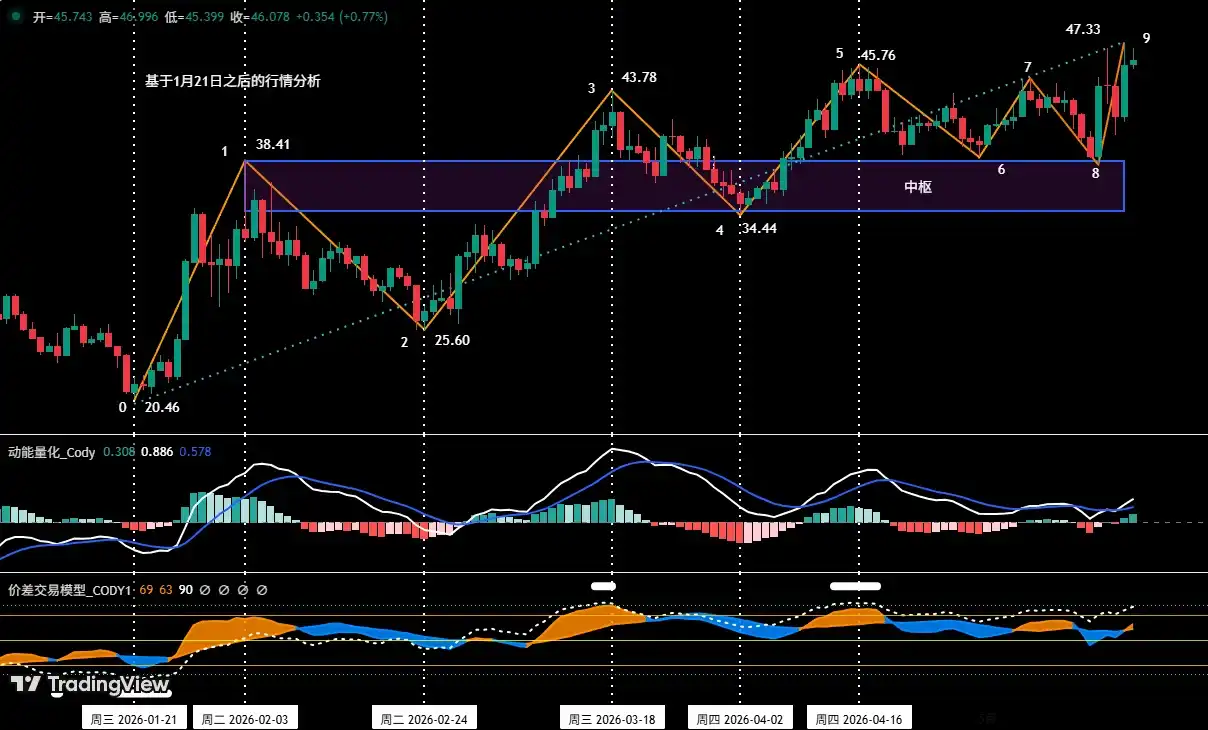
Figure 5

1. As shown in (Figure 5), the rally in HYPE starting from the low of $20.46 on January 21st, on the daily chart, can be divided into segments 0-1, 1-2, 2-3, 3-4, 4-5, 5-6, 6-7, 7-8, 8-9, totaling nine segments. Since the recent price reached a new high of $47.30 (endpoint 9) since the rally from $20.46, the current price structure remains in a daily-level uptrend.

2. As shown in (Figure 5), because segments 1-2, 2-3, and 3-4 overlap, they collectively construct a daily-level "rally central pivot" (or "upward central zone").

3. If the HYPE price can continue to operate above the key point of $38.41 (the upper boundary of the central pivot), the market is expected to maintain a high-level consolidation pattern on the daily chart, to digest previous gains and accumulate directional momentum.

IV. HYPE Trend Judgment and Subsequent Operation Prediction

1. HYPE Market Trend Forecast for This Week:

Core HYPE view for this week: Focus on observing the gain or loss in the multi/empty battle around the central pivot upper boundary ($38.41) and the previous high ($45.76).

2. HYPE Short-term Trading Strategy for This Week:

Combined with the current market structure, the following three sets of short-term operational contingency plans have been optimized and formulated for you, with the core revolving around the battle over the "central pivot upper boundary ($38.41) and the previous high ($45.76)".

• Plan A: Breakout Go Long (Trend Continuation)

If the price effectively breaks through and stabilizes above the $45.76 support, simultaneously combined with bottom signals triggered by the two major models, consider lightly testing a long position. Position must be controlled below 30% and strictly adhere to stop-loss discipline.

• Plan B: Breakdown Turn Short (Trend Reversal)

If the price effectively breaks below the $45.76 support, simultaneously combined with top signals triggered by the two major models, consider lightly testing a short position. Position must be controlled below 30% and strictly adhere to stop-loss discipline.

• Plan C: Support Go Long (Trend Reversal Back Up)

If the price retraces to near $38.41, finds support, shows signs of stabilization, and simultaneously combines with bottom signals triggered by the two major models, consider lightly testing a long position. Position must be controlled below 30% and strictly adhere to stop-loss discipline.

V. Finally, Let's Talk About Results

1. Short-term Operation Review: (See Table 1)

We strictly followed the operational contingency plan. Based on trading signals from our self-constructed Price Difference Trading Model and Momentum Quantitative Model, we completed one short-term (long position) operation last week, achieving a trading profit of 2.02%.

1. Bitcoin Short-term Trade Details Summary: (Leverage*1)
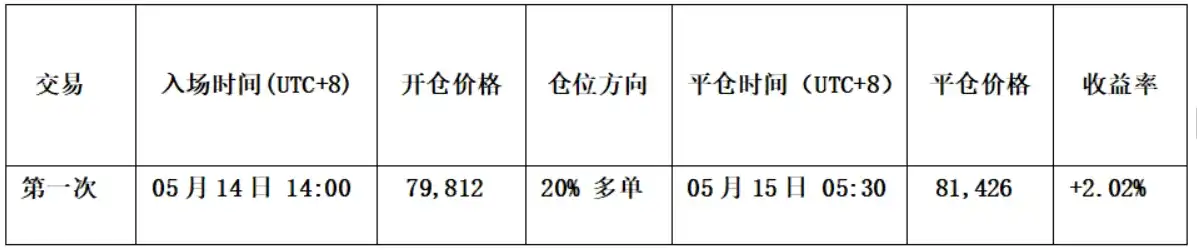
Table 1

2. Short-term Trade Recap: (See Figure 6)

• Entry Strategy:

a. When the price fell near $78,500 and showed signs of stabilization and then broke through the previous consolidation range upper resistance at $79,500;

b. The Price Difference Trading Model triggered a bottom warning signal (white dot + red dot), forming a bottom resonance with the Momentum Quantitative Model.

Therefore, we established a 20% long position at $79,812.

• Exit Strategy:

a. When the price rallied near $82,000 and met resistance, with the K-line forming a top resistance signal;

b. The Price Difference Trading Model triggered a strong top warning signal (green dot + white dot), forming a top selling signal with the Momentum Quantitative Model.

Therefore, we closed all positions near $81,426.

• Summary: This trade successfully profited approximately 2.02%.

HYPE_30-minute Chart: (Momentum Quantitative Model + Price Difference Trading Model)
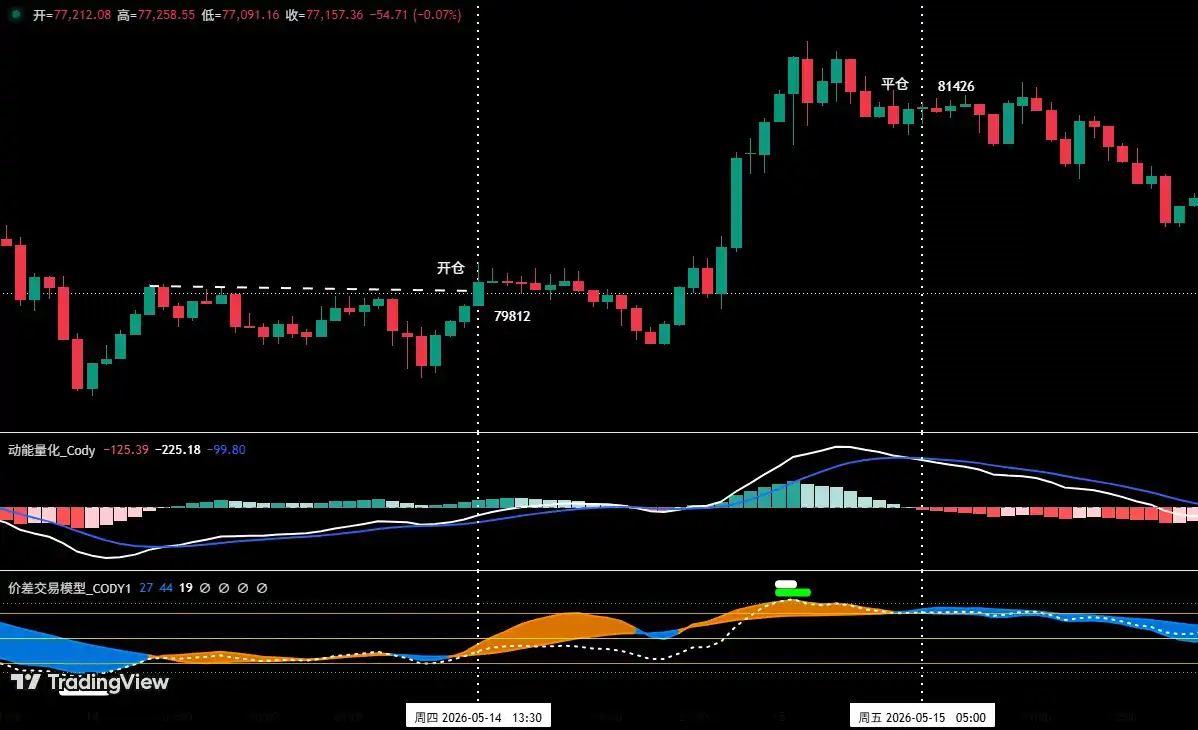
Figure 6 (Short-term Trade Illustration)

VI. Special Notes:

1. When opening a position: Immediately set the initial stop-loss level.

2. When profit reaches 1%: Move the stop-loss to the entry price (breakeven point) to ensure principal safety.

3. When profit reaches 2%: Move the stop-loss to the 1% profit level.

4. Continuous tracking: Thereafter, for every additional 1% profit in price, move the stop-loss level up by 1% accordingly, dynamically protecting and locking in profits.

Financial markets change rapidly. All market analysis and trading strategies require dynamic adjustment. All views, analytical models, and operational strategies involved in this article are derived from personal technical analysis and are for personal trading log purposes only. They do not constitute any investment advice or operational basis. Markets involve risks, investment requires caution. Please do not make decisions based on this.


Domande pertinenti

QBased on the article, what are the two main future path scenarios for BTC price movement, and what is the key factor in determining which path is more likely?

AThe two main future path scenarios are Path One (bullish) and Path Two (bearish). Path One posits that the correction from the October 2025 high is over and a new uptrend has started. Path Two suggests the current move is merely a B-wave rebound within a larger, monthly-scale correction. The key factor is the nature of the rebound since the February 6 low. If the rally ends soon, Path Two becomes more likely. If it continues to extend in time and price, especially breaking above the $90,000–$93,100 region, Path One gains significant probability.

QAccording to the analysis, what specific price zone is identified as the most critical short-term battle ground for BTC this week?

AThe most critical short-term battle ground for BTC this week is the $78,500–$79,500 price zone. The outcome of the struggle between buyers and sellers in this area will be a key indicator of whether the price can maintain its high-level consolidation or turn downward into a deeper adjustment.

QWhat are the two short-term trading plans (Plan A and Plan B) proposed for BTC in the article, and what are their respective entry triggers?

AThe two short-term trading plans for BTC are Plan A and Plan B. Plan A is 'Selling on rallies at resistance.' The entry trigger is when the price rebounds to the $78,500–$79,500 zone and encounters resistance, coupled with a top signal from the quantitative models. Plan B is 'Following the trend on a breakdown.' The entry trigger is when the price effectively breaks below the $73,500–$75,000 support zone, combined with a top signal from the models.

QHow does the article characterize the recent performance of HYPE in contrast to BTC?

AThe article states that while BTC has been locked in a tug-of-war within the $78K–$82K range, HYPE has been 'setting new highs on its own,' rising over 10% for the week mentioned. It is portrayed as outperforming and marching to its own beat.

QWhat is the suggested risk management rule (trailing stop method) for locking in profits after a successful trade entry?

AThe suggested trailing stop method is: 1) Set an initial stop-loss immediately upon opening a position. 2) Move the stop-loss to the break-even point (entry price) once a 1% profit is achieved. 3) Move the stop-loss to lock in a 1% profit when the total profit reaches 2%. 4) Continue tracking, moving the stop-loss up by 1% for every additional 1% gain in price, thereby dynamically protecting and locking in profits.

Letture associate

Single-Day Plunge of 30%, Arthur Hayes Suddenly Liquidates: Why Did ZEC Get Exploded by Security Issues?

On June 5th, Zcash founder Zooko Wilcox disclosed a critical soundness vulnerability in the project's latest Orchard privacy pool. This flaw, found in the elliptic curve multiplication constraints, could allow an attacker to create unlimited counterfeit ZEC within the shielded pool, with transactions appearing valid. The vulnerability was discovered in late May by security researcher Taylor Hornby, who utilized Anthropic's new Opus 4.8 AI model for a targeted audit. The Zcash ecosystem had already performed an emergency network upgrade to patch the issue. However, the detailed disclosure triggered severe market panic, causing ZEC's price to plummet over 30% in a single day. Notably, prominent investor Arthur Hayes announced he had sold his entire ZEC position following the news. The incident starkly challenges the "technological trust" narrative central to privacy coins. Despite years of top-tier cryptographic audits, the bug persisted until uncovered with advanced AI-assisted research. This highlights the growing gap between theoretical perfection and practical implementation in privacy technology. The event serves as a industry-wide warning: in an AI-driven security landscape, the assumption that "undiscovered equals safe" is obsolete. It underscores the urgent need for continuous, proactive security practices combining AI audits, formal verification, and rapid response mechanisms.

foresightnews_api56 min fa

Single-Day Plunge of 30%, Arthur Hayes Suddenly Liquidates: Why Did ZEC Get Exploded by Security Issues?

foresightnews_api56 min fa

Breaking the Curse of DeFi Cascading Liquidations, Vitalik Proposes a New Solution

**Vitalik Buterin Proposes New DeFi Design to Eliminate Forced Liquidations** Ethereum co-founder Vitalik Buterin has published a proposal for a new decentralized finance (DeFi) architecture aimed at removing the automatic liquidation mechanisms prevalent in current lending protocols. The core idea involves creating synthetic assets using options as building blocks, fundamentally avoiding the抵押借贷结构 that triggers forced sell-offs. The proposal responds to a recurring flaw in DeFi: during sharp market downturns, mass自动清算 of under-collateralized positions can exacerbate price declines, creating systemic selling pressure and market instability, as evidenced by recent crypto market volatility. Buterin's model would split an asset like 1 ETH into two option-like derivatives, P and N, pegged to a price index with a set strike price and expiration. At expiry, an oracle determines the settlement price to allocate the underlying ETH between P and N holders. This design eliminates the "cliff" of instant liquidation. Instead, a position's value would gradually drift from its target peg if not actively rebalanced by the user, transferring the rebalancing decision from the protocol to the user or automated tools. A key advantage is the reduced reliance on high-frequency, real-time oracle price feeds, which are vulnerable to manipulation and errors in current systems. The delayed settlement in the options model allows for more robust, fault-tolerant oracle designs. However, significant challenges remain for practical adoption. High transaction costs (slippage) from frequent rebalancing on automated market makers (AMMs) could erode user funds. The model may not be suitable for stablecoins requiring a strict 1:1 dollar peg, as it inherently allows for value drift. Success would depend on developing new liquidity provisioning models and deep markets for these synthetic assets. The proposal represents a fundamental rethinking of DeFi risk management, challenging the industry to explore alternatives to被动集中平仓 rather than merely optimizing existing liquidation processes. It remains a theoretical framework awaiting implementation and testing by development teams.

foresightnews_api59 min fa

Breaking the Curse of DeFi Cascading Liquidations, Vitalik Proposes a New Solution

foresightnews_api59 min fa

Bitcoin's Decline Marks the Transformation of Crypto

Title: The Decline of Bitcoin Marks the Transformation of Crypto While Bitcoin's price recently fell below $70,000, down approximately 45% from its peak, the broader crypto industry is not following it into decline. Instead, crypto is maturing and evolving beyond its dependence on Bitcoin's price movements. Two of Bitcoin's core functions are being usurped. First, AI has captured its role as the primary speculative asset. AI, with its tangible revenue, explosive demand, and massive capital inflows ($700-830 billion in 2024), is siphoning off the speculative "hot money" that once drove Bitcoin. It also contributes to a sustained high-interest-rate environment, further tightening liquidity for assets like Bitcoin. Second, dollar-pegged stablecoins like USDC and USDT have replaced Bitcoin as the crypto market's foundational currency and primary on/off-ramp. Most trading pairs and on-chain transactions are now settled in stablecoins, severing the historical link where all capital inflows had to pass through Bitcoin first. This decoupling allows projects to thrive based on their own fundamentals rather than Bitcoin's price. Examples include Hyperliquid, an on-chain derivatives exchange with annual revenues of $8-13 billion, and prediction market platform Polymarket, valued at $200 billion with $3.65 billion in annual fees. These projects are evaluated on traditional metrics like revenue and user growth. New opportunities are emerging, particularly around privacy. Privacy coins like Zcash (ZEC) are seeing surging demand, while infrastructure like NEAR enables private, cross-chain asset transfers without requiring users to hold a specific token—privacy becomes a universal service layer. In this new paradigm, stablecoins are the universal cash, various project tokens represent equity, and privacy-enabled cross-chain coordination layers (like NEAR) act as the critical infrastructure connecting a fragmented, multi-chain ecosystem. Bitcoin is now just one asset among many. The era where the entire crypto market moved in lockstep with Bitcoin is over. The industry's health should now be judged by project fundamentals—real revenue, active users, and tokenomics that capture value—and the development of the underlying infrastructure enabling a mature, dollar-denominated crypto economy.

foresightnews_api1 h fa

Bitcoin's Decline Marks the Transformation of Crypto

foresightnews_api1 h fa

Lightspark CEO: In Ten Years, Bitcoin Will Be as Invisible as TCP/IP, Yet Power Trillions in Daily Transactions

A decade from now, Bitcoin will function like TCP/IP — invisible yet foundational, supporting trillions in daily transactions globally, according to Lightspark CEO David Marcus. In this future, a coffee shop in Lagos receives instant payment, a manufacturer in São Paulo settles an invoice with a supplier in Ho Chi Minh City, and a freelancer in Bangalore gets paid weekly from an Austin startup — all via Bitcoin's settlement layer, with none of the parties consciously interacting with it. This vision parallels the adoption of open protocols: first driven by necessity where existing systems fail, then scaling rapidly as tools mature and economic benefits become clear. The structural shift begins with wallets. Modern non-custodial wallets, like Spark, allow users to hold dollars, local currency, and Bitcoin in a single address, seamlessly switching between them. This eliminates friction and revolutionizes global custody, moving significant deposits to user-controlled keys not by ideology, but by superior utility. As a result, Bitcoin becomes the default savings layer for billions, as its fixed supply and appreciating value make it a rational choice for savers holding it alongside stablecoins in their everyday wallets. Businesses follow a similar path, from small companies in emerging markets to multinational corporations, holding Bitcoin alongside operational stablecoins. The latest trend is direct Bitcoin transactions for commerce. When both parties hold Bitcoin, transacting in it becomes the simplest option — no conversions, no intermediary currency. This starts in niche areas like high-value B2B settlements but grows as infrastructure makes sending Bitcoin as easy as stablecoins. An accelerating force is AI agents. By 2036, AI agents conducting commerce on behalf of individuals and firms will increasingly choose Bitcoin for settlement. Optimizing for speed, finality, and minimal counterparty risk across jurisdictions, they find Bitcoin's global, neutral, and programmable network ideal for netting and settling obligations. Thus, Bitcoin is becoming the native currency for machine commerce, just as it has become a native savings asset for humans. The global monetary system is being rebuilt from the protocol layer: open infrastructure, default self-custody, Bitcoin settling everything underneath, with stablecoins as the interface. Most users won't think about Bitcoin when they transact — and they won't need to.

foresightnews_api1 h fa

Lightspark CEO: In Ten Years, Bitcoin Will Be as Invisible as TCP/IP, Yet Power Trillions in Daily Transactions

foresightnews_api1 h fa

Trading

Spot
Futures

Articoli Popolari

Come comprare HYPE

Benvenuto in HTX.com! Abbiamo reso l'acquisto di Hyperliquid (HYPE) semplice e conveniente. Segui la nostra guida passo passo per intraprendere il tuo viaggio nel mondo delle criptovalute.Step 1: Crea il tuo Account HTXUsa la tua email o numero di telefono per registrarti il tuo account gratuito su HTX. Vivi un'esperienza facile e sblocca tutte le funzionalità,Crea il mio accountStep 2: Vai in Acquista crypto e seleziona il tuo metodo di pagamentoCarta di credito/debito: utilizza la tua Visa o Mastercard per acquistare immediatamente HyperliquidHYPE.Bilancio: Usa i fondi dal bilancio del tuo account HTX per fare trading senza problemi.Terze parti: abbiamo aggiunto metodi di pagamento molto utilizzati come Google Pay e Apple Pay per maggiore comodità.P2P: Fai trading direttamente con altri utenti HTX.Over-the-Counter (OTC): Offriamo servizi su misura e tassi di cambio competitivi per i trader.Step 3: Conserva Hyperliquid (HYPE)Dopo aver acquistato Hyperliquid (HYPE), conserva nel tuo account HTX. In alternativa, puoi inviare tramite trasferimento blockchain o scambiare per altre criptovalute.Step 4: Scambia Hyperliquid (HYPE)Scambia facilmente Hyperliquid (HYPE) nel mercato spot di HTX. Accedi al tuo account, seleziona la tua coppia di trading, esegui le tue operazioni e monitora in tempo reale. Offriamo un'esperienza user-friendly sia per chi ha appena iniziato che per i trader più esperti.

279 Totale visualizzazioniPubblicato il 2024.12.11Aggiornato il 2026.06.02

Come comprare HYPE

Discussioni

Benvenuto nella Community HTX. Qui puoi rimanere informato sugli ultimi sviluppi della piattaforma e accedere ad approfondimenti esperti sul mercato. Le opinioni degli utenti sul prezzo di HYPE HYPE sono presentate come di seguito.

活动图片