Bitwise Seeks to Acquire Chorus One to Dominate Institutional Staking as BMIC Momentum Builds

bitcoinistPubblicato 2026-02-04Pubblicato ultima volta 2026-02-04

Introduzione

Bitwise, a major asset management firm, is reportedly seeking to acquire Chorus One, a leading European institutional staking provider, signaling a strategic move to dominate the crypto yield infrastructure. This acquisition highlights the growing institutional focus on staking as a key revenue stream. However, this consolidation raises concerns over centralization risks and vulnerabilities, such as potential "Harvest Now, Decrypt Later" quantum attacks. In response, projects like BMIC ($BMIC) are gaining attention for offering a quantum-secure finance stack designed to protect digital assets against future cryptographic threats. BMIC's presale has already raised significant funds, reflecting strong market interest in next-generation security solutions.

The institutional race to capture the crypto yield economy just entered a new, aggressive phase. Reports indicating that asset management giant Bitwise seeks to acquire Chorus One, a leading European institutional staking provider, signal a pivotal shift in market structure.

This isn’t merely about accumulation, it’s a battle for control of the infrastructure itself.

Bitwise (already a heavyweight in the ETF sector) appears to be positioning itself vertically within the crypto stack. By targeting Chorus One, which operates validators for over 60 networks and secures billions in assets, Bitwise is moving beyond simple asset exposure.

They’re aiming to capture the technical ‘yield layer’ of the blockchain ecosystem. Why? Because it validates the thesis that staking, not just trading, is where the next trillion dollars of institutional capital will flow.

With Bitcoin hovering near $76K and Ethereum dominance holding steady, the market appetite for yield-bearing infrastructure is insatiable. But let’s be honest: this consolidation of staking power brings new risks.

As centralized entities amass validator keys, the attack surface for bad actors grows. This centralization paradox is driving capital toward decentralized, next-generation security solutions that can protect assets even as the stakes get higher.

While the giants fight for today’s yields, forward-looking investors are positioning themselves in protocols like BMIC ($BMIC), which addresses the existential threat looming over all digital assets: quantum decryption.

Buy $BMIC here.

The Quantum Threat to Institutional Staking Infrastructure

The potential acquisition of Chorus One by Bitwise underscores a critical reality: digital assets are only as valuable as the cryptography securing them.

As institutions lock up billions in staking contracts, they become prime targets for ‘Harvest Now, Decrypt Later’ (HNDL) attacks. State actors and sophisticated syndicates are already hoarding encrypted data, waiting for quantum computing power to mature enough to shatter current encryption standards like RSA and ECC.

Here is where the narrative shifts from simple accumulation to survival. If the underlying cryptographic signatures of a validator are compromised, the entire stake is at risk. The industry is finally waking up to the fact that legacy wallets and staking mechanisms, regardless of who owns them, are built on math that has an expiration date.

BMIC ($BMIC) tackles this vulnerability head-on.

Unlike traditional wallets that merely store keys, BMIC offers a full quantum-secure finance stack. By integrating ERC-4337 smart accounts with proprietary post-quantum cryptography, the project ensures that user keys are never exposed during transactions or staking activities.

This creates a defensive moat that appeals to both retail users fearing wallet drains and enterprise players looking to future-proof their operations against the inevitability of quantum computing.

Learn more about BMIC here.

BMIC Offers ‘Harvest Now, Decrypt Later’ Protection as Presale Surges

While Bitwise focuses on aggregating current market share, BMIC is engineering the safety rails for the next decade of crypto. The project’s unique value proposition centers on eliminating public key exposure, the primary vector for both current phishing attacks and future quantum breaks.

Through its Quantum Meta-Cloud and AI-enhanced threat detection, the platform creates an ecosystem where users can transact, stake, and govern without the perpetual anxiety of private key management.

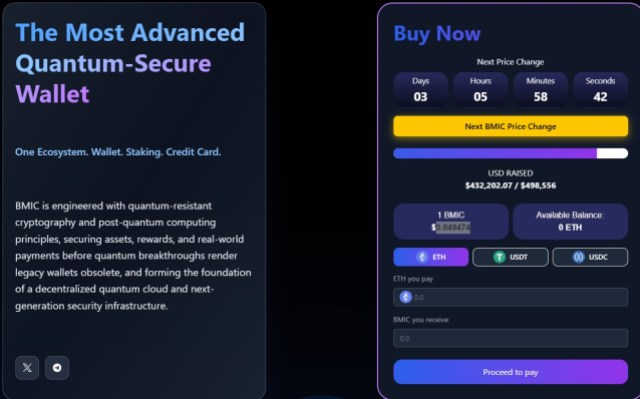
The market has responded sharply to this utility. The BMIC presale has already raised over $432K so far, a figure that suggests a significant appetite for security-first infrastructure. With tokens currently priced at $0.049474, early participants are betting on the transition from legacy wallets to quantum-resistant architectures.
What distinguishes BMIC from standard wallet providers is its recognition of the ‘burn-to-compute’ economy and governance utility. It isn’t just a storage solution; it’s ecosystem fuel designed to power a secure, decentralized computing layer.

As the industry watches giants like Bitwise consolidate the staking layer, the smart money is hedging against the technical debt of that very infrastructure by backing the only platform built to withstand the post-quantum era.

Visit the BMIC presale page.

Disclaimer This article is for informational purposes only and does not constitute financial advice. Cryptocurrency investments carry high risks, including total loss of capital. Always conduct your own due diligence.


Domande pertinenti

QWhat is the main strategic move by Bitwise discussed in the article, and what is its significance?

AThe article discusses Bitwise's move to acquire Chorus One, a leading European institutional staking provider. This signifies a pivotal shift in market structure, representing a vertical integration into the crypto stack and a battle for control of the yield infrastructure itself, not just asset accumulation.

QAccording to the article, what is the 'Quantum Threat' to institutional staking infrastructure?

AThe 'Quantum Threat' refers to 'Harvest Now, Decrypt Later' (HNDL) attacks, where state actors or sophisticated syndicates hoard encrypted data, waiting for quantum computing to mature enough to break current encryption standards like RSA and ECC, thereby compromising validator signatures and putting entire stakes at risk.

QHow does the BMIC ($BMIC) protocol claim to address the vulnerabilities of traditional staking and wallets?

ABMIC offers a full quantum-secure finance stack by integrating ERC-4337 smart accounts with proprietary post-quantum cryptography. This ensures user keys are never exposed during transactions or staking, creating a defensive moat against both current threats and future quantum decryption.

QWhat market response is cited as evidence of appetite for BMIC's solution?

AThe article cites that the BMIC presale has raised over $432K, suggesting a significant market appetite for its security-first infrastructure, with investors betting on the transition from legacy wallets to quantum-resistant architectures.

QWhat centralization risk does the article associate with the consolidation of staking power by entities like Bitwise?

AThe article states that as centralized entities amass validator keys, the attack surface for bad actors grows. This centralization paradox increases risk and is driving capital toward decentralized, next-generation security solutions.

Letture associate

Korean Youth, Making a 'Last Stand' in an Epic Bull Market

South Korea is experiencing an unprecedented stock market boom in the first half of 2026, with the KOSPI index doubling in six months, driven primarily by tech giants Samsung Electronics and SK Hynix. This "epic bull run," tied to the semiconductor cycle, has sparked a nationwide frenzy for stock trading. The country, with a population of just over 50 million, now has over 105 million securities accounts. The article, from the perspective of a Chinese national living in Seoul, explores how this speculative fever reflects deeper societal anxieties among Korean youth. Facing stagnant wages, high costs of living, housing pressures, and rigid social stratification, many young people see the volatile market as a "last chance" to alter their predetermined life trajectories and escape financial precarity. Stories include a young office worker investing her meager savings, a couple delaying marriage due to financial pressures, and a seasoned trader navigating exclusive social circles where market information is currency. However, the boom also exposes and exacerbates existing inequalities. While some achieve windfalls, others face devastating losses, with borrowing to invest reaching record highs. The narrative contrasts the illusion of equal opportunity with the harsh reality that the ability to absorb risk is unevenly distributed. Ultimately, the market frenzy is portrayed not as a solution, but as a symptom of a generation's struggle against a system offering limited upward mobility, where daily life is a precarious balance of bills, debts, and societal expectations.

marsbit14 min fa

Korean Youth, Making a 'Last Stand' in an Epic Bull Market

marsbit14 min fa

Young South Koreans, Making a 'Last-Ditch Effort' in an Epic Bull Market

This article explores how an unprecedented stock market boom in South Korea during the first half of 2026, driven by the semiconductor industry, is transforming the lives of ordinary people, particularly the youth. The KOSPI index doubled in six months, fueled by giants Samsung and SK Hynix, leading to a frenzy of retail investing. With over 105 million stock accounts in a population of just over 50 million, a sense of "FOMO" (fear of missing out) is pervasive. Through the perspective of Li Yuning, a Chinese woman living in Seoul, the piece follows several young Koreans who see the market as a last chance to escape stifling economic pressures, high housing costs, and narrow social mobility. Individuals like Minji, a low-paid office worker, and Junho, saving for marriage, invest their limited savings, while experienced traders like Suhu navigate exclusive social circles. The narrative reveals that this speculative fever stems less from greed and more from deep-seated anxiety about being left behind in a society with growing wealth inequality and rigid class structures. However, the boom also exposes stark social divides. It exacerbates wealth gaps, as those with family support or existing capital fare better. The pressure to succeed is immense, with stories of devastating losses leading to personal tragedy. Ultimately, the article suggests the牛市 acts as a pressure valve and a temporary illusion of opportunity in a system where traditional paths to advancement seem increasingly closed, leaving young people to gamble on the market as a final, desperate bid for a better future.

链捕手20 min fa

Young South Koreans, Making a 'Last-Ditch Effort' in an Epic Bull Market

链捕手20 min fa

Doubao Charges More than GPT, While DeepSeek Slashes Prices Dramatically: Who Will Win?

The article discusses the divergent pricing strategies of two major Chinese AI companies. In May, Doubao (by ByteDance) began testing fees, with its professional tier priced higher than ChatGPT Plus. Meanwhile, DeepSeek permanently cut prices for its V4-Pro API to a quarter of the original, setting new global lows. Doubao, with high user traffic from ByteDance apps like TikTok, leads in monthly active users but faces massive compute costs from its free model. Its move to a freemium model targets heavy users, aiming to balance scale and monetization amid substantial investments. DeepSeek's price cut is attributed to architectural innovations that slash inference costs, adaptation to domestic hardware reducing dependency, and engineering optimizations. It focuses on the enterprise (B2B) market, aiming to become a leading model base. Both companies are currently unprofitable. The article contrasts their approaches with Anthropic, which is profitable by primarily serving enterprises with high-value use cases like coding and agents. It argues that sustainable AI business models require integrating AI into real workflows to deliver tangible ROI, rather than just offering chat services. DeepSeek's recent $7 billion funding round, including investments from Tencent, is noted to bolster its B2B position. The ultimate winner will be the player that successfully transforms AI into measurable returns, whether through consumer productivity ecosystems or enterprise platforms.

marsbit30 min fa

Doubao Charges More than GPT, While DeepSeek Slashes Prices Dramatically: Who Will Win?

marsbit30 min fa

Promised Year of Crypto IPOs? Only One Went Public in Six Months, Down 70%

The much-anticipated wave of crypto IPOs in 2026 has failed to materialize, with market conditions worsening dramatically. While SpaceX prepares for the largest IPO in history, raising $75 billion at a $1.75 trillion valuation, the crypto sector faces a frozen pipeline. The sole crypto IPO success this year, BitGo, serves as a cautionary tale. After launching on the NYSE in January at $18, its stock has plummeted approximately 70%. Other major contenders have stalled or delayed. Kraken, which secretly filed in late 2025, has put its plans on ice, seeing its valuation drop 33% to $13.3 billion. Consensys has postponed its filing until autumn at the earliest, and Bitpanda is poised to miss its self-imposed H1 deadline for a Frankfurt listing. This widespread retreat is driven by a severe liquidity crunch. Bitcoin has fallen below $60,000, with capital being diverted to AI stocks and the massive SpaceX offering. The poor performance of earlier crypto listings like Gemini and the stagnant price of Coinbase further dampen investor appetite. A key underlying pressure is the impending US midterm elections in November, which could alter the currently favorable regulatory landscape. Companies had hoped to go public during this window of policy certainty, but challenging market dynamics have overridden those plans. The transparency that comes with being a public company is now seen as a potential liability rather than a benefit in a down market. The industry's fate now hinges on a few critical watchpoints: whether Kraken restarts its process in H2, if Consensys files in the fall, and if SpaceX's debut can revitalize market liquidity. Otherwise, the promised "crypto IPO year" will likely be pushed beyond the election.

marsbit44 min fa

Promised Year of Crypto IPOs? Only One Went Public in Six Months, Down 70%

marsbit44 min fa

Trading

Spot
Futures

Articoli Popolari

Come comprare ONE

Benvenuto in HTX.com! Abbiamo reso l'acquisto di Harmony (ONE) semplice e conveniente. Segui la nostra guida passo passo per intraprendere il tuo viaggio nel mondo delle criptovalute.Step 1: Crea il tuo Account HTXUsa la tua email o numero di telefono per registrarti il tuo account gratuito su HTX. Vivi un'esperienza facile e sblocca tutte le funzionalità,Crea il mio accountStep 2: Vai in Acquista crypto e seleziona il tuo metodo di pagamentoCarta di credito/debito: utilizza la tua Visa o Mastercard per acquistare immediatamente HarmonyONE.Bilancio: Usa i fondi dal bilancio del tuo account HTX per fare trading senza problemi.Terze parti: abbiamo aggiunto metodi di pagamento molto utilizzati come Google Pay e Apple Pay per maggiore comodità.P2P: Fai trading direttamente con altri utenti HTX.Over-the-Counter (OTC): Offriamo servizi su misura e tassi di cambio competitivi per i trader.Step 3: Conserva Harmony (ONE)Dopo aver acquistato Harmony (ONE), conserva nel tuo account HTX. In alternativa, puoi inviare tramite trasferimento blockchain o scambiare per altre criptovalute.Step 4: Scambia Harmony (ONE)Scambia facilmente Harmony (ONE) nel mercato spot di HTX. Accedi al tuo account, seleziona la tua coppia di trading, esegui le tue operazioni e monitora in tempo reale. Offriamo un'esperienza user-friendly sia per chi ha appena iniziato che per i trader più esperti.

320 Totale visualizzazioniPubblicato il 2024.12.12Aggiornato il 2026.06.02

Come comprare ONE

Discussioni

Benvenuto nella Community HTX. Qui puoi rimanere informato sugli ultimi sviluppi della piattaforma e accedere ad approfondimenti esperti sul mercato. Le opinioni degli utenti sul prezzo di ONE ONE sono presentate come di seguito.

活动图片












