Bittensor jumps 28% as Anthropic restrictions fuel TAO’s $300 test

ambcryptoPubblicato 2026-06-15Pubblicato ultima volta 2026-06-15

Introduzione

Bittensor (TAO) surged 28% weekly, recovering from key support near $180.9 as buyers gained momentum. The price broke through resistance and the 20-day SMA, reaching ~$267.4 with strong volume and improving technical indicators like RSI and MACD. The rally was fueled in part by news that Anthropic restricted access to some AI models for foreign nationals, highlighting a weakness in centralized AI and boosting demand for decentralized AI projects like Bittensor. Attention now turns to the $280-$300.6 resistance zone. Maintaining support above the $244.7-$255 range is crucial for the bullish structure; losing it could lead to a retracement toward $210-$220. The sustainability of the move depends on continued demand beyond the initial headline-driven boost.

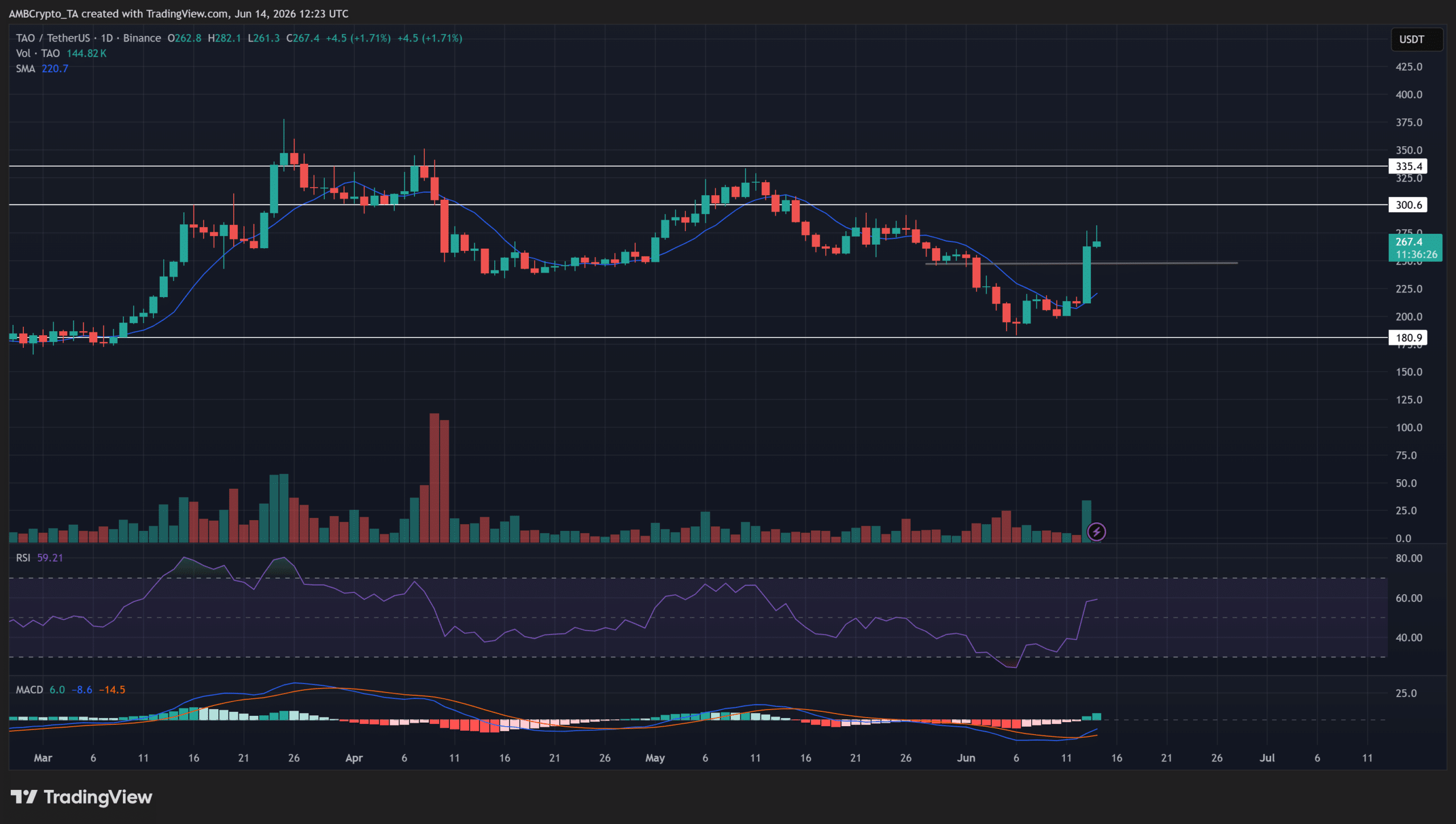
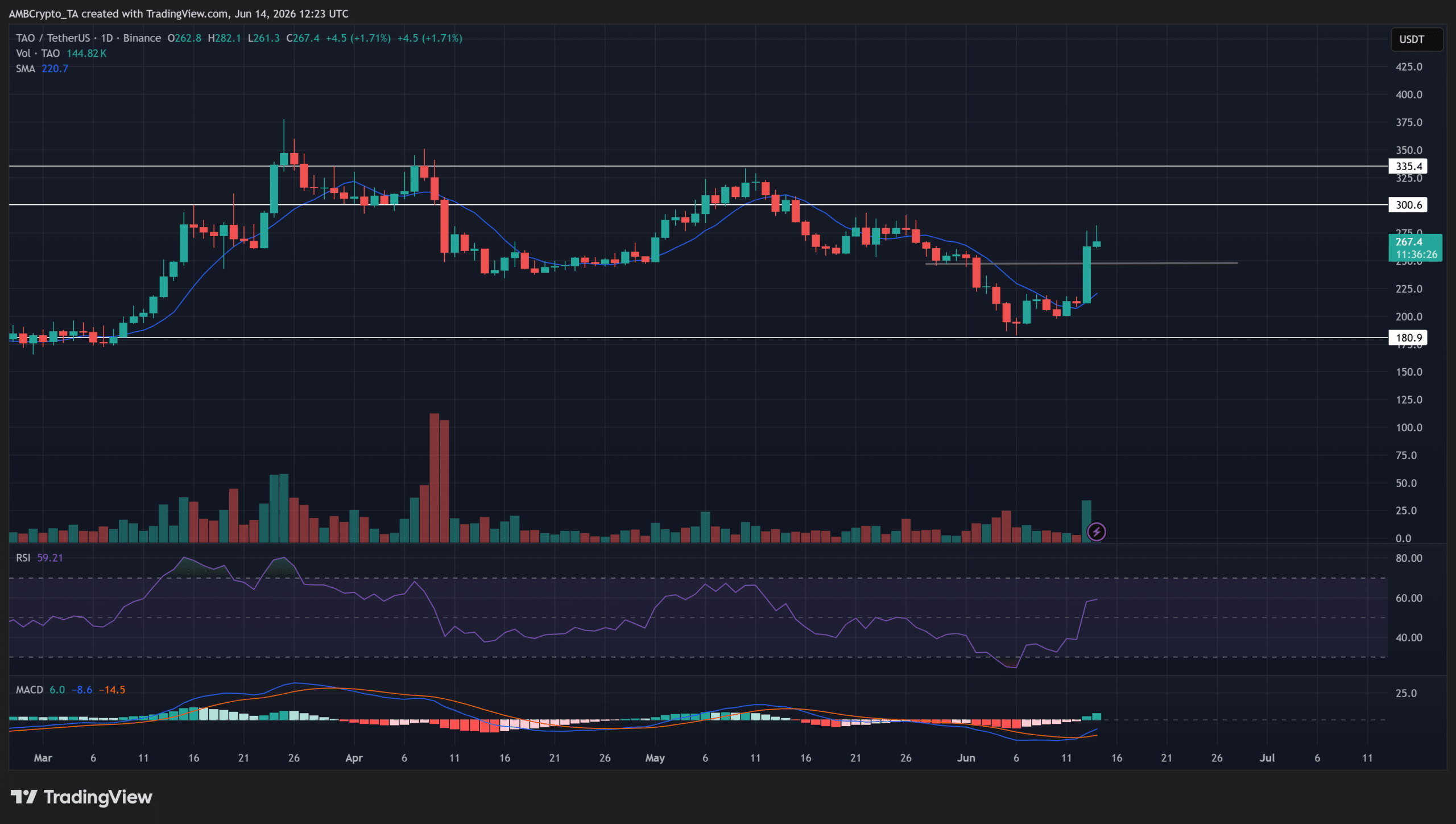
Bittensor [TAO] gained 9% in the last 24 hours, extending its weekly gain to 28% as buyers continued rebuilding momentum. The recovery began near the key $180.9 support zone.

There, repeated selling attempts failed to generate fresh downside pressure.

As sellers lost control, buyers gradually absorbed available supply and stabilized price action. This transition was followed by a brief consolidation phase, which suggested accumulation rather than continued distribution.
Source: TAO/USDT on TradingView

Momentum then accelerated sharply, lifting TAO from roughly $215 to $267.4 within two sessions. In the process, price reclaimed the 20-day SMA at $220.70 and pushed through a resistance area that had limited advances for weeks.

Volume expanded aggressively during the breakout, producing its strongest positive reading in nearly two months.

Meanwhile, RSI climbed to 59.2 from below 40, while MACD continued strengthening. Attention now turns to the $280-$300.6 region, where buyers and sellers will likely contest the recovery’s strength.

Anthropic’s move fuels TAO demand

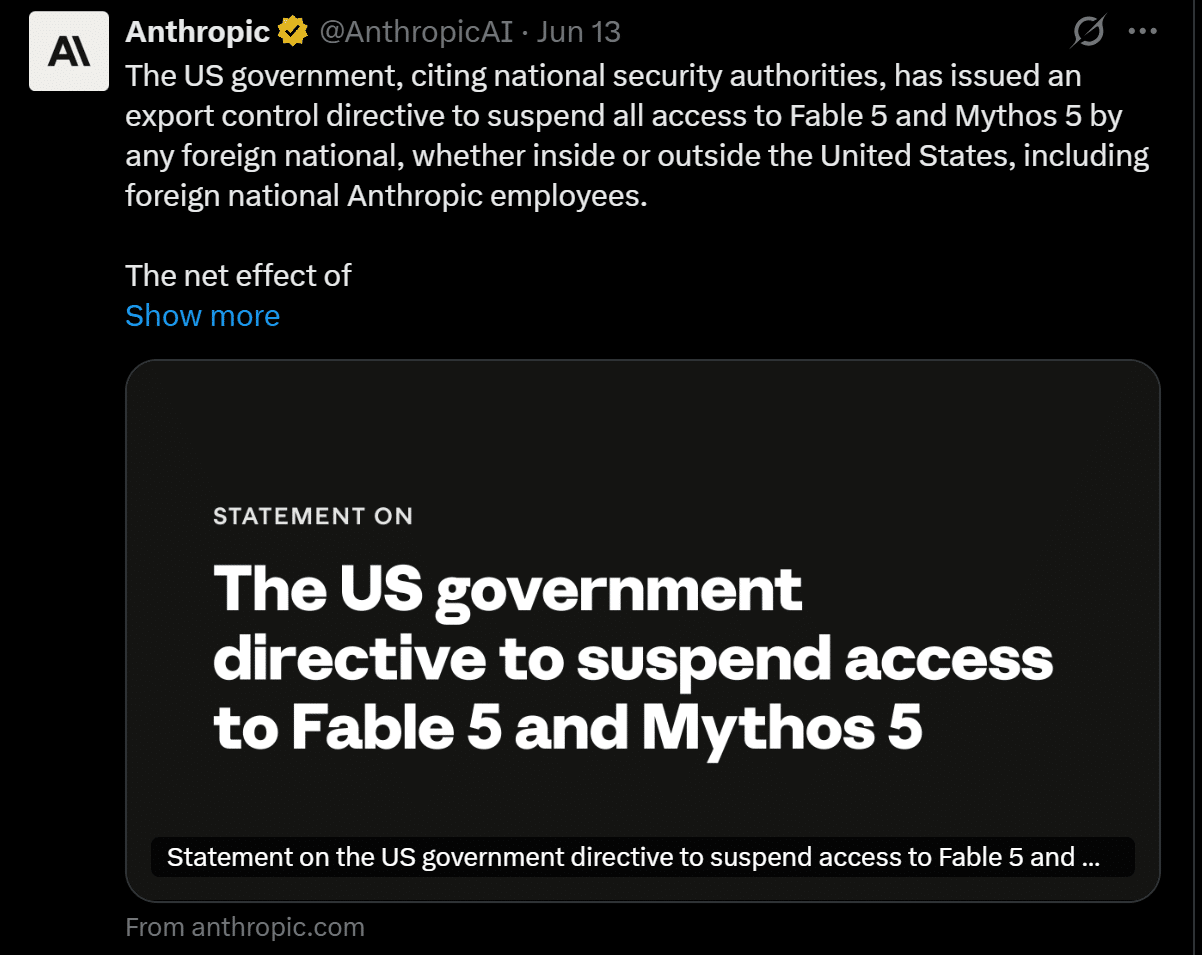
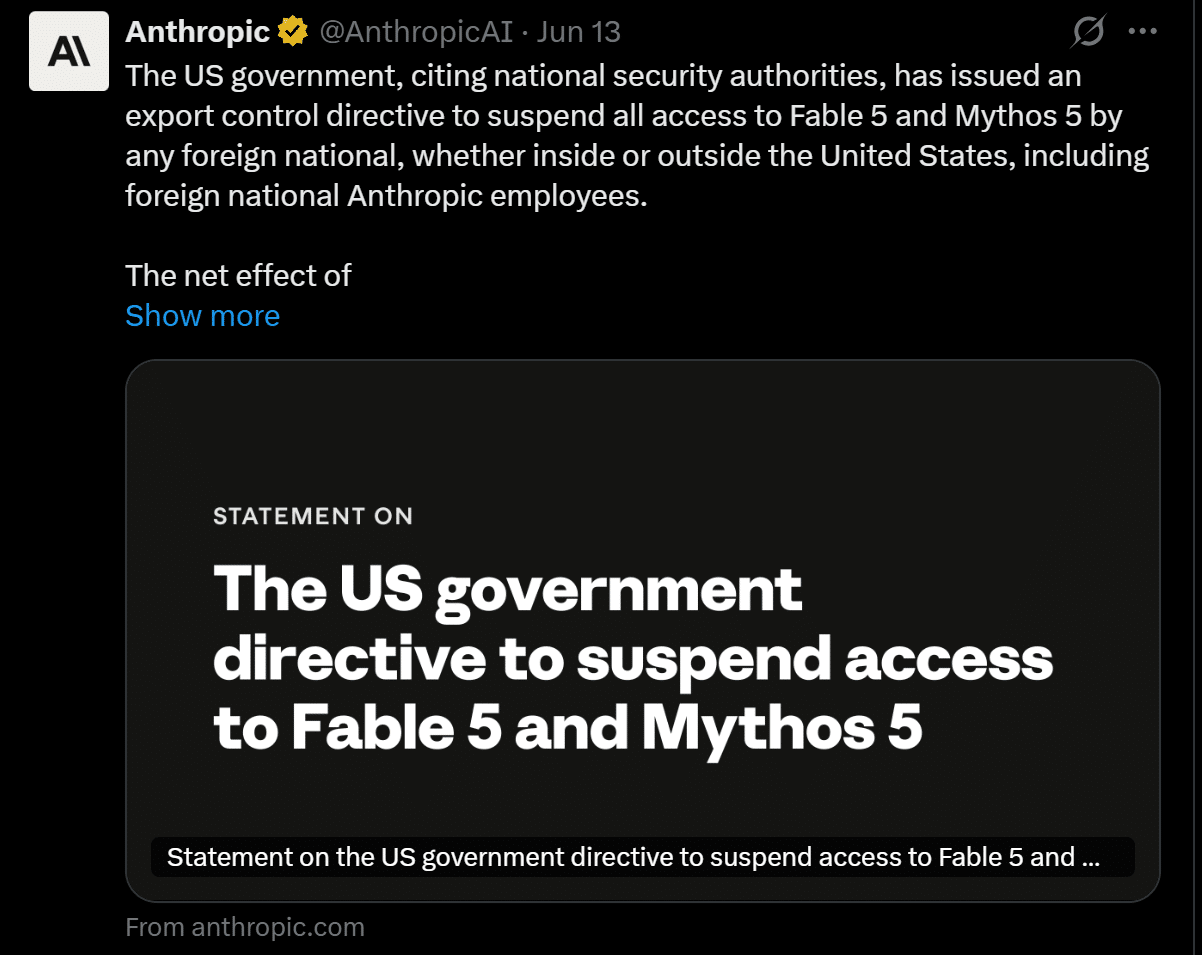
Bittensor’s rally did not emerge in isolation. Anthropic announced that access to Fable 5 and Mythos 5 would be suspended for foreign nationals following a U.S. government directive. The decision immediately highlighted a key weakness of centralized AI systems.
Source: X

Access could be restricted by regulation, regardless of demand. That narrative quickly spilled into crypto markets. As a result, traders rotated toward decentralized AI projects, helping TAO extend its advance toward the $272-$279 range.

Volume climbed above $560 million, reinforcing the strength of the move. This reaction suggests buyers were responding to more than technical momentum alone.

However, the durability of the rally now depends on whether demand continues after the headline impact fades.

Can bulls force a break above $300?

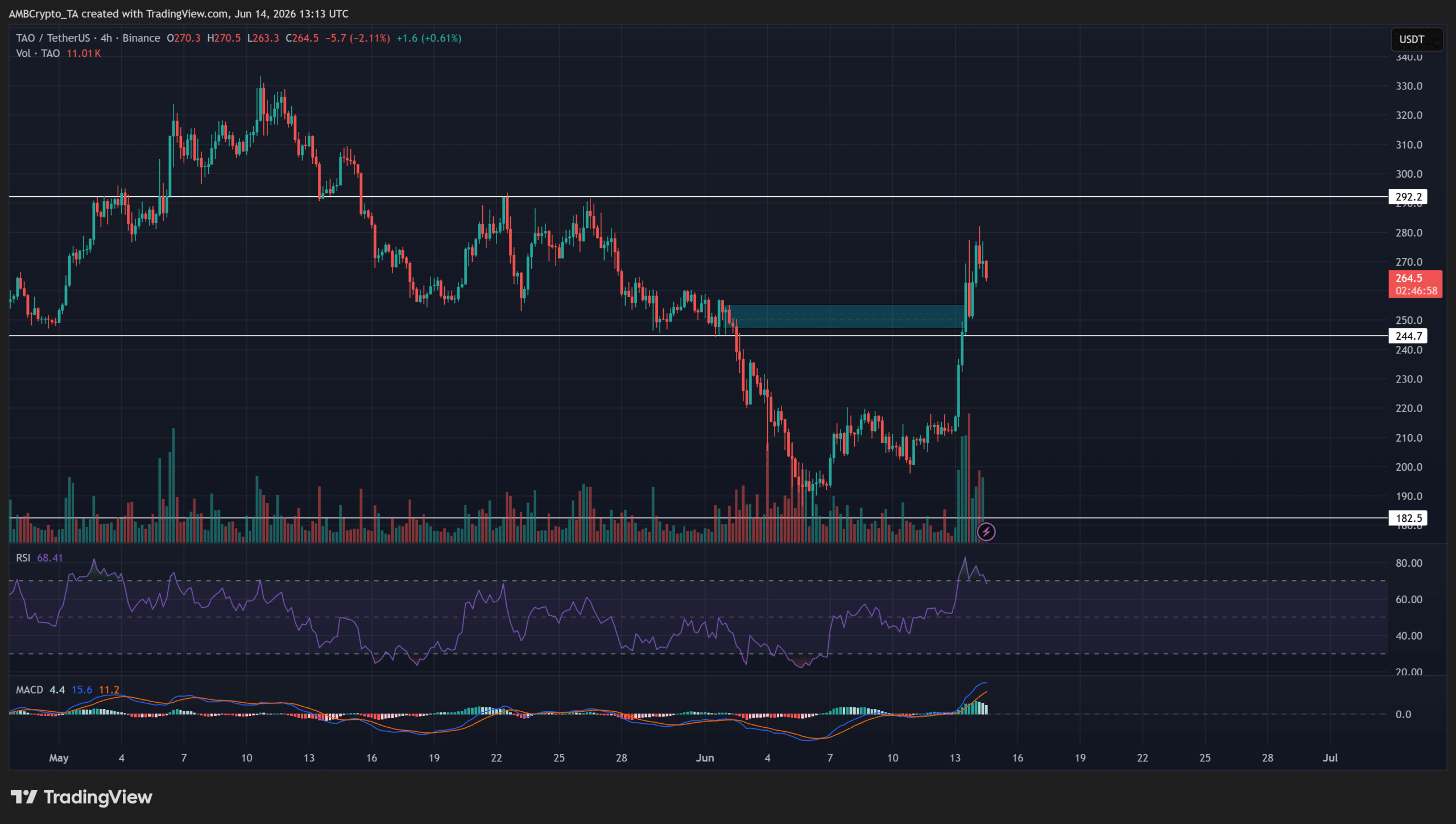
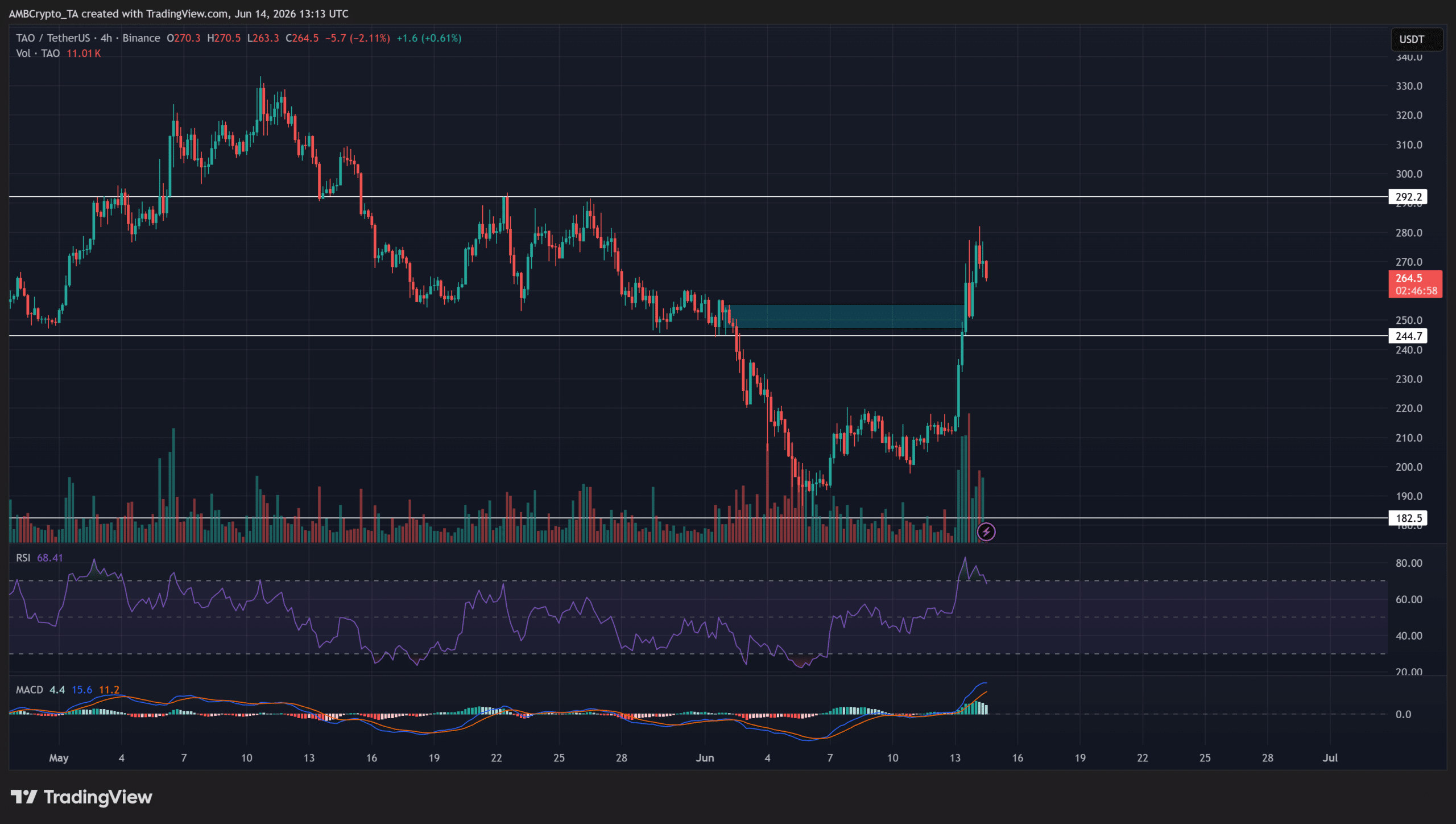
TAO’s sharp rebound has shifted attention toward whether buyers can maintain control above newly reclaimed levels. After rallying from the $182.5 liquidity sweep to $292.2, the price encountered resistance near a key May supply zone and began pulling back.
Source: TAO/USDT on TradingView

That reaction places the former $244.7-$255 consolidation range in focus. The area previously acted as resistance before the breakout and now serves as the market’s most important support zone.

Holding above it would preserve the recovery structure and keep $300 within reach. Losing it would expose TAO to a deeper retracement toward $210-$220 support.


Final Summary

  • Bittensor [TAO] reclaimed key resistance levels as rising volume and AI-driven demand strengthened the recovery structure.
  • TAO now faces a decisive $300 test, with support holding critical to preserving recent gains.

Crypto di tendenza

Domande pertinenti

QWhat was the main catalyst for Bittensor's (TAO) recent 28% price rally, according to the article?

AThe main catalyst was an announcement from Anthropic restricting access to its AI models (Fable 5 and Mythos 5) for foreign nationals. This highlighted a weakness in centralized AI systems and drove demand towards decentralized AI projects like Bittensor, fueling TAO's price surge.

QFrom which key support level did TAO's recovery begin, and to what level did it initially rally?

ATAO's recovery began near the key $180.9 support zone. Momentum then accelerated sharply, lifting the price from roughly $215 to $267.4 within two trading sessions.

QWhat is the critical support zone that TAO must hold to maintain its recovery structure and keep the $300 price target in reach?

AThe critical support zone is the former consolidation range of $244.7 to $255. This area previously acted as resistance before the breakout and is now the most important support zone. Holding above it is necessary to preserve the recovery structure.

QHow did technical indicators like RSI and volume behave during TAO's price breakout?

ADuring the breakout, the Relative Strength Index (RSI) climbed from below 40 to 59.2, indicating strengthening momentum. Volume also expanded aggressively, producing its strongest positive reading in nearly two months, reinforcing the strength of the move.

QWhat factor does the article suggest will determine the durability of TAO's rally beyond the initial headline impact?

AThe durability of the rally depends on whether demand for TAO continues after the initial impact of the Anthropic news headline fades. Sustained demand is needed to maintain the upward momentum.

Letture associate

U.S. Tech Momentum Stocks Post Largest Single-Day Gain Ever, But Is the Plunge Over?

US tech momentum stocks staged a sharp rebound on Tuesday (July 21st). Morgan Stanley's TMT Momentum Factor surged over 12%, marking its largest single-day gain on record, exceeding even peaks from the 2000 dot-com bubble. Key momentum indices from Goldman Sachs also posted their strongest daily performances in years. The rally was led by semiconductors, with the Philadelphia Semiconductor Index jumping 4.6%. This rebound followed three consecutive down days and a cumulative 33% plunge in momentum stocks, one of the steepest drawdowns since the dot-com era. Analysts attribute the surge largely to a short squeeze. Heavy selling had pushed high-beta momentum stocks into deeply oversold territory, forcing many short sellers, particularly in Asia, to cover their positions, creating a self-reinforcing buying spiral. However, the rebound's internals appear weak. Trading volume was notably low, and advancing stocks still lagged decliners on the S&P 500, indicating a narrow, concentrated rally rather than broad market participation. Diverging views emerge on the outlook. BTIG warns the bounce has hit key resistance and recommends selling into strength, citing extreme volatility and historical parallels to past market tops. Conversely, Goldman Sachs and UBS believe the momentum unwind is nearing its end, suggesting it may be time to gradually add exposure, as positioning has been significantly reduced. They caution, however, that high volatility warrants a measured approach, potentially using defined-risk strategies. The upcoming earnings season, particularly reports from major tech firms like Alphabet, is seen as a critical test for the rally's sustainability. Simultaneously, bond markets flashed a warning, with yields rising partly due to spiking oil prices. Analysts note that if long-term Treasury yields break decisively higher, it could pose a significant headwind for equities, especially growth stocks.

marsbit7 min fa

U.S. Tech Momentum Stocks Post Largest Single-Day Gain Ever, But Is the Plunge Over?

marsbit7 min fa

U.S. Tech Momentum Stocks Record Largest Single-Day Gain Ever, but Has the Rout Ended?

U.S. tech momentum stocks staged a dramatic rebound on Tuesday, July 21st. Key momentum indices like the Morgan Stanley TMT Momentum Factor and Goldman Sachs' High Beta Momentum Long Index posted historic or near-historic single-day gains, fueled largely by semiconductor stocks. This sharp rally followed a severe three-day sell-off that saw momentum stocks plunge 33%, marking one of the steepest pullbacks since the dot-com bubble. Analysts attribute the bounce primarily to a short squeeze, as forced covering from over-leveraged traders, particularly in Asia, created a buying spiral. However, the rally's health is questioned due to weak market breadth—overall trading volume was low, and decliners outnumbered advancers in the S&P 500 despite the index's gain—suggesting a narrow, concentrated surge rather than broad recovery. Opinions on the sustainability diverge. BTIG strategists warn the rebound has hit key resistance levels, citing extreme volatility and historic stock dispersion as signs of an ongoing broader correction, and recommend selling into strength. Conversely, Goldman Sachs and UBS view the aggressive momentum unwinding as nearing its end, noting reduced positioning and a lack of new fundamental catalysts. They suggest the sell-off presents a selective opportunity to add exposure, albeit cautiously and gradually using defined-risk strategies. The immediate trajectory hinges on the ongoing earnings season, with market focus on Alphabet's capital expenditure guidance for AI investment clarity. Meanwhile, bond markets present a risk, with rising Treasury yields—potentially heading toward 5.5%—and widening credit spreads for mega-cap tech companies posing a threat to equity valuations. The combination of technical factors, earnings results, and macro conditions leaves the durability of the rebound in doubt.

链捕手10 min fa

U.S. Tech Momentum Stocks Record Largest Single-Day Gain Ever, but Has the Rout Ended?

链捕手10 min fa

Long-Divided Must Unite, Long-United Must Divide: When L1 Becomes Its Own Rollup, What Is Ethereum's Endgame?

"The Inevitable Cycle: When L1 Becomes Its Own Rollup – What is Ethereum's Endgame?" For years, the Ethereum community grappled with concerns that L2s were fragmenting the ecosystem and eroding L1's value. While L2s provided cheaper execution, they also splintered liquidity and the unified user experience of a single chain. This has prompted a fundamental reassessment of the relationship between L1 and L2. Ethereum's roadmap is evolving. The "Scale" initiative merges L1 and L2 expansion into a holistic framework. L1 itself is advancing with higher gas limits, statelessness, and zkEVM verification, no longer content to be just a low-throughput settlement layer. Consequently, the primary value proposition of L2s is shifting from merely providing cheap blockspace to offering L1 cannot easily provide: application-specific optimizations, privacy features, and flexible governance models. L2s are becoming a spectrum of execution environments with varying degrees of security inheritance from Ethereum. A critical challenge in this multi-chain future is interoperability. The vision is to make Ethereum "feel like one chain again." This relies on advancements in native account abstraction (like EIP-7702) and intent-based architectures (Open Intents Framework), where users declare desired outcomes, and solvers handle the complex cross-chain execution. Furthermore, shortening Ethereum's finality time from minutes to seconds is crucial, as it underpins trust between chains for bridges, stablecoins, and cross-chain applications. Perhaps the most provocative idea is that Ethereum L1 itself could become a form of "its own Rollup." As zkEVM and proof systems mature, high-performance nodes could execute transactions and generate validity proofs. Regular validators would then verify these proofs instead of re-executing all transactions. This blurs the traditional L1/L2 hierarchy, making "Rollup" more of a general execution-verification architecture. Native Rollup aims to integrate L2 validation more directly into the Ethereum protocol, allowing L2s to inherit L1's security more fully and move away from reliance on security councils. In the end, L2s are not destined to replace L1 or be made obsolete by it. The likely future is a unified system where diverse execution environments—each optimized for specific use cases like DeFi, gaming, or privacy—coexist. They will share a common foundation of security, liquidity, and verifiable state, seamlessly connected to restore a cohesive user experience. The next phase for Ethereum is not just about scaling through separation, but about intelligently reintegrating what was separated back into a coherent whole.

链捕手26 min fa

Long-Divided Must Unite, Long-United Must Divide: When L1 Becomes Its Own Rollup, What Is Ethereum's Endgame?

链捕手26 min fa

Agent Race Ends, Super Workbench Takes Over

The era of fragmented AI agents is ending. Over the past month, China's tech giants—Tencent, Alibaba, and ByteDance—have simultaneously shifted strategy: instead of launching new, standalone AI agents, they are consolidating their various agent projects into unified "super workbenches." Tencent integrated its QClaw teams into WorkBuddy, a strategic product hailed as a potential third flagship after QQ and WeChat. Alibaba is merging its QoderWork, Wukong, and MuleRun agents into a new "Qianwen Office" platform under DingTalk's leadership. ByteDance rebranded its TRAE SOLO coding agent to TRAE Work, signaling a broader focus on workflow collaboration. This convergence marks a pivotal industry consensus. The initial exploration phase, where companies rapidly built numerous overlapping agents for different scenarios, proved costly and inefficient. With open-source tools eroding technical barriers, competition has shifted from agent creation to resource consolidation and cost control. Historically, platform wars are won not by creating more products, but by simplifying them—as seen with browsers unifying web access and super-apps consolidating services. Now, the "super workbench" aims to become the unified AI entry point for work. This reflects a deeper market realization: the primary audience for AI is no longer just programmers (a market in the tens of millions) but all knowledge workers (a market of billions). The real opportunity lies in augmenting everyday tasks—managing emails, documents, data, and meetings—across the entire workday. The core battleground is becoming control over the primary AI entry point that employees use daily. Tencent's WorkBuddy leverages WeChat and Tencent Docs; Alibaba's Qianwen Office taps into DingTalk's organizational data; ByteDance's TRAE Work integrates with Feishu's workflows. Whoever owns this "super workbench" gains strategic control over orchestrating enterprise data and APIs. This shift is redefining enterprise software. Traditional SaaS applications, valued for their user interfaces, will recede into the background. Their core functionalities will be exposed as standardized "Skills" or APIs for the super workbench's agents to invoke. Software value will shift from selling user seats to charging based on API calls and outcomes delivered. The evolution of agents is moving through clear stages: first as novel standalone products, then as consolidated primary work entry points, and finally as pervasive, invisible capabilities embedded into the digital fabric. The recent moves by major tech firms signal the transition from the first stage into the second, accelerating toward the third. In the end, the most successful agent technology may become invisible—like electricity or the HTTP protocol—a fundamental, unnamed infrastructure powering work itself.

marsbit53 min fa

Agent Race Ends, Super Workbench Takes Over

marsbit53 min fa

Trading

Spot

Articoli Popolari

Come comprare GAIN

Benvenuto in HTX.com! Abbiamo reso l'acquisto di GriffinAI (GAIN) semplice e conveniente. Segui la nostra guida passo passo per intraprendere il tuo viaggio nel mondo delle criptovalute.Step 1: Crea il tuo Account HTXUsa la tua email o numero di telefono per registrarti il tuo account gratuito su HTX. Vivi un'esperienza facile e sblocca tutte le funzionalità,Crea il mio accountStep 2: Vai in Acquista crypto e seleziona il tuo metodo di pagamentoCarta di credito/debito: utilizza la tua Visa o Mastercard per acquistare immediatamente GriffinAIGAIN.Bilancio: Usa i fondi dal bilancio del tuo account HTX per fare trading senza problemi.Terze parti: abbiamo aggiunto metodi di pagamento molto utilizzati come Google Pay e Apple Pay per maggiore comodità.P2P: Fai trading direttamente con altri utenti HTX.Over-the-Counter (OTC): Offriamo servizi su misura e tassi di cambio competitivi per i trader.Step 3: Conserva GriffinAI (GAIN)Dopo aver acquistato GriffinAI (GAIN), conserva nel tuo account HTX. In alternativa, puoi inviare tramite trasferimento blockchain o scambiare per altre criptovalute.Step 4: Scambia GriffinAI (GAIN)Scambia facilmente GriffinAI (GAIN) nel mercato spot di HTX. Accedi al tuo account, seleziona la tua coppia di trading, esegui le tue operazioni e monitora in tempo reale. Offriamo un'esperienza user-friendly sia per chi ha appena iniziato che per i trader più esperti.

348 Totale visualizzazioniPubblicato il 2025.09.24Aggiornato il 2026.06.02

Come comprare GAIN

Discussioni

Benvenuto nella Community HTX. Qui puoi rimanere informato sugli ultimi sviluppi della piattaforma e accedere ad approfondimenti esperti sul mercato. Le opinioni degli utenti sul prezzo di GAIN GAIN sono presentate come di seguito.

活动图片