Bitcoin Returns to $70K: Rebound or Real Trap?

marsbitPubblicato 2026-02-09Pubblicato ultima volta 2026-02-09

Introduzione

Bitcoin surged from $60,000 to over $70,000 in under 24 hours, erasing a 14% drop, but the rebound was driven more by macro-market stabilization and forced liquidations than strong spot buying. The sell-off was triggered by risk-off sentiment across assets, including tech stocks and metals, exacerbated by expectations of tighter liquidity under a potential Trump-appointed Fed chair. Despite the rebound, derivatives markets show persistent bearish signals: negative funding rates, skewed put options, and ETF outflows. Options traders are pricing in a significant chance of a drop to $50,000–$60,000 by late February. Holding $70,000 depends on sustained macro stability, reduced leverage, improved miner conditions, and a reversal in institutional outflows. The rebound appears fragile, with underlying sentiment remaining cautious.

Author: CryptoSlate

Compiled by: Deep Tide TechFlow

Original link: https://cryptoslate.com/bitcoin-rocketed-15-to-get-back-above-70000-but-the-options-market-is-currently-pricing-in-a-terrifying-new-floor/

Deep Tide Insights:

After a violent 24-hour rebound from $60,000 to $70,000, Bitcoin appears to have recouped its losses. However, the fundamental logic reveals that this was not driven by firm spot buying but rather by forced position adjustments and short squeezes triggered by a recovery in the broader macro market. This article delves into the causes of this "hair-raising turmoil" in early February 2026: from liquidity contraction expectations following Trump's appointment of Kevin Warsh to the pressure on miners' profits hitting a historical low. Despite the price climbing back above $70,000, options traders are heavily betting on a potential secondary dip to $50,000-$60,000 by the end of February, revealing the still-fragile sentiment and complex financial games beneath the surface of this "violent rebound."

Bitcoin surged from $60,000 to above $70,000 in less than 24 hours, erasing the brutal 14% drop that had tested all the "buy-the-dip" theories in the market.

The speed of this reversal—a 12% single-day rally, rebounding 17% from the intraday low—was so intense that it felt like the dust settling after a liquidation. However, the mechanism behind the rebound tells another story: it was more a combination of cross-asset stabilization and forced position rebalancing, rather than conviction-driven, large-scale spot demand.

Meanwhile, the derivatives market remains crowded with bearish protective positions, pricing in that $70,000 might be just a waystation, not a true bottom.

Liquidation Wave Meets Macro Pressure

On February 5th, the market opened around $73,100, briefly attempted an upward move, then collapsed, closing at $62,600. According to CoinGlass data, the single-day decline led to the liquidation of approximately $1 billion in leveraged Bitcoin positions.

This figure alone speaks volumes about the chain reaction of forced selling, but the broader context was even worse.

CoinGlass data shows that Bitcoin futures open interest (OI) had already dropped from around $61 billion to $49 billion last week, meaning the market was already deleveraging before the final wave of冲击 hit.

The trigger was not internal to cryptocurrency. Media reports characterized the sell-off as a deterioration in risk sentiment, primarily driven by a sell-off in tech stocks and volatility shocks in precious metals—silver plummeted by up to 18% to around $72.21, dragging down all correlated risk assets.

Deribit's research confirmed this spillover effect, pointing to a shift in derivatives sentiment to extreme pessimism: negative funding rates, an inverted implied volatility term structure, and the 25-delta risk-reversal skew depressed to around -13%.

This is a classic state of "extreme fear," where positioning amplifies price swings in both directions.

Policy narratives added fuel to the fire. According to Reuters, the market reacted strongly to reports that President-elect Donald Trump might choose Kevin Warsh as Fed Chair, with traders interpreting this as a signal of future balance sheet contraction and liquidity tightening.

Simultaneously, miners faced immense profit pressure. According to TheMinerMag, the hash price fell below $32 per PH/s, and the network difficulty was expected to下调 (adjust downward) by approximately 13.37% in two days. However, this relief mechanism had not yet taken effect before price broke below support levels.
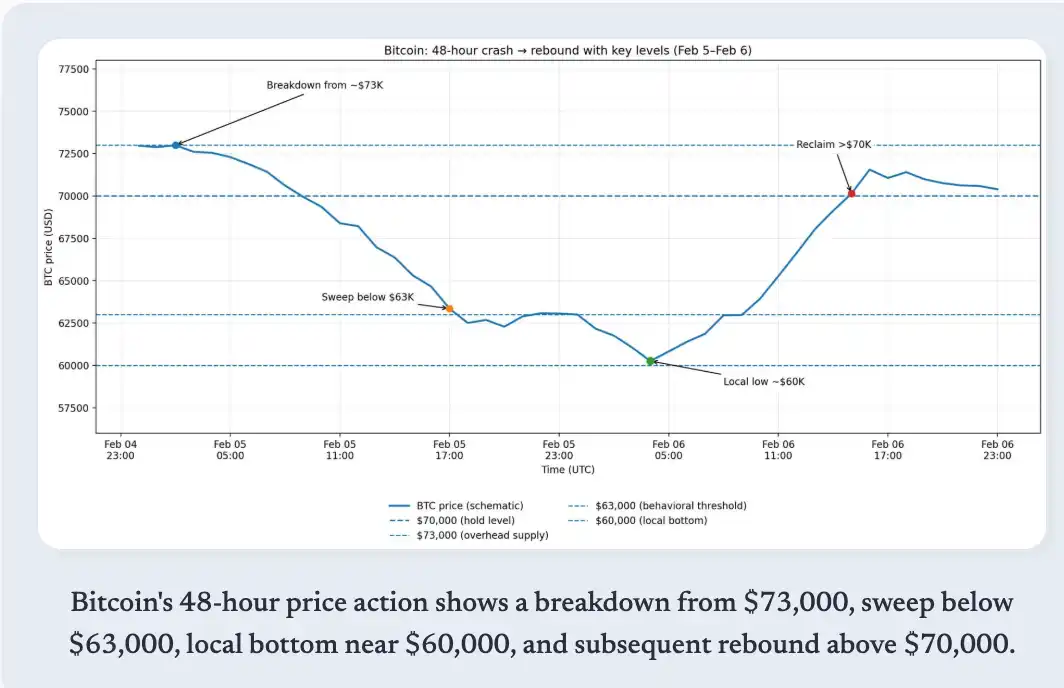
Bitcoin's price action over 48 hours, showing the crash from $73K, the sweep below $63K, local basing near $60K, and the subsequent rebound back above $70K.

Macro Reversal and Squeeze Mechanism

February 6th opened at the previous day's close, then fell to a daily low near $60,000 before rocketing to a high of $71,422. After three failed attempts to break above this level, the price fell back below $70,000.

The catalyst did not originate from within the crypto industry but was a sharp U-turn in cross-asset movements. Wall Street performed strongly: the S&P 500 rose 1.97%, the Nasdaq gained 2.18%, the Dow Jones increased 2.47%, and the Philadelphia Semiconductor Index (SOX) surged 5.7%.

Metal prices rebounded violently, with gold up 3.9% and silver up 8.6%, while the US Dollar Index fell 0.2%, signaling easier financial conditions.

Bitcoin moved mechanically with this shift. The correlation was evident: as tech stocks stabilized and metals rebounded, Bitcoin was pulled up through common risk exposures.

However, the violence of this rebound also reflected derivatives positioning. The near -13% skew, negative funding rates, and inverted volatility structure created conditions where any macro-positive catalyst could trigger short-covering and forced position adjustments.

This rally was essentially driven by a liquidity event and amplified by the unwinding of crowded short positions.

Nevertheless, forward-looking signals remain bearish. Data from Deribit shows that for options expiring on February 27th, put open interest is heavily concentrated at strike prices between $60,000 and $50,000.

Sean Dawson from Deribit told Reuters that the demand for downside protection is "extreme." This is not hindsight analysis; traders are explicitly hedging against the next leg down, even after the rebound.
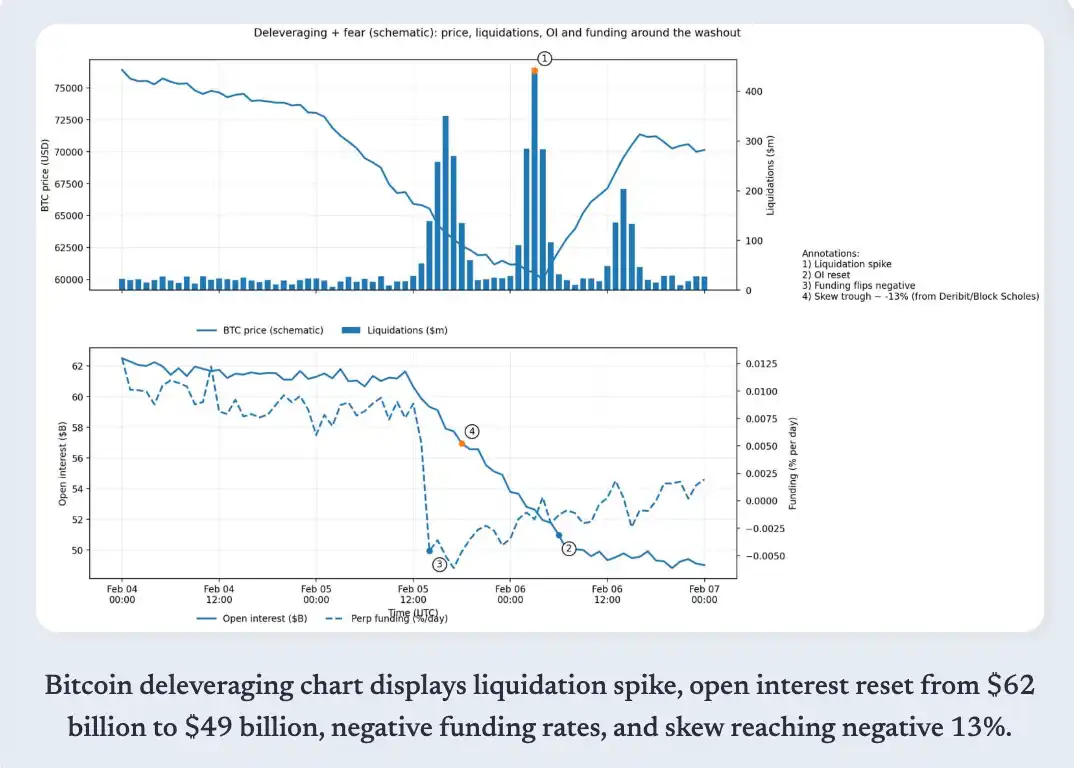
Bitcoin deleveraging chart showing liquidation spikes, OI reset from $62B to $49B, negative funding, and skew hitting -13%.

Can $70K Hold? Analytical Framework

The logic for holding $70,000 is based on three conditions.

First, the macro rebound needs to persist, with tech stocks continuing to stabilize, and US Treasury yields and the dollar not tightening again. This rally was clearly a cross-asset correlation; if US stocks turn lower again, Bitcoin will not be immune.

Second, leverage needs to continue cooling off with no new forced selling emerging. Open interest has already declined significantly, reducing the risk of a "vacuum drop."

Third, miner pressure needs substantive relief when the difficulty adjustment takes effect. If prices can hold steady within the adjustment window, the anticipated 13.37% difficulty下调 should reduce marginal selling pressure and allow the hash rate to stabilize.

Arguments supporting another washout also have three reasons:

First, options positioning remains skewed bearish. The largest put concentrations for late February are at $60K-$50K, a forward-looking signal embedded in market-implied probabilities, not lagging sentiment.

Second, derivatives signals remain fragile. Extreme skew, the recent prevalence of negative funding rates, and an inverted volatility structure align more with the characteristics of a "relief rally" within a fear regime, not a trend reversal.

Third, ETF flow data shows continued outflows. As of February 5th, Bitcoin ETF net monthly outflows had reached $690 million. Although data for February 6th is not yet available, the existing pattern suggests institutional allocators have not shifted from "de-risking" to "re-engagement."

Signal Dashboard

Indicator Latest Reading / Status (As of Publishing) Bull Confirmation (What Needs to Change) Bear Continuation (What to Watch For) Source
Derivatives Perp Funding Rate Negative (below 0%) -- "Extremely Bearish" state Funding turns positive & stabilizes on major platforms (not just 1-2 hour spikes) Funding stays negative / oscillates wildly during price chops → "Bull Trap" risk
Options Risk 25D Risk Reversal (Skew) Short-term skew as low as ~-13% (Surge in put demand) Skew recovers towards 0 (Less downside protection demand) & stabilizes Skew remains deeply negative (Sustained protective buying)
Leverage Futures OI Deleveraging / OI drop (Forced liquidation phase); Recent reports show ~$55B equiv exited in 30d OI flattens out (No rapid re-levering) & price holds $70K OI accumulates quickly during bounce → Probability of next liquidation leg increases
Fund Flows Spot BTC ETF Net Flow Net Outflows: Feb 4 -$544.9M, Feb 5 -$434.1M Outflows decelerate to flat, then turn to slight inflows Outflows accelerate (Consecutive -$400M to -$500M days)→ Repeat washout risk
Mining Hash Price + Difficulty Adj Hash Price < $32/PH/s (Historic lows); Difficulty下调 ~13.37% expected Difficulty下调 arrives & hashrate stabilizes (Reduces miner sell pressure) Hash price falls further / Hashrate drops significantly → Increased miner selling/inventory outflow

The True Meaning of $70K

This price level itself holds no magic. Its importance lies in its position just above the $66,900 to $70,600 on-chain absorption cluster identified by Glassnode.

Holding $70,000 means this cluster has absorbed enough supply to temporarily stabilize prices. However, holding firm depends not just on technical support but also on the return of spot demand, the unwinding of derivatives hedge positions, and the stabilization of institutional flows.

The rebound from $60,000 was real, but its composition is crucial. If macro conditions change, cross-asset stability will reverse.

The unwinding of forced positions created a mechanical rebound, which does not necessarily translate into a sustained trend. Options traders are still pricing in a significant probability of a move down towards $50,000-$60,000 within the next three weeks.

Bitcoin reclaimed $70,000 but is currently consolidating below it. This suggests a pause before the next test, and the outcome of that next test depends on three conditions occurring in sequence: sustained macro risk appetite, deceleration or reversal of ETF outflows, and normalization of derivatives sentiment.

The market delivered a violent snap-back, but the forward curve and flow data indicate traders are not yet betting on its persistence. $70,000 is not the endgame; it is merely the baseline that will determine the winner of the next phase of the debate.


Domande pertinenti

QWhat were the main factors that triggered the violent Bitcoin price drop to around $60,000 on February 5th, 2026?

AThe main triggers were a broader risk-off sentiment in financial markets, including a sell-off in tech stocks and extreme volatility in precious metals (like silver dropping ~18%), which negatively impacted all risk assets. Additionally, market concerns about potential future liquidity tightening—sparked by reports that Donald Trump might appoint Kevin Warsh as Fed Chair—exacerbated the sell-off. Forced liquidations of leveraged Bitcoin positions (around $1 billion in BTC liquidations) also amplified the downward move.

QHow did the rebound from ~$60,000 to over $70,000 occur within 24 hours, and what was the primary mechanism behind it?

AThe rebound was primarily driven by a macro market reversal, where tech stocks rallied (S&P 500 +1.97%, Nasdaq +2.18%), metals recovered sharply (gold +3.9%, silver +8.6%), and the Dollar Index weakened. This cross-asset stabilization created a mechanical lift for Bitcoin. The violent nature of the bounce was amplified by a short squeeze—derivatives positioning was extremely bearish (with negative funding rates, inverted volatility, and a -13% risk-reversal skew), so any macro improvement forced short covering and rapid position rebalancing.

QWhat does the options market indicate about traders' expectations for Bitcoin's price by the end of February 2026?

AThe options market shows significant bearish hedging, with a large concentration of put open interest at strike prices between $50,000 and $60,000 for February 27th expiries. This indicates that traders are pricing in a substantial risk of a second downturn to those levels, despite the recent rebound. The demand for downside protection is described as 'extreme,' suggesting a lack of conviction in the sustainability of the $70,000 recovery.

QWhat three conditions are necessary for Bitcoin to sustainably hold above $70,000, according to the analysis?

A1. Sustained macro rebound: Tech stocks must continue to stabilize, with no renewed tightening in Treasury yields or the US Dollar. 2. Leverage cooling: Further forced selling must be avoided, and open interest should not rapidly re-leverage. 3. Miner relief: The expected 13.37% network difficulty adjustment must take effect, reducing mining pressure and stabilizing hash rate to minimize marginal selling from miners.

QWhat key on-chain level is referenced as important for Bitcoin's price stability, and why is holding $70,000 significant in that context?

AThe $66,900 to $70,600 range is identified as an on-chain absorption cluster by Glassnode. Holding above $70,000 means that this cluster has absorbed enough supply to provide temporary price support. However, for the level to be sustained, it requires genuine spot demand, normalization of derivatives sentiment, and a reversal in ETF outflows—not just technical absorption.

Letture associate

You Bet on the News, the Pros Read the Rules: The True Cognitive Gap in Losing Money on Polymarket

The article explains that the key to profiting on Polymarket, a prediction market platform, lies not just predicting real-world events correctly, but in meticulously understanding the specific rules that govern how each market will be resolved. It illustrates this with examples, such as a market on Venezuela's 2026 leader, where the official rules defining "officially holds" the office overruled the intuitive answer of who was in practical control. Other examples include debates over the definition of a "token" or what constitutes an "agreement." The core argument is that a "reality vs. rules" gap creates pricing discrepancies that savvy traders ("车头" or "whales") exploit. The platform has a formal dispute resolution process managed by UMA token holders to settle ambiguous outcomes. This process involves proposal submission, a challenge window, a discussion period, and a final vote. However, the article highlights a critical flaw in this system compared to a traditional court: the lack of separation between the arbiters (UMA voters) and the interested parties (traders with financial stakes in the outcome). This conflict of interest undermines the discussion phase, leads to herd mentality, and results in opaque final decisions without explanatory rulings. Consequently, the system lacks a body of precedent, making it difficult for users to learn from past disputes. The ultimate takeaway is that success on Polymarket requires a lawyer-like scrutiny of the rules to identify and capitalize on the cognitive gap between how events appear and how they are contractually defined for settlement.

marsbit26 min fa

You Bet on the News, the Pros Read the Rules: The True Cognitive Gap in Losing Money on Polymarket

marsbit26 min fa

Will the Fed Still Cut Interest Rates? Tonight's Data Is Crucial

The core debate surrounding the Federal Reserve's potential interest rate cuts is intensifying amid geopolitical conflict and rebounding inflation. The key question is whether high energy prices will cause persistent inflation or weaken consumer demand enough to force the Fed to cut rates. Citigroup presents a bullish case for cuts, arguing that oil supply disruptions from the Strait of Hormuz are temporary and will not lead to lasting inflationary pressure. They point to receding bond yields and oil prices as evidence the market is pricing in a short-lived shock. Citi's data also shows tightening financial conditions, a stabilizing labor market, and healthy tax returns, supporting their view that the path to lower rates remains open. Conversely, Deutsche Bank offers a starkly contrasting, more hawkish outlook. They argue the Fed's current policy is already neutral and expect rates to remain unchanged indefinitely. Their view is based on stalled disinflation progress and a shift toward more hawkish rhetoric from key Fed officials like Waller, who cited risks from prolonged Middle East conflict and tariffs. Other officials, including Williams and Hammack, signaled rates would likely stay on hold for a "considerable time." The market pricing has shifted dramatically, now forecasting zero cuts in 2026. The imminent release of the March retail sales "control group" data is highlighted as a critical test. This metric, which excludes gas station sales, will reveal if high gasoline prices are eroding consumer spending in other areas. A weak reading could support the case for imminent rate cuts, while a strong one would bolster the argument for the Fed to hold steady. This data is pivotal for determining the near-term policy path.

marsbit47 min fa

Will the Fed Still Cut Interest Rates? Tonight's Data Is Crucial

marsbit47 min fa

Trading

Spot
Futures

Articoli Popolari

Cosa è BITCOIN

Comprendere HarryPotterObamaSonic10Inu (ERC-20) e la sua posizione nel mondo delle criptovalute Negli ultimi anni, il mercato delle criptovalute ha assistito a un aumento della popolarità delle meme coin, catturando l'interesse non solo dei trader, ma anche di coloro che cercano coinvolgimento comunitario e valore di intrattenimento. Tra questi token unici c'è HarryPotterObamaSonic10Inu (ERC-20), un progetto intrigante che mescola riferimenti culturali nel tessuto delle criptovalute. Questo articolo esplora gli aspetti chiave di HarryPotterObamaSonic10Inu, analizzando i suoi meccanismi, l'etica guidata dalla comunità e il suo coinvolgimento con il panorama crittografico più ampio. Che cos'è HarryPotterObamaSonic10Inu (ERC-20)? Come suggerisce il suo nome, HarryPotterObamaSonic10Inu è una meme coin costruita sulla blockchain di Ethereum, classificata secondo lo standard ERC-20. A differenza delle criptovalute tradizionali che possono enfatizzare l'utilità pratica o il potenziale investimento, questo token prospera grazie al valore di intrattenimento e alla forza della sua comunità. Il progetto mira a creare un ambiente in cui gli utenti coinvolti possono riunirsi, condividere idee e partecipare ad attività ispirate a diversi fenomeni culturali. Una caratteristica notevole di HarryPotterObamaSonic10Inu è la zero tassa sulle transazioni. Questo elemento allettante tende a incoraggiare il trading e il coinvolgimento della comunità, privo di costi aggiuntivi che possono scoraggiare i trader di piccole dimensioni. L'offerta totale della moneta è fissata a un miliardo di token, un numero che segna la sua intenzione di mantenere una circolazione sostanziale all'interno della comunità. Creatore di HarryPotterObamaSonic10Inu (ERC-20) Le origini di HarryPotterObamaSonic10Inu sono avvolte in un certo mistero; i dettagli sul creatore rimangono sconosciuti. Lo sviluppo di questo token non presenta un team identificabile o un piano esplicito, cosa non rara nel settore delle meme coin. Invece, il progetto è emerso organicamente, con il suo progresso fortemente dipendente dall'entusiasmo e dalla partecipazione della sua comunità. Investitori di HarryPotterObamaSonic10Inu (ERC-20) Per quanto riguarda investimenti esterni e finanziamenti, HarryPotterObamaSonic10Inu rimane ambiguo. Il token non elenca alcuna fondazione di investimento conosciuta o un sostegno organizzativo significativo. Invece, la linfa vitale del progetto è la sua comunità di base, che informa la sua crescita e sostenibilità attraverso azioni collettive e coinvolgimento nello spazio crittografico. Come funziona HarryPotterObamaSonic10Inu (ERC-20)? In quanto meme coin, HarryPotterObamaSonic10Inu opera principalmente al di fuori delle strutture tradizionali che governano spesso il valore degli asset. Ci sono diversi aspetti distintivi che definiscono il funzionamento del progetto: Transazioni senza tasse: Senza costi fiscali sulle transazioni, gli utenti possono comprare e vendere liberamente il token senza preoccuparsi di costi nascosti. Coinvolgimento della comunità: Il progetto prospera sull'interazione della comunità, sfruttando le piattaforme social per creare entusiasmo e facilitare il coinvolgimento. Discussioni, condivisione di contenuti e coinvolgimento sono elementi cruciali che aiutano ad espandere la sua portata e a favorire la lealtà tra i sostenitori. Nessuna utilità pratica: Va notato che HarryPotterObamaSonic10Inu non offre un'utilità concreta all'interno dell'ecosistema finanziario. Piuttosto, è classificato come un token principalmente per attività di intrattenimento e comunitarie. Riferimento culturale: Il token incorpora astutamente elementi della cultura pop per attirare interesse, collegandosi a appassionati di meme e seguaci delle criptovalute. HarryPotterObamaSonic10Inu esemplifica come le meme coin operino in modo diverso rispetto ai progetti di criptovalute più tradizionali, entrando nel mercato come costrutti sociali innovativi piuttosto che come asset utilitari. Cronologia di HarryPotterObamaSonic10Inu (ERC-20) La storia di HarryPotterObamaSonic10Inu è segnata da diversi traguardi notevoli: Creazione: Il token è emerso da un meme virale, catturando l'immaginazione di molti appassionati di criptovalute. Le date di creazione specifiche non sono disponibili, sottolineando la sua crescita organica. Inserimento negli scambi: HarryPotterObamaSonic10Inu ha fatto il suo ingresso in vari scambi, consentendo un accesso e un trading più facili da parte della comunità. Iniziative di coinvolgimento della comunità: Attività in corso volte a migliorare l'interazione della comunità, comprese gare, campagne sui social media e generazione di contenuti da parte di fan e sostenitori. Piani di espansione futura: La tabella di marcia del progetto include il lancio di una collezione NFT, merchandising e un sito di eCommerce relativo ai suoi temi culturali, coinvolgendo ulteriormente la comunità e cercando di aggiungere più dimensioni al suo ecosistema. Punti chiave su HarryPotterObamaSonic10Inu (ERC-20) Natura guidata dalla comunità: Il progetto dà priorità al contributo collettivo e alla creatività, garantendo che il coinvolgimento degli utenti sia al centro del suo sviluppo. Classificazione come meme coin: Rappresenta l'epitome delle criptovalute basate sull'intrattenimento, distinguendosi dai veicoli d'investimento tradizionali. Nessuna affiliazione diretta con Bitcoin: Nonostante la somiglianza nel nome del ticker, HarryPotterObamaSonic10Inu è distintivo e non ha alcuna relazione con Bitcoin o altre criptovalute consolidate. Focus sulla collaborazione: HarryPotterObamaSonic10Inu è progettato per creare uno spazio per la collaborazione e la condivisione di storie tra i suoi detentori, fornendo un canale per la creatività e il legame comunitario. Prospettive future: L'ambizione di espandersi oltre il suo presupposto iniziale verso NFT e merchandising delinea un percorso per il progetto per potenzialmente entrare in strade più mainstream all'interno della cultura digitale. Poiché le meme coin continuano a catturare l'immaginazione della comunità crittografica, HarryPotterObamaSonic10Inu (ERC-20) si distingue per i suoi legami culturali e il suo approccio centrato sulla comunità. Anche se potrebbe non adattarsi al modello tipico di un token orientato all'utilità, la sua essenza risiede nella gioia e nella camaraderia coltivate tra i suoi sostenitori, evidenziando la natura in evoluzione delle criptovalute in un'epoca sempre più digitale. Con la continuazione dello sviluppo del progetto, sarà importante osservare come le dinamiche della comunità influenzano la sua traiettoria nel panorama in continuo cambiamento della tecnologia blockchain.

1.1k Totale visualizzazioniPubblicato il 2024.04.01Aggiornato il 2024.12.03

Cosa è BITCOIN

Come comprare BTC

Benvenuto in HTX.com! Abbiamo reso l'acquisto di Bitcoin (BTC) semplice e conveniente. Segui la nostra guida passo passo per intraprendere il tuo viaggio nel mondo delle criptovalute.Step 1: Crea il tuo Account HTXUsa la tua email o numero di telefono per registrarti il tuo account gratuito su HTX. Vivi un'esperienza facile e sblocca tutte le funzionalità,Crea il mio accountStep 2: Vai in Acquista crypto e seleziona il tuo metodo di pagamentoCarta di credito/debito: utilizza la tua Visa o Mastercard per acquistare immediatamente BitcoinBTC.Bilancio: Usa i fondi dal bilancio del tuo account HTX per fare trading senza problemi.Terze parti: abbiamo aggiunto metodi di pagamento molto utilizzati come Google Pay e Apple Pay per maggiore comodità.P2P: Fai trading direttamente con altri utenti HTX.Over-the-Counter (OTC): Offriamo servizi su misura e tassi di cambio competitivi per i trader.Step 3: Conserva Bitcoin (BTC)Dopo aver acquistato Bitcoin (BTC), conserva nel tuo account HTX. In alternativa, puoi inviare tramite trasferimento blockchain o scambiare per altre criptovalute.Step 4: Scambia Bitcoin (BTC)Scambia facilmente Bitcoin (BTC) nel mercato spot di HTX. Accedi al tuo account, seleziona la tua coppia di trading, esegui le tue operazioni e monitora in tempo reale. Offriamo un'esperienza user-friendly sia per chi ha appena iniziato che per i trader più esperti.

3.5k Totale visualizzazioniPubblicato il 2024.12.12Aggiornato il 2025.03.21

Come comprare BTC

Cosa è $BITCOIN

ORO DIGITALE ($BITCOIN): Un'Analisi Completa Introduzione all'ORO DIGITALE ($BITCOIN) L'ORO DIGITALE ($BITCOIN) è un progetto basato su blockchain che opera sulla rete Solana, con l'obiettivo di combinare le caratteristiche dei metalli preziosi tradizionali con l'innovazione delle tecnologie decentralizzate. Sebbene condivida un nome con Bitcoin, spesso definito “oro digitale” a causa della sua percezione come riserva di valore, l'ORO DIGITALE è un token separato progettato per creare un ecosistema unico all'interno del panorama Web3. Il suo obiettivo è posizionarsi come un asset digitale alternativo valido, anche se i dettagli riguardanti le sue applicazioni e funzionalità sono ancora in fase di sviluppo. Cos'è l'ORO DIGITALE ($BITCOIN)? L'ORO DIGITALE ($BITCOIN) è un token di criptovaluta esplicitamente progettato per l'uso sulla blockchain di Solana. A differenza di Bitcoin, che fornisce un ruolo di stoccaggio di valore ampiamente riconosciuto, questo token sembra concentrarsi su applicazioni e caratteristiche più ampie. Aspetti notevoli includono: Infrastruttura Blockchain: Il token è costruito sulla blockchain di Solana, nota per la sua capacità di gestire transazioni ad alta velocità e a basso costo. Dinamiche di Offerta: L'ORO DIGITALE ha un'offerta massima fissata a 100 quadrilioni di token (100P $BITCOIN), sebbene i dettagli riguardanti la sua offerta circolante siano attualmente non divulgati. Utilità: Sebbene le funzionalità precise non siano esplicitamente delineate, ci sono indicazioni che il token potrebbe essere utilizzato per varie applicazioni, potenzialmente coinvolgendo applicazioni decentralizzate (dApp) o strategie di tokenizzazione degli asset. Chi è il Creatore dell'ORO DIGITALE ($BITCOIN)? Attualmente, l'identità dei creatori e del team di sviluppo dietro l'ORO DIGITALE ($BITCOIN) rimane sconosciuta. Questa situazione è tipica tra molti progetti innovativi nel settore blockchain, in particolare quelli allineati con la finanza decentralizzata e i fenomeni delle meme coin. Sebbene tale anonimato possa favorire una cultura guidata dalla comunità, intensifica le preoccupazioni riguardo alla governance e alla responsabilità. Chi sono gli Investitori dell'ORO DIGITALE ($BITCOIN)? Le informazioni disponibili indicano che l'ORO DIGITALE ($BITCOIN) non ha alcun sostenitore istituzionale noto o investimenti di venture capital prominenti. Il progetto sembra operare su un modello peer-to-peer incentrato sul supporto e sull'adozione della comunità piuttosto che su percorsi di finanziamento tradizionali. La sua attività e liquidità si trovano principalmente su exchange decentralizzati (DEX), come PumpSwap, piuttosto che su piattaforme di trading centralizzate consolidate, evidenziando ulteriormente il suo approccio di base. Come Funziona l'ORO DIGITALE ($BITCOIN) Le meccaniche operative dell'ORO DIGITALE ($BITCOIN) possono essere elaborate in base al suo design blockchain e alle caratteristiche della rete: Meccanismo di Consenso: Sfruttando il proof-of-history (PoH) unico di Solana combinato con un modello di proof-of-stake (PoS), il progetto garantisce una validazione efficiente delle transazioni contribuendo all'alta performance della rete. Tokenomics: Sebbene meccanismi deflazionistici specifici non siano stati dettagliati ampiamente, l'ampia offerta massima di token implica che potrebbe soddisfare microtransazioni o casi d'uso di nicchia che devono ancora essere definiti. Interoperabilità: Esiste il potenziale per l'integrazione con l'ecosistema più ampio di Solana, inclusi vari piattaforme di finanza decentralizzata (DeFi). Tuttavia, i dettagli riguardanti integrazioni specifiche rimangono non specificati. Cronologia degli Eventi Chiave Ecco una cronologia che evidenzia traguardi significativi riguardanti l'ORO DIGITALE ($BITCOIN): 2023: Il dispiegamento iniziale del token avviene sulla blockchain di Solana, contrassegnato dal suo indirizzo di contratto. 2024: L'ORO DIGITALE guadagna visibilità poiché diventa disponibile per il trading su exchange decentralizzati come PumpSwap, consentendo agli utenti di scambiarlo contro SOL. 2025: Il progetto assiste a un'attività di trading sporadica e a un potenziale interesse per impegni guidati dalla comunità, sebbene non siano state documentate partnership significative o avanzamenti tecnici fino ad ora. Analisi Critica Punti di Forza Scalabilità: L'infrastruttura sottostante di Solana supporta alti volumi di transazioni, il che potrebbe migliorare l'utilità di $BITCOIN in vari scenari di transazione. Accessibilità: Il potenziale basso prezzo di trading per token potrebbe attrarre investitori al dettaglio, facilitando una partecipazione più ampia grazie a opportunità di proprietà frazionata. Rischi Mancanza di Trasparenza: L'assenza di sostenitori, sviluppatori o di un processo di audit pubblicamente noti potrebbe generare scetticismo riguardo alla sostenibilità e all'affidabilità del progetto. Volatilità del Mercato: L'attività di trading è fortemente dipendente dal comportamento speculativo, il che può comportare una significativa volatilità dei prezzi e incertezze per gli investitori. Conclusione L'ORO DIGITALE ($BITCOIN) emerge come un progetto intrigante ma ambiguo all'interno dell'evolvente ecosistema di Solana. Sebbene tenti di sfruttare la narrativa dell'“oro digitale”, la sua partenza dal ruolo consolidato di Bitcoin come riserva di valore sottolinea la necessità di una chiara differenziazione della sua utilità e struttura di governance. L'accettazione e l'adozione future dipenderanno probabilmente dall'affrontare l'attuale opacità e dalla definizione più esplicita delle sue strategie operative ed economiche. Nota: Questo rapporto comprende informazioni sintetizzate disponibili a ottobre 2023, e potrebbero essersi verificati sviluppi oltre il periodo di ricerca.

99 Totale visualizzazioniPubblicato il 2025.05.13Aggiornato il 2025.05.13

Cosa è $BITCOIN

Discussioni

Benvenuto nella Community HTX. Qui puoi rimanere informato sugli ultimi sviluppi della piattaforma e accedere ad approfondimenti esperti sul mercato. Le opinioni degli utenti sul prezzo di BTC BTC sono presentate come di seguito.

活动图片