Bitcoin & Ethereum ETF Outflows Persist: Monthly Netflows Remain Red

bitcoinistPubblicato 2025-12-31Pubblicato ultima volta 2025-12-31

Introduzione

Bitcoin and Ethereum spot ETFs have continued to experience net outflows over the past 30 days, with current netflows at -$656 million for BTC and -$422 million for ETH. This indicates sustained capital withdrawal from these digital assets, resembling outflows seen in early 2025. Despite a slight recent improvement, demand remains weak. Historically, such periods were followed by strong price rallies, but it's uncertain if a recovery will occur this time. Meanwhile, cryptocurrency treasury holdings have grown significantly, now exceeding $185 billion across 368 entities, with companies holding 73% of these assets. Bitcoin's price is currently consolidating around $88,100.

Data shows the 30-day ETF netflow is still negative for both Bitcoin and Ethereum, suggesting capital has been flowing away from the digital assets.

Bitcoin & Ethereum ETF Netflows Have Been Negative Recently

As explained by CryptoQuant community analyst Maartunn in a new post on X, Bitcoin and Ethereum spot exchange-traded funds (ETFs) have faced a negative netflow over the past month.

Spot ETFs are investment vehicles that allow investors to gain indirect exposure to an underlying asset’s price movements. In the context of cryptocurrencies, this means that an ETF investor never has to interact on-chain; the fund buys and custodies the tokens on their behalf.

US spot ETFs are a relatively new phenomenon in the digital asset sector, only getting approval by the Securities and Exchange Commission (SEC) in January 2024 for Bitcoin and July 2024 for Ethereum.

Spot ETFs can look like a convenient mode of investing for traders unfamiliar with cryptocurrency wallets and exchanges. Institutional entities, in particular, prefer to gain exposure through them.

Since their arrival, these investment vehicles have quickly gained popularity by tapping into this demand from the traditional investors and established themselves as one of the cornerstones of the sector.

Below is a chart that shows how the 30-day netflows related to the Bitcoin and Ethereum spot ETFs have changed during their existence so far.
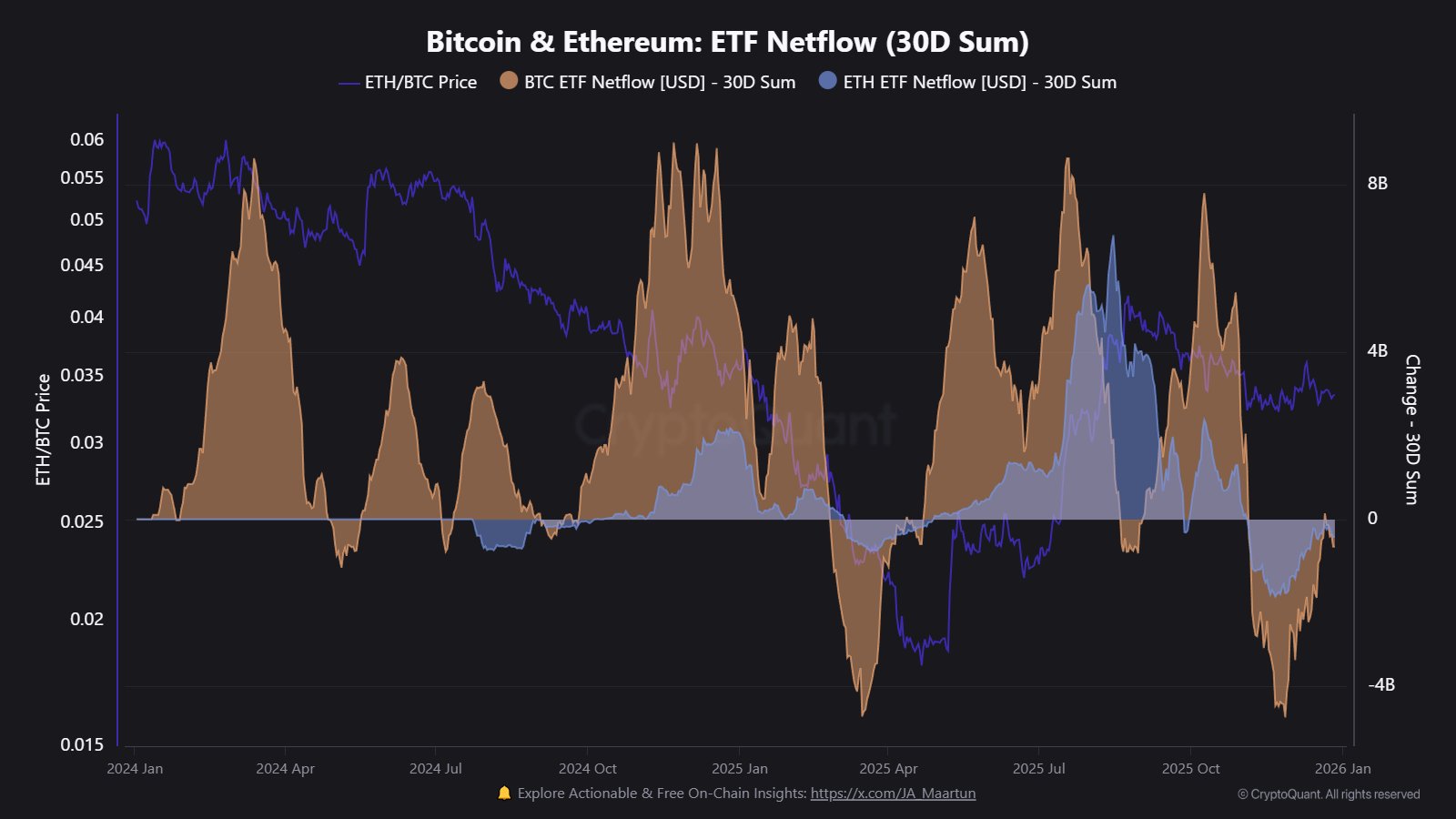
Looks like the value of the metric has been negative for both of these assets in recent weeks | Source: @JA_Maartun on X

As is visible in the graph, the 30-day spot ETF netflow has been negative for both Bitcoin and Ethereum since a while now, suggesting that the funds have been witnessing sustained net outflows.

The situation has improved a bit most recently, but the indicator is still red for both assets, sitting at -$656 million for BTC and -$422 million for ETH. The weak demand in the market is similar to the phase of outflows from the first half of 2025.

Back then, demand eventually made an explosive return, with Bitcoin and Ethereum witnessing sharp price rallies. It now remains to be seen whether a comeback will happen this time or if the slowdown in demand is here to stay for now.

Another relatively recent source of demand in the market is digital asset treasuries. As highlighted by institutional DeFi solutions provider Sentora in a new X post, holdings of cryptocurrency treasuries now exceed $185 billion across 368 entities.
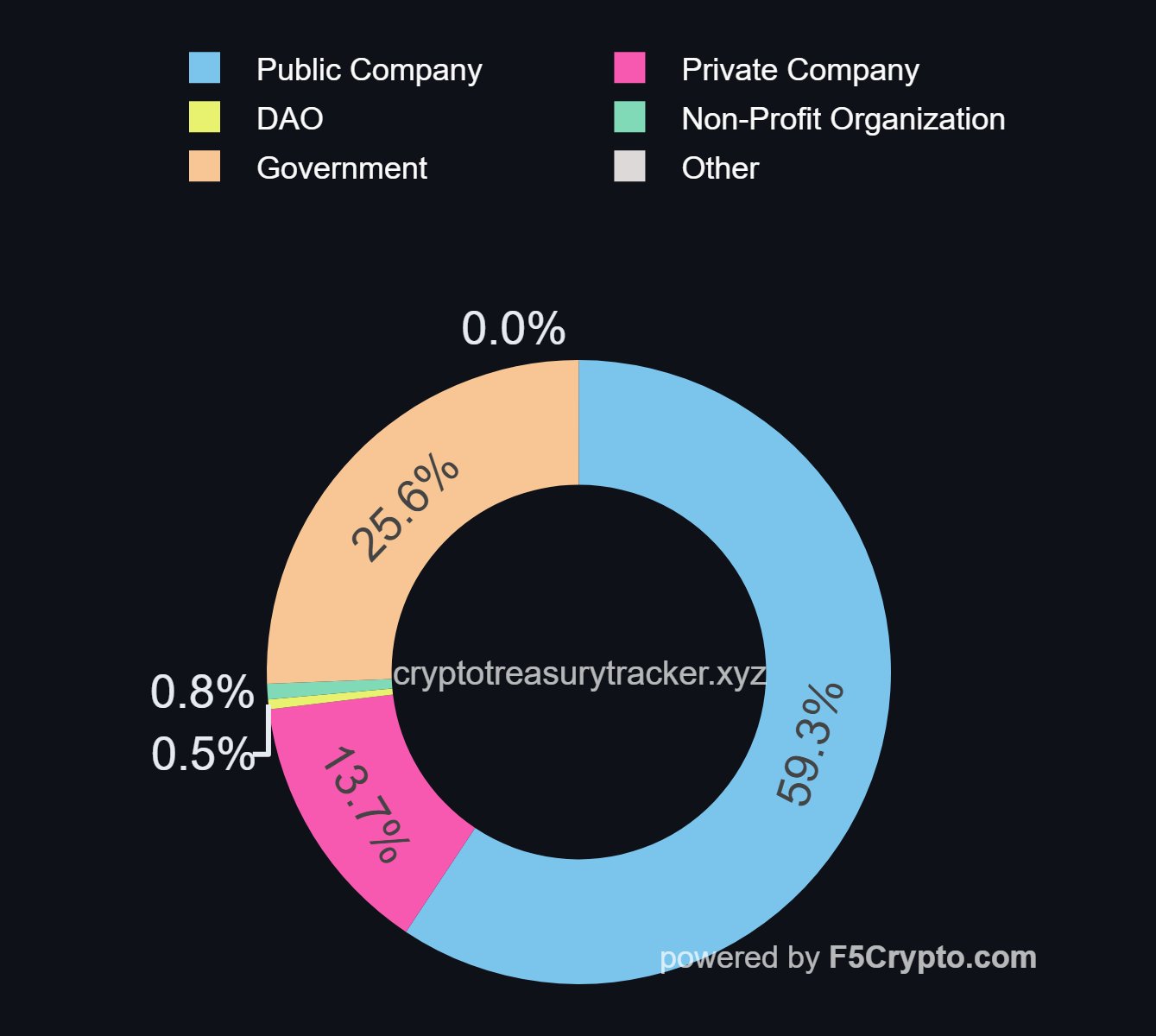
The breakdown of treasuries across various sectors | Source: Sentora on X

Out of this amount, 73% of the digital asset treasuries are controlled by companies, while the rest is in the hands of governments.

BTC Price

At the time of writing, Bitcoin is trading around $88,100, unchanged from last week.

The price of the coin seems to have been consolidating recently | Source: BTCUSDT on TradingView


Domande pertinenti

QWhat does the negative 30-day ETF netflow indicate for Bitcoin and Ethereum?

AThe negative 30-day ETF netflow indicates that capital has been flowing away from both Bitcoin and Ethereum, suggesting sustained net outflows from these digital assets.

QWhen did the SEC approve spot ETFs for Bitcoin and Ethereum in the US?

AThe SEC approved spot ETFs for Bitcoin in January 2024 and for Ethereum in July 2024.

QWhat are the current 30-day netflow values for Bitcoin and Ethereum ETFs mentioned in the article?

AThe current 30-day netflow is -$656 million for Bitcoin (BTC) and -$422 million for Ethereum (ETH).

QAccording to the article, what is the total value of digital asset treasuries held across entities, and what percentage is controlled by companies?

AThe total value of digital asset treasuries held across 368 entities is over $185 billion, with 73% controlled by companies.

QWhat was Bitcoin's price at the time of writing, and how has it performed recently?

AAt the time of writing, Bitcoin was trading around $88,100, unchanged from the previous week, and appears to be consolidating.

Letture associate

a16z: AI's 'Amnesia', Can Continuous Learning Cure It?

The article "a16z: AI's 'Amnesia' – Can Continual Learning Cure It?" explores the limitations of current large language models (LLMs), which, like the protagonist in the film *Memento*, are trapped in a perpetual present—unable to form new memories after training. While methods like in-context learning (ICL), retrieval-augmented generation (RAG), and external scaffolding (e.g., chat history, prompts) provide temporary solutions, they fail to enable true internalization of new knowledge. The authors argue that compression—the core of learning during training—is halted at deployment, preventing models from generalizing, discovering novel solutions (e.g., mathematical proofs), or handling adversarial scenarios. The piece introduces *continual learning* as a critical research direction to address this, categorizing approaches into three paths: 1. **Context**: Scaling external memory via longer context windows, multi-agent systems, and smarter retrieval. 2. **Modules**: Using pluggable adapters or external memory layers for specialization without full retraining. 3. **Weights**: Enabling parameter updates through sparse training, test-time training, meta-learning, distillation, and reinforcement learning from feedback. Challenges include catastrophic forgetting, safety risks, and auditability, but overcoming these could unlock models that learn iteratively from experience. The conclusion emphasizes that while context-based methods are effective, true breakthroughs require models to compress new information into weights post-deployment, moving from mere retrieval to genuine learning.

marsbit22 min fa

a16z: AI's 'Amnesia', Can Continuous Learning Cure It?

marsbit22 min fa

Can a Hair Dryer Earn $34,000? Deciphering the Reflexivity Paradox in Prediction Markets

An individual manipulated a weather sensor at Paris Charles de Gaulle Airport with a portable heat source, causing a Polymarket weather market to settle at 22°C and earning $34,000. This incident highlights a fundamental issue in prediction markets: when a market aims to reflect reality, it also incentivizes participants to influence that reality. Prediction markets operate on two layers: platform rules (what outcome counts as a win) and data sources (what actually happened). While most focus on rules, the real vulnerability lies in the data source. If reality is recorded through a specific source, influencing that source directly affects market settlement. The article categorizes markets by their vulnerability: 1. **Single-point physical data sources** (e.g., weather stations): Easily manipulated through physical interference. 2. **Insider information markets** (e.g., MrBeast video details): Insiders like team members use non-public information to trade. Kalshi fined a剪辑师 $20,000 for insider trading. 3. **Actor-manipulated markets** (e.g., Andrew Tate’s tweet counts): The subject of the market can control the outcome. Evidence suggests Tate’sociated accounts coordinated to profit. 4. **Individual-action markets** (e.g., WNBA disruptions): A single person can execute an event to profit from their pre-placed bets. Kalshi and Polymarket handle these issues differently. Kalshi enforces strict KYC, publicly penalizes insider trading, and reports to regulators. Polymarket, with its anonymous wallet-based system, has historically been more permissive, arguing that insider information improves market accuracy. However, it cooperated with authorities in the "Van Dyke case," where a user traded on classified government information. The core paradox is reflexivity: prediction markets are designed to discover truth, but their financial incentives can distort reality. The more valuable a prediction becomes, the more likely participants are to influence the event itself. The market ceases to be a mirror of reality and instead shapes it.

marsbit1 h fa

Can a Hair Dryer Earn $34,000? Deciphering the Reflexivity Paradox in Prediction Markets

marsbit1 h fa

Trading

Spot
Futures

Articoli Popolari

Come comprare RED

Benvenuto in HTX.com! Abbiamo reso l'acquisto di RedStone (RED) semplice e conveniente. Segui la nostra guida passo passo per intraprendere il tuo viaggio nel mondo delle criptovalute.Step 1: Crea il tuo Account HTXUsa la tua email o numero di telefono per registrarti il tuo account gratuito su HTX. Vivi un'esperienza facile e sblocca tutte le funzionalità,Crea il mio accountStep 2: Vai in Acquista crypto e seleziona il tuo metodo di pagamentoCarta di credito/debito: utilizza la tua Visa o Mastercard per acquistare immediatamente RedStoneRED.Bilancio: Usa i fondi dal bilancio del tuo account HTX per fare trading senza problemi.Terze parti: abbiamo aggiunto metodi di pagamento molto utilizzati come Google Pay e Apple Pay per maggiore comodità.P2P: Fai trading direttamente con altri utenti HTX.Over-the-Counter (OTC): Offriamo servizi su misura e tassi di cambio competitivi per i trader.Step 3: Conserva RedStone (RED)Dopo aver acquistato RedStone (RED), conserva nel tuo account HTX. In alternativa, puoi inviare tramite trasferimento blockchain o scambiare per altre criptovalute.Step 4: Scambia RedStone (RED)Scambia facilmente RedStone (RED) nel mercato spot di HTX. Accedi al tuo account, seleziona la tua coppia di trading, esegui le tue operazioni e monitora in tempo reale. Offriamo un'esperienza user-friendly sia per chi ha appena iniziato che per i trader più esperti.

384 Totale visualizzazioniPubblicato il 2025.03.05Aggiornato il 2025.03.21

Come comprare RED

Discussioni

Benvenuto nella Community HTX. Qui puoi rimanere informato sugli ultimi sviluppi della piattaforma e accedere ad approfondimenti esperti sul mercato. Le opinioni degli utenti sul prezzo di RED RED sono presentate come di seguito.

活动图片












