Bitcoin saw a sharp pullback this week, dropping below the $92,500 mark after failing to hold above $95,500. While the decline reignited bear market fears across crypto, bulls are now trying to stabilize price and defend the current range before selling pressure accelerates further. The move came as markets reacted to renewed macro uncertainty, with tariff headlines out of Europe adding fresh risk-off pressure across global assets.
The latest narrative centers on potential EU retaliatory measures against the United States, including tariffs and trade restrictions aimed at countering political threats tied to NATO tensions. Even without immediate implementation, the headlines were enough to tighten liquidity and trigger fast deleveraging, pushing Bitcoin lower as traders reduced risk exposure.
Despite the drop, analyst MorenoDV argues the market is not collapsing into a cycle end, but instead entering a phase of “risk redistribution.” His view is based on Bitcoin’s Realized Price by UTXO age bands, a framework that helps map where psychological pressure is building across different holder groups. Rather than tracking trend direction, the metric highlights which cohorts are comfortable, which are underwater, and where latent selling pressure could emerge.
In MorenoDV’s view, Bitcoin is rotating stress between cohorts, not breaking structurally.
Bitcoin’s current drawdown is not creating uniform stress across the market. Instead, pressure is building unevenly across different holder cohorts, based on their realized price levels. In the current setup, spot price sits near $95,583, while the 1w–1m cohort realized price is $89,255 and the 1m–3m cohort is $93,504.
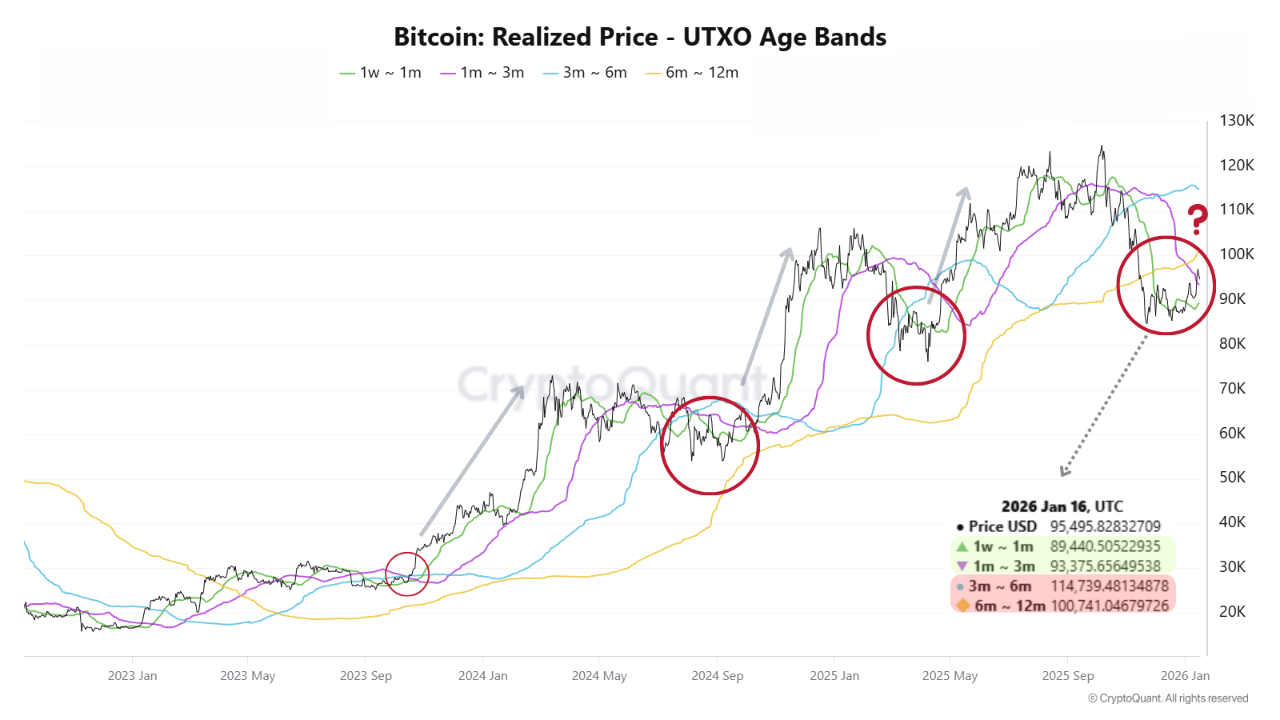
That means newer short-term holders are still in profit, which is an important stabilizing factor. When the most recent buyers are rewarded rather than punished, downside follow-through tends to weaken, because fear does not compound at the margin.
However, the pressure is concentrated in older short-term cohorts. The 3m–6m realized price stands at $114,808, and the 6m–12m cohort sits near $100,748, placing both groups underwater. This suggests Bitcoin has not been aggressively redistributed at lower levels, since a large portion of mid-term holders remains trapped above spot. The market is showing discomfort, but not capitulation, with losses being absorbed through patience rather than forced selling.
If Bitcoin begins reclaiming the 6m–12m realized price, that cohort’s stress could ease quickly. Still, sustainability depends on psychology. Mid-term holders must view this phase as a temporary drawdown, not a structural breakdown. If that belief breaks, selling pressure can appear even stronger.