Author: Rita
The stablecoin market is experiencing a reversal. After nearly six months of sideways movement and even decline, the supply of USDC suddenly increased by $1.7 billion in the last week of August. Circle's stock price has rebounded 42% since its crash triggered by OUSD competition concerns.
On August 24th, Bernstein published a research report indicating this is not a short-term technical rebound. Four key factors are driving a new stablecoin expansion cycle: the macro interest rate environment, the expansion of the on-chain capital market, the adoption of stablecoin payments, and the emergence of AI agent payments. Circle, as the largest compliant stablecoin issuer, is positioned to benefit significantly. Bernstein maintains an "Outperform" rating on Circle with a price target of $140, representing a potential 59% upside from the current price.
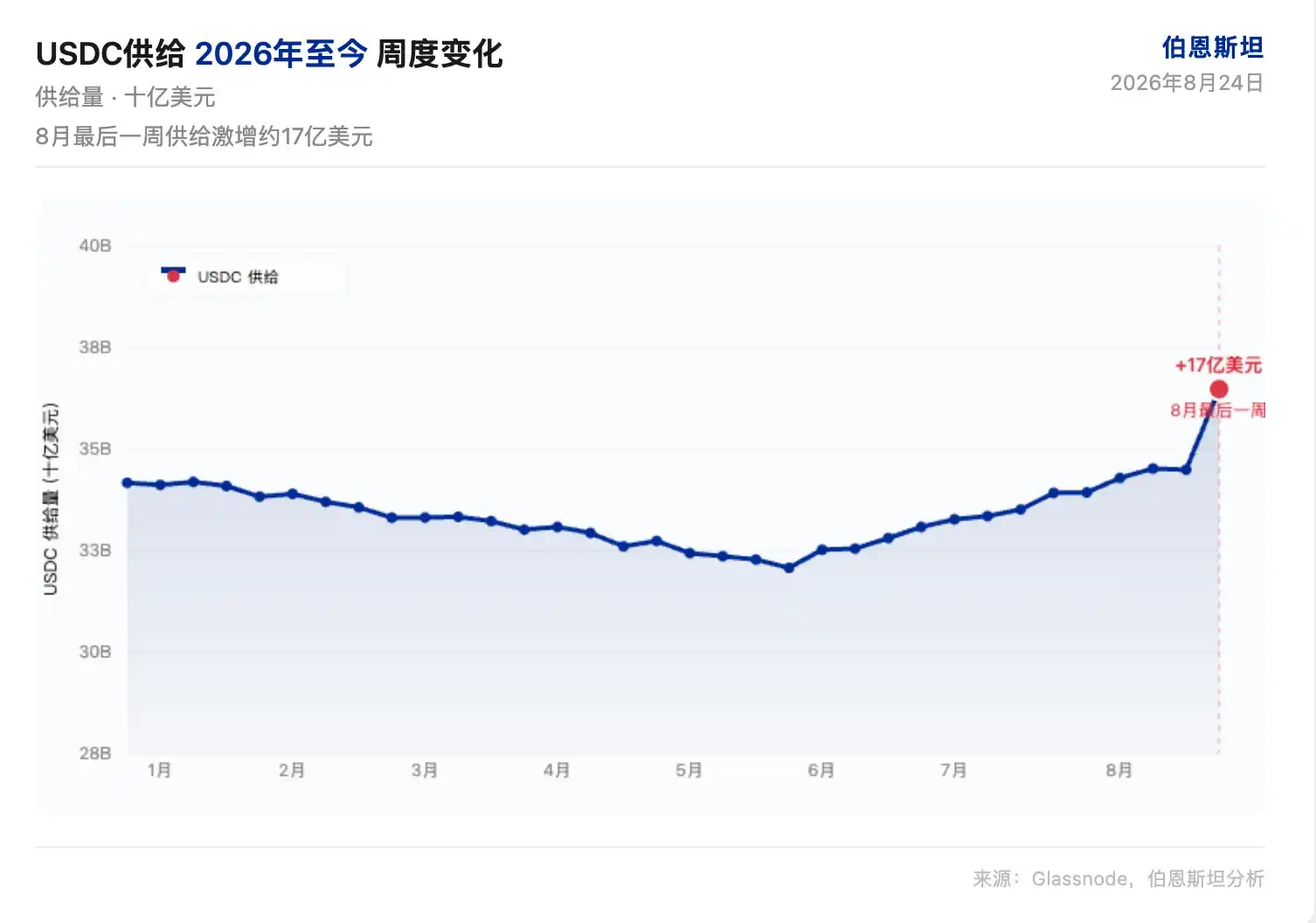
USDC Supply Recovery Validates Macro Logic
The US Treasury's long-end bond repurchase program is reshaping the macro logic for stablecoins. Bernstein notes that while the Treasury intervenes in the long-end yield curve through repurchases, it continues issuing Treasury bills at the short end. Stablecoins are effectively absorbing this incremental short-term debt supply.
Both Bitcoin and stablecoins benefit from this macro shift. Bitcoin is favored as a "hard asset," while stablecoins serve as a channel for absorbing short-term Treasury supply. The overall recovery of the cryptocurrency market also provides collateral support for stablecoin expansion.
The stagnation in USDC supply over the past six months was mainly influenced by the sluggish crypto market. The current recovery in USDC supply and the crypto market rebound are forming a positive feedback loop: rising token prices increase the value of on-chain collateral, which in turn drives demand for stablecoins.
AI Agent Payments Open a New Growth Frontier
Stablecoin payments are extending from "person-to-person" to "machine-to-machine."
Bernstein specifically highlights the x402 payment protocol. Designed for AI agents, this micropayment protocol allows AI agents to autonomously hold wallets, discover services, and make instant payments using USDC. In August alone, the x402 protocol processed approximately 20 million transactions, with a monthly transaction volume of about $1 million and an average transaction value of only $0.05. While seemingly insignificant, this represents the true form of nanopayments: high-frequency, small-value, and requiring no human intervention.
The number of active merchant wallets grew from 1,000 in February to 10,000 in August, with new merchant services continuously being built. USDC accounts for over 99% of the transaction volume on the x402 agent payment protocol.
Bernstein believes this is an early signal of stablecoin applications evolving from a "payment tool" to the "native currency of the digital economy." The current scale is small, but the direction is clear.
Circle Benefits from Blockchain Capital Market and Payment Adoption
Circle, as a US-compliant stablecoin issuer, is benefiting from two structural trends.
The first trend is the expansion of the on-chain capital market. Circle's ARC blockchain has attracted institutions like BlackRock, DTCC, Mastercard, and Visa as founding validator nodes. This blockchain supports asset tokenization and programmable finance, bringing traditional securities on-chain. DTCC plans to tokenize its custodied assets on ARC, and BlackRock's BUILD fund also plans to expand onto ARC. Furthermore, Circle, in partnership with Marex, a CFTC-registered derivatives clearing organization, completed the first derivative initial margin transaction guaranteed by a stablecoin. This is a milestone, as USDC is becoming a recognized eligible collateral in regulated derivatives markets.
The second trend is the continued penetration of stablecoin payments. Adjusted stablecoin transaction volume was approximately $11 trillion in 2025, with an annualized run rate of about $17 trillion as of July 2026, representing roughly 60% year-over-year growth. USDC's market share in adjusted transaction volume increased from about 40% in 2025 to over 60% year-to-date in 2026. Its share in wallet-to-wallet transfers similarly rose from 23% to 50%.
Real-world payment volume is growing steadily. Stablecoin payment volume in the first half of 2026 was approximately $260 billion, with an annualized growth rate of about 30%. Business-to-business payments account for about 40%, making it the largest payment category. Circle has established USDC integration with over 70% of its OUSD Alliance partners.
The ARC public blockchain is scheduled to officially launch on September 16th. It already has over 100 private mainnet partners, processed about 500 million transactions during the testnet phase, covered approximately 3 million wallets, and maintained 100% uptime.
Bernstein's valuation is based on a long-term discounted free cash flow model. The $140 price target corresponds to an enterprise value of approximately 23 times the projected adjusted EBITDA for 2028. Key risks include the high volatility of digital assets, increased competition from banks and payment institutions, and Circle's revenue model, which is 99% reliant on interest income.
The stablecoin expansion cycle, driven simultaneously by macro interest rates, regulatory clarity, payment adoption, and AI agents, represents a structural narrative. Circle is at the intersection of these trends. It is the most compliant stablecoin issuer in the US and a natural beneficiary of the on-chain capital market expansion.
Disclaimer
This article is Tide Research's compilation and interpretation of a third-party brokerage research report (Bernstein, August 24, 2026), combined with public market information. The ratings, price targets, earnings forecasts, and related judgments cited in the article are the views of the brokerage's analysts, representing only the stance of their respective institutions. They do not represent the views of Tide Research and do not constitute any investment advice.
The market involves risks; decisions must be made independently. This article should not be used as a basis for trading any securities.