Behind ZEC's Over 30% Plunge: An 'Unlimited Minting' Vulnerability with No Way to Prove if It Was Ever Exploited

marsbitPubblicato 2026-06-05Pubblicato ultima volta 2026-06-05

Introduzione

A critical vulnerability was discovered in Zcash's Orchard privacy pool, allowing for the theoretical creation of undetectable counterfeit ZEC. Researcher Taylor Hornby found the flaw on May 29th, 2024, within the Orchard circuit's cryptographic constraints, which could let an attacker bypass asset conservation rules. Although a rapid emergency fix was deployed within days via a coordinated soft and hard fork, a core uncertainty remains: due to Orchard's privacy features, it is impossible to cryptographically prove whether this "unlimited mint" flaw was exploited in the nearly four years since the pool's 2022 launch. This uncertainty, rather than the patched flaw itself, triggered a market panic, causing ZEC's price to drop over 30%. While the Zcash Foundation stated no evidence of exploitation was found, independent entity Shielded Labs emphasized the impossibility of definitively proving no counterfeit ZEC was ever created. The incident highlights the unique trust challenge in privacy systems. To address this, developers are proposing a new network upgrade with enhanced auditing to allow verifiable proof of supply integrity. Notably, the researcher utilized the newly released AI model Claude Opus 4.8 as a tool during the security review, signaling the growing role of advanced AI in uncovering complex cryptographic vulnerabilities.

On June 5th, Zcash founder Zooko Wilcox published a rare, detailed security retrospective.

The article disclosed that security researcher Taylor Hornby discovered a severe forging vulnerability in Orchard, Zcash's latest generation privacy pool, on May 29th. An attacker could construct a transaction that should not have passed validation, generating unlimited and undetectable counterfeit ZEC within Orchard.

This was not merely a theoretical risk. Taylor had already written a complete exploit program in a local test environment, successfully generating counterfeit ZEC. If the same program were deployed on the mainnet, an attacker could theoretically generate an unlimited quantity of counterfeit assets in their own mainnet wallet.

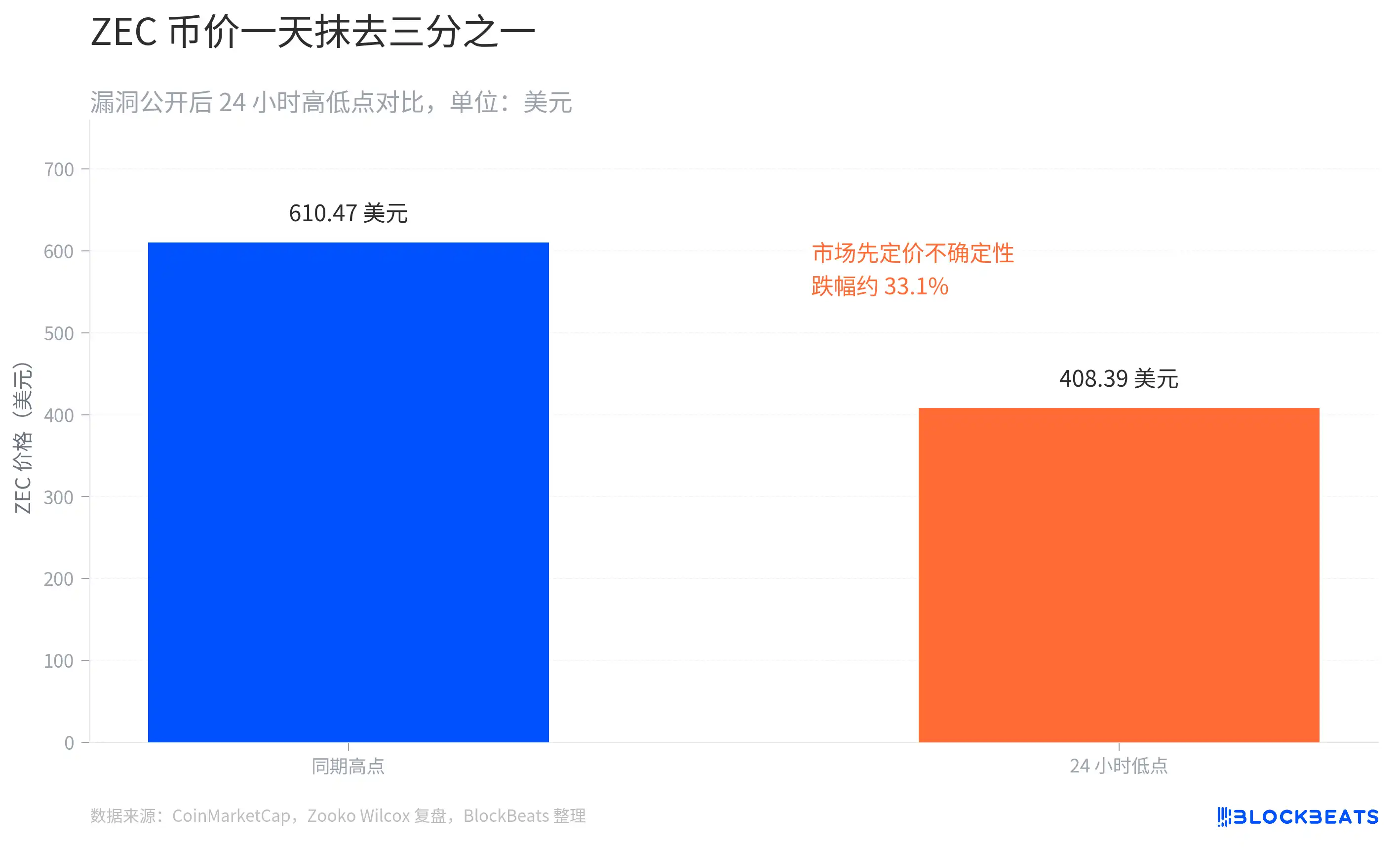
After the news became public, ZEC plunged by over 30%. Data from CoinMarketCap shows ZEC hit a 24-hour low of $408.39, down about one-third from its recent high of $610.47. Unfortunately, this was one of the few assets in the crypto space with excellent wealth effects recently, boasting a promising narrative favored by numerous industry leaders, now shattered by this vulnerability.
If one only looks at the outcome, this seems like another familiar crypto security incident: a vulnerability is discovered, developers rush to patch it, and the market panics.

However, the truly thorny aspect of the Orchard incident is that, while the vulnerability has been patched, the Zcash community cannot directly answer another, more sensitive question:

Has anyone exploited this vulnerability in the past four years?

Four-Day Emergency Patch, Orchard Briefly Suspended

Orchard is Zcash's next-generation privacy payment protocol launched in 2022 and one of the primary privacy pools currently used by Zcash. Users can hide balances, transaction amounts, and fund flows, while proving to the network via zero-knowledge proofs that transactions comply with the rules.

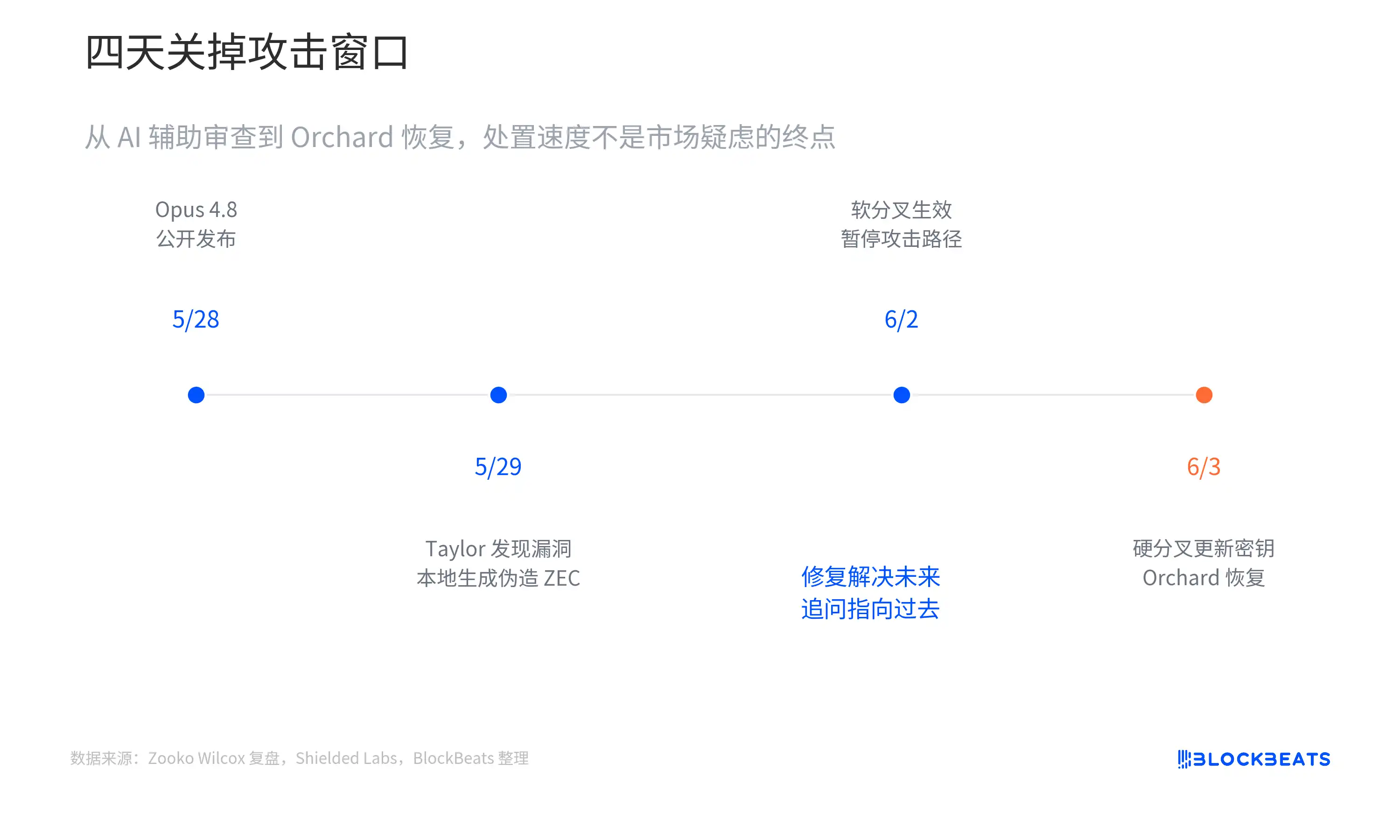
According to the timeline disclosed by Zooko, Shielded Labs, and the Zcash community, Taylor discovered anomalies during a targeted security audit of the Orchard circuit on May 29th and immediately privately disclosed the vulnerability to the Zcash Open Development Lab (ZODL). Shielded Labs is an independent, donation-funded Zcash ecosystem support organization based in Switzerland, long involved in Zcash's protocol development, security, and network sustainability efforts, and is not affiliated with the Zcash Foundation or ZODL.

ZODL engineers confirmed the issue was genuine within hours of receiving the report and began seeking a fix. To avoid exposing the vulnerability's details by directly releasing a code patch, the team first chose to temporarily shut down Orchard: prohibiting the creation of new Orchard outputs and the spending of funds already within Orchard.

After coordinating upgrades among developers, miners, node operators, exchanges, and infrastructure providers, an emergency soft fork took effect on June 2nd. Subsequently, Zcash performed a hard fork upgrade to update the verification key for the Orchard circuit and restored Orchard functionality on June 3rd. Transparent addresses and the Sapling privacy pool continued to operate during this period.

The entire process, from disclosure to remediation, took only a few days. In terms of emergency response speed, this was a remarkably successful handling.

But the market did not calm down because the vulnerability was fixed, as the fix addresses the future, not the past.
The Market Fears Not a Future Attack, But That an Attack May Have Already Happened

Ordinary security incidents usually have a relatively clear scale of loss. For a hacked smart contract, on-chain tracking can reveal how much the attacker moved; a cross-chain bridge vulnerability allows for tracking fund flows and affected addresses.

The Orchard incident is different.

According to Shielded Labs' explanation, this vulnerability could be used to generate unlimited and undetectable counterfeit ZEC within Orchard. Due to Orchard's inherent privacy properties, it is impossible for outsiders to cryptographically prove definitively whether this attack vector was exploited before the fix.

This means the market is not facing a determined loss figure but a kind of unquantifiable uncertainty:

If someone indeed found and exploited the vulnerability in the past, does counterfeit ZEC already exist within Orchard? If it exists, what is the scale? Do these assets remain in the privacy pool? Have they gradually leaked out through normal transactions?

More importantly, this risk window did not just open on May 29th. Shielded Labs stated that the vulnerability had existed since Orchard's launch in May 2022, until the emergency fix was completed in June 2026. In other words, the problem lay dormant for nearly four years.

What the market truly fears is not what happened between May 29th and June 2nd, but whether undetectable anomalies occurred during those past four years.

This is also the core reason behind ZEC's plunge of over 30%.

The market is selling off not just a vulnerability, but a repricing of the credibility of the supply.

How a Missing Mathematical Constraint Evolved into an 'Unlimited Minting' Risk

Seeing the words 'unlimited minting vulnerability,' our first thought might be that hackers gained admin privileges or some kind of protocol backdoor.

The reality is more fundamental.

Orchard's security relies on a zero-knowledge proof circuit (Orchard circuit). Users can hide specific transaction details but must prove to the network that their transaction satisfies protocol rules. One of the most important rules is asset conservation: a transaction cannot create new value out of thin air.

Simply put, users don't have to reveal how much ZEC they have or how much they send to whom, but the network must be able to confirm that:

The assets spent indeed come from legitimate inputs.
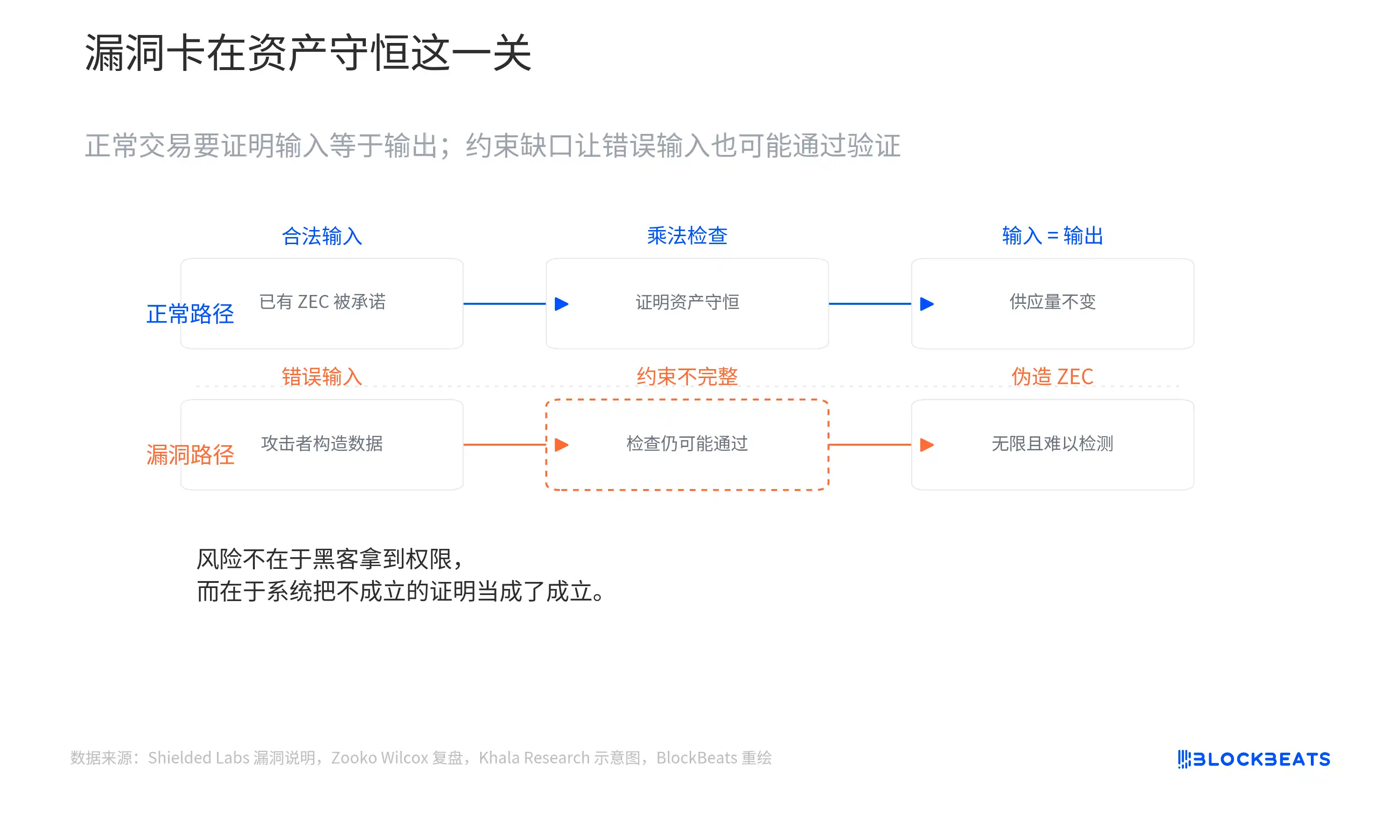
The problem Taylor discovered lies in an elliptic curve multiplication check within the Orchard circuit.

Shielded Labs describes it as an 'under-constrained element,' meaning a circuit element with incomplete constraints. Because the relevant mathematical relationship was not fully constrained, an attacker could input arbitrary erroneous data into the elliptic curve multiplication process, yet the verification process might still return a pass.

In other words, the attacker doesn't need to crack cryptographic algorithms or control network nodes.

They only need to construct a set of data that should not hold, tricking the system into erroneously believing the transaction still satisfies asset conservation.

Once this false proof is accepted by the network, the non-existent ZEC can be treated as legitimate assets, remaining within Orchard.

This is why Shielded Labs used extremely severe wording:

unlimited, undetectable counterfeit ZEC

The truly dangerous part is not just 'unlimited,' but 'undetectable.'

An Important Distinction Lies Between Two Statements

In its post-upgrade announcement, the Zcash Foundation stated that there is currently no evidence the vulnerability was exploited, no detection of unauthorized value creation, and user funds and privacy remain unaffected. The announcement also emphasized that Zcash's existing Turnstile Accounting mechanism can track value flows between different pools and protect the 21 million ZEC total supply cap.

Meanwhile, Shielded Labs clearly stated that it is impossible to cryptographically prove that counterfeit ZEC never appeared in Orchard's history.

These two statements may seem contradictory but actually address two different levels of the problem.

Zcash's original Turnstile Accounting can be understood as a 'gate' between different asset pools. The system can count how much legitimate asset entered Orchard and limit the scale of assets that can flow out of Orchard.

Suppose Orchard originally contained only 1 million legitimate ZEC; even if an attacker counterfeited more assets inside, the system would not allow assets exceeding the legitimate scale to flow out entirely. This helps prevent the total Zcash network supply cap from being easily breached.

But this mechanism cannot directly prove that counterfeit coins never appeared inside Orchard.

If counterfeit assets remain within Orchard, or gradually replace real assets within the legal outflow quota, the original statistical mechanism may not provide a definitive historical conclusion.

Regarding this arguably one of the oldest crypto privacy projects, all we know is that there is currently no evidence of abnormal minting, but the community still cannot directly prove that counterfeit assets never existed within Orchard.

This is precisely the type of risk the market finds hardest to handle.

The problem is not how many counterfeit coins have been discovered, but that no one can definitively confirm they never existed.

How Can Zcash Prove There Are No Counterfeit Coins in Orchard?

Patching the vulnerability is only the first step.

Shielded Labs has stated it is working with other Zcash developers on a new network upgrade proposal. The plan includes deploying a new privacy pool and enforcing Turnstile Accounting for all assets migrating out of Orchard.

This is akin to setting up a new migration gate for Orchard.

Assets in the old Orchard wishing to enter the new privacy pool would need to complete migration according to verifiable rules. The system could re-count the scale of legitimate assets flowing out and determine if there are any extra ZEC that cannot be migrated normally.
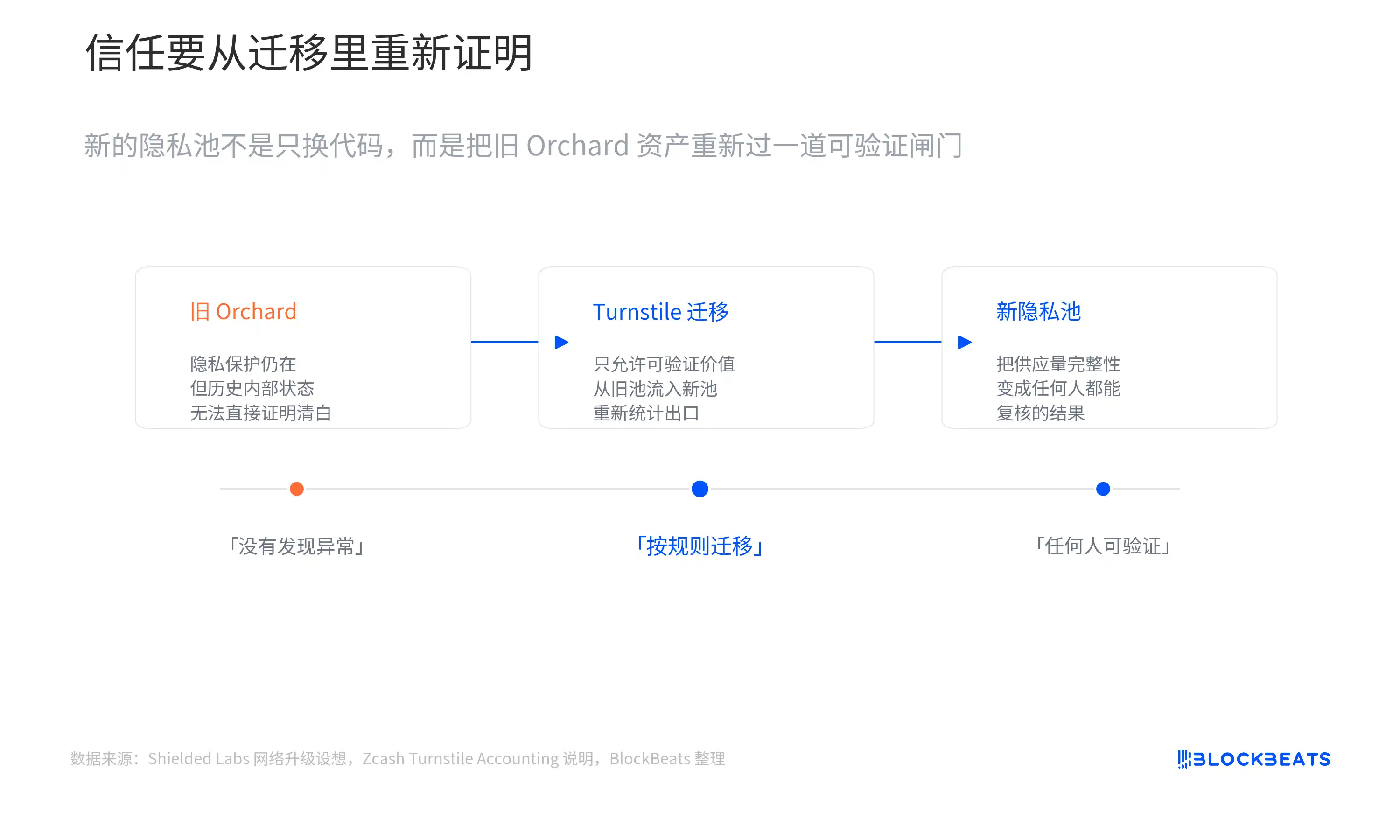
If the upgrade proceeds smoothly, anyone could verify Zcash's supply integrity and further prove no counterfeit assets exist in Orchard.

The significance of this plan is not just fixing code, but rebuilding market trust in Orchard.

Because in a privacy system, trust should not come from 'we think an attack didn't happen,' but from 'anyone can verify an attack didn't happen.'

Shielded Labs itself acknowledges the probability of prior malicious exploitation is low. The vulnerability was hidden for years and extremely difficult to discover; Taylor was actively searching for such issues in a dedicated security research project; after disclosure, the ecosystem quickly shut the attack window within days.

But Shielded Labs also emphasizes that users should not rely solely on the development team's subjective judgment.

The market needs proof.

Why Was a Four-Year-Old Vulnerability Discovered Now?

The Orchard incident has another detail easily overlooked by the market.

On May 28th, Anthropic released Claude Opus 4.8.

One day later, Taylor discovered the Orchard vulnerability.

According to the retrospective by Zooko and Shielded Labs, shortly after Opus 4.8's release, Taylor used it for a highly targeted audit of the Orchard circuit and discovered the issue on May 29th. Subsequently, with the assistance of Opus 4.8, he wrote a complete exploit program, generating unlimited, undetectable counterfeit ZEC in a local environment.

This detail is noteworthy not because AI can independently conduct cryptographic audits.

Public information does not support such an exaggerated conclusion.

Taylor himself is an experienced security researcher. Shielded Labs also mentioned he used a combination of traditional security research methods, a customized AI tool framework, and specifically designed prompts. Opus 4.8 was a crucial tool in the audit process, but not the only factor.

What is truly notable is that Taylor used not Anthropic's restricted-access, cybersecurity-focused model Claude Mythos Preview, but the newly publicly released general-purpose model Opus 4.8.

Anthropic positions Mythos Preview as an advanced model with significant vulnerability discovery and exploitation capabilities. Due to potential misuse risks, Anthropic did not release this model directly to the public but provides access to vetted partners via Project Glasswing.

In contrast, Opus 4.8 is a general-purpose model accessible to ordinary developers. Anthropic emphasized in its release notes its improvements in code analysis, complex task execution, and identifying code defects.

This makes the Orchard incident send an even more significant signal:

The capability to discover high-value vulnerabilities is diffusing from a few specialized security models to general-purpose models.

A general-purpose model released publicly for just one day, guided by a professional researcher, was able to participate in auditing a complex zero-knowledge proof circuit and help discover a critical vulnerability hidden for nearly four years.

This does not mean cryptography experts are no longer important.

On the contrary, Taylor's experience, choice of audit target, and ability to validate the model's output remain the core of the entire process.

But the combination of experts and AI is significantly lowering the cost of discovering complex vulnerabilities.

The Vulnerability is Closed, But the Market Still Awaits Answers

For Zcash, the most urgent attack window is closed.

Orchard functionality is restored, the verification circuit is updated, and there is currently no evidence the vulnerability was maliciously exploited.

But ZEC's plunge of over 30% indicates the market cares about more than just whether the code is fixed.

The market is still waiting for a more definitive answer:

In the past nearly four years, did counterfeit ZEC ever appear inside Orchard?

If the new privacy pool and Turnstile Accounting upgrade can be successfully implemented, the community will finally have a chance to prove supply integrity and rebuild market trust.

But until that proof is completed, the Orchard incident retains an unavoidable suspense:

Did those theoretically unlimited counterfeit ZEC never exist, or were they once hidden where no one could directly see?


Domande pertinenti

QWhat is the primary reason the ZEC price dropped over 30% despite the Orchard vulnerability being quickly patched?

AThe primary reason for the price drop was not the vulnerability itself or the risk of future attacks, but the market's inability to determine whether the vulnerability had already been exploited in the past. The vulnerability existed for nearly four years, and due to Orchard's privacy features, there is no way to cryptographically prove whether undetectable counterfeit ZEC was created during that time. This created profound uncertainty about the true supply integrity of ZEC.

QWhat specific aspect of the Orchard circuit was flawed, and what did it allow an attacker to do?

AThe flaw was an "under-constrained element" in an elliptic curve multiplication check within the Orchard zero-knowledge proof circuit. This incomplete mathematical constraint allowed an attacker to input incorrect data. The verification process could incorrectly pass, making the system believe a transaction obeyed the conservation of assets (no new value creation) when it did not. This enabled the creation of unlimited, undetectable counterfeit ZEC within the Orchard pool.

QWhat is the key difference between the statements from Zcash Foundation and Shielded Labs regarding the historical exploitation of the vulnerability?

AThe Zcash Foundation stated there is no evidence the vulnerability was exploited and that the overall 21 million ZEC supply cap remains protected by the Turnstile Accounting mechanism. Shielded Labs, however, clarified that while the supply cap is protected, it is cryptographically impossible to prove that no counterfeit ZEC was *ever* created inside Orchard in the past. Their statements address different levels: one is about the lack of observed evidence and the outer supply limit, while the other is about the fundamental impossibility of proving a negative within the private pool.

QWhat role did Anthropic's Claude Opus 4.8 play in the discovery of the Orchard vulnerability?

AAnthropic's Claude Opus 4.8, a publicly released general-purpose AI model, was used as a key tool by security researcher Taylor Hornby. The day after its release, Hornby used it to assist in a targeted security review of the Orchard circuit, which led to the discovery of the vulnerability. He then used Opus 4.8 to help write the complete exploit program. This highlights how vulnerability discovery capabilities are diffusing from specialized, restricted security models to publicly available general AI models when guided by expert researchers.

QWhat is the proposed next step by Shielded Labs to rebuild trust in Zcash's supply integrity after the patch?

AShielded Labs is working on a proposal for a new network upgrade. This involves deploying a new privacy pool and enforcing Turnstile Accounting on all assets migrating out of the old Orchard pool. This creates a new 'gate' for migration. By verifying the rules during this process, the network can effectively audit the assets leaving Orchard. If successful, this would allow anyone to verify that no extra, illegitimate ZEC existed in Orchard, moving trust from subjective assurance to objective, verifiable proof.

Letture associate

Trading

Spot
Futures

Articoli Popolari

Cosa è $S$

Comprendere SPERO: Una Panoramica Completa Introduzione a SPERO Mentre il panorama dell'innovazione continua a evolversi, l'emergere delle tecnologie web3 e dei progetti di criptovaluta gioca un ruolo fondamentale nel plasmare il futuro digitale. Un progetto che ha attirato l'attenzione in questo campo dinamico è SPERO, denotato come SPERO,$$s$. Questo articolo mira a raccogliere e presentare informazioni dettagliate su SPERO, per aiutare gli appassionati e gli investitori a comprendere le sue basi, obiettivi e innovazioni nei domini web3 e crypto. Che cos'è SPERO,$$s$? SPERO,$$s$ è un progetto unico all'interno dello spazio crypto che cerca di sfruttare i principi della decentralizzazione e della tecnologia blockchain per creare un ecosistema che promuove l'impegno, l'utilità e l'inclusione finanziaria. Il progetto è progettato per facilitare interazioni peer-to-peer in modi nuovi, fornendo agli utenti soluzioni e servizi finanziari innovativi. Al suo interno, SPERO,$$s$ mira a responsabilizzare gli individui fornendo strumenti e piattaforme che migliorano l'esperienza dell'utente nello spazio delle criptovalute. Questo include la possibilità di metodi di transazione più flessibili, la promozione di iniziative guidate dalla comunità e la creazione di percorsi per opportunità finanziarie attraverso applicazioni decentralizzate (dApps). La visione sottostante di SPERO,$$s$ ruota attorno all'inclusività, cercando di colmare le lacune all'interno della finanza tradizionale mentre sfrutta i vantaggi della tecnologia blockchain. Chi è il Creatore di SPERO,$$s$? L'identità del creatore di SPERO,$$s$ rimane piuttosto oscura, poiché ci sono risorse pubblicamente disponibili limitate che forniscono informazioni dettagliate sul suo fondatore o fondatori. Questa mancanza di trasparenza può derivare dall'impegno del progetto per la decentralizzazione—un ethos che molti progetti web3 condividono, dando priorità ai contributi collettivi rispetto al riconoscimento individuale. Centrando le discussioni attorno alla comunità e ai suoi obiettivi collettivi, SPERO,$$s$ incarna l'essenza dell'empowerment senza mettere in evidenza individui specifici. Pertanto, comprendere l'etica e la missione di SPERO rimane più importante che identificare un creatore singolo. Chi sono gli Investitori di SPERO,$$s$? SPERO,$$s$ è supportato da una varietà di investitori che vanno dai capitalisti di rischio agli investitori angelici dedicati a promuovere l'innovazione nel settore crypto. Il focus di questi investitori generalmente si allinea con la missione di SPERO—dando priorità a progetti che promettono avanzamenti tecnologici sociali, inclusività finanziaria e governance decentralizzata. Queste fondazioni di investitori sono tipicamente interessate a progetti che non solo offrono prodotti innovativi, ma contribuiscono anche positivamente alla comunità blockchain e ai suoi ecosistemi. Il supporto di questi investitori rafforza SPERO,$$s$ come un concorrente degno di nota nel dominio in rapida evoluzione dei progetti crypto. Come Funziona SPERO,$$s$? SPERO,$$s$ impiega un framework multifunzionale che lo distingue dai progetti di criptovaluta convenzionali. Ecco alcune delle caratteristiche chiave che sottolineano la sua unicità e innovazione: Governance Decentralizzata: SPERO,$$s$ integra modelli di governance decentralizzati, responsabilizzando gli utenti a partecipare attivamente ai processi decisionali riguardanti il futuro del progetto. Questo approccio favorisce un senso di proprietà e responsabilità tra i membri della comunità. Utilità del Token: SPERO,$$s$ utilizza il proprio token di criptovaluta, progettato per servire varie funzioni all'interno dell'ecosistema. Questi token abilitano transazioni, premi e la facilitazione dei servizi offerti sulla piattaforma, migliorando l'impegno e l'utilità complessivi. Architettura Stratificata: L'architettura tecnica di SPERO,$$s$ supporta la modularità e la scalabilità, consentendo un'integrazione fluida di funzionalità e applicazioni aggiuntive man mano che il progetto evolve. Questa adattabilità è fondamentale per mantenere la rilevanza nel panorama crypto in continua evoluzione. Coinvolgimento della Comunità: Il progetto enfatizza iniziative guidate dalla comunità, impiegando meccanismi che incentivano la collaborazione e il feedback. Nutrendo una comunità forte, SPERO,$$s$ può affrontare meglio le esigenze degli utenti e adattarsi alle tendenze di mercato. Focus sull'Inclusione: Offrendo basse commissioni di transazione e interfacce user-friendly, SPERO,$$s$ mira ad attrarre una base utenti diversificata, inclusi individui che potrebbero non aver precedentemente interagito nello spazio crypto. Questo impegno per l'inclusione si allinea con la sua missione generale di empowerment attraverso l'accessibilità. Cronologia di SPERO,$$s$ Comprendere la storia di un progetto fornisce preziose intuizioni sulla sua traiettoria di sviluppo e sui traguardi. Di seguito è riportata una cronologia suggerita che mappa eventi significativi nell'evoluzione di SPERO,$$s$: Fase di Concettualizzazione e Ideazione: Le idee iniziali che formano la base di SPERO,$$s$ sono state concepite, allineandosi strettamente con i principi di decentralizzazione e focus sulla comunità all'interno dell'industria blockchain. Lancio del Whitepaper del Progetto: Dopo la fase concettuale, è stato rilasciato un whitepaper completo che dettaglia la visione, gli obiettivi e l'infrastruttura tecnologica di SPERO,$$s$ per suscitare interesse e feedback dalla comunità. Costruzione della Comunità e Prime Interazioni: Sono stati effettuati sforzi attivi di outreach per costruire una comunità di early adopters e potenziali investitori, facilitando discussioni attorno agli obiettivi del progetto e ottenendo supporto. Evento di Generazione del Token: SPERO,$$s$ ha condotto un evento di generazione del token (TGE) per distribuire i propri token nativi ai primi sostenitori e stabilire una liquidità iniziale all'interno dell'ecosistema. Lancio della Prima dApp: La prima applicazione decentralizzata (dApp) associata a SPERO,$$s$ è stata attivata, consentendo agli utenti di interagire con le funzionalità principali della piattaforma. Sviluppo Continuo e Partnership: Aggiornamenti e miglioramenti continui alle offerte del progetto, inclusi partnership strategiche con altri attori nello spazio blockchain, hanno plasmato SPERO,$$s$ in un concorrente competitivo e in evoluzione nel mercato crypto. Conclusione SPERO,$$s$ rappresenta una testimonianza del potenziale del web3 e delle criptovalute di rivoluzionare i sistemi finanziari e responsabilizzare gli individui. Con un impegno per la governance decentralizzata, il coinvolgimento della comunità e funzionalità progettate in modo innovativo, apre la strada verso un panorama finanziario più inclusivo. Come per qualsiasi investimento nello spazio crypto in rapida evoluzione, si incoraggiano potenziali investitori e utenti a ricercare approfonditamente e a impegnarsi in modo riflessivo con gli sviluppi in corso all'interno di SPERO,$$s$. Il progetto mostra lo spirito innovativo dell'industria crypto, invitando a ulteriori esplorazioni delle sue innumerevoli possibilità. Mentre il percorso di SPERO,$$s$ è ancora in fase di sviluppo, i suoi principi fondamentali potrebbero effettivamente influenzare il futuro di come interagiamo con la tecnologia, la finanza e tra di noi in ecosistemi digitali interconnessi.

75 Totale visualizzazioniPubblicato il 2024.12.17Aggiornato il 2024.12.17

Cosa è $S$

Cosa è AGENT S

Agent S: Il Futuro dell'Interazione Autonoma in Web3 Introduzione Nel panorama in continua evoluzione di Web3 e criptovalute, le innovazioni stanno costantemente ridefinendo il modo in cui gli individui interagiscono con le piattaforme digitali. Uno di questi progetti pionieristici, Agent S, promette di rivoluzionare l'interazione uomo-computer attraverso il suo framework agentico aperto. Aprendo la strada a interazioni autonome, Agent S mira a semplificare compiti complessi, offrendo applicazioni trasformative nell'intelligenza artificiale (AI). Questa esplorazione dettagliata approfondirà le complessità del progetto, le sue caratteristiche uniche e le implicazioni per il dominio delle criptovalute. Cos'è Agent S? Agent S si presenta come un innovativo framework agentico aperto, progettato specificamente per affrontare tre sfide fondamentali nell'automazione dei compiti informatici: Acquisizione di Conoscenze Specifiche del Dominio: Il framework apprende in modo intelligente da varie fonti di conoscenza esterne ed esperienze interne. Questo approccio duale gli consente di costruire un ricco repository di conoscenze specifiche del dominio, migliorando le sue prestazioni nell'esecuzione dei compiti. Pianificazione su Lungo Orizzonte di Compiti: Agent S impiega una pianificazione gerarchica potenziata dall'esperienza, un approccio strategico che facilita la suddivisione e l'esecuzione efficiente di compiti complessi. Questa caratteristica migliora significativamente la sua capacità di gestire più sottocompiti in modo efficiente ed efficace. Gestione di Interfacce Dinamiche e Non Uniformi: Il progetto introduce l'Interfaccia Agente-Computer (ACI), una soluzione innovativa che migliora l'interazione tra agenti e utenti. Utilizzando Modelli Linguistici Multimodali di Grandi Dimensioni (MLLM), Agent S può navigare e manipolare senza sforzo diverse interfacce grafiche utente. Attraverso queste caratteristiche pionieristiche, Agent S fornisce un framework robusto che affronta le complessità coinvolte nell'automazione dell'interazione umana con le macchine, preparando il terreno per innumerevoli applicazioni nell'AI e oltre. Chi è il Creatore di Agent S? Sebbene il concetto di Agent S sia fondamentalmente innovativo, informazioni specifiche sul suo creatore rimangono elusive. Il creatore è attualmente sconosciuto, il che evidenzia sia la fase embrionale del progetto sia la scelta strategica di mantenere i membri fondatori sotto anonimato. Indipendentemente dall'anonimato, l'attenzione rimane sulle capacità e sul potenziale del framework. Chi sono gli Investitori di Agent S? Poiché Agent S è relativamente nuovo nell'ecosistema crittografico, informazioni dettagliate riguardanti i suoi investitori e sostenitori finanziari non sono documentate esplicitamente. La mancanza di approfondimenti pubblicamente disponibili sulle fondazioni di investimento o sulle organizzazioni che supportano il progetto solleva interrogativi sulla sua struttura di finanziamento e sulla roadmap di sviluppo. Comprendere il supporto è cruciale per valutare la sostenibilità del progetto e il suo potenziale impatto sul mercato. Come Funziona Agent S? Al centro di Agent S si trova una tecnologia all'avanguardia che gli consente di funzionare efficacemente in contesti diversi. Il suo modello operativo è costruito attorno a diverse caratteristiche chiave: Interazione Uomo-Computer Simile a Quella Umana: Il framework offre una pianificazione AI avanzata, cercando di rendere le interazioni con i computer più intuitive. Mimando il comportamento umano nell'esecuzione dei compiti, promette di elevare le esperienze degli utenti. Memoria Narrativa: Utilizzata per sfruttare esperienze di alto livello, Agent S utilizza la memoria narrativa per tenere traccia delle storie dei compiti, migliorando così i suoi processi decisionali. Memoria Episodica: Questa caratteristica fornisce agli utenti una guida passo-passo, consentendo al framework di offrire supporto contestuale mentre i compiti si sviluppano. Supporto per OpenACI: Con la capacità di funzionare localmente, Agent S consente agli utenti di mantenere il controllo sulle proprie interazioni e flussi di lavoro, allineandosi con l'etica decentralizzata di Web3. Facile Integrazione con API Esterne: La sua versatilità e compatibilità con varie piattaforme AI garantiscono che Agent S possa adattarsi senza problemi agli ecosistemi tecnologici esistenti, rendendolo una scelta attraente per sviluppatori e organizzazioni. Queste funzionalità contribuiscono collettivamente alla posizione unica di Agent S all'interno dello spazio crittografico, poiché automatizza compiti complessi e multi-fase con un intervento umano minimo. Man mano che il progetto evolve, le sue potenziali applicazioni in Web3 potrebbero ridefinire il modo in cui si svolgono le interazioni digitali. Cronologia di Agent S Lo sviluppo e le tappe di Agent S possono essere riassunti in una cronologia che evidenzia i suoi eventi significativi: 27 Settembre 2024: Il concetto di Agent S è stato lanciato in un documento di ricerca completo intitolato “Un Framework Agentico Aperto che Usa i Computer Come un Umano”, mostrando le basi per il progetto. 10 Ottobre 2024: Il documento di ricerca è stato reso pubblicamente disponibile su arXiv, offrendo un'esplorazione approfondita del framework e della sua valutazione delle prestazioni basata sul benchmark OSWorld. 12 Ottobre 2024: È stata rilasciata una presentazione video, fornendo un'idea visiva delle capacità e delle caratteristiche di Agent S, coinvolgendo ulteriormente potenziali utenti e investitori. Questi indicatori nella cronologia non solo illustrano i progressi di Agent S, ma indicano anche il suo impegno per la trasparenza e il coinvolgimento della comunità. Punti Chiave su Agent S Man mano che il framework Agent S continua a evolversi, diversi attributi chiave si distinguono, sottolineando la sua natura innovativa e il potenziale: Framework Innovativo: Progettato per fornire un uso intuitivo dei computer simile all'interazione umana, Agent S porta un approccio nuovo all'automazione dei compiti. Interazione Autonoma: La capacità di interagire autonomamente con i computer attraverso GUI segna un passo avanti verso soluzioni informatiche più intelligenti ed efficienti. Automazione di Compiti Complessi: Con la sua metodologia robusta, può automatizzare compiti complessi e multi-fase, rendendo i processi più veloci e meno soggetti a errori. Miglioramento Continuo: I meccanismi di apprendimento consentono ad Agent S di migliorare dalle esperienze passate, migliorando continuamente le sue prestazioni e la sua efficacia. Versatilità: La sua adattabilità attraverso diversi ambienti operativi come OSWorld e WindowsAgentArena garantisce che possa servire un'ampia gamma di applicazioni. Man mano che Agent S si posiziona nel panorama di Web3 e delle criptovalute, il suo potenziale per migliorare le capacità di interazione e automatizzare i processi segna un significativo avanzamento nelle tecnologie AI. Attraverso il suo framework innovativo, Agent S esemplifica il futuro delle interazioni digitali, promettendo un'esperienza più fluida ed efficiente per gli utenti in vari settori. Conclusione Agent S rappresenta un audace passo avanti nell'unione tra AI e Web3, con la capacità di ridefinire il modo in cui interagiamo con la tecnologia. Sebbene sia ancora nelle sue fasi iniziali, le possibilità per la sua applicazione sono vaste e coinvolgenti. Attraverso il suo framework completo che affronta sfide critiche, Agent S mira a portare le interazioni autonome al centro dell'esperienza digitale. Man mano che ci addentriamo nei regni delle criptovalute e della decentralizzazione, progetti come Agent S giocheranno senza dubbio un ruolo cruciale nel plasmare il futuro della tecnologia e della collaborazione uomo-computer.

533 Totale visualizzazioniPubblicato il 2025.01.14Aggiornato il 2025.01.14

Cosa è AGENT S

Come comprare S

Benvenuto in HTX.com! Abbiamo reso l'acquisto di Sonic (S) semplice e conveniente. Segui la nostra guida passo passo per intraprendere il tuo viaggio nel mondo delle criptovalute.Step 1: Crea il tuo Account HTXUsa la tua email o numero di telefono per registrarti il tuo account gratuito su HTX. Vivi un'esperienza facile e sblocca tutte le funzionalità,Crea il mio accountStep 2: Vai in Acquista crypto e seleziona il tuo metodo di pagamentoCarta di credito/debito: utilizza la tua Visa o Mastercard per acquistare immediatamente SonicS.Bilancio: Usa i fondi dal bilancio del tuo account HTX per fare trading senza problemi.Terze parti: abbiamo aggiunto metodi di pagamento molto utilizzati come Google Pay e Apple Pay per maggiore comodità.P2P: Fai trading direttamente con altri utenti HTX.Over-the-Counter (OTC): Offriamo servizi su misura e tassi di cambio competitivi per i trader.Step 3: Conserva Sonic (S)Dopo aver acquistato Sonic (S), conserva nel tuo account HTX. In alternativa, puoi inviare tramite trasferimento blockchain o scambiare per altre criptovalute.Step 4: Scambia Sonic (S)Scambia facilmente Sonic (S) nel mercato spot di HTX. Accedi al tuo account, seleziona la tua coppia di trading, esegui le tue operazioni e monitora in tempo reale. Offriamo un'esperienza user-friendly sia per chi ha appena iniziato che per i trader più esperti.

1.1k Totale visualizzazioniPubblicato il 2025.01.15Aggiornato il 2026.06.02

Come comprare S

Discussioni

Benvenuto nella Community HTX. Qui puoi rimanere informato sugli ultimi sviluppi della piattaforma e accedere ad approfondimenti esperti sul mercato. Le opinioni degli utenti sul prezzo di S S sono presentate come di seguito.

活动图片













