Behind Circle's Strong Stock Rebound: AI, Prediction Markets, and Institutional Adoption

Odaily星球日报Pubblicato 2026-02-27Pubblicato ultima volta 2026-02-27

Introduzione

Circle's stock (CRCL) experienced a strong rebound, rising over 45% in two days after its Q4 2025 earnings report, reaching a high of $90. Key drivers include USDC's growing transaction volume, which hit $18.3 trillion in 2025, surpassing USDT. The growth is attributed to AI agent payments via the x402 protocol, prediction markets like Polymarket, and institutional adoption fueled by regulatory support such as the GENIUS Act. Analysts from Bernstein maintain an "Outperform" rating with a $190 target, while Ark Invest and Vanguard have significantly increased their holdings. However, some analysts caution that the surge may be driven by short squeezes rather than fundamentals. Challenges remain, including competition from Coinbase and potential resistance from traditional banks.

Original|Odaily Planet Daily(@OdailyChina)

Author|Wenser(@wenser 2010)

Recently, after the release of its Q4 2025 financial report, the stock price of "the first stablecoin stock" Circle (CRCL) experienced a long-awaited strong rebound, surging over 45% in two days and once hitting $90 today, reaching a new high since last November. In the continuously declining market of crypto concept stocks, Circle (CRCL) momentarily stole the spotlight, with major institutions and analysts beginning to cheer it on, and many traders even boldly claiming that "Circle's stock still has tenfold growth potential."

Behind the fervent sentiment, what the market is more concerned about might be the underlying drivers of this price rebound, as this directly determines whether Circle's (CRCL) stock price can continue to rise. Odaily Planet Daily will provide a brief analysis of this issue from the perspectives of Circle's business performance, institutional views, the AI "ticket," and prediction markets, attempting to clarify the key question of where Circle's next wave of growth will come from.

Transformation of Circle's Business Fundamentals: From Stablecoins to Internet Financial Infrastructure

When it comes to Circle, many might still perceive it through the stereotypical image of "the perpetual runner-up in the stablecoin race." However, in terms of performance and data growth in 2025, Circle's stablecoin USDC is rapidly catching up with Tether's stablecoin USDT.

Circle's Recent Report Card: USDC Transaction Volume Reached $18.3 Trillion in 2025, Ranking First in the Industry

According to data from the Artemis website, global stablecoin transaction volume surged 72% year-over-year in 2025, reaching a record $33 trillion; among them, the transaction volume of USDC, issued by Circle, reached $18.3 trillion, ranking first; in contrast, Tether's USDT transaction volume was only $13.3 trillion.

As we entered 2026, the scale of USDC transaction counts remained exceptionally rapid: in early February, Circle CEO Jeremy Allaire stated in a post that, according to Artemis data, the on-chain transaction count for USDC in January exceeded 8.4 trillion, while the total on-chain transaction count for the stablecoin market was 10 trillion. In terms of on-chain transaction count, USDC accounted for 84% of the total market share. In other words, unnoticed by many, USDC's trading activity has been quietly climbing. Moreover, the growth rate of USDC's circulation is also accelerating rapidly. As of February 12 local time, the issuance of USDC increased by approximately 2.6 billion tokens within a week.
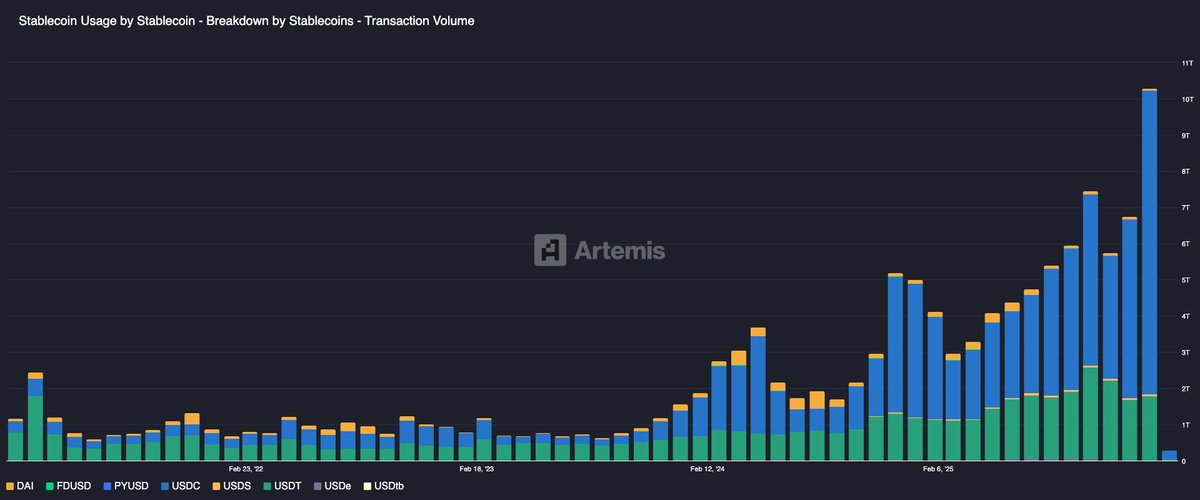
In comparison, the market capitalization of the "stablecoin leader" USDT fell 0.8% in February to $1.8361 trillion, continuing the decline of about 1% in January, marking the first consecutive monthly contraction since the Terra incident in 2022.

Finally, looking closely at its 2025 fiscal year financial report, Circle's USDC circulation at the end of 2025 was $753 billion, a 72% year-over-year increase; USDC on-chain transaction volume in Q4 2025 was $11.9 trillion, a 247% year-over-year increase; Q4 total revenue reached approximately $770 million, a sharp 77% increase compared to the same period last year; total revenue and reserve income for the 2025 fiscal year were $2.7 billion, a 64% year-over-year increase. Although its net loss from continuing operations reached $70 million, this was mainly affected by high IPO-related equity incentive expenses of $424 million. However, Circle expects USDC circulation to maintain an annual growth rate of about 40% in the future and forecasts that other business revenue (excluding reserve income) will reach approximately $170 million in 2026, higher than the approximately $110 million in 2025.

Personally, I speculate that the growth in USDC's circulation and transaction count might be driven by a combination of factors, including AI Agent crypto payment demand, the rising transaction volume in prediction markets, and institutional business demand following the passage of the GENIUS Act regulatory bill. We will elaborate on this point later.

Institutional Views Overview: Some Are Buying the Dip, Others Still Believe Circle Will "Outperform the Market"

Currently, market opinions on Circle's future stock performance are clearly divided: some investment institutions continue to buy the dip and accumulate shares; others are optimistic about its business model upgrade, transitioning from a stablecoin issuer to a fintech infrastructure provider; yet other research institutions believe this stock rebound is primarily driven by a short squeeze and lacks sustainability.

Bernstein: Circle Stock Aims for $190, Maintains "Outperform" Rating

Bernstein pointed out that Circle is no longer viewed merely as a "proxy investment target" for crypto assets but has transformed into a fintech infrastructure service provider, indicating a profound shift in its business positioning. The firm's analyst team believes that Circle will play a key role in this "fundamental transformation of the global economic system" and reaffirmed its "Outperform" rating and $190 target price in its latest research report, suggesting significant upside potential for the stock.

Furthermore, Bernstein analysts Gautam Chhugani and others noted in the report that Circle's Q4 performance clearly diverged from the overall crypto market trend, emphasizing that the company is moving towards becoming a core internet infrastructure provider, rather than just being in the stablecoin or crypto token business.

Ark Invest: Putting Money Where Their Mouth Is, Circle (CRCL) Stock Holdings Total Nearly $350 Million

Unlike research institutions, the investment firm Ark Invest, led by renowned Silicon Valley investor "Cathie Wood," has consistently been a "major buyer" of Circle.

In early February, trading documents showed that Ark Invest purchased approximately $9.4 million worth of Circle stock through two of its ETFs;

On February 12, Ark Invest increased its holdings again by 75,559 shares of Circle (CRCL), worth about $4.4 million.

Based on public information compiled, as of the time of writing, Ark Invest holds a total of approximately 4,015,642 shares of Circle (CRCL) through its three funds: ARKK (ARK Innovation ETF), ARKF (ARK Fintech Innovation ETF), and ARKW (ARK Next Generation Internet ETF), with a total market value of about $349 million (calculated at $87 per share).

Vanguard Group: Holds Over 5.65 Million Circle (CRCL) Shares, Once Faced Floating Losses Exceeding $400 Million

On February 14, according to the latest 13F filing submitted to the U.S. SEC by the world's second-largest fund management company, Vanguard Group, it currently holds a cumulative total of 5,653,110 shares of Circle stock CRCL (current value $339.4 million), with an entry cost of $739.6 million, resulting in floating losses of over $400 million at the time.

With Circle (CRCL)'s stock price rebounding to around $87 (at the time of writing), this nearly $740 million investment now shows a floating profit of over $152 million.

10x Research: Circle Surges Due to Short Squeeze

Yesterday, crypto research firm 10x Research stated in a post that the core driver of the recent rise in Circle's stock price was not the financial report data itself, but the market's positioning structure, which was more likely to trigger a high-probability short covering rally rather than a pure fundamental revaluation. It is reported that a hedge fund established a large short position before the earnings release. However, as Circle's stock price soared in a single day, it triggered a violent short squeeze, causing the hedge fund to lose approximately $500 million in a single day. 10x Research added that this round of sharp volatility not only affected Circle (CRCL) but also spilled over to Coinbase (COIN) and Bitcoin. Although Circle is a clear bullish target, the overall magnitude of the move was primarily driven by an imbalance in the overall crypto market positioning structure. New market catalysts might soon emerge, potentially reshaping the market narrative, after which trading logic may return to fundamentals. In other words, 10x Research is not optimistic about Circle (CRCL)'s future performance.

In summary, Circle is in a critical period of transitioning from its past concept as the "first stablecoin stock" to a narrative of "fintech infrastructure." The business performance of its stablecoin USDC is promising, and its other new revenue streams (non-interest income) have also proven their profitability to the market with a high gross profit of $37 million in Q4.

Whether Circle (CRCL) can continue its current strong upward trend may be closely related to three key keywords—"AI payments," "prediction markets," and "institutional adoption."

USDC's "Growth Boosters": AI Payments, Prediction Market Trading, Large-Scale Institutional Adoption

From Circle's financial reports and the external statements of CEO Jeremy Allaire, we can clearly see that Circle's revenue channels are rapidly expanding, unlike in the past when it heavily relied on the USDC stablecoin issuance business.

Previously, Circle announced that the Circle Payments Network (CPN) has 55 financial institutions registered, with another 74 financial institutions undergoing qualification review; the L1 blockchain network Arc testnet has gone live, attracting over 100 participants; USDC's inherent adoption rate and integration advantages also赋予 Circle with "automated payment" capabilities for AI Agents. This may become its ticket to the next era of interconnected finance.

Circle's "AI Ticket": x402 Protocol, AI Agent Economy, and A2A Transactions

Circle's first ticket comes from AI payments. The x402 standard, led by Coinbase, became a market focus upon its launch in 2025. This protocol allows AI Agents to directly pay for services, such as API data access, computational resources, or content subscriptions, using USDC through the HTTP 402 status code, effectively "bridging the last mile of payment" for AI Agents. USDC can thus be seamlessly integrated into the AI Agent economy. As for the A2A (Agent to Agent) and M2M (Machine to Machine) transactions proposed by many AI model companies, they will also circulate using USDC.

Previously, analysts predicted that the scale of the AI Agent economy ecosystem could exceed $30 trillion by 2030, with Agentic AI dominating 15% of daily financial decisions. In this regard, USDC possesses a super-early mover advantage.

Circle's "Prediction Market Ticket": Prediction Market Trading Volume Continues to Hit New Highs, Weekly Transaction Count Exceeds 38 Million

Another major driver for the growth of USDC and Circle's business data might be attributed to the prediction market sector, where business data is continuously rising.

According to Dune data, on February 23, the weekly transaction count (Feb 16-22) in prediction markets reached a new historical high of 38.01 million, with Polymarket's transaction count at 22.58 million, ranking first; Kalshi's transaction count was 14.86 million, ranking second.

At the same time, Circle is also making continuous efforts in platform-level cooperation with prediction market giants—in early February, Circle announced a partnership with Polymarket to promote the optimization of stablecoin infrastructure for prediction markets. Circle will introduce transparent, fully-reserved stablecoin infrastructure to prediction markets, improving settlement reliability and reducing friction to support the next phase of development in on-chain financial markets.

Based on the background of a "big year for predictions" featuring events like the Winter Olympics and the World Cup, USDC transaction volume and custody income are expected to see further growth.

Circle's "Institutional Adoption Ticket": Legislation, Trust Bank, and Partnership Ecosystem

For institutional users, Circle and USDC might currently be the only "relatively optimal solution." The main reasons are:

First, the GENIUS Act framework will drive a massive inflow of digital dollar reserves into the U.S. Treasury market, further boosting USDC issuance and circulation;

Second, Circle was approved to establish a national trust bank (First National Digital Currency Bank) in December 2025, accelerating its integration into the traditional financial system;

Third, Circle's partners cover various fields, including traditional payment institutions (e.g., Visa), financial software companies (e.g., Intuit), leading prediction market platforms (e.g., Polymarket), blockchain payment settlement networks (e.g., Morph Network), and cryptocurrency exchanges (e.g., Kraken, OKX, Bybit, Hyperliquid), gradually building its own "ecosystem moat."

Conclusion: Concerns for Circle's Stock Lie in Coinbase Profit Sharing and U.S. Banking Sector Strangulation

In summary, Circle (CRCL)'s stock market performance may usher in a wave of strong rebound. However, limited by the overall crypto market conditions and unresolved factors such as the CLARITY Act, its future performance still holds some uncertainty.

Specifically, first, there is Coinbase, which shares nearly $1 billion in annual stablecoin "promotion profits." According to assessments by BI analysts Paul Gulberg and Samuel Radowitz, if payment adoption accelerates under the GENIUS Act framework signed by President Trump in July 2025, Coinbase's stablecoin revenue could grow two to seven times. For a cryptocurrency exchange whose stock price is also under pressure, this is undoubtedly an indispensable big cake.

Second, as the "first compliant stablecoin stock," Circle is destined to face collective suppression from the U.S. banking sector. Although its trust bank application was approved, as Standard Chartered analysts stated in a report, stablecoins pose a real risk to global and U.S. bank deposits. U.S. bank deposits will decrease as the market value of stablecoins grows, with the reduction accounting for a weight roughly equivalent to the stablecoin market value. U.S. regional banks are the most affected, while investment banks are the least affected. The report shows that only 14.5% of Circle's reserve assets are bank deposits, with a very low redeposit ratio. Similarly, traditional banks, driven by profit, are unlikely to sit idly by.

As for whether Circle (CRCL)'s stock price can achieve the "10x miracle" mentioned at the beginning of the article again, beyond the timing of last year's "stablecoin boom," it might require more "regional convenience policies" provided by the U.S. government and regulatory authorities to give it a helping hand.


Domande pertinenti

QWhat were the key factors driving the recent surge in Circle's (CRCL) stock price according to the article?

AThe article attributes the surge to a combination of factors: strong Q4 2025 financial results showing significant growth in USDC transaction volume and revenue, a major short squeeze that caused significant losses for hedge funds, and a broader narrative shift where Circle is being viewed as a financial technology infrastructure provider rather than just a stablecoin company. This shift is fueled by its potential in AI agent payments, the prediction market, and increased institutional adoption.

QHow did USDC's performance compare to USDT in terms of transaction volume in 2025?

AAccording to Artemis data cited in the article, USDC's transaction volume reached $18.3 trillion in 2025, ranking first in the industry. In contrast, Tether's USDT transaction volume was $13.3 trillion for the same period.

QWhich major investment firms are highlighted as significant holders or supporters of Circle stock, and what were their positions?

AThe article mentions Ark Invest, which held approximately 4 million shares across three ETFs with a total value of around $349 million, and Vanguard Group, which held over 5.65 million shares. Bernstein maintained an 'Outperform' rating with a $190 price target, while 10x Research presented a bearish view, attributing the price rise to a short squeeze rather than fundamentals.

QWhat are the three key areas or 'tickets' identified as major growth drivers for USDC and Circle's future?

AThe three key growth areas, referred to as 'tickets,' are: 1) AI Payments, through the x402 protocol enabling AI Agent economies; 2) The Prediction Market, with platforms like Polymarket driving massive transaction volumes using USDC; and 3) Institutional Adoption, fueled by regulatory acts like GENIUS Act and Circle's new national trust bank charter.

QWhat are the main potential risks or concerns for Circle's stock price mentioned in the article's conclusion?

AThe conclusion points to two main concerns: 1) The profit-sharing relationship with Coinbase, which takes a significant portion of stablecoin promotion profits and could see its own revenue grow substantially under the GENIUS Act, potentially limiting Circle's upside. 2) Opposition from the traditional U.S. banking sector, which views stablecoins as a threat to their deposits and may politically resist their growth.

Letture associate

Trading

Spot
Futures

Articoli Popolari

Cosa è $S$

Comprendere SPERO: Una Panoramica Completa Introduzione a SPERO Mentre il panorama dell'innovazione continua a evolversi, l'emergere delle tecnologie web3 e dei progetti di criptovaluta gioca un ruolo fondamentale nel plasmare il futuro digitale. Un progetto che ha attirato l'attenzione in questo campo dinamico è SPERO, denotato come SPERO,$$s$. Questo articolo mira a raccogliere e presentare informazioni dettagliate su SPERO, per aiutare gli appassionati e gli investitori a comprendere le sue basi, obiettivi e innovazioni nei domini web3 e crypto. Che cos'è SPERO,$$s$? SPERO,$$s$ è un progetto unico all'interno dello spazio crypto che cerca di sfruttare i principi della decentralizzazione e della tecnologia blockchain per creare un ecosistema che promuove l'impegno, l'utilità e l'inclusione finanziaria. Il progetto è progettato per facilitare interazioni peer-to-peer in modi nuovi, fornendo agli utenti soluzioni e servizi finanziari innovativi. Al suo interno, SPERO,$$s$ mira a responsabilizzare gli individui fornendo strumenti e piattaforme che migliorano l'esperienza dell'utente nello spazio delle criptovalute. Questo include la possibilità di metodi di transazione più flessibili, la promozione di iniziative guidate dalla comunità e la creazione di percorsi per opportunità finanziarie attraverso applicazioni decentralizzate (dApps). La visione sottostante di SPERO,$$s$ ruota attorno all'inclusività, cercando di colmare le lacune all'interno della finanza tradizionale mentre sfrutta i vantaggi della tecnologia blockchain. Chi è il Creatore di SPERO,$$s$? L'identità del creatore di SPERO,$$s$ rimane piuttosto oscura, poiché ci sono risorse pubblicamente disponibili limitate che forniscono informazioni dettagliate sul suo fondatore o fondatori. Questa mancanza di trasparenza può derivare dall'impegno del progetto per la decentralizzazione—un ethos che molti progetti web3 condividono, dando priorità ai contributi collettivi rispetto al riconoscimento individuale. Centrando le discussioni attorno alla comunità e ai suoi obiettivi collettivi, SPERO,$$s$ incarna l'essenza dell'empowerment senza mettere in evidenza individui specifici. Pertanto, comprendere l'etica e la missione di SPERO rimane più importante che identificare un creatore singolo. Chi sono gli Investitori di SPERO,$$s$? SPERO,$$s$ è supportato da una varietà di investitori che vanno dai capitalisti di rischio agli investitori angelici dedicati a promuovere l'innovazione nel settore crypto. Il focus di questi investitori generalmente si allinea con la missione di SPERO—dando priorità a progetti che promettono avanzamenti tecnologici sociali, inclusività finanziaria e governance decentralizzata. Queste fondazioni di investitori sono tipicamente interessate a progetti che non solo offrono prodotti innovativi, ma contribuiscono anche positivamente alla comunità blockchain e ai suoi ecosistemi. Il supporto di questi investitori rafforza SPERO,$$s$ come un concorrente degno di nota nel dominio in rapida evoluzione dei progetti crypto. Come Funziona SPERO,$$s$? SPERO,$$s$ impiega un framework multifunzionale che lo distingue dai progetti di criptovaluta convenzionali. Ecco alcune delle caratteristiche chiave che sottolineano la sua unicità e innovazione: Governance Decentralizzata: SPERO,$$s$ integra modelli di governance decentralizzati, responsabilizzando gli utenti a partecipare attivamente ai processi decisionali riguardanti il futuro del progetto. Questo approccio favorisce un senso di proprietà e responsabilità tra i membri della comunità. Utilità del Token: SPERO,$$s$ utilizza il proprio token di criptovaluta, progettato per servire varie funzioni all'interno dell'ecosistema. Questi token abilitano transazioni, premi e la facilitazione dei servizi offerti sulla piattaforma, migliorando l'impegno e l'utilità complessivi. Architettura Stratificata: L'architettura tecnica di SPERO,$$s$ supporta la modularità e la scalabilità, consentendo un'integrazione fluida di funzionalità e applicazioni aggiuntive man mano che il progetto evolve. Questa adattabilità è fondamentale per mantenere la rilevanza nel panorama crypto in continua evoluzione. Coinvolgimento della Comunità: Il progetto enfatizza iniziative guidate dalla comunità, impiegando meccanismi che incentivano la collaborazione e il feedback. Nutrendo una comunità forte, SPERO,$$s$ può affrontare meglio le esigenze degli utenti e adattarsi alle tendenze di mercato. Focus sull'Inclusione: Offrendo basse commissioni di transazione e interfacce user-friendly, SPERO,$$s$ mira ad attrarre una base utenti diversificata, inclusi individui che potrebbero non aver precedentemente interagito nello spazio crypto. Questo impegno per l'inclusione si allinea con la sua missione generale di empowerment attraverso l'accessibilità. Cronologia di SPERO,$$s$ Comprendere la storia di un progetto fornisce preziose intuizioni sulla sua traiettoria di sviluppo e sui traguardi. Di seguito è riportata una cronologia suggerita che mappa eventi significativi nell'evoluzione di SPERO,$$s$: Fase di Concettualizzazione e Ideazione: Le idee iniziali che formano la base di SPERO,$$s$ sono state concepite, allineandosi strettamente con i principi di decentralizzazione e focus sulla comunità all'interno dell'industria blockchain. Lancio del Whitepaper del Progetto: Dopo la fase concettuale, è stato rilasciato un whitepaper completo che dettaglia la visione, gli obiettivi e l'infrastruttura tecnologica di SPERO,$$s$ per suscitare interesse e feedback dalla comunità. Costruzione della Comunità e Prime Interazioni: Sono stati effettuati sforzi attivi di outreach per costruire una comunità di early adopters e potenziali investitori, facilitando discussioni attorno agli obiettivi del progetto e ottenendo supporto. Evento di Generazione del Token: SPERO,$$s$ ha condotto un evento di generazione del token (TGE) per distribuire i propri token nativi ai primi sostenitori e stabilire una liquidità iniziale all'interno dell'ecosistema. Lancio della Prima dApp: La prima applicazione decentralizzata (dApp) associata a SPERO,$$s$ è stata attivata, consentendo agli utenti di interagire con le funzionalità principali della piattaforma. Sviluppo Continuo e Partnership: Aggiornamenti e miglioramenti continui alle offerte del progetto, inclusi partnership strategiche con altri attori nello spazio blockchain, hanno plasmato SPERO,$$s$ in un concorrente competitivo e in evoluzione nel mercato crypto. Conclusione SPERO,$$s$ rappresenta una testimonianza del potenziale del web3 e delle criptovalute di rivoluzionare i sistemi finanziari e responsabilizzare gli individui. Con un impegno per la governance decentralizzata, il coinvolgimento della comunità e funzionalità progettate in modo innovativo, apre la strada verso un panorama finanziario più inclusivo. Come per qualsiasi investimento nello spazio crypto in rapida evoluzione, si incoraggiano potenziali investitori e utenti a ricercare approfonditamente e a impegnarsi in modo riflessivo con gli sviluppi in corso all'interno di SPERO,$$s$. Il progetto mostra lo spirito innovativo dell'industria crypto, invitando a ulteriori esplorazioni delle sue innumerevoli possibilità. Mentre il percorso di SPERO,$$s$ è ancora in fase di sviluppo, i suoi principi fondamentali potrebbero effettivamente influenzare il futuro di come interagiamo con la tecnologia, la finanza e tra di noi in ecosistemi digitali interconnessi.

75 Totale visualizzazioniPubblicato il 2024.12.17Aggiornato il 2024.12.17

Cosa è $S$

Cosa è AGENT S

Agent S: Il Futuro dell'Interazione Autonoma in Web3 Introduzione Nel panorama in continua evoluzione di Web3 e criptovalute, le innovazioni stanno costantemente ridefinendo il modo in cui gli individui interagiscono con le piattaforme digitali. Uno di questi progetti pionieristici, Agent S, promette di rivoluzionare l'interazione uomo-computer attraverso il suo framework agentico aperto. Aprendo la strada a interazioni autonome, Agent S mira a semplificare compiti complessi, offrendo applicazioni trasformative nell'intelligenza artificiale (AI). Questa esplorazione dettagliata approfondirà le complessità del progetto, le sue caratteristiche uniche e le implicazioni per il dominio delle criptovalute. Cos'è Agent S? Agent S si presenta come un innovativo framework agentico aperto, progettato specificamente per affrontare tre sfide fondamentali nell'automazione dei compiti informatici: Acquisizione di Conoscenze Specifiche del Dominio: Il framework apprende in modo intelligente da varie fonti di conoscenza esterne ed esperienze interne. Questo approccio duale gli consente di costruire un ricco repository di conoscenze specifiche del dominio, migliorando le sue prestazioni nell'esecuzione dei compiti. Pianificazione su Lungo Orizzonte di Compiti: Agent S impiega una pianificazione gerarchica potenziata dall'esperienza, un approccio strategico che facilita la suddivisione e l'esecuzione efficiente di compiti complessi. Questa caratteristica migliora significativamente la sua capacità di gestire più sottocompiti in modo efficiente ed efficace. Gestione di Interfacce Dinamiche e Non Uniformi: Il progetto introduce l'Interfaccia Agente-Computer (ACI), una soluzione innovativa che migliora l'interazione tra agenti e utenti. Utilizzando Modelli Linguistici Multimodali di Grandi Dimensioni (MLLM), Agent S può navigare e manipolare senza sforzo diverse interfacce grafiche utente. Attraverso queste caratteristiche pionieristiche, Agent S fornisce un framework robusto che affronta le complessità coinvolte nell'automazione dell'interazione umana con le macchine, preparando il terreno per innumerevoli applicazioni nell'AI e oltre. Chi è il Creatore di Agent S? Sebbene il concetto di Agent S sia fondamentalmente innovativo, informazioni specifiche sul suo creatore rimangono elusive. Il creatore è attualmente sconosciuto, il che evidenzia sia la fase embrionale del progetto sia la scelta strategica di mantenere i membri fondatori sotto anonimato. Indipendentemente dall'anonimato, l'attenzione rimane sulle capacità e sul potenziale del framework. Chi sono gli Investitori di Agent S? Poiché Agent S è relativamente nuovo nell'ecosistema crittografico, informazioni dettagliate riguardanti i suoi investitori e sostenitori finanziari non sono documentate esplicitamente. La mancanza di approfondimenti pubblicamente disponibili sulle fondazioni di investimento o sulle organizzazioni che supportano il progetto solleva interrogativi sulla sua struttura di finanziamento e sulla roadmap di sviluppo. Comprendere il supporto è cruciale per valutare la sostenibilità del progetto e il suo potenziale impatto sul mercato. Come Funziona Agent S? Al centro di Agent S si trova una tecnologia all'avanguardia che gli consente di funzionare efficacemente in contesti diversi. Il suo modello operativo è costruito attorno a diverse caratteristiche chiave: Interazione Uomo-Computer Simile a Quella Umana: Il framework offre una pianificazione AI avanzata, cercando di rendere le interazioni con i computer più intuitive. Mimando il comportamento umano nell'esecuzione dei compiti, promette di elevare le esperienze degli utenti. Memoria Narrativa: Utilizzata per sfruttare esperienze di alto livello, Agent S utilizza la memoria narrativa per tenere traccia delle storie dei compiti, migliorando così i suoi processi decisionali. Memoria Episodica: Questa caratteristica fornisce agli utenti una guida passo-passo, consentendo al framework di offrire supporto contestuale mentre i compiti si sviluppano. Supporto per OpenACI: Con la capacità di funzionare localmente, Agent S consente agli utenti di mantenere il controllo sulle proprie interazioni e flussi di lavoro, allineandosi con l'etica decentralizzata di Web3. Facile Integrazione con API Esterne: La sua versatilità e compatibilità con varie piattaforme AI garantiscono che Agent S possa adattarsi senza problemi agli ecosistemi tecnologici esistenti, rendendolo una scelta attraente per sviluppatori e organizzazioni. Queste funzionalità contribuiscono collettivamente alla posizione unica di Agent S all'interno dello spazio crittografico, poiché automatizza compiti complessi e multi-fase con un intervento umano minimo. Man mano che il progetto evolve, le sue potenziali applicazioni in Web3 potrebbero ridefinire il modo in cui si svolgono le interazioni digitali. Cronologia di Agent S Lo sviluppo e le tappe di Agent S possono essere riassunti in una cronologia che evidenzia i suoi eventi significativi: 27 Settembre 2024: Il concetto di Agent S è stato lanciato in un documento di ricerca completo intitolato “Un Framework Agentico Aperto che Usa i Computer Come un Umano”, mostrando le basi per il progetto. 10 Ottobre 2024: Il documento di ricerca è stato reso pubblicamente disponibile su arXiv, offrendo un'esplorazione approfondita del framework e della sua valutazione delle prestazioni basata sul benchmark OSWorld. 12 Ottobre 2024: È stata rilasciata una presentazione video, fornendo un'idea visiva delle capacità e delle caratteristiche di Agent S, coinvolgendo ulteriormente potenziali utenti e investitori. Questi indicatori nella cronologia non solo illustrano i progressi di Agent S, ma indicano anche il suo impegno per la trasparenza e il coinvolgimento della comunità. Punti Chiave su Agent S Man mano che il framework Agent S continua a evolversi, diversi attributi chiave si distinguono, sottolineando la sua natura innovativa e il potenziale: Framework Innovativo: Progettato per fornire un uso intuitivo dei computer simile all'interazione umana, Agent S porta un approccio nuovo all'automazione dei compiti. Interazione Autonoma: La capacità di interagire autonomamente con i computer attraverso GUI segna un passo avanti verso soluzioni informatiche più intelligenti ed efficienti. Automazione di Compiti Complessi: Con la sua metodologia robusta, può automatizzare compiti complessi e multi-fase, rendendo i processi più veloci e meno soggetti a errori. Miglioramento Continuo: I meccanismi di apprendimento consentono ad Agent S di migliorare dalle esperienze passate, migliorando continuamente le sue prestazioni e la sua efficacia. Versatilità: La sua adattabilità attraverso diversi ambienti operativi come OSWorld e WindowsAgentArena garantisce che possa servire un'ampia gamma di applicazioni. Man mano che Agent S si posiziona nel panorama di Web3 e delle criptovalute, il suo potenziale per migliorare le capacità di interazione e automatizzare i processi segna un significativo avanzamento nelle tecnologie AI. Attraverso il suo framework innovativo, Agent S esemplifica il futuro delle interazioni digitali, promettendo un'esperienza più fluida ed efficiente per gli utenti in vari settori. Conclusione Agent S rappresenta un audace passo avanti nell'unione tra AI e Web3, con la capacità di ridefinire il modo in cui interagiamo con la tecnologia. Sebbene sia ancora nelle sue fasi iniziali, le possibilità per la sua applicazione sono vaste e coinvolgenti. Attraverso il suo framework completo che affronta sfide critiche, Agent S mira a portare le interazioni autonome al centro dell'esperienza digitale. Man mano che ci addentriamo nei regni delle criptovalute e della decentralizzazione, progetti come Agent S giocheranno senza dubbio un ruolo cruciale nel plasmare il futuro della tecnologia e della collaborazione uomo-computer.

401 Totale visualizzazioniPubblicato il 2025.01.14Aggiornato il 2025.01.14

Cosa è AGENT S

Come comprare S

Benvenuto in HTX.com! Abbiamo reso l'acquisto di Sonic (S) semplice e conveniente. Segui la nostra guida passo passo per intraprendere il tuo viaggio nel mondo delle criptovalute.Step 1: Crea il tuo Account HTXUsa la tua email o numero di telefono per registrarti il tuo account gratuito su HTX. Vivi un'esperienza facile e sblocca tutte le funzionalità,Crea il mio accountStep 2: Vai in Acquista crypto e seleziona il tuo metodo di pagamentoCarta di credito/debito: utilizza la tua Visa o Mastercard per acquistare immediatamente SonicS.Bilancio: Usa i fondi dal bilancio del tuo account HTX per fare trading senza problemi.Terze parti: abbiamo aggiunto metodi di pagamento molto utilizzati come Google Pay e Apple Pay per maggiore comodità.P2P: Fai trading direttamente con altri utenti HTX.Over-the-Counter (OTC): Offriamo servizi su misura e tassi di cambio competitivi per i trader.Step 3: Conserva Sonic (S)Dopo aver acquistato Sonic (S), conserva nel tuo account HTX. In alternativa, puoi inviare tramite trasferimento blockchain o scambiare per altre criptovalute.Step 4: Scambia Sonic (S)Scambia facilmente Sonic (S) nel mercato spot di HTX. Accedi al tuo account, seleziona la tua coppia di trading, esegui le tue operazioni e monitora in tempo reale. Offriamo un'esperienza user-friendly sia per chi ha appena iniziato che per i trader più esperti.

806 Totale visualizzazioniPubblicato il 2025.01.15Aggiornato il 2025.03.21

Come comprare S

Discussioni

Benvenuto nella Community HTX. Qui puoi rimanere informato sugli ultimi sviluppi della piattaforma e accedere ad approfondimenti esperti sul mercato. Le opinioni degli utenti sul prezzo di S S sono presentate come di seguito.

活动图片