Beginner Hacker's Guide: How to Ace Your First Hackathon

marsbitPubblicato 2026-01-13Pubblicato ultima volta 2026-01-13

Introduzione

A Beginner Hacker's Guide: How to Ace Your First Hackathon This guide provides essential tips for first-time hackathon participants to maximize their learning and success, regardless of winning. Key advice includes: * **Choosing the Right Event:** Start with well-organized hackathons from major companies (e.g., Google, AWS) or on established platforms like DoraHacks for clear rules and valuable feedback. * **Understanding the Rules:** Thoroughly read and adhere to all submission guidelines and judging criteria to avoid disqualification. * **Focus on Quality, Not Just Prizes:** Avoid reusing old projects. Instead, focus on creating something new that genuinely aligns with the hackathon's theme. * **Communicate Early and Often:** Engage with organizers, mentors, and the community on platforms like Discord for clarifications and help instead of working in isolation. * **Learn from Others:** Study past winning submissions on platforms like DoraHacks to understand what makes a project stand out. Network with other participants during the event. * **Perfect Your Demo:** Create a clear, concise 1-3 minute demo video and compelling documentation. Your presentation is as important as the project itself. * **Manage Time Wisely:** Plan your time effectively, delegate tasks in a team, and leave ample time to prepare your final submission. * **Keep Building:** View the hackathon as a starting point. Whether you win or not, continue to develop your project, learn from...

Ready to sign up for your first hackathon? Maybe you're a college student looking to build something cool over the weekend, or an indie developer exploring new tech and meeting like-minded people. Whatever the case, welcome! You're about to experience one of the best ways for developers to learn, create, and grow.

But most beginners don't realize this: the people who get the most out of a hackathon aren't necessarily the ones who win prizes. Prizes are great, but the skills, portfolio projects, and connections you gain have a much longer shelf life.

This guide will help you avoid common beginner pitfalls so you can walk away with a full load of gains, whether you win or not.

1. How to Choose Your First Hackathon and Platform

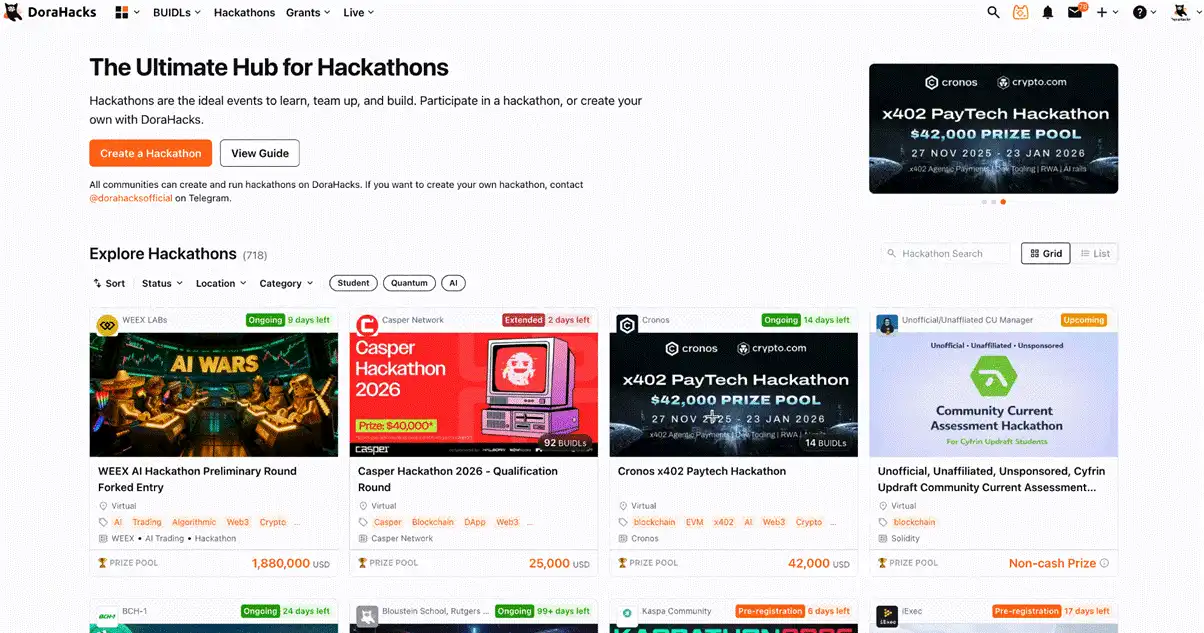
Not all hackathons are created equal. As a beginner, it's recommended to start with events hosted by large companies, such as Google or AWS's AI-themed hackathons, or events from major crypto tech companies like Circle or Binance. These hackathons have clear rules, responsive organizers, and judges who provide valuable feedback (and yes, the rewards are usually quite generous).

A reliable platform can help filter out the noise. DoraHacks is one of the world's primary hackathon platforms. Thanks to the trust of hackers and the industry, DoraHacks consistently collaborates with leading enterprises and communities to host hackathons in various tech fields like AI and blockchain. The platform's reputation means both organizers and participants have a basic quality guarantee. Furthermore, the platform archives hundreds of thousands of past projects; you can research before competing and learn from previous winners (more on that later).

Be cautious of smaller platforms or hackathons with vague information—your time is precious, so spend it on competitions that respect that.
2. Treat the Rules as Your Lifeline (This is Crucial for Your Submission)

This might sound obvious, but you'd be surprised how many excellent projects get disqualified for not following the rules. Before writing your first line of code or description, thoroughly read the rules. Understand exactly what details to submit and in what format.

Pay attention to eligibility requirements; check submission materials like demo videos, GitHub repositories, or any documentation; note any restrictions; and understand the judging criteria.
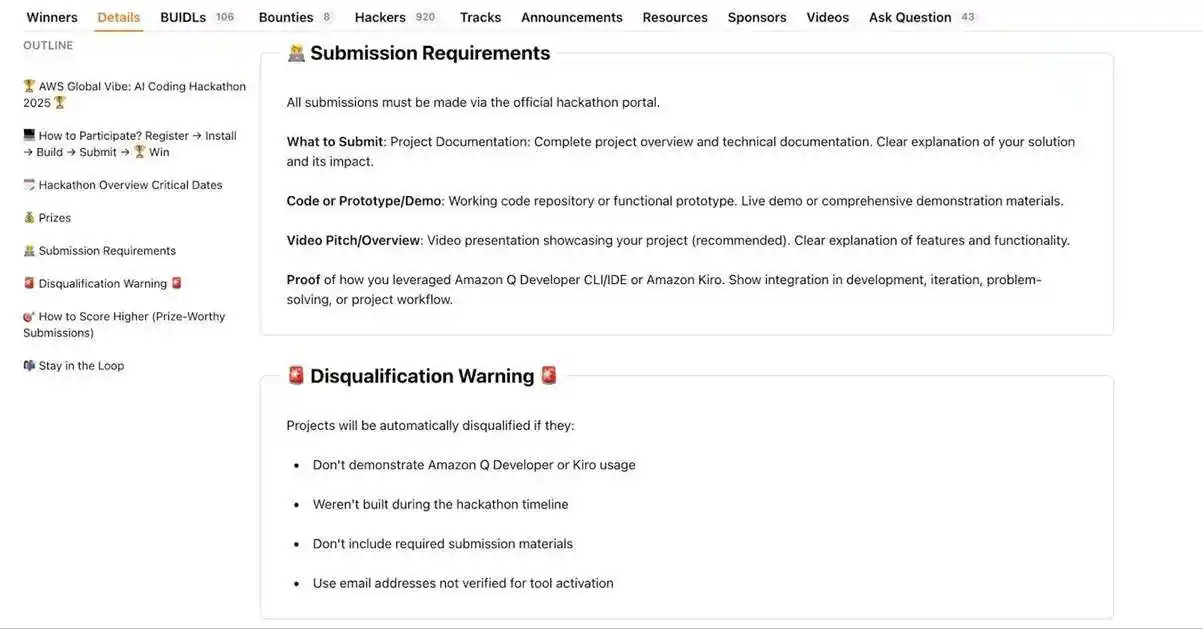
Rules for the 2025 AWS AI Vibe Coding Hackathon

The rules aren't red tape; they're a contract between you and the organizers. Following them not only shows professionalism but also ensures your efforts are judged fairly.

3. Don't Be a "Bounty Hunter"

Tempted to submit the same project to every hackathon hoping to get lucky? Stop. Organizers and judges can easily spot recycled, off-topic projects, and these submissions usually don't fare well.

Most hackathons have themes for a reason. Even if there's an "open track," judges will still evaluate how well your project aligns with the hackathon's goals. Submitting an unrelated dating app at a blockchain hackathon won't be a good fit, no matter how polished it is.

Instead of spreading yourself thin across ten unrelated competitions, focus on a few that genuinely match your interests and skills. You'll produce better work and make a stronger impression on judges and sponsors who actually care about these issues.

4. Communicate Early and Often

Many beginners treat hackathons like an exam—heads down, no talking, figure it all out alone. This is a big mistake. Good hackathons have organizers, mentors, and community channels specifically to help you succeed. Use them!

If the rules are unclear, ask for clarification before going down the wrong path. If you hit a technical snag, reach out to a mentor or post in the community Discord. If you're unsure if your idea fits the theme, check with the organizers early; don't wait until judging to find out. For example, on DoraHacks, you can message the organizers directly.

Don't struggle alone when help is readily available.
5. Learn from Other Hackers

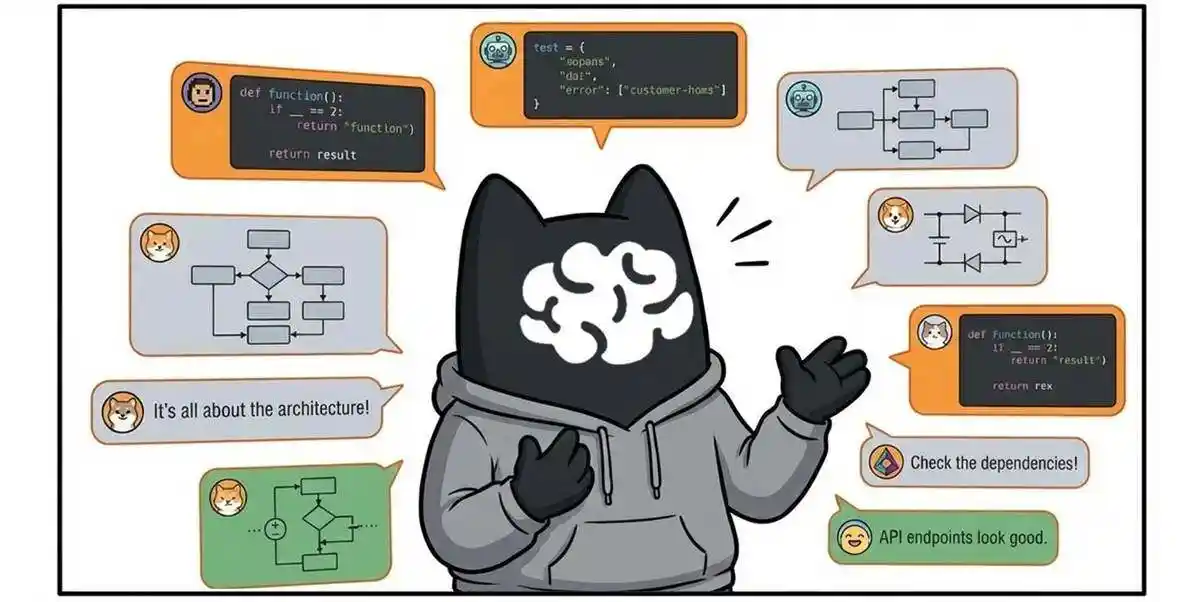
One of the most underrated benefits of hackathons is the opportunity to learn from other participants. You're surrounded by people solving similar problems with different approaches, skill levels, and perspectives.

Studying past projects is one of the fastest ways to improve. On DoraHacks, you can browse a vast archive of past projects (like this one), filter by category, and see exactly what winning teams submitted. Watch their demo videos, read their project pages, and observe how they present their ideas. Notice what makes top projects stand out: a clear problem statement, a polished demo, strong alignment with the theme. Equally important: observe what weaker projects lack so you can avoid the same pitfalls.

During the competition, interact with other participants too. Share your progress, ask what others are working on, and don't be afraid to give or receive feedback. The hacker community is generally very supportive; today's competitor could be your collaborator or co-founder tomorrow.
6. Submit a Great Demo

A great project with a poor presentation often loses to a decent project with an amazing demo. Judges have limited time and dozens of submissions to review. Make it easy for them.

Your written description is crucial: use clear language, logical flow, and don't assume judges have background information you haven't provided. Screenshots, diagrams, and links to a working demo all make your submission stronger.

Keep your demo video concise and clear: explain the problem you're solving, show how your solution works, highlight what's unique—aim for 1 to 3 minutes total, unless the rules specify otherwise.
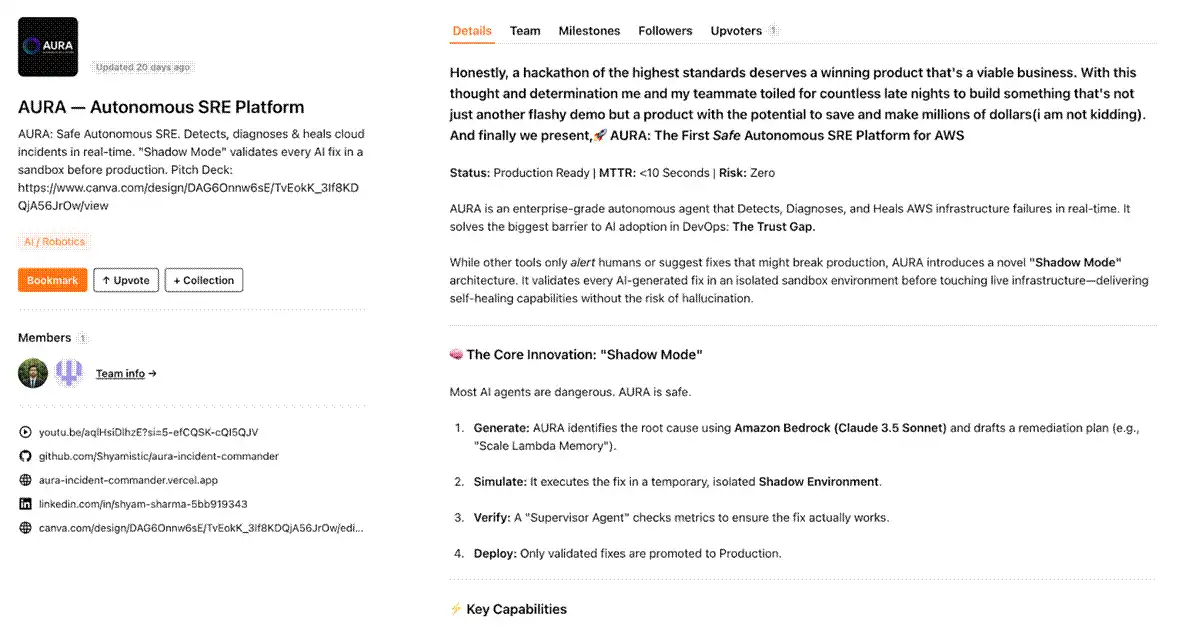
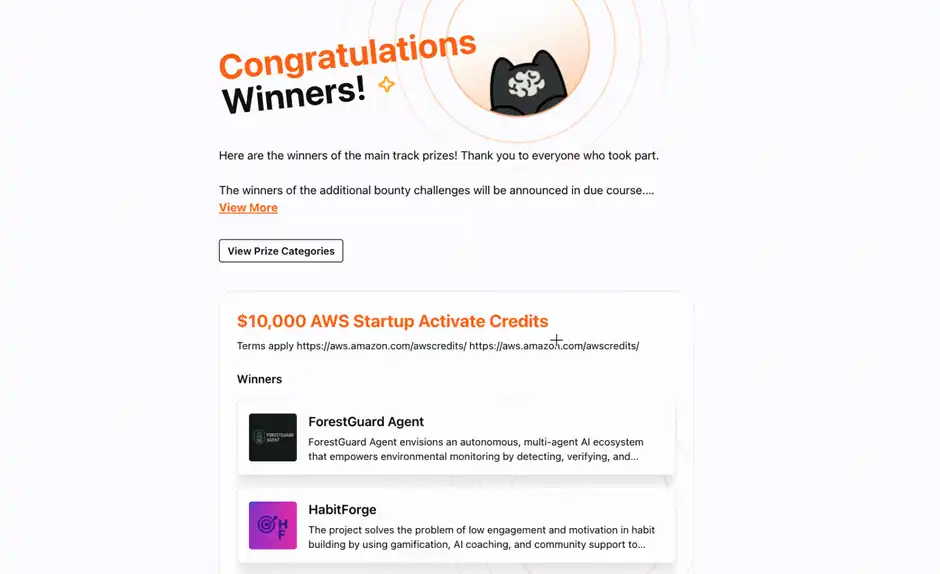
An example of a winning project on DoraHacks

Treat your submission like a pitch. You're not just showing what you built; you're convincing the judges why it matters.

7. Manage Your Time Wisely

Hackathons have deadlines, and they arrive faster than you think. Poor time management is the most common reason potentially great projects end up with incomplete submissions.

Always reserve time for submitting your materials. Recording the demo video, writing documentation, packaging everything up—these take longer than you think. Don't wait until the last minute.

If you're on a team, define roles clearly. Working in parallel is efficient only if everyone knows their responsibilities.

8. Accept the Outcome and Keep Building

Hackathons are competitions, and competitions have winners and losers. You might give it your all and walk away empty-handed. It stings, but it's completely normal.

The difference between a successful hacker and a frustrated one is how they respond. If you don't win, ask yourself what you learned. If the idea is solid and you keep iterating seriously, opportunities will find you. Many successful projects didn't win their first hackathon either but found their moment through continuous improvement.

The hackathon ends, but your work doesn't have to. If the project has potential, keep developing it. Hackathon projects are excellent portfolio pieces, and continued progress shows potential employers or investors that you're serious.

Countless amazing projects are born at hackathons and then disappear forever. The excitement fades, life gets busy, and that brilliant idea never gets another commit. Don't let that happen to you.

Celebrate the wins, learn from the losses, and then keep competing. In the long run, persistence matters more than luck.

Conclusion: Play the Long Game

Your first hackathon is just the beginning. You'll make mistakes, learn lessons, and probably wish you'd done some things sooner. That's okay; everyone starts from zero.

The people who get the most out of hackathons treat each one as a step in a longer journey. They accumulate skills, expand their network, and build a track record of consistent participation and delivery. Over time, victories come not from luck but from becoming stronger.

So, find a hackathon on DoraHacks that excites you, read the rules, chat with the organizers, learn from others, and keep creating. Leave the rest to time.

Happy hacking!

About DoraHacks

DoraHacks is a leading global hackathon community and open-source developer incentive platform. DoraHacks provides a toolkit for all parties to empower them to organize hackathons and fund early-stage ecosystem startups.

DoraHacks is committed to driving a global hacker movement in Web3, AI, quantum computing, and space technology. To date, over 30,000 startup teams have received more than $300 million in total funding through the DoraHacks community. Numerous open-source communities, enterprises, and technology ecosystems are actively utilizing DoraHacks and its BUIDL AI capabilities to organize hackathons and provide financial support for open-source initiatives.

Website | Twitter | Discord | Telegram | Binance Live | Youtube

Domande pertinenti

QWhat is the most important thing to do before writing any code for a hackathon?

ARead the rules thoroughly to understand submission requirements, format, eligibility, and judging criteria.

QWhy should new hackers avoid being 'prize miners'?

ASubmitting the same project to multiple unrelated hackathons is easily spotted by judges and usually results in poor outcomes due to lack of relevance to the theme.

QWhat is a key benefit of studying past projects on platforms like DoraHacks?

AIt is one of the fastest ways to learn what makes winning projects successful, such as clear problem statements, polished demos, and strong theme alignment.

QWhat is a crucial element for a successful project submission that many beginners overlook?

AA good demo, including a clear and concise 1-3 minute video that explains the problem, shows the solution working, and highlights its unique value.

QWhat should a hacker do if their project doesn't win a hackathon?

ALearn from the experience, ask what was gained, and continue building and iterating on the project, as persistence is more important than luck in the long run.

Letture associate

If the AI Bubble Is Already Bursting, Who Will Truly Survive?

If the AI Bubble is Bursting, Who Will Remain? The debate over an AI bubble is intensifying, with figures like Ray Dalio warning of high levels and Jensen Huang seeing immense, early-stage opportunity. Both views hold truth: a speculative bubble in capital markets likely exists, mirroring the dot-com era, but the underlying technological shift is real and transformative. History shows that while bubbles burst—wiping out overvalued companies and speculative capital—they often leave behind critical physical and digital infrastructure. The dot-com bust, for instance, eliminated many firms but left the global fiber optic networks and data centers that enabled the rise of Amazon, Netflix, and cloud computing. Today's massive AI infrastructure investments (projected at trillions by 2030) in data centers, power, cooling, and GPUs may follow a similar path, creating the foundation for future applications. A key divergence from past bubbles is the "Jevons Paradox" effect in AI. As the cost of AI inference has plummeted by over 99.7% since 2023, enterprise spending on AI has skyrocketed. Cheap "tokens" have unlocked vast, previously uneconomical use cases, moving AI from simple chatbots into core business workflows—code generation, legal document review, scientific simulation, and financial analysis. The market is now in a phase of self-correction, weeding out superficial "API-wrapper" startups, but this cleansing process strengthens the ecosystem. The long-term trajectory is clear. The value is gradually shifting from capital expenditure (CapEx) on hardware to operational expenditure (OpEx) on transformative applications. As AI becomes a utility, the winners will be firms that deeply integrate it to solve vertical industry problems in law, healthcare, finance, and manufacturing. The泡沫 will recede, but the foundational shift towards an AI-powered era across all sectors is irreversible. The underlying productive force of AI contains no bubble.

marsbit24 min fa

If the AI Bubble Is Already Bursting, Who Will Truly Survive?

marsbit24 min fa

If the AI Bubble Is Already Bursting, Who Will Truly Remain?

**Summary: If the AI Bubble is Bursting, What Will Remain?** The debate around an AI bubble is intensifying, with figures like Ray Dalio warning of high valuations while Jensen Huang sees immense opportunity. This echoes the dot-com bubble, which saw massive wealth destruction but ultimately left behind critical infrastructure like undersea cables and broadband, enabling future giants like Amazon and Netflix. Similarly, today's AI boom involves trillions invested in data centers, power, cooling, and GPUs, while application-layer revenue remains comparatively modest. This investment-disparity signals a bubble. However, the core technological progress is real and accelerating. AI inference costs have plummeted by over 99.7% since 2023, making intelligence increasingly cheap and accessible. This cost collapse is unlocking vast new demand. Instead of reducing spending, enterprises are tripling their AI cloud expenditure. Cheap "tokens" enable AI to move beyond simple chatbots into complex workflows—automating code writing, legal document review, financial analysis, and scientific research. This follows "Jevons's paradox": improved efficiency leads to greater total consumption. The market is now undergoing a necessary purification, weeding out "API-wrapper" startups with no real moat. The deeper evolution involves a shift from capital expenditure (CapEx) on infrastructure to operational expenditure (OpEx) on value-creation in applications. While hardware vendors currently profit most, long-term value will migrate to AI-native firms solving vertical industry problems. Ultimately, a market correction will cleanse speculative excess but will not reverse the AI+ trend. The massive physical and algorithmic infrastructure being built will endure, becoming a cheap, utility-like foundation. Just as the internet became indispensable to all industries post-2000, AI is poised to empower and redefine every sector, moving society irreversibly toward an intelligence-augmented era. The bubble may burst, but the underlying productive momentum is solid.

链捕手31 min fa

If the AI Bubble Is Already Bursting, Who Will Truly Remain?

链捕手31 min fa

Microsoft CEO: In the AI Era, How Do You Define a Company's Moat?

Microsoft CEO Satya Nadella argues that in the AI era, a company's true competitive edge, or "moat," is not determined by choosing the single most powerful model, but by its ability to build a continuous "learning loop." This system integrates and evolves by connecting human workflows, domain expertise, organizational judgment, and employee experience. He posits that future companies will accumulate two types of capital: Human Capital (employee knowledge, judgment, creativity) and "Token Capital" (a firm's own built and owned AI capabilities). Importantly, AI amplifies rather than devalues human capital. Human direction is essential to guide progress, as computational power alone is aimless. The core opportunity lies in creating a closed-loop system where human and token capital reinforce each other in a compound, self-improving cycle. A company must be able to preserve its unique institutional knowledge—its "company veteran" expertise—even if it switches underlying general-purpose AI models. This requires private evaluation benchmarks, reinforcement learning environments based on internal data, and queryable knowledge bases. Nadella warns against a future where economic value is concentrated by a few dominant models that commoditize entire industries' knowledge. Instead, the priority should be building a broad "frontier ecosystem" where every company, industry, and nation can own its learning loop. This allows organizations to retain control of their intellectual property, amplify employee capabilities, and ensure the economic value created by AI is captured within their own businesses and communities. True corporate sovereignty in the AI age comes from turning organizational knowledge into a compounding system that creates enduring, defensible value.

marsbit1 h fa

Microsoft CEO: In the AI Era, How Do You Define a Company's Moat?

marsbit1 h fa

ETFs Are Just the Ticket: The True Institutionalization of Bitcoin Is Happening Where You Can't See It

Beyond the Bitcoin ETF spotlight, a deeper institutionalization is underway, leveraging Bitcoin as a foundational financial primitive. Institutions are using Bitcoin for purposes long reserved for assets like U.S. Treasuries and gold: as collateral for loans, insurance reserves, and the backbone of rated bonds. Examples include a Barbados-based insurer capitalizing with $40M in Bitcoin reserves and Ledn's $188M securitization of Bitcoin-backed loans, which received the first-ever investment-grade rating (BBB-) from S&P for a digital asset-backed security. This structure was stress-tested during a 27% price drop in early 2026, triggering automatic liquidations that functioned as designed but revealed the systemic risk of synchronized selling across leveraged positions. Infrastructure is evolving to support this, with platforms like Anchorage Digital's Atlas network enabling secure, institutional-grade settlement and collateral management. Strategies like basis trades and corporate treasuries (exemplified by companies like MicroStrategy issuing billions in equity and debt to fund Bitcoin acquisitions) further integrate Bitcoin into financial mechanics. While ETFs solved "how to own" Bitcoin, these developments answer "what to do with it," embedding the asset into the working machinery of finance—as collateral upon which loans, derivatives, and structured products are built. The real, enduring institutional shift is happening in these largely invisible plumbing and financing systems.

marsbit1 h fa

ETFs Are Just the Ticket: The True Institutionalization of Bitcoin Is Happening Where You Can't See It

marsbit1 h fa

ZEC Co-Founder Responds to Orchard Vulnerability: No Signs of Theft, Orchard Pool to Be Sealed

ZEC Co-Founder Addresses Orchard Vulnerability: No Signs of Theft, Plans to Sunset Orchard Pool A security vulnerability was recently discovered in Zcash's Orchard shielded pool, raising key concerns. The primary questions are whether the flaw was exploited, if user funds are safe, whether users can verify the total ZEC supply, and if other similar vulnerabilities exist. Analysis suggests the vulnerability was likely not exploited prior to its discovery. It was found proactively by a researcher using specialized tools, not due to an active breach. The development team and mining pools acted quickly to contain the issue. Typical financially-motivated attacks would likely have left visible on-chain evidence, which has not been observed. User funds in Orchard are considered safe and should be recoverable, assuming no prior exploitation. If the flaw was never used, all legitimate funds can be withdrawn. The article outlines risks associated with moving funds to transparent addresses or other pools, but concludes that leaving assets in place is a reasonable option. Currently, users cannot independently verify that the total ZEC supply hasn't been inflated due to this bug. However, the planned Ironwood network upgrade is designed to resolve this. It will permanently close the Orchard pool to new deposits and internal transfers, allowing only withdrawals. This mechanism will cap total withdrawals at the amount of legitimately deposited funds, enabling anyone to cryptographically verify the supply post-upgrade. Multiple teams, including Shielded Labs, have conducted extensive audits focused on counterfeiting vulnerabilities, assisted by advanced AI tools. No additional flaws of this type have been found so far, increasing confidence that no other similar undisclosed vulnerabilities exist. In summary, evidence indicates the Orchard bug was probably not used, user funds are secure, and no other counterfeiting flaws are currently known. The upcoming Ironwood upgrade will restore users' ability to independently verify the total ZEC supply, closing this chapter.

Foresight News1 h fa

ZEC Co-Founder Responds to Orchard Vulnerability: No Signs of Theft, Orchard Pool to Be Sealed

Foresight News1 h fa

Trading

Spot
Futures
活动图片





