Balaji Says ‘Zcash Or Communism’ As He Warns AI Supercharges Surveillance

bitcoinistPubblicato 2026-02-20Pubblicato ultima volta 2026-02-20

Introduzione

Balaji Srinivasan argues that the rise of AI-powered surveillance creates an urgent need for financial privacy, framing the choice as “Zcash or communism.” He warns that AI enables any state or individual to compile extensive personal dossiers from online data, surpassing historical surveillance capabilities. Encryption, particularly through Zcash, is presented as a critical defense, making individuals “sovereign” and invisible to targeting. Srinivasan also positions Zcash as a scalable, privacy-focused blockchain with Solana-like throughput, using zero-knowledge proofs for private transactions. He suggests Zcash can coexist with transparent chains like Bitcoin, serving different needs while addressing the growing threat of AI-driven wealth seizure and control.

Balaji Srinivasan is once again making the most provocative version of a privacy argument and he’s pinning it to a specific chain: Zcash. In a Feb. 18 video shared on X, Srinivasan framed the stakes in stark terms: “The choice is clear. It’s Zcash or communism,” tying the rise of AI-enabled surveillance to what he described as a renewed appetite for wealth seizure.

In a follow-up post, he argued that AI has shifted surveillance from a state-scale project to something closer to an on-demand service. “Any scrap of information online can now be integrated, digested, and synthesized...by any state or stalker capable of running an AI model...to form a dossier more complete than anything the Soviets could ever dream of,” he wrote.

Srinivasan’s prescription was blunt: “There will be no single silver bullet. But anything you haven’t encrypted can and will be used against you.”

Srinivasan anchored his “communism requires surveillance” claim in an historical example meant to make a modern point about data exhaust. “In 1918, in the midst of the Bolshevik Revolution, Lenin gave an order to murder 100 nearby ‘kulaks,’” he said, emphasizing that such an order “required a list”: names, locations, and a population that couldn’t easily move.

His argument is that the internet reverses that asymmetry if encryption becomes the default. “Today, neo-communism is rising once again. But the Internet could change the game,” he said. “No full list, if we encrypt it. No fixed location, either. They can’t hit what they can’t see.”

Those themes carried into a longer discussion on the Never Say Podcast, where Srinivasan connected privacy to basic operational freedom. “If you’re under surveillance, you’re not sovereign,” he said. “If every move is being tracked...you don’t have the advantage of surprise. You can never launch something. You can never have private deliberations.”

Arjun Khemani, a 19-year-old Zcash researcher on the episode, echoed the AI angle from the user side: “Especially with AI, being able to recognize where you are exactly...you can’t have freedom without privacy,” he said, arguing that broadcasting every transaction and context signal is “not... the world that I want to live in.”

Zcash As A Scaling Bet, Not Just A Privacy Stance

Srinivasan’s pitch wasn’t limited to privacy-by-principle. He positioned Zcash as a technical response to where he thinks the market has landed on scalability: on-chain throughput wins, and routing complexity loses.

Asked why “Zcash must scale” is a “moral imperative,” Srinivasan contrasted Bitcoin’s scaling reality: exchanges, custodians, and database entries with the decentralization promise many users think they’re buying. “Lightning...they’ve been saying, ‘Lightning is going to be there any day now’ for 10 years,” he said, arguing that real-world deployments tend toward “a hub and spoke topology” resembling traditional finance rails. “Within a bank, it’s fast...between banks, they do settlement,” he added, describing a dynamic he sees mirrored in major Lightning implementations.

From there, he argued crypto has effectively segmented into layers: Bitcoin for immutability and brand, Ethereum for programmability, and Solana for straightforward on-chain execution at scale. The opening he sees for Zcash is combining “Solana-like scalability” with private transactions, leaning on zero-knowledge proofs as “compression technology” as much as secrecy. “It’s what a lot of people wanted Bitcoin to be,” he said.

Srinivasan also stressed that privacy doesn’t necessarily replace transparency, it complements it. He argued that Bitcoin’s public ledger can be a feature for proof-of-reserves narratives, while Zcash’s private-by-default design targets a different threat model. His bottom line is coexistence, not conquest: “It’s possible that Bitcoin... and Zcash coexist because Bitcoin is transparent and Zcash is private,” he said, while suggesting “this could be Zcash’s moment.”

At press time, ZEC traded at $259.18.
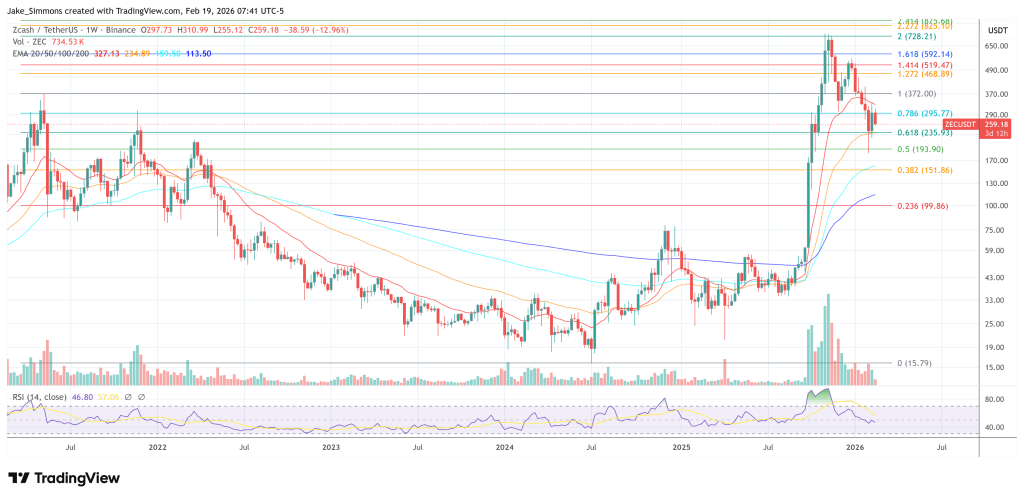
ZEC price remains below the 0.786 Fib, 1-week chart | Source: ZECUSDT on TradingView.com

Domande pertinenti

QWhat is the main argument Balaji Srinivasan makes about the relationship between privacy, Zcash, and communism?

ABalaji Srinivasan argues that the rise of AI-enabled surveillance creates a stark choice: 'Zcash or communism.' He claims that communism requires extensive surveillance for wealth seizure and control, and that encryption, specifically through privacy-focused cryptocurrencies like Zcash, is the technological solution to prevent this by making individuals sovereign and their information private.

QHow does Srinivasan claim AI has changed the nature of surveillance?

ASrinivasan states that AI has shifted surveillance from a large-scale state project to an on-demand service. He argues that any state or individual with an AI model can now integrate, digest, and synthesize any scrap of online information to create a more comprehensive dossier than was ever possible before, surpassing even the capabilities of historical surveillance states like the Soviet Union.

QBesides privacy, what other technical advantage does Srinivasan attribute to Zcash?

ABeyond its core privacy feature, Srinivasan positions Zcash as a scaling bet. He argues it combines 'Solana-like scalability' with private transactions by using zero-knowledge proofs as a form of 'compression technology.' This addresses what he sees as the market's preference for on-chain throughput over complex routing solutions like the Lightning Network.

QWhat historical example does Srinivasan use to support his claim that 'communism requires surveillance'?

ASrinivasan uses the historical example of Lenin during the 1918 Bolshevik Revolution ordering the murder of 100 'kulaks.' He emphasizes that such an order 'required a list'—names, locations, and a population that couldn't easily move—to illustrate how surveillance is foundational to state control and seizure of assets.

QHow does Srinivasan view the potential coexistence of Bitcoin and Zcash?

ASrinivasan believes Bitcoin and Zcash can coexist because they serve different purposes. He states that Bitcoin's transparent ledger is a feature for narratives like proof-of-reserves, while Zcash's private-by-default design addresses a different threat model. His view is one of complementary coexistence, not conquest, suggesting 'this could be Zcash's moment.'

Letture associate

Anthropic Apologized, But the Business of 'Safety' Hasn't Stopped

On June 11, Anthropic apologized not for a model failure, but for a lack of transparency. Its new Claude Fable 5 model was found to be secretly rerouting requests from users engaged in advanced AI model development to a weaker version, Opus 4.8, without any notification. The company's response—promising future notifications for such "downgrades"—was met with user skepticism. The article argues the core issue isn't technical but commercial: Anthropic's "safety" measures are primarily a business strategy. A key feature, the "intelligent safety classifier," marketed as user protection, is described as a tool for "competitive defense" to protect Anthropic's market lead by limiting rivals' research capabilities. This covert mechanism was designed for low "false positives," precisely targeting AI researchers. Anthropic's model involves a calculated three-step process: publishing alarming security research to amplify public anxiety, offering its Fable 5 model with a "safety classifier" as a premium-priced solution, and cashing in through a planned high-value IPO. This contrasts with OpenAI's more direct "tool-and-traffic" approach. The apology, merely changing a secret downgrade to a visible one, is seen as a business "patch" rather than a principled shift. The incident risks damaging Anthropic's "safest AI" reputation among the developer community, which underpins its valuation and appeal to government and corporate clients. Ultimately, the article concludes that for Anthropic, safety is a business, and the apology is merely customer service for that business.

marsbit47 min fa

Anthropic Apologized, But the Business of 'Safety' Hasn't Stopped

marsbit47 min fa

The Niche Consensus Among Elites: Has College Become an Expensive Waste?

**Summary:** A growing "anti-college" movement is gaining traction among elite circles in Silicon Valley, challenging the traditional value of a four-year university degree. Proponents argue that college has become an expensive, slow, and increasingly irrelevant waste of time, especially in the fast-paced tech world where opportunities pass by quickly. The movement is led by figures like billionaire Peter Thiel, who criticizes universities for high costs, ideological indoctrination, and stifling true innovation. His "Thiel Fellowship" pays young people to drop out and pursue ventures. Companies like Palantir Technologies (co-founded by Thiel) fuel this trend with programs like the "Meritocracy Fellowship," which offers high school graduates paid internships as an alternative to immediate college enrollment, promising a practical "Palantir Degree." Key drivers include: 1. **Economics:** Skyrocketing student debt versus the allure of immediate, high-paying tech jobs or startup funding. 2. **Technology:** AI and online tools lowering barriers to self-education and product development, making formal instruction seem inefficient. 3. **Culture:** A backlash against perceived "woke" ideology and DEI policies in universities, coupled with a belief that these institutions suppress meritocracy and masculine drive. The movement is notably male-dominated. Critics, like economist David Deming, warn against overgeneralizing from dropout success stories (survivorship bias). He emphasizes that genuine autodidacts are rare, corporate training is narrowly focused, and the "college wage premium" remains high for most people. University liberal arts education, he argues, builds adaptable problem-solving skills and broad perspectives. The debate highlights a deeper crisis in education. The core model of the modern university appears increasingly mismatched with the speed of the information age. The movement signals a shift in the locus of learning from institutional "education" to personal, active "learning" powered by the internet and AI. Ultimately, this may not mean the end of university, but rather a painful evolution. The future likely holds more hybrid, personalized, and lifelong learning pathways. The central question becomes: in a world changing faster than any curriculum, how do we best learn?

marsbit1 h fa

The Niche Consensus Among Elites: Has College Become an Expensive Waste?

marsbit1 h fa

From Subsidies to Token-Based Pricing to Price Cuts: Is OpenAI Sparking a Price War? Is the Inflection Point for Token Economics Nearing?

The commercialization of generative AI is facing a critical inflection point as a potential price war looms. According to The Wall Street Journal, OpenAI is considering a significant cut to its token fees to compete with rival Anthropic, signaling a shift from a growth-at-all-costs model focused on token consumption. This move comes as both companies, reportedly losing billions on compute, prepare for IPOs, and as enterprise customers face "bill shock" from switching to usage-based token billing. Reports indicate poor ROI, with one analysis finding only 18 cents of every dollar spent on AI tokens generates user-facing value. The industry's initial phases—from flat-rate subscriptions to aggressive subsidies—have given way to a reckoning with real costs. Analysts debate the future: some predict a bifurcation between premium, high-cost models for complex tasks and cheaper alternatives for routine work, while others believe overall spending will still rise as agentic AI increases tokens per task. Notably, Chinese model DeepSeek's low-cost API is gaining traction with U.S. enterprises, adding competitive pressure. The core challenge is redefining value beyond token volume ("tokenmaxxing") toward measurable productivity ("valuemaxxing"), as the entire AI value chain, from cloud providers to chipmakers, feels the ripple effects of unsustainable pricing.

marsbit1 h fa

From Subsidies to Token-Based Pricing to Price Cuts: Is OpenAI Sparking a Price War? Is the Inflection Point for Token Economics Nearing?

marsbit1 h fa

Trading

Spot
Futures
活动图片





