'ASIC Giant' Marvell Sets Record Quarterly Revenue, Raises Guidance Again, CEO Says Data Center Business Is 'On Fire'

marsbitPubblicato 2026-05-28Pubblicato ultima volta 2026-05-28

Introduzione

Marvell Technology, a leading player in custom AI chips and data center connectivity, reported record revenue for its fiscal Q1 2027, driven by explosive demand in its data center business. Revenue reached $2.418 billion, slightly surpassing expectations, though GAAP net income fell year-over-year due to acquisition-related costs. Crucially, data center revenue hit $1.83 billion, making up 76% of the total and growing 27% YoY. The company significantly raised its full-year and next-year guidance, citing "exceptionally strong AI-related orders." Revenue is now projected at ~$11.5 billion for FY2027 and ~$16.5 billion for FY2028. CEO Matt Murphy emphasized that growth in the data center segment is accelerating. The AI Interconnect business, now expected to grow over 70% annually, saw its forecast lifted again due to rising network demands in complex AI models. Additionally, Marvell's custom chip (XPU) business is on a steep growth path, with FY2028 revenue anticipated to double and a target of over $10 billion by FY2029. The company also expanded its strategic collaboration with NVIDIA, focusing on silicon photonics, system integration, and AI-RAN solutions. To secure supply for surging demand, Marvell plans about $1 billion in supplier prepayments this fiscal year, highlighting its long-term capacity planning. Despite the strong results, the stock dipped slightly in after-hours trading.

Marvell delivered a seemingly brilliant report card with record revenue and a significant guidance raise.

After the U.S. market closed on May 27th, AI custom chip, optical communication, and data center interconnect leader Marvell released its Q1 FY2027 financial results and held an earnings call. The data center business continued its explosive growth, leading the company to once again significantly raise its full-year guidance. CEO Matt Murphy directly stated on the call, "Our data center business is on fire", and "orders are exceptionally strong."

Marvell's Q1 FY2027 revenue was $2.418 billion, up 28% year-over-year and 9% quarter-over-quarter, slightly exceeding analyst expectations of $2.41 billion. Non-GAAP earnings per share were $0.80, in line with analyst estimates. However, GAAP net profit was $34.5 million, a significant decline from $177.9 million in the same period last year, primarily due to one-time costs and non-cash amortization related to the acquisitions of Celestial AI and XConn.

The data center business contributed $1.83 billion in revenue, accounting for 76% of total revenue, up 27% year-over-year and 11% quarter-over-quarter.

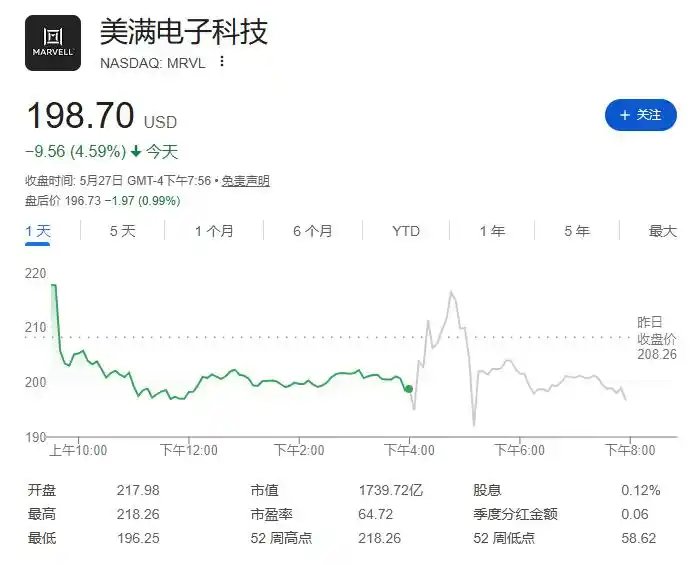
Following the earnings report and call, the company's stock price fell slightly by about 1%. Year-to-date, the stock had already more than doubled ahead of the earnings report. Against high expectations, merely "meeting expectations" may no longer be enough to impress the market.
01

"AI-Related Orders Are Exceptionally Strong," Marvell Raises Guidance Again

This marks Marvell raising its guidance for multiple consecutive quarters.

For the Q2 FY2027 guidance, the company expects revenue of approximately $2.7 billion (plus or minus 5%), representing year-over-year growth of about 35%, higher than the analyst consensus estimate of $2.6 billion. The non-GAAP EPS guidance range is $0.88 to $0.98, compared to the analyst consensus of $0.90.

For the full-year guidance, Marvell raised its FY2027 revenue expectation to approximately $11.5 billion, representing growth of about 40% year-over-year. Three months ago, the company's guidance was "approaching $11 billion."

More attention-grabbing is the outlook for FY2028. Marvell raised its FY2028 revenue target to approximately $16.5 billion, about $1.5 billion higher than the guidance provided last quarter, representing year-over-year growth of about 45%.

CEO Matt Murphy stated in the earnings release: "We are seeing exceptionally strong AI-related orders, and as a result, we are significantly raising our revenue expectations for Marvell's FY2027 and FY2028, showing substantial improvement compared to the guidance provided last quarter."

02

Data Center: Accounts for 76% of Revenue, Growth Still Accelerating

Q1 data center revenue was $1.83 billion, up 27% year-over-year and 11% quarter-over-quarter, accounting for 76% of total revenue.

Marvell's growth forecasts for this business are:

FY2026: +46% (already achieved)

FY2027: approximately +50%

FY2028: approximately +55%

Murphy stated:

The data center business is on fire, and we expect growth rates to accelerate this year and next, starting from an already high base.

03

Interconnect Business: Growth Rate from 30%→50%→70%, CEO Says "There's Room for Upside"

The AI Data Center Interconnect business is the largest segment within Marvell's data center portfolio, covering optical interconnect, DCI modules, coherent optics, and other product lines.

The expected annual growth rate for this business has been raised consecutively over the past few quarters: around 30% around September last year, later raised to 50%, and now raised again to over 70%.

When pressed by analysts, Murphy said directly:

I think there is a lot of potential for upside here. Our traditional DSP business will see a significant jump next year, the 1.6T product line has higher value content, DCI is accelerating, along with new businesses like retimers, AEC, and scale-up optics... This is the beginning of a major growth cycle for us.

Why has the interconnect business suddenly become so important? Murphy provided a clear logic:

Early generative AI primarily addressed compute and memory bottlenecks, with network interconnect being a secondary concern. However, with the deployment of more complex architectures like inference models and Mixture of Experts (MoE) models, the volume of data transmission within AI clusters has increased dramatically, significantly elevating the importance of network interconnect.

Some key numbers:

TIA and Driver Chips: Expected to surpass an annualized revenue run rate of $1 billion in the coming quarters.

DCI Module Business: Already shipping to all five major U.S. hyperscale cloud providers. Expected to surpass an annualized revenue run rate of $1 billion in FY2028, approximately double that of FY2026 (~$500 million).

Scale-up optics (NPO/CPO Optical Interconnect): Previously expected to be around $150 million; now raised, expected to exceed $300 million in FY2028.

04

Custom Chips (XPU): Doubling Next Year, Targeting Over $10 Billion by FY2029

Marvell's custom chip (Custom/XPU) business is another important growth line and a major focus for the market.

Current Progress:

FY2027 Custom Chip Revenue: Growth exceeding 20% year-over-year.

FY2028 Custom Chip Revenue: Expected to double year-over-year, higher than last quarter's expectation.

FY2029 Target: Exceed $10 billion (previous target was approximately $8 billion).

Analyst Vivek Arya (Bank of America Securities) pressed during the call: Does this mean FY2028 custom chip revenue will be over $4 billion, then jump to $10 billion in FY2029, implying a single-year incremental revenue of $5-6 billion?

Murphy's response was: Yes, you heard that correctly.

Three drivers for FY2028 custom chip growth:

Continued growth from existing flagship XPU projects.

More than ten XPU satellite projects (NIC, CXL, etc.) entering higher-volume production stages, with demand consistently exceeding expectations.

A new leading XPU project entering production — Murphy stated, "The project is progressing smoothly, and the full-year production plan is in place."

Murphy also revealed that while newly won design projects typically require about a two-year development cycle before contributing revenue, the significance of these projects lies in providing security for longer-term growth, which he referred to as "insurance policies."

05

Expanding Collaboration with NVIDIA, Three Key Directions Materializing

This quarter, Marvell announced an expanded strategic collaboration with NVIDIA. Murphy detailed three core directions on the call:

1. Optical Interconnect Collaboration: Marvell has long provided DSP, TIA, and drivers to NVIDIA. The two companies are now further collaborating on developing silicon photonics technology, considered a key enabling technology for scale-up networks.

2. NVLink Fusion Integration: Allows Marvell to build custom chips and network semiconductors that seamlessly interface with NVIDIA's infrastructure. Murphy stated this provides hyperscale cloud providers with greater flexibility to freely mix and match between custom chips and NVIDIA chips. "Marvell uniquely provides the bridge between these two architectures," creating new market opportunities for both companies.

3. AI-RAN: Marvell will enhance its Octeon base station processors to enable them to work directly in tandem with NVIDIA GPUs, running both 5G/6G wireless workloads and AI applications on the same hardware platform.

06

Supply Chain: Locking in Capacity Early, ~$1 Billion in Prepayments Planned This Year

Facing continuously climbing demand, supply chain management has become a critical variable.

CFO Willem Meintjes revealed on the call that the company plans to make approximately $1 billion in supplier prepayments during FY2027, with the first payments starting in Q2. These prepayments will be credited against future material purchases.

COO Chris Koopmans explained Marvell's supply chain strategy in response to analyst questions:

Everything related to AI has been supply-constrained from day one. Our approach is to build extremely close relationships with a small number of core suppliers, provide them with five-year demand forecasts, deliver on our promises every time, and back up our forecasts with action and prepayments.

Financially, Q1 operating cash flow reached a record $639 million. The company repurchased $200 million worth of stock in the quarter and paid $54 million in dividends. As of the end of Q1, total debt stood at $4.96 billion, with net debt/EBITDA at 0.32x.

This article is from the WeChat public account "Wall Street Insights Max," author: Long Yue

Domande pertinenti

QWhat was the key factor behind Marvell's significant increase in its revenue guidance for fiscal years 2027 and 2028?

AThe key factor was exceptionally strong AI-related orders, which led the company to significantly raise its revenue outlook compared to the guidance provided the previous quarter.

QWhat percentage of Marvell's total Q1 revenue came from its Data Center segment, and what was its growth rate?

AMarvell's Data Center segment contributed 76% of its total Q1 revenue, with a year-over-year growth of 27% and a sequential growth of 11%.

QHow did Marvell describe the growth trajectory for its AI Data Center Interconnect (Interconnect) business?

AMarvell described the growth trajectory as accelerating significantly, with the annual growth rate expectation being raised from around 30% to 50%, and now to over 70%. The CEO indicated there is substantial upside potential remaining.

QWhat is Marvell's stated revenue target for its Custom Chip (XPU) business by fiscal year 2029, and what major driver was mentioned for growth in fiscal year 2028?

AMarvell's stated revenue target for its Custom Chip (XPU) business by fiscal year 2029 is over $10 billion. A major driver for growth in fiscal year 2028 is the expected doubling of its custom chip revenue, aided by a new major XPU project entering production.

QWhat are the three core areas of Marvell's expanded strategic collaboration with NVIDIA, as detailed in the earnings call?

AThe three core areas are: 1) Collaboration on optical interconnect and silicon photonics technology. 2) NVLink Fusion Integration, allowing Marvell to build custom chips and networking semiconductors that interface seamlessly with NVIDIA infrastructure. 3) AI-RAN, enhancing Marvell's Octeon base station processors to work directly with NVIDIA GPUs for simultaneous 5G/6G and AI workloads.

Letture associate

GitHub, Transfixed by AI

On the night of February 9th, GitHub suffered a major outage caused by a simple configuration change—reducing a cache refresh interval from 12 to 2 hours—that triggered a cascade of failures. This was not an isolated event, but part of a broader pattern. In early 2026, GitHub experienced at least 8 major incidents, failing to meet its promised 99.9% availability. These outages stemmed from structural issues: explosive growth in load, tight service coupling, and insufficient protection against abnormal traffic. This unprecedented load is driven by AI Agents. In 2025, GitHub handled ~1 billion commits. By 2026, weekly commits reached 275 million, projecting to ~14 billion for the year—a 14x increase. AI tools like Claude Code now contribute 4.5% of all public repository commits, with weekly submissions surging 25x in just three months. AI-generated pull requests jumped from 4 million to 17 million per month in half a year. Unlike human developers, AI Agents work continuously, generating commits at a scale that overwhelms infrastructure designed for human rhythms. The surge also shattered GitHub's business model. Copilot's flat-rate pricing, based on assisting human developers, became unsustainable as Agentic AI sessions consumed resources worth hundreds of dollars for a few dollars in fees. In response, GitHub imposed usage limits and, by June 1st, shifted to a pay-per-use "AI Credits" system. Facing this new reality, GitHub realized a 10x scaling plan was insufficient. It announced a need to *redesign* its architecture for 30x current scale—decoupling services, adding fault isolation, and improving change management to prevent cascading failures. Other platforms like Stripe and AWS are facing similar challenges with AI Agents. Fundamentally, GitHub is transitioning from a human collaboration platform to an "exhaust pipe" for automated AI workflows. Its detailed post-mortem reports aim to maintain trust during this turbulent rebuild. The February outage was not just a technical glitch, but a signal of the software industry's entry into a new, AI-driven era.

marsbit16 min fa

GitHub, Transfixed by AI

marsbit16 min fa

Both Suffer Massive Losses Exceeding $90 Billion, Which Is in Greater Peril: Strategy or Bitmine?

Facing massive paper losses exceeding $90 billion each amidst a sharp market downturn, "Digital Asset Treasury" (DAT) giants Strategy and Bitmine find themselves in a precarious position, but with different underlying risks. Strategy, heavily invested in Bitcoin (BTC), faces significant financial strain. Its strategy relies heavily on debt, including convertible notes and preferred stock (STRC) requiring substantial dividend payments. With its cash reserves dwindling and BTC offering no staking yield for cash flow, Strategy's high leverage makes it vulnerable. A continued price decline could force asset sales to meet obligations, potentially creating a negative feedback loop. Its market value has already fallen sharply. In contrast, Bitmine, an Ethereum (ETH) holder, appears on firmer financial ground. It primarily funds its purchases through equity offerings (like ATM programs), avoiding debt pressure. It also generates income by staking a large portion of its ETH holdings. While not immune to market drops and shareholder dilution concerns, Bitmine maintains more flexibility, recently announcing a new preferred share offering to raise further capital. The core divergence lies in their financing: Bitmine uses equity (investor money), while Strategy uses debt (borrowed money). Consequently, Bitmine currently faces less immediate liquidity pressure than Strategy, which must navigate the dual challenge of servicing debt/dividends and a declining core asset (BTC) price.

marsbit23 min fa

Both Suffer Massive Losses Exceeding $90 Billion, Which Is in Greater Peril: Strategy or Bitmine?

marsbit23 min fa

Where the AI Bubble Really Is: Which Layer of Players Are Naked

AI Bubble: Where It Really Is and Who's Swimming Naked This analysis dissects the AI industry not as a single entity but as a five-layer pyramid, arguing that bubbles are concentrated in specific tiers, not uniformly distributed. **Key Distinction from the 2000 Dot-com Bubble:** Unlike 2000, where companies had stock prices before revenue, today's leading AI players have massive, contract-backed revenue driving their valuations. Core infrastructure demand is real, with every GPU running at full capacity for paying customers. **The Five-Layer Pyramid & Bubble Assessment:** * **L0 (Fab/Manufacturing) & Top L4 (Leading AI Apps): NO BUBBLE.** Companies like TSMC, NVIDIA, major cloud providers (Microsoft, Google, Meta, Amazon), and top AI labs have real revenues and orders. Supply is tightly constrained by TSMC's disciplined capacity control and physical limits like power/land for data centers, preventing a supply glut. * **L1 (Memory): BATTLEGROUND.** Sky-high HBM margins could signal a new structural cycle or a classic "boom before bust." The oligopoly of three major players may enforce supply discipline, making this a high-stakes bet. * **L2 (Interconnect/Optical Modules): BUBBLE TERRITORY.** Companies like Lumentum and AAOI have seen stock surges (4-10x) far outpacing revenue growth. This hardware segment has lower physical barriers to expansion than fabs, allowing speculation. It mirrors the 2000 bubble's epicenter—optics. * **L3 (Infrastructure/"GPU Landlords"): VULNERABLE.** GPU leasing companies profit from the current compute shortage but own no long-term moat. Their business model relies on a temporary bottleneck that will ease as big tech expands and new tech (e.g., potential space-based data centers) emerges. * **L4 Long Tail (VC-backed Startups): STRONG BUBBLE SIGNALS.** VC funding concentration in AI is twice that of the 1999 peak. Many startups with little revenue use the valuation logic of successful giants to justify their own, creating high risk of a "valuation crunch" when funding dries up. **Critical Risks to Monitor:** 1. **GPU Depreciation & Accounting:** Companies extending the assumed useful life of GPUs artificially boost profits. The true economic life depends on future generational leaps from NVIDIA. 2. **"GPU Credit" & Off-Balance-Sheet Leverage:** Emerging structures where shell companies borrow to buy GPUs and lease them out (with chipmakers sometimes investing) move debt off major balance sheets. This echoes the "vendor financing" of 2000 and the securitization risks of 2008, though currently small-scale. 3. **TSMC Abandoning Caution:** If the primary supply bottleneck (TSMC's conservative capacity planning) breaks, runaway supply could trigger a bust. 4. **Algorithmic Efficiency Breakthrough:** A major leap in software efficiency could drastically reduce the need for raw compute hardware, undermining the investment thesis. **Conclusion:** The AI boom is expensive and has frothy areas, but its core is underpinned by real demand and physical supply constraints. The bubble risk is layered: most present in optical components, GPU leasing, and the long-tail startup ecosystem, while the foundational chip manufacturing and leading application layers remain relatively solid—for now.

marsbit36 min fa

Where the AI Bubble Really Is: Which Layer of Players Are Naked

marsbit36 min fa

Trading

Spot
Futures
活动图片





