ARK Founder Cathie Wood's 2026 Forecast: Gold Peaks, Dollar Rebounds, Bitcoin Charts Its Own Course

marsbitPubblicato 2026-01-20Pubblicato ultima volta 2026-01-20

Introduzione

ARK Invest founder Cathie Wood's 2026 outlook predicts a "Reaganomics on steroids" era for the U.S. economy, driven by deregulation, tax cuts, stable monetary policy, and technological innovation. She anticipates a strong economic rebound from a "coiled spring" state, with productivity surges (4-6% annually) and controlled inflation (possibly negative) fueling 6-8% nominal GDP growth. Wood forecasts a significant dollar rally, similar to the 1980s, which could halt gold's momentum, while Bitcoin may outperform due to its supply constraints and low correlation with other assets. She dismisses AI bubble concerns, arguing that earnings growth will justify high valuations, and expects market returns even with compressed P/E ratios. Key themes include AI-driven capital expenditure booms, corporate tax rates near 10%, and deflationary pressures from innovation.

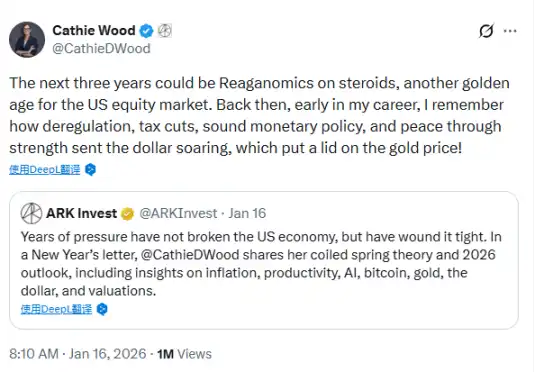
ARK Invest founder Cathie Wood ("Wood Sister") released a macro outlook in her latest New Year's letter to investors for 2026, likening the next three years to "Reaganomics on steroids." She pointed out that with the convergence of deregulation, tax cuts, sound monetary policy, and innovative technology, the U.S. stock market is set to usher in another "golden age," while an impending surge in the U.S. dollar could put an end to gold's upward momentum.
Specifically, Cathie Wood believes that despite continuous real GDP growth over the past three years, the underlying U.S. economy has actually experienced a rolling recession and is currently in a "coiled spring" state, poised for a strong rebound in the coming years. She particularly emphasized that with David Sacks appointed as the first AI and Cryptocurrency Czar to lead deregulation, and the effective corporate tax rate moving towards 10%, U.S. economic growth will receive a significant policy dividend.

At the macro level, Wood predicts that inflation will be further controlled, possibly even turning negative, driven by a productivity boom. She expects the U.S. nominal GDP growth rate to remain in the range of 6% to 8% in the coming years, primarily driven by productivity gains rather than inflation.

In terms of market impact, Wood predicts that the relative advantage of U.S. investment returns will drive the dollar exchange rate significantly higher, replaying the nearly doubling of the dollar in the 1980s. She warned that although gold prices have risen substantially in recent years, the strengthening dollar will suppress gold prices, while Bitcoin, due to its supply mechanism and low asset correlation, will show a different trend from gold.

Regarding investor concerns about market valuation, Wood does not believe an AI bubble has formed. She pointed out that although price-to-earnings ratios are at historically high levels, as AI, robotics, and other technologies drive a productivity explosion, corporate profit growth will digest high valuations, and the market may achieve positive returns while compressing P/E ratios, similar to the bull market path of the mid-to-late 1990s.

Below is the original text of the letter to investors:

Happy New Year to ARK's investors and other supporters! We are very grateful for your support.

As I elaborate in this letter, we truly believe there are many reasons for investors to be optimistic! I hope you enjoy our discussion. From the perspective of economic history, we are at a pivotal moment.

Coiled Spring

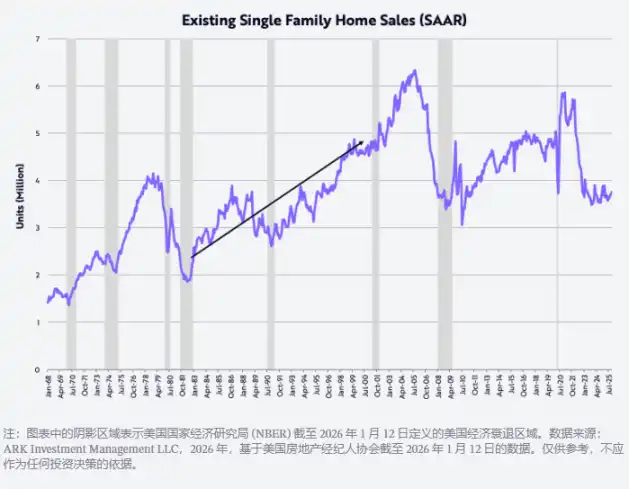
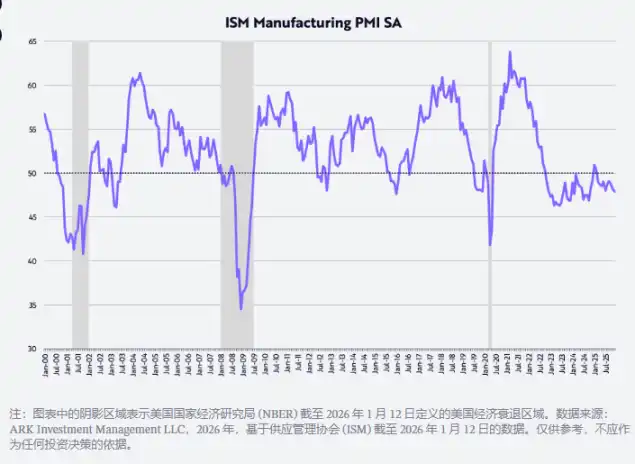
Although U.S. real Gross Domestic Product (GDP) has continued to grow over the past three years, the underlying structure of the U.S. economy has experienced a rolling recession and has gradually become a spring compressed to its limit, likely to rebound strongly in the coming years. In response to supply shocks related to the COVID-19 pandemic, the Federal Reserve raised the federal funds rate from 0.25% in March 2022 to 5.5% by July 2023 over a 16-month period, a record increase of 22 times. This rate hike pushed housing, manufacturing, non-AI-related capital expenditures, and the U.S. middle- and low-income groups into a recession, as shown in the chart below.

Measured by existing home sales, the housing market declined by 40% from an annualized rate of 5.9 million units in January 2021 to 3.5 million units in October 2023. This level was last seen in November 2010, and over the past two years, existing home sales have fluctuated around this level. This indicates how tightly the spring is compressed: the current level of existing home sales is comparable to the early 1980s, when the U.S. population was about 35% smaller than it is now.
Measured by the U.S. Purchasing Managers' Index (PMI), manufacturing has been in contraction for about three years. According to this diffusion index, 50 is the dividing line between expansion and contraction, as shown below.
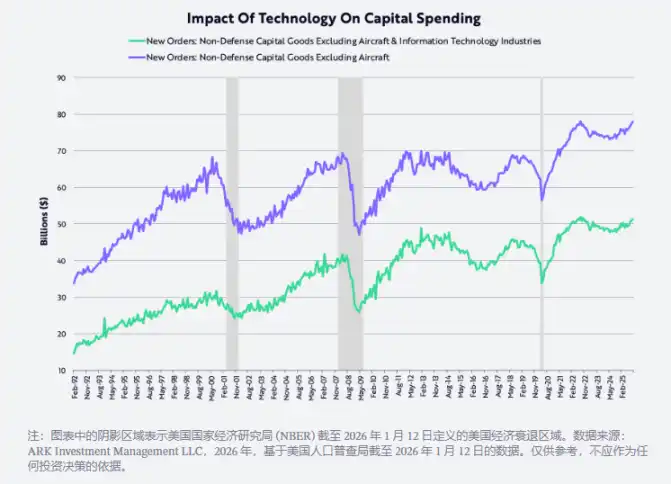
Meanwhile, capital expenditures measured by non-defense capital goods (excluding aircraft) peaked in mid-2022 and have since recovered to that level, whether affected by technology or not. In fact, this capital expenditure indicator struggled for more than 20 years to break through after the tech and telecom bubble burst, until 2021, when COVID-19-related supply shocks forced both digital and physical investment to accelerate. The former spending cap seems to have turned into a spending floor, as AI, robotics, energy storage, blockchain technology, and multi-omics sequencing are ready to enter their golden age. Following the tech and telecom bubble of the 1990s, a peak expenditure of about $70 billion persisted for 20 years; now, as the following chart shows, this could be the strongest capital expenditure cycle in history. We believe an AI bubble is still a long way off!
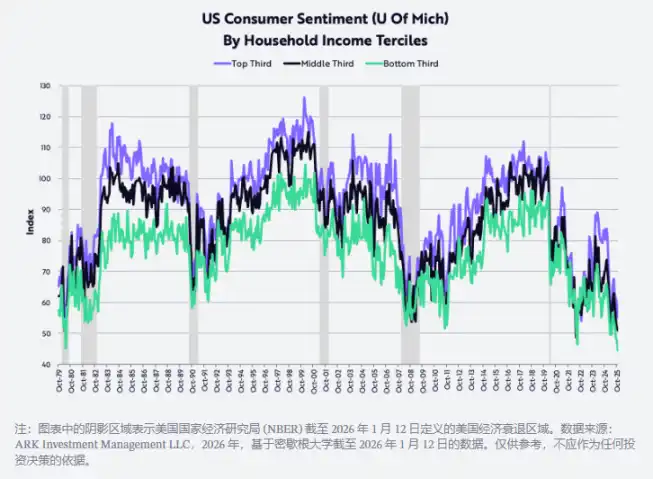
At the same time, data from the University of Michigan shows that confidence among middle- and low-income groups has fallen to its lowest level since the early 1980s. Back then, double-digit inflation and high interest rates severely eroded purchasing power and pushed the U.S. economy into consecutive recessions. Moreover, as shown below, confidence among high-income groups has also declined in recent months. In our view, consumer confidence is currently one of the most tightly compressed "springs" with the greatest rebound potential.
Deregulation, Coupled with Lower Taxes, Inflation, and Interest Rates

Thanks to the combined effects of deregulation, lower taxes (including tariffs), inflation, and interest rates, the rolling recession experienced by the U.S. in recent years could reverse rapidly and dramatically in the coming year and beyond.

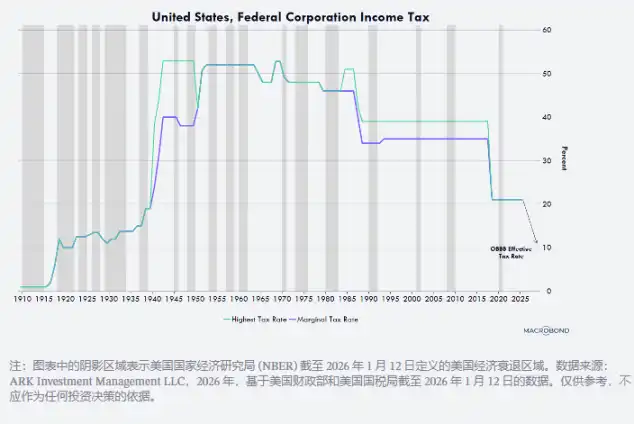
Deregulation is unleashing innovative vitality across various fields, particularly in artificial intelligence and digital assets, led by the first "AI and Cryptocurrency Czar," David Sacks. Meanwhile, reductions in tip, overtime, and social security taxes will provide U.S. consumers with substantial tax refunds this quarter, potentially boosting the annualized growth rate of real disposable income from about 2% in the second half of 2025 to about 8.3% this quarter. Additionally, with accelerated depreciation for manufacturing facilities, equipment, software, and domestic R&D expenditures, the effective corporate tax rate will be pushed down to near 10% (as shown below), corporate tax refunds are expected to rise significantly, and 10% is one of the lowest tax rates globally.

For example, any company that begins construction on a manufacturing plant in the U.S. by the end of 2028 can fully depreciate the building in the first year it is placed in service, instead of over 30 to 40 years as in the past. Equipment, software, and domestic R&D expenditures can also be 100% depreciated in the first year. This cash flow incentive was made permanent in last year's budget bill and is retroactive to January 1, 2025.
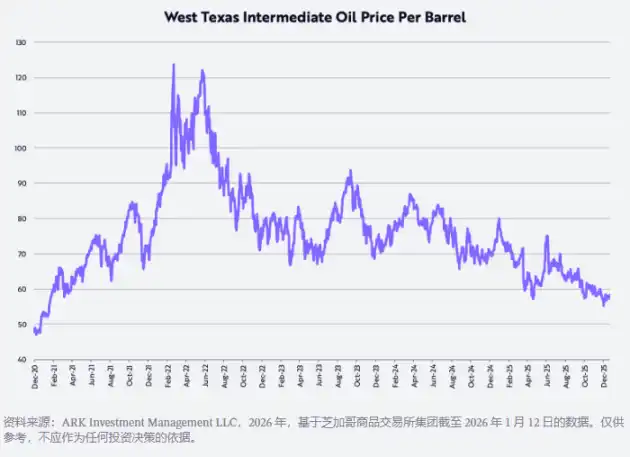
Over the past few years, inflation as measured by the Consumer Price Index (CPI) has stubbornly hovered in the 2% to 3% range, but in the coming years, for several reasons shown below, the inflation rate is likely to fall to a surprisingly low level—possibly even negative. First, West Texas Intermediate (WTI) crude oil prices have fallen by about 53% since the post-COVID peak of about $124 per barrel on March 8, 2022, and are currently down about 22% year-over-year.
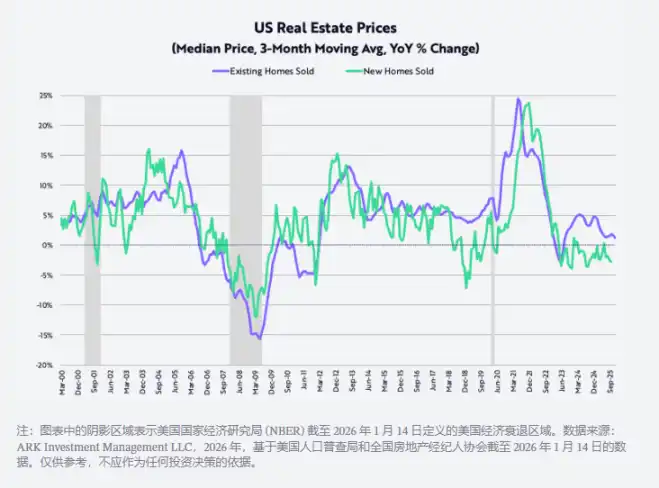
Since peaking in October 2022, the sales price of new single-family homes has fallen by about 15%; meanwhile, the inflation rate for existing single-family home prices—based on a three-month moving average—has dropped from about 24% year-over-year at the post-COVID peak in June 2021 to about 1.3%, as shown below.
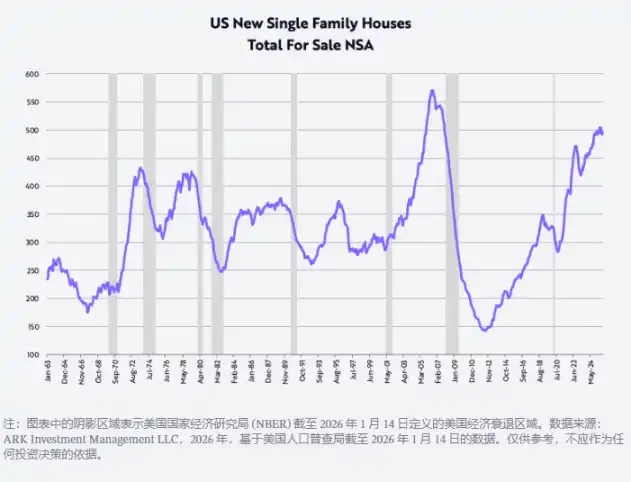
In the fourth quarter, to digest the inventory of nearly 500,000 new single-family homes (the highest level since October 2007, just before the global financial crisis, as shown below), the major homebuilders significantly reduced prices, with year-over-year declines of: Lennar -10%, KBHomes -7%, and DRHorton -3%. The impact of these price declines will be reflected in the Consumer Price Index (CPI) with a lag over the coming years.
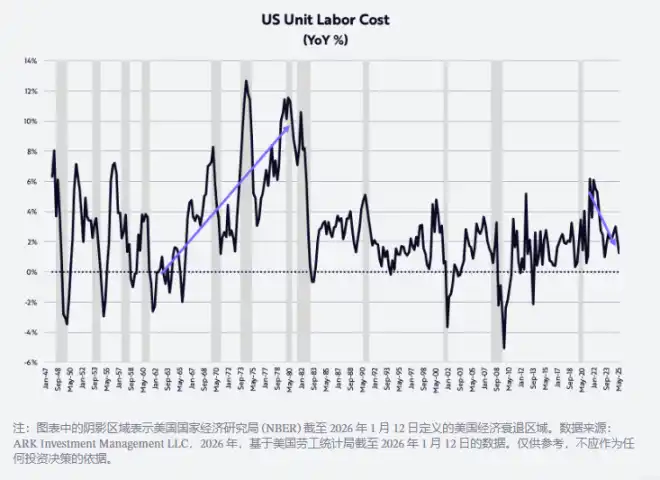
Finally, nonfarm productivity, one of the most powerful forces curbing inflation, grew against the trend in the context of a continuous recession, increasing 1.9% year-over-year in the third quarter. In contrast to a 3.2% increase in compensation per hour worked, the rise in productivity has reduced unit labor cost inflation to 1.2%, as shown below. There is no sign of 1970s-style cost-push inflation in this number!
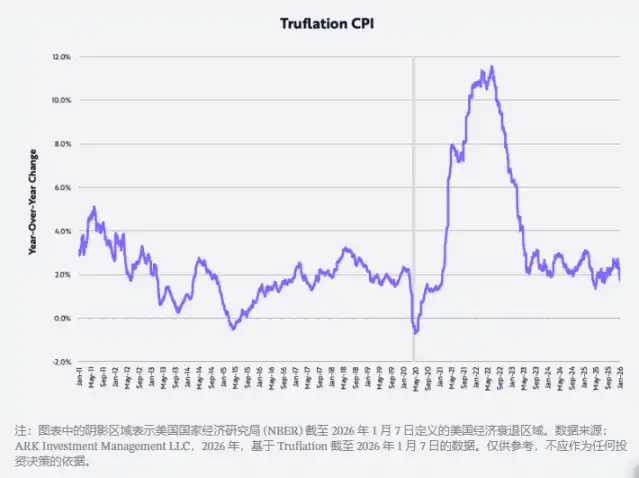
This improvement is also validated: the inflation rate measured by Truflation has recently fallen to 1.7% year-over-year, as shown below, nearly 100 basis points (bps) lower than the inflation rate calculated by the Bureau of Labor Statistics (BLS) based on CPI.
Productivity Boom

Indeed, if our research on technology-driven disruptive innovation is correct, then in the coming years, nonfarm productivity growth should accelerate to 4-6% per year, driven by both cyclical and long-term factors, further reducing unit labor cost inflation. The convergence of the major innovation platforms currently developing—artificial intelligence, robotics, energy storage, public blockchain technology, and multi-omics—is expected not only to drive productivity growth to sustainably new highs but also to create enormous wealth.

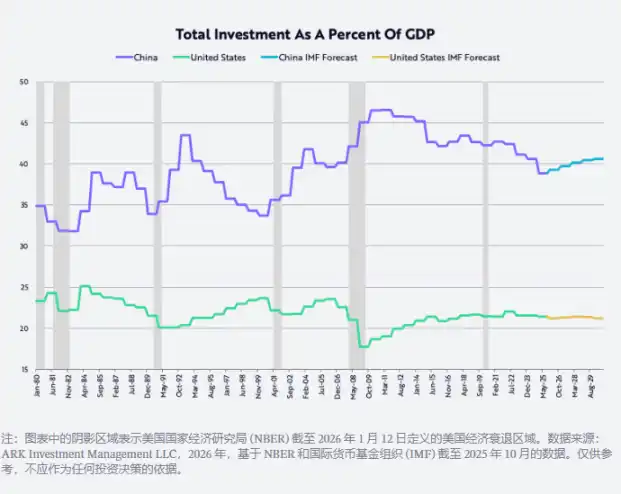
Productivity gains could also correct significant geo-economic imbalances in the global economy. Companies can direct the benefits of productivity gains to one or more of the following four strategic directions: expanding profit margins, increasing R&D and other investments, raising wages, and/or lowering prices. In China, raising wages for more productive employees and/or increasing profit margins could help the economy break free from its structural problem of overinvestment. Since joining the World Trade Organization (WTO) in 2001, China's investment as a percentage of GDP has averaged about 40%, nearly double that of the U.S., as shown below. Raising wages would shift the Chinese economy toward a consumption-oriented model, moving away from a commoditized path.
However, in the short term, technology-driven productivity gains may continue to slow U.S. job growth, pushing the unemployment rate from 4.4% to above 5.0% and prompting the Federal Reserve to continue cutting interest rates. Subsequently, deregulation and other fiscal stimulus measures should amplify the impact of low interest rates and accelerate GDP growth in the second half of 2026. Meanwhile, inflation is likely to continue to slow, not only due to falling oil prices, housing prices, and tariffs but also thanks to technological advancements that boost productivity and reduce unit labor costs.

Surprisingly, AI training costs are falling by 75% annually, while AI inference costs (i.e., the cost of running AI application models) are falling by up to 99% annually (according to some benchmarks). These unprecedented declines in the cost of various technologies should drive a surge in their unit growth. Therefore, we expect the U.S. nominal GDP growth rate to remain in the range of 6% to 8% in the coming years, primarily driven by productivity growth of 5% to 7%, labor force growth of 1%, and an inflation rate of -2% to +1%.

The cumulative deflationary effects of AI and the other four major innovation platforms will shape an economic environment similar to the last major technological revolution period from 1879 to 1929, triggered by the internal combustion engine, electricity, and the telephone. During that period, short-term interest rates moved in sync with nominal GDP growth, while long-term rates responded to the deflationary undercurrents accompanying the technology boom, causing the yield curve to invert by an average of about 100 basis points, as shown below.

Other New Year Thoughts

Gold Price Rise vs. Bitcoin Price Fall

During 2025, the price of gold rose by 65%, while the price of Bitcoin fell by 6%. Many observers attributed the surge in gold prices from $1,600 per ounce in October 2022, at the end of the U.S. stock market bear market, to $4,300, a gain of 166%, to inflation risks. However, another explanation is that global wealth growth (exemplified by the 93% rise in the MSCI World Equity Index) has exceeded the annualized growth rate of global gold supply of about 1.8%. In other words, the incremental demand for gold may have exceeded its supply growth. Interestingly, during the same period, the price of Bitcoin rose by 360%, while its supply grew at an annualized rate of only about 1.3%. It is worth noting that gold and Bitcoin miners may react very differently to these price signals: gold miners respond by increasing gold production, while Bitcoin cannot do this. Mathematically, Bitcoin will grow by about 0.82% annually over the next two years, after which its growth rate will slow to about 0.41% per year.

A Long-Term Perspective on Gold Prices

Measured by the ratio of market capitalization to M2 money supply, the price of gold has only been higher than this level once in the past 125 years, during the Great Depression of the early 1930s. At that time, the gold price was fixed at $20.67 per ounce, while the M2 money supply plummeted by about 30% (as shown below). Recently, the gold-to-M2 ratio has exceeded the previous peak, which occurred in 1980 when inflation and interest rates soared into double digits. In other words, from a historical perspective, the price of gold has reached an extremely high level.

The chart below also shows that the long-term decline in this ratio has been closely related to solid stock market returns. According to research by Ibbotson and Sinquefield, stocks have had a compound annual return of about 10% since 1926. After the ratio reached two major long-term peaks in 1934 and 1980, stock prices as measured by the Dow Jones Industrial Average (DJIA) achieved returns of 670% and 1015% over the 35 and 21 years ending in 1969 and 2001, respectively, representing annualized returns of 6% and 12%. Notably, small-cap stocks had annualized returns of 12% and 13%, respectively.
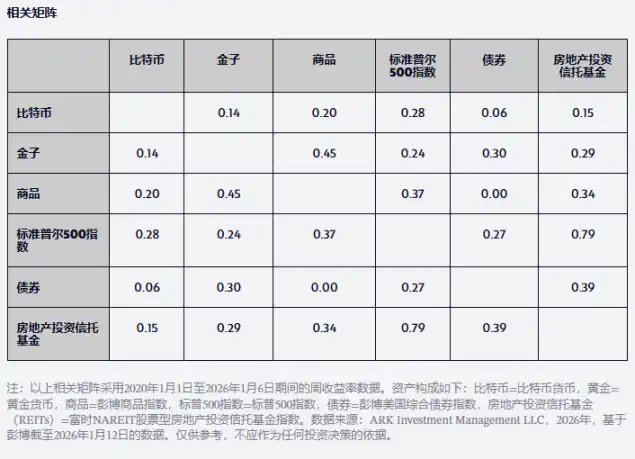
For asset allocators, another important consideration is Bitcoin's relatively low correlation with gold returns and with other major asset classes since 2020, as shown in the table below. Notably, Bitcoin's correlation with gold is even lower than the correlation between the S&P 500 and bonds. In other words, for asset allocators seeking higher risk-adjusted returns in the coming years, Bitcoin should be a good diversification option.
U.S. Dollar Outlook

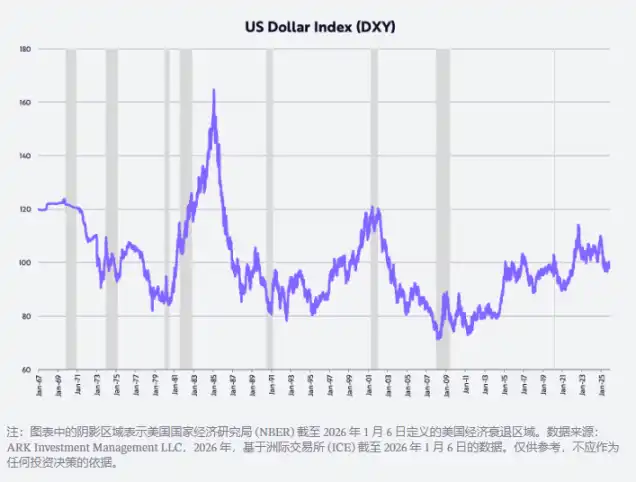
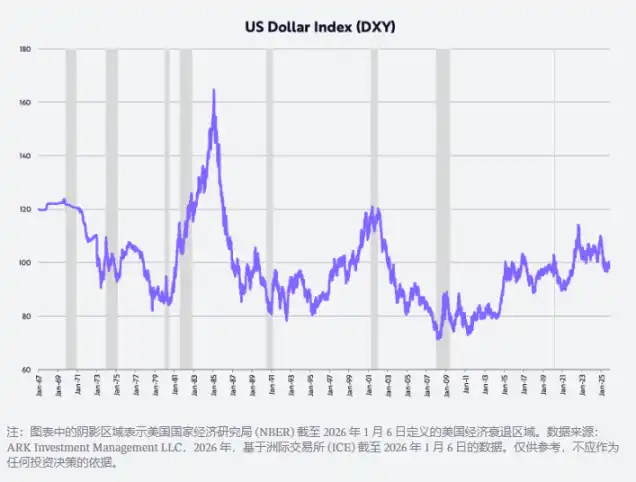
Over the past few years, a popular narrative has been the end of American exceptionalism, with the dollar recording its largest first-half decline since 1973 and its largest full-year decline since 2017. Last year, as measured by the trade-weighted dollar index (DXY), the dollar fell 11% in the first half and 9% for the full year. If our predictions about fiscal policy, monetary policy, deregulation, and U.S.-led technological breakthroughs are correct, then U.S. investment returns will improve relative to the rest of the world, pushing the dollar exchange rate higher. The Trump administration's policies mirror the situation during the Reaganomics era of the early 1980s, when the dollar exchange rate nearly doubled, as shown below.
AI Hype

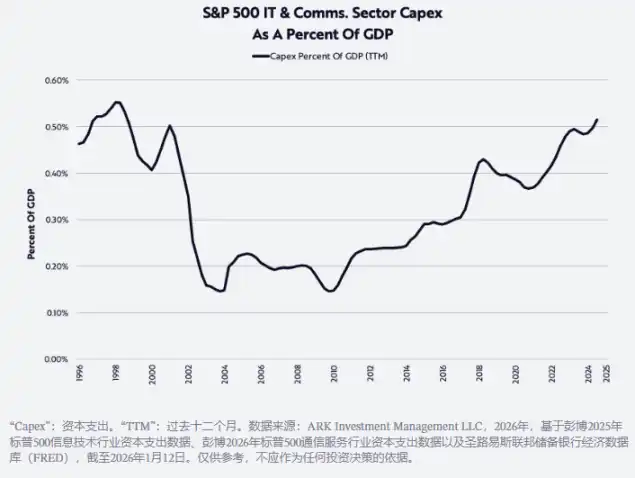
As shown below, the AI boom is driving capital expenditures to their highest levels since the late 1990s. In 2025, investment in data center systems (including computing, networking, and storage equipment) grew by 47% to nearly $500 billion, and is expected to grow another 20% in 2026 to about $600 billion, far above the long-term trend of $150-200 billion annually in the launch of ChatGPT a decade ago. Such massive investment规模 inevitably raises the question: "What is the return on this investment? And where will it be reflected?"
Beyond semiconductors and listed large cloud companies, unlisted AI-native companies are also benefiting from growth and investment returns. AI companies are among the fastest-growing businesses in history. Our research shows that consumer adoption of AI is twice as fast as the adoption of the internet in the 1990s, as shown below.
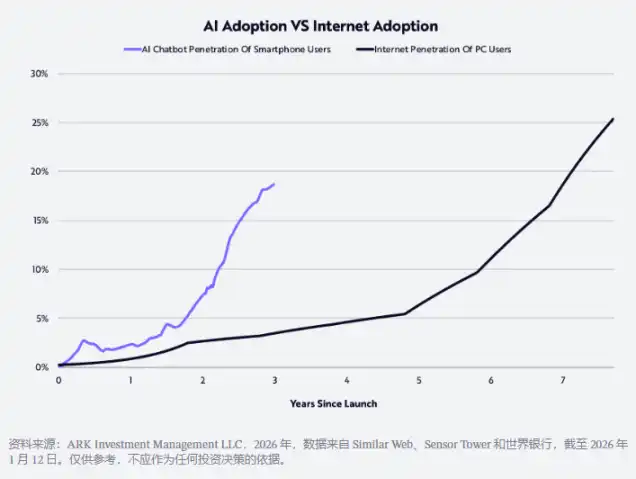
It is reported that by the end of 2025, OpenAI and Anthropic's annualized revenue will reach $20 billion and $9 billion, respectively, up 12.5 times and 90 times from $1.6 billion and $100 million a year earlier! Rumors suggest that both companies are considering initial public offerings (IPOs) in the next year or two to raise funds for the massive investments required to support their product models.

As Fidji Simo, CEO of OpenAI's applied division, said: "The capabilities of AI models far exceed what most people experience in their daily lives, and 2026 is the year to bridge this gap. The leaders in AI will be those who can translate cutting-edge research into products that are truly useful for individuals, businesses, and developers." This year, with more humane, intuitive, and integrated user experiences, we expect to make substantial progress in this area. ChatGPT Health is an early example, a dedicated section within the ChatGPT platform that helps users improve their health based on their personal health data.

In enterprises, many AI applications are still in their early stages, hindered by bureaucracy, inertia, and/or prerequisites such as restructuring and building data infrastructure, leading to slow progress. By 2026, organizations may realize that they need to use their own data to train models and iterate quickly, or risk being left behind by more aggressive competitors. AI-driven use cases should provide immediate and excellent customer service, faster product launch speeds, and help startups create more value with fewer resources.

Overvalued Market

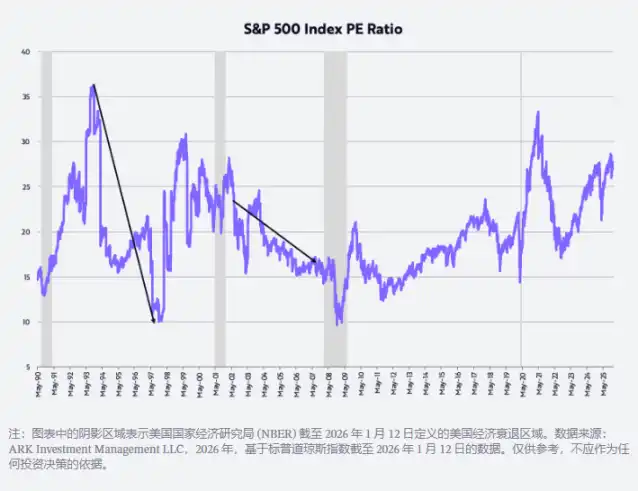
Many investors are concerned about overvalued stock markets, which are currently at historically high levels, as shown below. Our own valuation assumption is that the price-to-earnings (P/E) ratio will fall back to around 20 times, the average of the past 35 years. Some of the most significant bull markets have occurred alongside P/E compression. For example, from mid-October 1993 to mid-November 1997, the S&P 500 had an annualized return of 21%, while its P/E ratio fell from 36 times to 10 times. Similarly, from July 2002 to October 2007, the S&P 500 had an annualized return of 14%, while its P/E ratio fell from 21 times to 17 times. Given our expectations that real GDP growth will be driven by productivity gains and slowing inflation, the same dynamics should reappear in this market cycle, possibly even more significantly.
As always, many thanks to ARK's investors and other supporters, and also to Dan, Will, Katie, and Keith for helping me write this very long New Year's greeting!


Domande pertinenti

QWhat are Cathie Wood's main predictions for the US economy and markets by 2026?

ACathie Wood predicts a strong US economic rebound driven by deregulation, tax cuts, and technological innovation. She expects productivity growth of 4-6%, controlled inflation (possibly negative), nominal GDP growth of 6-8%, a surging US dollar, a peak in gold prices, and Bitcoin outperforming due to its low correlation with other assets.

QHow does Cathie Wood justify her view that the AI bubble has not yet formed?

AShe argues that despite high capital expenditure in AI infrastructure (e.g., data centers), the adoption rate of AI is twice as fast as the internet in the 1990s. Companies like OpenAI and Anthropic show explosive revenue growth, and AI-driven productivity gains will justify current investments and valuations.

QWhy does Wood believe the US dollar will strengthen significantly by 2026?

AShe attributes the expected dollar strength to US policy advantages (deregulation, tax cuts), higher relative investment returns, and a productivity boom. This mirrors the 1980s 'Reaganomics' era when the dollar nearly doubled in value.

QWhat is Wood's rationale for predicting a peak in gold prices and Bitcoin's independent performance?

AGold prices have surged due to demand outpacing supply, but historical ratios (e.g., gold/M2) suggest overvaluation. Bitcoin, with its fixed supply growth (~1.3% annually) and low correlation to other assets, is seen as a better diversification tool and less susceptible to dollar strength.

QHow does Wood address concerns about high market valuations in US stocks?

AShe acknowledges high P/E ratios but argues that productivity-driven earnings growth will compress valuations organically. Historical examples (e.g., 1993-1997) show markets can deliver strong returns even as P/E ratios decline if earnings expand sufficiently.

Letture associate

Trading

Spot
Futures

Articoli Popolari

Cosa è $S$

Comprendere SPERO: Una Panoramica Completa Introduzione a SPERO Mentre il panorama dell'innovazione continua a evolversi, l'emergere delle tecnologie web3 e dei progetti di criptovaluta gioca un ruolo fondamentale nel plasmare il futuro digitale. Un progetto che ha attirato l'attenzione in questo campo dinamico è SPERO, denotato come SPERO,$$s$. Questo articolo mira a raccogliere e presentare informazioni dettagliate su SPERO, per aiutare gli appassionati e gli investitori a comprendere le sue basi, obiettivi e innovazioni nei domini web3 e crypto. Che cos'è SPERO,$$s$? SPERO,$$s$ è un progetto unico all'interno dello spazio crypto che cerca di sfruttare i principi della decentralizzazione e della tecnologia blockchain per creare un ecosistema che promuove l'impegno, l'utilità e l'inclusione finanziaria. Il progetto è progettato per facilitare interazioni peer-to-peer in modi nuovi, fornendo agli utenti soluzioni e servizi finanziari innovativi. Al suo interno, SPERO,$$s$ mira a responsabilizzare gli individui fornendo strumenti e piattaforme che migliorano l'esperienza dell'utente nello spazio delle criptovalute. Questo include la possibilità di metodi di transazione più flessibili, la promozione di iniziative guidate dalla comunità e la creazione di percorsi per opportunità finanziarie attraverso applicazioni decentralizzate (dApps). La visione sottostante di SPERO,$$s$ ruota attorno all'inclusività, cercando di colmare le lacune all'interno della finanza tradizionale mentre sfrutta i vantaggi della tecnologia blockchain. Chi è il Creatore di SPERO,$$s$? L'identità del creatore di SPERO,$$s$ rimane piuttosto oscura, poiché ci sono risorse pubblicamente disponibili limitate che forniscono informazioni dettagliate sul suo fondatore o fondatori. Questa mancanza di trasparenza può derivare dall'impegno del progetto per la decentralizzazione—un ethos che molti progetti web3 condividono, dando priorità ai contributi collettivi rispetto al riconoscimento individuale. Centrando le discussioni attorno alla comunità e ai suoi obiettivi collettivi, SPERO,$$s$ incarna l'essenza dell'empowerment senza mettere in evidenza individui specifici. Pertanto, comprendere l'etica e la missione di SPERO rimane più importante che identificare un creatore singolo. Chi sono gli Investitori di SPERO,$$s$? SPERO,$$s$ è supportato da una varietà di investitori che vanno dai capitalisti di rischio agli investitori angelici dedicati a promuovere l'innovazione nel settore crypto. Il focus di questi investitori generalmente si allinea con la missione di SPERO—dando priorità a progetti che promettono avanzamenti tecnologici sociali, inclusività finanziaria e governance decentralizzata. Queste fondazioni di investitori sono tipicamente interessate a progetti che non solo offrono prodotti innovativi, ma contribuiscono anche positivamente alla comunità blockchain e ai suoi ecosistemi. Il supporto di questi investitori rafforza SPERO,$$s$ come un concorrente degno di nota nel dominio in rapida evoluzione dei progetti crypto. Come Funziona SPERO,$$s$? SPERO,$$s$ impiega un framework multifunzionale che lo distingue dai progetti di criptovaluta convenzionali. Ecco alcune delle caratteristiche chiave che sottolineano la sua unicità e innovazione: Governance Decentralizzata: SPERO,$$s$ integra modelli di governance decentralizzati, responsabilizzando gli utenti a partecipare attivamente ai processi decisionali riguardanti il futuro del progetto. Questo approccio favorisce un senso di proprietà e responsabilità tra i membri della comunità. Utilità del Token: SPERO,$$s$ utilizza il proprio token di criptovaluta, progettato per servire varie funzioni all'interno dell'ecosistema. Questi token abilitano transazioni, premi e la facilitazione dei servizi offerti sulla piattaforma, migliorando l'impegno e l'utilità complessivi. Architettura Stratificata: L'architettura tecnica di SPERO,$$s$ supporta la modularità e la scalabilità, consentendo un'integrazione fluida di funzionalità e applicazioni aggiuntive man mano che il progetto evolve. Questa adattabilità è fondamentale per mantenere la rilevanza nel panorama crypto in continua evoluzione. Coinvolgimento della Comunità: Il progetto enfatizza iniziative guidate dalla comunità, impiegando meccanismi che incentivano la collaborazione e il feedback. Nutrendo una comunità forte, SPERO,$$s$ può affrontare meglio le esigenze degli utenti e adattarsi alle tendenze di mercato. Focus sull'Inclusione: Offrendo basse commissioni di transazione e interfacce user-friendly, SPERO,$$s$ mira ad attrarre una base utenti diversificata, inclusi individui che potrebbero non aver precedentemente interagito nello spazio crypto. Questo impegno per l'inclusione si allinea con la sua missione generale di empowerment attraverso l'accessibilità. Cronologia di SPERO,$$s$ Comprendere la storia di un progetto fornisce preziose intuizioni sulla sua traiettoria di sviluppo e sui traguardi. Di seguito è riportata una cronologia suggerita che mappa eventi significativi nell'evoluzione di SPERO,$$s$: Fase di Concettualizzazione e Ideazione: Le idee iniziali che formano la base di SPERO,$$s$ sono state concepite, allineandosi strettamente con i principi di decentralizzazione e focus sulla comunità all'interno dell'industria blockchain. Lancio del Whitepaper del Progetto: Dopo la fase concettuale, è stato rilasciato un whitepaper completo che dettaglia la visione, gli obiettivi e l'infrastruttura tecnologica di SPERO,$$s$ per suscitare interesse e feedback dalla comunità. Costruzione della Comunità e Prime Interazioni: Sono stati effettuati sforzi attivi di outreach per costruire una comunità di early adopters e potenziali investitori, facilitando discussioni attorno agli obiettivi del progetto e ottenendo supporto. Evento di Generazione del Token: SPERO,$$s$ ha condotto un evento di generazione del token (TGE) per distribuire i propri token nativi ai primi sostenitori e stabilire una liquidità iniziale all'interno dell'ecosistema. Lancio della Prima dApp: La prima applicazione decentralizzata (dApp) associata a SPERO,$$s$ è stata attivata, consentendo agli utenti di interagire con le funzionalità principali della piattaforma. Sviluppo Continuo e Partnership: Aggiornamenti e miglioramenti continui alle offerte del progetto, inclusi partnership strategiche con altri attori nello spazio blockchain, hanno plasmato SPERO,$$s$ in un concorrente competitivo e in evoluzione nel mercato crypto. Conclusione SPERO,$$s$ rappresenta una testimonianza del potenziale del web3 e delle criptovalute di rivoluzionare i sistemi finanziari e responsabilizzare gli individui. Con un impegno per la governance decentralizzata, il coinvolgimento della comunità e funzionalità progettate in modo innovativo, apre la strada verso un panorama finanziario più inclusivo. Come per qualsiasi investimento nello spazio crypto in rapida evoluzione, si incoraggiano potenziali investitori e utenti a ricercare approfonditamente e a impegnarsi in modo riflessivo con gli sviluppi in corso all'interno di SPERO,$$s$. Il progetto mostra lo spirito innovativo dell'industria crypto, invitando a ulteriori esplorazioni delle sue innumerevoli possibilità. Mentre il percorso di SPERO,$$s$ è ancora in fase di sviluppo, i suoi principi fondamentali potrebbero effettivamente influenzare il futuro di come interagiamo con la tecnologia, la finanza e tra di noi in ecosistemi digitali interconnessi.

75 Totale visualizzazioniPubblicato il 2024.12.17Aggiornato il 2024.12.17

Cosa è $S$

Cosa è AGENT S

Agent S: Il Futuro dell'Interazione Autonoma in Web3 Introduzione Nel panorama in continua evoluzione di Web3 e criptovalute, le innovazioni stanno costantemente ridefinendo il modo in cui gli individui interagiscono con le piattaforme digitali. Uno di questi progetti pionieristici, Agent S, promette di rivoluzionare l'interazione uomo-computer attraverso il suo framework agentico aperto. Aprendo la strada a interazioni autonome, Agent S mira a semplificare compiti complessi, offrendo applicazioni trasformative nell'intelligenza artificiale (AI). Questa esplorazione dettagliata approfondirà le complessità del progetto, le sue caratteristiche uniche e le implicazioni per il dominio delle criptovalute. Cos'è Agent S? Agent S si presenta come un innovativo framework agentico aperto, progettato specificamente per affrontare tre sfide fondamentali nell'automazione dei compiti informatici: Acquisizione di Conoscenze Specifiche del Dominio: Il framework apprende in modo intelligente da varie fonti di conoscenza esterne ed esperienze interne. Questo approccio duale gli consente di costruire un ricco repository di conoscenze specifiche del dominio, migliorando le sue prestazioni nell'esecuzione dei compiti. Pianificazione su Lungo Orizzonte di Compiti: Agent S impiega una pianificazione gerarchica potenziata dall'esperienza, un approccio strategico che facilita la suddivisione e l'esecuzione efficiente di compiti complessi. Questa caratteristica migliora significativamente la sua capacità di gestire più sottocompiti in modo efficiente ed efficace. Gestione di Interfacce Dinamiche e Non Uniformi: Il progetto introduce l'Interfaccia Agente-Computer (ACI), una soluzione innovativa che migliora l'interazione tra agenti e utenti. Utilizzando Modelli Linguistici Multimodali di Grandi Dimensioni (MLLM), Agent S può navigare e manipolare senza sforzo diverse interfacce grafiche utente. Attraverso queste caratteristiche pionieristiche, Agent S fornisce un framework robusto che affronta le complessità coinvolte nell'automazione dell'interazione umana con le macchine, preparando il terreno per innumerevoli applicazioni nell'AI e oltre. Chi è il Creatore di Agent S? Sebbene il concetto di Agent S sia fondamentalmente innovativo, informazioni specifiche sul suo creatore rimangono elusive. Il creatore è attualmente sconosciuto, il che evidenzia sia la fase embrionale del progetto sia la scelta strategica di mantenere i membri fondatori sotto anonimato. Indipendentemente dall'anonimato, l'attenzione rimane sulle capacità e sul potenziale del framework. Chi sono gli Investitori di Agent S? Poiché Agent S è relativamente nuovo nell'ecosistema crittografico, informazioni dettagliate riguardanti i suoi investitori e sostenitori finanziari non sono documentate esplicitamente. La mancanza di approfondimenti pubblicamente disponibili sulle fondazioni di investimento o sulle organizzazioni che supportano il progetto solleva interrogativi sulla sua struttura di finanziamento e sulla roadmap di sviluppo. Comprendere il supporto è cruciale per valutare la sostenibilità del progetto e il suo potenziale impatto sul mercato. Come Funziona Agent S? Al centro di Agent S si trova una tecnologia all'avanguardia che gli consente di funzionare efficacemente in contesti diversi. Il suo modello operativo è costruito attorno a diverse caratteristiche chiave: Interazione Uomo-Computer Simile a Quella Umana: Il framework offre una pianificazione AI avanzata, cercando di rendere le interazioni con i computer più intuitive. Mimando il comportamento umano nell'esecuzione dei compiti, promette di elevare le esperienze degli utenti. Memoria Narrativa: Utilizzata per sfruttare esperienze di alto livello, Agent S utilizza la memoria narrativa per tenere traccia delle storie dei compiti, migliorando così i suoi processi decisionali. Memoria Episodica: Questa caratteristica fornisce agli utenti una guida passo-passo, consentendo al framework di offrire supporto contestuale mentre i compiti si sviluppano. Supporto per OpenACI: Con la capacità di funzionare localmente, Agent S consente agli utenti di mantenere il controllo sulle proprie interazioni e flussi di lavoro, allineandosi con l'etica decentralizzata di Web3. Facile Integrazione con API Esterne: La sua versatilità e compatibilità con varie piattaforme AI garantiscono che Agent S possa adattarsi senza problemi agli ecosistemi tecnologici esistenti, rendendolo una scelta attraente per sviluppatori e organizzazioni. Queste funzionalità contribuiscono collettivamente alla posizione unica di Agent S all'interno dello spazio crittografico, poiché automatizza compiti complessi e multi-fase con un intervento umano minimo. Man mano che il progetto evolve, le sue potenziali applicazioni in Web3 potrebbero ridefinire il modo in cui si svolgono le interazioni digitali. Cronologia di Agent S Lo sviluppo e le tappe di Agent S possono essere riassunti in una cronologia che evidenzia i suoi eventi significativi: 27 Settembre 2024: Il concetto di Agent S è stato lanciato in un documento di ricerca completo intitolato “Un Framework Agentico Aperto che Usa i Computer Come un Umano”, mostrando le basi per il progetto. 10 Ottobre 2024: Il documento di ricerca è stato reso pubblicamente disponibile su arXiv, offrendo un'esplorazione approfondita del framework e della sua valutazione delle prestazioni basata sul benchmark OSWorld. 12 Ottobre 2024: È stata rilasciata una presentazione video, fornendo un'idea visiva delle capacità e delle caratteristiche di Agent S, coinvolgendo ulteriormente potenziali utenti e investitori. Questi indicatori nella cronologia non solo illustrano i progressi di Agent S, ma indicano anche il suo impegno per la trasparenza e il coinvolgimento della comunità. Punti Chiave su Agent S Man mano che il framework Agent S continua a evolversi, diversi attributi chiave si distinguono, sottolineando la sua natura innovativa e il potenziale: Framework Innovativo: Progettato per fornire un uso intuitivo dei computer simile all'interazione umana, Agent S porta un approccio nuovo all'automazione dei compiti. Interazione Autonoma: La capacità di interagire autonomamente con i computer attraverso GUI segna un passo avanti verso soluzioni informatiche più intelligenti ed efficienti. Automazione di Compiti Complessi: Con la sua metodologia robusta, può automatizzare compiti complessi e multi-fase, rendendo i processi più veloci e meno soggetti a errori. Miglioramento Continuo: I meccanismi di apprendimento consentono ad Agent S di migliorare dalle esperienze passate, migliorando continuamente le sue prestazioni e la sua efficacia. Versatilità: La sua adattabilità attraverso diversi ambienti operativi come OSWorld e WindowsAgentArena garantisce che possa servire un'ampia gamma di applicazioni. Man mano che Agent S si posiziona nel panorama di Web3 e delle criptovalute, il suo potenziale per migliorare le capacità di interazione e automatizzare i processi segna un significativo avanzamento nelle tecnologie AI. Attraverso il suo framework innovativo, Agent S esemplifica il futuro delle interazioni digitali, promettendo un'esperienza più fluida ed efficiente per gli utenti in vari settori. Conclusione Agent S rappresenta un audace passo avanti nell'unione tra AI e Web3, con la capacità di ridefinire il modo in cui interagiamo con la tecnologia. Sebbene sia ancora nelle sue fasi iniziali, le possibilità per la sua applicazione sono vaste e coinvolgenti. Attraverso il suo framework completo che affronta sfide critiche, Agent S mira a portare le interazioni autonome al centro dell'esperienza digitale. Man mano che ci addentriamo nei regni delle criptovalute e della decentralizzazione, progetti come Agent S giocheranno senza dubbio un ruolo cruciale nel plasmare il futuro della tecnologia e della collaborazione uomo-computer.

433 Totale visualizzazioniPubblicato il 2025.01.14Aggiornato il 2025.01.14

Cosa è AGENT S

Come comprare S

Benvenuto in HTX.com! Abbiamo reso l'acquisto di Sonic (S) semplice e conveniente. Segui la nostra guida passo passo per intraprendere il tuo viaggio nel mondo delle criptovalute.Step 1: Crea il tuo Account HTXUsa la tua email o numero di telefono per registrarti il tuo account gratuito su HTX. Vivi un'esperienza facile e sblocca tutte le funzionalità,Crea il mio accountStep 2: Vai in Acquista crypto e seleziona il tuo metodo di pagamentoCarta di credito/debito: utilizza la tua Visa o Mastercard per acquistare immediatamente SonicS.Bilancio: Usa i fondi dal bilancio del tuo account HTX per fare trading senza problemi.Terze parti: abbiamo aggiunto metodi di pagamento molto utilizzati come Google Pay e Apple Pay per maggiore comodità.P2P: Fai trading direttamente con altri utenti HTX.Over-the-Counter (OTC): Offriamo servizi su misura e tassi di cambio competitivi per i trader.Step 3: Conserva Sonic (S)Dopo aver acquistato Sonic (S), conserva nel tuo account HTX. In alternativa, puoi inviare tramite trasferimento blockchain o scambiare per altre criptovalute.Step 4: Scambia Sonic (S)Scambia facilmente Sonic (S) nel mercato spot di HTX. Accedi al tuo account, seleziona la tua coppia di trading, esegui le tue operazioni e monitora in tempo reale. Offriamo un'esperienza user-friendly sia per chi ha appena iniziato che per i trader più esperti.

849 Totale visualizzazioniPubblicato il 2025.01.15Aggiornato il 2025.03.21

Come comprare S

Discussioni

Benvenuto nella Community HTX. Qui puoi rimanere informato sugli ultimi sviluppi della piattaforma e accedere ad approfondimenti esperti sul mercato. Le opinioni degli utenti sul prezzo di S S sono presentate come di seguito.

活动图片