Are Cardano Investors Exiting? ADA Open Interest Collapses In Sudden Derivatives Reset

bitcoinistPubblicato 2026-02-10Pubblicato ultima volta 2026-02-10

Introduzione

Cardano (ADA) is experiencing a significant decline, with its price dropping to as low as $0.22 amid a broader crypto market correction. This downturn is reflected in its derivatives market, where Open Interest (OI) has sharply collapsed from around $1.6 billion to $334 million, indicating a sudden unwind of leveraged positions and reduced speculative activity. Market expert Joao Wedson notes that the structure of open interest has flipped, with Binance's dominance dropping from over 80% in 2023 to just 22%, while Gate.io now leads with 31%. This fragmentation suggests a loss of upward momentum for ADA, as concentrated leverage on major exchanges like Binance has historically driven altcoin rallies. Despite the current weakness, some analysts view ADA's price level as a long-term accumulation range, potentially setting the stage for a bullish continuation targeting $2 to $3, or even $6 to $10 in a strong altcoin season. Cardano remains one of the most active chains in development, focusing on governance, scaling, and real-world utility.

Since the broader cryptocurrency market correction began, the price of Cardano (ADA) has steadily declined, reaching as low as $0.22. While prices are experiencing a steady downward trend, Cardano is starting to see a drop in multiple critical areas, such as its derivatives market, as Open Interest declines.

Derivatives Cool Off As Cardano Open Interest Plunges

Cardano’s ongoing decline has intensified and is beginning to reflect on its derivatives market as its Open Interest (OI) undergoes a sharp decrease. Its open interest has collapsed following a sudden unwind of leveraged positions, as shown in a report from Joao Wedson, a market expert and founder of Alphractal.

The sharp drop implies that traders have been driven out or have closed positions due to increased volatility, flushing out speculative exposure. By removing extra leverage from the system, these resets frequently signal a move away from overheated situations.

According to the expert, ADA open interest fell from about $1.6 billion to $334 million, but a trend is subtly unfolding underneath. Data shows that major players are aggressively closing their ADA positions. However, the key insight here lies in the direction that the open interest is now concentrated.
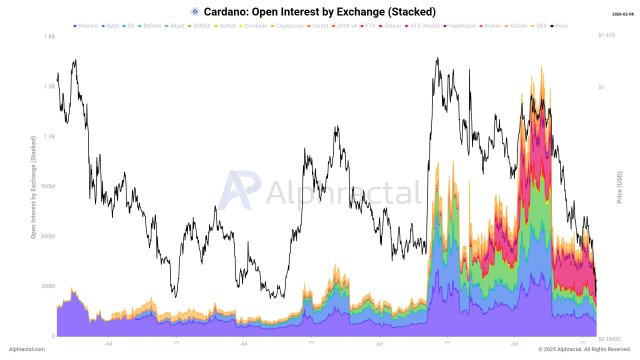
ADA’s derivatives market is weakening | Source: Chart from Joao Wedson on X

Wedson highlighted that Binance, the leading crypto exchange, controlled over 80% of ADA’s open interest back in 2023, with the remaining 20% collectively controlled by 17 other exchanges. Meanwhile, in 2026, this structure has completely flipped.

As seen on the chart, Binance currently holds just 22% of Cardano’s open interest, while Gateio is leading the charge with about 31% dominance. Although it may seem less impulsive, the expert stated that the shift is more important than most people in the sector realize.

The same was observed with Solana when it rallied from the $20 level to $200 between late 2023 and 2024, and Binance’s open interest dominance grew by 10%, reaching 52%. However, Binance’s dominance has declined again since 2024, and Solana’s price momentum has clearly weakened.

Wedson noted that the pattern is consistent. When open interest becomes fragmented and Binance’s share drops, altcoins typically lose their upward strength, and this is exactly what is happening with Cardano. Binance is frequently the exchange that drives significant altcoin rallies, but only when competition is constrained and leverage is concentrated.

ADA In An Accumulation Range

After a steep drop, Cardano’s price is sitting inside a long-term accumulation range. The structure is akin to the end of a corrective phase and preparation for a new cycle, and a break from the long-term downtrend supports a bullish continuation setup.

Once the breakout occurs, Wolf of Crypto predicts a move to $2 and $3, marking the mid-cycle target. Meanwhile, the full cycle target is set at $6 and $10 in a strong altcoin season scenario.

Currently, Cardano is still one of the best active chains in developer activity, focusing on governance, scaling, and real-world utility. Historically, after Bitcoin bottoms out, capital moves into high beta Layer 1s like Cardano, which could spur a bounce in ADA’s price.

ADA trading at $0.26 on the 1D chart | Source: ADAUSDT on Tradingview.com

Domande pertinenti

QWhat is the main reason for the sharp decline in Cardano's Open Interest (OI) according to the article?

AThe sharp decline in Cardano's Open Interest is due to a sudden unwind of leveraged positions, driven by increased volatility which has flushed out speculative exposure and closed trader positions.

QHow has the distribution of ADA's Open Interest across exchanges changed from 2023 to 2026?

AIn 2023, Binance controlled over 80% of ADA's open interest, with 17 other exchanges holding the remaining 20%. By 2026, this structure flipped, with Binance holding only 22% and Gateio leading with about 31% dominance.

QWhat pattern did the expert observe regarding Binance's open interest dominance and altcoin price strength?

AThe expert noted that when open interest becomes fragmented and Binance's share drops, altcoins typically lose their upward strength. Binance often drives significant altcoin rallies only when leverage is concentrated and competition is constrained.

QWhat is the predicted price target for Cardano (ADA) if a breakout occurs from its current accumulation range?

AIf a breakout occurs, the mid-cycle target is predicted to be $2 to $3, and the full cycle target in a strong altcoin season scenario is set at $6 to $10.

QWhat factors support a potential bullish continuation setup for Cardano's price according to the article?

ACardano's price is in a long-term accumulation range, which is akin to the end of a corrective phase. A break from the long-term downtrend, combined with its strong developer activity and potential capital inflow into high beta Layer 1s after Bitcoin bottoms out, supports a bullish setup.

Letture associate

Raising Interest Rates Is Not a Tech Killer, EPS Is: A Strategy for Discarding the Weak and Retaining the Strong After the AI Theme's Sharp Decline

**Summary: Rising Interest Rates Are Not the Killer of Tech; EPS Is: The "Keep the Strong, Ditch the Weak" Strategy After the AI Theme Plunge** The author argues that the sharp sell-off in tech and AI-related stocks, triggered by a strong US jobs report that heightened Fed rate hike fears, represents a "pullback to pick up passengers" rather than a "car crash." The true end of a tech bull market is not determined by an extra 25 basis point hike, but by industry overcapacity and the disproval of earnings per share (EPS) expectations. Historical analysis shows that during past rate hike cycles, the Nasdaq-100 often outperformed, provided EPS growth remained strong. The current phase is seen as a shift from a "broad narrative-driven rally" to a "focused verification stage" for AI. The investment strategy should be to "keep the strong, ditch the weak." * **Retain exposure** to high-conviction AI infrastructure leaders with clear order visibility, stable margins, strong cash flow, and upward EPS revisions (e.g., AI servers, advanced packaging, optical modules, key cloud suppliers). * **Reduce exposure** to high-beta, narrative-driven stocks with unclear profit paths (e.g., some quantum computing, space, or speculative chip stocks), especially on rebounds. Valuation concerns should focus on whether earnings can catch up to high multiples, not on high P/E alone. Crowded positioning signals a concentration into quality assets, not necessarily a market top. The upcoming Q2 earnings season will be a key validation point. The core principle is to hold stocks with proven EPS, while using macro events (CPI data, central bank meetings) to manage timing and risk.

marsbit34 min fa

Raising Interest Rates Is Not a Tech Killer, EPS Is: A Strategy for Discarding the Weak and Retaining the Strong After the AI Theme's Sharp Decline

marsbit34 min fa

The Largest IPO in History Ignites Heated Debate: Is SpaceX Worth $1.77 Trillion?

SpaceX's potential IPO is priced at $135 per share, aiming to raise $75 billion and valuing the company at approximately $1.77 trillion, which would make it the largest IPO in history. This valuation has sparked intense debate among investors. Bullish analysts, including major underwriters Goldman Sachs and Morgan Stanley, argue the valuation is justified by SpaceX's long-term potential. They see it not just as a rocket company but as a future leader in space infrastructure, with key growth drivers being Starlink satellite internet, low-cost rocket launches, and future AI-related ventures. They project revenues reaching hundreds of billions to trillions of dollars by 2030-2040. ARK Invest's model suggests a 2030 enterprise value could reach $2.5 trillion. Bearish analysts from independent research firms like Morningstar, PitchBook, and New Constructs contend the IPO price is excessively high, already pricing in unrealistic future growth. Using DCF and sum-of-the-parts models, they estimate fair value between $780 billion and $1.7 trillion, significantly below the IPO target. They highlight risks such as the speculative nature of AI projections, over-dependence on Elon Musk, high growth expectations, and corporate governance concerns. Trefis set a target price of just $79 per share. While both sides acknowledge SpaceX's unique position in commercial space, the core disagreement centers on whether the $135 share price offers a reasonable margin of safety or is overly optimistic. Despite the valuation controversy, reported strong demand for the IPO indicates significant market interest.

marsbit2 h fa

The Largest IPO in History Ignites Heated Debate: Is SpaceX Worth $1.77 Trillion?

marsbit2 h fa

After the Passage of the GENIUS Act and the CLARITY Act, What Is the Correct Architecture for On-Chain Yield?

The article discusses the evolution of on-chain credit, distinguishing three markets: overcollateralized crypto lending, unsecured lending (largely unsuccessful), and asset-backed credit (ABC). ABC, backed by identifiable real-world collateral with legal recourse, is identified as the fastest-growing category and the only one credibly addressing adverse selection—the core problem in credit where the riskiest borrowers self-select. Current growth in on-chain Real World Assets (RWAs), particularly tokenized private credit funds (e.g., Maple Finance, Centrifuge), is substantial but often merely "wraps" existing fund structures, inheriting their risks rather than solving adverse selection at the protocol level. The regulatory landscape is a key driver, with the US GENIUS Act (prohibiting stablecoin issuers from paying yield) and the proposed CLARITY Act (closing loopholes on indirect yield) set to redefine permissible yield-bearing products. This makes vaults (like ERC-4626) the critical architecture—they become the primary compliant vehicle for delivering yield, functioning as issuance, disclosure, distribution, and recovery mechanisms. The author's thesis is that the correct post-GENIUS/CLARITY architecture involves building ABC solutions where credit assessment, structure, and recovery are encoded directly into the smart contract vault layer, moving beyond mere tokenized fund wrappers to solve adverse selection fundamentally and ensure regulatory compliance.

Foresight News2 h fa

After the Passage of the GENIUS Act and the CLARITY Act, What Is the Correct Architecture for On-Chain Yield?

Foresight News2 h fa

Trading

Spot
Futures

Articoli Popolari

Come comprare ADA

Benvenuto in HTX.com! Abbiamo reso l'acquisto di Cardano (ADA) semplice e conveniente. Segui la nostra guida passo passo per intraprendere il tuo viaggio nel mondo delle criptovalute.Step 1: Crea il tuo Account HTXUsa la tua email o numero di telefono per registrarti il tuo account gratuito su HTX. Vivi un'esperienza facile e sblocca tutte le funzionalità,Crea il mio accountStep 2: Vai in Acquista crypto e seleziona il tuo metodo di pagamentoCarta di credito/debito: utilizza la tua Visa o Mastercard per acquistare immediatamente CardanoADA.Bilancio: Usa i fondi dal bilancio del tuo account HTX per fare trading senza problemi.Terze parti: abbiamo aggiunto metodi di pagamento molto utilizzati come Google Pay e Apple Pay per maggiore comodità.P2P: Fai trading direttamente con altri utenti HTX.Over-the-Counter (OTC): Offriamo servizi su misura e tassi di cambio competitivi per i trader.Step 3: Conserva Cardano (ADA)Dopo aver acquistato Cardano (ADA), conserva nel tuo account HTX. In alternativa, puoi inviare tramite trasferimento blockchain o scambiare per altre criptovalute.Step 4: Scambia Cardano (ADA)Scambia facilmente Cardano (ADA) nel mercato spot di HTX. Accedi al tuo account, seleziona la tua coppia di trading, esegui le tue operazioni e monitora in tempo reale. Offriamo un'esperienza user-friendly sia per chi ha appena iniziato che per i trader più esperti.

1.3k Totale visualizzazioniPubblicato il 2024.12.10Aggiornato il 2026.06.02

Come comprare ADA

Discussioni

Benvenuto nella Community HTX. Qui puoi rimanere informato sugli ultimi sviluppi della piattaforma e accedere ad approfondimenti esperti sul mercato. Le opinioni degli utenti sul prezzo di ADA ADA sono presentate come di seguito.

活动图片