Altura Explains Delay in Vault Wind-Down Process Due to Frozen Bank Accounts

cryptonews.ruPubblicato 2026-07-29Pubblicato ultima volta 2026-07-29

Introduzione

Altura, a DeFi yield-focused protocol, announced a delay in the final stage of closing its stablecoin vault due to a bank freezing its account. Over £16.4 million in cash for the final user payout round is currently locked while the bank conducts an internal review. The closure process began in June following significant withdrawal pressure. Altura had already recovered assets from partners and was preparing an OTC trade to convert the cash to USDT for distribution. The company stated the situation is beyond its control and awaits bank clearance. Altura's vault, built on HyperEVM, once held nearly $39 million. The protocol stressed that its issues are unrelated to other market stress points like Main Street and that its core lending operations remain unaffected. The timeline for final user repayments now depends on when the bank unfreezes the account.

Altura has announced a temporary freeze by a bank of the account holding cash intended for the final round of payouts from its stablecoin vault.

The yield-focused DeFi protocol wrote: "The situation is entirely out of our control, and we cannot take any further action until we receive an update from the bank," confirming the restriction is delaying the wind-down of its treasury bill operations that began in June.

What Happened, According to Altura?

Before the freeze, Altura had already prepared the final step—an over-the-counter (OTC) trade to swap the returned cash for $USDT, which would then be distributed to users. In a message to its followers, the team stated the funds were in an account at Altura Bank and were set to be sent to the OTC trading partner when access to the account was temporarily blocked.

Currently, over £16.4 million is frozen in the account while the bank conducts an internal review based on screenshots the protocol shared on the X network.

Altura reported that it has contacted the bank, and the bank has asked it to wait until the account review is complete.

Months of Wind-Down Preceding the Freeze

The restriction of access to the protocol's bank accounts comes at the very end of a process that has stretched throughout the summer. Altura decided to close its vault in June and has since been returning user funds as positions in underlying assets are settled.

On July 15, the team reported the return of $14.97 million, with $6.95 million still outstanding. About a week later, it stated that $1 million worth of trades remained undisclosed, with completion expected soon.

On July 23, CEO Ranvir Arora told users that the protocol had received full repayment from its real-world asset partners and that conversion on the OTC market was the next and final step. Earlier, on June 25, Altura noted that transfers to its bank account go through JPMorgan Chase and directed users to a new "Proof of Reserves" tab in its app to track progress.

What Prompted the Wind-Down Process?

The decision to wind down is linked to withdrawal hype. Over a 24-hour period in June, Altura processed over 8.5 million $USDT in instant withdrawals before Arora announced the gradual vault closure. He explained the move was due to "sustained withdrawal demand and current market sentiment."

Pressure arose concurrently with issues in other segments of the yield-bearing stablecoin market. The msUSD on Main Street traded below the dollar after its proof-of-reserves provider ceased cooperation, and this strain spread to protocols actively using withdrawals, such as Altura.

Altura stated it never held any assets related to Main Street or its strategies, and that its HyperEVM credit vault, its associated $USDT/AVLT market, and borrowers remained unaffected. Arora also refuted what he called misinformation and speculation, stating that baseless claims fueled the fear driving withdrawals.

What Are the Numbers Behind the Altura Vault?

The Altura vault was built on yield-bearing stablecoins on the Ethereum-linked HyperEVM network. At the time of the withdrawal hype, DefiLlama tracked the protocol's total value locked (TVL) on Hyperliquid L1 at around $32.36 million, with a single yield pool and an average APY of about 17.49%. The vault's volume had previously peaked at around $39 million.

Altura has not yet given a precise date for completing the deal. As the final transaction now awaits bank review rather than settlement scheduling, the timing of the last payouts depends on when the account is reopened.


Crypto di tendenza

Domande pertinenti

QWhat is the main reason given by Altura for the delay in closing its stablecoin vault?

AAltura cites the temporary freezing of its bank account by the bank as the main reason, which is preventing the final round of user payouts.

QHow much money is currently locked in the frozen bank account according to the article?

AOver 16.4 million pounds sterling (GBP) is currently locked in the frozen bank account.

QWhat was the final step Altura was preparing before the account freeze occurred?

AAltura was preparing for an over-the-counter (OTC) trade to convert the returned cash into USDT for distribution to users.

QWhat initial event in June prompted Altura to begin the process of closing its vault?

AThe decision was prompted by a surge in withdrawal requests, with Altura processing over 8.5 million USDT in instant withdrawals within 24 hours, driven by 'sustained withdrawal demand and current market sentiment.'

QWhat was the Total Value Locked (TVL) of the Altura protocol on the Hyperliquid L1 at the time of the withdrawal surge?

AAt the time of the withdrawal surge, the total value locked (TVL) was approximately $32.36 million.

Letture associate

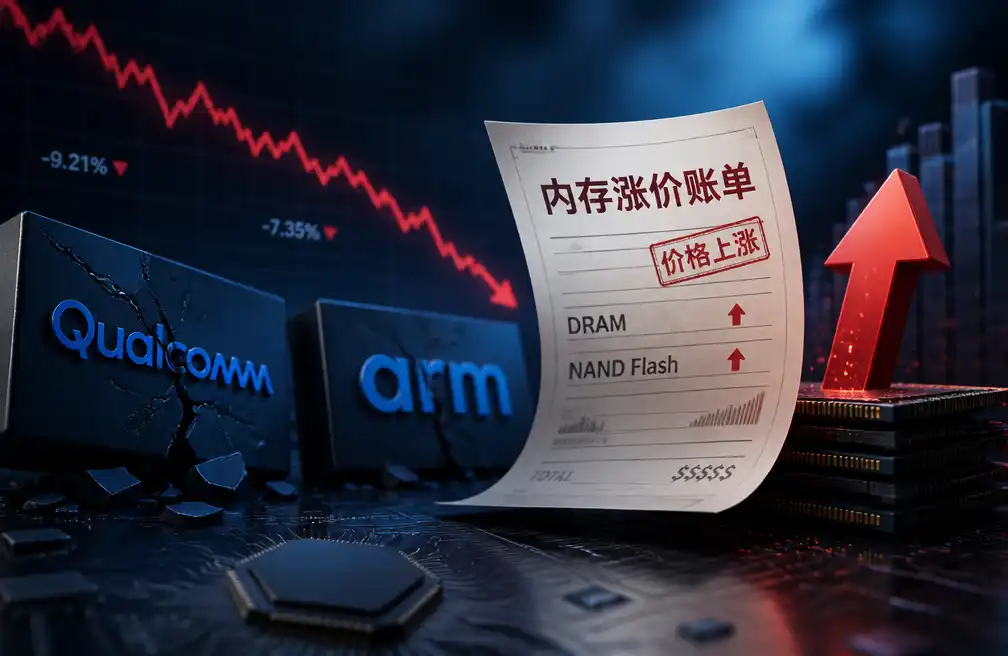
Qualcomm and Arm Fall Together: The Bill for Memory Price Hikes Finally Arrives at Mobile Chip Companies

After posting Q2 FY2026 results, Qualcomm and Arm both saw their shares decline, reflecting the impact of memory price increases on the smartphone chip sector. Qualcomm's revenue of $9.95B slightly beat expectations, but EPS of $2.21 fell short. More concerning was its guidance for next quarter, with EPS projections below analyst estimates. The company directly attributed a >$1.50 per share annual EPS headwind to rising memory costs and supply constraints in Android phones, prompting planned price hikes. While automotive revenue grew 61% and is approaching one-third of phone revenue, the mobile segment declined 20%. Qualcomm also confirmed a significant reduction in its modem share for the upcoming iPhone and outlined a plan for data center revenue to replace all Apple-related income by FY2027. Arm's results surpassed expectations with revenue of $1.29B and EPS of $0.45, and its guidance was also strong. However, its stock fell. Key concerns included royalty revenue failing to set a new record and a downward revision to full-year royalty growth guidance from ~20% to the high-teens, citing weak smartphone demand and high memory prices. Despite robust growth in its data center business, Arm's premium valuation (over 100x forward P/E) means even beating expectations isn't enough to push the stock higher, as any sign of uncertainty is magnified. Ongoing global antitrust investigations add another risk factor. The situation highlights a broader shift. Memory price surges, which boosted Samsung's profits, are now pressuring chip designers. Meanwhile, the semiconductor sector saw significant corrections in July, with the hardest-hit stocks often being those with the biggest AI-driven gains year-to-date. Qualcomm, lacking such a premium, was an exception.

marsbit10 min fa

Qualcomm and Arm Fall Together: The Bill for Memory Price Hikes Finally Arrives at Mobile Chip Companies

marsbit10 min fa

13 Business Lines Surpass $100 Million in Annualized Revenue, Robinhood Moves Toward a 'Super Financial App'

Robinhood Q2 2026 Earnings: Record Revenue and a Push Towards a "Super Financial App" Robinhood (HOOD) reported strong Q2 2026 results, with net revenue reaching $1.308 billion, up 32% year-over-year, and net income hitting $561 million, a 45% increase. The company now has 13 distinct business lines each generating over $100 million in annualized revenue. Key drivers included a 44% surge in transaction-based revenue to $776 million, led by a more than 10x growth in "event contracts" (prediction markets) and strong performance in stocks and options. User metrics also grew, with funded accounts rising to 28.4 million and total assets under custody reaching $369 billion. The Robinhood Gold subscription service hit a record 4.8 million users. The report highlights a strategic shift for Robinhood. Moving beyond its core as a zero-commission trading platform for retail investors, it is actively building a broader financial ecosystem. This includes expanding into wealth management (Robinhood Strategies), payments (Robinhood Credit Card), and next-generation infrastructure like AI-powered "Agentic Trading" and its own Ethereum Layer 2 blockchain, Robinhood Chain. The company's goal is to evolve from a trading app into a comprehensive "super financial app," offering a one-stop shop for investing, cash management, and future on-chain finance.

Odaily星球日报40 min fa

13 Business Lines Surpass $100 Million in Annualized Revenue, Robinhood Moves Toward a 'Super Financial App'

Odaily星球日报40 min fa

13 Business Lines Surpass $100 Million in Annualized Revenue, Robinhood Advances Toward a 'Super Financial App'

On July 30th, Robinhood (HOOD) reported its Q2 2026 financial results, showcasing significant growth with record revenue and profits. The company achieved a net revenue of $1.308 billion, a 32% year-over-year (YoY) increase, and a net income of $561 million, up 45% YoY. This strong performance was driven by robust trading activity and expansion into new financial services. A key highlight was the surge in transaction-based revenue, which rose 44% YoY to $776 million. Notably, income from event contracts (prediction markets) skyrocketed over 10x to $156 million, emerging as a major new growth driver alongside strong gains in stock and options trading. However, crypto trading revenue declined by 38%. Beyond trading, Robinhood is successfully diversifying its revenue streams. User assets grew 32% to $369 billion, and the subscription service Robinhood Gold reached a record 4.8 million users. The company revealed that 13 of its business lines now generate over $100 million in annualized revenue, including its new credit card, prediction markets, and Gold subscriptions. Looking forward, Robinhood is strategically investing in AI and blockchain to build a comprehensive financial ecosystem. It has launched AI-powered "Agentic Trading" and the "Robinhood Chain," a layer-2 blockchain network. The company's vision is evolving from a retail trading platform into a "super financial app" that integrates trading, wealth management, payments, and next-generation digital asset services, though regulatory hurdles remain for some new ventures.

marsbit40 min fa

13 Business Lines Surpass $100 Million in Annualized Revenue, Robinhood Advances Toward a 'Super Financial App'

marsbit40 min fa

Trading

Spot

Articoli Popolari

Cosa è $BANK

Banca AI: Un Passo Rivoluzionario nel Futuro della Banca Introduzione In un'era caratterizzata da rapidi progressi tecnologici, Banca AI si trova all'incrocio tra intelligenza artificiale (AI) e servizi bancari. Questo progetto innovativo mira a ridefinire il panorama finanziario, migliorando l'efficienza operativa, le misure di sicurezza e le esperienze dei clienti attraverso il potere dell'AI. Mentre ci impegniamo in questa esplorazione di Banca AI, esamineremo cosa comporta il progetto, le sue dinamiche operative, il suo contesto storico e i traguardi significativi. Cos'è Banca AI? Alla sua essenza, Banca AI rappresenta un'iniziativa trasformativa volta a integrare l'intelligenza artificiale in varie operazioni bancarie. Questo progetto sfrutta le capacità dell'AI per automatizzare processi, migliorare i protocolli di gestione del rischio e potenziare l'interazione con i clienti attraverso servizi personalizzati. Gli obiettivi principali di Banca AI includono: Automazione delle Funzioni Bancarie: Sfruttando le tecnologie AI, Banca AI mira ad automatizzare compiti di routine, riducendo il carico sulle risorse umane e aumentando l'efficienza. Miglioramento della Gestione del Rischio: Il progetto utilizza algoritmi AI per prevedere e identificare i rischi, rafforzando così le misure di sicurezza contro le frodi e altre minacce. Personalizzazione dei Servizi Bancari: Banca AI si concentra sull'offrire prodotti e servizi finanziari su misura analizzando i dati e i comportamenti dei clienti. Miglioramento dell'Esperienza del Cliente: L'implementazione di soluzioni guidate dall'AI, come chatbot e assistenti virtuali, mira a fornire agli utenti interazioni più umane, rivoluzionando il modo in cui i clienti si relazionano con le banche. Con questi obiettivi, Banca AI si posiziona come un attore cruciale nel rendere la banca più efficiente, sicura e centrata sull'utente. Chi è il Creatore di Banca AI? I dettagli riguardanti il creatore di Banca AI rimangono sconosciuti. Pertanto, non è stata identificata alcuna persona o organizzazione specifica nelle informazioni disponibili. L'anonimato che circonda la nascita del progetto solleva domande, ma non sminuisce la sua ambiziosa visione e obiettivi. Chi sono gli Investitori di Banca AI? Simile al creatore del progetto, informazioni specifiche riguardo gli investitori o le organizzazioni di supporto di Banca AI non sono state divulgate. Senza queste informazioni, è difficile delineare il sostegno finanziario e istituzionale che potrebbe spingere il progetto in avanti. Tuttavia, l'importanza di avere una solida base di investimento è fondamentale per sostenere lo sviluppo in un campo così innovativo. Come Funziona Banca AI? Banca AI opera su più fronti innovativi, concentrandosi su fattori unici che la differenziano dai framework bancari tradizionali. Di seguito sono riportate le caratteristiche operative chiave: Automazione: Applicando algoritmi di machine learning, Banca AI automatizza vari processi manuali all'interno delle banche. Ciò si traduce in una riduzione dei costi operativi e consente ai lavoratori umani di reindirizzare i propri sforzi verso attività più strategiche. Gestione Avanzata del Rischio: L'integrazione dell'AI nelle pratiche di gestione del rischio fornisce alle banche strumenti per prevedere con precisione potenziali minacce come le frodi, garantendo che le informazioni e i beni dei clienti rimangano al sicuro. Raccomandazioni Finanziarie Personalizzate: Attraverso l'apprendimento continuo dalle interazioni con i clienti, i sistemi AI sviluppano una comprensione sfumata delle esigenze degli utenti, consentendo loro di offrire consigli su misura per le decisioni finanziarie. Interazioni Migliorate con i Clienti: Utilizzando chatbot e assistenti virtuali alimentati dall'AI, Banca AI consente un'esperienza cliente più coinvolgente, permettendo agli utenti di risolvere rapidamente le loro richieste, riducendo così i tempi di attesa e migliorando i livelli di soddisfazione. Tutte queste caratteristiche operative posizionano Banca AI come un pioniere nel settore bancario, stabilendo nuovi standard per la fornitura di servizi e l'eccellenza operativa. Timeline di Banca AI Comprendere la traiettoria di Banca AI richiede uno sguardo al suo contesto storico. Di seguito è riportata una timeline che evidenzia traguardi e sviluppi importanti: Inizio 2010: La concettualizzazione dell'integrazione dell'AI nei servizi bancari ha cominciato a guadagnare attenzione mentre le istituzioni bancarie riconoscevano i potenziali benefici. 2018: Si è verificato un aumento significativo nell'implementazione delle tecnologie AI quando le banche hanno iniziato a utilizzare strumenti AI come i chatbot per servizi clienti di base e sistemi di gestione del rischio per migliorare la sicurezza. 2023: La sofisticazione dell'AI ha continuato ad avanzare, con l'introduzione dell'AI generativa per compiti più complessi come l'elaborazione di documenti e l'analisi degli investimenti in tempo reale. Quest'anno ha segnato un significativo salto nelle capacità offerte alle banche dalla tecnologia AI. 2024-Stato Attuale: A partire da quest'anno, Banca AI è su una traiettoria ascendente, con ricerche e sviluppi in corso pronti a migliorare ulteriormente le capacità nelle operazioni bancarie. L'esplorazione continua delle applicazioni AI suggerisce sviluppi entusiasmanti in arrivo. Punti Chiave su Banca AI Integrazione dell'AI nella Banca: Banca AI si concentra sull'adozione dell'intelligenza artificiale per snellire i processi bancari e migliorare le esperienze degli utenti. Focus su Automazione e Gestione del Rischio: Il progetto enfatizza fortemente queste aree, mirando a spostare il carico di compiti di routine mentre migliora le strutture di sicurezza attraverso analisi predittive. Soluzioni Bancarie Personalizzate: Sfruttando i dati dei clienti, Banca AI consente servizi bancari su misura che si adattano alle esigenze individuali degli utenti. Impegno per lo Sviluppo: Banca AI rimane impegnata in sforzi di ricerca e sviluppo continuativi, garantendo la sua adattabilità e rilevanza continua man mano che la tecnologia continua a evolversi. Conclusione In sintesi, Banca AI rappresenta un passo cruciale in avanti nell'industria bancaria, sfruttando l'intelligenza artificiale per rimodellare i paradigmi operativi, migliorare la sicurezza e promuovere la soddisfazione del cliente. Nonostante le lacune nelle informazioni riguardo il creatore e gli investitori, gli obiettivi chiari e i meccanismi funzionali di Banca AI forniscono una solida base per la sua continua evoluzione. Mentre la tecnologia AI continua ad avanzare e fondersi con il settore bancario, Banca AI è ben posizionata per avere un impatto significativo sul futuro dei servizi finanziari, migliorando il modo in cui comprendiamo e interagiamo con la banca.

147 Totale visualizzazioniPubblicato il 2024.04.06Aggiornato il 2024.12.03

Cosa è $BANK

Come comprare BANK

Benvenuto in HTX.com! Abbiamo reso l'acquisto di Lorenzo Protocol (BANK) semplice e conveniente. Segui la nostra guida passo passo per intraprendere il tuo viaggio nel mondo delle criptovalute.Step 1: Crea il tuo Account HTXUsa la tua email o numero di telefono per registrarti il tuo account gratuito su HTX. Vivi un'esperienza facile e sblocca tutte le funzionalità,Crea il mio accountStep 2: Vai in Acquista crypto e seleziona il tuo metodo di pagamentoCarta di credito/debito: utilizza la tua Visa o Mastercard per acquistare immediatamente Lorenzo ProtocolBANK.Bilancio: Usa i fondi dal bilancio del tuo account HTX per fare trading senza problemi.Terze parti: abbiamo aggiunto metodi di pagamento molto utilizzati come Google Pay e Apple Pay per maggiore comodità.P2P: Fai trading direttamente con altri utenti HTX.Over-the-Counter (OTC): Offriamo servizi su misura e tassi di cambio competitivi per i trader.Step 3: Conserva Lorenzo Protocol (BANK)Dopo aver acquistato Lorenzo Protocol (BANK), conserva nel tuo account HTX. In alternativa, puoi inviare tramite trasferimento blockchain o scambiare per altre criptovalute.Step 4: Scambia Lorenzo Protocol (BANK)Scambia facilmente Lorenzo Protocol (BANK) nel mercato spot di HTX. Accedi al tuo account, seleziona la tua coppia di trading, esegui le tue operazioni e monitora in tempo reale. Offriamo un'esperienza user-friendly sia per chi ha appena iniziato che per i trader più esperti.

743 Totale visualizzazioniPubblicato il 2025.05.09Aggiornato il 2026.06.02

Come comprare BANK

Discussioni

Benvenuto nella Community HTX. Qui puoi rimanere informato sugli ultimi sviluppi della piattaforma e accedere ad approfondimenti esperti sul mercato. Le opinioni degli utenti sul prezzo di BANK BANK sono presentate come di seguito.

活动图片