All about why blockchain firms will now become part of U.S Treasury’s cybersecurity program

ambcryptoPubblicato 2026-04-10Pubblicato ultima volta 2026-04-10

Introduzione

The U.S. Department of the Treasury has launched a new initiative through its Office of Cybersecurity and Critical Infrastructure Protection (OCCIP) to include blockchain and crypto firms in a cybersecurity program. This move aims to share timely cyber threat intelligence to help these firms prevent and respond to attacks. The announcement comes amid ongoing security challenges in the crypto industry, highlighted by incidents like the 2026 Drift Protocol attack, which resulted in approximately $285 million in losses and was linked to state-backed cyber operations. The article underscores that security vulnerabilities remain a critical systemic risk in crypto, capable of triggering prolonged market downturns, as seen during the 2022 crash following the collapse of FTX. By providing early warnings and fostering coordinated risk management, the Treasury’s program seeks to strengthen institutional confidence and reduce the likelihood of future large-scale market disruptions.

When we talk about “risk” in crypto, the real and often underestimated risk lies in security.

Over the years, the crypto industry has expanded rapidly, bringing institutional participation, new products, and large-scale adoption. And yet, the underlying investment risk has not fully disappeared. The reason is simple – Security vulnerabilities continue to exist across smart contracts, bridges, wallets, and exchanges.

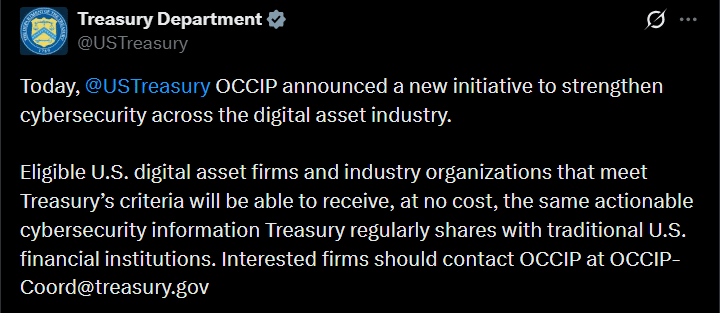
Seen in this light, the latest move by the U.S Treasury becomes relevant. Notably, the U.S Department of the Treasury has launched a new cybersecurity initiative. Through its Office of Cybersecurity and Critical Infrastructure Protection (OCCIP), the program will share timely cyber threat information with eligible crypto and blockchain firms to help them prevent and respond to attacks.
Source: X

Interestingly, the timing of this initiative feels almost deliberate.

Just four months into 2026, the crypto market has already faced another reminder of its security gaps. The recent Drift Protocol attack exposed vulnerabilities within the platform’s trading mechanisms, resulting in losses estimated at around $285 million. In fact, early investigations have linked the activity to DPRK-style operations, suggesting a level of planning typically associated with state-backed cyber groups.

Against this backdrop, the U.S Treasury’s decision to roll out a cybersecurity program for digital asset firms carries significant importance. The key question now is – Will stronger government-backed cybersecurity coordination help strengthen institutional confidence in crypto assets?

OCCIP’s significance viewed through crypto’s 2022 crash

The impact of security lapses goes far beyond a temporary wave of FUD in the market.

In some cases, the consequences are long-lasting. The collapse of FTX in 2022 serves as a clear example. What initially appeared to be a single exchange failure quickly evolved into a security crisis for the entire industry. Billions of dollars were lost, and major lending firms faced significant liquidity stress.

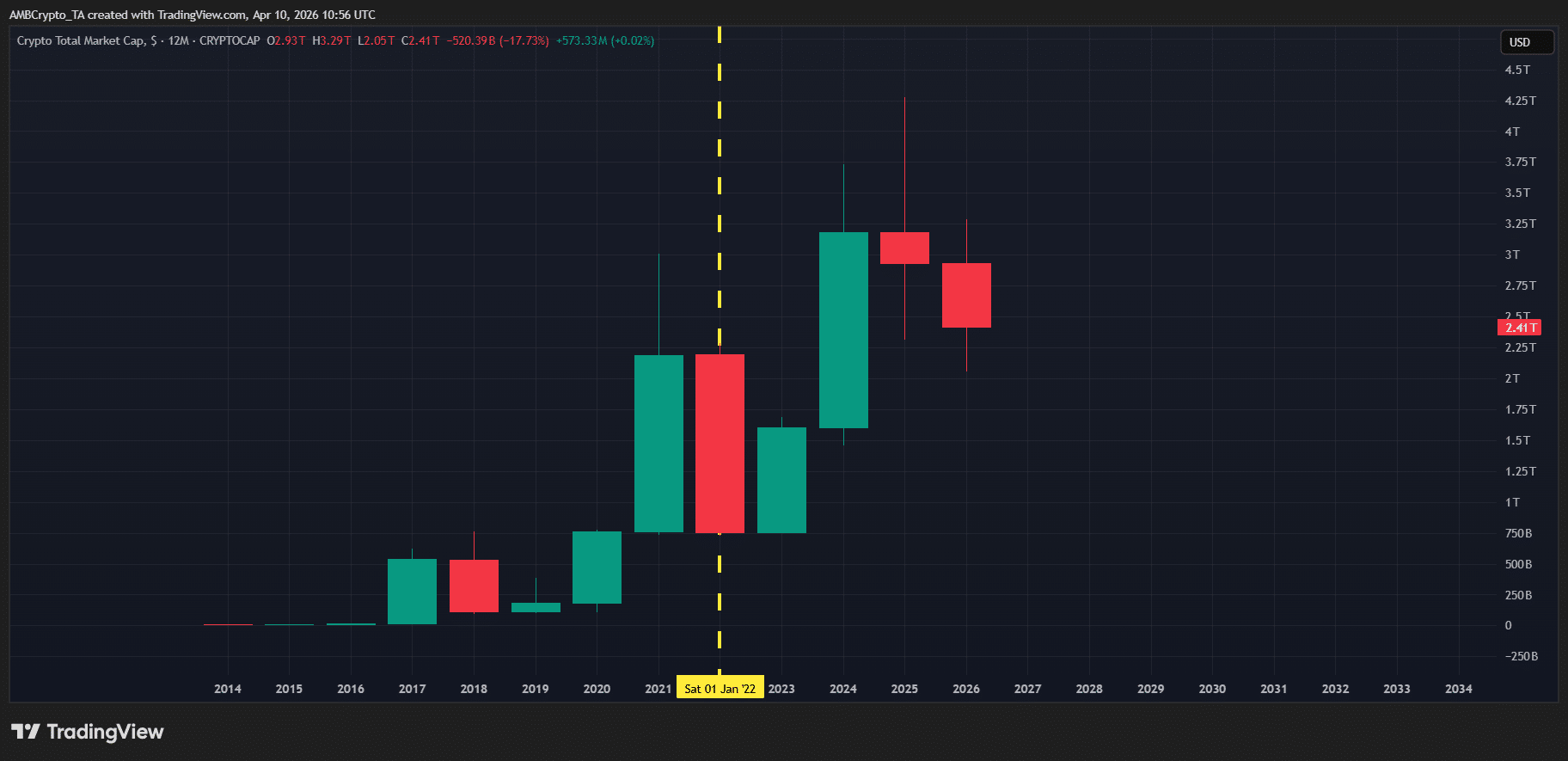
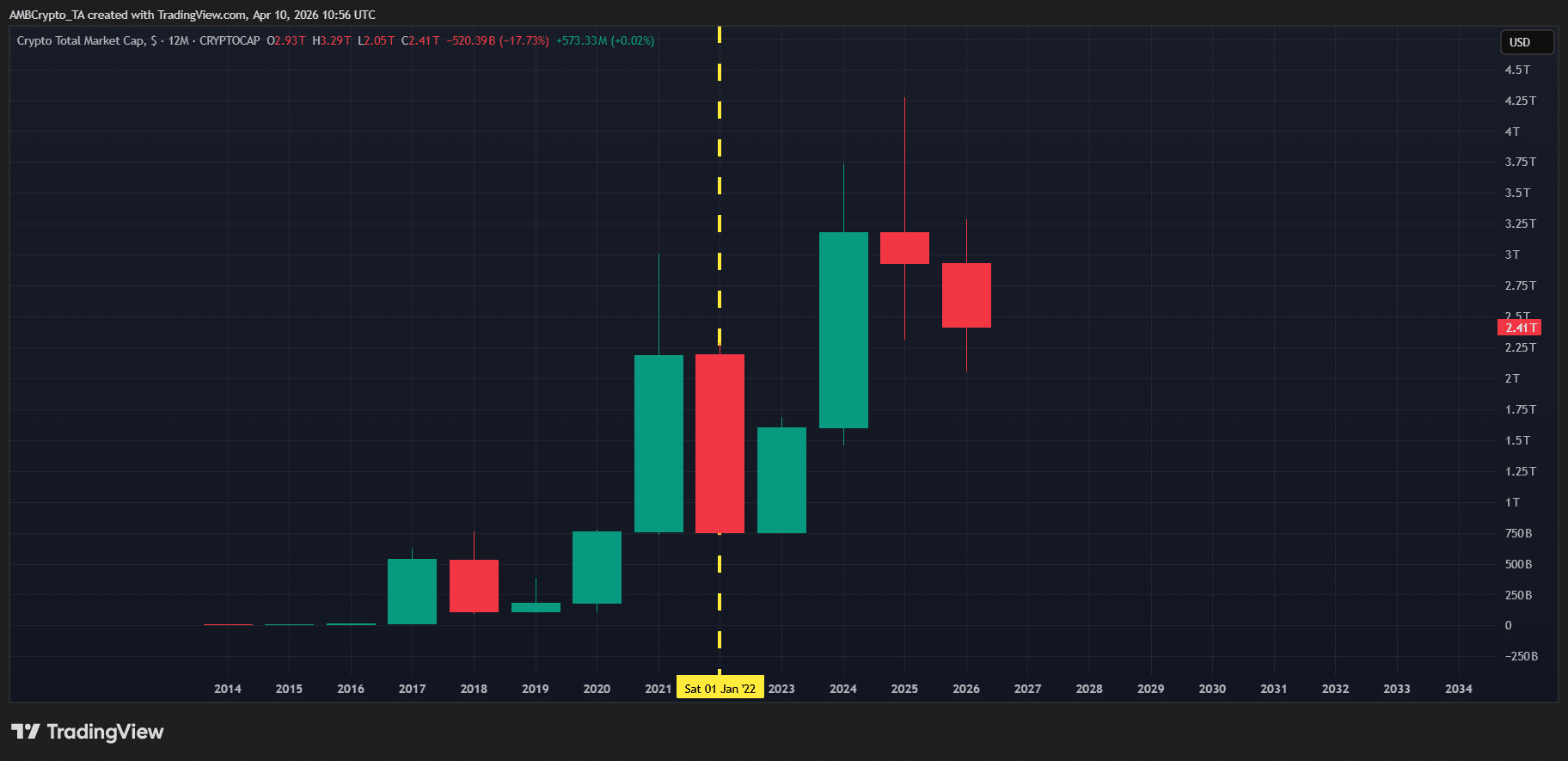
From a technical standpoint, the impact was equally severe. The crypto market ended 2022 down roughly 66%, a period still considered one of the harshest bear markets in crypto history. Recovery was slow rather than immediate.

Throughout 2023, the market managed to regain only 50% of the losses as investors remained cautious.

In fact, it wasn’t until the 2024 cycle that broader momentum returned.
Source: TradingView (TOTAL/USDT)

In essence, the impact of major security failures in crypto extends well beyond price correction.

Instead, they reshape market cycles, delay institutional adoption, and reinforce the industry’s need for stronger security infrastructure and coordinated risk management. Fast forward to now, this is exactly where the U.S Treasury’s OCCIP program starts to become relevant.

From a broader perspective, risks around digital assets have not disappeared. Instead, they are evolving. Alongside protocol exploits and exchange breaches, newer concerns like quantum computing threats are beginning to enter the discussion, keeping long-term security risks on the radar and raising concerns about another 2022-style market shock.

However, the shift now seems to be towards prevention rather than reaction. With OCCIP, digital asset firms will gain access to early warning signals, allowing them to strengthen defenses before vulnerabilities escalate. In turn, this will help keep institutional confidence intact, lowering the chances of another market shock.


Final Summary

  • Security is crypto’s real systemic risk, with repeated exploits showing how security failures can trigger long-term market downturns.
  • By giving digital asset firms access to cyber intelligence, the U.S Treasury’s move could reduce the risk of another shock.


Domande pertinenti

QWhat is the main focus of the U.S. Treasury's new cybersecurity initiative for blockchain firms?

AThe U.S. Treasury's new cybersecurity initiative, through its Office of Cybersecurity and Critical Infrastructure Protection (OCCIP), aims to share timely cyber threat information with eligible crypto and blockchain firms to help them prevent and respond to attacks.

QHow did the 2022 FTX collapse demonstrate the long-lasting impact of security failures in crypto?

AThe FTX collapse in 2022 evolved from a single exchange failure into an industry-wide security crisis, resulting in billions of dollars lost, significant liquidity stress for major lending firms, and a prolonged market downturn with the crypto market ending the year down roughly 66%.

QWhat recent security incident in 2026 highlighted ongoing vulnerabilities, according to the article?

AThe recent Drift Protocol attack in early 2026 exposed vulnerabilities in the platform's trading mechanisms, resulting in estimated losses of around $285 million, with investigations linking the activity to DPRK-style operations.

QHow does the OCCIP program aim to change the approach to cybersecurity risks for digital asset firms?

AThe OCCIP program shifts the approach from reaction to prevention by providing digital asset firms with early warning signals and cyber intelligence, allowing them to strengthen defenses before vulnerabilities escalate and reduce the risk of market shocks.

QWhat broader risks beyond protocol exploits and exchange breaches are mentioned as emerging concerns?

ANewer concerns like quantum computing threats are beginning to enter the discussion, keeping long-term security risks on the radar and raising concerns about potential future market shocks.

Letture associate

Winter for Crypto IPOs: Consensys and Ledger Withdraw Applications

The crypto IPO window is tightening significantly in 2026, marked by prominent companies delaying or pausing their public listing plans. Following a successful 2025 "harvest year" that saw Circle, Bullish, and Gemini go public amidst a bull market, the tide has turned. Consensys, developer of MetaMask, recently postponed its IPO until at least fall 2026. Hardware wallet leader Ledger also suspended its planned US listing due to unfavorable market conditions, with Kraken having previously delayed its own plans. This shift is driven by a cooling market in 2026, characterized by a significant Bitcoin price correction, declining trading volumes, and reduced investor risk appetite for crypto stocks. The poor post-IPO performance of 2025 listings like Circle and Bullish, which saw major share price declines, has heightened investor caution. This contrasts sharply with the current AI sector, where companies like SpaceX, OpenAI, and Anthropic are commanding massive valuations and investor enthusiasm based on narratives of stable, exponential growth. Crypto companies now face pressure to transition from hype-driven models to demonstrating reliable cash flows and robust compliance. While the paused IPO plans may lead to valuation resets and affect ecosystem liquidity, they also accelerate industry consolidation toward stronger, more compliant infrastructure players. A potential recovery in Bitcoin's price and clearer regulations could reopen the IPO window in the latter half of 2026.

marsbit2 h fa

Winter for Crypto IPOs: Consensys and Ledger Withdraw Applications

marsbit2 h fa

ChatGPT Can Manage Your Money for You. Would You Trust It with Your Bank Account?

OpenAI has launched a personal finance tool for ChatGPT, currently in preview for US-based ChatGPT Pro users. This feature allows users to connect their bank and investment accounts (via Plaid, supporting over 12,000 institutions) directly to ChatGPT. It analyzes transactions, generates visual dashboards, and offers conversational financial advice—such as budgeting or planning for major purchases—based on the user's actual data. This move follows OpenAI's acquisitions of fintech startups Roi and Hiro Finance, signaling a strategic push into vertical "super assistant" applications, similar to its earlier health-focused feature. However, the launch has sparked significant privacy concerns. Critics question the safety of granting such sensitive financial access to an AI, especially amid ongoing lawsuits alleging OpenAI shared user chat data with third parties like Meta and Google. OpenAI emphasizes that ChatGPT only reads data (no transaction capabilities), deletes it within 30 days if disconnected, and offers opt-out options for model training. Yet, trust remains a major hurdle. The trend reflects a broader industry shift: AI companies like Anthropic and Perplexity are also targeting high-value, data-rich domains like finance and health. While technically promising, the tool operates in a regulatory gray area—it provides personalized guidance but disclaims formal financial advice or liability. Ultimately, OpenAI's challenge is convincing users to trust an AI with their most private financial information.

marsbit2 h fa

ChatGPT Can Manage Your Money for You. Would You Trust It with Your Bank Account?

marsbit2 h fa

Trading

Spot
Futures
活动图片