After the 'Golden Finger' Points to IBM, the Stock God Trump's Next Target Emerges

marsbitPubblicato 2026-06-02Pubblicato ultima volta 2026-06-02

Introduzione

The White House occupant is being called a "stock god." Financial disclosures show former President Trump executed 3,642 stock trades in Q1 2026, averaging 58 per trading day. More significantly, a pattern has emerged where companies he publicly praises often see their stock prices rise and frequently overlap with his personal portfolio holdings, government industrial policy, and federal funding. Since a high-profile Tesla event in March 2025, Trump has publicly endorsed at least nine companies, including Intel, Dell, Micron, Palantir, IBM, Apple, Thermo Fisher, Nvidia, and AMD. These "Trump concept stocks" share key traits: they are tied to AI, semiconductors, quantum computing, or "Made in America" narratives; they often receive government contracts, subsidies (like CHIPS Act funding), or regulatory favors; and their CEOs typically have strong personal or political ties to Trump. Timing raises questions. In several instances, such as with Palantir and Dell, Trump's personal account established or increased positions weeks before his public endorsements, which were followed by significant stock price jumps. While his assets are reportedly held in a blind trust managed by his children, the correlation is notable. Based on this pattern, analysis suggests the next companies likely to be endorsed are those where the US government has already taken a strategic equity stake but which haven't yet received a high-profile "call-out." Prime candidates include MP Materials (rare ear...

This White House is home to a stock god.

According to the latest disclosed financial documents, Trump completed 3,642 U.S. stock trades in the first quarter of this year, averaging about 58 trades per trading day. This frequency far exceeds that of most professional fund managers.

If it were only about high trading frequency, this matter wouldn't be enough to attract market attention.

What has truly started making Wall Street talk is another set of increasingly difficult-to-ignore data: over the past year, publicly listed companies that Trump has publicly praised by name are showing increasingly obvious overlap with his holdings, government industrial policies, and the flow of federal funds.

Perhaps the most impressive was last year when Trump turned the White House South Lawn into a Tesla product launch event. In front of media cameras, he sat in a Model S, calling Tesla a "great product" and the Cybertruck having the "coolest design."

This was followed by a series of companies including Dell, Intel, Micron, NVIDIA, IBM, Apple, Thermo Fisher, and others entering his public praise list one after another.

The stock prices of some companies showed noticeable abnormal movements after being named; for others, Trump's account had already established positions before the praise; and some companies simultaneously received government contracts, subsidies, export licenses, or other policy support.

When these events occur individually, they might just be coincidences. But when more and more coincidences start pointing to the same group of companies, we can't help but ask a question: Is Trump supporting U.S. manufacturing and the tech industry, or is he shaping his own list of "presidential concept stocks"?

And if this pattern truly exists, then the question the market cares most about is: Who will be the next to be named by the White House?

Common Traits of the Promoted Companies

Counting from the March 2025 performance that turned the White House South Lawn into a Tesla showroom to May 2026, there have been nine publicly listed companies that Trump has publicly named or posted strong support for on Truth Social, with the density sharply rising in 2026. The most typical examples are Dell and Intel.

On February 10th of this year, the Trump account established a position of $1 million to $5 million. On May 8th, he publicly called out from the White House, "Go buy a Dell, they're great." Dell's stock price surged about 14% intraday. Before this, the Dell family had already committed $6.25 billion to "Trump accounts."

Intel represents another typical case. In August 2025, the Trump administration converted the $8.9 billion subsidy owed to Intel under the CHIPS and Science Act into equity, acquiring approximately 9.9% at $20.47 per share, making the U.S. government Intel's largest shareholder. The online community simply calls it a "U.S. state-owned enterprise." Six months later, in early March 2026, his personal account also appeared in Intel's holdings. Subsidy conversion to equity, government backing, personal holdings, and public promotion have all become bullish factors for Intel.

Another landmark moment was Palantir (PLTR). On April 10th, he endorsed it on Truth Social by its company name and stock ticker, calling it "proven to have powerful combat capabilities and equipment," becoming the first sitting president to do so.
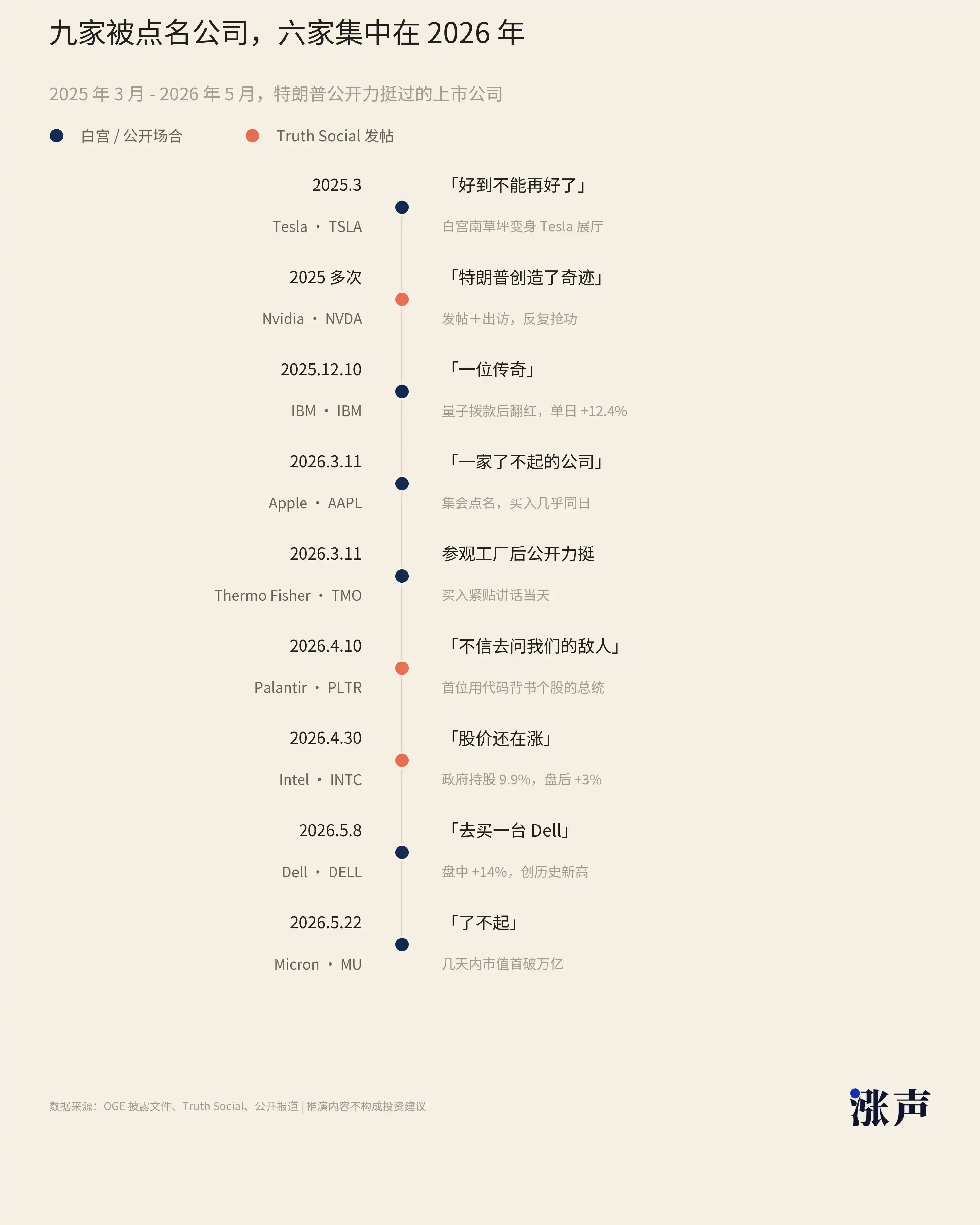
If we expand the scope from Trump's personal holdings to publicly listed companies he has publicly praised by name, the number far exceeds the few familiar tech giants. Based on statistics from public speeches, White House events, and Truth Social posts, Trump has explicitly praised at least 9 publicly listed companies over the past year or so, causing short-term stock price increases, including Intel, Dell, Micron, Palantir, IBM, Apple, Thermo Fisher Scientific, Tesla, and NVIDIA.

We've summarized some of their commonalities:

First and most obviously, they almost all fit the narratives of "AI/new tech," "U.S. leading manufacturing," and "reshoring of production capacity."

Industrially, they are highly concentrated in the AI computing power and semiconductor chain. Intel, Micron, NVIDIA, AMD are chips; Dell is computing hardware; IBM is quantum; Palantir is AI software.

Secondly, each named company has a direct interest lever that the government can pull. For example, Intel has 9.9% government ownership; Palantir is a major federal contractor; IBM and Intel received CHIPS Act grants; NVIDIA and AMD benefit from loosened export controls to China; Dell received a $9.7 billion Pentagon contract on May 27th, shortly after being praised. Apple was praised because it promised investment in the U.S. and iPhone glass production at its Kentucky factory; Intel and Micron are domestic fabs; Dell assembles AI servers in the U.S.; IBM has its quantum foundry in Albany; Tesla, on the day it was promoted, saw Musk promise on the spot to double U.S. production. Trump rarely praises purely overseas production; he praises the act of "moving production lines back to the U.S." itself.

To some extent, the narratives of these companies have been packaged and elevated into matters of "national security" and "competition with China." Chips are a bottleneck; quantum is cybersecurity. Of course, a prerequisite for being named is often the CEO first submitting a pledge of allegiance.
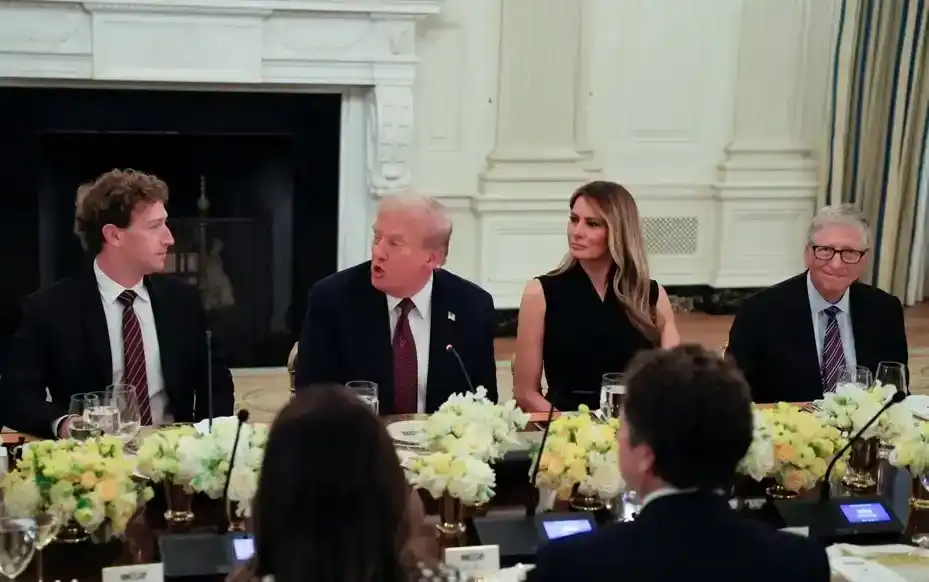
Trump hosting a dinner for tech giants after taking office last year, asking each about their investment amounts in the U.S.

All the positive factors are, first and foremost, "having the right connections." These CEOs generally publicly expressed support for Trump or have personal relationships with him.

Jensen Huang accompanied him on visits and publicly thanked him; the Dell family donated $6.25 billion to "Trump accounts"; Oracle's Larry Ellison is a long-time supporter, deeply involved in the Stargate and TikTok deals; Musk was an ally during the promotion period; Arvind Krishna was named in the room during a face-to-face meeting.

Although the White House's unified explanation is that the President's assets are held in a trust managed by his children, with independent third-party discretionary accounts, and Trump himself does not participate in specific trades, we can indeed observe that the timing of Trump's promotions overlaps with his personal holdings and trades.

For example, Palantir was intensively bought in March, and Trump named it on Truth Social a few weeks later; Dell was bought on February 10th ($1-5 million per month), and publicly promoted in May; Apple and Thermo Fisher were bought and publicly praised almost on the same day.

If these patterns are correct, then predicting Trump's next promotion isn't difficult.

Who Might Be the Next to Be Promoted

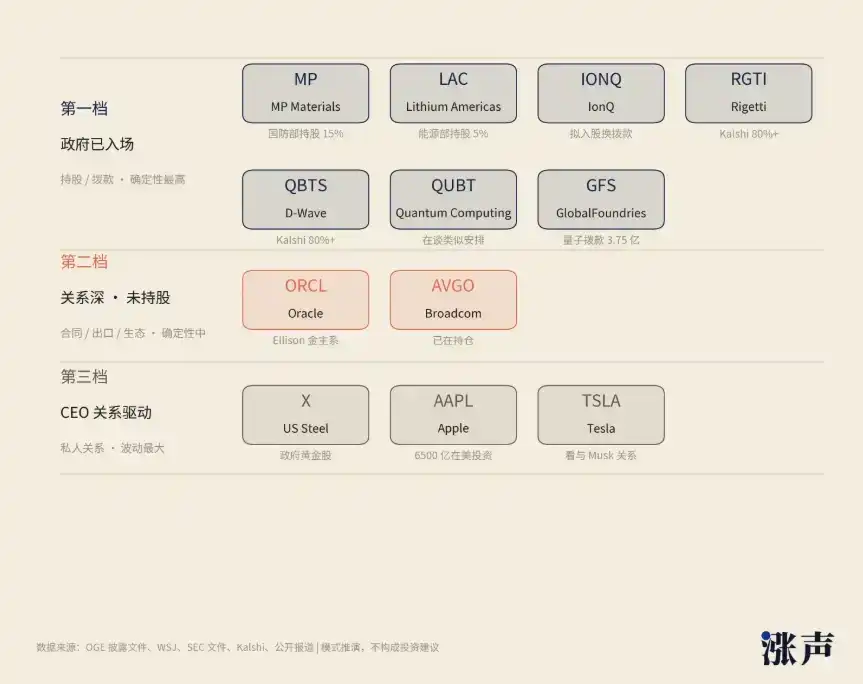
First and most likely are companies where the government has already taken a position: MP Materials (MP), Lithium Americas (LAC), IonQ (IONQ), Rigetti (RGTI), D-Wave (QBTS), etc.

MP Materials is currently one of the U.S.'s core rare earth magnet suppliers. Its main business is rare earth mining and separation processing, ultimately used to manufacture permanent magnets, which go directly into fighter jets, electric vehicles, and missile systems.

In other words, it's not just a "resource company" but a link in the defense supply chain.

In July 2025, the U.S. Department of Defense acquired approximately 15% equity and related arrangements, transforming it from an ordinary publicly listed company into a kind of "quasi-strategic asset." More crucially, this move occurred before the government's investment in Intel.

But an interesting point in the market is: compared to Intel being frequently discussed, MP is relatively low-key, and hasn't even been centrally named in political narratives. This state of being "already invested in but not yet narrated" itself constitutes a lag in pricing.

Lithium Americas is a typical lithium resource development company. Its core asset is the Thacker Pass lithium project in Nevada, USA, one of the largest known lithium resources in North America. The strategic significance of lithium needs no explanation: electric vehicles, battery storage, military energy systems all depend on it.

The U.S. Department of Energy indirectly holds approximately 5% equity through warrants and project structures and obtains about a 5% economic interest in the Thacker Pass project. Simultaneously, the project is tied to General Motors (GM), forming a tripartite structure of "government + industry + listed company."
More critically, the U.S. Department of Energy explicitly defined Thacker Pass as a "national security-level strategic lithium asset" in documents.

Furthermore, according to The Wall Street Journal, several companies including IonQ (IONQ), Rigetti (RGTI), and D-Wave (QBTS) are discussing obtaining at least $10 million-level grant support through "government equity stakes or quasi-equity arrangements." Quantum Computing (QUBT) and Atom Computing are also being considered under similar frameworks.

These quantum computing players are currently still in very early stages, but their peculiarity lies in the fact that they almost naturally belong to the intersection of national security and basic scientific research.

If we extend the timeline, the U.S. government previously initiated a roughly $20 billion quantum technology support program, with IBM receiving about $10 billion, GlobalFoundries (GFS) about $3.75 billion, and the remaining funds allocated to various labs and companies.

IBM has already been fully traded by the market for a round, and the next step will naturally go to more "pure" quantum plays. Notably, the market has already priced this ahead of him. On Kalshi, in the market betting on "which companies the government will invest in this year," the probability for Rigetti and D-Wave has already been bet to over 80%.

GlobalFoundries (GFS) deserves special mention. It both received that $3.75 billion quantum grant and is itself a U.S. domestic fab, fitting both the chip and domestic manufacturing narratives, making it the most suitable company to be incidentally named at a "Made in America Chips" event.

Apart from companies where the government has already taken a position, there are also some that perfectly fit structurally and have deep enough government ties but haven't yet received explicit equity that are worth mentioning.

However, this category is more likely to be named through contracts, exports, or ecosystem support, potentially less direct than previous promotions.

Oracle (ORCL) might be the best positioned among them. Ellison's personal relationship, Stargate, the TikTok deal, and existing holdings in his personal account—all the soft conditions are in place, just waiting for a formal verbal endorsement. Broadcom (AVGO) is similar, a core supplier of custom AI chips and data center construction, already in the holdings.

Besides these, there are companies driven by CEO personal relationships. The U.S. Steel (X) line is worth separate attention. In the Nippon Steel acquisition case, the government obtained a "golden share" stronger than ordinary equity, and the "protect American steel" narrative can be reused at any time. Apple, although already promoted, has a $650 billion U.S. investment promise that is material that can be reused repeatedly, so the probability of being promoted again is not low. Tesla depends on the degree of repair in his relationship with Musk, making it the most volatile item on this list.

It should be noted that the above is a pattern extrapolation based on publicly disclosed industrial policies and equity stake clues, not a deterministic prediction, and certainly does not constitute any investment advice. These targets themselves carry high political premiums, and political premiums are always double-edged. They can push stock prices up after a post, but can also compress valuations when the wind changes direction.

After all, relying solely on the "White House Stock God" to promote stocks makes price increases very fragile.


Domande pertinenti

QAccording to the article, what is the average number of stock trades President Trump executed per trading day in Q1 of the reported year, and why did it attract Wall Street's attention?

AAccording to the article, President Trump executed an average of approximately 58 stock trades per trading day in Q1, totaling 3,642 trades. This frequency itself surpassed that of most professional fund managers. However, what truly drew Wall Street's focus was the increasing overlap between the companies he publicly praised, his personal stock holdings, government industrial policies, and the flow of federal funds, suggesting a potential pattern beyond mere coincidence.

QWhat are the three main common characteristics shared by the companies publicly praised by Trump, as summarized in the article?

AThe article summarizes three main common characteristics of the companies Trump praised: 1) Their narratives align with 'AI & New Tech,' 'U.S. Leading Manufacturing,' and 'Production Reshoring.' 2) Each company has a direct interface where government interests can be applied, such as receiving CHIPS Act grants, government contracts, export license approvals, or commitments to U.S. investment. 3) Their CEOs generally have demonstrated public support or personal connections with Trump, having offered what the article terms 'pledges of allegiance' or investments.

QUsing the pattern identified in the article, which category of companies is most likely to be Trump's next 'stock tip' target, and name two specific examples mentioned.

ABased on the pattern identified, companies where the U.S. government has already taken an equity stake or similar financial interest are the most likely category to be Trump's next 'stock tip' target. Two specific examples mentioned are MP Materials (MP), a rare earths supplier where the Defense Department acquired ~15% interest, and Lithium Americas (LAC), a lithium developer where the Department of Energy holds an indirect ~5% stake and economic interest.

QBesides companies with direct government stakes, what other type of company might be named by Trump, and which company is cited as the best candidate due to its 'soft conditions'?

ABesides companies with direct government stakes, companies that perfectly fit the strategic narrative and have deep government ties, even without an explicit equity stake, might also be named. The article cites Oracle (ORCL) as the best candidate in this category due to its 'soft conditions' being fully in place: CEO Larry Ellison's personal relationship with Trump, involvement in projects like Stargate and the TikTok deal, and Trump's existing personal holdings in the company.

QWhat cautionary note does the article provide regarding investments based on the 'presidential stock tip' phenomenon?

AThe article cautions that investments based on this phenomenon carry high 'political premium,' which is a double-edged sword. This premium can push stock prices up following a public endorsement but can also compress valuations just as quickly if the political winds change. It concludes that stock gains relying solely on 'White House stock god' tips are inherently fragile.

Letture associate

After Three Consecutive Quarters of Decline, Can the Crypto Market Find a Window for Stabilization in Q3?

The cryptocurrency market has just concluded its worst-performing quarter since 2022, with total capitalization dropping 12.6% to $2.1 trillion. All core metrics indicate capital is leaving the sector, not just rotating within it. Bitcoin fell 14.2% and Ethereum dropped 25.4% in Q2, breaking their previous correlation with US tech stocks. A key driver is the reversal in US spot Bitcoin ETF flows, which saw a net outflow of approximately $4.67 billion in Q2, including a record monthly outflow near $4.5 billion in June. While recent data suggests long-term holders are accumulating again, sustained ETF outflows mean continued selling pressure. Market focus is now singularly on the Federal Reserve. The upcoming July FOMC meeting is seen as the most critical event for Q3. A dovish signal could support Bitcoin reclaiming a $68,000-$84,000 range, while a hawkish stance might establish a new trading band around $50,000-$56,000. Additionally, regulatory uncertainty persists, with the progress of the crucial *CLARITY Act* stalling in the Senate, reducing its perceived 2026 passage probability to 40-45%. Despite the broad downturn, a few sectors showed growth. Prediction markets saw nominal volume surge 48.7% year-over-year to $113.8 billion, and tokenized collectibles transaction volume rose 143% quarterly to $1.4 billion. The Real-World Asset (RWA) tokenization sector also continued steady growth, now representing ~$28.1 billion in on-chain value. The market's foundation for an extreme crash appears limited, with Bitcoin price hovering near its 200-week moving average. However, the trading paradigm has shifted from narrative-driven speculation to decisions based on price action, policy developments, and interest rate expectations, making a broad sentiment-driven rally unlikely in the near term.

marsbit3 h fa

After Three Consecutive Quarters of Decline, Can the Crypto Market Find a Window for Stabilization in Q3?

marsbit3 h fa

BIT Trading Moment: BTC Still Suppressed by Weekly 200 EMA, Rejection May Restart Decline; Storage and Semiconductors that Surged Last Night Begin Falling in Evening Trading

**Crypto & Stock Market Wrap: Bitcoin Tests Resistance, Stocks Retreat After AI Surge** Bitcoin consolidates around $66,000, facing key resistance near $68,000—an area seen as a major psychological and technical hurdle where previous rallies have failed. Analysts note the cryptocurrency is caught between its 200-week moving average (~$63,333) and 200-week EMA (~$68,328). A clear break above $68k is needed to signal a stronger bullish trend, while a rejection could lead to a retest of $63k support. Market sentiment remains cautious, with low futures open interest pointing to a low-liquidity rebound rather than a full bull market. Bitcoin spot ETFs saw another $203 million inflow. US stock futures pointed lower after a strong Tuesday session led by a massive rebound in semiconductors and memory stocks. The rally was fueled by renewed optimism about AI-driven hardware demand, with Micron, SanDisk, and SK Hynix surging. However, those gains reversed in pre-market trading. Super Micro Computer (SMCI) soared over 20% after hours on strong guidance and a record backlog. Other standouts included Rocket Lab and nuclear energy plays Oklo and X-Energy. Rising oil prices (Brent above $91) and climbing Treasury yields (10-year near 4.64%), however, are reigniting inflation concerns and acting as a headwind for equities. In Asia, markets were mixed. South Korea's KOSPI pared early gains to close slightly higher as semiconductor stocks like SK Hynix gave back initial surges. Japan's Nikkei edged lower as the yen hit a fresh 38-year low against the dollar, raising fears of potential market intervention. Key events to watch include the Samsung Galaxy launch, AMD's AI event, and a slew of major tech earnings from Alphabet, Tesla, and IBM after the close on Wednesday, followed by the ECB meeting and Intel's earnings on Thursday.

marsbit3 h fa

BIT Trading Moment: BTC Still Suppressed by Weekly 200 EMA, Rejection May Restart Decline; Storage and Semiconductors that Surged Last Night Begin Falling in Evening Trading

marsbit3 h fa

Former CFTC Chairman, Circle President Tarbert: Preaching Long-Termism While Cashing Out $30 Million Himself

Former CFTC Chairman and Circle President Heath Tarbert has consistently advocated for a long-term vision in public, urging patience from investors as Circle’s stock price has fallen significantly from its peak. However, it has been revealed that since Circle’s IPO, Tarbert has continuously sold his CRCL shares through pre-arranged trading plans, cashing out approximately $30 million, without making any public market purchases. This contrast between his public messaging and personal actions has drawn criticism. Tarbert joined Circle in July 2023 as Chief Legal Officer, leveraging his regulatory experience to help guide the company through its IPO and expansion. Despite promoting stablecoins as long-term infrastructure, he established a 10b5-1 trading plan just before Circle went public, leading to substantial stock sales over the following year. In March 2026, he initiated another plan to sell more shares. His career trajectory highlights a pattern of moving between high-level regulatory roles and influential positions in the financial sector. After resigning as CFTC Chairman in early 2021, he joined Citadel Securities as Chief Legal Officer just 27 days later, during a period of intense regulatory scrutiny for the firm. He later joined Circle, aiding its efforts to navigate regulatory challenges for its public listing. While Tarbert's expertise in policy and compliance is valuable to companies like Circle, his actions—advocating long-term confidence while personally divesting—raise questions about the alignment between his public statements and his private financial decisions, leaving investors who followed his advice to bear the market risks.

marsbit3 h fa

Former CFTC Chairman, Circle President Tarbert: Preaching Long-Termism While Cashing Out $30 Million Himself

marsbit3 h fa

Gate Research Institute: The 'Wall Street-ization' Wave of Crypto Financial Products – Competition or Integration?

The article titled "Gate Research Institute: Are Crypto Financial Products Sparking a 'Wall Street' Wave—Competition or Convergence?" explores the evolving relationship between the crypto ecosystem and traditional finance (TradFi). The piece begins by reflecting on Bitcoin's original 2009 vision of decentralization, disintermediation, and moving away from banks. It then contrasts this with the 2024 landscape, where key crypto assets like Bitcoin are increasingly held through Wall Street products like ETFs issued by giants like BlackRock. The article questions whether this signifies that TradFi is systematically taking over the rights to issue, price, custody, and distribute crypto financial assets. The core argument is that this is not a zero-sum takeover but rather a bidirectional convergence where each side addresses the other's weaknesses. Crypto offers 24/7 global markets, programmable settlement, and open access but lacks compliant channels, institutional-grade custody, deep fiat liquidity, and mainstream distribution. TradFi possesses these but is constrained by legacy systems, limited operating hours, and slow settlement. Two primary convergence paths are highlighted: * **Path A (CEX to TradFi):** Exemplified by Gate, which has progressed from offering tokenized stocks and CFDs to providing direct, real stock trading (US, Hong Kong, South Korea) within its platform, using USDT. * **Path B (TradFi to Crypto):** Exemplified by Robinhood, which has integrated crypto trading, acquired exchanges like Bitstamp, and is moving traditional assets like stocks onto the blockchain via tokenization and its own Layer 2. Both paths are ultimately competing to become the next-generation, unified financial account—a "super account" where users can seamlessly trade cryptocurrencies, stocks, ETFs, RWA (Real World Assets), and tokenized treasury products in one interface. The growth of RWA and tokenized treasuries (e.g., BlackRock's BUIDL) is presented as the asset-layer fusion, providing stable, yield-bearing assets on-chain and acting as a bridge between the two worlds. In conclusion, the "Wall Street-ization" of crypto is framed as a mutual transformation. Decentralized ideals persist in the protocol layer, while at the application layer, a more efficient, global, and accessible unified capital market is emerging from this convergence. The future competition lies not between crypto exchanges and stockbrokers, but between platforms vying to offer the most comprehensive asset coverage, liquidity, and user experience within a single account.

marsbit3 h fa

Gate Research Institute: The 'Wall Street-ization' Wave of Crypto Financial Products – Competition or Integration?

marsbit3 h fa

Trading

Spot
活动图片




