Author: Ada, Deep Tide TechFlow
On June 2nd, Marvell's stock surged 32.5% in a single day, closing at $290.79, a record high. Over the past 12 months, it has risen 265%. The direct catalyst was Jensen Huang naming Marvell's custom ASICs and optical interconnect as "the core of AI data center architecture" at Computex.
A company being personally endorsed by NVIDIA's CEO at a major conference is rare enough. This company was founded in 1995 by Weili Dai and her husband, Sehat Sutardja, in their living room. Weili Dai is the youngest of the three Dai siblings from Shanghai and one of the driving forces behind this family's thirty-year footprint in the chip industry.
The eldest brother, Weimin Dai, is in Shanghai, serving as the Chairman of VeriSilicon, known as the "first semiconductor IP stock" on the A-share market. Around 2026, VeriSilicon's market cap was approximately 150 billion RMB, with AI ASIC orders hitting record highs for six consecutive quarters. The second brother, Weijin Dai, is currently a director and General Manager of the IP Business Division at VeriSilicon. Vivante, which he founded in 2007, was acquired by VeriSilicon for $57.53 million.
Looking back over the past thirty years, the three Dai siblings founded six companies, with two going public and four being acquired. But that's only half the story. What truly flows beneath is the network woven within the chip industry following the marriage alliance between the "Dai" and "Sutardja" families. From the US to China, from EDA tools to factories or production lines for chiplet advanced packaging, from IP licensing to AI SuperNIC.
Three Siblings Made Six Bets Over Thirty Years, Hitting the Right Timing Each Time
All three Dai siblings graduated with degrees in Electrical Engineering from UC Berkeley. Their entrepreneurial timelines perfectly align with three major paradigm shifts in the semiconductor industry.
1995: Weili Dai, along with her husband Sehat Sutardja and Sehat's brother Pantas Sutardja, founded Marvell in Silicon Valley, focusing on hard drive storage controllers, adopting a pure fabless model. The same year, the eldest brother, Weimin Dai, founded Ultima in Silicon Valley, developing EDA tools. This was the late stage of PC普及 (popularization), where fabless design and the move towards EDA tooling were core features of the semiconductor industry's first major restructuring. The Dai family bet on both trends simultaneously. Ultima was acquired by Cadence in 2000, and Marvell went public in 2000.
1996: Weijin Dai co-founded Silicon Perspective, developing digital implementation EDA, which was acquired by Cadence for approximately $500 million in 2002. Around the same period, the eldest brother, Weimin Dai, turned his attention to China. In 2001, he returned to Shanghai to found VeriSilicon, betting on the "IP licensing + one-stop chip customization" model, providing semi-finished products to nascent SoC design companies in China. That same year, China joined the WTO, and the number of local chip design companies exploded from over 100 to several thousand. VeriSilicon was the ammunition supplier for this wave.
2007: Weijin Dai founded Vivante, focusing on embedded GPU IP, targeting automotive and IoT applications. This was on the eve of the mobile internet boom, a time when all endpoints began requiring graphics capabilities. In 2016, Weimin Dai's VeriSilicon fully acquired Vivante for $57.53 million. Weijin Dai transitioned from CEO of Vivante to General Manager of VeriSilicon's IP Business Division. This internal family merger connected the "China IP leader" and "embedded GPU IP" lines.
2019: Weili Dai embarked on her third venture. After leaving Marvell, she, along with Sehat and former Marvell executive Sohail Syed, founded Dream Big Semiconductor in Silicon Valley, focusing on chip open platforms and AI SuperNICs. In 2021, Weili Dai, Sehat, and Korean semiconductor veteran Han Byung Joon co-founded Silicon Box in Singapore, a chiplet advanced packaging fab. Chiplets represent the only viable industry path to continue boosting single-chip performance as Moore's Law slows, betting on the post-Moore era.
August 2020: Weimin Dai's VeriSilicon went public on the STAR Market, raising 1.862 billion RMB, crowned by the market as the "first semiconductor IP stock." October 2025: Weili Dai's Dream Big was acquired by Arm for $265 million in cash.
Six companies over thirty years, two IPOs, four acquisitions by top-tier buyers. This is an impressive track record, but focusing solely on it misses the real other half of the story.
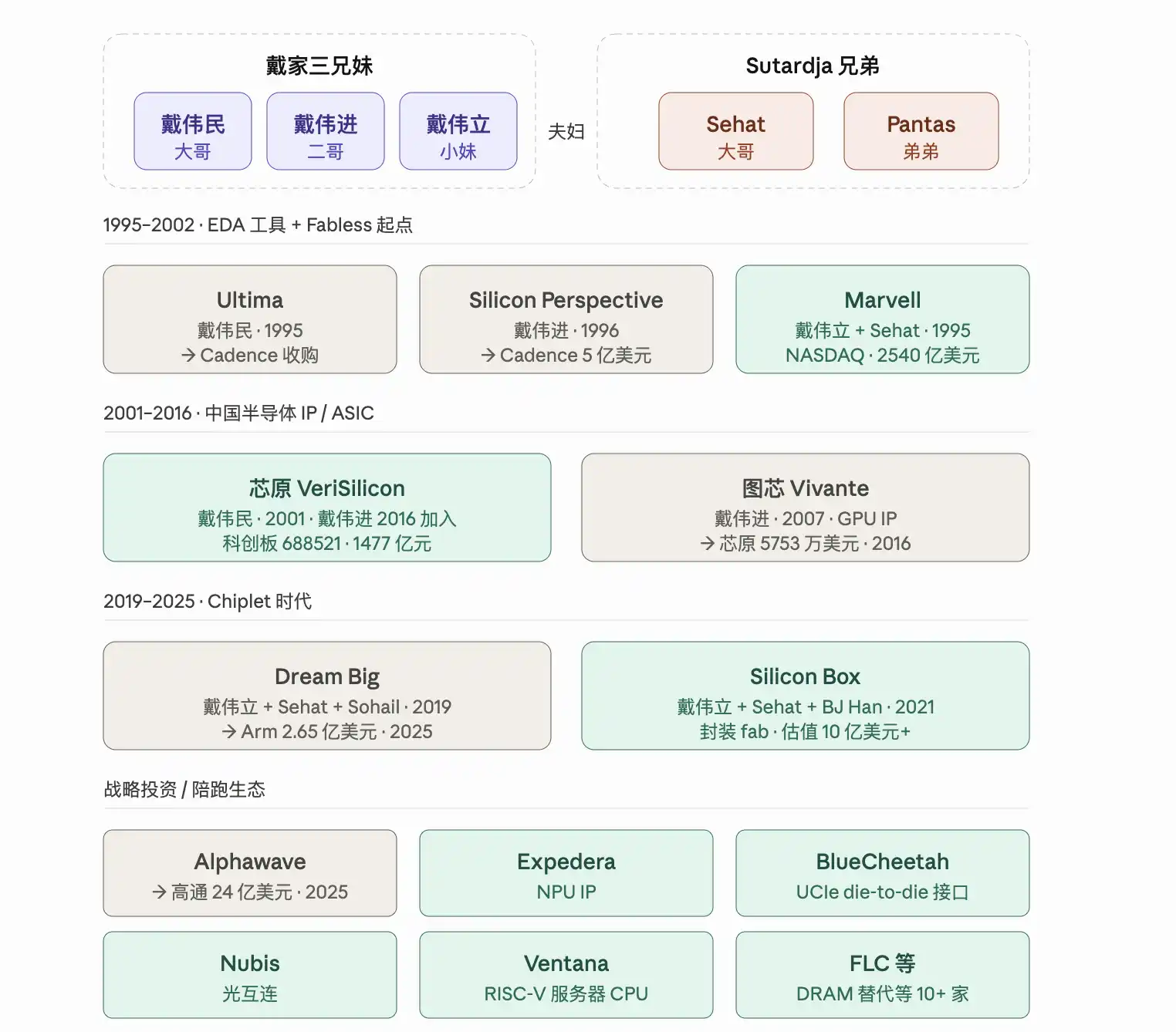
The Industrial Foundation Built by Two Families
The founding trio of Marvell in 1995 was Weili Dai, Sehat Sutardja, and Sehat's brother, Pantas Sutardja. Sehat was born in Jakarta, Indonesia, became a licensed radio technician at 13, and earned his Ph.D. in Electrical Engineering from Berkeley in 1988, where he met and married Weili Dai. Marvell was a product of the collaboration between the "Dai" and "Sutardja" families from day one, not just a husband-and-wife startup.
This advantage has amplified over the thirty years.
The Dai family has deep roots in China's semiconductor ecosystem. The eldest brother, Weimin Dai's VeriSilicon is a leading domestic IP provider. Its cooperation with SMIC and Huahong Grace can be traced back to the founding of SMIC. VeriSilicon's first 0.18-micron standard cell library for SMIC solved the IP export control issues SMIC faced at the time. The second brother, Weijin Dai, from Silicon Perspective to Vivante and back to VeriSilicon, layered networks in EDA, GPU IP, and IoT customers into China's local SoC ecosystem.
Looking at the Sutardja family, starting from the Marvell era, their engineering network extended to Southeast Asia and Europe. In 2021, when Weili Dai and Sehat co-founded Silicon Box in Singapore with Han Byung Joon, the company crossed the unicorn threshold by early 2024. It has a roughly $2 billion advanced semiconductor packaging factory in Tampines, Singapore, and is building a $3.6 billion new factory in Italy. Behind these factories lie industrial policy alignments with Singapore's Economic Development Board and the Italian government. This capacity-scheduling capability across East Asia and Europe is something the Dai family's connections in mainland China alone couldn't unlock.
More significant is the combined investment portfolio of the "Dai + Sutardja" families. Focusing on the chiplet ecosystem, there are at least 15 publicly traceable companies they have invested in or co-founded: Alphawave (high-speed SerDes interconnect IP, acquired by Qualcomm for $2.4 billion in December 2025); Expedera (NPU IP); BlueCheetah (UCIe die interface IP); Nubis (optical interconnect); Ventana (RISC-V server CPUs); FLC (DRAM alternative solutions). These companies, along with the previously mentioned VeriSilicon, Vivante, Dream Big, and Silicon Box, cover nearly every layer needed for the chiplet era: semiconductor IP, interconnect standards, packaging fabs, specialized compute chips. The two families have jointly built an entire industrial foundation for the post-Moore era.
Replicating Marvell's Rise Logic
What is the logic behind Marvell's current surge?
Over the past year, the bottlenecks in AI data centers have been quietly shifting. GPU compute shortages were the story of 2023-2024. By the second half of 2025, as hyper-scale training and inference ramped up, the real bottlenecks became three things: custom ASICs (allowing customers to not constantly buy NVIDIA's general-purpose GPUs), high-speed interconnect between chips, and the advanced packaging capability to pack these into the same package.
Marvell is positioned on the first two. Making custom ASICs like TPUs for Google and Amazon, and using optical communication chips for high-speed transmission. This is the real reason for its 265% rise over the year, and the real reason NVIDIA invested $2 billion in Marvell in March. Jensen Huang himself needs this interconnect thread.
Overlay the same map with the "Dai + Sutardja Family" marker, and the picture changes completely.
Dream Big bets on chiplet platforms and AI SuperNICs (800 Gbps bandwidth for lateral GPU interconnect). When Arm announced the $265 million cash acquisition in October 2025, Arm's intention was clear: to upgrade from selling CPU IP to becoming a "full-stack data center architect," mirroring NVIDIA's 2019 $6.9 billion acquisition of Mellanox.
Alphawave bets on high-speed SerDes interconnect IP, listed in London. On December 18, 2025, Qualcomm completed its $2.4 billion acquisition. The Dai+Sutardja family is Alphawave's second-largest shareholder, with Weili Dai cashing out approximately $237 million from the deal.
VeriSilicon in China operates on "IP + one-stop ASIC customization," similar to what Marvell does in the US, but with a customer structure of Chinese AI chip buyers like Alibaba, ByteDance, and Cambricon. AI compute accounted for 73% of new orders in 2025, and 91% of the 8.24 billion RMB new orders signed in the first four months of 2026. Its market cap is around 147.7 billion RMB ($20.5 billion), about 8% of Marvell's size, but with a steeper growth curve.
Silicon Box bets on chiplet advanced packaging fabs. Its valuation crossed the $1 billion threshold in early 2024. This company doesn't plan to IPO or sell, representing the heaviest piece on the board for the Dai+Sutardja families in the critical AI infrastructure capacity layer.
Additionally, there are over 10 invested/incubated companies like Expedera (NPU IP), BlueCheetah (UCIe die interface IP), Nubis (optical interconnect), Ventana (RISC-V server CPU), FLC (DRAM alternative). Each precisely occupies a position within the previously mentioned "three AI data center bottlenecks."
Adding these assets together, a conservative estimate places the scale of assets directly related to the two families in this AI wave at over $22 billion. This number won't appear on any list because it's dispersed across five jurisdictions, four company types, and over a dozen companies, but it exists.
From the perspective of a family industrial portfolio, the two families have placed at least six independent bets in this AI data center wave, each highly overlapping with the current logic driving Marvell's rise. Marvell is their loudest brand, but far from their only ticket in this round.
The Third Path: Key Components at Standard Transition Points
Currently, there are two mainstream narratives in the AI semiconductor industry.
One is platform-type giants reaping the benefits. NVIDIA sells GPUs + the CUDA ecosystem; Broadcom and Marvell sell custom ASICs + interconnect. This is the track for players with market caps above $150 billion.
The other is independent ASIC startups aiming for IPO. Companies like Tenstorrent, Cerebras, Groq, Etched bypass NVIDIA, focusing on acceleration for specific scenarios, betting on establishing a pole independent of GPUs.
The Dai+Sutardja families have taken a third path: creating key components for open standards, building their own packaging fabs, waiting for acquisition by giants, or becoming the domestic IP leader themselves. This path makes particular sense in the chiplet era because chiplets themselves are the antithesis of closed vertical integration. As long as standards are open, key IP + packaging capacity become scarce commodities, offering a much shorter path than independently building entire ASICs and aiming for IPO.
But the trade-off is clear. This path is destined not to produce the next NVIDIA. It allows founders multiple graceful exits and long-term retention of influence within the industrial ecosystem, but it won't place anyone on the final podium of AI infrastructure.
When Weili Dai and her husband founded Marvell in a Silicon Valley living room in 1995, the company was little-known. Today, Marvell is a $254 billion AI data center star. Although Weili Dai had exited most of her equity from thirty years ago at various points, simultaneously, she and her family still hold stakes in VeriSilicon, Silicon Box, cash from the Alphawave sale, cash from Dream Big's sale to Arm, and equity in over a dozen chiplet ecosystem companies.
Marvell was her most resounding victory, but not her only one, and likely not her last.