After $HYPE Hits a New High, Is It Worth Considering the Stock of "HYPE Version MicroStrategy" $PURR?

marsbitPubblicato 2026-05-25Pubblicato ultima volta 2026-05-25

Introduzione

**HYPE Hits New Highs: Is $PURR, the "HYPE Version of MicroStrategy," Worth Considering?** The stock of Hyperliquid Strategies (NASDAQ: $PURR), a publicly-traded company that exclusively buys and holds the cryptocurrency HYPE, has gained over 100% year-to-date, mirroring HYPE's own 150% surge to new all-time highs. This has sparked discussions about PURR being a more "capital-efficient" play than MicroStrategy's bitcoin strategy, given its reported ~$1 billion unrealized gain on a ~$220 million investment. The article clarifies that PURR is essentially a pure-play wrapper for HYPE, with no other business. It resulted from a 2025 SPAC merger led by firms like Paradigm and Atlas Merchant Capital, bringing traditional finance veterans to its board. Its value is entirely derived from the price of HYPE. While PURR offers a crucial compliance bridge for US-based institutional and retirement accounts unable to access HYPE directly, the analysis questions the "capital efficiency" narrative. The outsized gains are attributed to HYPE's exceptional performance, not superior corporate strategy. For investors who can buy HYPE directly, holding PURR introduces unnecessary risks: potential shareholder dilution from future stock offerings, incomplete passthrough of staking rewards, market hour mismatches, and counterparty risk via its single custodian. A key metric is its mNAV (modified net asset value). Current calculations show PURR trades at a discount to its HYPE holdings, but this c...

Author: Deep Tide TechFlow

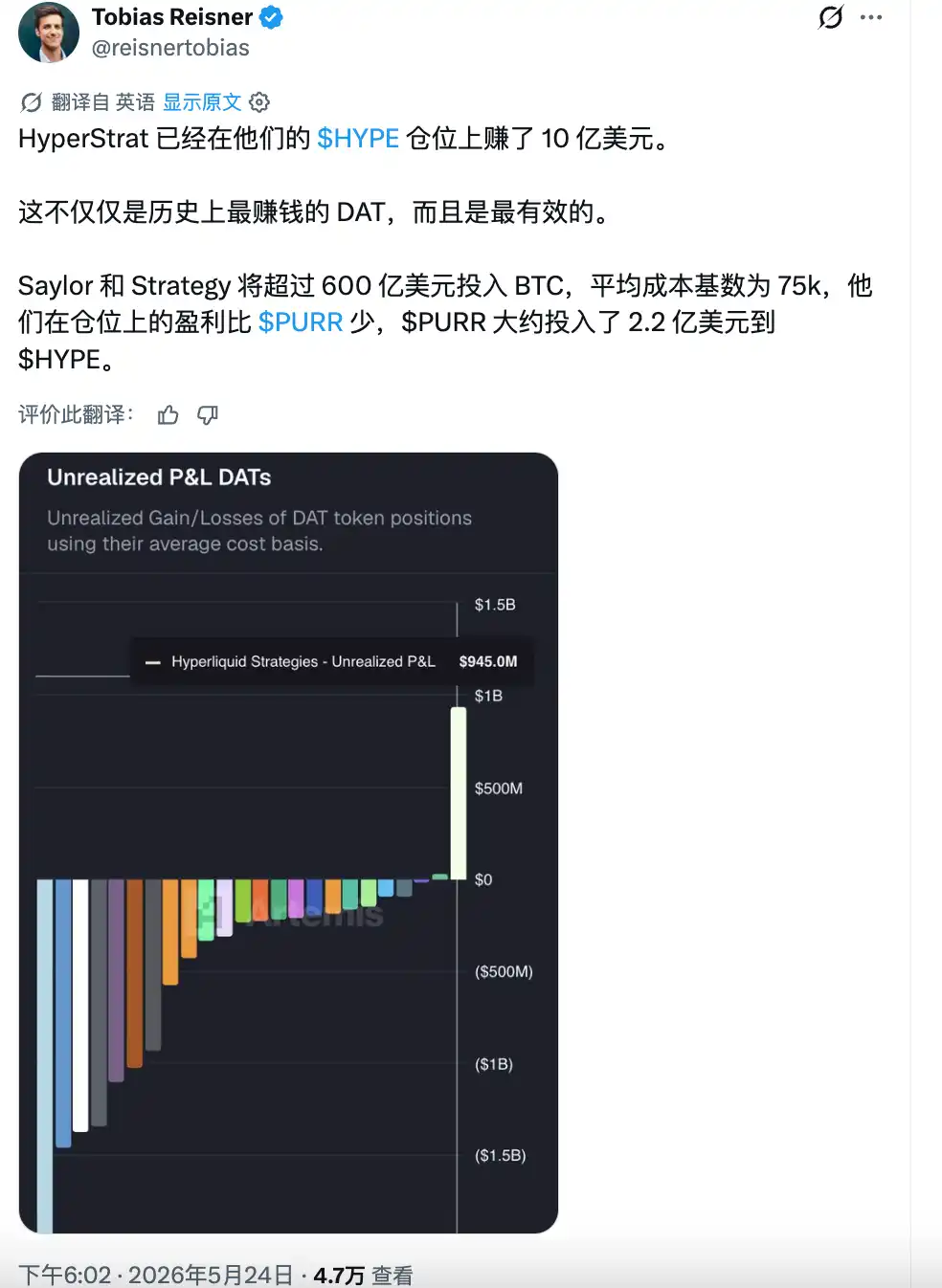
On May 24, a tweet about Hyperliquid Strategies(NASDAQ: PURR) sparked considerable discussion in the English Crypto Twitter (CT) space:

This company used approximately $220 million to buy HYPE, and its current unrealized profit has neared $1 billion, even surpassing the profit efficiency of Michael Saylor's Strategy (formerly MicroStrategy) on BTC.
This topic is now gradually spreading to the Chinese-speaking community. HYPE recently hit a new all-time high above $62, with a year-to-date increase of over 150%, making it one of the strongest-performing mainstream crypto assets this year.

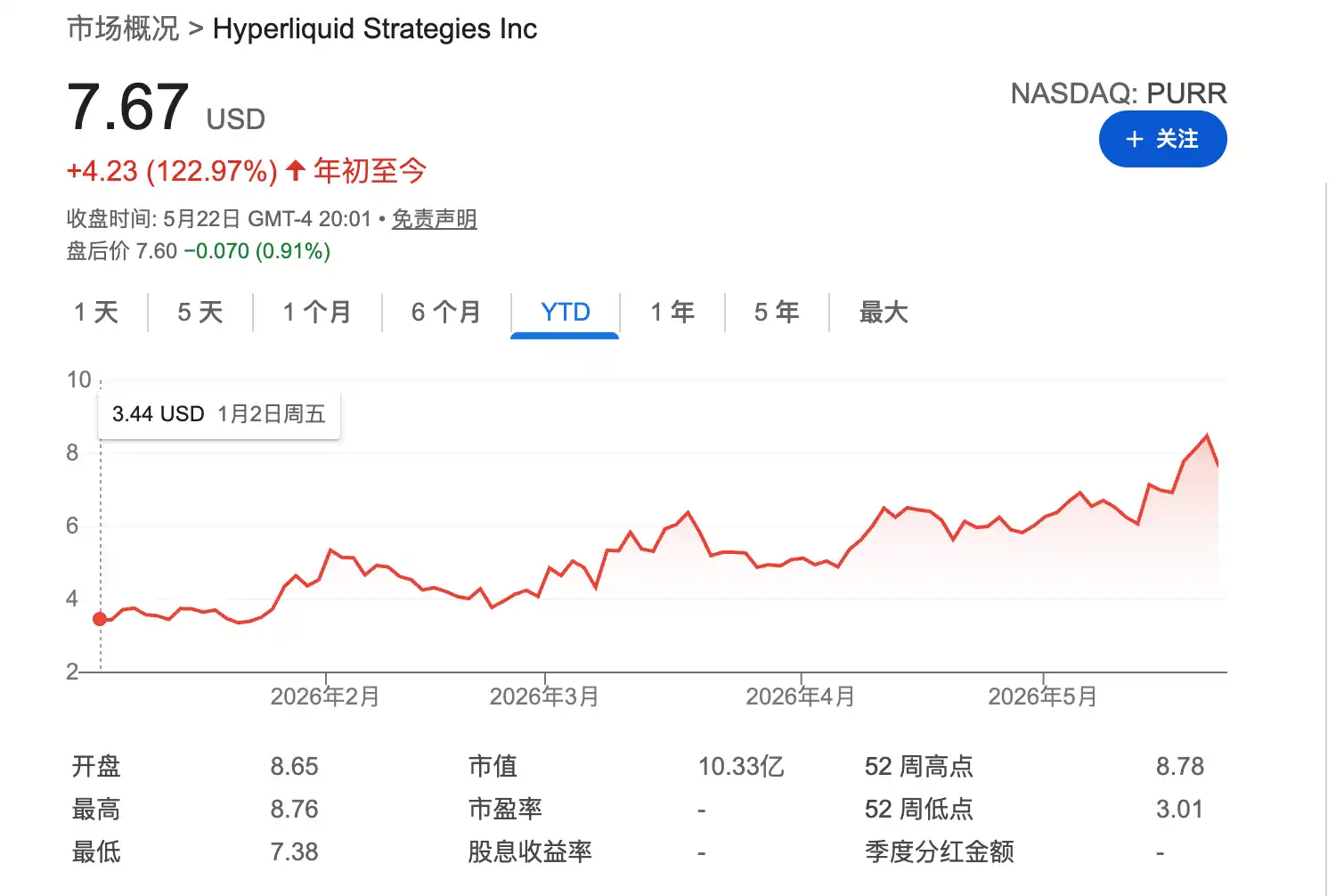
As the only listed company proxy for HYPE, PURR has also risen over 100% year-to-date, naturally becoming a target of FOMO during US stock research.
However, before following the trend, several questions need to be clarified:

1. What exactly is this company?

2. What's the difference between investing in it and directly buying HYPE?

3. Does the claim that its "capital efficiency exceeds MicroStrategy" hold up under scrutiny?

$PURR, a Pure DAT

First, the conclusion: PURR is not a company with actual operations; it's essentially a pure stock-wrapped product for $HYPE.

Its business model can be summarized in one sentence: buy HYPE, stake HYPE, hold HYPE. As of April 2026, public information shows the company holds approximately 20.8 million HYPE tokens, with about $114 million in cash and zero debt.

This means the entire value of this stock depends on one thing: the price of HYPE.

Since there is no business to analyze, evaluating such a company comes down to two dimensions: the underlying asset itself, and who is operating this shell.

The latter determines capital operation capabilities—such as when to issue shares to buy more tokens, when to buy back shares to support the price, how to manage the premium/discount between the stock price and net asset value... This also influences whether institutional capital is willing to enter through this vehicle.
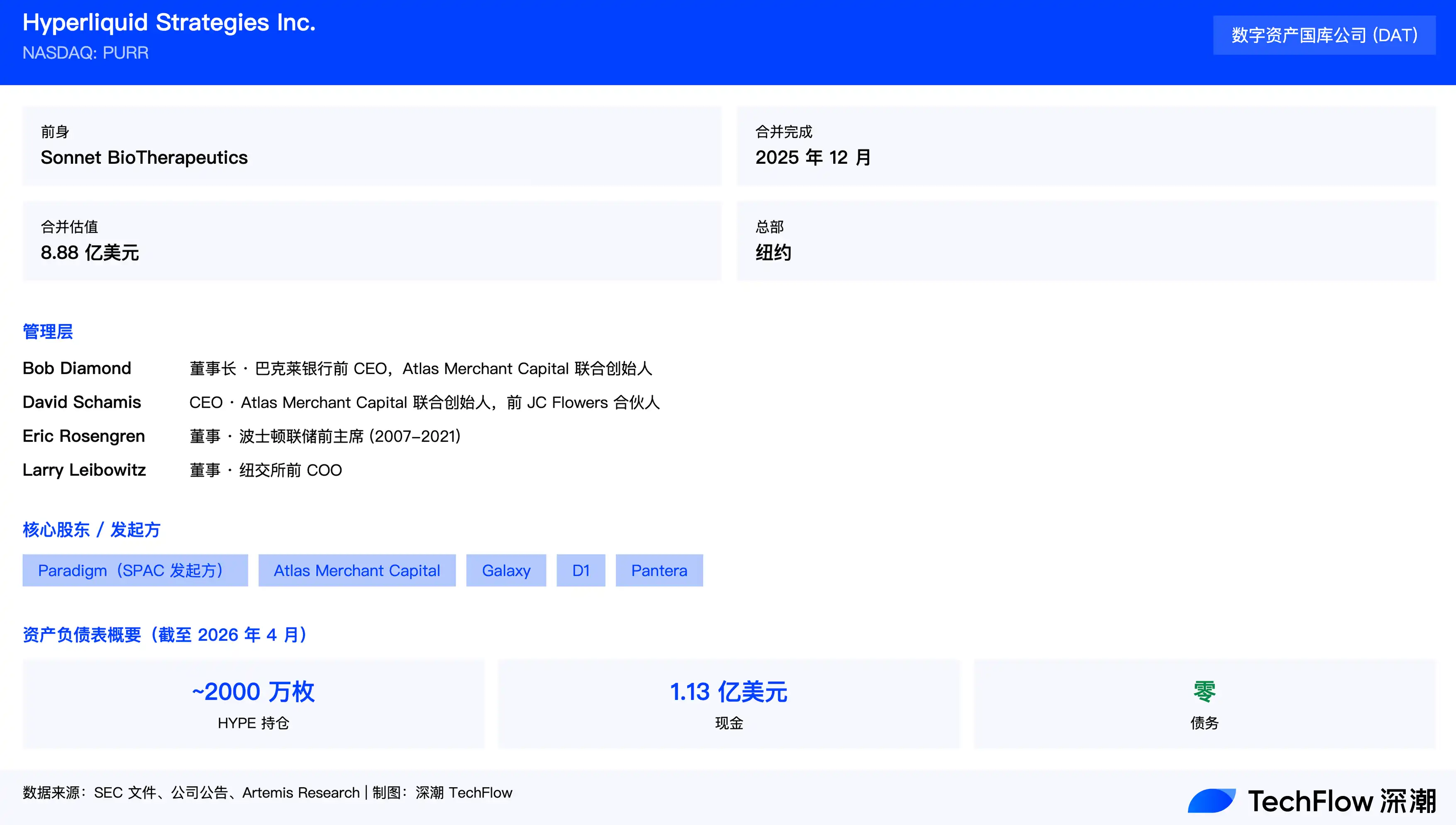
Historically, PURR's predecessor was Sonnet BioTherapeutics, a small biotech company listed on NASDAQ. In July 2025, it announced a merger with Rorschach I, completed the transaction in December of the same year, with an overall valuation of $888 million, renamed Hyperliquid Strategies, and ticker changed to PURR.

Notably, the initiators of this transaction were Paradigm and Atlas Merchant Capital.

Paradigm is one of the top-tier venture capital firms in the crypto industry, having invested in projects like Uniswap, Blur, Friend.tech, and has deep involvement in the Hyperliquid ecosystem, directly participating in the formation of this SPAC.

Atlas Merchant Capital is a financial services investment firm based in New York and London. Its two founders took key positions at PURR: Chairman Bob Diamond is the former CEO of Barclays, and CEO David Schamis is a former partner at JC Flowers.

The board also includes former Boston Fed President Eric Rosengren and former NYSE COO Larry Leibowitz. Other participants include Galaxy, D1, and Pantera, all leading institutions in crypto and macro fields.

While most DAT company management teams come from the crypto-native circle, PURR's team is almost entirely composed of traditional finance veterans.

$HYPE's Strength Propels $PURR Skyward

The reason PURR caught the attention of the Chinese-speaking community is directly tied to HYPE's own strength.

HYPE has surged from around $25 at the beginning of the year, breaking through $62 in May to set a new all-time high, with a year-to-date increase exceeding 150%. Against the backdrop of BTC's sideways movement and ETH and SOL's relatively flat performance this year, HYPE stands out as the most impressive mainstream crypto asset.

Our previous articles have deconstructed Hyperliquid's fundamental flywheel: a perp DEX with about 70% market share, weekly fee revenue exceeding ten million dollars, and 97% of protocol fees used for HYPE buyback and burn. This flywheel continues to accelerate.

(Reference reading: "Market Watch: From HYPE to ZEC, Grasping the 4 Narrative Threads Behind Recent Altcoin Hype")

When HYPE rises, PURR naturally follows suit.

As the only HYPE proxy listed on US stock exchanges, PURR has gained over 100% year-to-date, rising from the $3 range to a recent high of $8.79.

For investors with only US stock accounts who do not directly access the crypto market, PURR is almost the only choice to gain HYPE exposure. However, what propelled PURR from a "niche asset" to a "social media topic" were several concentrated institutional signals materializing since May.

Goldman Sachs disclosed in its Q1 13F filing the purchase of approximately 650,000 PURR shares. While the amount isn't huge (around $3.3 million), the Goldman Sachs name itself serves as endorsement. Concurrently, 21Shares and Bitwise's HYPE spot ETFs were listed on NASDAQ and NYSE respectively, and Cantor Fitzgerald raised its PURR price target from $6 to $8.

These events, superimposed on the timing of HYPE's new high, pushed PURR into more people's field of vision.

Then came the tweet mentioned at the beginning of the article: PURR used $220 million principal to buy HYPE, and its current unrealized profit is nearly $1 billion. Calculated in the short term, its capital efficiency definitely surpasses MicroStrategy's.

Under such a sharp rally, it's bound to attract significant attention. However, if you're considering trading this stock, caution is still advised.

The DAT with the Highest Capital Efficiency, Really?

Strategy (formerly MicroStrategy) invested over $60 billion to buy BTC at an average cost of around $75,000; PURR only used about $220 million to buy HYPE, yet its unrealized profit is close to or even exceeds the former's. The conclusion is that PURR's "capital efficiency" far surpasses MicroStrategy's?

This comparison holds up numerically but is logically misleading.

PURR's early HYPE holdings have an average cost of around $7, with the current price at $62, a nearly 9x increase. Strategy's BTC average cost is around $75,000, and BTC is currently hovering around that level, having barely moved.

Therefore, PURR's higher unrealized profit isn't due to any smarter operations by the company; it's simply because the underlying asset's appreciation is on a completely different scale. Anyone, at the same time, directly buying HYPE spot with the same amount of money could have achieved the same return rate, without bearing the risk of equity dilution.

In other words, it's a victory of "picking the right coin." If PURR's establishment date were pushed back half a year, entering when HYPE was at $40, this "capital efficiency" story wouldn't exist at all.

For US stock investors only noticing PURR today, a more practical question is: At the current price for PURR, are you paying a premium or a discount relative to the value of HYPE held by the company?

This involves the core valuation metric for DAT companies—mNAV (modified Net Asset Value per share).
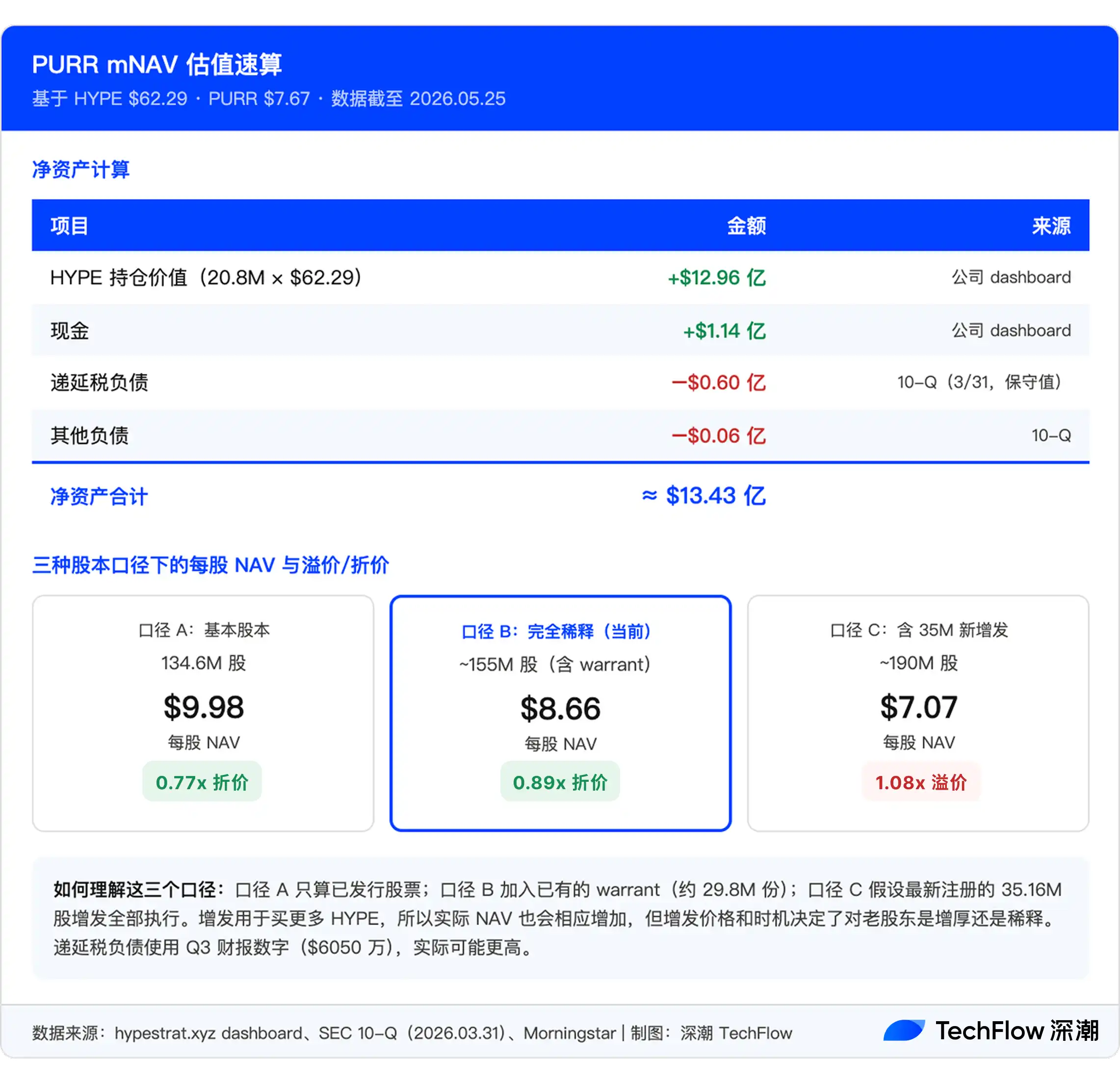
We pulled data from PURR's official dashboard and SEC filings for a quick mNAV calculation.

The company currently holds 20.8 million HYPE tokens (worth approximately $1.296 billion at the current price), plus $114 million in cash. After deducting deferred tax liabilities and other liabilities, the net asset value is around $1.34 billion.

Based solely on the 134.6 million shares issued, the NAV per share is about $9.98. With the current stock price at $7.67, this represents a discount of about 23%. If we include the approximately 29.8 million existing warrants, fully diluted to about 155 million shares, the NAV per share becomes about $8.66, a discount of about 11%. However, the company just registered an additional 35.16 million shares for issuance. If all these are executed, expanding the denominator to about 190 million shares, the NAV per share drops to $7.07, and the stock price would instead represent a slight premium of 1.08x.

Therefore, whether PURR is "cheap" or "expensive" depends on how much future dilution you anticipate.

Issuance itself isn't necessarily bad. If management issues shares at a high premium and uses the raised capital to buy more HYPE, the HYPE holdings per share could actually increase. But if they issue shares when market sentiment cools and the stock price falls below NAV, that dilutes existing shareholders.

This company has only been operating for half a year and hasn't experienced a full downcycle. There is no historical record to reference how management will operate under extreme market conditions.

Also note that the deferred tax liability used in the above calculation is $60.5 million from the Q3财报 cutoff date (March 31). However, HYPE has risen significantly since the end of March, so the tax liability corresponding to unrealized gains has likely increased further. The actual NAV might be slightly lower than our calculation.

What's the Difference Between Buying PURR and Directly Buying HYPE

This is the most practical question. Since PURR's entire value derives from HYPE, why not skip the middle layer and buy HYPE directly?

The answer is simple: for some investors, they can't. US retirement accounts (IRA, 401k), traditional brokerage accounts, and some institutionally-managed funds with strict compliance requirements cannot directly hold crypto assets.

Moreover, the Hyperliquid platform explicitly restricts access for US residents.

Therefore, PURR provides a NASDAQ-listed stock wrapper, allowing such capital to gain HYPE exposure through standard stock trading. The shell built by Paradigm essentially sells this compliant access channel.

If you belong to this category of investors, PURR is indeed currently almost the only option. Although 21Shares and Bitwise's HYPE spot ETFs were listed in mid-May, these products have been live for a very short time, and their liquidity and tracking error remain to be observed.

But if you have the ability to buy HYPE directly, then PURR's stock wrapper layer becomes purely a friction cost with negative effects; it cannot be considered a source of extra alpha on top of HYPE's beta.

This cost manifests on several levels:

First, dilution risk. By directly holding HYPE, your share cannot be diluted by others. But by holding PURR stock, the company can issue new shares at any time to buy more HYPE.

Second, incomplete profit transmission. Direct HYPE holders can stake themselves to earn staking rewards, and future airdrops/ecosystem incentives go directly to them. Through PURR, staking rewards go to the company's accounts first, and only indirectly reflect in the net asset value per share after deducting operational expenses and taxes.

Third, trading time and pricing friction. HYPE trades 24/7, while PURR trades only during US stock market hours. If HYPE experiences significant volatility over the weekend or after-hours, PURR holders must wait for the market to open to react.

Fourth, counterparty risk. SEC filings disclose that PURR's entire HYPE holdings are custodied with a single custodian. By holding PURR, your asset safety relies on this custodian's performance capability and the company's operational continuity.

The author's judgment is that PURR is more of a "channel product" than an "investment product." Its value lies in bridging the channel from traditional financial accounts to HYPE, nothing more. If you don't need this channel, then every additional risk brought by the middle layer is unnecessary.

Therefore, for crypto and US stock investors in the Chinese-speaking community, the conclusion is relatively straightforward:

The judgment you need to make is whether you are bullish on HYPE, not whether you are bullish on the PURR shell itself.


Domande pertinenti

QWhat is Hyperliquid Strategies (NASDAQ: PURR), and what is its core business model?

AHyperliquid Strategies (NASDAQ: PURR) is a publicly traded company that is essentially a pure-play investment vehicle for the HYPE cryptocurrency. Its business model is solely to buy, stake, and hold HYPE. As of April 2026, it held approximately 20.8 million HYPE tokens and around $113 million in cash, with zero debt. Therefore, the company's entire value depends on the price of HYPE.

QHow does PURR's claimed 'capital efficiency' compare to MicroStrategy (now Strategy) investing in Bitcoin, and is the comparison valid?

APURR has generated nearly $1 billion in unrealized gains from an initial investment of about $220 million in HYPE, which appears more capital efficient than Strategy's massive Bitcoin investments. However, this comparison is misleading. The difference in returns is primarily due to HYPE's price rising nearly 9x from PURR's average cost basis, while Bitcoin's price has remained relatively flat near Strategy's average cost. The 'efficiency' stems from choosing a high-performing asset, not from superior corporate strategy. An investor buying HYPE directly at the same time would have achieved the same return.

QWhat are the main risks or costs associated with investing in PURR compared to directly buying HYPE?

AInvesting in PURR instead of directly buying HYPE introduces several risks and costs: 1) **Dilution Risk**: PURR can issue new shares, diluting existing shareholders' ownership. 2) **Incomplete Yield**: Staking rewards, airdrops, or ecosystem incentives for HYPE go to the company first and are only indirectly reflected in net asset value after expenses and taxes. 3) **Trading Friction**: PURR trades only during U.S. market hours, while HYPE trades 24/7, creating a lag in price reaction. 4) **Counterparty Risk**: Investors rely on the security of PURR's single custodian and the company's operational continuity.

QAccording to the article, who are the key players behind the formation of PURR, and what is their background?

AThe formation of PURR was led by major traditional finance figures. The key participants include crypto venture capital firm Paradigm and investment firm Atlas Merchant Capital. Atlas Merchant Capital's founders hold core positions: Bob Diamond (former Barclays CEO) is Chairman, and David Schamis (former JC Flowers partner) is CEO. The board also includes former Boston Fed President Eric Rosengren and former NYSE COO Larry Leibowitz. Other backers include Galaxy, D1, and Pantera. Unlike many Digital Asset Trusts (DATs), PURR's leadership is dominated by traditional finance veterans rather than crypto-native individuals.

QFor which type of investor does PURR represent a valuable or necessary investment vehicle?

APURR is primarily valuable for investors who cannot directly purchase HYPE cryptocurrency due to regulatory or platform restrictions. This includes U.S.-based retirement accounts (IRAs, 401ks), traditional brokerage accounts, and certain institutional funds with strict compliance rules. Furthermore, the Hyperliquid platform restricts U.S. residents. For these investors, PURR provides a Nasdaq-listed, compliant channel to gain exposure to HYPE's price movements, making it practically their only option. For investors who can buy HYPE directly, PURR's wrapper adds unnecessary layers of cost and risk.

Letture associate

Blocked Its Own Treasure, WeChat AI Steps Up

Tencent's stock surged over 10% on June 2nd amid reports that WeChat, with 1.43 billion monthly users, is finalizing tests for a native AI Agent. The reported feature, accessible by swiping right from the main interface, allows users to issue commands in natural language. The AI then decomposes tasks and automatically calls upon relevant Mini Programs within WeChat to complete actions like ordering food, booking tickets, or making payments, creating a closed-loop service execution system. This strategic shift follows the internal conflict and subsequent "blocking" of Tencent's standalone AI app, Yuanbao, by WeChat for violating sharing rules during a 2026 Spring Festival promotion. The incident highlighted a lack of internal consensus and exposed the weakness of competing in the standalone AI assistant arena against rivals like ByteDance's Doubao (345M MAU) and Alibaba's Qianwen. The new WeChat AI Agent aims to leverage WeChat's unique assets—its massive user base, standardized Mini Program APIs, WeChat Pay, and identity system—to move from simple content generation to actual task execution. Analysts note this changes the competitive landscape from model benchmarks to which AI can connect to more real-world services. However, success depends on key variables: the capability of Tencent's underlying Hunyuan model, managing massive inference costs, and redesigning incentives for Mini Program developers whose traffic might be bypassed. The move is seen as an attempt to keep user service intent within WeChat's ecosystem as AI begins to redefine how users access services.

marsbit57 min fa

Blocked Its Own Treasure, WeChat AI Steps Up

marsbit57 min fa

ByteDance Adopts Arm CPUs, Jensen Huang: So Sad I Didn't Buy Arm

**Summary:** At Computex 2026, Arm CEO Rene Haas announced that ByteDance and Oracle have adopted Arm's self-designed Arm AGI data center CPU. The company expects significant revenue growth from this product, projecting $20 billion in demand for the 2027/2028 fiscal years. Haas noted that restricting AI-capable CPUs from the US to China is nearly impossible due to their widespread applications. Arm's stock has surged dramatically this year, notably rising 16% after NVIDIA's Arm-based Vera CPU and RTX Spark announcements. A highlight was the informal, humorous on-stage conversation between Haas and NVIDIA CEO Jensen Huang. Huang joked about NVIDIA's failed attempt to acquire Arm and playfully lamented selling his Arm shares. Both executives showed a clear sense of camaraderie and shared regret over the missed merger. Key technical topics were discussed: 1. **AI PC Design:** Huang explained NVIDIA's RTX Spark superchip (with a 20-core Arm CPU) is designed for future AI agents that will autonomously run and use tools on PCs, blending local and cloud processing. 2. **Agent vs. OS:** Huang emphasized the operating system remains crucial, as AI agents rely on its APIs and tools to function. 3. **Growth Constraints:** He identified the shift to "useful AI" that generates profitable tokens as a primary driver for immense, almost limitless, computational demand. Haas outlined Arm's strategy across PC and data centers. For PCs, Arm collaborates with partners like NVIDIA and MediaTek, offering its compute subsystem (CSS) for custom SoCs. In data centers, its Arm AGI CPU (built on TSMC's 3nm process) has gained major partners including OpenAI, Meta, and now ByteDance and Oracle. Arm presented a multi-year roadmap for its in-house CPU line. The article concludes that while GPUs dominated the AI training race, the explosion of AI agents is shifting significant focus to CPUs for inference, state management, and tool orchestration. The industry is trending towards vertical integration, with companies like cloud providers designing chips and chip/IP firms offering full solutions, all competing to deliver more efficient computing per watt.

marsbit1 h fa

ByteDance Adopts Arm CPUs, Jensen Huang: So Sad I Didn't Buy Arm

marsbit1 h fa

New Wall Street Play: Yen Shorts Still Adding, But Japan Stocks Don't Rely on Carry Trade Unwinding

On June 3rd, USD/JPY hit 160.44, its highest level since July 2024, while the Nikkei 225 surged past 68,000 points. Contrary to popular narratives of an imminent "carry trade unwind" akin to August 2024, data reveals a more complex picture. Speculative net short positions in yen futures have actually increased, reaching -114,667 contracts by late May, suggesting traders are doubling down rather than retreating. Meanwhile, Japan's Finance Ministry conducted its largest-ever single-round FX intervention (11.73 trillion yen) in April-May but failed to hold the 160 yen line. The Nikkei's rally is not driven by carry trade dynamics. Foreign investors are aggressively buying Japanese stocks, with net purchases in 2026 running nearly 16 times higher than 2025 levels. This inflow is concentrated in AI and semiconductor-related stocks like SoftBank and Socionext, fueled by positive sector outlooks, rather than being a flight from unwinding yen shorts. Furthermore, the Nikkei has continued climbing despite the Bank of Japan's (BOJ) rate hikes to 0.75%. This disconnect exists because the current equity boom is fueled by AI-driven foreign investment, not reliant on cheap yen funding. However, this relationship remains fragile. Should the BOJ hike rates further (e.g., to 1.0%) while dollar weakness increases carry trade costs, the trajectories of the yen and Japanese stocks could reconverge, potentially triggering volatility.

marsbit1 h fa

New Wall Street Play: Yen Shorts Still Adding, But Japan Stocks Don't Rely on Carry Trade Unwinding

marsbit1 h fa

Broadcom's Q3 Guidance Misses Expectations by $12 Billion, After-Hours Trading Plummets Over 13%, AI Narrative "Cooling"?

On June 3, Broadcom released record Q2 FY26 results with revenue of $22.19B, up 48% YoY, and AI chip sales of $10.8B, up 143%. Adjusted EPS of $2.44 beat estimates. However, its Q3 AI semiconductor revenue guidance of $16B, while up over 200% YoY, fell roughly $1.2B (7%) short of analyst consensus expectations of $17.2B. This miss, coupled with slightly weaker-than-expected software revenue, triggered a severe market reaction. CEO Hock Tan maintained the FY26 AI revenue outlook of over $100B but did not raise it, disappointing investors who had priced in more robust growth. The stock plummeted over 13% in after-hours trading, erasing roughly $270B in market cap. The sell-off extended to peers like Marvell. A key concern for markets, particularly for Chinese optical module suppliers, was Tan's comment that the contribution of AI networking (e.g., Ethernet switches, optical interconnect chips) to AI revenue, currently near 40%, is expected to normalize to around 30% over time, signaling a potential peak in growth for that segment. Despite the guidance shortfall, Tan reiterated that AI demand remains "insatiable" and reaffirmed the long-term target of exceeding $100B in AI revenue by FY27. The reaction highlights the heightened sensitivity and premium valuation placed on AI-exposed stocks, where anything less than stellar guidance can prompt significant profit-taking. The broader question is whether this represents a cooling AI narrative or a correction in overstretched valuations.

marsbit1 h fa

Broadcom's Q3 Guidance Misses Expectations by $12 Billion, After-Hours Trading Plummets Over 13%, AI Narrative "Cooling"?

marsbit1 h fa

Trading

Spot
Futures
活动图片




