After a Valuation of $1 Billion and Five Years of Exploration, Why Did It 'Admit Defeat'?

深潮Pubblicato 2025-12-09Pubblicato ultima volta 2025-12-09

Introduzione

After five years of development and raising $180 million at a near $1 billion valuation, Farcaster has officially conceded that its Web3 social strategy did not succeed. The platform, initially designed as a decentralized alternative to Twitter, aimed to address issues like platform monopoly, user data ownership, and creator monetization through an on-chain, protocol-based approach. Despite a brief surge in early 2024—when monthly active users (MAU) peaked at around 80,000—growth quickly stalled. MAU has since declined to under 20,000 by late 2025. Farcaster’s user base remained heavily concentrated within the crypto-native community, failing to attract mainstream users due to high barriers to entry, niche content, and inferior user experience compared to established platforms like X or Instagram. Co-founder Dan Romero announced a strategic pivot from social-first to a wallet-focused product, acknowledging that social alone wasn’t driving sustainable growth. Internal data showed that wallet features—used for transactions, trading, and interacting with dApps—consistently outperformed social modules in user retention and frequency. The shift reflects a broader realization: It’s easier to add social features to a wallet than to build a social product around crypto. While the move has sparked some community discontent, Farcaster is betting that deeper integration with on-chain utilities represents a more viable path to product-market fit.

Written by: Bootly

After five years of operation, raising approximately $180 million in total funding, and reaching a valuation once nearing $1 billion, Farcaster has officially admitted: the path of Web3 social has not succeeded.
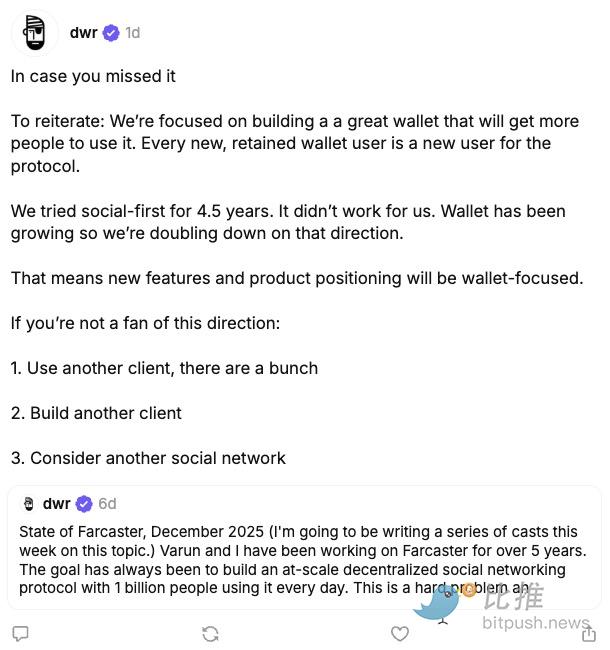
Recently, Farcaster co-founder Dan Romero posted a series of messages on the platform, announcing that the team will abandon the "social-first" product strategy and instead fully focus on the wallet direction. In his words, this is not an active upgrade but a choice forced by reality after a long period of attempts.

"We tried social-first for 4.5 years, and it didn't work."

This judgment not only signifies Farcaster's transformation but also once again highlights the structural challenges of Web3 social.

The Gap Between Ideal and Reality: Why Farcaster Failed to Become the 'Decentralized Twitter'

Farcaster was born in 2020, during the rise of the Web3 narrative. It attempted to solve three core problems of Web2 social platforms:

  • Platform monopoly and censorship

  • User data not belonging to users themselves

  • Creators unable to monetize directly

Its design approach was highly idealistic:

  • Decentralized protocol layer

  • Freedom to build clients

  • Social relationships on-chain and migratable

Among the various "decentralized social" projects, Farcaster was once considered the product closest to PMF. Especially after Warpcast gained traction in 2023, many KOLs from Crypto Twitter joined, making it seem like the prototype of the next-generation social network.

But problems soon emerged.

According to Farcaster's monthly active user (MAU) statistics on Dune Analytics, Farcaster's user growth trajectory shows a very clear but not optimistic pattern:
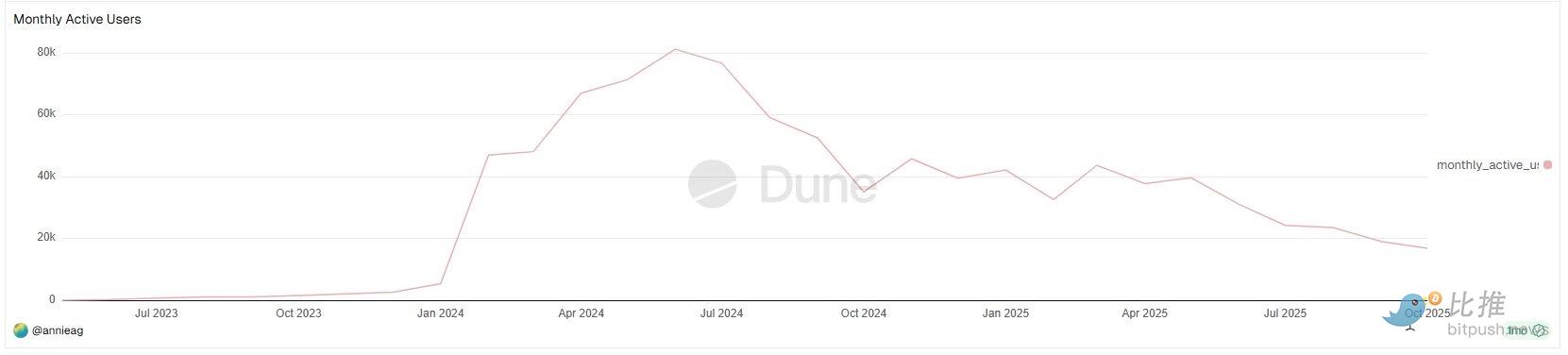
For most of 2023, Farcaster's monthly active users were almost negligible;

The real growth inflection point occurred in early 2024, with MAU rapidly increasing from a few thousand to about 40,000–50,000 in a short time, and even approaching 80,000 by mid-2024.

This was Farcaster's only truly scalable growth window since its inception. It is particularly noteworthy that this growth did not occur during a bear market but during a period of high activity in the Base ecosystem and the emergence of dense SocialFi narratives.

However, this window did not last long.

Starting in the second half of 2024, monthly active data showed a clear decline, and over the following year, it exhibited a volatile downward trend:

  • MAU rebounded multiple times, but the peaks continued to lower

  • By the second half of 2025, monthly active users had fallen to less than 20,000

In fact, Farcaster's growth has always been unable to "break through," with its user structure highly homogeneous:

  • Crypto practitioners

  • VCs

  • Builders

  • Crypto-native users

For ordinary users:

  • High registration barrier

  • Social content is heavily "insider-focused"

  • User experience not better than X / Instagram

This prevented Farcaster from ever forming true network effects.

DeFi KOL Ignas (@DeFiIgnas) on X bluntly stated that Farcaster "just admitted what everyone has felt for a long time":

The strength of X's (formerly Twitter) network effects is almost impossible to break head-on.

This is not a problem with the crypto narrative but a structural barrier of social products. From a product perspective, the issues with Farcaster's social side are very typical:

  • User growth has always been locked into the crypto-native crowd

  • Content is highly insular and difficult to spill over

  • Creator monetization and user retention did not form a positive feedback loop

This is why Ignas succinctly summarized Farcaster's new strategy in one sentence:

"It's easier to add social to a wallet than to add a wallet to a social product."

This judgment essentially admits that "social is not the first-order need of Web3."

"The Bubble Is Comfortable, but the Numbers Are Cold"

If MAU data answers "how Farcaster performed," then another question is: How big is this market itself?

Crypto creator Wiimee provided a set of striking comparative data on X.
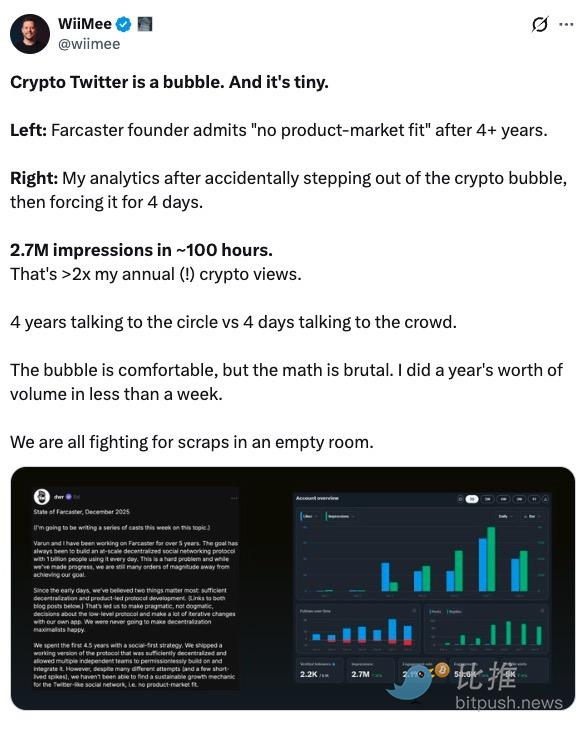
After "accidentally stepping out of the crypto content circle," Wiimee created content for a general audience for four consecutive days. His analysis data showed that in about 100 hours, he received 2.7 million impressions, more than double the total views of all his crypto content over a year.

He stated:

"Crypto Twitter is a bubble, and it's small. Four years of speaking to insiders is less effective than four days of speaking to the masses."

This is not a direct criticism of Farcaster but reveals a more fundamental problem:

Crypto social itself is a highly self-referential ecosystem with weak spillover capabilities. When content, relationships, and attention are all confined to the same batch of users, even the most refined protocol design cannot break through the upper limit of market scale.

This means Farcaster faced not "the product isn't good enough" but "there aren't enough people in the field."

Wallet, on the Other Hand, Achieved PMF

What truly changed Farcaster's internal judgment was not a reflection on social but the unexpected validation of the wallet.

Earlier in 2024, Farcaster introduced a built-in wallet in its application, initially intended only as a supplement to the social experience. But from usage data, the wallet's growth slope, frequency of use, and retention performance were significantly different from the social module.

Dan Romero emphasized in a public response:

"Every new and retained wallet user is a new user for the protocol."

This statement itself reveals the logical core of the strategic shift. The wallet addresses not "the desire to express" but real, rigid on-chain behavioral needs: transfers, transactions, signatures, and interactions with new applications.

In October, Farcaster acquired Clanker, an AI Agent-driven token issuance tool, and gradually integrated it into the wallet system. This move was also seen as the team's clear bet on the "wallet-first" path.

From a business perspective, this direction has clear advantages:

  • Higher frequency of use

  • Clearer monetization path

  • Tighter integration with the on-chain ecosystem

In contrast, social seems more like a nice-to-have rather than an engine for growth.

Although the wallet strategy is justified by the data, community controversy has also followed.

Several long-term users explicitly stated that they are not opposed to the wallet itself but are uncomfortable with the cultural shift that comes with it: from "users" being redefined as "traders," from "co-builders" being labeled as "old guard."

This exposes a practical problem: when a product direction changes, community sentiment is often harder to migrate than the roadmap. Farcaster's protocol layer remains decentralized, but the choice of product direction is still concentrated in the hands of the team. This tension is amplified during transformation.

Romero later admitted that there were communication issues but made it clear that the team had made its choice.
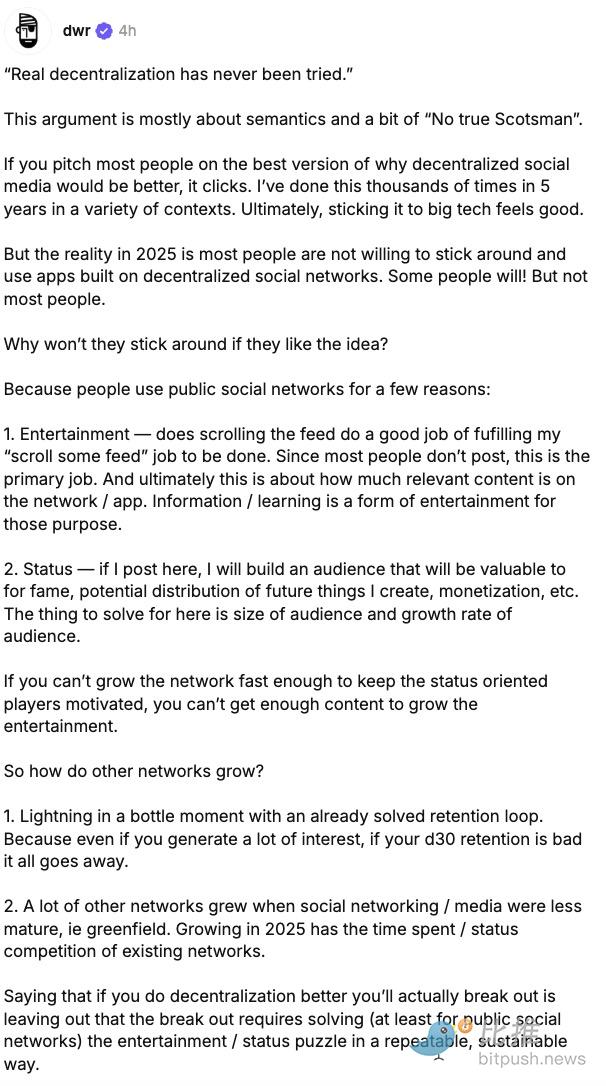
This is not arrogance but a common decisive reality for startup projects in the later stages of their lifecycle. In this sense, Farcaster did not abandon the social ideal but gave up the illusion of its scalability.

As one observer perhaps put it best:

"First, let users stay for the tools; then there is space for social to exist."

Farcaster's choice may not be the most romantic, but it might be the one closest to reality. Deeply integrating native financial tools (wallets, transactions, issuance) is the practical path to converting into sustainable commercial value.


Domande pertinenti

QWhy did Farcaster decide to pivot from a social-first strategy to a wallet-focused approach?

AFarcaster shifted its strategy because after 4.5 years of focusing on social, it did not achieve product-market fit. The social approach failed to scale beyond the crypto-native user base, while the wallet feature demonstrated stronger growth, retention, and clearer monetization paths.

QWhat were the main challenges Farcaster faced in trying to build a decentralized social platform?

AFarcaster struggled with high user onboarding barriers, highly insular crypto-focused content, inability to break out of the crypto echo chamber, and failure to form genuine network effects competitive with platforms like X (Twitter) or Instagram.

QHow did Farcaster's user growth trend reflect its struggles in social?

AFarcaster's monthly active users (MAU) saw a brief surge to around 80,000 in mid-2024 but quickly declined, falling to under 20,000 by late 2025. Growth was confined to crypto insiders and never achieved broad adoption.

QWhat key insight did the comparison between crypto content and mainstream content exposure reveal?

AA creator's experiment showed that four days of creating content for a general audience generated 2.7 million impressions—more than double the exposure of a year's worth of crypto content—highlighting the small size and limited reach of the crypto social bubble.

QWhy is the wallet considered a more promising direction for Farcaster than social?

AThe wallet addresses core, frequent on-chain needs like transactions, transfers, and signing, leading to higher usage and retention. It integrates more effectively with the crypto economy and offers clearer monetization compared to social features, which are harder to scale and monetize.

Letture associate

Google and Amazon Simultaneously Invest Heavily in a Competitor: The Most Absurd Business Logic of the AI Era Is Becoming Reality

In a span of four days, Amazon announced an additional $25 billion investment, and Google pledged up to $40 billion—both direct competitors pouring over $65 billion into the same AI startup, Anthropic. Rather than a typical venture capital move, this signals the latest escalation in the cloud wars. The core of the deal is not equity but compute pre-orders: Anthropic must spend the majority of these funds on AWS and Google Cloud services and chips, effectively locking in massive future compute consumption. This reflects a shift in cloud market dynamics—enterprises now choose cloud providers based on which hosts the best AI models, not just price or stability. With OpenAI deeply tied to Microsoft, Anthropic’s Claude has become the only viable strategic asset for Google and Amazon to remain competitive. Anthropic’s annualized revenue has surged to $30 billion, and it is expanding into verticals like biotech, positioning itself as a cross-industry AI infrastructure layer. However, this funding comes with constraints: Anthropic’s independence is challenged as it balances two rival investors, its safety-first narrative faces pressure from regulatory scrutiny, and its path to IPO introduces new financial pressures. Globally, this accelerates a "tri-polar" closed-loop structure in AI infrastructure, with Microsoft-OpenAI, Google-Anthropic, and Amazon-Anthropic forming exclusive model-cloud alliances. In contrast, China’s landscape differs—investments like Alibaba and Tencent backing open-source model firm DeepSeek reflect a more decoupled approach, though closed-source models from major cloud providers still dominate. The $65 billion bet is ultimately about securing a seat at the table in an AI-defined future—where missing the model layer means losing the cloud war.

marsbit43 min fa

Google and Amazon Simultaneously Invest Heavily in a Competitor: The Most Absurd Business Logic of the AI Era Is Becoming Reality

marsbit43 min fa

Computing Power Constrained, Why Did DeepSeek-V4 Open Source?

DeepSeek-V4 has been released as a preview open-source model, featuring 1 million tokens of context length as a baseline capability—previously a premium feature locked behind enterprise paywalls by major overseas AI firms. The official announcement, however, openly acknowledges computational constraints, particularly limited service throughput for the high-end DeepSeek-V4-Pro version due to restricted high-end computing power. Rather than competing on pure scale, DeepSeek adopts a pragmatic approach that balances algorithmic innovation with hardware realities in China’s AI ecosystem. The V4-Pro model uses a highly sparse architecture with 1.6T total parameters but only activates 49B during inference. It performs strongly in agentic coding, knowledge-intensive tasks, and STEM reasoning, competing closely with top-tier closed models like Gemini Pro 3.1 and Claude Opus 4.6 in certain scenarios. A key strategic product is the Flash edition, with 284B total parameters but only 13B activated—making it cost-effective and accessible for mid- and low-tier hardware, including domestic AI chips from Huawei (Ascend), Cambricon, and Hygon. This design supports broader adoption across developers and SMEs while stimulating China's domestic semiconductor ecosystem. Despite facing talent outflow and intense competition in user traffic—with rivals like Doubao and Qianwen leading in monthly active users—DeepSeek has maintained technical momentum. The release also comes amid reports of a new funding round targeting a valuation exceeding $10 billion, potentially setting a new record in China’s LLM sector. Ultimately, DeepSeek-V4 represents a shift toward open yet realistic infrastructure development in the constrained compute landscape of Chinese AI, emphasizing engineering efficiency and domestic hardware compatibility over pure model scale.

marsbit1 h fa

Computing Power Constrained, Why Did DeepSeek-V4 Open Source?

marsbit1 h fa

Trading

Spot
Futures

Articoli Popolari

Cosa è WL

I. Introduzione al ProgettoWorldLand è una L2 o side chain di Ethereum, progettata come una soluzione dal basso verso l'alto per migliorare l'ecosistema di Ethereum.II. Informazioni sul Token1) Informazioni di BaseNome del token: WL (WorldLand)III. Link CorrelatiSito web:https://worldland.foundation/Esploratori:https://bscscan.com/address/0x8aaB31fbc69C92fa53f600910Cf0f215531F8239Social:https://x.com/WorldLand_space Nota: L'introduzione al progetto proviene dai materiali pubblicati o forniti dal team ufficiale del progetto, che sono solo a scopo di riferimento e non costituiscono consulenza per gli investimenti. HTX non si assume alcuna responsabilità per eventuali perdite dirette o indirette risultanti.

292 Totale visualizzazioniPubblicato il 2026.03.28Aggiornato il 2026.03.28

Cosa è WL

Come comprare WL

Benvenuto in HTX.com! Abbiamo reso l'acquisto di WorldLand (WL) semplice e conveniente. Segui la nostra guida passo passo per intraprendere il tuo viaggio nel mondo delle criptovalute.Step 1: Crea il tuo Account HTXUsa la tua email o numero di telefono per registrarti il tuo account gratuito su HTX. Vivi un'esperienza facile e sblocca tutte le funzionalità,Crea il mio accountStep 2: Vai in Acquista crypto e seleziona il tuo metodo di pagamentoCarta di credito/debito: utilizza la tua Visa o Mastercard per acquistare immediatamente WorldLandWL.Bilancio: Usa i fondi dal bilancio del tuo account HTX per fare trading senza problemi.Terze parti: abbiamo aggiunto metodi di pagamento molto utilizzati come Google Pay e Apple Pay per maggiore comodità.P2P: Fai trading direttamente con altri utenti HTX.Over-the-Counter (OTC): Offriamo servizi su misura e tassi di cambio competitivi per i trader.Step 3: Conserva WorldLand (WL)Dopo aver acquistato WorldLand (WL), conserva nel tuo account HTX. In alternativa, puoi inviare tramite trasferimento blockchain o scambiare per altre criptovalute.Step 4: Scambia WorldLand (WL)Scambia facilmente WorldLand (WL) nel mercato spot di HTX. Accedi al tuo account, seleziona la tua coppia di trading, esegui le tue operazioni e monitora in tempo reale. Offriamo un'esperienza user-friendly sia per chi ha appena iniziato che per i trader più esperti.

218 Totale visualizzazioniPubblicato il 2026.03.28Aggiornato il 2026.03.28

Come comprare WL

Come comprare BASED

Benvenuto in HTX.com! Abbiamo reso l'acquisto di Based (BASED) semplice e conveniente. Segui la nostra guida passo passo per intraprendere il tuo viaggio nel mondo delle criptovalute.Step 1: Crea il tuo Account HTXUsa la tua email o numero di telefono per registrarti il tuo account gratuito su HTX. Vivi un'esperienza facile e sblocca tutte le funzionalità,Crea il mio accountStep 2: Vai in Acquista crypto e seleziona il tuo metodo di pagamentoCarta di credito/debito: utilizza la tua Visa o Mastercard per acquistare immediatamente BasedBASED.Bilancio: Usa i fondi dal bilancio del tuo account HTX per fare trading senza problemi.Terze parti: abbiamo aggiunto metodi di pagamento molto utilizzati come Google Pay e Apple Pay per maggiore comodità.P2P: Fai trading direttamente con altri utenti HTX.Over-the-Counter (OTC): Offriamo servizi su misura e tassi di cambio competitivi per i trader.Step 3: Conserva Based (BASED)Dopo aver acquistato Based (BASED), conserva nel tuo account HTX. In alternativa, puoi inviare tramite trasferimento blockchain o scambiare per altre criptovalute.Step 4: Scambia Based (BASED)Scambia facilmente Based (BASED) nel mercato spot di HTX. Accedi al tuo account, seleziona la tua coppia di trading, esegui le tue operazioni e monitora in tempo reale. Offriamo un'esperienza user-friendly sia per chi ha appena iniziato che per i trader più esperti.

455 Totale visualizzazioniPubblicato il 2026.03.30Aggiornato il 2026.03.30

Come comprare BASED

Discussioni

Benvenuto nella Community HTX. Qui puoi rimanere informato sugli ultimi sviluppi della piattaforma e accedere ad approfondimenti esperti sul mercato. Le opinioni degli utenti sul prezzo di A A sono presentate come di seguito.

活动图片













