a16z Infographic: AI Costs Halved, Usage Doubled, US 30-Year-Olds Enter the Era of 'Delayed Adulthood'

marsbitPubblicato 2026-03-02Pubblicato ultima volta 2026-03-02

Introduzione

This a16z report analyzes four key trends through data visualization. First, while the "DExit" narrative suggests companies are leaving Delaware due to legal shifts, the data reveals a more nuanced picture; Delaware's overall share of businesses has actually grown, though specific entities like Wyoming LLCs are gaining traction. Second, AI sector demonstrates the Jevons Paradox: as the cost of AI tokens halved, their usage doubled, and demand for older GPUs remains strong, indicating the AI-driven economy is still in its early stages. Third, AI capital expenditure is massive, comparable to total US bank lending and significantly larger than corporate tax income or the military budgets of other G7 nations. Finally, prediction markets like Kalshi are now outperforming professional forecasters in predicting Federal Funds Rates. The report concludes with a societal trend: 30-year-olds are increasingly delaying traditional life milestones like marriage, homeownership, and having children, with college enrollment being the only metric that has risen sharply, though its value is now being questioned.

Deep Tide Guide: This edition of a16z's Chart Weekly covers four topics, each worthy of a standalone article: the Jevons Effect triggered by falling AI costs, the true scale of tech giants' capital expenditures, Kalshi prediction markets outperforming professional forecasting agencies, and the comprehensive postponement of life milestones among 30-year-olds in the US. With solid data sources and a calm, restrained perspective, it serves as a high-quality reference for understanding the intersection of current tech and macro trends.

DExit......Real Trend or Illusion?

Delaware remains the preferred state for US corporate registration, but this status is quietly loosening:
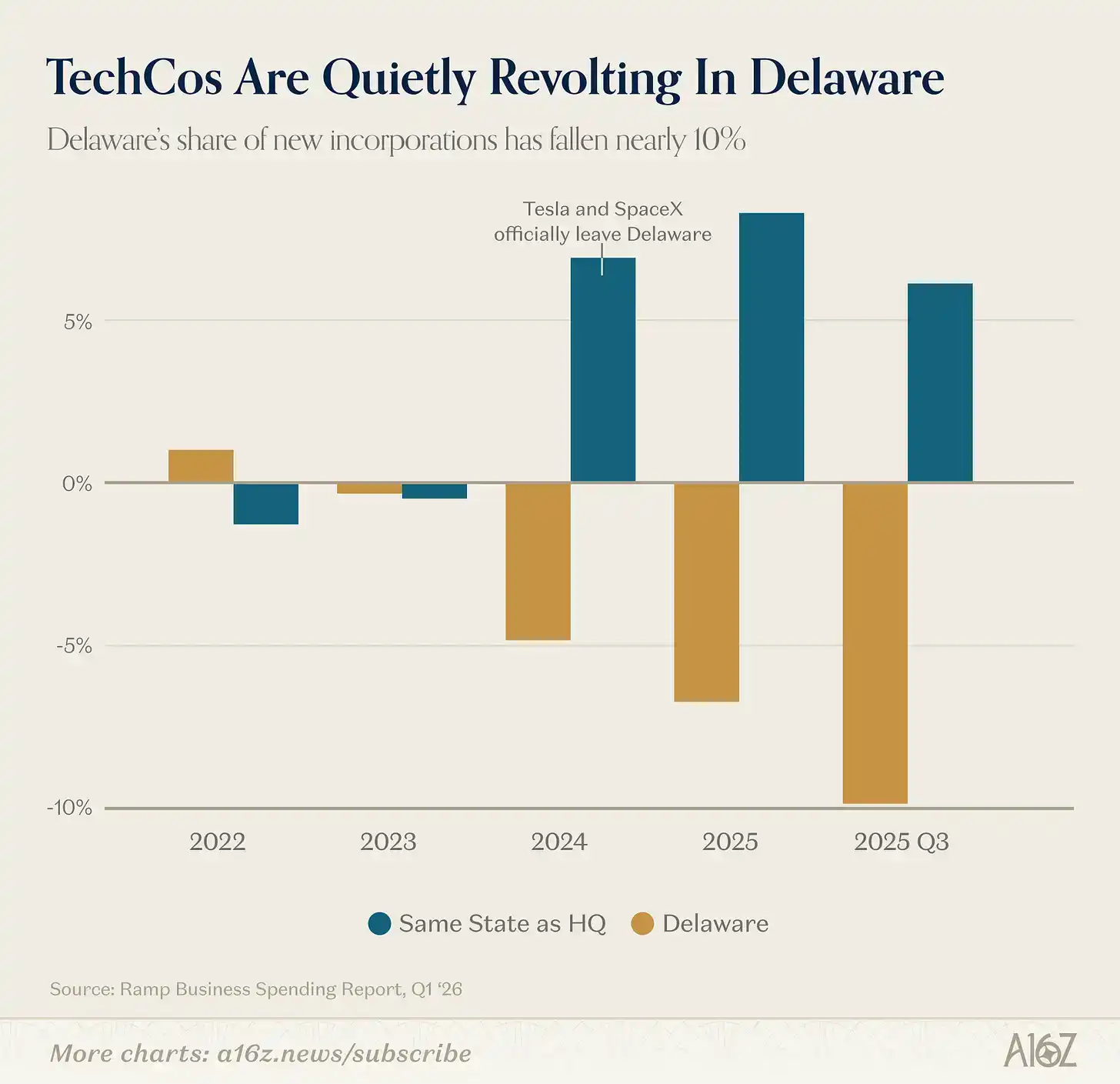
According to Ramp's data, Delaware's share of new company registrations has been declining since 2023, with a drop of about 10% in Q3 2025.

History doesn't repeat itself exactly, but it often rhymes......maybe.

Delaware wasn't always the holy land for corporate registration.

About a century ago, Delaware replaced New Jersey—the original "Mother of Trusts"—as the preferred state for incorporation. New Jersey lost its edge because then-Governor Woodrow Wilson tried to curb "corporate abuses," severely worsening the state's business environment. Delaware's corporate law was modeled on pre-Wilson era New Jersey law and was happy to welcome fleeing businesses. It then spent nearly 100 years, alongside the Delaware Court of Chancery, building a reputation as a mature and fair venue for resolving disputes between companies and investors.

However, what took a century to build began to shake in just a few years. Rightly or wrongly, the Delaware Court of Chancery has recently taken a more lenient stance on shareholder lawsuits (including, but not limited to, several high-profile cases like Tesla), and companies have genuinely started moving their registrations elsewhere. Goodnight, and good luck, Delaware.

This is at least the mainstream narrative, but other data shows a more complex picture.

First, even Delaware's founding myth isn't entirely accurate.

It wasn't until the 1980s (about 60 years after Governor Wilson's term) that Delaware truly surpassed New Jersey to become the number one state for US corporate registrations:
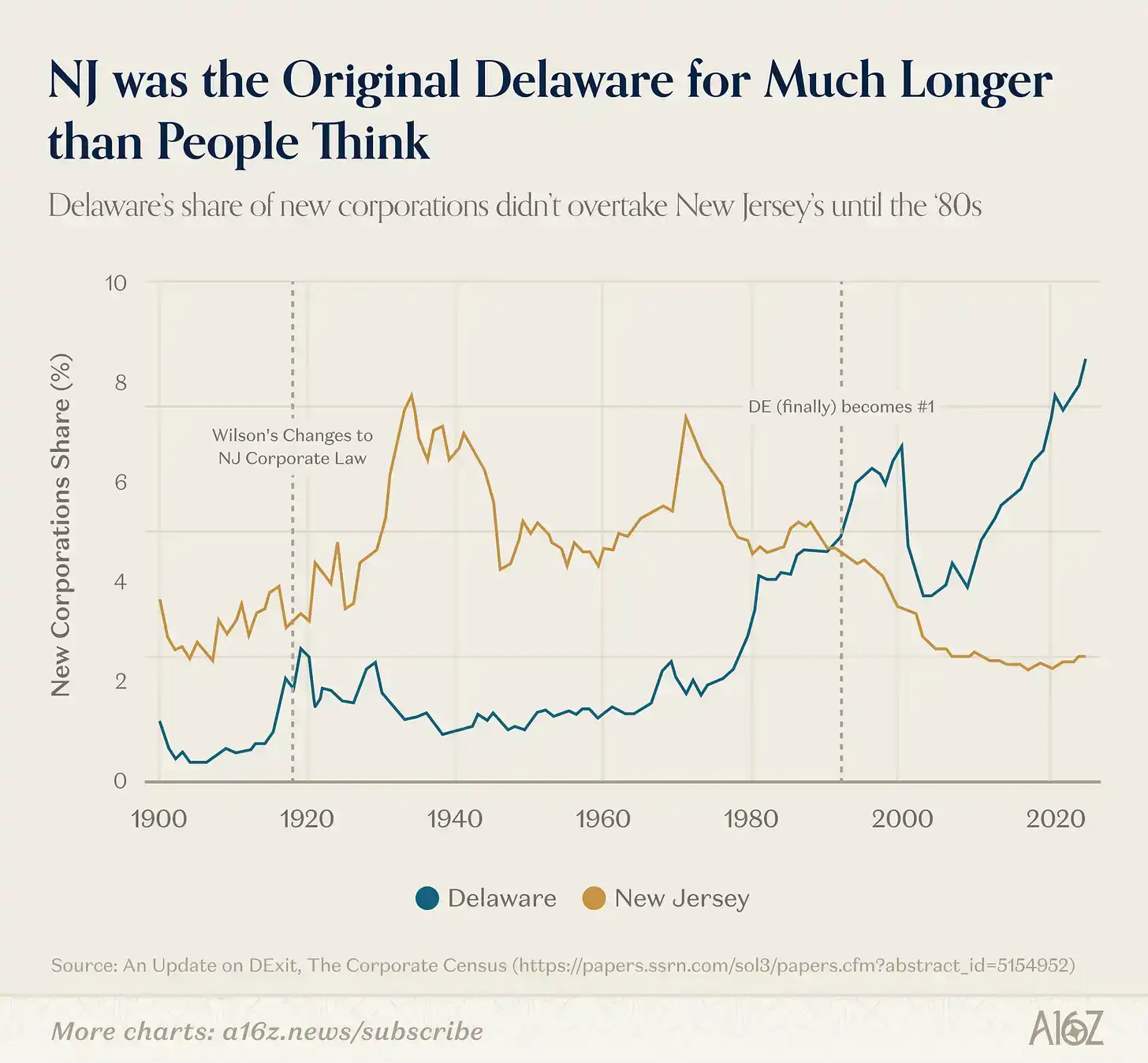
New Jersey's dominance lasted much longer than the mainstream narrative suggests. The catalyst for Delaware's eventual overtaking was likely its passage of a series of laws related to director liability, which were particularly favored by public companies, coupled with self-reinforcing network effects that created their own inertia.

Second, regardless of what's happening with high-profile public companies (and the companies in Ramp's data), Delaware as a whole still seems to be doing well, even more than well:
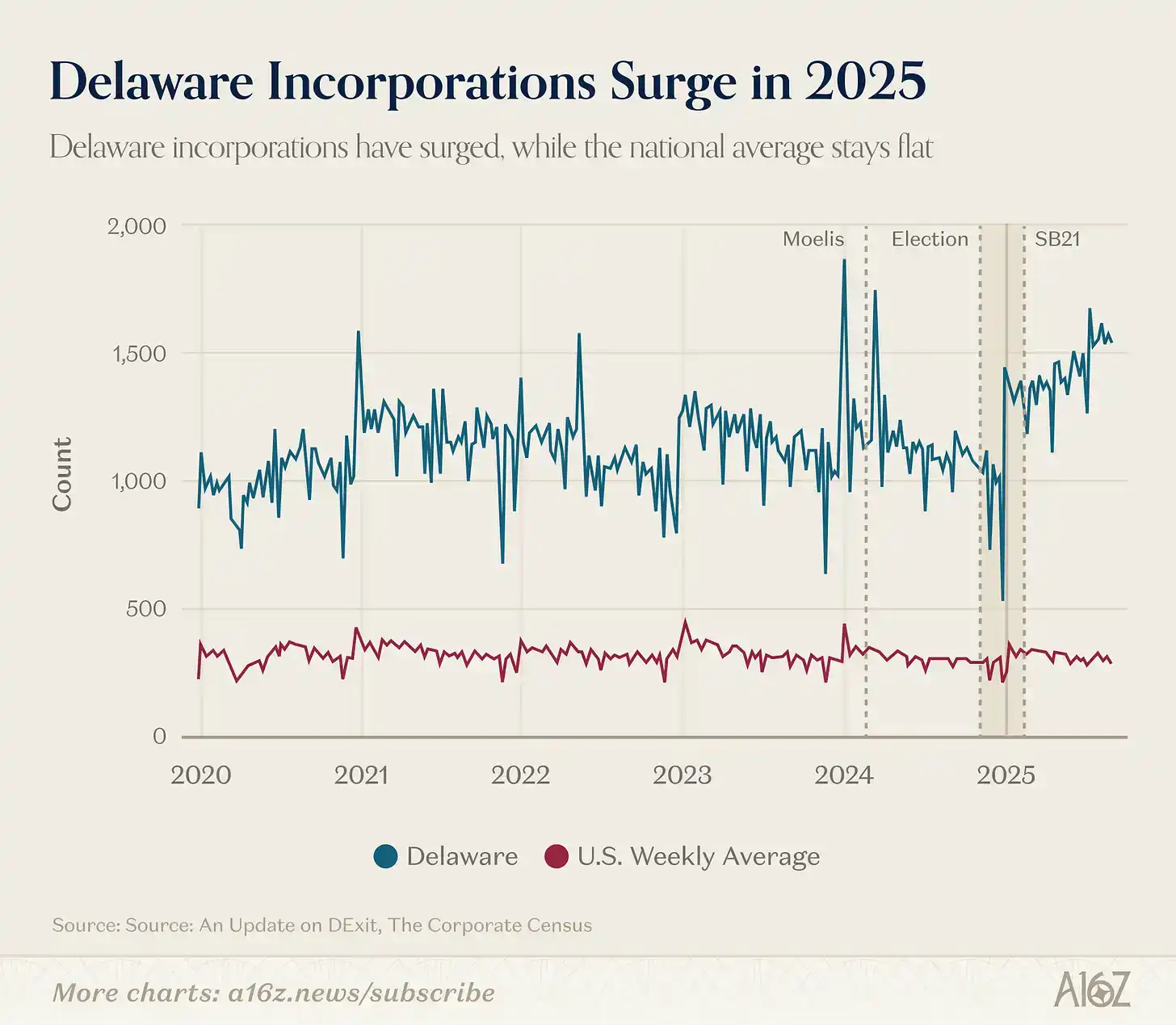
According to data published by the Harvard Law School Forum on Corporate Governance, Delaware's share of the total number of US businesses actually grew significantly from late 2024 into 2025.

In fact, if you're looking for a clear case of "DExit," it's probably this one, and it has nothing to do with Tesla, but rather a specific type of company structure:
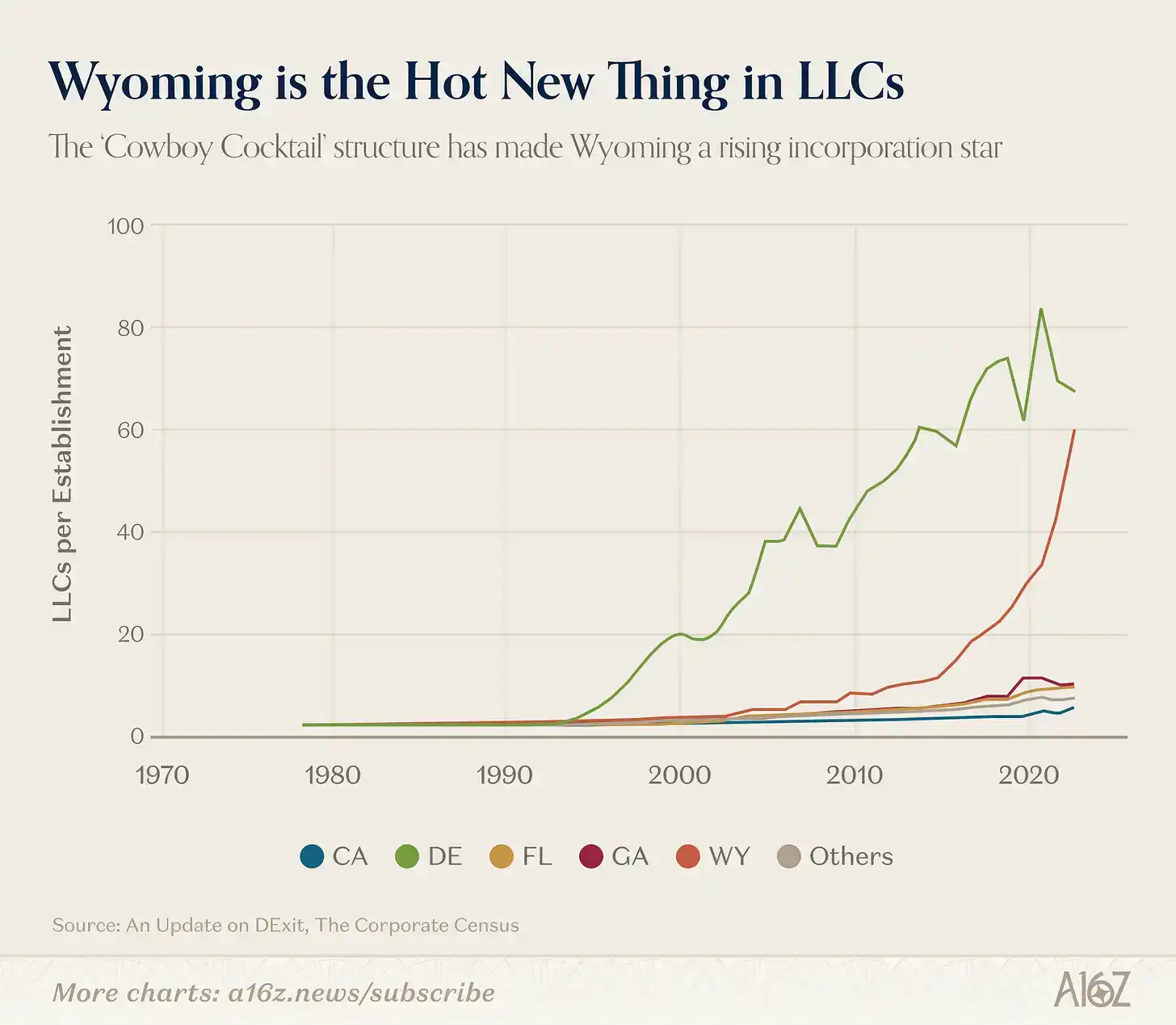
Wyoming LLCs began to surge around 2015.

Why? This is likely related to specific asset protection and privacy provisions in Wyoming's LLC law, which the state itself promotes as a "cowboy cocktail."

In short, the point here isn't that DExit isn't happening (because at least some data suggests it is—even if it's just a few high-profile companies moving out, it's significant), but the reality is certainly more complex than the mainstream narrative presents.

The reality is that Delaware still enjoys the advantage of being the default option, not to mention all the network effects tied to it, and these are very hard to shake.

We published an earlier version of this chart before, but as more data comes in, the effect becomes more striking.

Token costs fall, Token consumption rises:
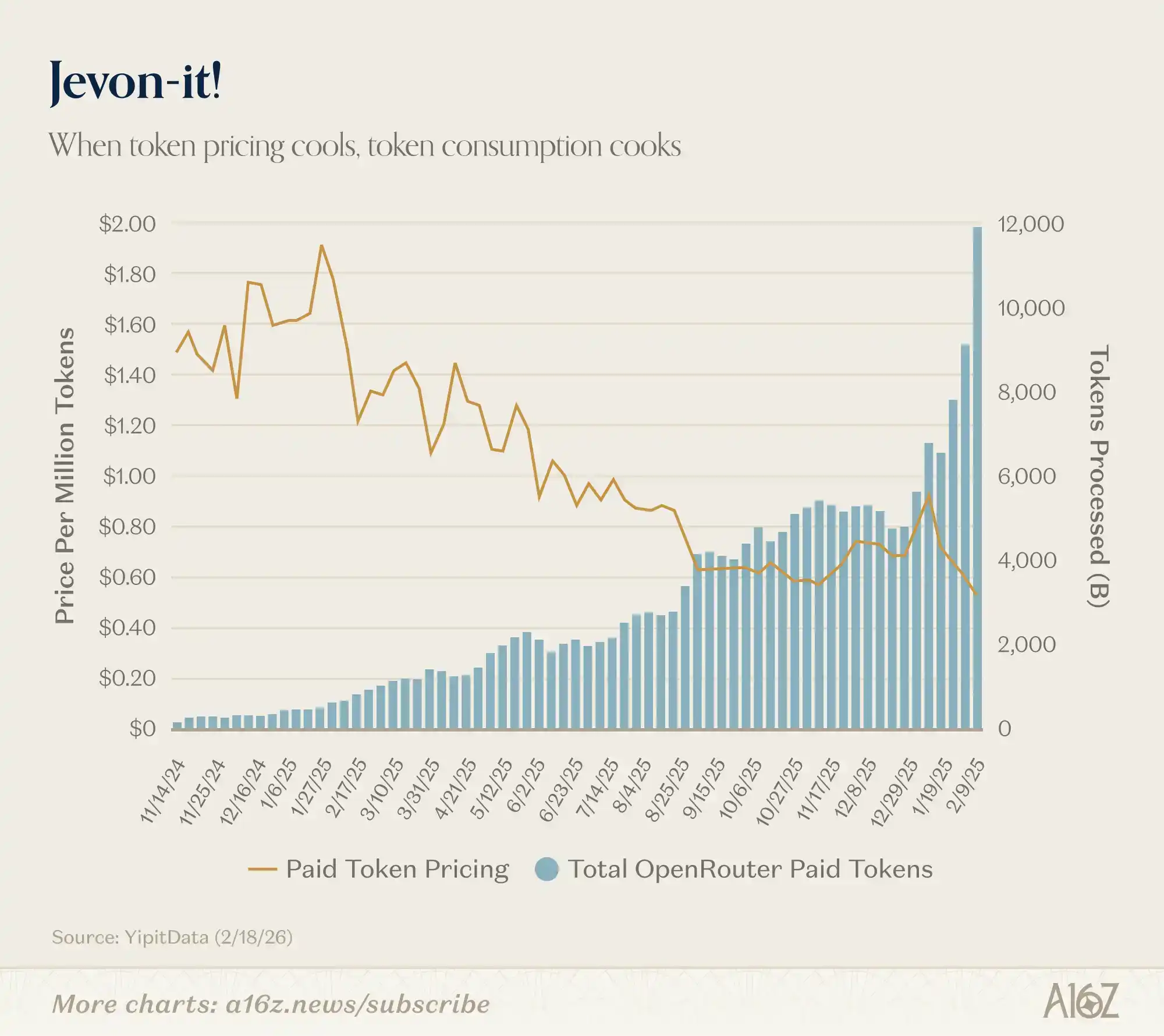
Since the beginning of this year, paid Token pricing has dropped from about 90 cents per million Tokens to 50 cents, while the number of Tokens processed has nearly doubled, from about 6,000 to 12,000.

This is a classic Jevons effect. The cheaper AI gets, the more AI we use. Delightful.

Remember when people said that when newer, better GPUs hit the market, the old ones would become worthless?

That doesn't seem to be the case either:
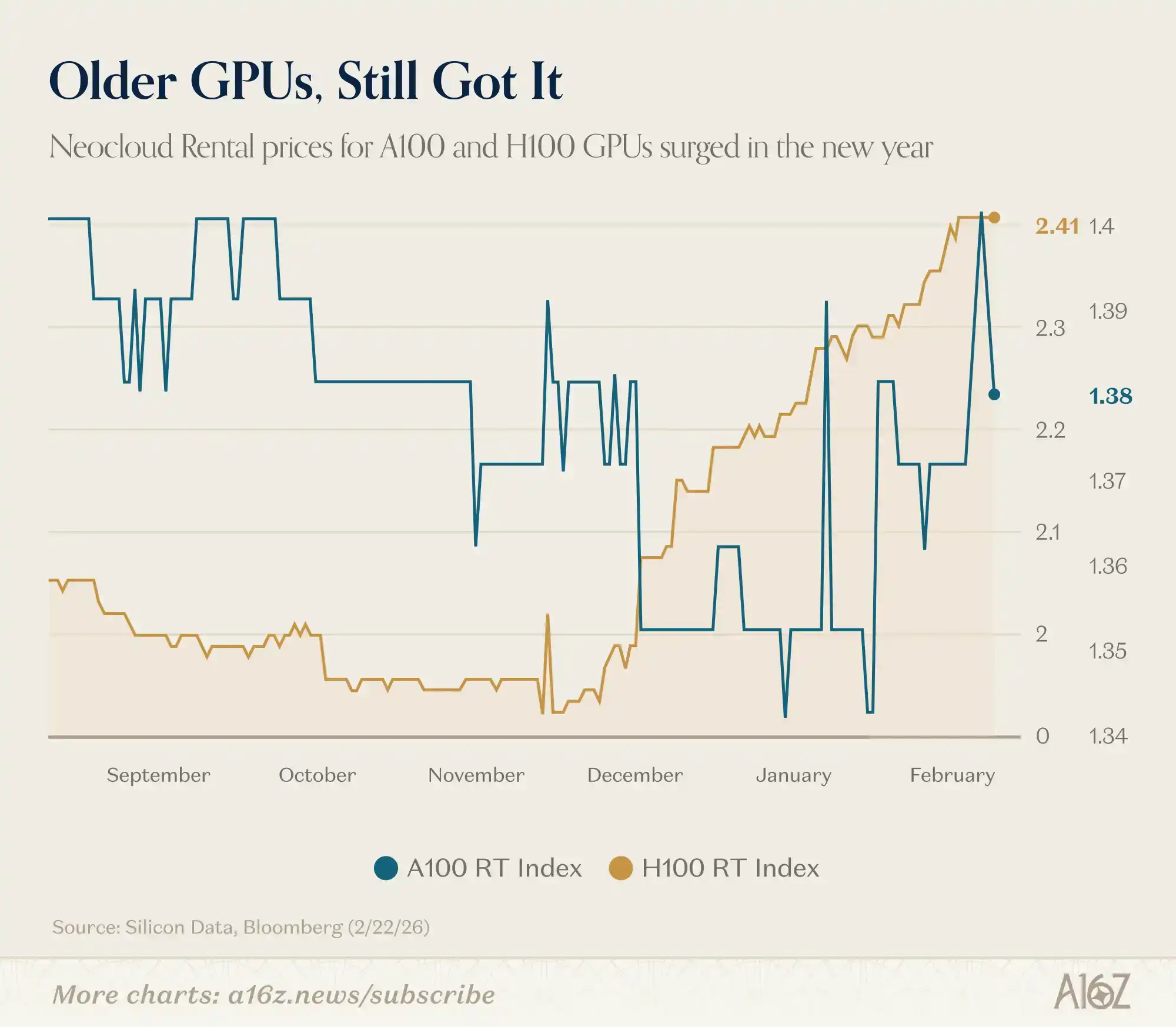
According to Silicon Data, rental prices for NVIDIA's H100 and A100 have both increased this year.

The market is far from showing signs of a compute oversupply; instead, it seems we haven't even scratched the surface of existing demand.

This comparison isn't a perfect analogy, but if history is any guide, it might take us a while longer to truly "see" what an AI-driven "economy" actually looks like:
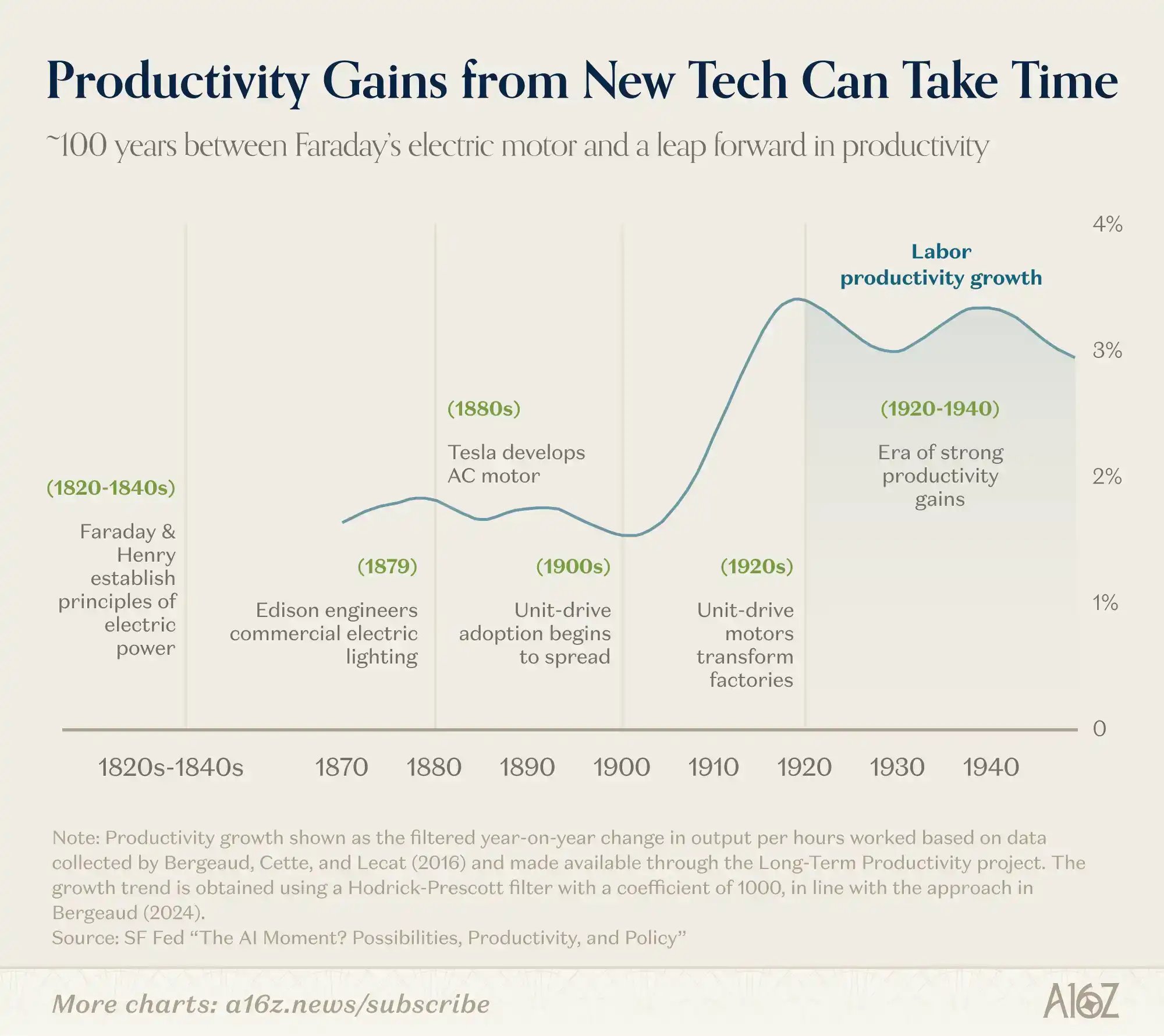
From the initial discussions of electric current by Faraday and Henry to the true explosion of industrial productivity in the first half of the 20th century, it took about 100 years.

Technology iteration cycles have indeed accelerated since the 1820s, but the variables involved in a platform-level shift remain extremely numerous.

Roy Amara famously said: "We tend to overestimate the effect of a technology in the short run and underestimate the effect in the long run."

Capital Expenditure, Put on the Axis

Here's a set of data that will never gets old: AI capital expenditure is huge.

Consider these comparisons:

2026 AI capex is projected to be close to the total net new lending by all US banks in 2025:
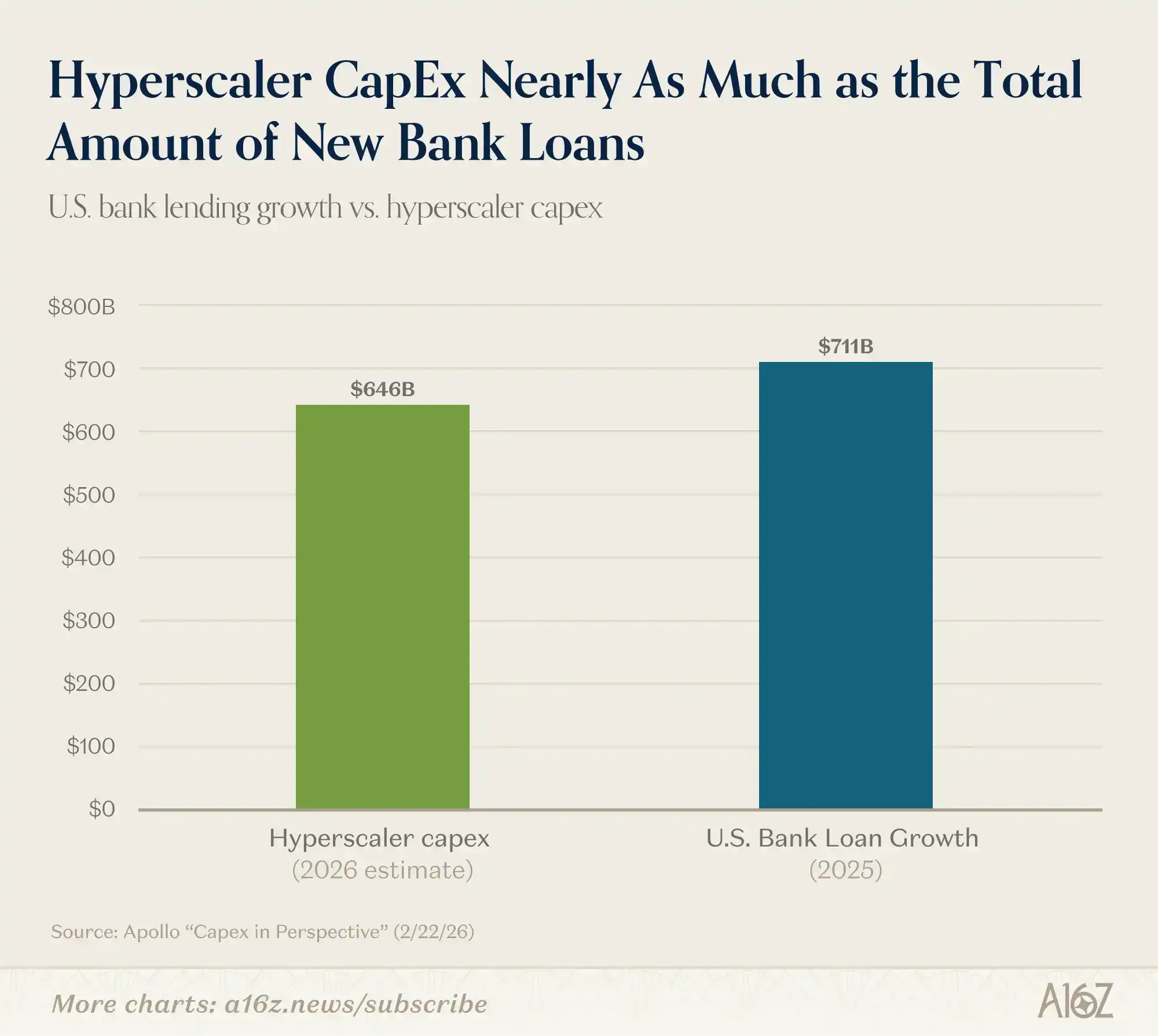
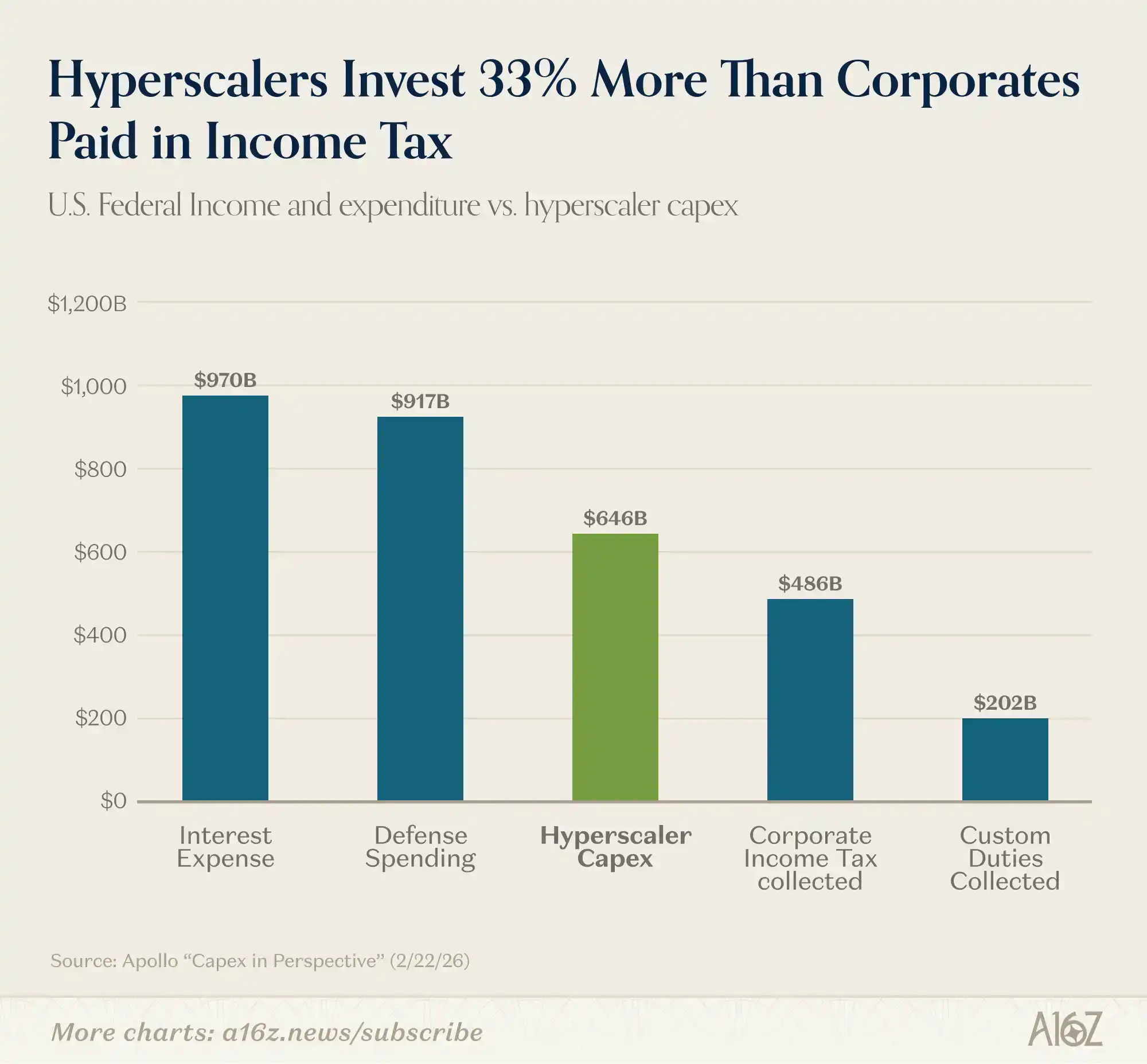
Capex is about 33% higher than total US corporate income tax revenue and about 3 times the total tariff revenue:
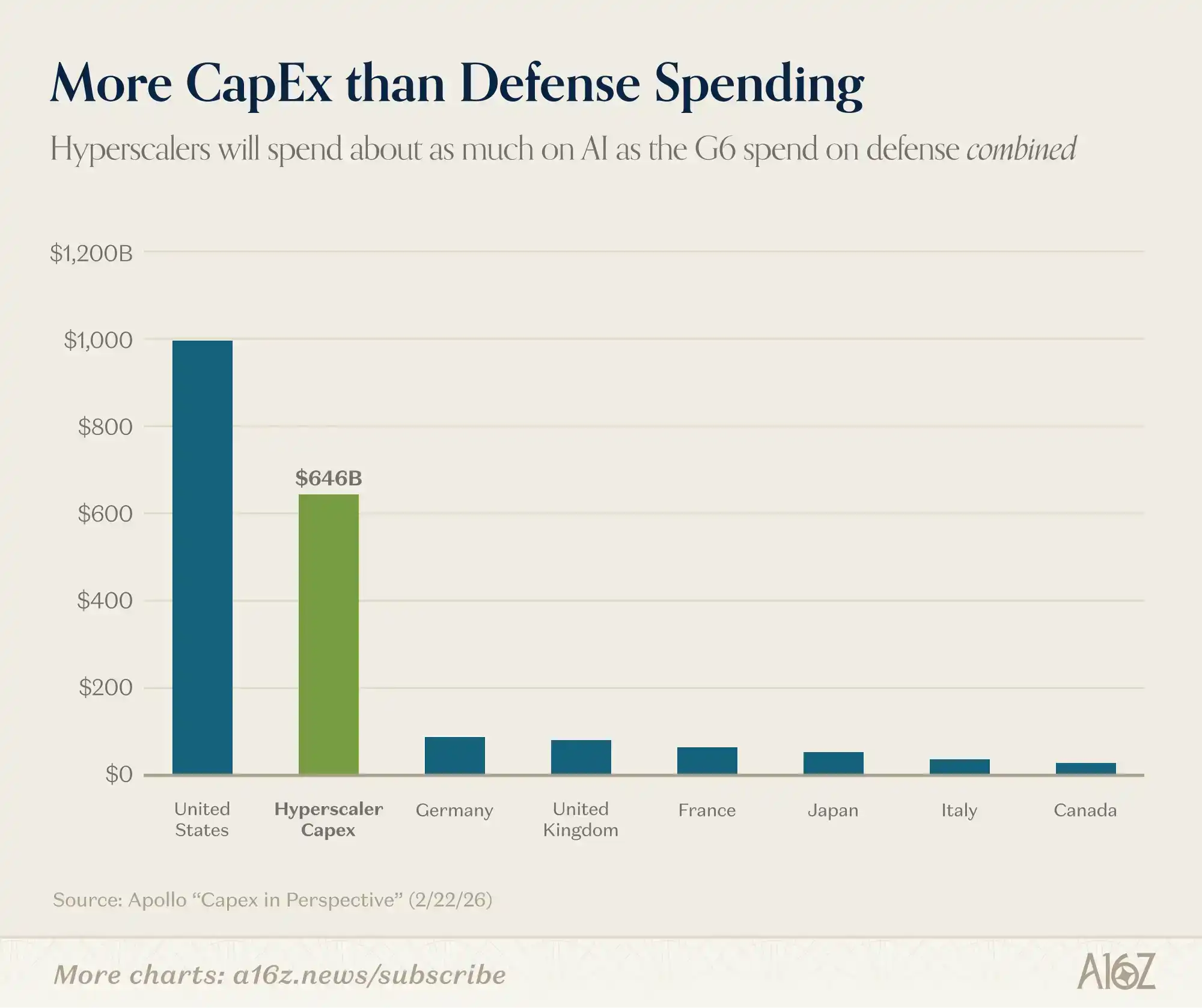
Capex is about 6 times the total military budget of any non-US G7 member country:
So, yes, capital expenditure is really huge.

Kalshi Moves into Macro Forecasting

Federal Reserve researchers think prediction markets are pretty good.

At least on one metric, Kalshi's predictions for the federal funds rate have already outperformed professional forecasting agencies:
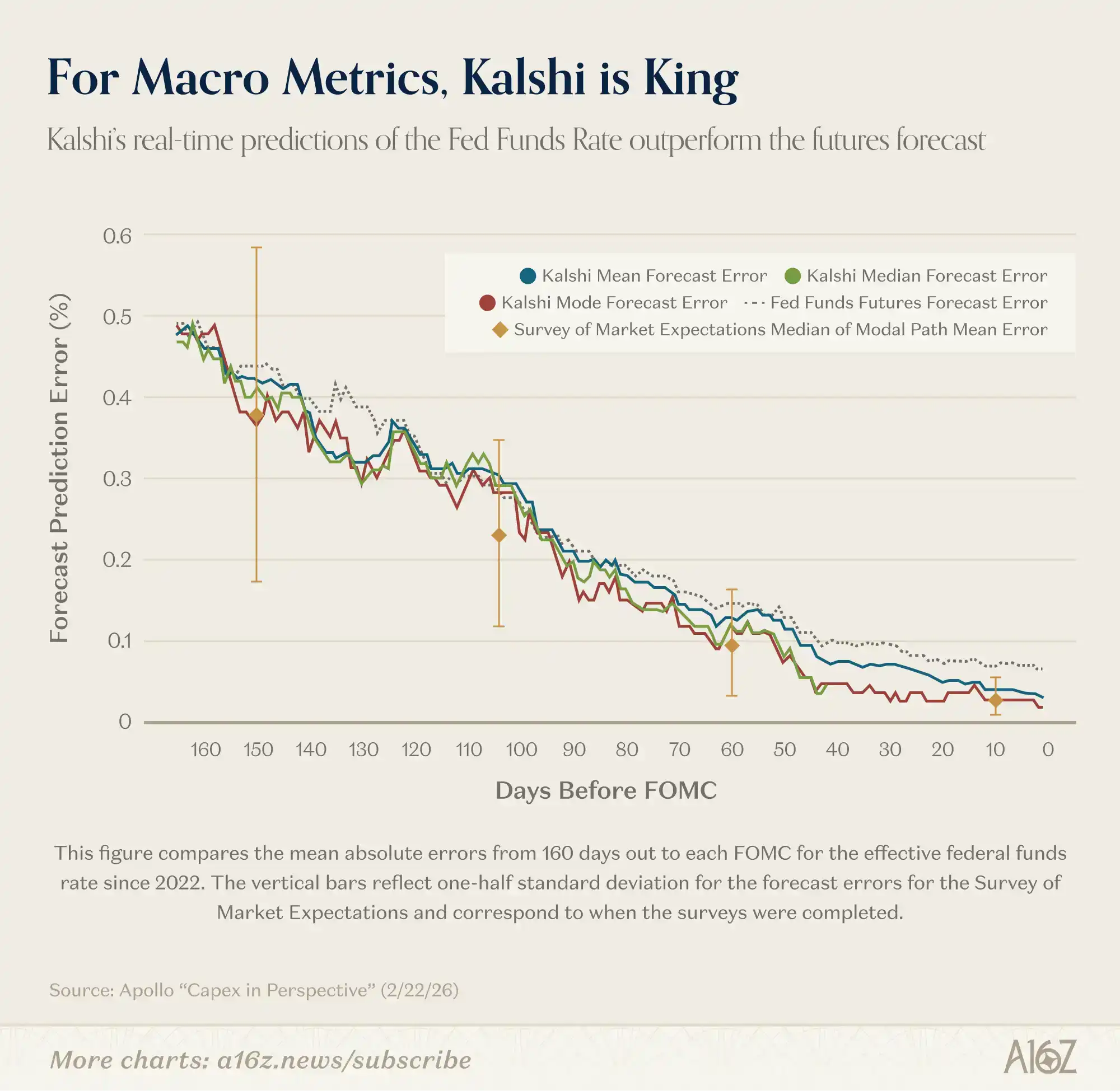
For predictions of the federal funds rate 150 days later (i.e., after 3 FOMC meetings), Kalshi's mean absolute error is very close to that of professional forecasters. But unlike surveys that provide only a snapshot of the modal path every six weeks, Kalshi provides a continuously updated full probability distribution......We find that Kalshi's median and mode predictions have a perfect track record on the day before FOMC meetings, which is a statistically significant improvement over federal funds futures predictions.

In other words, while all predictors start out similar, Kalshi's continuously updated predictions optimize over time, eventually achieving a perfect prediction record the day before the rate is officially announced. Furthermore, Kalshi's performance is also better than predictions from futures markets.

Kalshi's advantage extends beyond the federal funds rate. As the Fed researchers point out, since there are no other options markets for macro indicators like inflation, growth, and unemployment, Kalshi is the only place that provides a "high-frequency, continuously updated, probability distribution-rich 'baseline' reflecting 'crowd' judgments on the direction of these economic indicators.

Sounds pretty important.

The Delay of Adulthood

Here is a thought-provoking chart, with (a little) commentary:
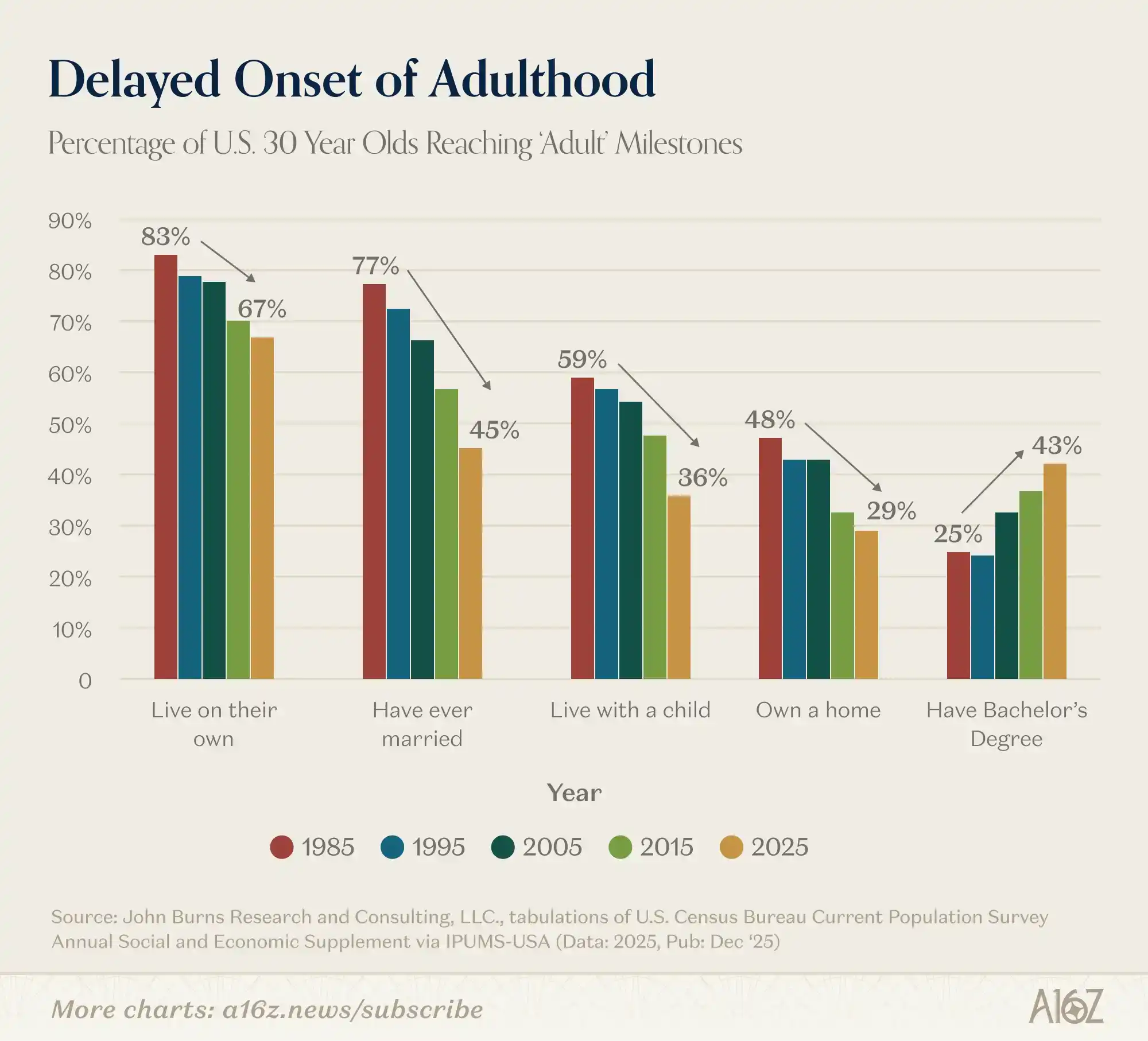
The proportion of 30-year-olds achieving major life milestones has been declining quite steeply since at least the 1980s.

Fewer and fewer 30-year-olds:

Live independently;

Have ever been married;

Live with children;

Own their home.

The only exception is college enrollment—the proportion of 30-year-olds with a bachelor's degree has almost doubled since 1995.

So, is college worth it?
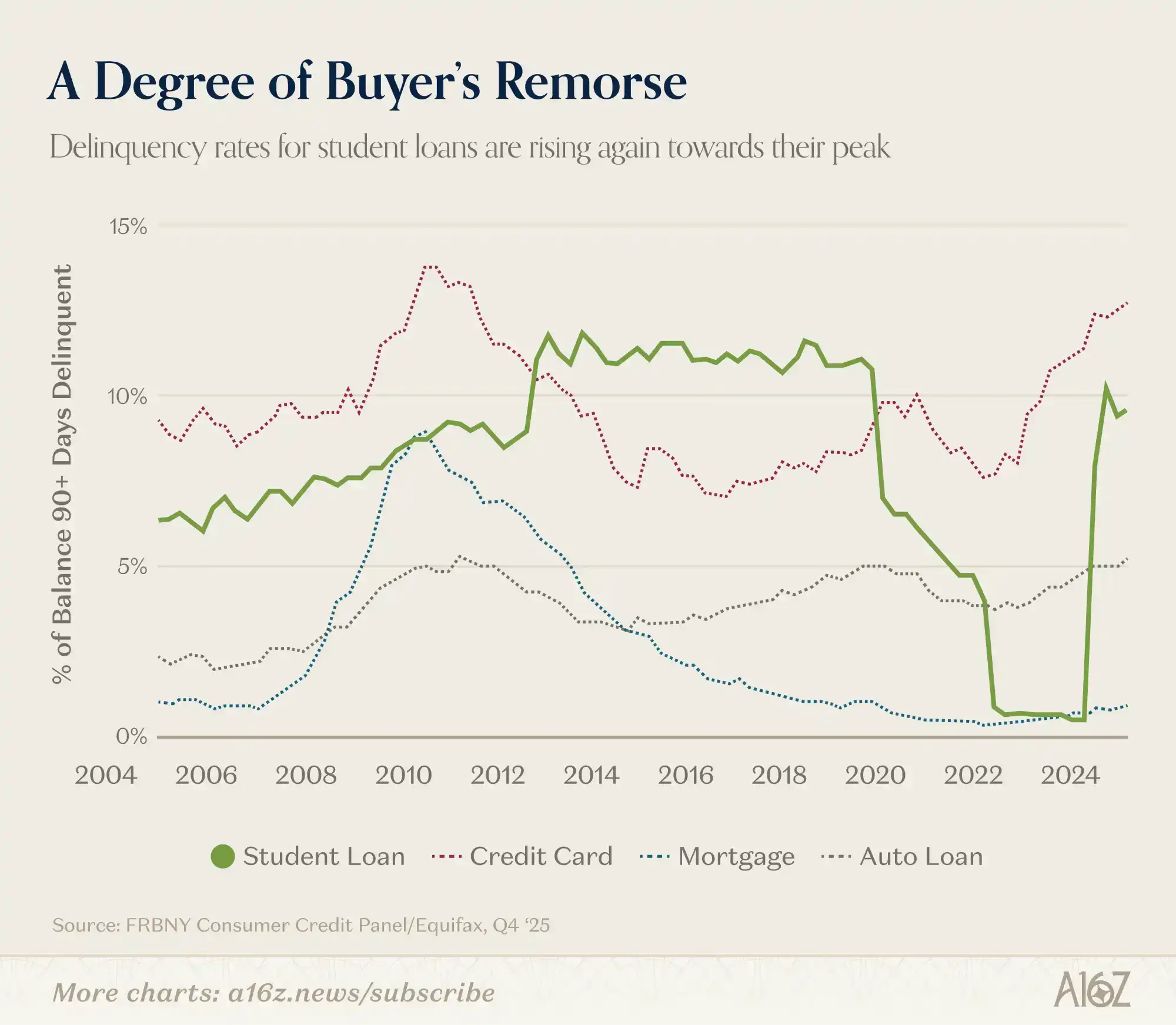
Milestones? More like milestones around the neck, right?!

Maybe, maybe not, but a sense of "buyer's remorse" seems to be in the air.

Domande pertinenti

QWhat is the Jevons effect in the context of AI, as mentioned in the article?

AThe Jevons effect refers to the phenomenon where as AI becomes cheaper (with token costs dropping from about $0.90 to $0.50 per million tokens), its usage increases significantly (nearly doubling from around 6,000 to 12,000 tokens processed). This demonstrates that lower costs drive higher consumption of AI resources.

QAccording to the article, what is the 'DExit' trend and is it fully supported by data?

AThe 'DExit' trend suggests that companies are increasingly leaving Delaware as their state of incorporation, partly due to perceived looser stances in shareholder litigation by the Delaware Court of Chancery. However, data shows the situation is more complex: while some high-profile companies have moved out, Delaware's overall share of U.S. businesses has actually grown significantly, indicating it remains the default choice for many due to network effects and historical advantages.

QHow does Kalshi's prediction market performance compare to professional forecasting agencies for Federal Funds rates?

AKalshi's prediction market has outperformed professional forecasting agencies for Federal Funds rates. While initial predictions are similar, Kalshi's continuously updated probability distributions improve over time, achieving a perfect prediction record the day before FOMC meetings. This performance is statistically significant and better than futures market predictions.

QWhat major life milestones are declining among 30-year-olds in the U.S., based on the article?

AAmong 30-year-olds in the U.S., there has been a decline in the proportions who are living independently, have ever been married, live with children, and own a home. The only exception is college enrollment, where the rate has nearly doubled since 1995.

QHow does AI capital expenditure in 2026 compare to other major economic metrics mentioned in the article?

AAI capital expenditure in 2026 is projected to be nearly equivalent to the net new lending by all U.S. banks in 2025, about 33% higher than total U.S. corporate income tax revenue, roughly three times the total tariff revenue, and about six times the military budget of any non-U.S. G7 country, highlighting its massive scale.

Letture associate

Has Hook Summer Really Arrived? sato, Lo0p, FLOOD Ignite the New Narrative of Uniswap v4

"Hook Summer" Arrives? Sato, Lo0p, FLOOD Ignite Uniswap v4 Narrative Amidst a slight market recovery, attention within the Ethereum ecosystem has shifted to Meme coins built on Uniswap v4's Hook protocol. Following ASTEROID, tokens like sato, sat1, Lo0p, and FLOOD have become market focal points, with market caps ranging from millions to tens of millions, bringing concentrated liquidity to a narrative-dry market. Uniswap v4 Hooks are "plugin smart contracts" that allow developers to inject custom logic at key points in a liquidity pool's lifecycle (initialization, adding/removing liquidity, swaps, etc.), making the AMM programmable. Recent representative projects include: * **sato**: Market cap peaked over $38M; uses a v4 curve mechanism for minting/burning, locking ETH as reserve. * **sat1**: Market cap briefly exceeded $10M, positioning as an "optimized sato," but later declined significantly. * **Lo0p**: Market cap neared $6.6M; a "lending AMM protocol" allowing users to borrow ETH against deposited LO0P tokens without immediate selling pressure. * **FLOOD**: Market cap approached $6M; channels trading reserves into Aave v3 to generate yield, which is retained in the pool. The emergence of these Hook-based tokens could drive long-term growth for the Uniswap ecosystem by attracting users and liquidity to v4 pools. Combined with Uniswap's activated fee switch (partially used to burn UNI), the long-term outlook for UNI appears positive. However, short-term UNI price appreciation is not directly guaranteed. Factors include the sustainability and lifecycle of these new tokens, their price volatility, overall market conditions, and regulatory pressures. Currently, Uniswap v4's TVL ($595M) lags behind v3 and v2, indicating Hook adoption still requires time to mature. In summary, the Hook ecosystem serves as "long-term nourishment" for UNI, but acts more as a "catalyst" than a direct "booster" in the short term. Note: These are early-stage experimental tokens and may carry unknown risks.

marsbit18 min fa

Has Hook Summer Really Arrived? sato, Lo0p, FLOOD Ignite the New Narrative of Uniswap v4

marsbit18 min fa

Has Hook Summer Truly Arrived? sato, Lo0p, FLOOD Ignite the New Uniswap v4 Narrative

With the broader market showing signs of recovery, a new wave of interest has emerged around Ethereum-based meme coins. Following ASTEROID, tokens like sato, sat1, Lo0p, and FLOOD, built upon the Uniswap v4 Hook protocol, are capturing market attention. Their market capitalizations range from millions to tens of millions of dollars, injecting much-needed focused liquidity into a market lacking narratives. This article explores whether this trend signifies an incoming "Hook Summer" and its potential impact on UNI's price. Hooks are essentially plug-in smart contracts for Uniswap v4 liquidity pools, allowing developers to inject custom logic at key points in a pool's lifecycle (like initialization, adding/removing liquidity, swaps). This transforms the AMM into programmable building blocks. Key highlighted projects include: * **sato**: Peaked over $38M market cap. It utilizes a v4 curve for minting/burning; buying locks ETH as reserve to mint new tokens, while selling redeems ETH from the reserve and burns tokens. * **sat1**: Market cap briefly exceeded $10M, promoted as an "optimized sato," but later declined significantly. * **Lo0p**: Reached nearly $6.6M. It's a lending AMM protocol where buying LO0P tokens locks them as collateral, allowing users to borrow ETH from the pool reserve at 40% LTV, aiming to improve capital efficiency for idle ETH in LPs. * **FLOOD**: Peaked near $6M. Its mechanism directs asset reserves from buys into Aave v3 to generate yield, with fees and interest retained in the pool to potentially influence the token's price long-term. In the long term, the development of the Hook ecosystem can attract users and liquidity to Uniswap v4, benefiting UNI's fundamentals—especially combined with the recent activation of the protocol fee switch, where a portion of fees is used to burn UNI. However, in the short term, these Hook-based tokens are unlikely to directly drive significant UNI price appreciation. Their impact is moderated by factors like token sustainability, price volatility, and broader market and regulatory conditions. Currently, Uniswap v4's TVL ($595M) still trails behind v2 and v3, indicating adoption and growth will take time. The article concludes that while the Hook ecosystem provides long-term "nourishment" for UNI, its short-term role is more of a "catalyst" than a "booster." Readers are cautioned that these are early-stage experimental tokens and may carry unknown risks.

Odaily星球日报30 min fa

Has Hook Summer Truly Arrived? sato, Lo0p, FLOOD Ignite the New Uniswap v4 Narrative

Odaily星球日报30 min fa

Interview with Michael Saylor: I Did Say I Would Sell Bitcoin, But Never a Net Sale

Interview with Michael Saylor: I Said We'd Sell Bitcoin, But Never Be a Net Seller In a recent podcast, MicroStrategy Executive Chairman Michael Saylor clarified the company's stance on potentially selling Bitcoin. Following MicroStrategy's earnings call statement about being prepared to sell BTC to fund dividends for its STRC (Strategic) credit product, Saylor emphasized the distinction between selling and being a "net seller." Saylor explained the core business model: MicroStrategy sells credit instruments like STRC and uses the proceeds to buy Bitcoin, which is viewed as "digital capital" expected to appreciate around 30-40% annually. A portion of these capital gains can then be used to pay the dividends on the credit products. He stressed that even if the company sells some Bitcoin for dividends, it simultaneously buys much more with new credit issuance. For example, after raising $3.2 billion from STRC sales in April, the dividend obligation was only $80-90 million, making the company a net buyer. The clarification aims to counter market narratives questioning the value of Bitcoin on MicroStrategy's balance sheet if it were never sold, and to dismiss claims of a "Ponzi scheme." Saylor reiterated his personal philosophy for investors: "Don't be a net seller of bitcoin" and ensure your Bitcoin holdings increase each year. Saylor also discussed Bitcoin's role as the foundation for "digital credit," noting that STRC has become the largest and most liquid preferred stock issue in the U.S., offering high risk-adjusted returns (Sharpe ratio). He highlighted Bitcoin's deep liquidity, stating that even large purchases by MicroStrategy do not move the market significantly, which is driven by macro factors, geopolitical tensions, and capital flows from ETFs and credit products. Finally, Saylor reflected on his early inspiration from sci-fi books, which motivated his path to MIT, and maintained his fundamental thesis on Bitcoin remains unchanged: it is superior digital capital enabling superior digital credit.

链捕手35 min fa

Interview with Michael Saylor: I Did Say I Would Sell Bitcoin, But Never a Net Sale

链捕手35 min fa

Beaten SK Hynix Employees in China: Year-end Bonus Less Than 5% of Korean Staff's

"SK Hynix Chinese Staff Hit Hard: Bonuses Less Than 5% of Korean Counterparts" Driven by the AI boom, South Korea's SK Hynix is experiencing record performance, with media reports predicting massive year-end bonuses for its employees, making them highly desirable in the matchmaking market. However, this prosperity starkly contrasts with the situation for the company's Chinese employees. According to reports, SK Hynix operates under a rule allocating 10% of operating profit for employee bonuses. While projections suggest Korean employees could receive bonuses reaching millions of RMB, a Chinese employee with over a decade of technical experience revealed the disparity: "If they get 3 million, Chinese staff get less than 5% of that." After adjustments based on KPI ratings, this employee's highest bonus was slightly over 100,000 RMB. Bonuses are paid annually in Korea but semi-annually in China. During the industry downturn in 2023-2024, Chinese employees received no bonus at all. The gap extends beyond bonuses. Recruitment posts for SK Hynix's Chinese factories (in Wuxi, Dalian, Chongqing) show engineer monthly salaries ranging from 10,000 to 35,000 RMB, with a 13th-month salary promised. Chinese employees also receive standard benefits like annual leave but lack stock incentives, which are reportedly unavailable to them. Furthermore, management positions in China are predominantly held by Korean personnel, though industry observers note a gradual increase in local middle managers over time. SK Hynix has confirmed the 10% bonus rule but cautioned that specific future bonus amounts remain unpredictable. The company forecasts strong demand for HBM and other high-value enterprise products for the next 2-3 years, driven by AI infrastructure investment. This focus on business-to-business markets may continue to constrain supply for consumer products, potentially prolonging price increases for components like memory.

链捕手48 min fa

Beaten SK Hynix Employees in China: Year-end Bonus Less Than 5% of Korean Staff's

链捕手48 min fa

Trading

Spot
Futures

Articoli Popolari

Come comprare ERA

Benvenuto in HTX.com! Abbiamo reso l'acquisto di Caldera (ERA) semplice e conveniente. Segui la nostra guida passo passo per intraprendere il tuo viaggio nel mondo delle criptovalute.Step 1: Crea il tuo Account HTXUsa la tua email o numero di telefono per registrarti il tuo account gratuito su HTX. Vivi un'esperienza facile e sblocca tutte le funzionalità,Crea il mio accountStep 2: Vai in Acquista crypto e seleziona il tuo metodo di pagamentoCarta di credito/debito: utilizza la tua Visa o Mastercard per acquistare immediatamente CalderaERA.Bilancio: Usa i fondi dal bilancio del tuo account HTX per fare trading senza problemi.Terze parti: abbiamo aggiunto metodi di pagamento molto utilizzati come Google Pay e Apple Pay per maggiore comodità.P2P: Fai trading direttamente con altri utenti HTX.Over-the-Counter (OTC): Offriamo servizi su misura e tassi di cambio competitivi per i trader.Step 3: Conserva Caldera (ERA)Dopo aver acquistato Caldera (ERA), conserva nel tuo account HTX. In alternativa, puoi inviare tramite trasferimento blockchain o scambiare per altre criptovalute.Step 4: Scambia Caldera (ERA)Scambia facilmente Caldera (ERA) nel mercato spot di HTX. Accedi al tuo account, seleziona la tua coppia di trading, esegui le tue operazioni e monitora in tempo reale. Offriamo un'esperienza user-friendly sia per chi ha appena iniziato che per i trader più esperti.

330 Totale visualizzazioniPubblicato il 2025.07.17Aggiornato il 2025.07.17

Come comprare ERA

Discussioni

Benvenuto nella Community HTX. Qui puoi rimanere informato sugli ultimi sviluppi della piattaforma e accedere ad approfondimenti esperti sul mercato. Le opinioni degli utenti sul prezzo di ERA ERA sono presentate come di seguito.

活动图片













