A Major XRP Ledger Win That Most Investors Might Have Missed

bitcoinistPubblicato 2026-02-06Pubblicato ultima volta 2026-02-06

Introduzione

The XRP Ledger has activated the Permissioned Domains amendment after it achieved 91.19% validator approval and a mandatory two-week consensus period. This upgrade, introduced in v2.4.0, enables institutions, enterprises, and regulated entities to operate in controlled environments on the same public blockchain. It allows for known and compliant participants within defined domains while maintaining the ledger's core benefits of speed, low cost, and finality. This addresses a key limitation for banks and governments that require regulatory compliance, identity checks, and accountability, which are difficult on fully open networks. By allowing both permissioned and permissionless use, the upgrade removes a significant barrier to institutional adoption, positioning XRPL as shared financial infrastructure that meets regulatory expectations. Its impact may grow gradually as organizations begin utilizing these new capabilities.

The XRP Ledger quietly crossed an important milestone this week. After weeks of waiting, the Permissioned Domains amendment has finally gone live. Validators reached the required 80% yes vote back in January, but as protocol rules demand, that consensus had to hold for two consecutive weeks before activation.

On February 4, the waiting period ended, and the amendment officially became part of the XRP Ledger with a 91.19% approval. The moment passed with little noise, but investors might have missed its implications, which extend far deeper than a routine technical update.

Quiet Upgrade Changes How Institutions Can Use The XRP Ledger

Permissioned domains were introduced to the XRP Ledger on the v2.4.0 update. The rollout followed the standard governance process on the Ledger, which requires both a supermajority vote and sustained agreement over time to prevent rushed or unstable changes. In this case, validators voted yes early, locking in more than 80% approval in January.

According to Stern Drew, an XRP analyst on the social media platform X, the importance of Permissioned Domains lies in how they reshape what is possible on a public ledger. In simple terms, it makes the Ledger far more usable for institutions, enterprises, and regulated applications.

The upgrade allows controlled environments to exist on the same shared blockchain. Institutions can now operate inside clearly defined domains where participants are known, approved, and compliant, without giving up the speed, finality, and low-cost settlement XRPL is known for.
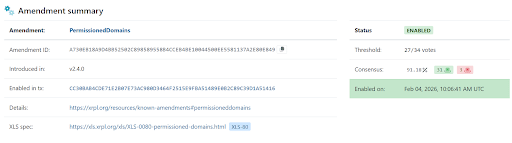
Source: Chart from XRPScan

This addresses a limitation in public blockchains, which are known for their openness. Public blockchains like the Ledger are great for openness, but the openness is unrealistic for banks, governments, and enterprises that must enforce rules, accountability, and identity checks.

Permissioned Domains resolve that tension by letting both models coexist. Sensitive or regulated activity can happen inside restricted domains, while the broader ledger is open and permissionless for everyone else.

Why This Matters For The Altcoin Going Forward

The most favorable outcome for XRP is the broad adoption of the Ledger by banks and financial institutions in their day-to-day operations. Therefore, the activation of permissioned domains on the Ledger removes one of the last structural barriers to real-world adoption.

XRPL can now serve as shared financial infrastructure, offering the guardrails regulators expect without sacrificing the benefits of a global public ledger. A bank can settle payments, a government can run regulated flows, and an enterprise can move large value, all without exposing sensitive operations to the entire public network.

This is why the Permissioned Domains upgrade carries more weight than its quiet rollout. It might be overlooked for now, but this kind of change tends to show its impact gradually, especially when institutions start creating domains on the Ledger.

Permissioned Domains is one of several amendments introduced by developers to strengthen the overall utility of the Ledger ecosystem. Another notable example is the lending feature, which is currently in the validator voting phase.

XRP trading at $1.29 on the 1D chart | Source: XRPUSDT on Tradingview.com

Domande pertinenti

QWhat is the Permissioned Domains amendment and why is it significant for the XRP Ledger?

AThe Permissioned Domains amendment is an upgrade that allows controlled environments to exist on the XRP Ledger, enabling institutions to operate in defined domains with known and compliant participants. Its significance lies in removing a key structural barrier to adoption by banks and financial institutions, as it provides the regulatory guardrails they require while maintaining the speed, finality, and low-cost settlement of the public ledger.

QWhat was the final approval percentage for the Permissioned Domains amendment and when did it go live?

AThe Permissioned Domains amendment received a 91.19% approval from validators and officially went live on February 4, after a mandatory two-week waiting period following the achievement of the required 80% consensus in January.

QHow does the Permissioned Domains feature address a key limitation of public blockchains for enterprise use?

AIt addresses the limitation of excessive openness in public blockchains by allowing both permissioned and permissionless models to coexist. Sensitive or regulated activities can occur within restricted domains where participants are known and approved, while the broader ledger remains open to everyone else.

QAccording to the article, what is the most favorable outcome for XRP and how does this upgrade contribute to it?

AThe most favorable outcome for XRP is the broad adoption of the XRP Ledger by banks and financial institutions in their day-to-day operations. This upgrade contributes directly to that outcome by making the ledger far more usable for institutions, enterprises, and regulated applications that require enforced rules, accountability, and identity checks.

QBesides Permissioned Domains, what is another notable amendment mentioned that is currently in development for the XRP Ledger?

AAnother notable amendment mentioned is a lending feature, which is currently in the validator voting phase and is being developed to further strengthen the overall utility of the XRP Ledger ecosystem.

Letture associate

RWA First Stock's Major Acquisition: Why Buy a 'Traditional' Mortgage Company?

On June 10th, Figure Technology Solutions (Nasdaq: FIGR), a blockchain-native capital markets firm, announced a $717 million acquisition of Kiavi, a leading non-bank lender for residential real estate investors. The deal involves Figure acquiring Kiavi's technology and operations for approximately $538 million, while forming a joint venture with alternative asset manager Sixth Street to purchase Kiavi's existing loan portfolio. Sixth Street also provided a $3 billion forward purchase commitment. This acquisition marks a strategic shift for Figure, known as the "RWA (Real World Asset) first stock," allowing it to expand significantly into the larger market of first-lien mortgages. Kiavi specializes in non-qualified mortgage (Non-QM) loans, such as short-term fix-and-flip (RTL) and rental property (DSCR) loans—a segment traditionally underserved by major banks. The move is expected to increase Figure's first-lien loan origination to over $7 billion annually, aiming for these to constitute about 40% of its business by 2027. Both companies leverage AI for underwriting: Kiavi uses proprietary models to value renovated properties and automate document processing, dominating the fix-and-flip lending space. Figure plans to integrate these assets onto its blockchain platform, Provenance, using its new 'Adaptor' product to standardize and tokenize the loans for institutional investors on its Democratized Prime marketplace. While the integration poses challenges—including merging different asset types, interest rate sensitivity of Kiavi's loans, and post-IPO execution risks—Figure projects the deal to be accretive to earnings with a cash payback period under four years. The transaction is seen as a major step in scaling blockchain-based capital markets, moving RWA tokenization from concept validation toward large-scale operation.

Foresight News22 min fa

RWA First Stock's Major Acquisition: Why Buy a 'Traditional' Mortgage Company?

Foresight News22 min fa

Trend in US Stocks: A Post Triggers a 930-Point Rebound, Tonight Belongs to SpaceX

On Thursday (June 11, U.S. Eastern Time), Wall Street staged a textbook V-shaped reversal. The Dow Jones surged 929.97 points (+1.86%) to close above 50,000, while the Nasdaq and S&P 500 rose 2.54% and 1.75%, respectively. The rally occurred despite the hottest PPI report in years, with May data showing a 6.5% year-on-year surge, the highest since 2022. The market ignored the inflation data, focusing instead on reports that former President Trump called off a planned strike on Iran, hinting at a potential multi-party peace agreement draft. This sparked a sharp drop in oil prices, fueling hopes that inflation may have peaked. Sector rotations were stark: previously battered AI hardware and cyclical stocks led the gains, while defensive sectors that hit record highs the prior day were sold off. Chip stocks like Micron and Intel saw sharp rebounds. In contrast, software giant Oracle plunged nearly 10% despite beating earnings, with concerns over cloud revenue and cash flow. Adobe also fell after hours despite raising guidance, as its CFO announced departure. The rally's sustainability is questioned, driven largely by social media posts about unconfirmed geopolitical developments. Inflation risks remain, with pipeline pressures still high. Meanwhile, the market's risk appetite faces a major test with SpaceX's historic IPO. Priced at $135 per share, it aims to raise ~$75 billion with a $1.75 trillion valuation, becoming the largest U.S. IPO ever. It will join the Nasdaq 100 in 15 days, triggering massive index fund buying. However, critics cite extreme valuation (88x sales) and market liquidity concerns.

marsbit45 min fa

Trend in US Stocks: A Post Triggers a 930-Point Rebound, Tonight Belongs to SpaceX

marsbit45 min fa

The Trillion-Dollar Valuation Test: Are the Three Super IPOs a Tech Stock Frenzy or a Crypto Market Nightmare?

Trillion-Dollar Valuation Test: Are the Three Mega IPOs a Tech Stock Frenzy or a Crypto Market Nightmare? The capital market in 2026 is witnessing a highly anticipated wave of tech IPOs, centered on SpaceX, OpenAI, and Anthropic. Collectively valued at over $3.5 trillion, their potential listing represents one of the largest such waves in recent years. This raises concerns about market liquidity, valuation bubbles, and potential capital outflows from other assets like crypto. SpaceX's valuation narrative has shifted from rocket launches to becoming a global infrastructure play via its Starlink satellite network, which now drives most revenue. Despite ongoing losses, investors focus on its long-term growth potential. OpenAI and Anthropic represent the core productivity engines of generative AI. Their public listings would offer the first direct investment opportunity in large foundation model companies, potentially triggering a repricing within the AI sector. Market fears of a massive "capital drain" from these IPOs are likely overstated. Historical precedents like Alibaba and Saudi Aramco show that mega-listings primarily cause capital reallocation, not destruction, within the vast equities market. Systemic risk is rarely triggered by IPOs alone. For stock markets, short-term volatility and sector repricing are expected, especially for AI concept stocks. Long-term, these listings could reinforce the tech sector's importance. For crypto, direct competition for speculative capital exists, particularly affecting AI-themed tokens. However, crypto's trajectory remains more tied to its own cycles, macro liquidity, and Bitcoin ETF flows rather than a single IPO event. The real risk lies not in the listings themselves but in the sky-high growth expectations embedded in these valuations. If future revenue, profitability, or commercialization progress disappoints, significant valuation resets could follow, impacting high-growth tech stocks. Ultimately, the market's direction hinges on macroeconomic conditions and whether these companies can deliver on their ambitious promises.

链捕手1 h fa

The Trillion-Dollar Valuation Test: Are the Three Super IPOs a Tech Stock Frenzy or a Crypto Market Nightmare?

链捕手1 h fa

Trillion-Dollar Valuation Test: Are the Three Super IPOs a Tech Stock Frenzy or a Crypto Market Nightmare?

Title: Trillion-Dollar Valuations at Stake: Super IPOs of SpaceX, OpenAI, Anthropic – Tech Boom or Crypto Nightmare? TL;DR: A wave of mega-tech IPOs is approaching, featuring SpaceX (targeting a $1.75 trillion valuation), OpenAI (~$852B), and Anthropic (~$965B), with a combined potential valuation exceeding $3.5 trillion. This tests the market's pricing of innovation and sparks debate on liquidity impact. * **SpaceX**'s valuation is now driven more by its Starlink global communications infrastructure than its core rocket business. * **OpenAI & Anthropic** offer the first major public investment opportunities in foundational AI models, potentially repricing the entire AI sector. * Concerns about a market-wide "liquidity drain" are likely overblown; history shows large IPOs mainly cause fund reallocation, not disappearance, and rarely trigger systemic risk. * Crypto markets, especially some AI-themed tokens, may face short-term fund competition, but their long-term trajectory depends more on macro liquidity, regulation, and Bitcoin cycles. * The real risk lies not in the IPOs themselves, but in whether these companies can justify their sky-high valuations with future revenue growth and profitability. Unmet expectations could lead to significant repricing pressure. Ultimately, these IPOs represent a massive market pricing of next-gen tech infrastructure, not a prelude to a market crash. The broader market direction will be determined by macro conditions, corporate earnings, and risk appetite.

marsbit1 h fa

Trillion-Dollar Valuation Test: Are the Three Super IPOs a Tech Stock Frenzy or a Crypto Market Nightmare?

marsbit1 h fa

Trading

Spot
Futures

Articoli Popolari

Cosa è XRP 2.0

XRP 2.0: Una Nuova Frontiera nel Paesaggio delle Criptovalute Introduzione a XRP 2.0 Nel mondo in continua evoluzione delle criptovalute, nuovi progetti emergono continuamente, cercando attenzione e adozione. Una tale iniziativa promettente è XRP 2.0, un nuovo progetto di criptovaluta progettato per sfruttare avanzate tecnologie blockchain e metodologie di crittografia robuste. Anche se il nome richiama alla mente l'XRP di Ripple, è fondamentale notare che XRP 2.0 opera in modo indipendente, concentrandosi sul miglioramento della sicurezza delle transazioni, della privacy e della scalabilità. Mentre il panorama finanziario digitale abbraccia sempre di più soluzioni decentralizzate, XRP 2.0 mira a contribuire in modo significativo al web3 e all'espansione generale dei progetti crypto. Cos'è XRP 2.0? Alla sua base, XRP 2.0 è un progetto di criptovaluta che mira a creare un ecosistema di valuta digitale sicuro e decentralizzato. La sua tecnologia fondamentale integra principi di blockchain sofisticati con tecniche di crittografia all'avanguardia. L'obiettivo principale di XRP 2.0 è quello di affermarsi come una piattaforma affidabile ed efficiente in grado di consentire un'esecuzione rapida delle transazioni, dando priorità a migliori protezioni della privacy per i suoi utenti. Il progetto è promosso come una soluzione a molte limitazioni affrontate dalle criptovalute esistenti, proponendo un sistema in grado di gestire un volume maggiore di transazioni con migliorata velocità e privacy. Questa versatilità pone XRP 2.0 come un significativo competitor in un mercato affollato di varie valute digitali. Chi è il Creatore di XRP 2.0? L'identità del creatore dietro XRP 2.0 è stata segnalata come 'Wilbur'. Tuttavia, i dettagli completi riguardanti Wilbur o l'entità associata rimangono sfuggenti. L'anonimato di molti creatori di criptovalute non è un fenomeno raro nel settore, spesso progettato per mantenere un certo grado di privacy e sicurezza. Chi sono gli Investitori di XRP 2.0? Al momento, informazioni specifiche relative alle fondazioni o organizzazioni di investimento a supporto di XRP 2.0 non sono disponibili pubblicamente. Nel settore delle criptovalute, il supporto di investitori rinomati può influenzare significativamente la credibilità e il successo di un progetto, tuttavia la trasparenza riguardo ai sostenitori finanziari di XRP 2.0 non è stata stabilita. Come Funziona XRP 2.0? XRP 2.0 si distingue per l'impiego di una combinazione di tecnologia blockchain e algoritmi di crittografia avanzati che garantiscono transazioni sicure e decentralizzate. La sua struttura innovativa include caratteristiche uniche progettate per promuovere il coinvolgimento degli utenti e ampliare le funzionalità oltre le transazioni convenzionali delle criptovalute. Tra queste caratteristiche, XRP 2.0 incorpora capacità alimentate da intelligenza artificiale, come funzionalità di testo in immagini e testo in voce. Queste aggiunte sono progettate per migliorare l'esperienza interattiva per gli utenti, promuovendo una maggiore applicabilità in vari settori. Unendo progressi tecnologici con design incentrati sugli utenti, XRP 2.0 mira a catturare l'attenzione di una vasta gamma di individui e aziende che cercano di integrare soluzioni di criptovaluta nei loro framework operativi. Cronologia di XRP 2.0 Comprendere XRP 2.0 richiede di esaminare i traguardi che hanno definito il suo percorso fino ad ora: 23 luglio 2023: XRP 2.0 viene introdotto come un nuovo progetto di criptovaluta, mirante a rivoluzionare le capacità di transazione sicura e decentralizzata nel dominio blockchain. 8 settembre 2023: Si verifica il lancio di un altro progetto, XRP20, marcando l'emergere di un token ERC-20 sulla blockchain di Ethereum che resta non correlato a XRP 2.0. 13 novembre 2023: Il ledger XRP subisce un significativo aggiornamento con il rilascio della versione 2.0.0 del software server rippled. È essenziale notare che questo sviluppo è scollegato dal progetto di criptovaluta XRP 2.0. Punti Chiave su XRP 2.0 Per distillare l'essenza di XRP 2.0, emergono diversi fattori critici: Caratteristiche Uniche: L'inclusione di funzionalità come il testo in immagini e testo in voce alimentato da intelligenza artificiale diversifica ulteriormente le potenziali applicazioni di XRP 2.0. Tecnologia Blockchain: Il framework utilizza meccanismi blockchain avanzati e protocolli di crittografia, garantendo un ambiente sicuro e decentralizzato per le transazioni. Scalabilità e Privacy: XRP 2.0 dà priorità a migliori protezioni della privacy nei processi di transazione e alla scalabilità necessaria per accogliere una base di utenti in crescita. Nessuna Affiliazione con Ripple: È importante notare che, nonostante il suo nome, XRP 2.0 non ha alcuna fedeltà o collaborazione con l'XRP di Ripple, distinguendo il proprio framework operativo e obiettivi all'interno dell'ecosistema delle criptovalute. Conclusione XRP 2.0 rappresenta un'ambiziosa venture nell'ambito delle criptovalute, mirante a offrire una combinazione di sicurezza, privacy ed efficienza nelle transazioni digitali. Integrando tecnologie sofisticate e caratteristiche user-friendly, il progetto si propone di ampliare gli orizzonti di ciò che le criptovalute possono realizzare nell'economia digitale odierna. Sebbene l'anonimato del suo creatore e la mancanza di investitori dichiarati possano sollevare domande per alcuni, il focus di XRP 2.0 su funzionalità avanzate e decentralizzazione ne amplifica l'appeal in un mercato crypto sempre più affollato. Man mano che il panorama delle criptovalute continua a evolversi, XRP 2.0 potrebbe emergere come un attore decisivo nell'espansione di soluzioni blockchain sicure e scalabili.

166 Totale visualizzazioniPubblicato il 2024.04.05Aggiornato il 2024.12.03

Cosa è XRP 2.0

Come comprare XRP

Benvenuto in HTX.com! Abbiamo reso l'acquisto di XRP (XRP) semplice e conveniente. Segui la nostra guida passo passo per intraprendere il tuo viaggio nel mondo delle criptovalute.Step 1: Crea il tuo Account HTXUsa la tua email o numero di telefono per registrarti il tuo account gratuito su HTX. Vivi un'esperienza facile e sblocca tutte le funzionalità,Crea il mio accountStep 2: Vai in Acquista crypto e seleziona il tuo metodo di pagamentoCarta di credito/debito: utilizza la tua Visa o Mastercard per acquistare immediatamente XRPXRP.Bilancio: Usa i fondi dal bilancio del tuo account HTX per fare trading senza problemi.Terze parti: abbiamo aggiunto metodi di pagamento molto utilizzati come Google Pay e Apple Pay per maggiore comodità.P2P: Fai trading direttamente con altri utenti HTX.Over-the-Counter (OTC): Offriamo servizi su misura e tassi di cambio competitivi per i trader.Step 3: Conserva XRP (XRP)Dopo aver acquistato XRP (XRP), conserva nel tuo account HTX. In alternativa, puoi inviare tramite trasferimento blockchain o scambiare per altre criptovalute.Step 4: Scambia XRP (XRP)Scambia facilmente XRP (XRP) nel mercato spot di HTX. Accedi al tuo account, seleziona la tua coppia di trading, esegui le tue operazioni e monitora in tempo reale. Offriamo un'esperienza user-friendly sia per chi ha appena iniziato che per i trader più esperti.

1.5k Totale visualizzazioniPubblicato il 2024.12.10Aggiornato il 2026.06.02

Come comprare XRP

Discussioni

Benvenuto nella Community HTX. Qui puoi rimanere informato sugli ultimi sviluppi della piattaforma e accedere ad approfondimenti esperti sul mercato. Le opinioni degli utenti sul prezzo di XRP XRP sono presentate come di seguito.

活动图片














