A Group of On-Chain Players Who Didn't Watch the World Cup Made a Fortune on ANSEM

Odaily星球日报Pubblicato 2026-06-29Pubblicato ultima volta 2026-06-29

Introduzione

A group of cryptocurrency traders who weren't focused on the FIFA World Cup prediction markets found massive gains in a Solana-based meme coin called ANSEM. Within less than a day, the coin's market cap skyrocketed from around $4 million to over $100 million, peaking near $97 million. The token is not officially created or endorsed by the prominent Solana influencer and KOL known as Ansem (Zion Thomas). However, its name and the fact that approximately 65% of its total supply was sent to Ansem's public wallet created a strong associative link in the community. The major price surge was triggered when Ansem publicly stated he had no plans to launch a personal token but would instead redistribute the creator fees earned from his Pump.fun profile as weekly random airdrops to followers. This announcement resonated deeply with a market feeling disappointed by the delayed PUMP token airdrop, framing ANSEM as the vehicle for "Ansem's airdrop." The explosive move, including a 135x gain for one early buyer, has reignited discussions and excitement around Solana meme coins. However, the summary cautions that ANSEM's rise is primarily driven by market sentiment, community narrative, and a relatively low circulating supply, making it highly volatile and dependent on sustained social engagement.

Original | Odaily Planet Daily(@OdailyChina)

Author | Asher(@Asher_0210)

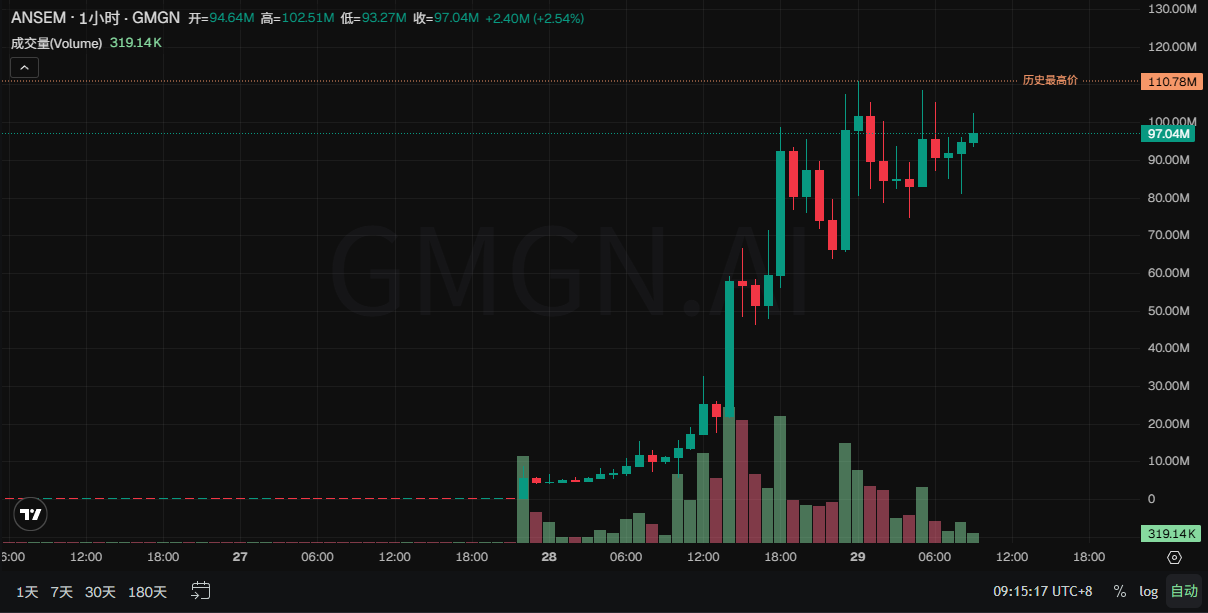
Lately, I've been focused on researching major opportunities within the World Cup prediction markets, completely missing out on an even bigger opportunity in a corner of the on-chain world. Yesterday, the Solana Meme scene witnessed a long-awaited rapid-rise play — ANSEM. In the early hours of yesterday, ANSEM's market cap was only around $4 million. In less than a day, it surpassed $100 million and currently stands at approximately $97 million.
Stories of overnight riches flooded social media.

According to Lookonchain monitoring, a smart-money wallet spent 56.4 SOL (around $4,050) to buy 25.99 million ANSEM 10 days ago. As ANSEM's price skyrocketed, the holder sold all holdings yesterday for 7,649 SOL, valued at approximately $539,000, realizing a gain of over 135x.

Why did ANSEM suddenly surge? What is its actual relationship with the prominent KOL Ansem? Can it lift other Meme coins? Odaily Planet Daily will delve into these questions below.

Does It Matter if ANSEM Isn't Issued by Ansem?

Upon hearing of ANSEM's surge yesterday, many people's first reaction was: Is this a token issued by Ansem himself?

The answer is no.

Ansem, whose real name is Zion Thomas, is one of the most representative KOLs in the Solana Meme circle. During the last Meme frenzy, keywords like WIF, Solana small caps, early-stage pumps, and on-chain bullish sentiment were long associated with him. For many Solana players, Ansem is not just a KOL but more like the "King of Solana Memes."

However, ANSEM is not a token issued by him.

ANSEM, full name The Black Bull, is a community Meme within the Solana ecosystem. It is neither issued by Ansem nor endorsed by him in any way. Its description even specifically emphasizes that the token has no official affiliation with Ansem.

But in the Meme market, "relationship" isn't defined by official statements; it's shouted into existence by the community. The name ANSEM alone naturally directs associations toward Ansem. As long as the community is willing to create content, memes, and narratives around this name, ANSEM is automatically categorized as an Ansem-related Meme.

Even more cleverly, ANSEM's theme is "The Black Bull." This name expertly captures the emotions of Meme players. The Black Bull doesn't correspond to a specific product but rather to the market persona Ansem has cultivated: bullish on Solana, fearless in chasing Memes, unafraid of volatility, standing in the on-chain trenches like a black bull.

ANSEM didn't stop at just the name. The creator sent approximately 65% of ANSEM's total supply to Ansem's public wallet, forcibly tethering the token to Ansem himself through on-chain holdings.

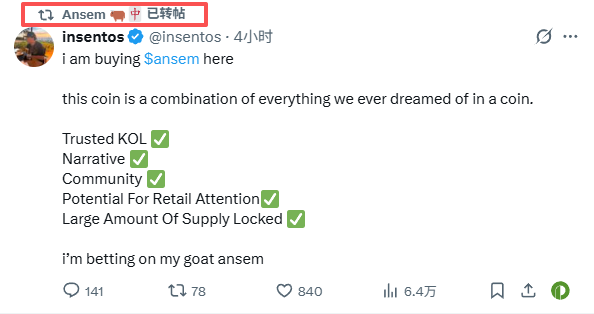
However, the true catalyst for ANSEM's 190x surge within a day was an X (formerly Twitter) post from Ansem that touched the most sensitive nerve of Solana Meme players — the long-awaited PUMP airdrop hadn't arrived, so he would give something back to the on-chain community.

With No PUMP Airdrop in Sight, Market Sentiment Found a Home in ANSEM

ANSEM truly began attracting concentrated attention from large funds following Ansem's statement regarding Pump.fun creator fees.

On X, he stated, "I have no current plans to launch a personal token, but I will use the creator fees earned from my Pump.fun profile to randomly airdrop to followers each week." Reportedly, Ansem earned around $200,000 from these creator fees last week alone.
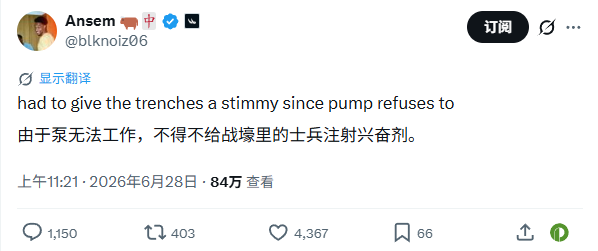
This statement perfectly addressed the emotional void left by the absent PUMP airdrop.

Pump.fun has generated significant revenue, and the PUMP token has been launched, but the airdrop many early users anticipated never materialized. When Ansem said he would redistribute his earnings from Pump.fun back to on-chain players, the market easily interpreted it as a simpler message: What PUMP didn't deliver, Ansem will.

ANSEM was consequently thrust back into the spotlight. It was no longer just another Ansem-related Meme but became the most direct trading vehicle for the sentiment of "Ansem giving back to the on-chain community."

More importantly, Ansem's continued engagement on X yesterday, discussing Solana Memes, Pump.fun, and market sentiment, allowed this association to further ferment.
The Meme "Feeling" is Back, But Don't Forget This is a Sentiment Play

The reason ANSEM went viral across all platforms yesterday is precisely because its rise was fast and furious enough. It had been a long time since a Solana ecosystem Meme coin rallied from a rapid pump to a market cap exceeding $100 million within a single day, and equally long since stories of "turning thousands into hundreds of thousands" flooded the on-chain narrative.

Of course, ANSEM's ability to be rapidly bid up in a short period is also related to its token distribution. The creator sending ~65% of the total supply to Ansem's public wallet essentially locked a majority of the tokens in an address under the market's full scrutiny. With fewer tokens actually circulating for trading externally, concentrated buying pressure can more easily push the price up.

ANSEM captured the sentiment left unfulfilled by the missing PUMP airdrop, as well as the pent-up restlessness of Solana Meme players who hadn't seen a major rally in a long time. ANSEM's current ascent is still largely driven by sentiment, consensus, and attention. Whether Ansem will continue engaging, if community heat can be sustained, and if major holders will sell are all uncertainties. Particularly with a low actual circulating supply, what goes up fast can come down even faster.

As for how long this sentiment-fueled fire will burn, it depends on whether the community can continue expanding the narrative, and whether newcomers are willing to keep buying into this story.


Domande pertinenti

QWhat is the connection between the ANSEM token and the KOL named Ansem?

AThe ANSEM token is not issued or officially endorsed by the KOL Ansem. However, it is a community meme token on Solana named after him, and its creator sent approximately 65% of the total ANSEM supply to Ansem's public wallet, creating a strong associative link in the community's perception.

QWhat triggered the rapid price surge of ANSEM as mentioned in the article?

AThe rapid surge was primarily triggered by Ansem's post on X, where he stated he would use the creator fees earned from his Pump.fun profile for weekly random airdrops to followers. This tapped into the community's unfulfilled expectations for a PUMP token airdrop, redirecting that market sentiment towards ANSEM.

QAccording to the article, what was one specific example of a high-return trade involving ANSEM?

AAccording to Lookonchain, one 'smart money' address bought 25.99 million ANSEM for 56.4 SOL (around $4,050) 10 days prior. They sold all of it yesterday for 7,649 SOL (approximately $539,000), realizing a profit of over 135 times their initial investment.

QWhat is the full name of the ANSEM token and what does it symbolize?

AThe full name of the ANSEM token is 'The Black Bull'. It symbolizes the market image of KOL Ansem, who is known for being bullish on Solana, aggressively trading memes, and enduring market volatility—qualities likened to a 'black bull' in the crypto trenches.

QWhat does the article suggest are the main risks or uncertain factors for the ANSEM token?

AThe article suggests the main risks include its reliance on community sentiment and attention rather than fundamentals, the uncertainty of whether Ansem will continue to engage with it, the potential for large holders (like the wallet holding 65% of supply) to sell, and the token's high volatility due to a relatively low circulating supply.

Letture associate

IPO Imminent, OpenAI Faces Major Personnel Upheaval

OpenAI, preparing for a potential IPO, is experiencing significant leadership turmoil. In mid-August 2026, longtime "GPU geek" Scott Gray quietly left, and within three days, Chief Operating Officer Brad Lightcap (8-year veteran) and Chief Revenue Officer Denise Dresser (8-month tenure) departed. This follows a broader exodus of at least 10 senior executives in 2026, including heads of product, safety, and ethics. Analysts view this as a strategic "surgery" to transform from a research lab into a sales-driven enterprise company before going public. Revenue now tilts toward enterprise clients, surpassing consumer income sooner than expected, with annualized revenue reaching $40 billion. The new CRO, Dali Rajic, is a veteran enterprise sales leader. Concurrently, OpenAI has disbanded independent safety teams like "Preparedness," which assessed catastrophic risks, integrating their functions into core research. Critics warn this removes dedicated "brakes" on AI development. The leadership vacuum raises questions about who is the clear second-in-command after former apps CEO Fidji Simo moved to an advisory role. Co-founder Greg Brockman appears to be consolidating power. As OpenAI races against rival Anthropic ($47B annualized revenue), it faces the dual challenge of commercial execution while managing the departure of foundational technical talent and ensuring responsible AI development remains a priority.

marsbit9 min fa

IPO Imminent, OpenAI Faces Major Personnel Upheaval

marsbit9 min fa

AI Can 'Have Moods Too'! New Research from USTC: Confusion and Anxiety Make AI Work Better

The article discusses research from the University of Science and Technology of China and Oxford, revealing that allowing AI to recognize and act upon simulated "internal emotions" can significantly improve its performance. The study demonstrates a coherent pairing between specific emotional states in AI agents and their subsequent skill choices. For instance, an agent feeling curious and desirous will search for products, while one feeling confused and tense will rephrase queries. This mirrors human decision-making influenced by emotions. Statistical validation showed a 76.5% semantic consistency in these pairings. Crucially, the research challenges the traditional view of AI errors as flaws to be eliminated. It found that "bad" emotions like confusion, tension, or frustration serve as useful metacognitive signals, indicating a mismatch between the current strategy and the environment. By responding to these signals, AI can proactively adjust before a failure occurs. This is particularly effective in complex tasks prone to failure. For example, in tasks like "heating an item" and "picking up two items," success rates surged from 9.6% to 56.9% and 4.4% to 31.3%, respectively, when using the emotion-driven skill selection method (EMOTION2SKILL). The AI's "nervous" state about a closed microwave, for instance, prompted it to check and open it first, preventing failure. The article also mentions related work from Tianjin University, which embeds emotional prediction into world models (Large Emotional World Model, LEWM), significantly improving prediction accuracy in human-centric environments. Removing emotional data was found to degrade performance even in unrelated logical reasoning tasks. These studies build on earlier findings, like those from Anthropic, that identifiable emotional representations exist within large language models (LLMs). The focus is shifting from philosophical debate about AI emotion to practically harnessing these internal states as functional signals to enhance AI robustness and capability.

marsbit44 min fa

AI Can 'Have Moods Too'! New Research from USTC: Confusion and Anxiety Make AI Work Better

marsbit44 min fa

Trading

Spot
活动图片