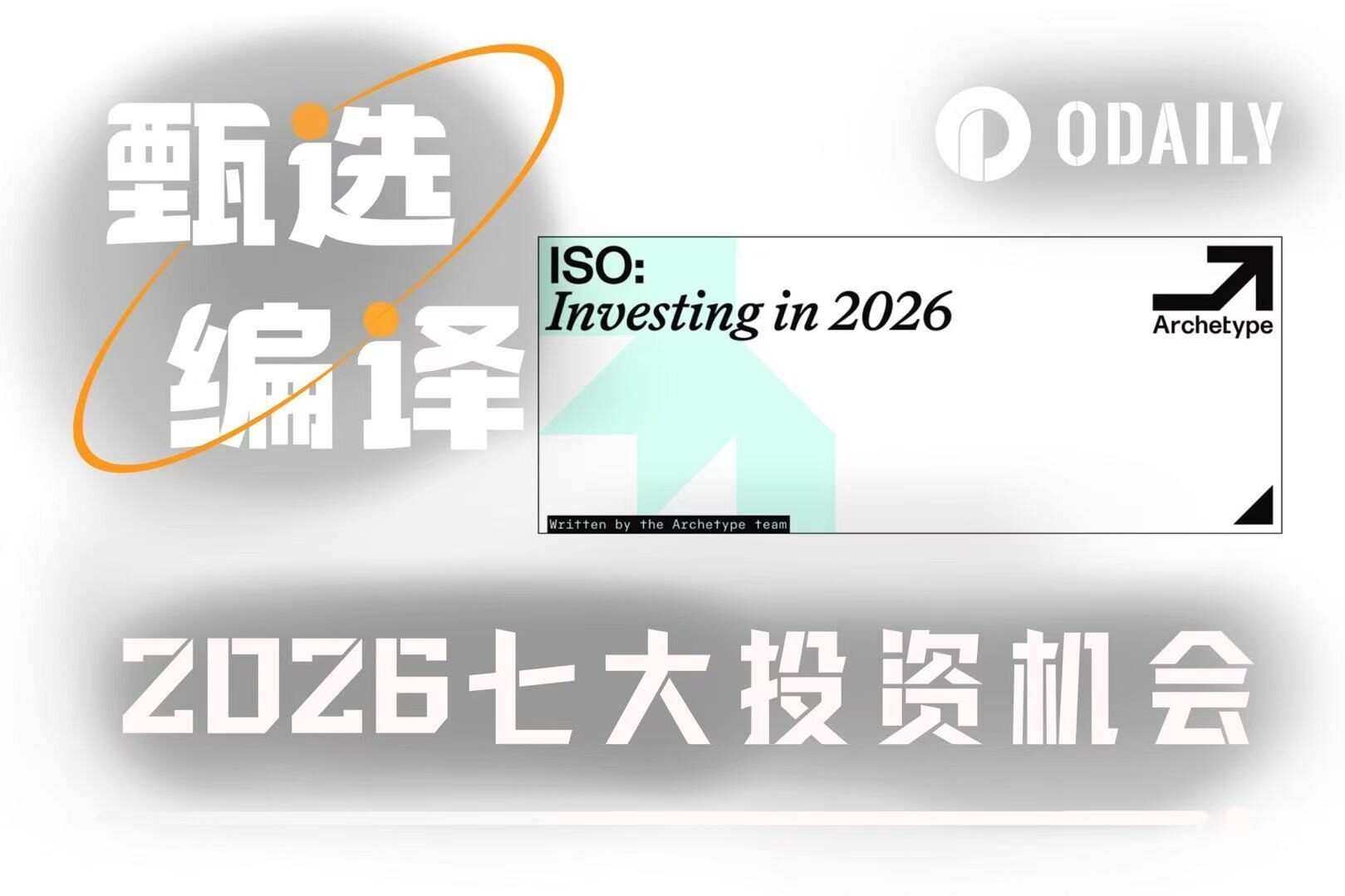
A Brief History of the Encrypted Future: Seven Major Trends Reshaping the Industry Narrative in 2026

Odaily星球日报Pubblicato 2025-12-11Pubblicato ultima volta 2025-12-11

Introduzione

"Crypto Future: 7 Trends Reshaping the Industry Narrative in 2026" This article outlines seven key trends expected to define the crypto industry in 2026. First, **Appchains** will see a major breakthrough, as applications built on custom, purpose-specific blockchains optimized for unique user experiences and cultures will flourish, enabled by modular infrastructure. Second, **prediction markets** will continue to innovate, with success hinging on solutions that reduce spreads, increase open interest, and capture specific categories of volume. Third, **Agentic Curators** will emerge, using AI agents (LLMs with tools) to manage DeFi risk and strategies through reasoning, not just fixed algorithms, competing directly with human managers. Fourth, **short-form video** will become the dominant traffic and commerce gateway, with platforms blurring the lines between content and payment. Crypto is essential for enabling microtransactions and tracking complex revenue sharing. Fifth, **new AI Scaling Laws** will be driven by blockchain, as decentralized training and inference networks move from testing to production, offering verifiable, confidential computation and challenging centralized AI development. Sixth, **RWA (Real World Assets)** will achieve real-world adoption at scale. Tokenization will expand beyond stablecoins to assets like commodities, credit, and equities, upgrading global capital markets through on-chain transparency and DeFi composability. Finally, an **Agent-...

Author | @archetypevc

Compiled by | Odaily Planet Daily (@OdailyChina)

Translator | DingDang (@XiaMiPP)

Editor's Note: As we step into 2026, the focus of the industry narrative is quietly shifting. Structural adjustments are underway in capital, infrastructure, user demands, and content distribution methods. Archetype has gathered insights from multiple industry researchers to outline several trends that are currently forming and may evolve into key investment windows in the coming year.

This article is compiled by Odaily Planet Daily, aiming to present readers with Archetype's perspective on the underlying driving forces of the next phase of crypto applications and the structural inflection points most worthy of attention in 2026.
When "Chains Built for Apps" Finally Make Sense: The Best Time for Appchains Has Arrived

by Aadharsh Pannirselvam

In a nutshell: Blockchains that are deliberately designed, finely crafted, and built and optimized based on underlying primitives for specific application scenarios will truly explode in the next year or two.

The developers, users, institutions, and capital recently flooding onto the chain are very different from those in previous cycles. They have their own distinct cultures and preferences (i.e., their definition of "user experience"), which are often more important than abstract concepts like "decentralization" or "censorship resistance." Sometimes, these needs align with existing infrastructure; other times, they require completely different chain structures.

User experience is particularly crucial for crypto applications like Blackbird and Farcaster that target non-professional users and are abstracted. Designs that would have been considered heretical three years ago, such as node deployment, a single sequencer, or customized databases, are now the most reasonable solutions. The same applies to stablecoin chains or trading scenarios (like Hyperliquid, GTE) that are highly dependent on latency and price precision.

But not all new applications are like this.

Today, an important counterforce is growing: the preference for "privacy" from both institutions and the general user base. The experiential demands of different applications vary greatly, so their underlying chain architectures should not be uniform.

The good news is that assembling a chain from scratch that meets application needs is far simpler than it was two years ago. It's now more like "building a custom PC."

You can pick every hard drive, fan, and power cable yourself—but most of the time, this isn't necessary. You can simply choose from a range of highly compatible, customizable preset configurations, like selecting a Digital Storm or Framework. If you need a degree of personalization, you can add your own components on top of their proven base. This ensures stability while maintaining high flexibility.

Similarly, when applications can freely assemble and adjust primitives like consensus mechanisms, execution layers, data storage, and liquidity structures, they can build chain forms with different cultural characteristics, allowing the application's own "experience definition" to be natively supported, thus forming a differentiated competitive advantage. This difference is like the distinct yet shared underlying commonalities between a ToughBook, ThinkPad, desktop tower, and MacBook.

More importantly, each component becomes a tunable "knob," without worrying about affecting the whole system or being constrained by the upgrade pace of the parent protocol.

With Circle's acquisition of Informal Systems' Malachite, the importance of independently mastering "customized block space" has become an industry trend. In the coming year, I look forward to seeing more applications quickly build their own chains and block space using "default templates" and underlying modules provided by Commonware, Delta, etc., much like using HashiCorp or Stripe Atlas.

Ultimately, this will allow applications to truly control their own cash flow and build moats through chain structures that better fit the user experience.

Prediction Markets Will Continue to Innovate (But Only Some Players Will Break Through)

By Tommy Hang

In this cycle, prediction markets have undoubtedly been one of the best-performing application categories. The total trading volume of fully on-chain prediction markets has repeatedly hit new highs, with weekly trading volumes consistently breaking $2 billion, clearly indicating that this category has taken a key step towards becoming a mass-consumer product.

Amid the hype, a large number of new projects attempting to challenge Polymarket and Kalshi have emerged. But identifying "true innovation" amidst the noise is key to judging which projects are worth focusing on in 2026.

From a market structure perspective, I am most interested in solutions that reduce spreads and enhance open interest. Although market creation is still permissioned and curated, liquidity in prediction markets remains thin for both market makers and traders. The best paths include optimizing routing system, introducing different liquidity models, and improving collateral efficiency based on products like lending.

Categorized trading volume is a key factor determining platform success. For example, over 90% of Kalshi's trading volume in November came from sports markets, indicating that some platforms are naturally better suited to compete for specific liquidity. In contrast, Polymarket's trading volume in crypto and political markets is 5–10 times higher than Kalshi's.

Of course, on-chain prediction markets still have a long way to go before achieving true "mass adoption." For instance, the 2025 Super Bowl alone generated $23 billion in off-the-books betting volume in a single day, more than 10 times the current daily trading volume of all on-chain markets combined.

Closing this gap requires teams that can truly solve the underlying challenges of prediction markets. I will continue to watch these players next year.

Agentic Curators: Expanding DeFi's Next Layer with "Intelligent Agents"

By Eskender Abebe

Today's DeFi "asset screening and risk configuration layer" (curation layer) tends towards two extremes: either fully algorithmic (fixed rate curves, preset rebalancing rules) or fully reliant on humans (risk committees, active managers).

Agentic curators represent a third path: AI agents (LLM + tools + recurrent scheduling) managing the risk and strategies of vaults, lending markets, and structured products, not by executing fixed rules, but through "reasoning"—logical deduction about risk, yield, and position strategy.

Take Morpho's market as an example: designing an attractive yield product requires defining collateral asset rules, LTV limits, and various risk parameters. This is currently a human bottleneck, and intelligent agents can scale this process. Soon, you will see intelligent agent curators competing directly with algorithmic models and human managers.

So, when will DeFi's "Move 37" arrive?

Many fund managers have extreme attitudes towards AI: either believing LLMs will automate all trading desks, or that they will immediately collapse in real markets. But both overlook the real structural change: AI agents combine emotionless execution, systematic strategy, consistent policy constraints, and reasoning ability, whereas humans are noisy and pure algorithms are too fragile. In the future, LLMs will act like "architects," designing risk frameworks, strategy constraints, and portfolio structures, while truly high-frequency and sensitive computations are still executed by deterministic code.

When the cost of deep reasoning drops to "pennies," the strongest vaults will no longer be managed by the smartest people, but driven by the strongest computing power.

Short-Form Video Will Become the New "Traffic Entry Point"

By Katie Chiou

Short-form video is becoming the default interface for "global users to discover and purchase content." TikTok Shop's GMV exceeded $20 billion in the first half of 2025, nearly doubling year-on-year, acclimating global users to "watch and buy," where entertainment is the storefront.

Instagram is shifting Reels from a defensive product to a core revenue engine. This format brings more exposure and is accounting for an increasingly larger share of Meta's projected ad revenue for 2025. Whatnot has proven that real-time, personalized sales methods can achieve conversions at speeds unattainable by traditional e-commerce.

The logic is simple: real-time viewing leads users to make decisions faster. Every swipe is a potential purchase point. Therefore, platforms are quickly blurring the line between "recommendation feed" and "payment process"; the information feed itself is the new point of sale, and every content creator is a distribution channel.

AI will accelerate this trend: reducing video production costs, increasing content quantity, allowing creators and brands to test ideas in real-time. More content, more touchpoints, the more incentive platforms have to optimize conversion efficiency every second.

And crypto fits this trend perfectly: faster content requires faster, cheaper, programmable payment channels. As shopping becomes frictionless and directly embedded into the content itself, we need a system that can settle micro-payments, programmatically distribute and allocate revenue, and track the contributions of various parties in complex influence chains. Cryptocurrency is built for such processes; it's hard to imagine how the era of hyper-scale streaming-native commerce would develop without it.

Blockchain Will Drive New AI Scaling Laws

By Danny Sursock

Over the past few years, the AI narrative has been dominated almost entirely by giants and unicorns, with decentralized innovators long overlooked. However, away from the spotlight, several crypto-native teams have made astonishing progress in "decentralized training and inference," and have moved from whiteboard demos to real testing and production environments.

Today, teams like Ritual, Pluralis, Exo, Odyn, Ambient, Bagel are ready to "take the main stage" and welcome their golden age. This new generation of competitors is expected to have an explosive, orthogonal impact on the fundamental development trajectory of artificial intelligence.

Distributed training environments are breaking through existing scaling limits; asynchronous communication and parallelization schemes are being proven feasible in training tasks of real scale.

New consensus mechanisms and privacy technologies are making "verifiable" and "confidential" inference a reality.

A new generation of chain architectures combines "truly intelligent contract systems" with more general computing models, enabling AI agents to use crypto assets as a unified medium of exchange, forming a complete autonomous computing closed loop.

The foundational work is done.

The next challenge is to bring these underlying facilities to large-scale production and prove that blockchain can drive fundamental innovation in AI, not just serve as a conceptual slogan or fundraising story.

RWA: Real World Assets Will Truly Land in the Real World

By Dmitriy Berenzon

RWA (Real World Assets) has been discussed for years, and now it's finally迎来规模化 adoption—mass adoption of stablecoins,完备顺畅的 on/off-ramps, and clearer regulatory frameworks have made it happen. According to RWA.xyz data, over $18 billion in various assets have been issued on-chain, compared to just $3.7 billion a year ago. This trend will continue to accelerate in 2026.

It's important to note that "Tokenization" and "Vaults" are two different RWA design patterns: the former digitizes real-world assets, while the latter channels on-chain capital into offline yield scenarios.

In the future, I look forward to seeing tokenization cover a wider range of fields: from gold and rare earth metals, to short-term credit for business operations, to public and private equity, and more global fiat currencies. We can even be "bolder"—eggs, GPUs, energy derivatives, wage advances, Brazilian government bonds, Japanese yen... all can be put on-chain.

In essence, RWA is not about "putting more things on the chain," but about upgrading the way global capital is allocated. The high barriers to entry, low transparency, and fragmentation of traditional markets can be redefined on public chains and combined with DeFi primitives to achieve composability.

Of course, many assets will still face challenges such as transfer restrictions, lack of transparency, poor liquidity, risk management, and distribution efficiency, so infrastructure that solves these problems will be equally critical.

The Agent-Driven Product Renaissance is Coming

By Ash Egan

The core of the next generation internet will no longer be the apps we scroll through, but the "intelligent agents" we converse with.

We all know that bots and agents are rapidly increasing their share of all network activity. Rough estimates suggest this proportion has now reached about 50%, including both on-chain and off-chain activities. In the cryptocurrency space, bots are increasingly参与 in trading, management, assistance, contract scanning, and performing various operations on our behalf, from token swaps and fund management to smart contract audits and game development.

This is precisely the beginning of a "programmable, agentified internet." And 2026 will be the first year crypto product design is truly "agent-centric" (in a positive, non-dystopian way).

The future form is still emerging, but for me at least, I hope to spend less time clicking between pages and more time managing on-chain agents in chat-like interfaces: like Telegram, but the conversation partner is a "specific application/specific task agent." They will be able to formulate and execute complex strategies, automatically gather information most relevant to me across the network, and present it as trading results, risks and opportunities to watch, and curated information. I give them tasks, and they track opportunities, filter out all irrelevant information, and execute at the optimal time.

The infrastructure needed for this vision is actually already prepared on-chain. Combining the default open data graph, programmable micro-payments, on-chain social graphs, and cross-chain liquidity rails, we have everything needed to support a dynamic agent ecosystem. The "plug-and-play" nature of the crypto world means the繁琐 processes and obstacles agents face will be significantly reduced. Compared to Web2 infrastructure, blockchain's readiness for this agent revolution cannot be overstated.

This might be the most crucial point here: This is not just automation, but a liberation from Web2's data silos, various frictions, and unnecessary waiting. We are seeing this transformation firsthand in search: about 20% of Google searches now directly provide AI overviews, and data shows that once users see this overview, the probability of them clicking on traditional search result links drops significantly. Manually flipping through pages of information is becoming obsolete. A programmable, agent-driven network will extend this experience further to all the applications we use daily, which I believe is a tremendous boon.

In this new era, we will: reduce mindless scrolling, reduce emotional panic trading, and time zone differences will be彻底抹平 (no more saying "wait for Asian markets to wake up"). Interaction with the on-chain world will become simpler and more expressive for both developers and ordinary users.

As more assets, systems, and users move on-chain, this cycle will continuously自我强化 and accelerate. The more opportunities on-chain, the more intelligent agents deployed, the more value unlocked. Rinse and repeat. But what we build now, and how we build it, will determine whether this "agent-driven network" ultimately becomes a thin layer of noise and automation, or truly ignites a user-empowering, vibrant, and innovative product renaissance.

Domande pertinenti

QAccording to the article, what is the key reason for the rise of appchains in 2026?

AAppchains are rising because they allow applications to be built on blockchains that are specifically designed, finely tuned, and optimized for their unique use cases and user experience preferences, which is now easier than ever to assemble.

QWhat is identified as a major challenge for prediction markets to achieve mass adoption, and what is a key metric for success?

AA major challenge is the gap in trading volume compared to traditional markets (e.g., $23B in Super Bowl OTC betting vs. current on-chain daily volume). A key metric for success is the ability to reduce spreads and increase open interest.

QWhat new role does the article predict for AI agents (Agentic Curators) in the DeFi ecosystem?

AAI agents will act as 'curators' that use reasoning and logic to manage risk and strategy for vaults, lending markets, and structured products, competing with both algorithmic models and human managers.

QHow is the trend of short-form video as a 'traffic entry point' connected to the need for cryptocurrency?

AShort-form video platforms are blurring the line between content and commerce, requiring faster, cheaper, and programmable payment channels to settle micro-payments and distribute revenue programmatically, which is a natural fit for cryptocurrency.

QWhat fundamental shift in product design does the article predict for 2026, enabled by agents?

AProduct design will shift to be 'agent-centric,' where users interact with task-specific AI agents through chat-like interfaces to manage complex strategies and execute actions, moving away from manually clicking through applications.

Letture associate

Five Core Forms of AI Agent in YC's Eyes

The article outlines five core architectural patterns for effective AI Agents, emerging from tools like Codex and Claude, that move beyond simple prompts towards reusable, process-based capabilities. 1. **Skills**: Reusable, parameterized workflows that function like method calls, allowing a single process (e.g., "/investigate") to handle various tasks based on input parameters. 2. **Thin Harness**: A lightweight execution framework (~200 lines) that manages the AI model's "hands and feet"—handling loops, file I/O, and context—without becoming bloated. 3. **Resolvers**: Routing tables that map tasks to specific Skills, preventing "context corruption" when managing dozens of Skills and ensuring outputs go to the correct locations. 4. **Latent vs. Deterministic Layer**: A critical separation where LLMs handle judgment, synthesis, and pattern recognition, while deterministic code handles tasks requiring precision, consistency, and low cost (like calculations). 5. **Memory**: A persistent, accumulating knowledge base (e.g., a markdown folder) with a "current trusted conclusion" section and an append-only timeline, enabling the system to learn and retain context over time. Together, these patterns create a "process power"—a durable competitive advantage. Unlike one-off prompt-based applications whose value quickly commoditizes, a well-designed AI Agent system encodes experience into reusable, parameterized workflows, offloads stable rules to code, and continuously learns through memory. This creates a structured, hard-to-replicate capability that can provide sustained value for individuals or businesses, such as an accountant automating client reviews while preserving privacy and accumulating expertise.

marsbit1 h fa

Five Core Forms of AI Agent in YC's Eyes

marsbit1 h fa

Tiger Research: On-Chain Risk Operators, The Market Cap Gap Between 147 Trillion and 70 Billion

This report by Tiger Research examines the evolution of risk management in decentralized finance (DeFi) lending. It highlights a power shift from protocol developers to specialized professional risk operators who manage on-chain capital. The era of protocols and community governance solely dictating DeFi lending is ending. A new professional asset management layer has emerged. While the sector is nascent, capital and distribution channels are rapidly consolidating around top risk operator teams, whose past performance is now a key criterion for institutional entry. The industry's development, accelerated by modular infrastructures like Morpho, has led to a clear division of labor mirroring traditional finance: distribution channels (e.g., exchanges), strategy/risk management (the risk operators), and product infrastructure/asset custody (smart contract protocols). This structure lowers the entry barrier for traditional institutions. Currently, the total value managed by risk operators is approximately $70 billion, dominated by a few leading teams like Steakhouse (RWA focus), Sentora (AI models), and Gauntlet (crisis management). Competition now centers on collateral standards, distribution access, and crisis response capabilities. The report outlines three primary entry paths for institutions: 1) **Distribution Model**: Leveraging external risk operators as backend service providers (common for exchanges). 2) **Asset Supply Model**: Onboarding real-world assets to DeFi as collateral. 3) **Independent Operator Model**: Building an in-house team to become a risk operator (e.g., Bitwise). The core opportunity lies in the strategy/risk management layer, where traditional financial institutions can leverage their existing expertise in due diligence and risk assessment without deep technical development. A vast opportunity gap exists: the global traditional asset management industry manages ~$147 trillion, while the entire DeFi sector is only ~$800 billion, with the risk operator niche at ~$70 billion. This disparity signifies immense growth potential. Once robust risk frameworks and clearer regulations are established, even a minor allocation from traditional markets could trigger exponential DeFi growth. Early movers who help build these foundational systems will gain significant rule-setting influence and first-mover advantages.

marsbit1 h fa

Tiger Research: On-Chain Risk Operators, The Market Cap Gap Between 147 Trillion and 70 Billion

marsbit1 h fa

Interview with Circle's Chief Economist: USDC's Entry into Hyperliquid Benefits Circle and HYPE, Stablecoins Are Becoming Marginal Buyers of U.S. Treasuries

In an interview with Circle's Chief Economist Gordon Liao, the conversation covers the strategic significance of USDC replacing USDH as the reference asset on the decentralized perpetual exchange Hyperliquid. This shift, facilitated by Coinbase as the reserve manager and Circle providing technical infrastructure, aims to capture net interest income for the platform, with 90% of reserve earnings directed back to Hyperliquid for HYPE token buybacks. Liao discusses how stablecoins like USDC, with their substantial on-chain settlement volumes (e.g., $21 trillion in Q1 2026), are emerging as marginal buyers of U.S. Treasuries, concentrating on short-term debt and effectively reducing the weighted duration of the market, which may provide underlying support for long-term rates. The dialogue also explores the evolving nature of stablecoins as both a medium of exchange and a vehicle for capital and collateral liquidity. Additionally, the panel touches on the CLARITY Act's legislative progress, noting compromises around "activity-based rewards" and remaining hurdles like ethics concerns. On AI, there's debate over value capture, with predictions that distribution and application layers, rather than foundational model companies like OpenAI, will accrue most value. Regarding the bond market, Liao attributes the rise in 30-year yields primarily to an increased term premium (around 80 bps) driven by supply-demand dynamics, including fiscal expansion and changing investor demand, rather than expectations of Fed rate hikes.

marsbit1 h fa

Interview with Circle's Chief Economist: USDC's Entry into Hyperliquid Benefits Circle and HYPE, Stablecoins Are Becoming Marginal Buyers of U.S. Treasuries

marsbit1 h fa

Trading

Spot
Futures

Articoli Popolari

Come comprare HPP

Benvenuto in HTX.com! Abbiamo reso l'acquisto di House Party Protocol (HPP) semplice e conveniente. Segui la nostra guida passo passo per intraprendere il tuo viaggio nel mondo delle criptovalute.Step 1: Crea il tuo Account HTXUsa la tua email o numero di telefono per registrarti il tuo account gratuito su HTX. Vivi un'esperienza facile e sblocca tutte le funzionalità,Crea il mio accountStep 2: Vai in Acquista crypto e seleziona il tuo metodo di pagamentoCarta di credito/debito: utilizza la tua Visa o Mastercard per acquistare immediatamente House Party ProtocolHPP.Bilancio: Usa i fondi dal bilancio del tuo account HTX per fare trading senza problemi.Terze parti: abbiamo aggiunto metodi di pagamento molto utilizzati come Google Pay e Apple Pay per maggiore comodità.P2P: Fai trading direttamente con altri utenti HTX.Over-the-Counter (OTC): Offriamo servizi su misura e tassi di cambio competitivi per i trader.Step 3: Conserva House Party Protocol (HPP)Dopo aver acquistato House Party Protocol (HPP), conserva nel tuo account HTX. In alternativa, puoi inviare tramite trasferimento blockchain o scambiare per altre criptovalute.Step 4: Scambia House Party Protocol (HPP)Scambia facilmente House Party Protocol (HPP) nel mercato spot di HTX. Accedi al tuo account, seleziona la tua coppia di trading, esegui le tue operazioni e monitora in tempo reale. Offriamo un'esperienza user-friendly sia per chi ha appena iniziato che per i trader più esperti.

96 Totale visualizzazioniPubblicato il 2026.04.29Aggiornato il 2026.04.29

Come comprare HPP

Cosa è GENIUS

I. Introduzione al Progetto1. Cos'è Genius?Genius (GENIUS) si posiziona come il "terminal on-chain definitivo", una piattaforma di trading decentralizzata focalizzata sulla privacy e sulla velocità. Integrando tecnologie di privacy di alto livello, mira a costruire un'infrastruttura di trading privacy di nuova generazione attraverso reti come BNB Chain, consentendo agli utenti di interagire on-chain con un'esperienza fluida paragonabile a quella degli exchange centralizzati.2. Come Funziona Genius?L'architettura tecnica principale di Genius è strutturata come segue:(1) Invisibile alla catena: Gli utenti non devono gestire manualmente approvazioni a più passaggi per operazioni cross-chain, wrapping di asset o gestione complessa del gas.(2) Trading senza Firma: Attraverso integrazioni come Turnkey, Genius consente trading istantaneo senza conferme a comparsa o autorizzazione per transazione.(3) Aggregatore di Aggregatori: Genius è alimentato da uno stack di aggregazione di prima classe integrato con oltre 150 DEX, vantando un'efficienza di quotazione superiore rispetto ai prodotti concorrenti.(4) Gestione degli Account: La piattaforma adotta un'architettura non custodiale e sfrutta Turnkey e Lit Protocol per la gestione delle chiavi, consentendo agli utenti di accedere in modo sicuro ai propri account tramite passkey.3. Chi Ha Creato Genius?Secondo i suoi Termini di Servizio ufficiali, Genius è stato sviluppato da Shuttle Labs, Inc. Basandosi sull'account ufficiale X del progetto, Ryan Myher è uno dei principali contributori che guidano l'iterazione del prodotto, inclusi sviluppi come il lancio del protocollo Ghost, oltre a un coinvolgimento più ampio della comunità.Il fondatore di Binance CZ ha ufficialmente aderito al progetto come consulente, con l'obiettivo di aiutare il team a costruire un'esperienza di trading on-chain più veloce e rispettosa della privacy.Inoltre, il progetto ha ricevuto un forte sostegno da YZi Labs, che ha investito in Genius e collabora con la Genius Foundation, responsabile della manutenzione del core Genius Bridge Protocol (GBP).4. Tokenomics di GeniusGENIUS è il token nativo dell'ecosistema Genius. Ad oggi, il progetto non ha rilasciato un documento completo di tokenomics.Basandosi sulle ultime divulgazioni ufficiali, Genius incorpora un meccanismo deflazionistico, e il 4,6% dell'offerta totale di token era già stato bruciato durante la fase di lancio iniziale.Sistema di Genius Points (GP):(1) Trade-to-Earn: La piattaforma ha stabilito un pool di ricompensa di 200 milioni di Genius Points, e gli utenti guadagnano GP per ogni trade eseguito tramite il terminale.(2) Livelli e Badge: Genius presenta un sistema di badge basato sulla progressione che va da Smart a God, con livelli superiori che sbloccano vantaggi e benefici aggiuntivi.(3) Rendimento Nativo: Gli utenti che detengono asset designati come usdGG nel dashboard possono guadagnare rendimento nativo direttamente senza dover passare attraverso staking complessi.(4) Incentivi per Referral: I referenti possono guadagnare rimborsi sulle commissioni superiori al 45% pagati in USDC, insieme a GP aggiuntivi.5. Cronologia & Traguardi ChiaveMarzo 2020: È stato creato l'account ufficiale X del progetto, segnando l'inizio della sua fase di preparazione iniziale.13 gennaio 2026: Genius ha annunciato un investimento multimilionario da YZi Labs e ha contemporaneamente confermato CZ come consulente per accelerare lo sviluppo della sua infrastruttura di trading privacy.18 aprile 2026: Il progetto ha annunciato che il protocollo di privacy Ghost sarebbe stato lanciato a breve.29 aprile 2026: Il protocollo Ghost è stato ufficialmente aperto ai suoi primi 50 tester, segnando l'inizio di una nuova era per il trading privacy su BNB Chain. Allo stesso tempo, il team ha confermato che il 4,6% dei token è stato bruciato.​II. Informazioni sul Token1) Informazioni di BaseNome del token: GENIUS (Genius)III. Link CorrelatiSito web:https://www.tradegenius.com/homeEsploratori:https://bscscan.com/address/0x1f12b85aac097e43aa1555b2881e98a51090e9a6Social:https://x.com/GeniusTerminalNota: L'introduzione al progetto proviene dai materiali pubblicati o forniti dal team ufficiale del progetto, che è solo a scopo di riferimento e non costituisce consulenza per gli investimenti. HTX non si assume responsabilità per eventuali perdite dirette o indirette risultanti.

226 Totale visualizzazioniPubblicato il 2026.04.29Aggiornato il 2026.05.12

Cosa è GENIUS

Come comprare GENIUS

Benvenuto in HTX.com! Abbiamo reso l'acquisto di Genius (GENIUS) semplice e conveniente. Segui la nostra guida passo passo per intraprendere il tuo viaggio nel mondo delle criptovalute.Step 1: Crea il tuo Account HTXUsa la tua email o numero di telefono per registrarti il tuo account gratuito su HTX. Vivi un'esperienza facile e sblocca tutte le funzionalità,Crea il mio accountStep 2: Vai in Acquista crypto e seleziona il tuo metodo di pagamentoCarta di credito/debito: utilizza la tua Visa o Mastercard per acquistare immediatamente GeniusGENIUS.Bilancio: Usa i fondi dal bilancio del tuo account HTX per fare trading senza problemi.Terze parti: abbiamo aggiunto metodi di pagamento molto utilizzati come Google Pay e Apple Pay per maggiore comodità.P2P: Fai trading direttamente con altri utenti HTX.Over-the-Counter (OTC): Offriamo servizi su misura e tassi di cambio competitivi per i trader.Step 3: Conserva Genius (GENIUS)Dopo aver acquistato Genius (GENIUS), conserva nel tuo account HTX. In alternativa, puoi inviare tramite trasferimento blockchain o scambiare per altre criptovalute.Step 4: Scambia Genius (GENIUS)Scambia facilmente Genius (GENIUS) nel mercato spot di HTX. Accedi al tuo account, seleziona la tua coppia di trading, esegui le tue operazioni e monitora in tempo reale. Offriamo un'esperienza user-friendly sia per chi ha appena iniziato che per i trader più esperti.

122 Totale visualizzazioniPubblicato il 2026.04.29Aggiornato il 2026.05.12

Come comprare GENIUS

Discussioni

Benvenuto nella Community HTX. Qui puoi rimanere informato sugli ultimi sviluppi della piattaforma e accedere ad approfondimenti esperti sul mercato. Le opinioni degli utenti sul prezzo di A A sono presentate come di seguito.

活动图片