Nvidia's stock price closed lower for the seventh consecutive trading session, setting a new record for the longest losing streak since 2022.
On Monday, Nvidia's stock closed down 2.91%. Year-to-date, Nvidia has accumulated gains of only about 7%, ranking at the bottom among constituents of the Philadelphia Semiconductor Index. AI chip spending is being dispersed across a broader range of semiconductor companies.
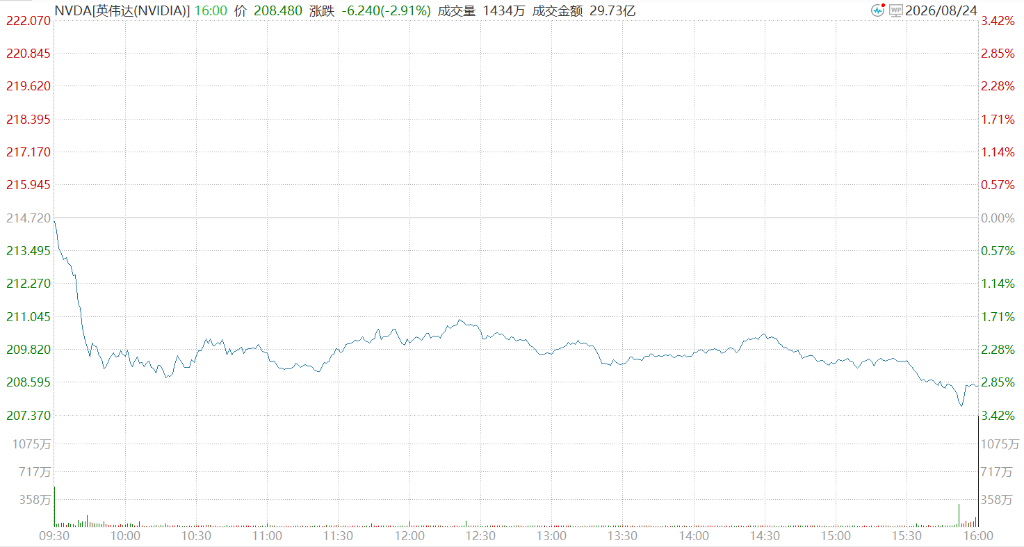
Valuation metrics are also declining, with Nvidia's forward price-to-earnings ratio dropping to approximately 18 times, reaching a new low in recent years. Despite strong fundamentals, market pricing for the AI hardware sector is becoming more cautious.
Contrasting with the stock price decline, Wall Street analysts continue to raise their earnings forecasts for Nvidia. Over the past three months, profit expectations have been cumulatively revised upward by 13%. The divergence between stock price movements and fundamental expectations is the most notable signal in this round of correction.
The Debate Over Valuation Retreat and Earnings Quality
Nvidia's forward P/E ratio has fallen to about 18x, a multi-year low. The cautious market pricing for the AI hardware segment stems from investors' ongoing scrutiny of its earnings quality and customer concentration.
Previously disclosed in Nvidia's 10-Q filing, of the approximately $58 billion in net profit, $13.4 billion came from unrealized gains on holdings of publicly traded equities. Excluding this portion, the normalized net profit corresponds to a P/E ratio approaching 60x; the top three customers collectively contributed 54% of revenue.
Despite stock price pressure, Wall Street analysts persist in raising their profit forecasts for Nvidia.
Over the past three months, Nvidia's profit forecasts have been cumulatively raised by 13%, with expectations for fiscal year 2027 reaching $228 billion in profit. Among the 82 analysts covering the stock, only three assign a Hold rating, and one assigns a Sell rating. The average price target implies upside potential of over 50%.
Fundamentals also remain robust. Nvidia's Data Center business achieved $193.7 billion in revenue for FY2026, with the upstream compute infrastructure segment capturing a scarcity premium first.
Regarding capital return, Nvidia authorized an additional $80 billion for stock repurchases in the quarter ended April, replacing Apple as the largest single share repurchaser in the U.S. stock market.
Moving forward, the focus will be on whether Nvidia can stabilize after the continuous pullback and whether the analysts' consistently rising profit forecasts will be reflected in the stock price.