Wall Street Morning News: S&P and Dow Hit New Highs, Philadelphia Semiconductor Index and Chip Stocks Rise for 4th Straight Day, SanDisk and Intel Surge Over 10%, Micron's Market Cap Returns to $1 Trillion

marsbitPubblicato 2026-08-05Pubblicato ultima volta 2026-08-05

Introduzione

U.S. stocks surged to record highs driven by strong earnings and easing Middle East tensions. The Dow Jones and S&P 500 both hit closing records, with the Nasdaq jumping 2.59%. The Philadelphia Semiconductor Index soared 6.55%, marking four straight days of gains, fueled by a broad AI rally spanning chips, software, and infrastructure. SanDisk and Intel surged over 10%, while Micron's market cap returned to the $1 trillion level. Geopolitical optimism weighed on oil, with WTI crude falling over 5%. Reports indicated the U.S., Iran, and Oman are nearing a temporary deal to reopen the Strait of Hormuz, alleviating supply disruption fears and lowering September Fed rate hike probabilities. Key stock movers included Palantir, up 29.45% on explosive revenue growth; Caterpillar, hitting a record high on raised guidance linked to data center demand; and AMD, rising 7% despite a post-earnings dip. Nvidia gained 2.56% after announcing new open-source models and securing an exclusive AI partnership with SpaceX. However, Oracle faces heightened credit risk due to heavy AI-related borrowing. Markets now focus on upcoming earnings from Uber and Eli Lilly, and a major SpaceX share lockup expiry on August 6th.

Published every Monday to Friday morning, focusing on macroeconomics, U.S. stocks, AI, precious metals, crude oil, and other directions. We review the market with data and seize opportunities with trends, produced by PANews.
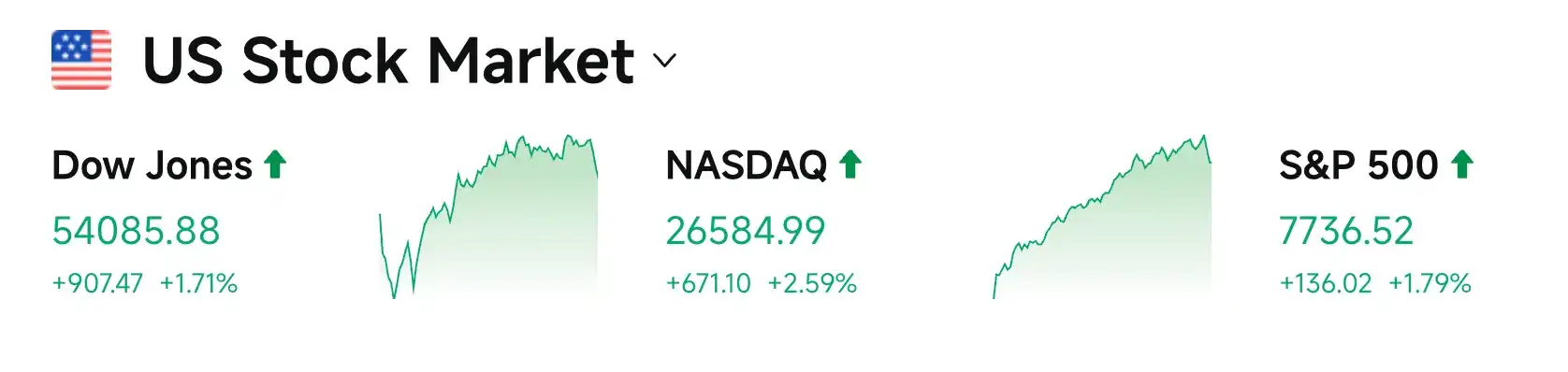
U.S. stocks soared across the board last night, driven by robust corporate earnings and geopolitical optimism. The Dow Jones Industrial Average surged 1.71%, breaking above 54,000 points for the first time and hitting a record closing high. The S&P 500 index rose 1.79%, also setting a new record. The Nasdaq Composite jumped 2.59%, led by the tech sector. Market sentiment swiftly shifted from recent volatility to a chase for gains, rallying from a near one-month low to new highs in just a few trading sessions.

Strait of Hormuz Agreement Nears Finalization, Oil Prices Fall for 3rd Straight Day

The most watched macroeconomic event is signs of easing tensions in the Strait of Hormuz. According to Axios, the U.S., Iran, and Oman are close to reaching an interim agreement, aiming for a formal announcement on Wednesday local time. The agreement aims to reopen the Strait of Hormuz, restore the U.S.-Iran ceasefire, and create conditions for subsequent nuclear talks. Influenced by this geopolitical positive development, concerns about energy supply disruptions eased, and international oil prices plunged sharply. WTI crude fell 5.58% yesterday, down 13.27% in August, currently fluctuating around $73.5; Brent crude broke below $80, hitting a low of $77.7, down about 12% this month.

The arrangement is tentatively set for 60 days and may be extended in the future. According to the currently discussed plan, all inbound vessels will use the northern shipping lane near the Iranian coast, and outbound vessels will use the southern lane near the Omani coast, coordinated jointly by Oman and Iran.

The agreement also includes a crucial component: parties plan to complete mine-clearing operations in the central channel of the Strait of Hormuz within 30 days. According to Bloomberg, Iran's stance has softened, now for the first time considering allowing European countries to participate in mine-clearing, in exchange for trust from shipping companies and insurers. No passage fees or related charges will be levied during the 60-day interim arrangement. In the long term, Oman proposes referencing the Strait of Malacca model, establishing a "voluntary fund" jointly financed by Gulf states and European member states of the International Maritime Organization (IMO) for channel maintenance, search and rescue, and security. Besides Oman, Qatar, Pakistan, and Saudi Arabia have also participated in mediation.

Despite rapid progress, the agreement still faces multiple uncertainties. Hardliners within Iran's Revolutionary Guards still have disagreements over foreign participation in mine-clearing and channel control rights, and there are precedents of agreements collapsing leading to escalated military conflict.

Falling Oil Prices Ease Inflation Concerns, September Rate Hike Probability Declines

The sharp drop in oil prices significantly eased inflation concerns. The 10-year U.S. Treasury yield fell about 6 basis points to near 4.6%, providing additional support for risk assets. Institutions like Wells Fargo noted that lower oil prices help moderate energy price pressures, but overall price stickiness persists, and inflation is unlikely to normalize overnight.
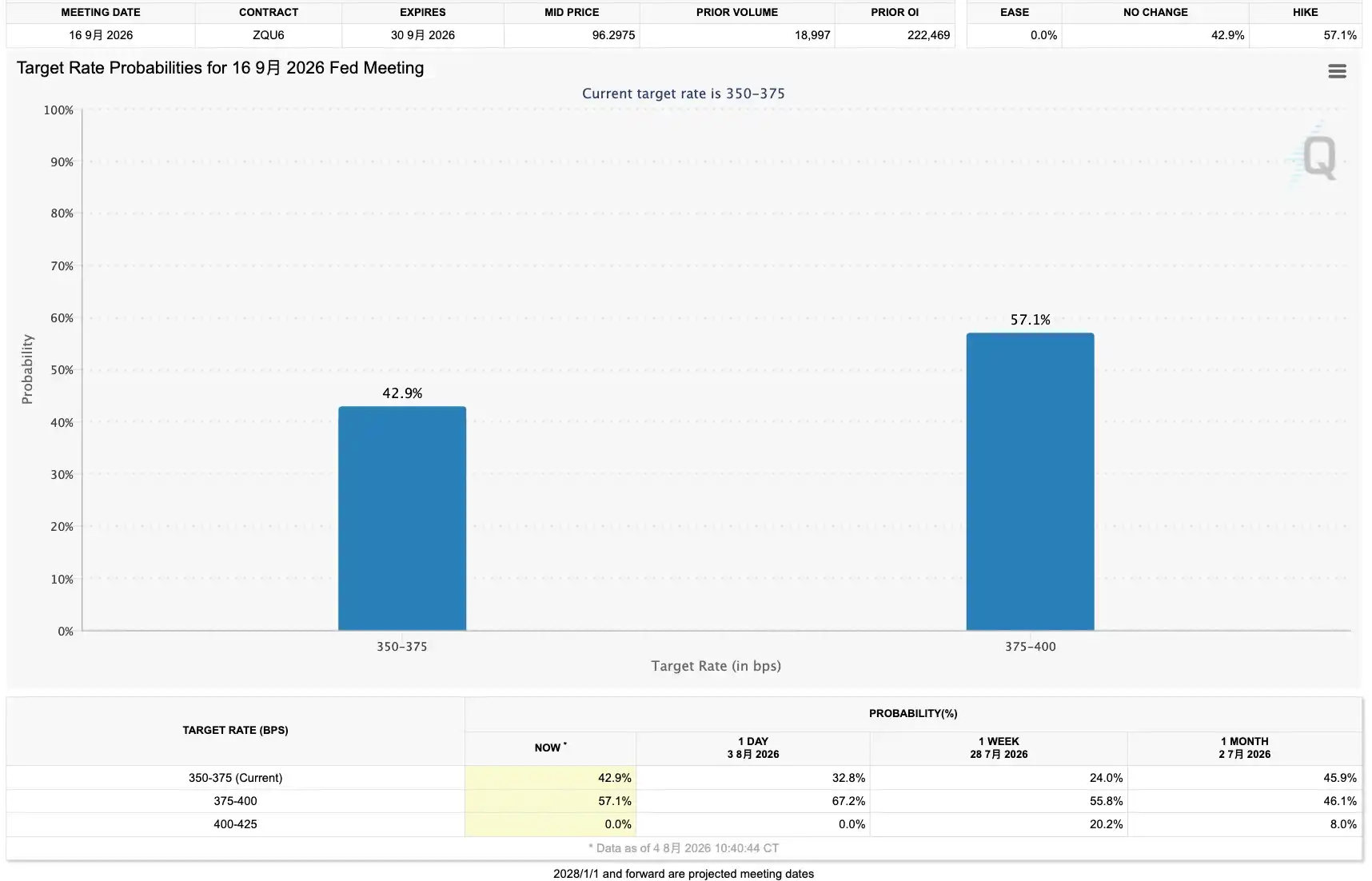
The U.S. dollar weakened slightly, and the yen's rally stalled. Regarding interest rates and institutional views, the CME FedWatch Tool shows that the probability of a 25 basis point rate hike in September is about 57.1%, down sharply from 67.2% the previous day, while the probability of holding steady is 42.9%. The market is closely watching this Friday's non-farm payrolls report. Strong data could reinforce rate hike expectations, while weak data could increase room for inaction. Institutions like JPMorgan believe that in a context where oil prices dominate Treasury movements, employment data will become a key short-term pricing node.

AI Trading Makes a Comeback, Funds Believe in the 'Computing Power-Application-Infrastructure' Loop Again

The strongest sector in U.S. stocks last night was still AI. Unlike previous rallies solely reliant on chip stocks, this AI market move is more comprehensive: Palantir used strong earnings to prove AI applications can drive revenue growth; semiconductor, memory, and optical communication sectors reflect rising computing power demand; Caterpillar shows data center construction demand is trickling down to traditional industrial equipment.

The Philadelphia Semiconductor Index surged 6.55%, rising for the fourth consecutive day, with 30 component stocks broadly higher. Memory chips, optical communication, AI software, data center infrastructure, and industrial equipment sectors performed notably well. The Nasdaq 100 index rose about 3.3% in a single day, its largest single-day gain since May 2025.

Major tech stocks were also generally stronger. Nvidia rose over 2%, Apple, Microsoft, and Tesla rose over 1%, Google rose 1.11%, but Amazon fell over 2%. Over the past four trading days, the "Magnificent Seven" tech giants have collectively risen nearly 10%, indicating funds are flowing back into large-cap growth stocks.

Peter Callahan, Goldman Sachs' chief tech trader, believes this rally stems from four factors: the market has already undergone a round of de-risking earlier, leaving cleaner positioning; technicals have improved; the Nasdaq 100 valuation is still at about a 10% discount to its five-year average; the earnings season has improved investor confidence in profits.

However, Goldman's trading desk also cautioned that market trading volume is about 7% below the 5-day average, indicating not exceptionally high activity. This means that while the index rally is strong, not all funds have fully returned yet. Future moves still depend on whether earnings and macro data can continue to support the uptrend.

Specific Company Actions and Stock Price Movements:
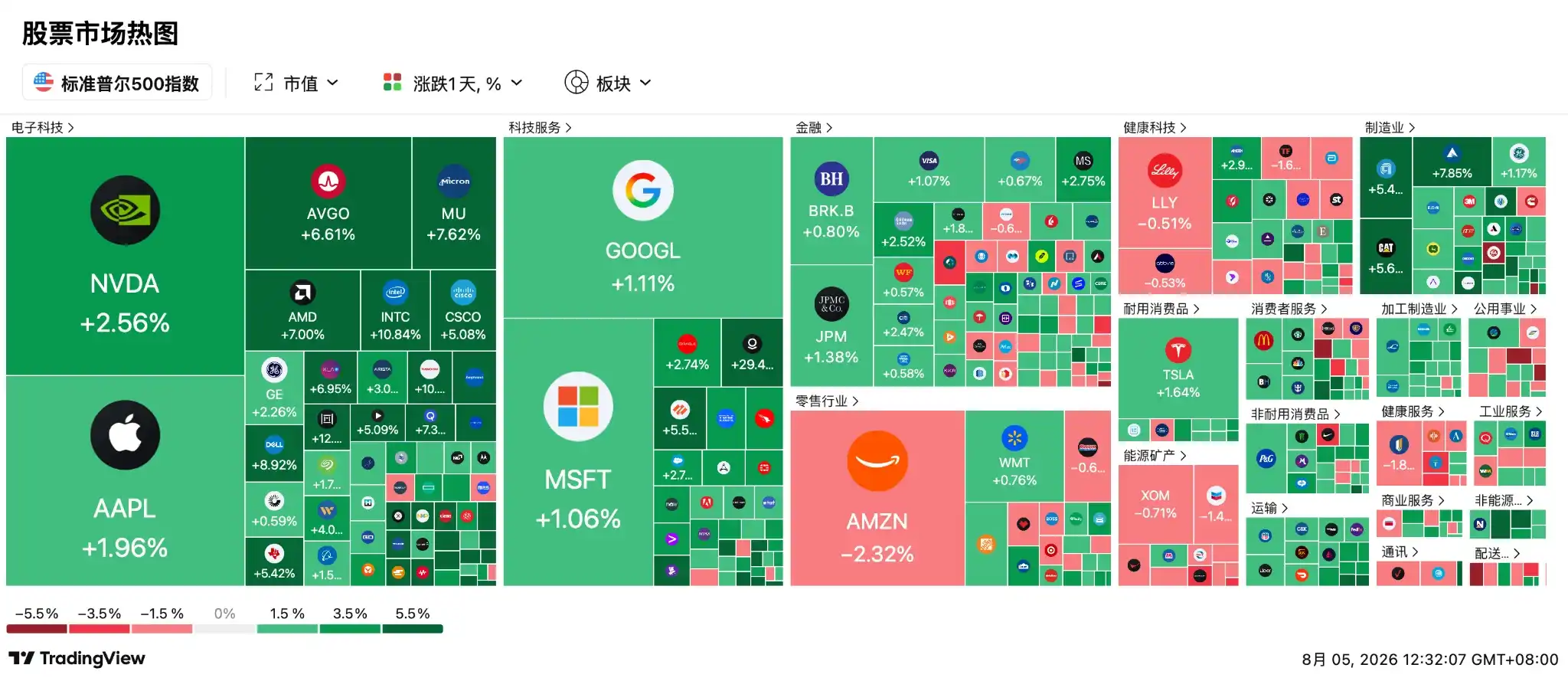
  • Palantir closed up 29.45%, strongly breaking above its 200-day moving average: The company's Q2 revenue soared 93% year-over-year to $1.935 billion, with U.S. commercial revenue surging 149%. CEO Alex Karp called this a "supernatural" quarter and stated that demand for AI sovereignty is being unleashed. Related AI software stocks also rose, Datadog and Shopify rose over 5%, ServiceNow and Applovin rose over 3%, Adobe and Salesforce rose over 2%.

  • Caterpillar surged over 5%, hitting a record high: This heavy equipment giant's Q2 sales broke the $20 billion mark for the first time (up 24% year-over-year) and it comprehensively raised its full-year guidance. Wells Fargo strategist Ohsung Kwon pointed out that Caterpillar is "the most traditional stock close to the AI concept," and the spillover benefits from data center construction have just begun. The industrial sector has performed strongly this year, rising about 20%.

  • SpaceX closed up 9.43%, after-hours fell nearly 9% due to high capex concerns: Yesterday, Musk confirmed AI services will exclusively adopt Nvidia architecture and set sights on the U.S. telecom market. Space-related stocks rose broadly, Rocket Lab rose nearly 6% (won a $397 million contract from the U.S. Space Force), AST SpaceMobile rose nearly 11%. The after-hours Q2 earnings report showed revenue of $7.8 billion, up 92% year-over-year, EBITDA surged, but AI-related capital expenditures reached $15.8 billion, expected to remain high in subsequent quarters.

  • AMD closed up 7%, after-hours fell nearly 8%: CEO Lisa Su expects data center sales to double by 2027 and announced collaborations with Anthropic and others. Semiconductor sector surged, ARM surged 17.36%, Marvell Technology rose nearly 13%, Intel rose nearly 11%, Qualcomm rose 7.23%, Broadcom rose nearly 7%, TSMC rose over 2%. After-hours Q2 earnings showed revenue of $11.54 billion, up 50% year-over-year, beating expectations, but Q3 revenue guidance didn't completely "wow" the market.

  • Nvidia closed up 2.56%: Nvidia CEO Jensen Huang announced the official open-source commercial release of Alpamayo 2 Super, Nvidia's open-source inference model for autonomous driving, aiming to advance applications like robotaxis, robots, and logistics vehicles. Concurrently, SpaceX stated future AI services will be "exclusively" based on Nvidia systems and plans to deploy Nvidia Vera Rubin NVL72 rack-scale systems on the ground and in space.

  • Micron Technology closed up 7.62%, market cap returned to the $1 trillion club: Bank of America reiterated a Buy rating and a $1,550 target price, viewing the recent pullback as an "excellent buying opportunity," and expects memory chip prices to normalize in 2027-2028. Memory sector rose across the board, SanDisk rose 10.84% (jointly released the first standard specification for High Bandwidth Flash HBF with SK Hynix), Rambus rose over 9%, SK Hynix rose over 8%, Western Digital rose over 4%.

  • Intel closed up 10.84%: Media reports indicated Intel's EMIB-T advanced packaging technology has made progress, with packaging yields nearing 90% and costs about 50% lower than TSMC's CoWoS solution. Intel expects to offer this packaging service at scale by 2027, while continuing to advance construction of its large Ohio wafer fab campus, targeting full operation by 2031.

  • Oracle closed up 2.74%: However, its stock price has been halved since June, its five-year credit default swap spread has surged to a historical high exceeding the peak of the 2008 financial crisis. Due to aggressive borrowing to fund AI data center construction, its current debt stands at $129.5 billion. S&P Global has downgraded its credit rating to BBB-, just one notch above "junk" grade. Moody's warned its leverage ratio may approach 5x, and the market is deeply concerned about the mismatch risk between its 15-year long-term leases and short-term AI contracts.

  • Bitdeer surged 23% intraday before closing up 0.09%: Bitdeer signed a 16-year data center hosting and services agreement with Norwegian cloud startup Volta Infra for deploying Nvidia GPUs and serving leading AI labs. Concurrently, Anthropic was reported to have reached a $100 billion, six-year computing power agreement with Volta.

  • Arista Networks (ANET) closed up 3.04%, after-hours surged 12.5%: Supported by AI networking demand, Q2 revenue slightly exceeded $3 billion, up 37.7% year-over-year, and the company raised its 2026 guidance for the third time, expecting full-year revenue of $12.6 billion, an annual growth rate of about 40%.

  • Apple rose nearly 2%: Apple has begun preparations for its September launch event, with U.S. retail employees able to apply for on-site work. The event is expected in the first half of September. Separately, Apple reportedly requested a judge to immediately ban OpenAI from using its trade secrets and demanded OpenAI return all confidential information.

Upcoming Focus:

August 5th Major Earnings: Circle, Uber, Eli Lilly, BeiGene, etc.

August 6th (Thursday)

  • SpaceX Lock-up Expiration: Up to 911.5 million restricted shares of SpaceX will be unlocked, with a potential value nearing $100 billion based on the latest stock price, representing the week's biggest liquidity pressure test. If selling pressure is limited post-expiration, it will boost market confidence in the capacity to absorb high-valuation tech assets; if concentrated selling emerges, it could dampen sentiment for the Nasdaq and Musk-related assets.

  • 05:00 SanDisk, Western Digital After-Hours Earnings: Will directly influence sentiment in the memory sector. Following recent consecutive pullbacks in Micron, SanDisk, and SK Hynix, the market will closely focus on enterprise SSD, NAND prices, AI data center storage demand, inventory cycles, and H2 guidance.

Crypto di tendenza

Domande pertinenti

QWhat were the main reasons for the sharp rise in US stock markets last night?

AThe primary drivers for the sharp rise in US stock markets last night were strong corporate earnings and optimism surrounding a potential geopolitical agreement regarding the Strait of Hormuz.

QWhat was the projected probability of a Fed rate hike in September according to the CME FedWatch Tool, and how did it change?

AAccording to the CME FedWatch Tool, the probability of a 25-basis-point Fed rate hike in September was approximately 57.1%, which was a significant decrease from 67.2% the previous day.

QWhich company reported a 93% year-over-year revenue surge and saw its stock price jump nearly 30%?

APalantir reported a 93% year-over-year revenue surge to $1.935 billion for Q2, and its stock price closed up 29.45%.

QWhat key development was reported regarding the EMIB-T advanced packaging technology?

AIntel's EMIB-T advanced packaging technology has reportedly made progress, nearing 90% packaging yield with costs approximately 50% lower than TSMC's CoWoS solution. Intel expects to offer this packaging service on a large scale by 2027.

QWhat major liquidity event for SpaceX is scheduled for August 6th (Thursday)?

AOn August 6th, up to 911.5 million restricted shares of SpaceX are scheduled to be unlocked, potentially representing nearly $100 billion in value. This event is considered a significant liquidity stress test for the week.

Letture associate

Meme Coin with $60 Million Market Cap Plunges 65% in One Minute, FOMO Faces Renewed Scrutiny

A Solana-based meme token, $CATE, which had surged from a $20M+ to over $80M market cap in about a week, experienced a dramatic 65% crash within one minute. This flash crash has intensified scrutiny on the trading app 'fomo' and highlighted the speculative nature of the current meme coin market. The crash coincided with two events: the token's X account being suspended and the fomo app experiencing downtime, preventing users from trading. While the X suspension was straightforward, the fomo outage raised significant questions. $CATE's primary narrative driver was the open endorsement by Poorgoat, a top-ranked trader on fomo with over 200,000 followers, who had turned a ~$45,000 investment into over $2M at the peak. The token itself had no novel fundamentals, being a "cat sister" to Doge, a concept already existing on Ethereum without success. The crash, triggered by less than $1.5M in selling volume despite over 60,000 holder addresses, exposed a harsh reality: purely "organic" community-driven meme tokens (excluding past successes like $SPX) may now have a market cap ceiling around $17M, as exemplified by the long-term chart of $neet. This incident has fueled existing controversies surrounding fomo. Critics have grown skeptical of the app, alleging that rankings dominated by KOLs who receive lucrative token airdrops could be manipulated to create "pump-and-dump" schemes, luring in retail users before a rug pull. The timing of the crash during fomo's outage—preventing many of its users (who represent over 60% of $CATE holders) from reacting—was viewed as highly suspicious. Further controversy arose when another popular fomo trader publicly sold near the peak, and concerns were raised about the security of accessing private keys during the app's downtime. Fomo's official explanation of server overload due to surging user traffic was met with skepticism, given its substantial funding. The event serves as a stark reminder of the risks in meme coin speculation and the potential vulnerabilities of relying on a single trading platform during market volatility.

marsbit11 min fa

Meme Coin with $60 Million Market Cap Plunges 65% in One Minute, FOMO Faces Renewed Scrutiny

marsbit11 min fa

Arthur Hayes' 10,000-Word New Article: When Will the AI Wave Peak? Will the Bubble Burst? Why Am I Frantically Buying ETH?

Arthur Hayes' latest article explores the intersection of AI investment, credit markets, and cryptocurrency. He argues that the massive capital expenditure (CAPEX) in AI infrastructure resembles a real estate-driven credit bubble, akin to the 2008 financial crisis, rather than a tech growth story. Hayes predicts that the AI bubble's peak will arrive in 2027, triggered not by failing AI profits but by a slowdown in the growth rate of data center construction and capex, revealing systemic over-leverage. He explains that banks, incentivized by government policy and steep yield curves, will continue lending to AI projects despite rising risks, expecting eventual government bailouts. Hayes further speculates that the US government might directly intervene by creating a sovereign wealth fund to buy AI equities, injecting permanent liquidity into the system. For crypto investors, this misallocation of capital is bullish. Hayes believes Bitcoin will bottom as AI capex growth decelerates but credit continues to flow, setting the stage for a major rally fueled by the inevitable large-scale monetary stimulus. He sets a rough year-end 2026 target of $5,000 for Ethereum, citing its potential role as a settlement layer for tokenized real-world assets (RWA) as a key narrative driver. The eventual government response to the AI credit bubble, he concludes, will unleash a cryptocurrency bull market unlike any seen since 2021.

marsbit25 min fa

Arthur Hayes' 10,000-Word New Article: When Will the AI Wave Peak? Will the Bubble Burst? Why Am I Frantically Buying ETH?

marsbit25 min fa

Goldman Sachs Details Korea Memory "8 Key Focus Points": Valuation, Long-Term Agreements, Inventory, CXMT Impact, Buybacks, etc.

Goldman Sachs maintains a "Buy" rating on Samsung Electronics and SK Hynix, stating their recent sharp share price corrections reflect excessive market pessimism unsupported by fundamentals. The report addresses eight key market concerns: 1. **HBM Pricing:** GS forecasts HBM blended average prices for Samsung and SK Hynix to nearly double by 2027 due to persistent tight supply and a need to re-establish price premiums over standard DRAM. 2. **Long-Term Agreements (LTAs):** LTA terms are shifting in favor of suppliers, featuring longer terms, higher coverage targets (60-70% of capacity), "floor-price" protections, and significant upfront customer deposits. 3. **Inventory:** While module maker inventory is elevated, this represents a small portion of the overall market. Supplier and end-customer inventories remain healthy at low levels. 4. **NAND Supply:** Fears of a NAND oversupply are overblown. Strong enterprise SSD demand is expected to offset consumer weakness, with the supply-demand gap widening through 2027. 5. **Shareholder Returns:** GS expects both companies' actual dividends to exceed current market consensus. Share buybacks would be well-received, especially for SK Hynix to counter ADR-related dilution. 6. **SK Hynix ADR Premium:** The ADR's ~30% premium over the local share is likely persistent due to conversion constraints but aids long-term valuation re-rating by improving global investor access. 7. **SK Hynix Q2 '26 Results:** The earnings miss was due to one-time factors like slower HBM4 mix transition. Q3 is expected to see a strong recovery with higher volumes and better pricing/mix. 8. **CXMT Impact:** The competitive threat from China's CXMT is limited to the domestic market due to its technology lag and different product mix, posing minimal risk to the global supply-demand balance. GS concludes the current low valuations (approx. 3.5x 2027 P/E) imply an unrealistic lack of profit sustainability.

marsbit26 min fa

Goldman Sachs Details Korea Memory "8 Key Focus Points": Valuation, Long-Term Agreements, Inventory, CXMT Impact, Buybacks, etc.

marsbit26 min fa

Trading

Spot

Articoli Popolari

Cosa è $S$

Comprendere SPERO: Una Panoramica Completa Introduzione a SPERO Mentre il panorama dell'innovazione continua a evolversi, l'emergere delle tecnologie web3 e dei progetti di criptovaluta gioca un ruolo fondamentale nel plasmare il futuro digitale. Un progetto che ha attirato l'attenzione in questo campo dinamico è SPERO, denotato come SPERO,$$s$. Questo articolo mira a raccogliere e presentare informazioni dettagliate su SPERO, per aiutare gli appassionati e gli investitori a comprendere le sue basi, obiettivi e innovazioni nei domini web3 e crypto. Che cos'è SPERO,$$s$? SPERO,$$s$ è un progetto unico all'interno dello spazio crypto che cerca di sfruttare i principi della decentralizzazione e della tecnologia blockchain per creare un ecosistema che promuove l'impegno, l'utilità e l'inclusione finanziaria. Il progetto è progettato per facilitare interazioni peer-to-peer in modi nuovi, fornendo agli utenti soluzioni e servizi finanziari innovativi. Al suo interno, SPERO,$$s$ mira a responsabilizzare gli individui fornendo strumenti e piattaforme che migliorano l'esperienza dell'utente nello spazio delle criptovalute. Questo include la possibilità di metodi di transazione più flessibili, la promozione di iniziative guidate dalla comunità e la creazione di percorsi per opportunità finanziarie attraverso applicazioni decentralizzate (dApps). La visione sottostante di SPERO,$$s$ ruota attorno all'inclusività, cercando di colmare le lacune all'interno della finanza tradizionale mentre sfrutta i vantaggi della tecnologia blockchain. Chi è il Creatore di SPERO,$$s$? L'identità del creatore di SPERO,$$s$ rimane piuttosto oscura, poiché ci sono risorse pubblicamente disponibili limitate che forniscono informazioni dettagliate sul suo fondatore o fondatori. Questa mancanza di trasparenza può derivare dall'impegno del progetto per la decentralizzazione—un ethos che molti progetti web3 condividono, dando priorità ai contributi collettivi rispetto al riconoscimento individuale. Centrando le discussioni attorno alla comunità e ai suoi obiettivi collettivi, SPERO,$$s$ incarna l'essenza dell'empowerment senza mettere in evidenza individui specifici. Pertanto, comprendere l'etica e la missione di SPERO rimane più importante che identificare un creatore singolo. Chi sono gli Investitori di SPERO,$$s$? SPERO,$$s$ è supportato da una varietà di investitori che vanno dai capitalisti di rischio agli investitori angelici dedicati a promuovere l'innovazione nel settore crypto. Il focus di questi investitori generalmente si allinea con la missione di SPERO—dando priorità a progetti che promettono avanzamenti tecnologici sociali, inclusività finanziaria e governance decentralizzata. Queste fondazioni di investitori sono tipicamente interessate a progetti che non solo offrono prodotti innovativi, ma contribuiscono anche positivamente alla comunità blockchain e ai suoi ecosistemi. Il supporto di questi investitori rafforza SPERO,$$s$ come un concorrente degno di nota nel dominio in rapida evoluzione dei progetti crypto. Come Funziona SPERO,$$s$? SPERO,$$s$ impiega un framework multifunzionale che lo distingue dai progetti di criptovaluta convenzionali. Ecco alcune delle caratteristiche chiave che sottolineano la sua unicità e innovazione: Governance Decentralizzata: SPERO,$$s$ integra modelli di governance decentralizzati, responsabilizzando gli utenti a partecipare attivamente ai processi decisionali riguardanti il futuro del progetto. Questo approccio favorisce un senso di proprietà e responsabilità tra i membri della comunità. Utilità del Token: SPERO,$$s$ utilizza il proprio token di criptovaluta, progettato per servire varie funzioni all'interno dell'ecosistema. Questi token abilitano transazioni, premi e la facilitazione dei servizi offerti sulla piattaforma, migliorando l'impegno e l'utilità complessivi. Architettura Stratificata: L'architettura tecnica di SPERO,$$s$ supporta la modularità e la scalabilità, consentendo un'integrazione fluida di funzionalità e applicazioni aggiuntive man mano che il progetto evolve. Questa adattabilità è fondamentale per mantenere la rilevanza nel panorama crypto in continua evoluzione. Coinvolgimento della Comunità: Il progetto enfatizza iniziative guidate dalla comunità, impiegando meccanismi che incentivano la collaborazione e il feedback. Nutrendo una comunità forte, SPERO,$$s$ può affrontare meglio le esigenze degli utenti e adattarsi alle tendenze di mercato. Focus sull'Inclusione: Offrendo basse commissioni di transazione e interfacce user-friendly, SPERO,$$s$ mira ad attrarre una base utenti diversificata, inclusi individui che potrebbero non aver precedentemente interagito nello spazio crypto. Questo impegno per l'inclusione si allinea con la sua missione generale di empowerment attraverso l'accessibilità. Cronologia di SPERO,$$s$ Comprendere la storia di un progetto fornisce preziose intuizioni sulla sua traiettoria di sviluppo e sui traguardi. Di seguito è riportata una cronologia suggerita che mappa eventi significativi nell'evoluzione di SPERO,$$s$: Fase di Concettualizzazione e Ideazione: Le idee iniziali che formano la base di SPERO,$$s$ sono state concepite, allineandosi strettamente con i principi di decentralizzazione e focus sulla comunità all'interno dell'industria blockchain. Lancio del Whitepaper del Progetto: Dopo la fase concettuale, è stato rilasciato un whitepaper completo che dettaglia la visione, gli obiettivi e l'infrastruttura tecnologica di SPERO,$$s$ per suscitare interesse e feedback dalla comunità. Costruzione della Comunità e Prime Interazioni: Sono stati effettuati sforzi attivi di outreach per costruire una comunità di early adopters e potenziali investitori, facilitando discussioni attorno agli obiettivi del progetto e ottenendo supporto. Evento di Generazione del Token: SPERO,$$s$ ha condotto un evento di generazione del token (TGE) per distribuire i propri token nativi ai primi sostenitori e stabilire una liquidità iniziale all'interno dell'ecosistema. Lancio della Prima dApp: La prima applicazione decentralizzata (dApp) associata a SPERO,$$s$ è stata attivata, consentendo agli utenti di interagire con le funzionalità principali della piattaforma. Sviluppo Continuo e Partnership: Aggiornamenti e miglioramenti continui alle offerte del progetto, inclusi partnership strategiche con altri attori nello spazio blockchain, hanno plasmato SPERO,$$s$ in un concorrente competitivo e in evoluzione nel mercato crypto. Conclusione SPERO,$$s$ rappresenta una testimonianza del potenziale del web3 e delle criptovalute di rivoluzionare i sistemi finanziari e responsabilizzare gli individui. Con un impegno per la governance decentralizzata, il coinvolgimento della comunità e funzionalità progettate in modo innovativo, apre la strada verso un panorama finanziario più inclusivo. Come per qualsiasi investimento nello spazio crypto in rapida evoluzione, si incoraggiano potenziali investitori e utenti a ricercare approfonditamente e a impegnarsi in modo riflessivo con gli sviluppi in corso all'interno di SPERO,$$s$. Il progetto mostra lo spirito innovativo dell'industria crypto, invitando a ulteriori esplorazioni delle sue innumerevoli possibilità. Mentre il percorso di SPERO,$$s$ è ancora in fase di sviluppo, i suoi principi fondamentali potrebbero effettivamente influenzare il futuro di come interagiamo con la tecnologia, la finanza e tra di noi in ecosistemi digitali interconnessi.

236 Totale visualizzazioniPubblicato il 2024.12.17Aggiornato il 2024.12.17

Cosa è $S$

Cosa è AGENT S

Agent S: Il Futuro dell'Interazione Autonoma in Web3 Introduzione Nel panorama in continua evoluzione di Web3 e criptovalute, le innovazioni stanno costantemente ridefinendo il modo in cui gli individui interagiscono con le piattaforme digitali. Uno di questi progetti pionieristici, Agent S, promette di rivoluzionare l'interazione uomo-computer attraverso il suo framework agentico aperto. Aprendo la strada a interazioni autonome, Agent S mira a semplificare compiti complessi, offrendo applicazioni trasformative nell'intelligenza artificiale (AI). Questa esplorazione dettagliata approfondirà le complessità del progetto, le sue caratteristiche uniche e le implicazioni per il dominio delle criptovalute. Cos'è Agent S? Agent S si presenta come un innovativo framework agentico aperto, progettato specificamente per affrontare tre sfide fondamentali nell'automazione dei compiti informatici: Acquisizione di Conoscenze Specifiche del Dominio: Il framework apprende in modo intelligente da varie fonti di conoscenza esterne ed esperienze interne. Questo approccio duale gli consente di costruire un ricco repository di conoscenze specifiche del dominio, migliorando le sue prestazioni nell'esecuzione dei compiti. Pianificazione su Lungo Orizzonte di Compiti: Agent S impiega una pianificazione gerarchica potenziata dall'esperienza, un approccio strategico che facilita la suddivisione e l'esecuzione efficiente di compiti complessi. Questa caratteristica migliora significativamente la sua capacità di gestire più sottocompiti in modo efficiente ed efficace. Gestione di Interfacce Dinamiche e Non Uniformi: Il progetto introduce l'Interfaccia Agente-Computer (ACI), una soluzione innovativa che migliora l'interazione tra agenti e utenti. Utilizzando Modelli Linguistici Multimodali di Grandi Dimensioni (MLLM), Agent S può navigare e manipolare senza sforzo diverse interfacce grafiche utente. Attraverso queste caratteristiche pionieristiche, Agent S fornisce un framework robusto che affronta le complessità coinvolte nell'automazione dell'interazione umana con le macchine, preparando il terreno per innumerevoli applicazioni nell'AI e oltre. Chi è il Creatore di Agent S? Sebbene il concetto di Agent S sia fondamentalmente innovativo, informazioni specifiche sul suo creatore rimangono elusive. Il creatore è attualmente sconosciuto, il che evidenzia sia la fase embrionale del progetto sia la scelta strategica di mantenere i membri fondatori sotto anonimato. Indipendentemente dall'anonimato, l'attenzione rimane sulle capacità e sul potenziale del framework. Chi sono gli Investitori di Agent S? Poiché Agent S è relativamente nuovo nell'ecosistema crittografico, informazioni dettagliate riguardanti i suoi investitori e sostenitori finanziari non sono documentate esplicitamente. La mancanza di approfondimenti pubblicamente disponibili sulle fondazioni di investimento o sulle organizzazioni che supportano il progetto solleva interrogativi sulla sua struttura di finanziamento e sulla roadmap di sviluppo. Comprendere il supporto è cruciale per valutare la sostenibilità del progetto e il suo potenziale impatto sul mercato. Come Funziona Agent S? Al centro di Agent S si trova una tecnologia all'avanguardia che gli consente di funzionare efficacemente in contesti diversi. Il suo modello operativo è costruito attorno a diverse caratteristiche chiave: Interazione Uomo-Computer Simile a Quella Umana: Il framework offre una pianificazione AI avanzata, cercando di rendere le interazioni con i computer più intuitive. Mimando il comportamento umano nell'esecuzione dei compiti, promette di elevare le esperienze degli utenti. Memoria Narrativa: Utilizzata per sfruttare esperienze di alto livello, Agent S utilizza la memoria narrativa per tenere traccia delle storie dei compiti, migliorando così i suoi processi decisionali. Memoria Episodica: Questa caratteristica fornisce agli utenti una guida passo-passo, consentendo al framework di offrire supporto contestuale mentre i compiti si sviluppano. Supporto per OpenACI: Con la capacità di funzionare localmente, Agent S consente agli utenti di mantenere il controllo sulle proprie interazioni e flussi di lavoro, allineandosi con l'etica decentralizzata di Web3. Facile Integrazione con API Esterne: La sua versatilità e compatibilità con varie piattaforme AI garantiscono che Agent S possa adattarsi senza problemi agli ecosistemi tecnologici esistenti, rendendolo una scelta attraente per sviluppatori e organizzazioni. Queste funzionalità contribuiscono collettivamente alla posizione unica di Agent S all'interno dello spazio crittografico, poiché automatizza compiti complessi e multi-fase con un intervento umano minimo. Man mano che il progetto evolve, le sue potenziali applicazioni in Web3 potrebbero ridefinire il modo in cui si svolgono le interazioni digitali. Cronologia di Agent S Lo sviluppo e le tappe di Agent S possono essere riassunti in una cronologia che evidenzia i suoi eventi significativi: 27 Settembre 2024: Il concetto di Agent S è stato lanciato in un documento di ricerca completo intitolato “Un Framework Agentico Aperto che Usa i Computer Come un Umano”, mostrando le basi per il progetto. 10 Ottobre 2024: Il documento di ricerca è stato reso pubblicamente disponibile su arXiv, offrendo un'esplorazione approfondita del framework e della sua valutazione delle prestazioni basata sul benchmark OSWorld. 12 Ottobre 2024: È stata rilasciata una presentazione video, fornendo un'idea visiva delle capacità e delle caratteristiche di Agent S, coinvolgendo ulteriormente potenziali utenti e investitori. Questi indicatori nella cronologia non solo illustrano i progressi di Agent S, ma indicano anche il suo impegno per la trasparenza e il coinvolgimento della comunità. Punti Chiave su Agent S Man mano che il framework Agent S continua a evolversi, diversi attributi chiave si distinguono, sottolineando la sua natura innovativa e il potenziale: Framework Innovativo: Progettato per fornire un uso intuitivo dei computer simile all'interazione umana, Agent S porta un approccio nuovo all'automazione dei compiti. Interazione Autonoma: La capacità di interagire autonomamente con i computer attraverso GUI segna un passo avanti verso soluzioni informatiche più intelligenti ed efficienti. Automazione di Compiti Complessi: Con la sua metodologia robusta, può automatizzare compiti complessi e multi-fase, rendendo i processi più veloci e meno soggetti a errori. Miglioramento Continuo: I meccanismi di apprendimento consentono ad Agent S di migliorare dalle esperienze passate, migliorando continuamente le sue prestazioni e la sua efficacia. Versatilità: La sua adattabilità attraverso diversi ambienti operativi come OSWorld e WindowsAgentArena garantisce che possa servire un'ampia gamma di applicazioni. Man mano che Agent S si posiziona nel panorama di Web3 e delle criptovalute, il suo potenziale per migliorare le capacità di interazione e automatizzare i processi segna un significativo avanzamento nelle tecnologie AI. Attraverso il suo framework innovativo, Agent S esemplifica il futuro delle interazioni digitali, promettendo un'esperienza più fluida ed efficiente per gli utenti in vari settori. Conclusione Agent S rappresenta un audace passo avanti nell'unione tra AI e Web3, con la capacità di ridefinire il modo in cui interagiamo con la tecnologia. Sebbene sia ancora nelle sue fasi iniziali, le possibilità per la sua applicazione sono vaste e coinvolgenti. Attraverso il suo framework completo che affronta sfide critiche, Agent S mira a portare le interazioni autonome al centro dell'esperienza digitale. Man mano che ci addentriamo nei regni delle criptovalute e della decentralizzazione, progetti come Agent S giocheranno senza dubbio un ruolo cruciale nel plasmare il futuro della tecnologia e della collaborazione uomo-computer.

684 Totale visualizzazioniPubblicato il 2025.01.14Aggiornato il 2025.01.14

Cosa è AGENT S

Come comprare S

Benvenuto in HTX.com! Abbiamo reso l'acquisto di Sonic (S) semplice e conveniente. Segui la nostra guida passo passo per intraprendere il tuo viaggio nel mondo delle criptovalute.Step 1: Crea il tuo Account HTXUsa la tua email o numero di telefono per registrarti il tuo account gratuito su HTX. Vivi un'esperienza facile e sblocca tutte le funzionalità,Crea il mio accountStep 2: Vai in Acquista crypto e seleziona il tuo metodo di pagamentoCarta di credito/debito: utilizza la tua Visa o Mastercard per acquistare immediatamente SonicS.Bilancio: Usa i fondi dal bilancio del tuo account HTX per fare trading senza problemi.Terze parti: abbiamo aggiunto metodi di pagamento molto utilizzati come Google Pay e Apple Pay per maggiore comodità.P2P: Fai trading direttamente con altri utenti HTX.Over-the-Counter (OTC): Offriamo servizi su misura e tassi di cambio competitivi per i trader.Step 3: Conserva Sonic (S)Dopo aver acquistato Sonic (S), conserva nel tuo account HTX. In alternativa, puoi inviare tramite trasferimento blockchain o scambiare per altre criptovalute.Step 4: Scambia Sonic (S)Scambia facilmente Sonic (S) nel mercato spot di HTX. Accedi al tuo account, seleziona la tua coppia di trading, esegui le tue operazioni e monitora in tempo reale. Offriamo un'esperienza user-friendly sia per chi ha appena iniziato che per i trader più esperti.

1.4k Totale visualizzazioniPubblicato il 2025.01.15Aggiornato il 2026.06.02

Come comprare S

Discussioni

Benvenuto nella Community HTX. Qui puoi rimanere informato sugli ultimi sviluppi della piattaforma e accedere ad approfondimenti esperti sul mercato. Le opinioni degli utenti sul prezzo di S S sono presentate come di seguito.

活动图片