Every Monday to Friday morning, focusing on macro trends, US stocks, AI, precious metals, and crude oil, using data to review the market and trends to seize opportunities. Produced by PANews.
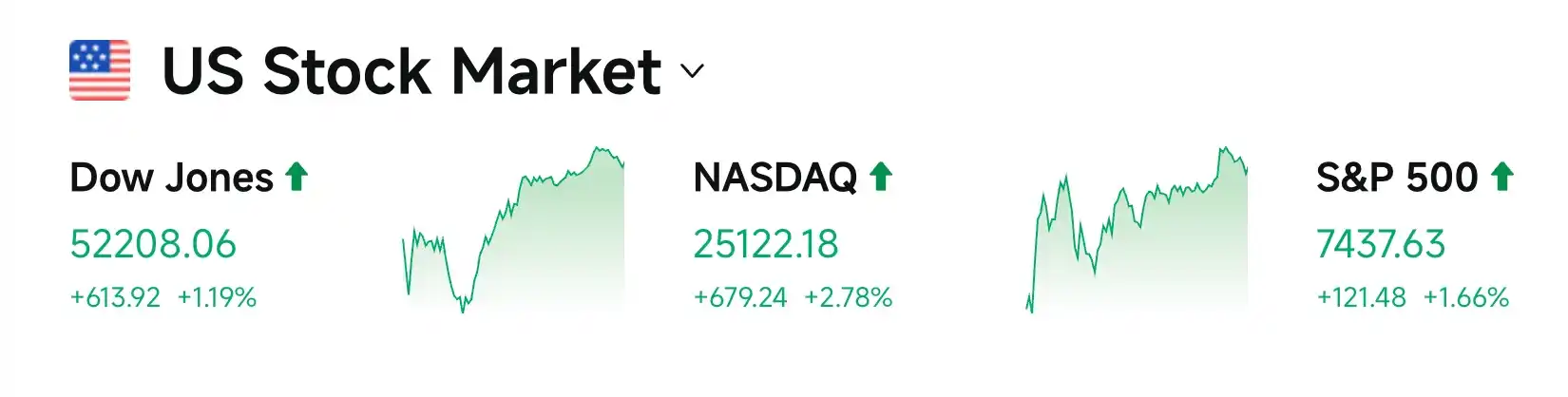
Following a sharp sell-off in the previous session, Wall Street experienced a fierce rebound. A far better-than-expected earnings report from Microsoft reignited confidence in AI investment, triggering a broad-based capital flow back into the technology sector. The Dow Jones Industrial Average rose 1.19%, the S&P 500 gained 1.66%, the Nasdaq Composite surged 2.78%, and the Nasdaq 100 jumped 3.36%, marking its third-largest one-day gain of the year. The VIX fear index plummeted 17.33% to 17.08.
Against Backdrop of Peace Headlines, Market Bets on OPEC+ Meeting
The geopolitical situation in the Middle East saw a dramatic turn. Former President Trump announced that Hamas has agreed in principle to a complete disarmament, with Israel gradually withdrawing troops as the agreement progresses. If finalized, this would represent the most significant political breakthrough since the outbreak of the Gaza conflict. However, the deal still requires formal signing, and significant differences remain among Israel, Hamas, Iran, and other parties. The market continues to watch for implementation risks.
Meanwhile, Iran announced a drone attack on a US military air base in Bahrain, claiming damage to the facility; Saudi Arabia, along with 43 countries, is promoting the establishment of a maritime defense alliance to enhance shipping security in the Red Sea, the Bab el-Mandeb Strait, and the Gulf of Aden. While diplomatic breakthroughs have emerged in the Middle East, military risks have not completely dissipated.
Oil prices edged lower, with WTI falling about 2% to $80.5 per barrel. The market is focused on the upcoming OPEC+ meeting, with traders wary of compliance with any output increase. ING strategists noted that the biggest uncertainty for oil before 2027 remains the direction of OPEC+ policy and whether member states will resist production quotas. The market expects OPEC+ may announce a production increase of 188,000 barrels per day in September, keeping bulls temporarily on the sidelines.
Dollar Slammed by 'Joint Effort from Japan and Korea', Yen Surges 3.3% During Session
On Thursday, the US Dollar Index plunged 0.9%, marking its biggest one-day drop since the beginning of the year, erasing all gains accumulated after Chairman Wash's first public appearance.
Notably, the market suspects Japan and Korea conducted synchronized currency interventions.
Nikkei reported that the Japanese government and the Bank of Japan likely intervened by buying yen and selling dollars, with US monetary authorities also conducting "rate checks" ahead of the intervention. South Korea was also reportedly selling dollars unusually aggressively. The Korean won appreciated 2% against the dollar, hitting a nine-month high; the Japanese yen surged as much as 3.3% against the dollar during the session, its largest intraday gain since December 2023.
Microsoft Earnings Reverse AI Cash Burn Doubts, Philadelphia Semiconductor Index Surges 8% in Biggest Jump in Four Months
Microsoft's earnings report became the key turning point reversing doubts about the 'cash burn' in the AI sector. Microsoft's Azure cloud business grew 43% at constant currency, not only far exceeding analyst expectations of 39.6%-40% but also helping its annual Azure revenue surpass $100 billion for the first time, making it the second cloud service provider after Amazon AWS to achieve this milestone.
Crucially, Microsoft's capital expenditure came in below expectations, and the company committed to maintaining positive free cash flow in fiscal year 2027, directly shattering prior market concerns about the sustainability of AI investments. Boosted by this, Microsoft's stock price soared 15.51%, adding about $450 billion in market value in a single day, surpassing Nvidia's previous record of a $440 billion single-day market cap increase and marking the largest single-day market value gain for an individual stock in US market history.
The semiconductor and storage sectors became the strongest beta plays in this rebound. The Philadelphia Semiconductor Index surged 8.19%, its largest single-day gain in recent months, and the Roundhill Memory ETF skyrocketed nearly 17%. SanDisk, Micron, SK Hynix, Western Digital, Seagate, and others rallied sharply as the market bet on sustained expansion in demand for HBM, NAND, and DRAM from AI data centers. Additionally, the "AI Stock God" Leopold's "Situational Awareness" fund, which had leveraged bets on AI, faced margin calls and was forced to sell about $16 billion in secondary market holdings. Citadel stepped in within 24 hours, not only averting a cascading sell-off risk but also triggering mechanical short covering, further fueling the market rebound.
Despite the tech sector's gain of over 5%, market breadth remained weak. Over 70% of the S&P 500 constituents closed lower, and the S&P 500 Equal Weight Index actually declined, showing a rare divergence of over 75 basis points from the benchmark index. Bloomberg strategists pointed out that since 1990, such a divergence has only occurred twice before, with the other instance happening on June 30, 2000, just before the peak of the Nasdaq tech stock cycle. SpotGamma also warned that the S&P 500 remains in a negative Gamma regime, with resistance at 7450 and support at 7300. A break below 7300 would reveal a near-vacuum of 0DTE option positive Gamma support down to 7000, suggesting this rally stems more from a squeeze in positioning than a genuine return of risk appetite. Investors need to be wary of concentration risks.
Specific Company Actions and Stock Price Movements:
-
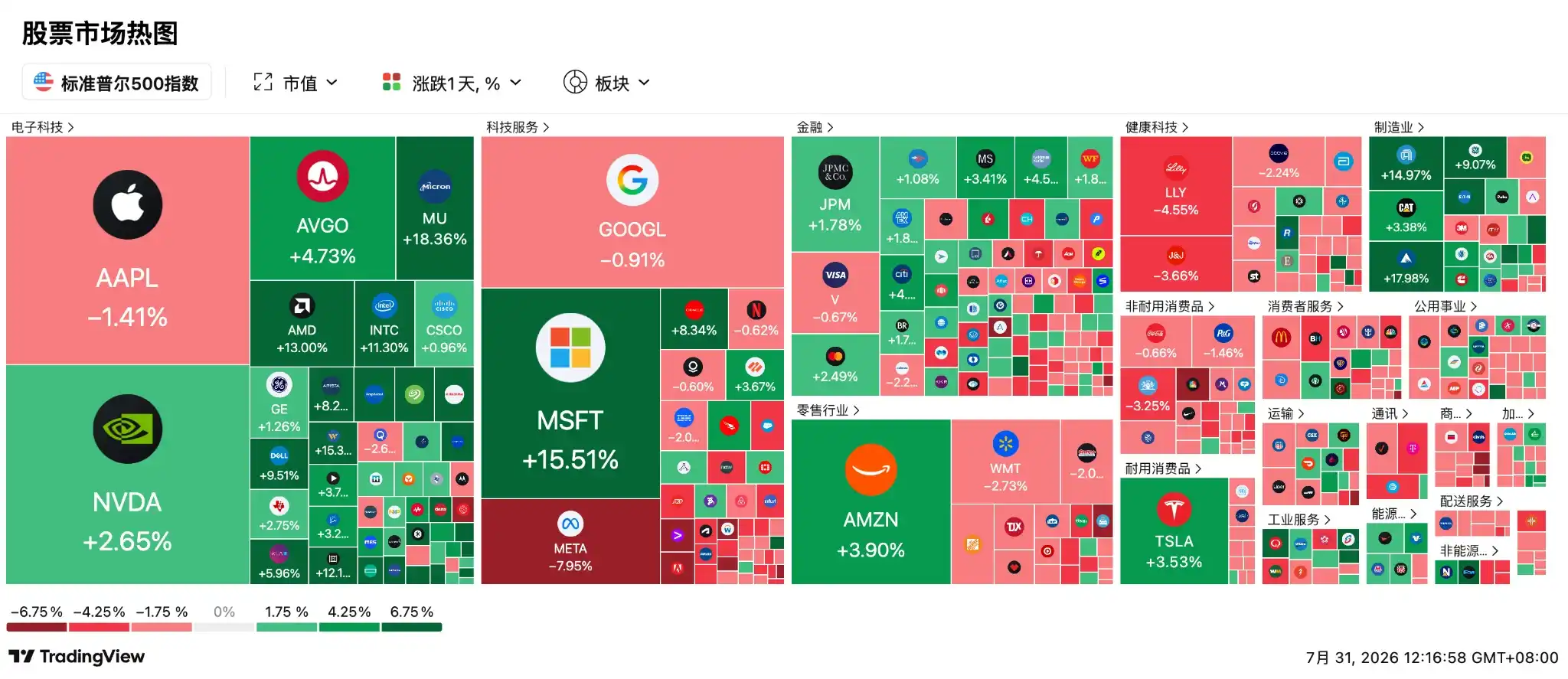
Microsoft surged 15.51%, its biggest one-day gain in 18 years: Market cap soared by $450 billion in a single day, a historical record. The company's Q4 Azure cloud revenue growth reached 43%, far exceeding expectations, and provided optimistic guidance on restrained capital expenditure and positive free cash flow for the new fiscal year. The Magnificent 7 Index rose 2.28%. Nvidia gained 2.65%, Amazon rose 3.90%, Tesla climbed 3.53%, but Meta fell 7.95%, Apple declined 1.41%, and Google Class A slipped 0.91%.
-
Cloud Computing sector rallied: New cloud service provider NEBIUS skyrocketed 27.13%, CoreWeave jumped 21.51%, Oracle rose 8.34%, Amazon gained 3.9%.
-
Semiconductor/Storage sector staged a violent rebound: Philadelphia Semiconductor Index up 8.19%, Semiconductor ETF up 6.88%, Roundhill Memory ETF up nearly 17%. Micron Technology soared 18.32%, SanDisk surged 25.99%, SK Hynix gained 17.52%, Western Digital rose over 15%, Seagate Technology climbed over 11%. Lam Research jumped 18.36%, Astera Labs up 20%, Applied Materials up 17.98%, AMD rose 13%, Intel gained 11.3%, TSMC was said to be developing advanced packaging technology similar to Intel's EMIB, Arm rose over 7%, TSMC ADR up 7.64%, Marvell Technology rose over 12%.
-
Optical Communications stocks followed the rebound: Applied Optoelectronics up nearly 18%, Lumentum up over 15%, Credo up over 13%, Coherent up over 12%, Corning up 9%.
-
Meta bucked the trend, falling 7.95%: Despite a future spending commitment of nearly $700 billion, high capital expenditure and cash flow pressures worried investors, and growth avenues beyond advertising remain to be proven.
-
Amazon closed up 3.90%, up over 10% after hours: AWS cloud revenue surged 37% in the quarter to $42.2 billion, hitting an 18-quarter high. CEO Andy Jassy stated AWS is entering a new growth cycle, with AI services, in-house Trainium chips, and enterprise AI applications becoming core future growth drivers. AWS has become a significant profit source for Amazon, and its AI infrastructure layout is gaining market recognition. However, Amazon still faces capital expenditure pressure, having raised its full-year capex plan. The market will continue to watch whether AI investments can be sustainably converted into profit growth.
-
Apple closed down 1.41%, down nearly 7% after hours: Cook bids farewell to the earnings report with 'beating earnings but missing expectations'. Quarterly revenue reached $109.417 billion, up 16% YoY, and EPS was $2.02, both exceeding estimates. However, citing "supply constraints," the CFO projected Q4 revenue growth of only 9%-11%, well below market expectations of 12.1%. Additionally, Greater China revenue missed expectations. Cook admitted on the conference call that soaring memory chip costs and advanced node capacity bottlenecks are eroding gross margins, and the company is struggling with a constrained supply chain.
-
Bloom Energy up 26.49%: The company had been questioned by short-seller Hunterbrook about its supply chain and capacity, particularly its reliance on scandium and the uncertainty of large order fulfillment. Bloom responded that the report was false and misleading, emphasizing supply chain diversification and minimal scandium usage.
What to Watch Next:
-
August 1 Deadline for Trump Administration AI Regulatory Framework: The draft has been sent to companies like OpenAI, Google, and Anthropic. The market will watch whether the US government strengthens regulations on large model safety, export controls, computing power oversight, and government procurement rules. If regulations lean strict, valuations of AI platform companies and cloud providers may face pressure; if the framework emphasizes innovation priority, the AI software and infrastructure chain may continue to receive risk premiums.
-
August 1 Microsoft Xbox Price Hike Takes Effect: Limited financial impact on Microsoft overall, but the market will observe whether consumer hardware price increases are absorbed by demand, also reflecting on the pricing power of Apple, Sony, Nintendo, and other consumer electronics chains.
-
August 1 South Korea July Export Data (YoY): The market is watching South Korea's semiconductor, storage, automobile, and electronics export performance. If exports continue strong growth, it will reinforce the AI hardware cycle recovery narrative, benefiting memory, foundry, and Asian tech stocks; if the data falls short, last night's semiconductor rebound in US stocks might be viewed as short-term short covering rather than a fundamental reversal.
-
August 2 OPEC+ Meeting: The market expects OPEC+ may announce a production increase of 188,000 barrels per day in September. If the increase materializes, upside pressure on oil prices will intensify, helping to moderate inflation expectations; if the increase is postponed due to escalating Middle East tensions, oil risk premiums may quickly return, pushing long-term US bond yields and inflation trades higher again.