Why Bitcoin Ignores Bad News from the US? The Answer is in the QCP Report

cryptonews.ruPubblicato 2026-08-18Pubblicato ultima volta 2026-08-18

Introduzione

The Bitcoin market is showing resilience despite weak US economic data and high oil prices, according to a QCP Capital report. While poor retail sales and consumer sentiment figures lowered expectations for an immediate Fed rate hike, persistently high oil prices complicate the inflation outlook. Bitcoin itself is trading in a narrow range just above $63,000, absorbing negative news without a significant breakdown. Similarly, Ethereum remains around $1,900. Market volatility is compressing, with implied volatility exceeding realized volatility, creating conditions for short volatility strategies, though QCP warns of significant risks if volatility spikes unexpectedly. Trader focus is now shifting to key upcoming events: the FOMC meeting minutes, July's PCE inflation data, and the Jackson Hole Economic Symposium, which could provide a new directional catalyst for the market currently stuck in a wait-and-see pattern.

A report from trading firm QCP Capital has noted that the Bitcoin market remains in a stable range despite weak macroeconomic data from the US and rising oil prices. Analysts at the company point out that the asset's quotes are holding near the lower boundary of its recent trading channel, while volatility continues to decline.
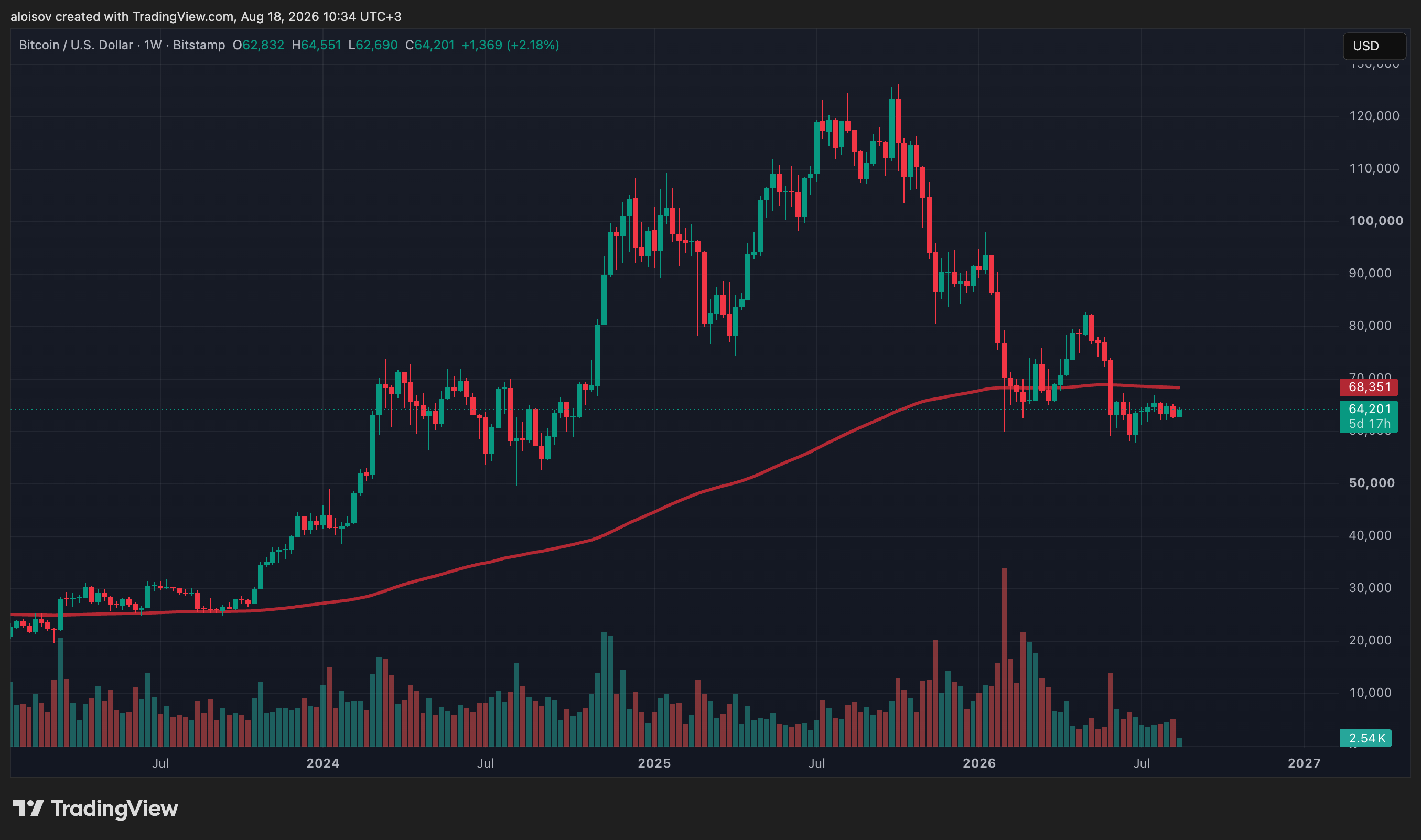
1-week BTC/USD chart and 200EMA. Source: Bitstamp

Weak Data, Strong Oil

U.S. stock indexes closed Friday, August 14th, slightly in the red: the S&P 500 lost 0.17%, the Nasdaq Composite fell 0.28%, and the Dow Jones dropped by approximately 108 points. According to QCP, economic statistics provided a more significant signal. The University of Michigan's preliminary Consumer Sentiment Index fell to 51.0 in August from 55.2 in July, and retail sales in July declined by 0.6%—the strongest monthly drop since May 2025.

Coupled with weaker labor market data released earlier this month, this statistics have reduced expectations for an immediate tightening of monetary policy. Federal funds rate futures now price in roughly a 30% probability of a 25 basis point rate hike at the September meeting. However, inflation remains above the target level, so the future policy trajectory will still depend on incoming data.

Oil remains the main counterweight to weakening business activity. WTI traded around $82.40, and Brent around $88.70 early Monday amid unresolved negotiations concerning the Strait of Hormuz. High energy prices can translate into general inflation and inflation expectations, complicating the interpretation of weak activity data for regulators.

The Range Holds, No Momentum

Against this backdrop, Bitcoin continues, as QCP notes, to "stagnate" rather than sharply decline. The spot price is holding just above $63,000 after a drop of about 3% over the week, continuing to fluctuate within the range that has defined its dynamics in recent weeks.

Analysts emphasize an important difference from the previous review: Bitcoin continues to absorb negative macroeconomic and geopolitical news without a sustained breakdown to the downside.

Instead of looking for directional signals at specific price levels, QCP suggests focusing on the fact that Bitcoin remains near the lower boundary of its recent range. A sustained exit beyond this channel would provide more information about market participants' positioning than the relatively restrained fluctuations within it.

Ethereum shows a similar lack of momentum, trading around $1,900 in recent sessions. Thus, the entire crypto market is currently characterized more by restrained conviction among participants than by acute stress.

Volatility is Compressing

The options market reflects the same calm. Bitcoin's one-week implied volatility is around 26%, while the seven-day realized volatility is closer to 20%. This gap means that options are still pricing in more movement than Bitcoin has actually demonstrated recently.

This is where the essence of the strategy analyzed by QCP in its report comes into play—so-called short volatility. The concept is simple: when implied volatility is higher than realized volatility, a trader can sell options, hoping to profit from the difference between how much movement is "priced in" and how much movement actually occurs.

  • The trader sells options (calls, puts, or their combinations) on Bitcoin or Ethereum

  • The option buyer pays a premium for the right, but not the obligation, to buy or sell the asset at a fixed price

  • If realized volatility turns out to be lower than what was priced into the option, the seller can potentially profit from the decay of the option's time value

  • However, if the market moves sharply and unexpectedly, the option seller incurs a loss, which is theoretically unlimited for naked positions

QCP explicitly warns: such a gap between implied and realized volatility is often called a positive volatility risk premium, but it does not mean that short volatility strategies are automatically profitable. Realized volatility can spike sharply, especially in the face of unexpected macroeconomic, geopolitical, or crypto-specific events—and then losses on sold options can exceed the premium received.

Overall, volatility has decreased over the past week as several scheduled catalyst events have passed. The U.S. Congress is on recess, so risks from the legislative agenda are also reduced for the near term, although the macroeconomic calendar remains busy.

Focus on the Jackson Hole Symposium

Market attention is shifting back to monetary policy. On Wednesday, the minutes of the July FOMC (Federal Open Market Committee—the body of the U.S. Federal Reserve responsible for the interest rate) meeting will be released—the document may provide more details on the 9-to-3 vote to keep the rate unchanged, including the arguments of the three committee members who voted for an increase.

Next, on August 26th, the July PCE index (Personal Consumption Expenditures index—a key inflation indicator monitored by the Fed) and the second estimate of Q2 GDP will be released, and from August 27th to 29th, the Economic Policy Symposium in Jackson Hole will take place. This year's theme is "Financial Innovations: Implications for Payments and Policy," making the event particularly significant for both monetary policy participants and digital asset market players.

For the crypto market, the backdrop remains more balanced than directional. Weak consumption and sentiment data have reduced some pressure in favor of further policy tightening, while high oil prices continue to complicate the inflation picture. Meanwhile, restrained realized volatility and sideways range movement indicate that neither side has yet gained sustained momentum.

Key Events

  • August 19 — FOMC meeting minutes

  • August 26 — U.S. July PCE index, second estimate of Q2 GDP

  • August 27–29 — Economic Policy Symposium in Jackson Hole

  • September 15–16 — FOMC meeting

The Bitcoin range resembles a taut but unbroken string—the market tests its boundaries again and again, yet a breakout has not occurred so far.

Currently, price and volatility are moving in sync, as if frozen in anticipation of a new external impulse—be it inflation data or signals from the Fed at the Jackson Hole symposium.

AI Opinion

From the perspective of machine data analysis, Bitcoin's range-bound phase finds a parallel in the asset's history after reaching peaks. As Hash Telegraph noted, after peaking at $73,679 in March 2024, Bitcoin traded for almost eight months within a $20,000 wide channel before breaking out on the backdrop of Trump's election victory. Similar mechanics—a prolonged hang-up in a wide channel after a local high followed by a sharp exit on an external trigger—recur in the asset's history more often than is commonly assumed when assessing the current pause.

The macroeconomic calendar rarely creates such a density of catalysts in a row—the FOMC minutes, PCE index, and Jackson Hole symposium form a kind of decision-making funnel, where the market postpones positioning until the last event. The risk of such a waiting strategy is that participants may react simultaneously to several signals, rather than sequentially, which can abruptly widen the range instead of a smooth breakout. Will the current channel remain relevant after the symposium, or will a new narrative on digital payments set a different trajectory for the crypto market?


Crypto di tendenza

Domande pertinenti

QAccording to the QCP Capital report, how does the bitcoin market react to negative US macro news?

AThe bitcoin market is absorbing the negative macroeconomic and geopolitical news without a sustained breakdown to the downside. It remains within a stable range, showing resilience and a lack of clear directional momentum.

QWhat key US economic data points mentioned in the article are currently weakening market expectations for an immediate policy tightening?

AThe weakening data points include the University of Michigan's preliminary consumer sentiment index dropping to 51.0 in August, July retail sales falling by 0.6%, and earlier weaker-than-expected labor market data. These have reduced expectations for an immediate monetary tightening by the Fed.

QWhat trading strategy related to volatility does QCP discuss, and what are its risks?

AQCP discusses the 'short volatility' strategy. This involves selling options when implied volatility is higher than realized volatility, aiming to profit from the decay of time value. The key risk is that realized volatility can spike unexpectedly due to macro, geopolitical, or crypto-specific events, potentially causing losses that exceed the premium received.

QWhat upcoming economic events are highlighted as key catalysts for the market's focus?

AThe key upcoming events are: the FOMC meeting minutes on August 19, the July PCE index and the second estimate of Q2 GDP on August 26, and the Jackson Hole Economic Symposium from August 27 to 29.

QWhat historical pattern regarding bitcoin's price action after a peak is mentioned in the article's 'AI Opinion' section?

AThe 'AI Opinion' section notes a historical pattern where after reaching a peak (like the $73,679 high in March 2024), bitcoin often trades within a wide range for an extended period before breaking out sharply due to an external trigger, such as a major political event.

Letture associate

Century-Old Chain Director Regulations Revived, a16z Faces Antitrust Investigation

The US Department of Justice has launched an antitrust investigation into venture capital firm Andreessen Horowitz (a16z), according to people familiar with the matter. The probe centers on whether a16z partners improperly hold board seats at competing artificial intelligence companies, specifically Databricks Inc. and Fivetran Inc., which both provide data collection and analytics services. a16z co-founder Ben Horowitz sits on Databricks' board, while partner Martin Casado is on Fivetran's board. The previously unreported investigation, ongoing for nearly a year, began around the time regulators reviewed and ultimately approved Fivetran's acquisition of a rival, dbt labs, last October. The inquiry revives a Biden-era enforcement focus on "interlocking directorates" under a 1914 law, where individuals or entities serve on the boards of direct competitors. While typical resolutions involve directors resigning from one board, this case is notable because the concern involves multiple partners from the same firm serving on competing boards. The scrutiny is heightened by a16z's significant political connections and influence, including donations to groups supporting both Trump and Harris, and its advocacy for relaxed AI regulations. A16z, managing $90 billion in assets, is a major investor in AI startups. The DOJ has not decided on any action, and the investigation may conclude without charges.

marsbit2 min fa

Century-Old Chain Director Regulations Revived, a16z Faces Antitrust Investigation

marsbit2 min fa

What Is the Cost of Bitcoin Mining Companies Going All-In on AI?

Bitcoin mining companies are undergoing a massive transformation, pivoting from cryptocurrency mining to AI infrastructure and high-performance computing (HPC) services. This shift is driven by the severe profitability crisis in Bitcoin mining following the 2024 halving and the October 2025 market crash, which pushed mining costs as high as $140,000 while Bitcoin's price fell to around $63,000. In response, major public miners like Core Scientific and TeraWulf are rebranding as "energy infrastructure platforms" or "AI cloud service providers." Their revenue structures have flipped, with AI/HPC hosting now constituting over 70-80% of quarterly revenue, dramatically surpassing declining Bitcoin mining income. They are securing massive, long-term contracts worth tens of billions of dollars with tech giants like AMD, CoreWeave, and Anthropic, locking in future cash flow. However, this all-in bet on AI carries significant risks. The AI compute market lacks Bitcoin's self-correcting mechanism, where unprofitable miners exit, reducing network difficulty and boosting profitability for those who remain. An AI compute supply glut could rapidly drive prices down, making today's lucrative long-term contracts burdensome. Furthermore, the transition is largely one-way; retrofitting facilities for AI and signing decade-plus contracts makes it nearly impossible to return to mining when its profitability eventually rebounds. Some companies, like Marathon Digital and Hut 8, are taking a more hedged approach. They are funding AI expansion through debt secured by Bitcoin holdings or by spinning off mining into separate subsidiaries, rather than completely divesting. This strategy maintains the optionality to shift power load back to Bitcoin mining if it becomes profitable again, positioning them as flexible power operators rather than being captive to a single, unproven market cycle. The article concludes that while the pivot to AI is a necessary survival move for many, abandoning Bitcoin mining entirely for long-term AI contracts is a risky gamble that could backfire.

marsbit6 min fa

What Is the Cost of Bitcoin Mining Companies Going All-In on AI?

marsbit6 min fa

Walsh May "Beat Around the Bush" at Global Central Bankers' Conference, but Internal Fed Division Is the Real Focus?

With the annual Jackson Hole symposium approaching, market expectations are rising for clues from Federal Reserve Chair Kevin Wash's upcoming speech on September monetary policy. However, analysts caution that expectations for clear guidance may be overstated, while underestimating the Fed's growing internal divisions. Since taking office in May, Wash has adopted a notably less communicative style than his predecessor, downplaying forward guidance and emphasizing policy independence from market pricing. His scheduled speech on "Financial Innovation in Payments" is thus more likely to focus on broad narratives than near-term policy signals. The more significant focus lies within the Fed itself. At Wash's first meeting in June, nearly half the committee's dot plot projections hinted at a 2026 rate hike need. The July meeting saw three regional Fed presidents dissent in favor of an immediate rate increase—an unusually high level of early-term dissent. This internal rift presents a clearer signal of policy uncertainty than any public speech. Market pricing currently shows high conviction for a September pause, with prediction markets assigning roughly a 74% probability to unchanged rates. Despite this consensus, traders remain wary of potential hawkish surprises amid mixed economic data. Analysts suggest that for investors, tracking the evolving voting patterns within the FOMC may offer more insight into future rate direction than parsing Wash's likely guarded Jackson Hole remarks.

marsbit7 min fa

Walsh May "Beat Around the Bush" at Global Central Bankers' Conference, but Internal Fed Division Is the Real Focus?

marsbit7 min fa

Automotive Chips Initiate a New Round of Game

After two years of deep inventory correction, the global automotive semiconductor industry is signaling a turning point in the second half of 2026, entering a structural upcycle. Unlike the broad-based shortages of 2022, this recovery is characterized by significant divergence across different chip segments, driven by 800V high-voltage platforms, high-level autonomous driving, and ongoing localization of supply chains in China. The industry-wide destocking cycle has concluded, with inventory levels at automakers and Tier 1 suppliers returning to healthy ranges. Key indicators, including rising OEM orders, lengthening component lead times, improving vendor revenues, and the initiation of price hikes by major suppliers like Infineon and Texas Instruments, confirm the start of a replenishment cycle. Segments are diverging into three tiers based on demand and supply dynamics. The first and strongest tier includes Silicon Carbide (SiC), high-voltage IGBTs, and automotive power management chips, fueled by the rapid adoption of 800V platforms. The second tier, experiencing a moderate recovery, comprises high-end 32-bit MCUs and automotive NOR Flash/DRAM, benefiting from advanced compute domains and AI-driven capacity constraints on mature nodes. The third tier, consisting of low-voltage MOSFETs and basic body electronics, remains stable with ample supply. The core growth logic has shifted from pure vehicle sales volume to increasing semiconductor content per vehicle. This is propelled by the transition to domain/centralized E/E architectures, software-defined vehicles, and new applications like commercial vehicle electrification and V2X communications. While the domestic Chinese supply chain is seizing this window for localization, risks remain, including potential softness in end-demand, future SiC oversupply, and possible easing of 8-inch wafer capacity constraints. In the near term, key segments are expected to see simultaneous volume and price increases, with the industry's cyclicality gradually giving way to more prominent long-term growth characteristics.

marsbit27 min fa

Automotive Chips Initiate a New Round of Game

marsbit27 min fa

Trading

Spot

Articoli Popolari

Cosa è BITCOIN

Comprendere HarryPotterObamaSonic10Inu (ERC-20) e la sua posizione nel mondo delle criptovalute Negli ultimi anni, il mercato delle criptovalute ha assistito a un aumento della popolarità delle meme coin, catturando l'interesse non solo dei trader, ma anche di coloro che cercano coinvolgimento comunitario e valore di intrattenimento. Tra questi token unici c'è HarryPotterObamaSonic10Inu (ERC-20), un progetto intrigante che mescola riferimenti culturali nel tessuto delle criptovalute. Questo articolo esplora gli aspetti chiave di HarryPotterObamaSonic10Inu, analizzando i suoi meccanismi, l'etica guidata dalla comunità e il suo coinvolgimento con il panorama crittografico più ampio. Che cos'è HarryPotterObamaSonic10Inu (ERC-20)? Come suggerisce il suo nome, HarryPotterObamaSonic10Inu è una meme coin costruita sulla blockchain di Ethereum, classificata secondo lo standard ERC-20. A differenza delle criptovalute tradizionali che possono enfatizzare l'utilità pratica o il potenziale investimento, questo token prospera grazie al valore di intrattenimento e alla forza della sua comunità. Il progetto mira a creare un ambiente in cui gli utenti coinvolti possono riunirsi, condividere idee e partecipare ad attività ispirate a diversi fenomeni culturali. Una caratteristica notevole di HarryPotterObamaSonic10Inu è la zero tassa sulle transazioni. Questo elemento allettante tende a incoraggiare il trading e il coinvolgimento della comunità, privo di costi aggiuntivi che possono scoraggiare i trader di piccole dimensioni. L'offerta totale della moneta è fissata a un miliardo di token, un numero che segna la sua intenzione di mantenere una circolazione sostanziale all'interno della comunità. Creatore di HarryPotterObamaSonic10Inu (ERC-20) Le origini di HarryPotterObamaSonic10Inu sono avvolte in un certo mistero; i dettagli sul creatore rimangono sconosciuti. Lo sviluppo di questo token non presenta un team identificabile o un piano esplicito, cosa non rara nel settore delle meme coin. Invece, il progetto è emerso organicamente, con il suo progresso fortemente dipendente dall'entusiasmo e dalla partecipazione della sua comunità. Investitori di HarryPotterObamaSonic10Inu (ERC-20) Per quanto riguarda investimenti esterni e finanziamenti, HarryPotterObamaSonic10Inu rimane ambiguo. Il token non elenca alcuna fondazione di investimento conosciuta o un sostegno organizzativo significativo. Invece, la linfa vitale del progetto è la sua comunità di base, che informa la sua crescita e sostenibilità attraverso azioni collettive e coinvolgimento nello spazio crittografico. Come funziona HarryPotterObamaSonic10Inu (ERC-20)? In quanto meme coin, HarryPotterObamaSonic10Inu opera principalmente al di fuori delle strutture tradizionali che governano spesso il valore degli asset. Ci sono diversi aspetti distintivi che definiscono il funzionamento del progetto: Transazioni senza tasse: Senza costi fiscali sulle transazioni, gli utenti possono comprare e vendere liberamente il token senza preoccuparsi di costi nascosti. Coinvolgimento della comunità: Il progetto prospera sull'interazione della comunità, sfruttando le piattaforme social per creare entusiasmo e facilitare il coinvolgimento. Discussioni, condivisione di contenuti e coinvolgimento sono elementi cruciali che aiutano ad espandere la sua portata e a favorire la lealtà tra i sostenitori. Nessuna utilità pratica: Va notato che HarryPotterObamaSonic10Inu non offre un'utilità concreta all'interno dell'ecosistema finanziario. Piuttosto, è classificato come un token principalmente per attività di intrattenimento e comunitarie. Riferimento culturale: Il token incorpora astutamente elementi della cultura pop per attirare interesse, collegandosi a appassionati di meme e seguaci delle criptovalute. HarryPotterObamaSonic10Inu esemplifica come le meme coin operino in modo diverso rispetto ai progetti di criptovalute più tradizionali, entrando nel mercato come costrutti sociali innovativi piuttosto che come asset utilitari. Cronologia di HarryPotterObamaSonic10Inu (ERC-20) La storia di HarryPotterObamaSonic10Inu è segnata da diversi traguardi notevoli: Creazione: Il token è emerso da un meme virale, catturando l'immaginazione di molti appassionati di criptovalute. Le date di creazione specifiche non sono disponibili, sottolineando la sua crescita organica. Inserimento negli scambi: HarryPotterObamaSonic10Inu ha fatto il suo ingresso in vari scambi, consentendo un accesso e un trading più facili da parte della comunità. Iniziative di coinvolgimento della comunità: Attività in corso volte a migliorare l'interazione della comunità, comprese gare, campagne sui social media e generazione di contenuti da parte di fan e sostenitori. Piani di espansione futura: La tabella di marcia del progetto include il lancio di una collezione NFT, merchandising e un sito di eCommerce relativo ai suoi temi culturali, coinvolgendo ulteriormente la comunità e cercando di aggiungere più dimensioni al suo ecosistema. Punti chiave su HarryPotterObamaSonic10Inu (ERC-20) Natura guidata dalla comunità: Il progetto dà priorità al contributo collettivo e alla creatività, garantendo che il coinvolgimento degli utenti sia al centro del suo sviluppo. Classificazione come meme coin: Rappresenta l'epitome delle criptovalute basate sull'intrattenimento, distinguendosi dai veicoli d'investimento tradizionali. Nessuna affiliazione diretta con Bitcoin: Nonostante la somiglianza nel nome del ticker, HarryPotterObamaSonic10Inu è distintivo e non ha alcuna relazione con Bitcoin o altre criptovalute consolidate. Focus sulla collaborazione: HarryPotterObamaSonic10Inu è progettato per creare uno spazio per la collaborazione e la condivisione di storie tra i suoi detentori, fornendo un canale per la creatività e il legame comunitario. Prospettive future: L'ambizione di espandersi oltre il suo presupposto iniziale verso NFT e merchandising delinea un percorso per il progetto per potenzialmente entrare in strade più mainstream all'interno della cultura digitale. Poiché le meme coin continuano a catturare l'immaginazione della comunità crittografica, HarryPotterObamaSonic10Inu (ERC-20) si distingue per i suoi legami culturali e il suo approccio centrato sulla comunità. Anche se potrebbe non adattarsi al modello tipico di un token orientato all'utilità, la sua essenza risiede nella gioia e nella camaraderia coltivate tra i suoi sostenitori, evidenziando la natura in evoluzione delle criptovalute in un'epoca sempre più digitale. Con la continuazione dello sviluppo del progetto, sarà importante osservare come le dinamiche della comunità influenzano la sua traiettoria nel panorama in continuo cambiamento della tecnologia blockchain.

2.3k Totale visualizzazioniPubblicato il 2024.04.01Aggiornato il 2024.12.03

Cosa è BITCOIN

Come comprare BTC

Benvenuto in HTX.com! Abbiamo reso l'acquisto di Bitcoin (BTC) semplice e conveniente. Segui la nostra guida passo passo per intraprendere il tuo viaggio nel mondo delle criptovalute.Step 1: Crea il tuo Account HTXUsa la tua email o numero di telefono per registrarti il tuo account gratuito su HTX. Vivi un'esperienza facile e sblocca tutte le funzionalità,Crea il mio accountStep 2: Vai in Acquista crypto e seleziona il tuo metodo di pagamentoCarta di credito/debito: utilizza la tua Visa o Mastercard per acquistare immediatamente BitcoinBTC.Bilancio: Usa i fondi dal bilancio del tuo account HTX per fare trading senza problemi.Terze parti: abbiamo aggiunto metodi di pagamento molto utilizzati come Google Pay e Apple Pay per maggiore comodità.P2P: Fai trading direttamente con altri utenti HTX.Over-the-Counter (OTC): Offriamo servizi su misura e tassi di cambio competitivi per i trader.Step 3: Conserva Bitcoin (BTC)Dopo aver acquistato Bitcoin (BTC), conserva nel tuo account HTX. In alternativa, puoi inviare tramite trasferimento blockchain o scambiare per altre criptovalute.Step 4: Scambia Bitcoin (BTC)Scambia facilmente Bitcoin (BTC) nel mercato spot di HTX. Accedi al tuo account, seleziona la tua coppia di trading, esegui le tue operazioni e monitora in tempo reale. Offriamo un'esperienza user-friendly sia per chi ha appena iniziato che per i trader più esperti.

4.8k Totale visualizzazioniPubblicato il 2024.12.12Aggiornato il 2026.06.02

Come comprare BTC

Cosa è $BITCOIN

ORO DIGITALE ($BITCOIN): Un'Analisi Completa Introduzione all'ORO DIGITALE ($BITCOIN) L'ORO DIGITALE ($BITCOIN) è un progetto basato su blockchain che opera sulla rete Solana, con l'obiettivo di combinare le caratteristiche dei metalli preziosi tradizionali con l'innovazione delle tecnologie decentralizzate. Sebbene condivida un nome con Bitcoin, spesso definito “oro digitale” a causa della sua percezione come riserva di valore, l'ORO DIGITALE è un token separato progettato per creare un ecosistema unico all'interno del panorama Web3. Il suo obiettivo è posizionarsi come un asset digitale alternativo valido, anche se i dettagli riguardanti le sue applicazioni e funzionalità sono ancora in fase di sviluppo. Cos'è l'ORO DIGITALE ($BITCOIN)? L'ORO DIGITALE ($BITCOIN) è un token di criptovaluta esplicitamente progettato per l'uso sulla blockchain di Solana. A differenza di Bitcoin, che fornisce un ruolo di stoccaggio di valore ampiamente riconosciuto, questo token sembra concentrarsi su applicazioni e caratteristiche più ampie. Aspetti notevoli includono: Infrastruttura Blockchain: Il token è costruito sulla blockchain di Solana, nota per la sua capacità di gestire transazioni ad alta velocità e a basso costo. Dinamiche di Offerta: L'ORO DIGITALE ha un'offerta massima fissata a 100 quadrilioni di token (100P $BITCOIN), sebbene i dettagli riguardanti la sua offerta circolante siano attualmente non divulgati. Utilità: Sebbene le funzionalità precise non siano esplicitamente delineate, ci sono indicazioni che il token potrebbe essere utilizzato per varie applicazioni, potenzialmente coinvolgendo applicazioni decentralizzate (dApp) o strategie di tokenizzazione degli asset. Chi è il Creatore dell'ORO DIGITALE ($BITCOIN)? Attualmente, l'identità dei creatori e del team di sviluppo dietro l'ORO DIGITALE ($BITCOIN) rimane sconosciuta. Questa situazione è tipica tra molti progetti innovativi nel settore blockchain, in particolare quelli allineati con la finanza decentralizzata e i fenomeni delle meme coin. Sebbene tale anonimato possa favorire una cultura guidata dalla comunità, intensifica le preoccupazioni riguardo alla governance e alla responsabilità. Chi sono gli Investitori dell'ORO DIGITALE ($BITCOIN)? Le informazioni disponibili indicano che l'ORO DIGITALE ($BITCOIN) non ha alcun sostenitore istituzionale noto o investimenti di venture capital prominenti. Il progetto sembra operare su un modello peer-to-peer incentrato sul supporto e sull'adozione della comunità piuttosto che su percorsi di finanziamento tradizionali. La sua attività e liquidità si trovano principalmente su exchange decentralizzati (DEX), come PumpSwap, piuttosto che su piattaforme di trading centralizzate consolidate, evidenziando ulteriormente il suo approccio di base. Come Funziona l'ORO DIGITALE ($BITCOIN) Le meccaniche operative dell'ORO DIGITALE ($BITCOIN) possono essere elaborate in base al suo design blockchain e alle caratteristiche della rete: Meccanismo di Consenso: Sfruttando il proof-of-history (PoH) unico di Solana combinato con un modello di proof-of-stake (PoS), il progetto garantisce una validazione efficiente delle transazioni contribuendo all'alta performance della rete. Tokenomics: Sebbene meccanismi deflazionistici specifici non siano stati dettagliati ampiamente, l'ampia offerta massima di token implica che potrebbe soddisfare microtransazioni o casi d'uso di nicchia che devono ancora essere definiti. Interoperabilità: Esiste il potenziale per l'integrazione con l'ecosistema più ampio di Solana, inclusi vari piattaforme di finanza decentralizzata (DeFi). Tuttavia, i dettagli riguardanti integrazioni specifiche rimangono non specificati. Cronologia degli Eventi Chiave Ecco una cronologia che evidenzia traguardi significativi riguardanti l'ORO DIGITALE ($BITCOIN): 2023: Il dispiegamento iniziale del token avviene sulla blockchain di Solana, contrassegnato dal suo indirizzo di contratto. 2024: L'ORO DIGITALE guadagna visibilità poiché diventa disponibile per il trading su exchange decentralizzati come PumpSwap, consentendo agli utenti di scambiarlo contro SOL. 2025: Il progetto assiste a un'attività di trading sporadica e a un potenziale interesse per impegni guidati dalla comunità, sebbene non siano state documentate partnership significative o avanzamenti tecnici fino ad ora. Analisi Critica Punti di Forza Scalabilità: L'infrastruttura sottostante di Solana supporta alti volumi di transazioni, il che potrebbe migliorare l'utilità di $BITCOIN in vari scenari di transazione. Accessibilità: Il potenziale basso prezzo di trading per token potrebbe attrarre investitori al dettaglio, facilitando una partecipazione più ampia grazie a opportunità di proprietà frazionata. Rischi Mancanza di Trasparenza: L'assenza di sostenitori, sviluppatori o di un processo di audit pubblicamente noti potrebbe generare scetticismo riguardo alla sostenibilità e all'affidabilità del progetto. Volatilità del Mercato: L'attività di trading è fortemente dipendente dal comportamento speculativo, il che può comportare una significativa volatilità dei prezzi e incertezze per gli investitori. Conclusione L'ORO DIGITALE ($BITCOIN) emerge come un progetto intrigante ma ambiguo all'interno dell'evolvente ecosistema di Solana. Sebbene tenti di sfruttare la narrativa dell'“oro digitale”, la sua partenza dal ruolo consolidato di Bitcoin come riserva di valore sottolinea la necessità di una chiara differenziazione della sua utilità e struttura di governance. L'accettazione e l'adozione future dipenderanno probabilmente dall'affrontare l'attuale opacità e dalla definizione più esplicita delle sue strategie operative ed economiche. Nota: Questo rapporto comprende informazioni sintetizzate disponibili a ottobre 2023, e potrebbero essersi verificati sviluppi oltre il periodo di ricerca.

525 Totale visualizzazioniPubblicato il 2025.05.13Aggiornato il 2025.05.13

Cosa è $BITCOIN

Discussioni

Benvenuto nella Community HTX. Qui puoi rimanere informato sugli ultimi sviluppi della piattaforma e accedere ad approfondimenti esperti sul mercato. Le opinioni degli utenti sul prezzo di BTC BTC sono presentate come di seguito.

活动图片