What Is the Cost of Bitcoin Mining Companies Going All-In on AI?

marsbitPubblicato 2026-08-18Pubblicato ultima volta 2026-08-18

Introduzione

Bitcoin mining companies are undergoing a massive transformation, pivoting from cryptocurrency mining to AI infrastructure and high-performance computing (HPC) services. This shift is driven by the severe profitability crisis in Bitcoin mining following the 2024 halving and the October 2025 market crash, which pushed mining costs as high as $140,000 while Bitcoin's price fell to around $63,000. In response, major public miners like Core Scientific and TeraWulf are rebranding as "energy infrastructure platforms" or "AI cloud service providers." Their revenue structures have flipped, with AI/HPC hosting now constituting over 70-80% of quarterly revenue, dramatically surpassing declining Bitcoin mining income. They are securing massive, long-term contracts worth tens of billions of dollars with tech giants like AMD, CoreWeave, and Anthropic, locking in future cash flow. However, this all-in bet on AI carries significant risks. The AI compute market lacks Bitcoin's self-correcting mechanism, where unprofitable miners exit, reducing network difficulty and boosting profitability for those who remain. An AI compute supply glut could rapidly drive prices down, making today's lucrative long-term contracts burdensome. Furthermore, the transition is largely one-way; retrofitting facilities for AI and signing decade-plus contracts makes it nearly impossible to return to mining when its profitability eventually rebounds. Some companies, like Marathon Digital and Hut 8, are taking a mor...

Written by: Prathik Desai

Compiled by: Luffy, Foresight News

Over the past year, every major publicly-traded Bitcoin miner has faced a survival crisis. A look at their financial reports reveals they are shedding their identity as "miners."

Now they are repackaging and repositioning themselves, calling themselves "energy infrastructure platforms," "vertically integrated AI cloud service providers," or "digital infrastructure enterprises built on electricity, land, and computing power."

Behind this rebranding lies a transformation in their revenue structure, with their market capitalization now exceeding valuations from when they were purely Bitcoin mining companies.

On the surface, the story seems wonderful. Struggling miners have seized the opportunity, embraced the explosive demand for AI inference computing power, and found a path to self-rescue. But if we take a broader perspective, they are also giving up some crucial things.

This article will explain why a 180-degree shift away from Bitcoin mining could backfire on miners in the future.

What Sparked This Transformation?

The Bitcoin block reward halving in April 2024 forced miners to make a choice: either mine Bitcoin, hold it, and wait to sell at a higher price, or retrofit their hardware to diversify into high-performance computing (HPC). In October 2024, Bitcoin's price rose from below $70,000, peaking at $124,000 in October 2025. This rally led some miners to continue mining and hoarding their output.

However, the market liquidation event on October 10, which wiped $19 billion from the crypto market's capitalization within 24 hours, triggered a downturn that has yet to be fully recovered from.

The current Bitcoin price of around $63,000 is nearly halved from last October's high. At this level, selling mined Bitcoin yields almost no profit. Bitcoin mining costs are affected by both electricity prices and network difficulty. The comprehensive mining cost rose from about $40,000 in February 2024 to a range of $90,000-$110,000 between October 2025 and July 2026. By August this year, Bitcoin's comprehensive mining cost hit a new high, soaring to $140,000.
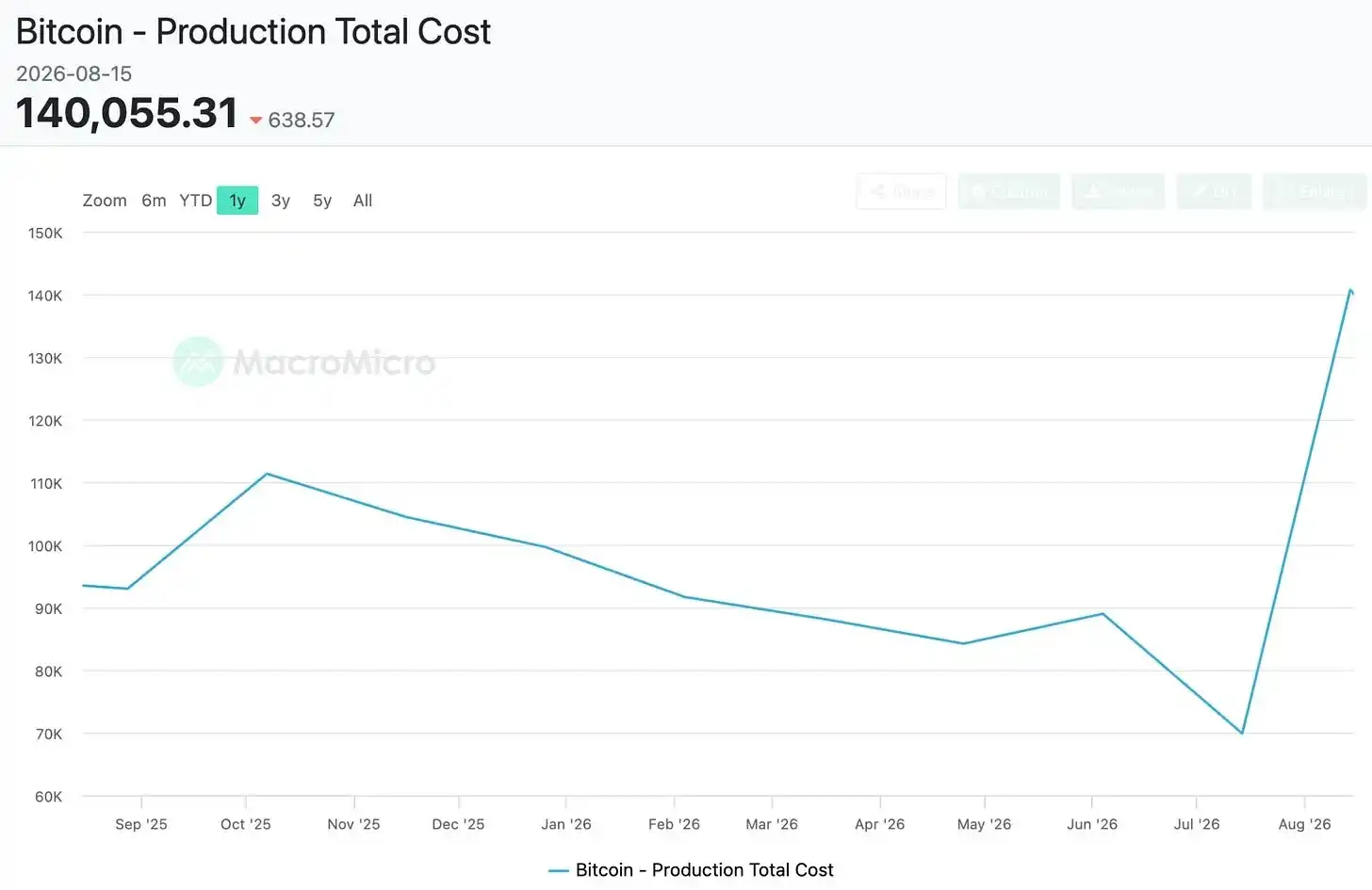
Source: MacroMicro

During the same period of worsening mining conditions, massive capital has flooded into the AI inference sector.

Bitcoin miners use ASIC chips to run complex algorithms and obtain block rewards. This hardware infrastructure is highly similar to the underlying requirements for high-performance computing and AI inference. This makes the transition to AI inference less daunting for miners, significantly lowering the barrier to entry. For miners seeking profitable outlets, pivoting to AI seems like a natural move.

Almost the entire listed mining sector has collectively changed course. The shift in revenue structure over the past few quarters vividly illustrates the scale of this transformation.

Take Core Scientific as an example: In Q2 2025, data center hosting services for AI and HPC generated only $10.6 million in quarterly revenue; during the same period, revenue from mining and selling Bitcoin was $62.4 million. Twelve months later, their positions were almost completely reversed. In Q2 2026, hosting revenue was $136.7 million, while mining revenue shrank by 65% to $21.5 million.

The proportion of hosting revenue to total company revenue skyrocketed from 14% last year to 83%.

TeraWulf's HPC leasing revenue already accounts for 71% of its total revenue. This business line had no revenue in the same period last year but reached $32 million in Q2 2026; during the same period, crypto asset mining revenue shrank by about 75%, remaining at only $13 million.
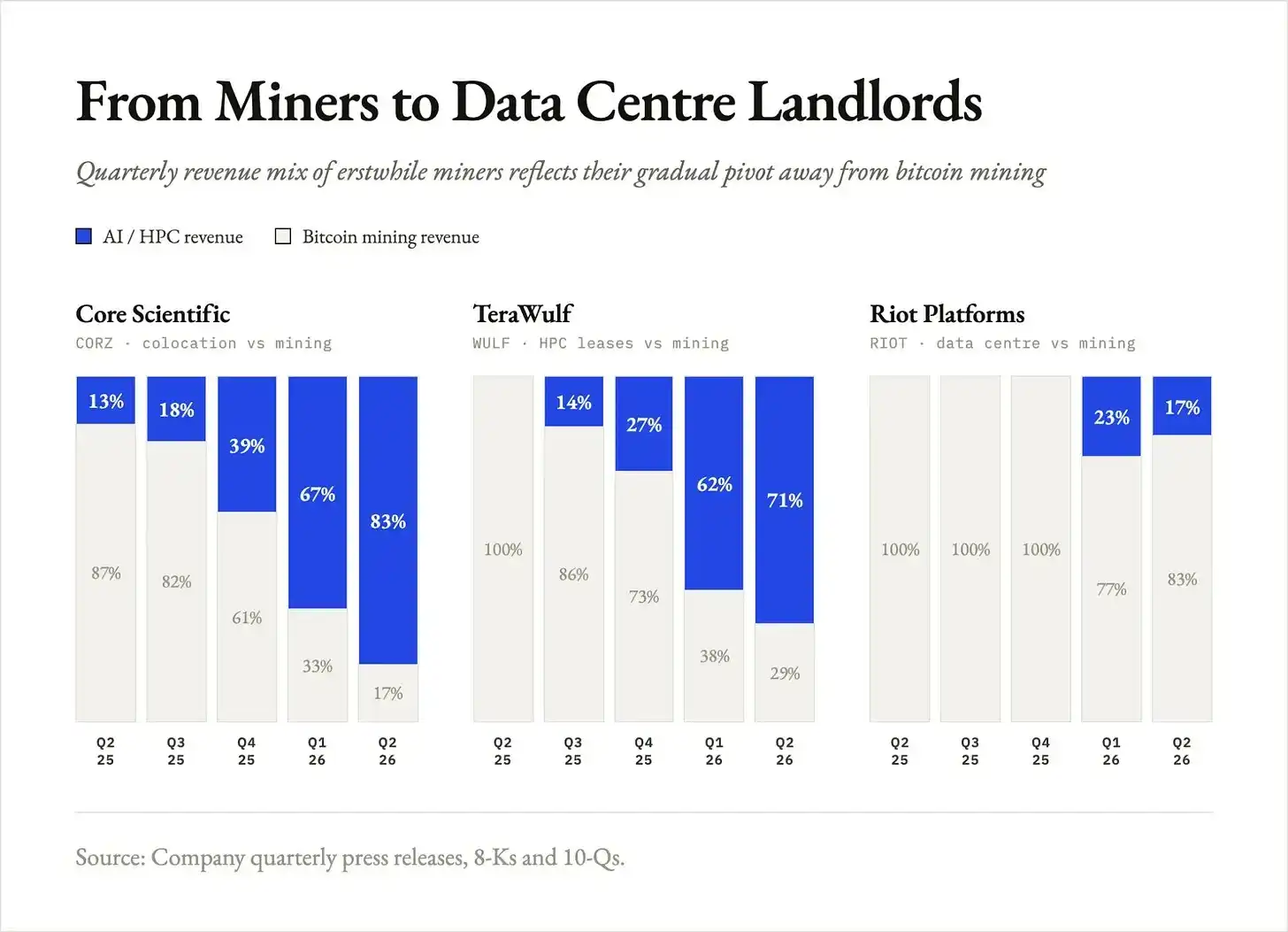
Many miners are also retrofitting their existing mining facilities and hardware to accommodate AI and HPC businesses.

A Worrisome Land Grab

The shift from Bitcoin mining to AI computing power has turned into a collective stampede. Beyond allocating existing capacity to AI, former Bitcoin miners are frantically securing electricity, land, and signing numerous demand orders. The total value of contracts already in place amounts to tens of billions of dollars.

Core Scientific has committed up to 2.5GW of available computing capacity to AMD and CoreWeave, with potential total revenue exceeding $24 billion over the contract period. Hut 8 holds 949 megawatts of contracted computing power with a base contract value of $26.6 billion and has secured $7.5 billion in new project financing.

TeraWulf signed a 20-year lease agreement worth approximately $19 billion with Anthropic and acquired a gigawatt-scale campus in Kentucky to meet computing demand. Over the past six months, Riot Platforms completed multiple leases totaling 241 megawatts, corresponding to a contract size of about $10 billion. Just last week, IREN delivered its first batch of AI cloud deployment nodes to Microsoft—a five-year contract valued at $9.7 billion; it also secured a 5GW partnership with Nvidia and continues acquiring power sites in Texas and Spain to supply computing needs.

This series of massive contracts has ignited market enthusiasm. Compared to miners' past businesses, signing 20-year leases with leading cloud providers promises more stable cash flow. After a full year of mining losses, locking in contracts for up to fifteen years seems like solid, tangible reality.

However, much market commentary underestimates the hidden risks.

Despite the hardship of mining, Bitcoin mining possesses a characteristic that AI hosting lacks: a self-healing mechanism. When mining becomes unprofitable, miners shut down their machines; when enough miners exit, the Bitcoin network difficulty automatically adjusts downward. The remaining miners, with the same equipment and electricity costs, can achieve higher returns.
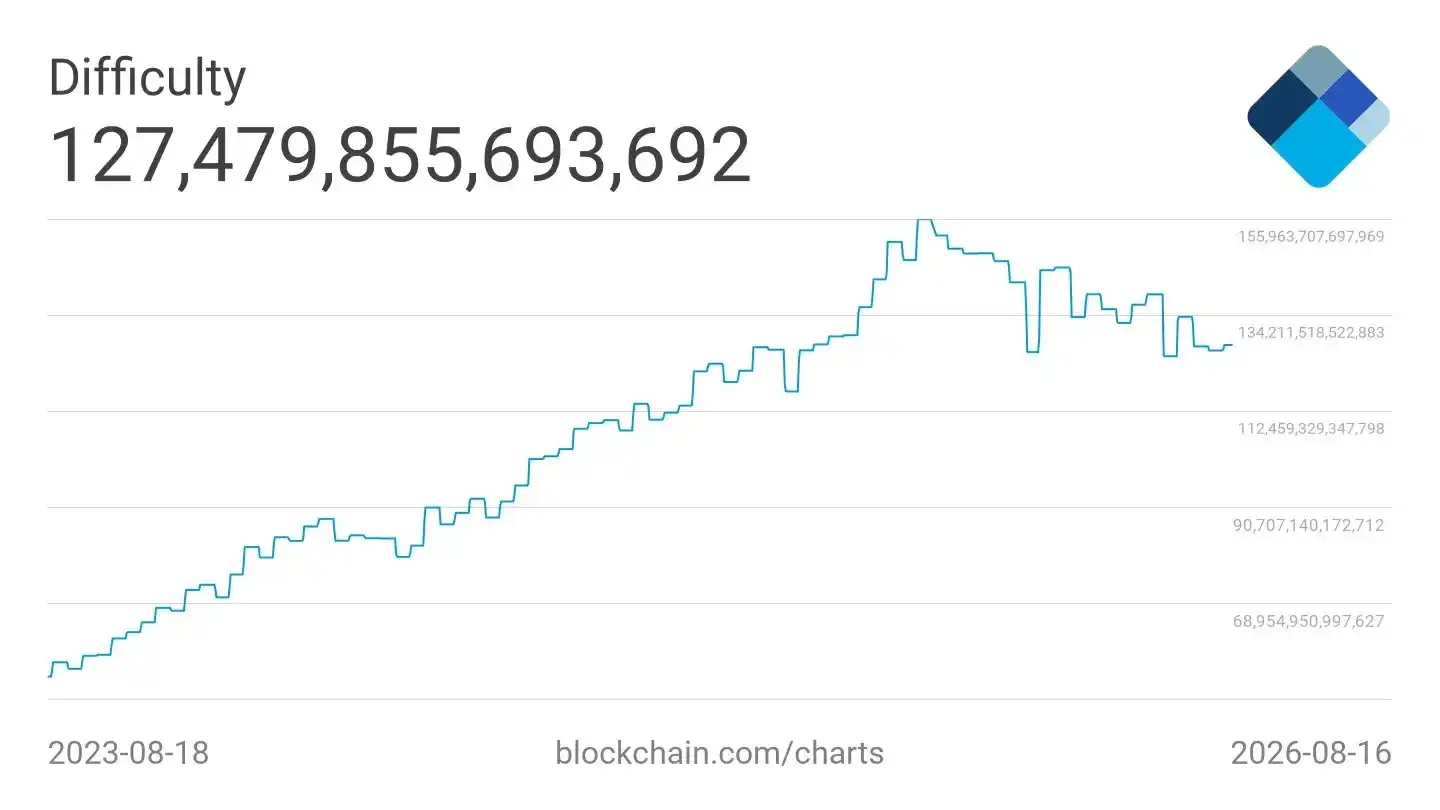
After many miners switched to the AI sector, Bitcoin's network difficulty has dropped from its peak of around 156 trillion in 2025 to 127.5 trillion. Every company exiting mining is making the mining rewards higher for those who remain.

However, the AI computing power industry lacks this automatic adjustment mechanism. If too many players flood in, causing an oversupply of computing power, prices will be driven down.

Although overall demand for AI computing is rising, prices may actually fall—seemingly contrary to basic economic principles. In fact, several AI companies have already lowered their service prices. In the early days of the industry, with hardware and supporting resources scarce, service providers could charge high premiums. Now, cloud giants worldwide are competing for megawatt-level power resources, and this scarcity has attracted a large number of Bitcoin miners and data center operators to massively expand capacity. Once new supply fills the demand gap, computing power prices will decline rapidly.

When prices fall, the 15-20 year long-term leases miners are signing at today's high prices will look prohibitively expensive in hindsight.

There is another tricky aspect to this transition: the path is largely one-way. Converting a mining facility into an AI computing campus is straightforward; the power infrastructure is already in place. But once you replace ASIC miners with H100 GPUs and sign a 20-year lease, you'll be tightly bound by this contract for the next two decades, unable to easily switch back to mining.

When market cycles reverse in the future, with Bitcoin prices breaking away from the $60,000 low and network difficulty decreasing, mining will inevitably become profitable again. By then, former miners who have completely transformed, constrained by multi-year long-term leases, can only watch the opportunity pass by. Worse still, if the actual revenue from AI computing falls short of the optimistic expectations at signing, a double blow will follow.

So, should miners not transform and just wait patiently for the mining cycle to turn? I don't think so. For most companies, transformation is a forced choice for survival. With a comprehensive mining cost of $140,000 and the coin price at only $63,000, continuing to mine is commercially unviable; AI is the only immediate lifeline.

But the will to survive drives companies to make extreme choices. The risk lies precisely with those players who go all-in on AI: forced by survival pressure, they completely abandon Bitcoin mining, destroy/replace all ASIC miners, and lock themselves into decades-long contracts in a nascent industry that will still experience price corrections.

However, not all miners have chosen a complete 180-degree turn; some companies have been more cautious.

Those With Hedging Options Hold the Advantage

Marathon Digital, the listed mining company with the largest Bitcoin treasury, has taken a cautious path. In Q2 2026, it sold 30% of its Bitcoin holdings to reduce debt, but it has not abandoned its Bitcoin mining equipment. Instead, it chose another way to fund its AI expansion.

MARA used its remaining Bitcoin as collateral to secure $150 million in funding through a 2026 credit facility to finance its AI business expansion. As of June 30, its balance sheet still holds over 35,000 Bitcoins while maintaining a flexible, load-adjustable mining operation.

Hut 8 has also not abandoned mining. It spun off its Bitcoin mining business into a new, wholly-owned subsidiary, American Bitcoin Corp, while the parent company focuses on HPC and AI infrastructure.

By keeping mining machines running and maintaining Bitcoin inventories, these companies hold an option abandoned by those who have gone all-in on the transformation. When mining becomes profitable again, they can switch their power load back to mining; companies deeply tied to long-term AI contracts can only watch from the sidelines.

Treating old mining operations as baggage and betting everything on AI computing is gambling on an unproven future. But historical patterns are easy to predict: chips, computers, smartphones—every emerging technology sees product prices fall as the industry matures. Signs of price softening have already appeared in the AI computing power industry.

Companies like Marathon and Hut 8 are not missing out on the AI boom. They haven't liquidated everything to buy GPUs. Instead, they retain some mining capacity and Bitcoin holdings, treating AI as a diversification strategy rather than betting all their capital on an immature sector that will undergo price re-evaluation. As long as the ASIC miners are still there, when mining becomes more profitable and AI computing premiums fade, they can switch the load back to mining Bitcoin.

From a broader perspective, these companies are essentially power operators; the hardware on top is either ASIC miners or H100 graphics cards. Companies that can flexibly allocate power resources between mining and AI computing based on which business yields higher returns will not be entirely at the mercy of market cycles and narratives.

Crypto di tendenza

Domande pertinenti

QWhat is the main reason leading major listed Bitcoin mining companies to shift their focus towards AI and high-performance computing (HPC)?

AThe primary driver is a severe survival crisis triggered by the Bitcoin block reward halving in April 2024 and a subsequent sharp drop in Bitcoin's price. With the current price of Bitcoin around $63,000 and the all-in mining cost having soared to as high as $140,000, continuing to mine and sell Bitcoin is largely unprofitable. Simultaneously, the explosive growth in demand for AI inference computing power offers a seemingly viable and lucrative alternative business model.

QWhat is a key long-term risk for miners who sign large, multi-year contracts for AI compute capacity at current high prices?

AA major risk is being locked into long-term (e.g., 15-20 year) contracts at peak prices. As more players enter the AI compute market and supply expands, the scarcity premium is likely to diminish, leading to a decline in compute pricing. Companies that signed contracts based on current high valuations may find their contracts economically burdensome in the future, while being unable to easily switch back to Bitcoin mining.

QHow does the Bitcoin mining industry's self-adjusting mechanism contrast with the dynamics of the AI compute market?

ABitcoin mining has a built-in self-healing mechanism: when mining becomes unprofitable, miners shut off machines, leading to a decrease in the network's mining difficulty. This automatically improves profitability for the remaining miners. In contrast, the AI compute market lacks such an automatic adjustment. If an oversupply of compute power develops, prices can be driven down without a corresponding automatic mechanism to restore profitability for suppliers.

QWhich mining companies are cited as examples of taking a more cautious, diversified approach to the AI shift, and what does this approach involve?

AMarathon Digital (MARA) and Hut 8 are cited as examples. Their cautious approach involves not fully abandoning Bitcoin mining. Marathon used part of its Bitcoin treasury as collateral for loans to fund AI expansion while retaining its mining hardware and a significant Bitcoin reserve. Hut 8 spun off its Bitcoin mining into a separate subsidiary while focusing the parent company on HPC/AI. This preserves the optionality to switch power back to mining if it becomes more profitable again.

QAccording to the article, what fundamental capability gives flexible miners a strategic advantage over those who are 'all-in' on AI?

AThe fundamental advantage is being able to act as flexible power operators. Companies that retain both Bitcoin mining hardware (ASICs) and AI computing hardware (GPUs) can dynamically allocate their electricity and infrastructure resources based on which application—Bitcoin mining or AI compute—offers higher returns at any given time. This flexibility protects them from being solely dependent on the volatile cycles of either market.

Letture associate

Dutch Prosecutors Seize $2.55 Million in Cryptocurrency Linked to Bankrupt Company Knaken

Dutch prosecutors have liquidated all remaining cryptocurrency assets belonging to the bankrupt trading platform Knaken, recovering $2.55 million for creditors. However, the court-appointed trustee warned that the platform's 6,300 affected clients will likely recover only a small portion of their investments, estimated between $11.6 and $13.9 million. The trustee, Carl Hamm, stated that the platform operated with a significant structural deficit, mixing client investments with operational expenses, rather than fully covering user deposits. Investigations reveal that Knaken's owner, Ronald J., transferred $2.67 million from company accounts to a private entity he owned—a transaction the court described as a conflict of interest. Despite financial troubles beginning as early as 2020, Knaken continued to expand its client base and secured high-profile sponsorship deals with major Dutch football clubs, without disclosing its difficulties to the Dutch Central Bank. The platform also issued participation certificates and took loans from clients. Prior to the bankruptcy declaration, Dutch authorities seized and sold Knaken's remaining crypto reserves under a law permitting the liquidation of rapidly depreciating assets. This $2.55 million is currently the only liquid asset in the bankruptcy estate. Some legal counsel for the victims questioned whether authorities overstepped by liquidating client assets. In response, Ronald J. contested some of the trustee's claims, asserting that Knaken acted as a broker with verifiable trade logs and that separate banking structures were later implemented for client funds. He acknowledged an asset shortfall but is actively working on a creditor settlement plan. The trustee is currently assessing the feasibility of any proposed settlement.

cryptonews.ru34 min fa

Dutch Prosecutors Seize $2.55 Million in Cryptocurrency Linked to Bankrupt Company Knaken

cryptonews.ru34 min fa

Trading

Spot

Articoli Popolari

Cosa è BITCOIN

Comprendere HarryPotterObamaSonic10Inu (ERC-20) e la sua posizione nel mondo delle criptovalute Negli ultimi anni, il mercato delle criptovalute ha assistito a un aumento della popolarità delle meme coin, catturando l'interesse non solo dei trader, ma anche di coloro che cercano coinvolgimento comunitario e valore di intrattenimento. Tra questi token unici c'è HarryPotterObamaSonic10Inu (ERC-20), un progetto intrigante che mescola riferimenti culturali nel tessuto delle criptovalute. Questo articolo esplora gli aspetti chiave di HarryPotterObamaSonic10Inu, analizzando i suoi meccanismi, l'etica guidata dalla comunità e il suo coinvolgimento con il panorama crittografico più ampio. Che cos'è HarryPotterObamaSonic10Inu (ERC-20)? Come suggerisce il suo nome, HarryPotterObamaSonic10Inu è una meme coin costruita sulla blockchain di Ethereum, classificata secondo lo standard ERC-20. A differenza delle criptovalute tradizionali che possono enfatizzare l'utilità pratica o il potenziale investimento, questo token prospera grazie al valore di intrattenimento e alla forza della sua comunità. Il progetto mira a creare un ambiente in cui gli utenti coinvolti possono riunirsi, condividere idee e partecipare ad attività ispirate a diversi fenomeni culturali. Una caratteristica notevole di HarryPotterObamaSonic10Inu è la zero tassa sulle transazioni. Questo elemento allettante tende a incoraggiare il trading e il coinvolgimento della comunità, privo di costi aggiuntivi che possono scoraggiare i trader di piccole dimensioni. L'offerta totale della moneta è fissata a un miliardo di token, un numero che segna la sua intenzione di mantenere una circolazione sostanziale all'interno della comunità. Creatore di HarryPotterObamaSonic10Inu (ERC-20) Le origini di HarryPotterObamaSonic10Inu sono avvolte in un certo mistero; i dettagli sul creatore rimangono sconosciuti. Lo sviluppo di questo token non presenta un team identificabile o un piano esplicito, cosa non rara nel settore delle meme coin. Invece, il progetto è emerso organicamente, con il suo progresso fortemente dipendente dall'entusiasmo e dalla partecipazione della sua comunità. Investitori di HarryPotterObamaSonic10Inu (ERC-20) Per quanto riguarda investimenti esterni e finanziamenti, HarryPotterObamaSonic10Inu rimane ambiguo. Il token non elenca alcuna fondazione di investimento conosciuta o un sostegno organizzativo significativo. Invece, la linfa vitale del progetto è la sua comunità di base, che informa la sua crescita e sostenibilità attraverso azioni collettive e coinvolgimento nello spazio crittografico. Come funziona HarryPotterObamaSonic10Inu (ERC-20)? In quanto meme coin, HarryPotterObamaSonic10Inu opera principalmente al di fuori delle strutture tradizionali che governano spesso il valore degli asset. Ci sono diversi aspetti distintivi che definiscono il funzionamento del progetto: Transazioni senza tasse: Senza costi fiscali sulle transazioni, gli utenti possono comprare e vendere liberamente il token senza preoccuparsi di costi nascosti. Coinvolgimento della comunità: Il progetto prospera sull'interazione della comunità, sfruttando le piattaforme social per creare entusiasmo e facilitare il coinvolgimento. Discussioni, condivisione di contenuti e coinvolgimento sono elementi cruciali che aiutano ad espandere la sua portata e a favorire la lealtà tra i sostenitori. Nessuna utilità pratica: Va notato che HarryPotterObamaSonic10Inu non offre un'utilità concreta all'interno dell'ecosistema finanziario. Piuttosto, è classificato come un token principalmente per attività di intrattenimento e comunitarie. Riferimento culturale: Il token incorpora astutamente elementi della cultura pop per attirare interesse, collegandosi a appassionati di meme e seguaci delle criptovalute. HarryPotterObamaSonic10Inu esemplifica come le meme coin operino in modo diverso rispetto ai progetti di criptovalute più tradizionali, entrando nel mercato come costrutti sociali innovativi piuttosto che come asset utilitari. Cronologia di HarryPotterObamaSonic10Inu (ERC-20) La storia di HarryPotterObamaSonic10Inu è segnata da diversi traguardi notevoli: Creazione: Il token è emerso da un meme virale, catturando l'immaginazione di molti appassionati di criptovalute. Le date di creazione specifiche non sono disponibili, sottolineando la sua crescita organica. Inserimento negli scambi: HarryPotterObamaSonic10Inu ha fatto il suo ingresso in vari scambi, consentendo un accesso e un trading più facili da parte della comunità. Iniziative di coinvolgimento della comunità: Attività in corso volte a migliorare l'interazione della comunità, comprese gare, campagne sui social media e generazione di contenuti da parte di fan e sostenitori. Piani di espansione futura: La tabella di marcia del progetto include il lancio di una collezione NFT, merchandising e un sito di eCommerce relativo ai suoi temi culturali, coinvolgendo ulteriormente la comunità e cercando di aggiungere più dimensioni al suo ecosistema. Punti chiave su HarryPotterObamaSonic10Inu (ERC-20) Natura guidata dalla comunità: Il progetto dà priorità al contributo collettivo e alla creatività, garantendo che il coinvolgimento degli utenti sia al centro del suo sviluppo. Classificazione come meme coin: Rappresenta l'epitome delle criptovalute basate sull'intrattenimento, distinguendosi dai veicoli d'investimento tradizionali. Nessuna affiliazione diretta con Bitcoin: Nonostante la somiglianza nel nome del ticker, HarryPotterObamaSonic10Inu è distintivo e non ha alcuna relazione con Bitcoin o altre criptovalute consolidate. Focus sulla collaborazione: HarryPotterObamaSonic10Inu è progettato per creare uno spazio per la collaborazione e la condivisione di storie tra i suoi detentori, fornendo un canale per la creatività e il legame comunitario. Prospettive future: L'ambizione di espandersi oltre il suo presupposto iniziale verso NFT e merchandising delinea un percorso per il progetto per potenzialmente entrare in strade più mainstream all'interno della cultura digitale. Poiché le meme coin continuano a catturare l'immaginazione della comunità crittografica, HarryPotterObamaSonic10Inu (ERC-20) si distingue per i suoi legami culturali e il suo approccio centrato sulla comunità. Anche se potrebbe non adattarsi al modello tipico di un token orientato all'utilità, la sua essenza risiede nella gioia e nella camaraderia coltivate tra i suoi sostenitori, evidenziando la natura in evoluzione delle criptovalute in un'epoca sempre più digitale. Con la continuazione dello sviluppo del progetto, sarà importante osservare come le dinamiche della comunità influenzano la sua traiettoria nel panorama in continuo cambiamento della tecnologia blockchain.

2.3k Totale visualizzazioniPubblicato il 2024.04.01Aggiornato il 2024.12.03

Cosa è BITCOIN

Come comprare BTC

Benvenuto in HTX.com! Abbiamo reso l'acquisto di Bitcoin (BTC) semplice e conveniente. Segui la nostra guida passo passo per intraprendere il tuo viaggio nel mondo delle criptovalute.Step 1: Crea il tuo Account HTXUsa la tua email o numero di telefono per registrarti il tuo account gratuito su HTX. Vivi un'esperienza facile e sblocca tutte le funzionalità,Crea il mio accountStep 2: Vai in Acquista crypto e seleziona il tuo metodo di pagamentoCarta di credito/debito: utilizza la tua Visa o Mastercard per acquistare immediatamente BitcoinBTC.Bilancio: Usa i fondi dal bilancio del tuo account HTX per fare trading senza problemi.Terze parti: abbiamo aggiunto metodi di pagamento molto utilizzati come Google Pay e Apple Pay per maggiore comodità.P2P: Fai trading direttamente con altri utenti HTX.Over-the-Counter (OTC): Offriamo servizi su misura e tassi di cambio competitivi per i trader.Step 3: Conserva Bitcoin (BTC)Dopo aver acquistato Bitcoin (BTC), conserva nel tuo account HTX. In alternativa, puoi inviare tramite trasferimento blockchain o scambiare per altre criptovalute.Step 4: Scambia Bitcoin (BTC)Scambia facilmente Bitcoin (BTC) nel mercato spot di HTX. Accedi al tuo account, seleziona la tua coppia di trading, esegui le tue operazioni e monitora in tempo reale. Offriamo un'esperienza user-friendly sia per chi ha appena iniziato che per i trader più esperti.

4.8k Totale visualizzazioniPubblicato il 2024.12.12Aggiornato il 2026.06.02

Come comprare BTC

Cosa è $BITCOIN

ORO DIGITALE ($BITCOIN): Un'Analisi Completa Introduzione all'ORO DIGITALE ($BITCOIN) L'ORO DIGITALE ($BITCOIN) è un progetto basato su blockchain che opera sulla rete Solana, con l'obiettivo di combinare le caratteristiche dei metalli preziosi tradizionali con l'innovazione delle tecnologie decentralizzate. Sebbene condivida un nome con Bitcoin, spesso definito “oro digitale” a causa della sua percezione come riserva di valore, l'ORO DIGITALE è un token separato progettato per creare un ecosistema unico all'interno del panorama Web3. Il suo obiettivo è posizionarsi come un asset digitale alternativo valido, anche se i dettagli riguardanti le sue applicazioni e funzionalità sono ancora in fase di sviluppo. Cos'è l'ORO DIGITALE ($BITCOIN)? L'ORO DIGITALE ($BITCOIN) è un token di criptovaluta esplicitamente progettato per l'uso sulla blockchain di Solana. A differenza di Bitcoin, che fornisce un ruolo di stoccaggio di valore ampiamente riconosciuto, questo token sembra concentrarsi su applicazioni e caratteristiche più ampie. Aspetti notevoli includono: Infrastruttura Blockchain: Il token è costruito sulla blockchain di Solana, nota per la sua capacità di gestire transazioni ad alta velocità e a basso costo. Dinamiche di Offerta: L'ORO DIGITALE ha un'offerta massima fissata a 100 quadrilioni di token (100P $BITCOIN), sebbene i dettagli riguardanti la sua offerta circolante siano attualmente non divulgati. Utilità: Sebbene le funzionalità precise non siano esplicitamente delineate, ci sono indicazioni che il token potrebbe essere utilizzato per varie applicazioni, potenzialmente coinvolgendo applicazioni decentralizzate (dApp) o strategie di tokenizzazione degli asset. Chi è il Creatore dell'ORO DIGITALE ($BITCOIN)? Attualmente, l'identità dei creatori e del team di sviluppo dietro l'ORO DIGITALE ($BITCOIN) rimane sconosciuta. Questa situazione è tipica tra molti progetti innovativi nel settore blockchain, in particolare quelli allineati con la finanza decentralizzata e i fenomeni delle meme coin. Sebbene tale anonimato possa favorire una cultura guidata dalla comunità, intensifica le preoccupazioni riguardo alla governance e alla responsabilità. Chi sono gli Investitori dell'ORO DIGITALE ($BITCOIN)? Le informazioni disponibili indicano che l'ORO DIGITALE ($BITCOIN) non ha alcun sostenitore istituzionale noto o investimenti di venture capital prominenti. Il progetto sembra operare su un modello peer-to-peer incentrato sul supporto e sull'adozione della comunità piuttosto che su percorsi di finanziamento tradizionali. La sua attività e liquidità si trovano principalmente su exchange decentralizzati (DEX), come PumpSwap, piuttosto che su piattaforme di trading centralizzate consolidate, evidenziando ulteriormente il suo approccio di base. Come Funziona l'ORO DIGITALE ($BITCOIN) Le meccaniche operative dell'ORO DIGITALE ($BITCOIN) possono essere elaborate in base al suo design blockchain e alle caratteristiche della rete: Meccanismo di Consenso: Sfruttando il proof-of-history (PoH) unico di Solana combinato con un modello di proof-of-stake (PoS), il progetto garantisce una validazione efficiente delle transazioni contribuendo all'alta performance della rete. Tokenomics: Sebbene meccanismi deflazionistici specifici non siano stati dettagliati ampiamente, l'ampia offerta massima di token implica che potrebbe soddisfare microtransazioni o casi d'uso di nicchia che devono ancora essere definiti. Interoperabilità: Esiste il potenziale per l'integrazione con l'ecosistema più ampio di Solana, inclusi vari piattaforme di finanza decentralizzata (DeFi). Tuttavia, i dettagli riguardanti integrazioni specifiche rimangono non specificati. Cronologia degli Eventi Chiave Ecco una cronologia che evidenzia traguardi significativi riguardanti l'ORO DIGITALE ($BITCOIN): 2023: Il dispiegamento iniziale del token avviene sulla blockchain di Solana, contrassegnato dal suo indirizzo di contratto. 2024: L'ORO DIGITALE guadagna visibilità poiché diventa disponibile per il trading su exchange decentralizzati come PumpSwap, consentendo agli utenti di scambiarlo contro SOL. 2025: Il progetto assiste a un'attività di trading sporadica e a un potenziale interesse per impegni guidati dalla comunità, sebbene non siano state documentate partnership significative o avanzamenti tecnici fino ad ora. Analisi Critica Punti di Forza Scalabilità: L'infrastruttura sottostante di Solana supporta alti volumi di transazioni, il che potrebbe migliorare l'utilità di $BITCOIN in vari scenari di transazione. Accessibilità: Il potenziale basso prezzo di trading per token potrebbe attrarre investitori al dettaglio, facilitando una partecipazione più ampia grazie a opportunità di proprietà frazionata. Rischi Mancanza di Trasparenza: L'assenza di sostenitori, sviluppatori o di un processo di audit pubblicamente noti potrebbe generare scetticismo riguardo alla sostenibilità e all'affidabilità del progetto. Volatilità del Mercato: L'attività di trading è fortemente dipendente dal comportamento speculativo, il che può comportare una significativa volatilità dei prezzi e incertezze per gli investitori. Conclusione L'ORO DIGITALE ($BITCOIN) emerge come un progetto intrigante ma ambiguo all'interno dell'evolvente ecosistema di Solana. Sebbene tenti di sfruttare la narrativa dell'“oro digitale”, la sua partenza dal ruolo consolidato di Bitcoin come riserva di valore sottolinea la necessità di una chiara differenziazione della sua utilità e struttura di governance. L'accettazione e l'adozione future dipenderanno probabilmente dall'affrontare l'attuale opacità e dalla definizione più esplicita delle sue strategie operative ed economiche. Nota: Questo rapporto comprende informazioni sintetizzate disponibili a ottobre 2023, e potrebbero essersi verificati sviluppi oltre il periodo di ricerca.

525 Totale visualizzazioniPubblicato il 2025.05.13Aggiornato il 2025.05.13

Cosa è $BITCOIN

Discussioni

Benvenuto nella Community HTX. Qui puoi rimanere informato sugli ultimi sviluppi della piattaforma e accedere ad approfondimenti esperti sul mercato. Le opinioni degli utenti sul prezzo di BTC BTC sono presentate come di seguito.

活动图片