Bezos, Schmidt, Powell Jobs: The Three AI Investment Philosophies of Silicon Valley's Old Money

marsbitPubblicato 2026-05-14Pubblicato ultima volta 2026-05-14

Introduzione

Jeff Bezos, Eric Schmidt, and Laurene Powell Jobs, three prominent figures from Silicon Valley's "old money," are deploying massive personal fortunes into AI, but with distinctly different investment philosophies reflecting their visions for the future. Eric Schmidt, the former Google CEO, approaches AI as a geopolitical and infrastructural arms race. Through his family office, Hillspire, he invests heavily in defense AI companies, energy infrastructure (like Bolt Data & Energy to power data centers), and space launch capabilities (Relativity Space). For Schmidt, the ultimate AI advantage lies in physical resources—energy, transport, and military application—framing it as a national competition requiring state-level strategy and endurance. Jeff Bezos is building a vertically integrated, full-stack AI empire. His bets span the model layer (via Amazon's massive investment in Anthropic), the application layer (through investments like Perplexity), and now, the physical execution layer. His new venture, Project Prometheus, with $6.2 billion, aims to inject AI into manufacturing, creating a closed loop from AI chips and cloud compute (AWS) to real-world production, potentially for Amazon's own ventures like the Kuiper satellite network. In contrast, Laurene Powell Jobs adopts a more subtle, human-centric approach through her Emerson Collective. Her AI investments focus on specific, positive-impact applications—such as AI for healthcare (Proximie, Atropos Health), education (Cur...

Author: Deep Chao TechFlow

On November 17, 2025, 61-year-old Jeff Bezos once again became the CEO of a company. It was the first time he returned to an operational role since stepping down from Amazon in 2021. The new company is called Project Prometheus, with a startup fund of $6.2 billion, focusing on "Physical AI" and targeting the manufacturing industry.

Seven months earlier, 70-year-old Eric Schmidt took control of a rocket company called Relativity Space and appointed himself as CEO. He didn't explain why he needed to step in at his age, perhaps "every day matters in the AI era" was the default answer.

In June of the same year, Steve Jobs' widow, Laurene Powell Jobs, gave a rare public interview. She sat next to Jony Ive, talking about the prototype she saw at the company io. It was an "AI device" acquired by OpenAI with $6.4 billion in stock, reportedly screenless and shaped like a player hanging around the neck. Her evaluation of the prototype was: "It's an incredible thing to see an idea become reality."

Three people, three different postures. But they are all placing bets at the same casino.

Over the past three years, top moneybags in Silicon Valley have almost all been doing the same thing: pouring money from family offices, venture capital, and charitable foundations into AI. Schmidt, Bezos, and Powell Jobs are just the three most prominent examples. But a closer look at their target lists reveals that this is not the same game; they are betting on three completely different futures.

Schmidt: Treating AI as the Next Cold War
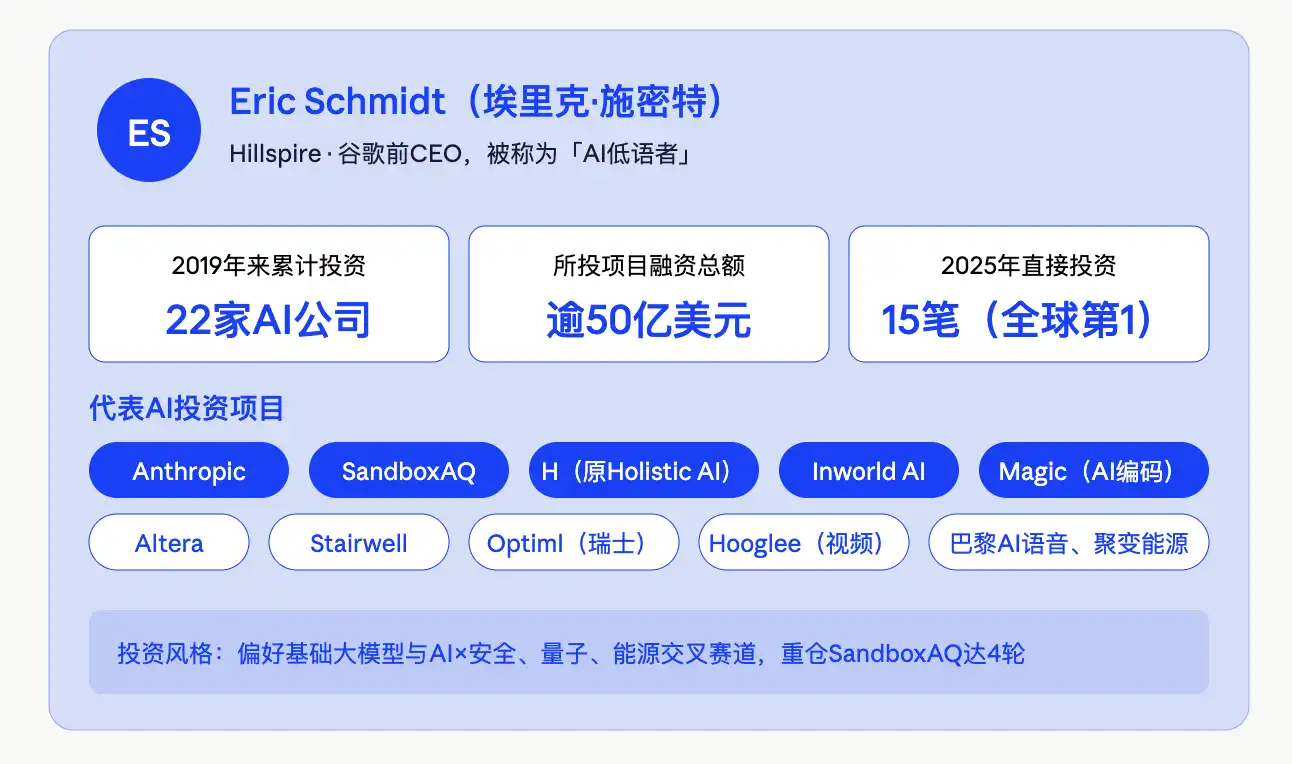
According to data cited by Wikipedia and The AI Insider, Schmidt's family office Hillspire has invested in over 22 AI companies since 2019, totaling more than $5 billion. The list includes Anthropic, SandboxAQ (a quantum+AI company spun off from Alphabet), Inworld AI, Holistic AI, and Altera. These are the targets that "insiders in the industry" would list.

But what truly reveals his underlying approach is another list.

White Stork: A company producing AI drones in Ukraine. Rebellion Defense: Defense AI. Istari: Simulation. Swift Beat: Military software. This is a family office that treats AI as the next generation of military equipment.

Schmidt has served as Chairman of the Defense Innovation Board since 2016 and co-led the National Security Commission on Artificial Intelligence from 2019 to 2021. He is a player who treats AI policy, defense procurement, and energy infrastructure as one and the same. In January 2024, Forbes disclosed that he simultaneously launched White Stork's drone projects in the U.S. and Ukraine, treating the Ukrainian battlefield as a "laboratory for AI weapons."

Then there's infrastructure.

In January 2026, he co-founded a company called Bolt Data & Energy with Texas Pacific Land, serving as its chairman. This company doesn't rent server rooms or buy electricity from the grid; it aims to build its own natural gas power plants in the West Texas wilderness, directly pumping electricity into data centers. The plan is to first reach 1 gigawatt, eventually scaling to 10 gigawatts, equivalent to the electricity consumption of 7 million households. Texas Pacific Land contributed $50 million, plus priority water supply rights. In an email reply to Fortune, Schmidt said: "The biggest bottleneck for AI is not algorithms, it's energy."

In March of the same year, he took control of Relativity Space. This company is developing a reusable rocket called Terran R, aiming to challenge SpaceX's monopoly in medium-to-low orbit launches. By that time, it had $2.9 billion in orders.

Putting these pieces together, the logic becomes clear.

Schmidt doesn't believe in the approach of "investing in a basket of large model companies." He believes the outcome of AI will ultimately depend on three things: computing power (data centers and electricity), transport (rockets, satellites, drones), and policy (defense committees and congressional hearings). He also invests in model companies, and even publicly wrote an article calling for the U.S. to increase open-source investment after DeepSeek emerged, but that's just one piece on his chessboard, not the whole game.

His reaction to DeepSeek is very telling. After DeepSeek's release in early 2025, Schmidt immediately wrote an article in The Washington Post, calling it a "turning point in the global AI race." His prescription wasn't retreat, but escalation, including more open source, more Stargate-style infrastructure, and more sharing of training methods between model labs.

In other words, he sees AI as an endurance race between nations, and he has already positioned himself on the sidelines while also serving as a committee member. At 70, stepping out to become CEO of Relativity might seem like a struggle to outsiders. He explains it himself: Kissinger worked until he was 100, "times of major transformation require responsibility, not withdrawal."

Bezos: The Full-Stack Control Freak
Bezos's approach is completely different from Schmidt's.

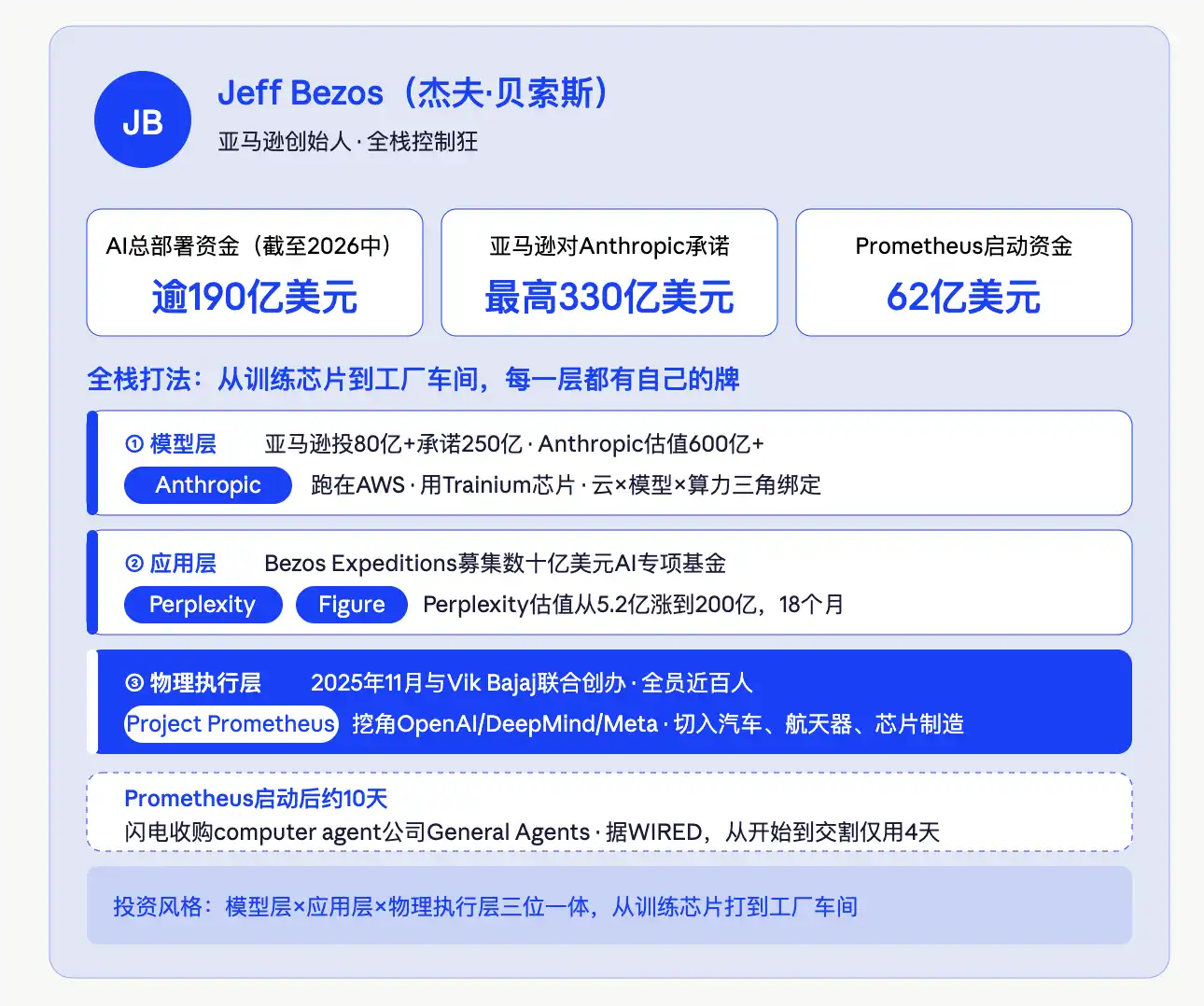
According to data cited by StartupHub from TechCrunch, The Information, and the Bezos Earth Fund, as of mid-2026, Bezos had deployed over $19 billion into AI. This number is still rising.

Breaking it down, it's mainly divided into three parts.

The first part is Anthropic. Amazon started investing in September 2023, eventually reaching $8 billion, and in April 2026, committed to adding up to $25 billion more. Anthropic runs on AWS, using Amazon's Trainium chips. This binds Amazon's cloud infrastructure, Bezos's model-layer bet, and Anthropic's research capacity into a triangle, going far beyond a mere financial investment. When Anthropic's valuation soared above $60 billion, Amazon had already captured the largest external slice of the pie.

The second part is the scattered investments of Bezos Expeditions. Bezos Expeditions is raising a multi-billion dollar AI-specific fund, upgrading "Bezos's personal angel investments" into "institutional investor." Among them, its investment in Perplexity, an AI search company, rose from a $520 million valuation in January 2024 to $20 billion in September 2025.

The third part is Project Prometheus.

In November 2025, Bezos and former Google X executive Vik Bajaj jointly announced the founding of this company, with a startup fund of $6.2 billion, nearly 100 employees. The team was recruited from OpenAI, DeepMind, and Meta. The founding advisor list included Ashish Vaswani and Jakob Uszkoreit, two of the authors of the 2017 paper "Attention Is All You Need." The company's goal is to apply AI to manufacturing, including cars, spacecraft, and chips.

Why manufacturing? Because this neatly meshes with Bezos's other businesses. Amazon has the Kuiper satellite constellation; once manufacturing AI is realized, its first batch of customers will be right in his own backyard.

Musk called Project Prometheus a "copycat" on X.

But structurally, this is not copying.

Bezos holds the model layer through Anthropic, the application layer through Perplexity and Figure, and the computing layer through Amazon. Now, by creating Prometheus, he's integrating AI into manufacturing, taking on the "physical world execution layer" as well. This is a full-stack approach, with his own cards at every layer, from training chips to deployment on the factory floor.

About 10 days after Project Prometheus launched, it quietly acquired a company called General Agents. This company developed "computer agents," AI agents capable of directly operating an entire computer. WIRED later disclosed that this acquisition, from start to closing, took only four days.

Donely's CEO Harsha Abegunasekara commented: "What General Agents truly cracked is speed; Ace runs on your computer almost instantaneously." His company was originally a competitor of General Agents.

From angel investing to forming a specialized fund, to personally taking the CEO role, Bezos only needed 18 months. He is essentially building a system larger than Amazon.

Powell Jobs: The Low-Key Camp
Looking at these three individuals together, Powell Jobs is the one who least resembles an "AI investor."

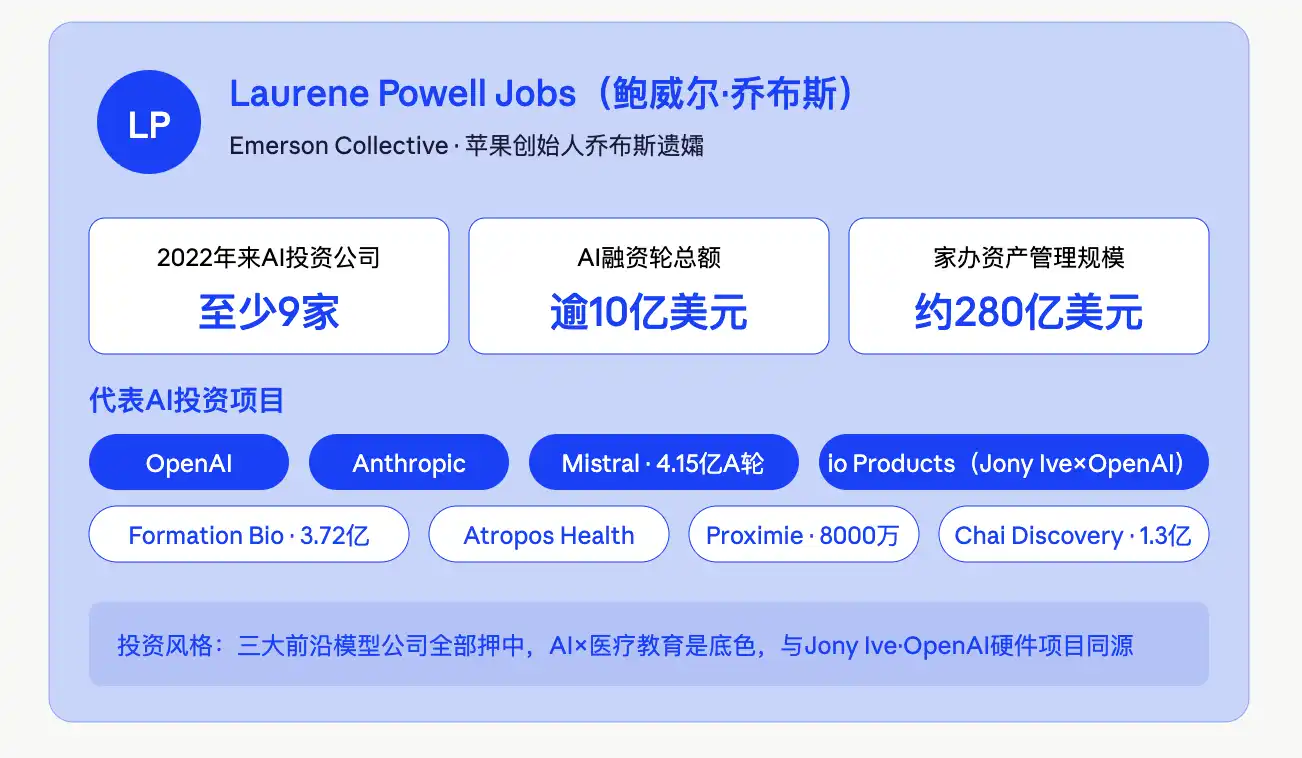
According to CNBC citing data from the private wealth platform Fintrx, her family office, Emerson Collective, has invested in at least 9 AI-related startups since 2022, participating in funding rounds totaling over $1 billion. This figure is not on the same scale as Schmidt's or Bezos's.

But the interesting part is the list itself.

Proximie: A remote surgical connection platform; Atropos Health: Clinical data AI; Formation Bio: AI drug discovery; Curipod: A Norwegian AI teaching tool; Mistral: The French large model company, Europe's sole contender against OpenAI.

No defense, no data centers, no rockets.

Emerson Collective's website clearly states its investment directions: Education, Energy & Environment, Digital Health, Fintech, Media. AI is just a tool woven into these themes. She holds a majority stake in The Atlantic and is very adept at Columbia-style "soft power" investments.

But the one investment she truly nailed is not on the same line as the ones mentioned above.

After Jony Ive left Apple in 2019, Powell Jobs invested in his design firm LoveFrom through Emerson Collective. Ive later said in a Financial Times interview: "If it weren't for Laurene, LoveFrom wouldn't exist at all." A few years later, Ive founded another hardware company called io, specializing in AI devices, and Powell Jobs invested again. In May 2025, OpenAI acquired io in an all-stock transaction worth $6.4 billion, making Ive a billionaire on paper. Emerson Collective also cashed out.

Another key investment: Emerson Collective was one of the early investors in Mistral AI when this French company was still Europe's last remaining contender in large models.

Putting these together, her AI bets are concentrated in two directions: either "using AI to solve specific human problems" or "reshaping the way humans and machines interact" (io's devices, Ive's design).

VC Sheet described Emerson Collective in an assessment: "An intentionally opaque LLC that houses venture capital, philanthropy, policy advocacy, art, and media ownership under one roof, able to use whichever tool—grants, policy lobbying, or investment—is most effective."

Philosophically, she is closer to the older generation of East Coast family offices: influence is more important than returns, the long term more important than the short term, having the microphone more important than the spotlight.

Three Investment Philosophies

Placing the three lists side by side, you see three sets of judgments about AI's future.

Schmidt is betting on national competition and infrastructure bottlenecks. In his world, AI will ultimately be determined by "who has the most electricity, the fastest rockets, the strongest drones." Models are just the entry ticket; the real moat is in the physical layer. That's why he personally steps in to lead Relativity and Bolt. What he wants is not returns, but control.

Bezos is betting on application diffusion at an industrial revolution scale. He believes AI will eventually permeate every machine tool, every airplane, every satellite like electricity. So he locks down the model layer through Amazon, the manufacturing layer through Prometheus, and embeds into the consumer application layer through Expeditions. He's not betting on whether a specific company will win, but whether this entire "full-stack" structure can win.

Powell Jobs is betting on something else. She's betting that humans will ultimately be unable to tolerate the current human-machine interaction model. She and Ive repeatedly emphasized in the Financial Times interview that "humans deserve better." Her investments in io, LoveFrom, medical AI, and educational AI are based on the same judgment: the biggest market of the next decade will be "fixing the side effects caused by the internet in the last decade."

Three sets of judgments, three different approaches.

Which one is right? No one knows. Schmidt might overestimate the weight of geopolitics in the AI economy. Bezos might underestimate the capital consumption of the "full-stack" heavy-asset model—a typical example is that Prometheus hasn't shipped anything yet, and there's already talk of needing to raise another $10 billion. Powell Jobs faces an even more awkward question: io's devices won't go into mass production until 2027, and OpenAI's own financial model has been repeatedly questioned by the market.

But one thing is certain. When the winners of the last internet generation collectively turn their family funds toward AI, this is no longer a small hype cycle in a certain sector. Bolt has already raised $150 million in startup funds; Anthropic alone is set to receive Amazon's committed $33 billion. Capital flows of this magnitude will shape the industrial geography of the next decade on their own.

As for who will have the last laugh, we'll have to look back in 2030. Until then, the three old-timers are still at the table, and the chips are still being added.

Domande pertinenti

QAccording to the article, what are the three distinct AI investment philosophies of Jeff Bezos, Eric Schmidt, and Laurene Powell Jobs?

AJeff Bezos's philosophy is an 'all-stack control freak' approach, aiming to build a system controlling everything from chips to factory floors through model layers (Anthropic), application layers (Perplexity, Figure), computing power (AWS), and manufacturing (Project Prometheus). Eric Schmidt views AI as the next Cold War, focusing on national competition and physical infrastructure like energy, rockets, drones, and defense policy. Laurene Powell Jobs focuses on human-centered applications, investing in using AI to solve specific human problems or reshape human-machine interaction through hardware and design.

QWhat specific company did Eric Schmidt personally become the CEO of to support his AI investment strategy, and what is its business?

AEric Schmidt became the CEO of Relativity Space, a rocket company developing a reusable rocket called Terran R to challenge SpaceX's monopoly in low-Earth orbit launch services. This is part of his strategy to secure the 'transportation' layer for AI's future.

QHow does Jeff Bezos's Project Prometheus connect to his broader business ecosystem?

AProject Prometheus focuses on applying AI to manufacturing (cars, spacecraft, chips). This aligns with Bezos's other businesses, as its first major clients could be internal. For example, Amazon has the Kuiper satellite constellation, and Project Prometheus's manufacturing AI could directly support its production.

QWhat is Laurene Powell Jobs's significant investment connection to Apple's former design chief Jony Ive?

ALaurene Powell Jobs's Emerson Collective invested in Jony Ive's design firm LoveFrom and later in his AI hardware company io. In 2025, OpenAI acquired io in a $6.4 billion all-stock deal, resulting in a significant financial return for both Ive and Emerson Collective.

QWhat common move have these three Silicon Valley figures made in the past three years regarding AI?

AIn the past three years, these top Silicon Valley figures have directed substantial capital from their family offices, venture capital, and charitable foundations into AI. While their specific strategies differ, they are all heavily betting on AI as a defining technology for the next decade, driving massive capital flows that will shape the future industry landscape.

Letture associate

Sam Altman in Conversation with Stripe CEO: The Era Where Ideas Are More Valuable Than Code Has Arrived!

At Stripe's 2026 annual conference, OpenAI CEO Sam Altman joined Stripe CEO Patrick Collison for a fireside chat. Altman shared key insights on the AI revolution, emphasizing that we are in a period of rapid takeoff, with AI capabilities advancing weekly. He outlined OpenAI's evolution from a research lab to a product company and now a large-scale "token factory" – a low-margin, utility-like provider of intelligence. Altman stressed that the most successful AI adopters have CEOs who personally automate workflows, driving organizational change. A significant shift is the rise of the "idea person." Altman now actively invests in founders with deep product insight but no coding skills, as AI tools enable them to build. He advocates for "suspension of disbelief" in investing, planning long-term (e.g., 20-year infrastructure deals) while focusing on a clear 2-year product roadmap. Beyond products, Altman is most excited about AI accelerating scientific discovery, shortening decade-long research cycles in complex diseases and driving breakthroughs in materials science and energy. He predicts the first profitable fusion reactor could emerge within five years, spurred by AI's compute demands. Finally, Altman defended OpenAI's philosophy of iterative public deployment over elite control, believing democratizing AI access is crucial to avoid centralized power and unlock global innovation.

marsbit2 h fa

Sam Altman in Conversation with Stripe CEO: The Era Where Ideas Are More Valuable Than Code Has Arrived!

marsbit2 h fa

Trading

Spot
Futures

Articoli Popolari

Cosa è $S$

Comprendere SPERO: Una Panoramica Completa Introduzione a SPERO Mentre il panorama dell'innovazione continua a evolversi, l'emergere delle tecnologie web3 e dei progetti di criptovaluta gioca un ruolo fondamentale nel plasmare il futuro digitale. Un progetto che ha attirato l'attenzione in questo campo dinamico è SPERO, denotato come SPERO,$$s$. Questo articolo mira a raccogliere e presentare informazioni dettagliate su SPERO, per aiutare gli appassionati e gli investitori a comprendere le sue basi, obiettivi e innovazioni nei domini web3 e crypto. Che cos'è SPERO,$$s$? SPERO,$$s$ è un progetto unico all'interno dello spazio crypto che cerca di sfruttare i principi della decentralizzazione e della tecnologia blockchain per creare un ecosistema che promuove l'impegno, l'utilità e l'inclusione finanziaria. Il progetto è progettato per facilitare interazioni peer-to-peer in modi nuovi, fornendo agli utenti soluzioni e servizi finanziari innovativi. Al suo interno, SPERO,$$s$ mira a responsabilizzare gli individui fornendo strumenti e piattaforme che migliorano l'esperienza dell'utente nello spazio delle criptovalute. Questo include la possibilità di metodi di transazione più flessibili, la promozione di iniziative guidate dalla comunità e la creazione di percorsi per opportunità finanziarie attraverso applicazioni decentralizzate (dApps). La visione sottostante di SPERO,$$s$ ruota attorno all'inclusività, cercando di colmare le lacune all'interno della finanza tradizionale mentre sfrutta i vantaggi della tecnologia blockchain. Chi è il Creatore di SPERO,$$s$? L'identità del creatore di SPERO,$$s$ rimane piuttosto oscura, poiché ci sono risorse pubblicamente disponibili limitate che forniscono informazioni dettagliate sul suo fondatore o fondatori. Questa mancanza di trasparenza può derivare dall'impegno del progetto per la decentralizzazione—un ethos che molti progetti web3 condividono, dando priorità ai contributi collettivi rispetto al riconoscimento individuale. Centrando le discussioni attorno alla comunità e ai suoi obiettivi collettivi, SPERO,$$s$ incarna l'essenza dell'empowerment senza mettere in evidenza individui specifici. Pertanto, comprendere l'etica e la missione di SPERO rimane più importante che identificare un creatore singolo. Chi sono gli Investitori di SPERO,$$s$? SPERO,$$s$ è supportato da una varietà di investitori che vanno dai capitalisti di rischio agli investitori angelici dedicati a promuovere l'innovazione nel settore crypto. Il focus di questi investitori generalmente si allinea con la missione di SPERO—dando priorità a progetti che promettono avanzamenti tecnologici sociali, inclusività finanziaria e governance decentralizzata. Queste fondazioni di investitori sono tipicamente interessate a progetti che non solo offrono prodotti innovativi, ma contribuiscono anche positivamente alla comunità blockchain e ai suoi ecosistemi. Il supporto di questi investitori rafforza SPERO,$$s$ come un concorrente degno di nota nel dominio in rapida evoluzione dei progetti crypto. Come Funziona SPERO,$$s$? SPERO,$$s$ impiega un framework multifunzionale che lo distingue dai progetti di criptovaluta convenzionali. Ecco alcune delle caratteristiche chiave che sottolineano la sua unicità e innovazione: Governance Decentralizzata: SPERO,$$s$ integra modelli di governance decentralizzati, responsabilizzando gli utenti a partecipare attivamente ai processi decisionali riguardanti il futuro del progetto. Questo approccio favorisce un senso di proprietà e responsabilità tra i membri della comunità. Utilità del Token: SPERO,$$s$ utilizza il proprio token di criptovaluta, progettato per servire varie funzioni all'interno dell'ecosistema. Questi token abilitano transazioni, premi e la facilitazione dei servizi offerti sulla piattaforma, migliorando l'impegno e l'utilità complessivi. Architettura Stratificata: L'architettura tecnica di SPERO,$$s$ supporta la modularità e la scalabilità, consentendo un'integrazione fluida di funzionalità e applicazioni aggiuntive man mano che il progetto evolve. Questa adattabilità è fondamentale per mantenere la rilevanza nel panorama crypto in continua evoluzione. Coinvolgimento della Comunità: Il progetto enfatizza iniziative guidate dalla comunità, impiegando meccanismi che incentivano la collaborazione e il feedback. Nutrendo una comunità forte, SPERO,$$s$ può affrontare meglio le esigenze degli utenti e adattarsi alle tendenze di mercato. Focus sull'Inclusione: Offrendo basse commissioni di transazione e interfacce user-friendly, SPERO,$$s$ mira ad attrarre una base utenti diversificata, inclusi individui che potrebbero non aver precedentemente interagito nello spazio crypto. Questo impegno per l'inclusione si allinea con la sua missione generale di empowerment attraverso l'accessibilità. Cronologia di SPERO,$$s$ Comprendere la storia di un progetto fornisce preziose intuizioni sulla sua traiettoria di sviluppo e sui traguardi. Di seguito è riportata una cronologia suggerita che mappa eventi significativi nell'evoluzione di SPERO,$$s$: Fase di Concettualizzazione e Ideazione: Le idee iniziali che formano la base di SPERO,$$s$ sono state concepite, allineandosi strettamente con i principi di decentralizzazione e focus sulla comunità all'interno dell'industria blockchain. Lancio del Whitepaper del Progetto: Dopo la fase concettuale, è stato rilasciato un whitepaper completo che dettaglia la visione, gli obiettivi e l'infrastruttura tecnologica di SPERO,$$s$ per suscitare interesse e feedback dalla comunità. Costruzione della Comunità e Prime Interazioni: Sono stati effettuati sforzi attivi di outreach per costruire una comunità di early adopters e potenziali investitori, facilitando discussioni attorno agli obiettivi del progetto e ottenendo supporto. Evento di Generazione del Token: SPERO,$$s$ ha condotto un evento di generazione del token (TGE) per distribuire i propri token nativi ai primi sostenitori e stabilire una liquidità iniziale all'interno dell'ecosistema. Lancio della Prima dApp: La prima applicazione decentralizzata (dApp) associata a SPERO,$$s$ è stata attivata, consentendo agli utenti di interagire con le funzionalità principali della piattaforma. Sviluppo Continuo e Partnership: Aggiornamenti e miglioramenti continui alle offerte del progetto, inclusi partnership strategiche con altri attori nello spazio blockchain, hanno plasmato SPERO,$$s$ in un concorrente competitivo e in evoluzione nel mercato crypto. Conclusione SPERO,$$s$ rappresenta una testimonianza del potenziale del web3 e delle criptovalute di rivoluzionare i sistemi finanziari e responsabilizzare gli individui. Con un impegno per la governance decentralizzata, il coinvolgimento della comunità e funzionalità progettate in modo innovativo, apre la strada verso un panorama finanziario più inclusivo. Come per qualsiasi investimento nello spazio crypto in rapida evoluzione, si incoraggiano potenziali investitori e utenti a ricercare approfonditamente e a impegnarsi in modo riflessivo con gli sviluppi in corso all'interno di SPERO,$$s$. Il progetto mostra lo spirito innovativo dell'industria crypto, invitando a ulteriori esplorazioni delle sue innumerevoli possibilità. Mentre il percorso di SPERO,$$s$ è ancora in fase di sviluppo, i suoi principi fondamentali potrebbero effettivamente influenzare il futuro di come interagiamo con la tecnologia, la finanza e tra di noi in ecosistemi digitali interconnessi.

75 Totale visualizzazioniPubblicato il 2024.12.17Aggiornato il 2024.12.17

Cosa è $S$

Cosa è AGENT S

Agent S: Il Futuro dell'Interazione Autonoma in Web3 Introduzione Nel panorama in continua evoluzione di Web3 e criptovalute, le innovazioni stanno costantemente ridefinendo il modo in cui gli individui interagiscono con le piattaforme digitali. Uno di questi progetti pionieristici, Agent S, promette di rivoluzionare l'interazione uomo-computer attraverso il suo framework agentico aperto. Aprendo la strada a interazioni autonome, Agent S mira a semplificare compiti complessi, offrendo applicazioni trasformative nell'intelligenza artificiale (AI). Questa esplorazione dettagliata approfondirà le complessità del progetto, le sue caratteristiche uniche e le implicazioni per il dominio delle criptovalute. Cos'è Agent S? Agent S si presenta come un innovativo framework agentico aperto, progettato specificamente per affrontare tre sfide fondamentali nell'automazione dei compiti informatici: Acquisizione di Conoscenze Specifiche del Dominio: Il framework apprende in modo intelligente da varie fonti di conoscenza esterne ed esperienze interne. Questo approccio duale gli consente di costruire un ricco repository di conoscenze specifiche del dominio, migliorando le sue prestazioni nell'esecuzione dei compiti. Pianificazione su Lungo Orizzonte di Compiti: Agent S impiega una pianificazione gerarchica potenziata dall'esperienza, un approccio strategico che facilita la suddivisione e l'esecuzione efficiente di compiti complessi. Questa caratteristica migliora significativamente la sua capacità di gestire più sottocompiti in modo efficiente ed efficace. Gestione di Interfacce Dinamiche e Non Uniformi: Il progetto introduce l'Interfaccia Agente-Computer (ACI), una soluzione innovativa che migliora l'interazione tra agenti e utenti. Utilizzando Modelli Linguistici Multimodali di Grandi Dimensioni (MLLM), Agent S può navigare e manipolare senza sforzo diverse interfacce grafiche utente. Attraverso queste caratteristiche pionieristiche, Agent S fornisce un framework robusto che affronta le complessità coinvolte nell'automazione dell'interazione umana con le macchine, preparando il terreno per innumerevoli applicazioni nell'AI e oltre. Chi è il Creatore di Agent S? Sebbene il concetto di Agent S sia fondamentalmente innovativo, informazioni specifiche sul suo creatore rimangono elusive. Il creatore è attualmente sconosciuto, il che evidenzia sia la fase embrionale del progetto sia la scelta strategica di mantenere i membri fondatori sotto anonimato. Indipendentemente dall'anonimato, l'attenzione rimane sulle capacità e sul potenziale del framework. Chi sono gli Investitori di Agent S? Poiché Agent S è relativamente nuovo nell'ecosistema crittografico, informazioni dettagliate riguardanti i suoi investitori e sostenitori finanziari non sono documentate esplicitamente. La mancanza di approfondimenti pubblicamente disponibili sulle fondazioni di investimento o sulle organizzazioni che supportano il progetto solleva interrogativi sulla sua struttura di finanziamento e sulla roadmap di sviluppo. Comprendere il supporto è cruciale per valutare la sostenibilità del progetto e il suo potenziale impatto sul mercato. Come Funziona Agent S? Al centro di Agent S si trova una tecnologia all'avanguardia che gli consente di funzionare efficacemente in contesti diversi. Il suo modello operativo è costruito attorno a diverse caratteristiche chiave: Interazione Uomo-Computer Simile a Quella Umana: Il framework offre una pianificazione AI avanzata, cercando di rendere le interazioni con i computer più intuitive. Mimando il comportamento umano nell'esecuzione dei compiti, promette di elevare le esperienze degli utenti. Memoria Narrativa: Utilizzata per sfruttare esperienze di alto livello, Agent S utilizza la memoria narrativa per tenere traccia delle storie dei compiti, migliorando così i suoi processi decisionali. Memoria Episodica: Questa caratteristica fornisce agli utenti una guida passo-passo, consentendo al framework di offrire supporto contestuale mentre i compiti si sviluppano. Supporto per OpenACI: Con la capacità di funzionare localmente, Agent S consente agli utenti di mantenere il controllo sulle proprie interazioni e flussi di lavoro, allineandosi con l'etica decentralizzata di Web3. Facile Integrazione con API Esterne: La sua versatilità e compatibilità con varie piattaforme AI garantiscono che Agent S possa adattarsi senza problemi agli ecosistemi tecnologici esistenti, rendendolo una scelta attraente per sviluppatori e organizzazioni. Queste funzionalità contribuiscono collettivamente alla posizione unica di Agent S all'interno dello spazio crittografico, poiché automatizza compiti complessi e multi-fase con un intervento umano minimo. Man mano che il progetto evolve, le sue potenziali applicazioni in Web3 potrebbero ridefinire il modo in cui si svolgono le interazioni digitali. Cronologia di Agent S Lo sviluppo e le tappe di Agent S possono essere riassunti in una cronologia che evidenzia i suoi eventi significativi: 27 Settembre 2024: Il concetto di Agent S è stato lanciato in un documento di ricerca completo intitolato “Un Framework Agentico Aperto che Usa i Computer Come un Umano”, mostrando le basi per il progetto. 10 Ottobre 2024: Il documento di ricerca è stato reso pubblicamente disponibile su arXiv, offrendo un'esplorazione approfondita del framework e della sua valutazione delle prestazioni basata sul benchmark OSWorld. 12 Ottobre 2024: È stata rilasciata una presentazione video, fornendo un'idea visiva delle capacità e delle caratteristiche di Agent S, coinvolgendo ulteriormente potenziali utenti e investitori. Questi indicatori nella cronologia non solo illustrano i progressi di Agent S, ma indicano anche il suo impegno per la trasparenza e il coinvolgimento della comunità. Punti Chiave su Agent S Man mano che il framework Agent S continua a evolversi, diversi attributi chiave si distinguono, sottolineando la sua natura innovativa e il potenziale: Framework Innovativo: Progettato per fornire un uso intuitivo dei computer simile all'interazione umana, Agent S porta un approccio nuovo all'automazione dei compiti. Interazione Autonoma: La capacità di interagire autonomamente con i computer attraverso GUI segna un passo avanti verso soluzioni informatiche più intelligenti ed efficienti. Automazione di Compiti Complessi: Con la sua metodologia robusta, può automatizzare compiti complessi e multi-fase, rendendo i processi più veloci e meno soggetti a errori. Miglioramento Continuo: I meccanismi di apprendimento consentono ad Agent S di migliorare dalle esperienze passate, migliorando continuamente le sue prestazioni e la sua efficacia. Versatilità: La sua adattabilità attraverso diversi ambienti operativi come OSWorld e WindowsAgentArena garantisce che possa servire un'ampia gamma di applicazioni. Man mano che Agent S si posiziona nel panorama di Web3 e delle criptovalute, il suo potenziale per migliorare le capacità di interazione e automatizzare i processi segna un significativo avanzamento nelle tecnologie AI. Attraverso il suo framework innovativo, Agent S esemplifica il futuro delle interazioni digitali, promettendo un'esperienza più fluida ed efficiente per gli utenti in vari settori. Conclusione Agent S rappresenta un audace passo avanti nell'unione tra AI e Web3, con la capacità di ridefinire il modo in cui interagiamo con la tecnologia. Sebbene sia ancora nelle sue fasi iniziali, le possibilità per la sua applicazione sono vaste e coinvolgenti. Attraverso il suo framework completo che affronta sfide critiche, Agent S mira a portare le interazioni autonome al centro dell'esperienza digitale. Man mano che ci addentriamo nei regni delle criptovalute e della decentralizzazione, progetti come Agent S giocheranno senza dubbio un ruolo cruciale nel plasmare il futuro della tecnologia e della collaborazione uomo-computer.

512 Totale visualizzazioniPubblicato il 2025.01.14Aggiornato il 2025.01.14

Cosa è AGENT S

Come comprare S

Benvenuto in HTX.com! Abbiamo reso l'acquisto di Sonic (S) semplice e conveniente. Segui la nostra guida passo passo per intraprendere il tuo viaggio nel mondo delle criptovalute.Step 1: Crea il tuo Account HTXUsa la tua email o numero di telefono per registrarti il tuo account gratuito su HTX. Vivi un'esperienza facile e sblocca tutte le funzionalità,Crea il mio accountStep 2: Vai in Acquista crypto e seleziona il tuo metodo di pagamentoCarta di credito/debito: utilizza la tua Visa o Mastercard per acquistare immediatamente SonicS.Bilancio: Usa i fondi dal bilancio del tuo account HTX per fare trading senza problemi.Terze parti: abbiamo aggiunto metodi di pagamento molto utilizzati come Google Pay e Apple Pay per maggiore comodità.P2P: Fai trading direttamente con altri utenti HTX.Over-the-Counter (OTC): Offriamo servizi su misura e tassi di cambio competitivi per i trader.Step 3: Conserva Sonic (S)Dopo aver acquistato Sonic (S), conserva nel tuo account HTX. In alternativa, puoi inviare tramite trasferimento blockchain o scambiare per altre criptovalute.Step 4: Scambia Sonic (S)Scambia facilmente Sonic (S) nel mercato spot di HTX. Accedi al tuo account, seleziona la tua coppia di trading, esegui le tue operazioni e monitora in tempo reale. Offriamo un'esperienza user-friendly sia per chi ha appena iniziato che per i trader più esperti.

925 Totale visualizzazioniPubblicato il 2025.01.15Aggiornato il 2025.03.21

Come comprare S

Discussioni

Benvenuto nella Community HTX. Qui puoi rimanere informato sugli ultimi sviluppi della piattaforma e accedere ad approfondimenti esperti sul mercato. Le opinioni degli utenti sul prezzo di S S sono presentate come di seguito.

活动图片