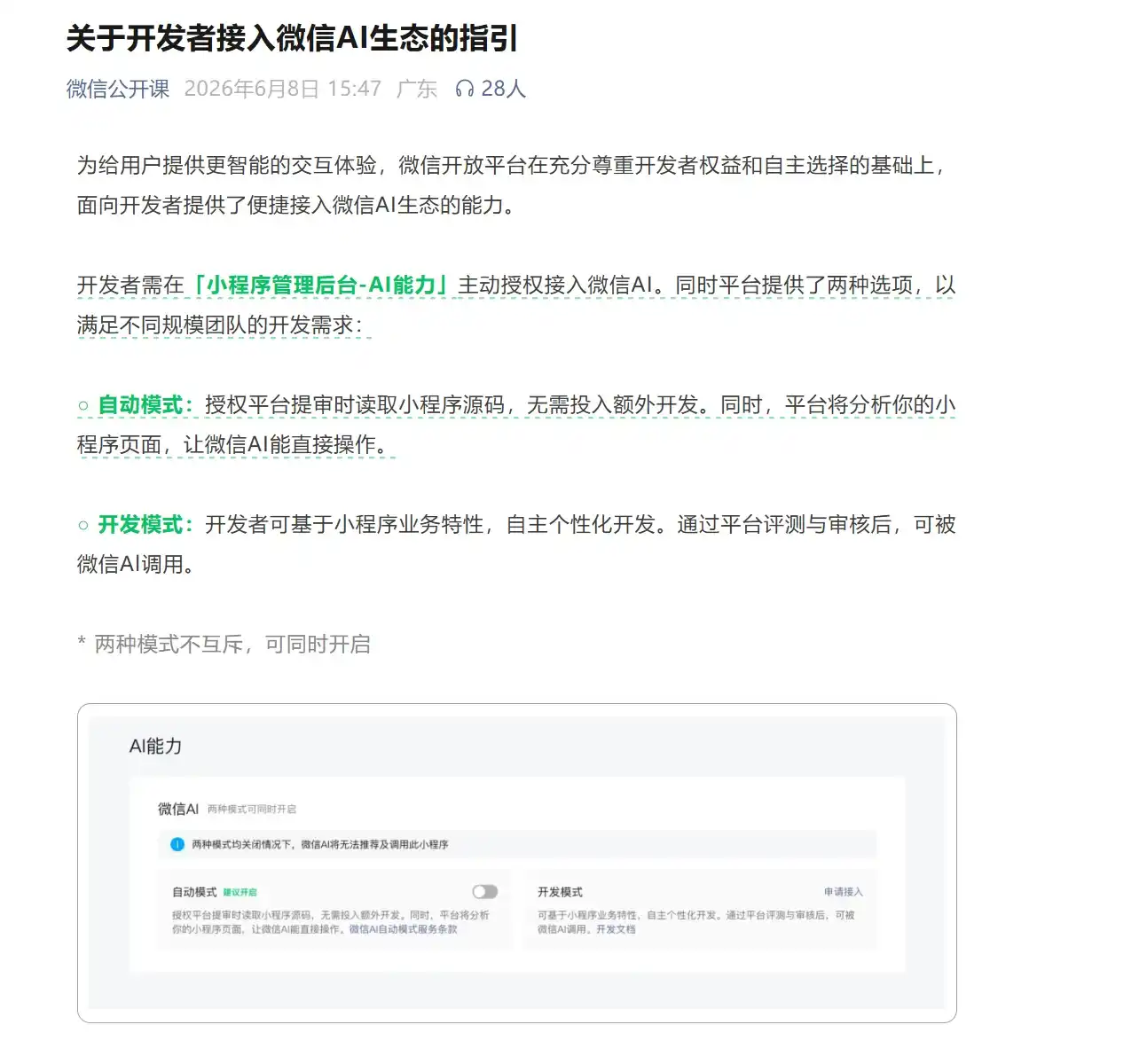
On June 8, 2026, the WeChat Developer Platform announced that WeChat AI entered its internal testing phase. This AI assistant, integrated within the WeChat ecosystem, supports users in directly invoking, accessing, and operating Mini Programs through natural language dialogues. The Open Platform offers two access modes: Automatic Mode, which allows authorized platform access to read Mini Program source code, enabling AI to directly operate pages without additional development; and Developer Mode, where developers independently build skills for AI invocation after platform review. The Terms of Service also note that 'WeChat AI' may be a temporary name, the final naming is yet to be determined, and access is optional, not affecting the normal operation of existing Mini Programs.
This marks the first time WeChat has opened its Mini Program ecosystem to AI at the conversational entry layer. The context at this time: Tencent's self-developed Hunyuan large model has joined the top tier in China in public benchmark tests; the Yuanbao App, following its explosive growth during the 2026 Spring Festival red envelope campaign, surpassed 100 million monthly active users (MAU). The WeChat AI internal test represents the latest step in Tencent's AI journey—from technology reserve and independent product validation towards delivery within a super app. The requirement for developers to hand over source code in Automatic Mode raises questions: how many developers will this low-threshold path attract, and what ecosystem interest conflicts will it encounter? These are questions to be answered during the internal testing phase.
An Opening at the Conversation Layer for the Mini Program Ecosystem
The two access modes for WeChat AI target entirely different developer groups.
The design logic of Automatic Mode is straightforward: authorize the platform to read the Mini Program source code during the review submission. The platform automatically analyzes the page structure, allowing AI to directly operate the pages without requiring additional development. A small game team with only two or three people, without needing an AI engineer or understanding Agent protocols, can simply check the authorization box. Their ordering Mini Program or tool application can then be invoked by WeChat AI.
According to data disclosed by WeChat Open Class in January 2026, the WeChat Mini Game ecosystem has gathered over 400,000 developers, 80% of whom are small teams of 30 people or fewer. The overall daily active users (DAU) exceeded 100 million in 2025, with MAU surpassing 500 million. This scale on the supply side is a unique moat for WeChat AI. ByteDance's Doubao or Alibaba's Tongyi Qianwen can create a standalone app or open APIs, but they lack a Mini Program ecosystem with over 100 million DAU to integrate directly. In essence, WeChat AI's Automatic Mode trades technical convenience for large-scale access, allowing the vast majority of the 400,000 developers to board this train at zero cost.
Developer Mode preserves customization space for service providers with complex business logic. Developers can autonomously build skills based on their business characteristics, which, after platform evaluation and review, become available for WeChat AI to call. The two modes can be enabled simultaneously and are not mutually exclusive.
The phrasing 'name undetermined' and 'optional behavior' indicates that the WeChat team still holds reservations regarding the product's positioning. The main tasks during the internal testing phase are to verify the technical pipeline and observe developer reactions. However, Automatic Mode has already touched upon a sensitive point: source code authorization. Some developers have expressed concerns in the WeChat Open Community, with core questions focusing on several aspects—how the platform guarantees code asset security after reading the source code; whether AI's direct page operation will invalidate existing tracking points and advertising display logic; and how responsibility is allocated if AI misoperations cause user losses. There are currently no public detailed rules explaining these issues.
After Achieving Second Place in Foundational Capabilities, Hunyuan Chooses to Go Deeper
What WeChat AI needs is not just a model that can chat; it needs an Agent foundation capable of understanding page structures and accurately executing operational instructions. This foundation is Tencent's Hunyuan large model.
In March 2025, the Chinese large model evaluation benchmark SuperCLUE released a report. Tencent's Hunyuan flagship version ranked second domestically in foundational model rankings, behind ByteDance's Doubao. However, it ranked first domestically in application capability dimensions, leading in sub-items such as text understanding & creation, instruction following, and Agent capability. Science Net, when summarizing the report, noted that Hunyuan performed better in the 'practical application' dimension than its foundational capability ranking suggested. Around the same time, Hunyuan Turbo S was included in the global Top 15 of the international evaluation Chatbot Arena for the first time.
Hunyuan's version iterations maintain a quarterly rhythm. An update to hunyuan-turbo was released in April 2025, followed by the flagship version TurboS in July, which enhanced reasoning capabilities. In April 2026, the Hy3 preview version was released, with official claims of a 40% improvement in inference efficiency. According to Tencent Cloud product documentation, older versions like HY 2.0 are scheduled to be discontinued starting June 26, 2026.
This pace is significantly slower than that of ByteDance and Alibaba. Over the past year, ByteDance's Doubao and Alibaba's Tongyi Qianwen have maintained a model release frequency approaching 'weekly updates,' while Hunyuan has remained stable with one major version update per quarter. Tencent management has previously made public statements about 'slow work yielding fine results.' The technical explanation is: the Agent era demands far higher stability and lower latency than the conversational era. Frequent switching of underlying models would prevent developers from engineering effective adaptations. The scenarios WeChat AI needs to invoke include placing orders, making payments, booking appointments—operations involving funds and sensitive information. Deterministic model output is much more critical than creativity.
Regarding resource investment, Tencent President Martin Lau disclosed during the 2025 annual report communication meeting that R&D investment for new AI products in 2025 was 18 billion RMB, and this investment would at least double in 2026. Content from the meeting, as relayed by The Paper, also showed that Lau stated the next core plan is to build dedicated AI agents within WeChat, integrating the full chain of Mini Programs, social features, and payments. The doubling of investment without accelerating the version release pace suggests funds are flowing more towards infrastructure reconstruction and data quality improvement, rather than competing for release windows.
Hunyuan's lead in application capabilities resonates with the scenario demands of WeChat AI. A model with a higher foundational ranking but weaker Agent capabilities might actually be less useful in WeChat AI's scenarios than Hunyuan. Tencent has chosen a path that does not chase parameter competition but focuses on practical application dimensions. This path is beginning to show its logical coherence with the launch of the WeChat AI internal test.
Daily Active Users Surpassed 50 Million During Spring Festival, Then What?
Prior to the WeChat AI internal test, the task of C-end validation for Tencent AI was undertaken by the Yuanbao App.
Yuanbao's growth curve exhibits a distinct pulse-like characteristic. According to QuestMobile monitoring data relayed by China National Radio, in January 2025, Yuanbao's MAU ranked 12th in the industry. By December 2025, it had climbed to 3rd place, behind only Doubao (MAU 226 million) and DeepSeek (MAU 135 million), with a full-year compound growth rate of 27.8%.
During the 2026 Spring Festival, Yuanbao experienced explosive growth. Data disclosed by Tencent officially shows Yuanbao's DAU peak exceeded 50 million, reaching 40.54 million on New Year's Eve, with MAU hitting 114 million. The Shanghai Securities News reported that this growth primarily came from social chain-driven user acquisition through red envelope activities.
However, post-Spring Festival, the data quickly declined. QuestMobile monitoring indicated that in April 2026, Yuanbao's normalized DAU was around 9 million. In the same period, Doubao's DAU was approximately 140 million, and Qianwen's was around 30 million. The peak-to-trough difference approached 5 times, highlighting the pulse-like growth characteristic. No public data is available for the DAU/MAU ratio, making it impossible to definitively judge user stickiness.
Yuanbao's role in Tencent's AI path is that of 'C-end validation for an independent product.' It has proven two things: First, Tencent has the ability to leverage WeChat's social chain to push an AI product in front of hundreds of millions of users. Second, users acquired via red envelopes are not retained. Martin Lau stated in the earnings call that Yuanbao's Spring Festival promotion effect exceeded expectations, and the next focus is optimizing core capabilities like voice dialogue. This statement itself indicates the team understands retention is the core proposition for the next stage.
The experience of Yuanbao's pulse growth, in turn, explains why WeChat AI chose to natively integrate directly within the super app rather than continue pushing a standalone app. A standalone app requires users to actively open it, relying on push notifications and activities for retention. Native integration relies on scenarios to bind users—when users need to order food, pay bills, or check courier status, WeChat AI is right there in the conversation flow. These are two completely different retention logics.
Every Mini Program Can Become 'Lobsterized,' But Service Providers Fear Being Bypassed
The product direction for WeChat AI was already clearly outlined in Pony Ma's public remarks in March 2026.
During the 2025 annual report communication meeting, Ma Huateng first discussed the concept of 'raising shrimp.' The 'lobster' type applications he referred to are AI Agents that possess a 'sense of a living person,' capable of autonomously executing tasks rather than merely answering questions. Ma stated that such applications provided inspiration for the WeChat AI under planning: in the future, every Mini Program could potentially undergo intelligent, 'lobsterized' transformation.
The core of this metaphor is pushing AI from a dialogue tool to a task executor. If WeChat AI were merely a chatbot, it wouldn't need to read source code or operate pages. The existence of Automatic Mode indicates its positioning is to complete cross-Mini Program tasks for users: ordering a cup of coffee, paying a utility bill, booking a hospital appointment, launching a mini-game. Users wouldn't need to know which Mini Program provides which service; they would just need to say one sentence to WeChat AI.
However, in the same meeting, Ma proactively addressed ecosystem interest conflicts. He pointed out that ecosystem service providers are concerned about being 'bypassed' or 'channelized' by AI agents. If a user says to WeChat AI, 'Help me order a latte,' and the AI directly invokes an atomic service from a coffee Mini Program to complete the transaction without the user ever entering the merchant's page, then the merchant's ad placements, brand exposure, and user retention efforts all go to zero. Service providers would not accept this outcome.
This is the core contradiction in WeChat AI's product design. The more efficient the centralized scheduling, the weaker the decentralized traffic sovereignty of merchants. The two access modes themselves do not solve this contradiction; they are merely an entry design. The real balancing mechanisms—such as traffic distribution rules, the relationship between atomic services and merchant pages, and data visibility in service provider backends—have not been publicly disclosed at all. Ma's exact words were that 'a balance must be struck between centralized scheduling and protection of decentralized traffic,' but specifically how this balance will be achieved has not been answered during the internal testing phase.
Three Lines Are in Position, But the Third Step Has Just Begun
With the parallel advancement of the three lines—Hunyuan, Yuanbao, and WeChat AI—Tencent's gradual AI path is logically coherent.
The bottom layer doesn't pursue the fastest model but builds the most stable Agent foundation. Hunyuan's domestic #1 ranking in SuperCLUE's application capability dimension supports WeChat AI's demand for precise operations. The middle layer uses a standalone app to validate social chain-driven user acquisition and basic user experience; Yuanbao's Spring Festival MAU surpassing 100 million verifies the leveraging effect of WeChat's traffic pool for AI products. The top layer pursues native integration within the super app, using scenarios to reduce retention pressure; the WeChat AI internal test directly faces 400,000 developers and a Mini Program ecosystem with over 100 million DAU.
However, whether C-end perception has been reversed can currently only be judged as 'partially complete.' Yuanbao's hundred-million-level MAU primarily came from the red envelope pulse; its normalized DAU of around 9 million remains a significant gap from Doubao's 140 million. WeChat AI has just entered internal testing; ordinary users cannot yet perceive it. There remains a noticeable gap between Tencent AI's share of public mindshare and its technical level.
Whether WeChat AI can bridge this gap depends on three variables. First, whether the source code trust issue in Automatic Mode can be resolved on the developer side, which determines the scale of access from the supply side. Second, whether the traffic distribution rules between centralization and decentralization can gain acceptance from service providers, which determines whether ecosystem interests can be balanced. Third, whether the accuracy of AI operations and the clarity of responsibility allocation can give users confidence to place orders, which determines the depth of C-end usage.
The positioning of the three lines is a prerequisite, but whether they can form a chain where 'Hunyuan ensures reliability, Yuanbao validates user habits, and WeChat AI delivers the final experience' requires at least two more quarters of public data to verify. Ma Huateng said in the earnings call that 'AI is a marathon, not a sprint.' The WeChat AI internal test is merely a marker point as this marathon reaches its mid-course; the finish line is still a long way off.