Sam Bankman-Fried Appeals Conviction While Crypto Security Braces for the Quantum Era with $BMIC

bitcoinistPubblicato 2026-02-11Pubblicato ultima volta 2026-02-11

Introduzione

Sam Bankman-Fried, founder of FTX, has appealed his fraud conviction and 25-year sentence, reopening a major case that highlighted a catastrophic breakdown of trust in crypto. As the industry grapples with this legacy, attention is shifting toward next-generation security solutions. A key emerging threat is quantum computing, which risks breaking current encryption standards. The article highlights $BMIC as a project built to address this with a post-quantum cryptographic security stack, including quantum-resistant wallets, staking, and payments. Having raised over $446K in its presale, BMIC represents a growing investor focus on preemptive security rather than reactive fixes, positioning itself as a potential new standard in crypto infrastructure.

Sam Bankman-Fried, the disgraced founder of FTX, is officially appealing his conviction and 25-year prison sentence. The legal filing reopens one of the biggest fraud cases in crypto history, and for an industry still grappling with the fallout, it’s like pouring salt in a very old wound.
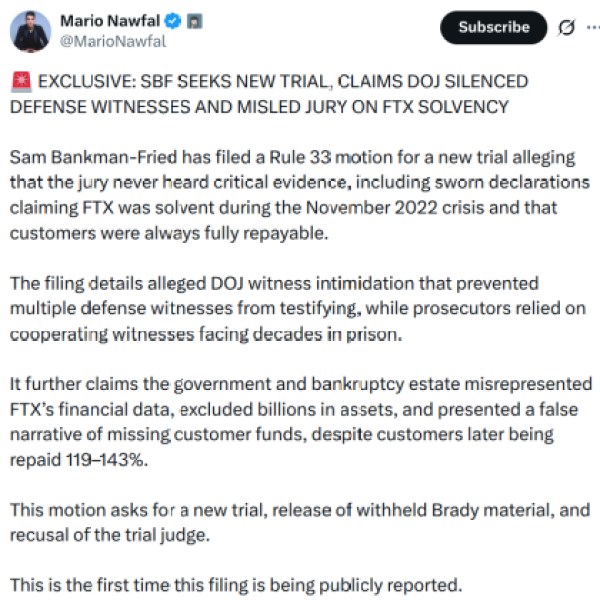
SBF’s appeal challenges various trial decisions, from witness testimony to alleged conflicts of interest. But let’s be clear: the FTX saga was never about tech failing. It was a catastrophic breakdown of trust.

Billions in user funds vanished not because of a sophisticated hack, but due to internal fraud and shockingly poor custody. That collapse forced a painful but necessary conversation across the market: How do we actually secure digital assets?

While the courts wrestle with crypto’s ghosts, innovators are already building for the future. We’re now seeing a clear shift in investor focus toward projects that prioritize provable, next-gen security over pure hype. That’s where the real story is.

The Quantum Threat and BMIC’s Future-Proof Solution

But what most market coverage misses is that while the industry defends against today’s threats, a far bigger one looms: quantum computing. State-sponsored and corporate labs are racing to build machines capable of shattering the encryption that protects everything from bank accounts to crypto wallets.

It’s a threat (one many still dismiss) known as the ‘harvest now, decrypt later’ attack, stealing encrypted data today with the plan to unlock it once quantum computers are powerful enough. For crypto, this isn’t just a problem; it’s an existential risk.

This is the exact problem BMIC ($BMIC) was engineered to solve. It isn’t just another DeFi protocol or meme coin; it’s a foundational security layer built for the quantum age. The project delivers a full stack of financial tools, wallet, staking, and payments, all shielded by post-quantum cryptography (PQC).
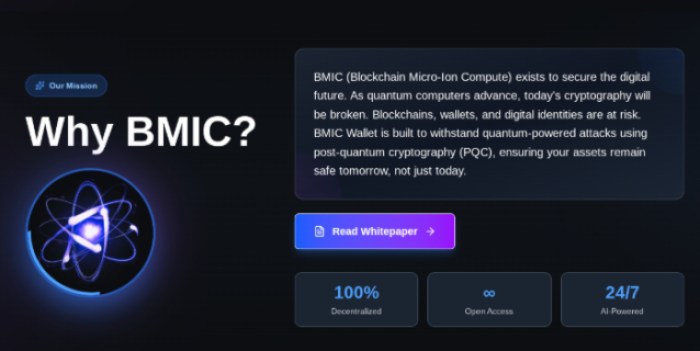
While traditional wallets expose public keys during transactions, BMIC uses ERC-4337 smart accounts and a Zero Public-Key Exposure model to protect users from both current and future threats. It even integrates an AI-enhanced threat detection system to proactively neutralize suspicious activity.

The key difference here is a shift from reactive security to preemptive protection. So, is your portfolio truly safe if its core cryptography has a known expiration date?

LEARN MORE ABOUT BMIC AND ITS QUANTUM STACK

A New Security Standard Attracting Early Investment

If history has taught us anything, it’s that after a major market failure like FTX, capital flows toward infrastructure that promises to prevent the next crisis. We’re seeing that play out right now. The early traction for the BMIC presale seems to prove the point, having already raised over $446K, with tokens currently priced at just $0.049474.

Frankly, this doesn’t look like speculative froth; it looks like a calculated investment in a long-term solution. It’s why we picked $BMIC as a best new cryptocurrency.

The project’s utility is centered on its native token, $BMIC, which powers the whole ecosystem. It’s used for staking on the quantum-secure network, participating in governance, and fueling its ‘Burn-to-Compute’ model for access to advanced security features.

The ripple effect of a successful quantum-proof platform could be immense, potentially setting a new security standard for the entire industry. The risk? As always, it comes down to execution and adoption. But in a market still scarred by FTX, a project building decentralized, future-proof security is a compelling story.

buy your $BMIC here

This article is for informational purposes only and does not constitute financial advice. All investments carry risks, and readers should conduct their own due diligence.


Domande pertinenti

QWhat is Sam Bankman-Fried appealing and why is this significant for the crypto industry?

ASam Bankman-Fried is appealing his conviction and 25-year prison sentence for his role in the FTX fraud case. This is significant because it reopens one of the largest fraud cases in crypto history, forcing the industry to confront the catastrophic breakdown of trust and the need for better security measures.

QAccording to the article, what is the 'existential risk' facing cryptocurrency that many still dismiss?

AThe existential risk is the threat posed by quantum computing, specifically through 'harvest now, decrypt later' attacks, where encrypted data is stolen today with the intention of decrypting it once quantum computers become powerful enough to break current encryption standards.

QWhat specific problem does the BMIC ($BMIC) project claim to solve?

ABMIC ($BMIC) is engineered to provide a foundational security layer for the quantum age. It uses post-quantum cryptography (PQC) to protect a full stack of financial tools, including its wallet, staking, and payments system, from both current threats and future quantum attacks.

QHow does BMIC's security model differ from traditional crypto wallets?

AUnlike traditional wallets that expose public keys during transactions, BMIC uses ERC-4337 smart accounts and a Zero Public-Key Exposure model to protect users. It also integrates an AI-enhanced threat detection system for proactive security, shifting from a reactive to a preemptive protection model.

QWhat evidence does the article provide to suggest that BMIC is attracting serious investment rather than speculative interest?

AThe article points to the BMIC presale having raised over $446K as evidence of calculated, long-term investment. It states this early traction indicates capital is flowing toward infrastructure that promises to prevent future crises, like the FTX collapse, rather than mere speculative froth.

Letture associate

5 Minutes to Make AI Your Second Brain

This article introduces a powerful personal knowledge management system combining Claude Code and Obsidian, designed to function as an "AI second brain." Unlike traditional RAG systems that perform temporary, one-off retrievals, this system enables AI to continuously build and maintain an evolving knowledge wiki. The architecture consists of three layers: a raw data layer (notes, articles, transcripts), an AI-maintained structured knowledge base that builds cross-references, and a schema layer that governs organization and system logic. Core operations are Ingest (bringing in external information), Query (instant knowledge access), and Lint (checking consistency and fixing issues). The system's power lies in creating a "compound interest" effect for knowledge: it reduces cognitive load by offloading the tasks of connecting, organizing, and understanding information to AI, while simultaneously improving the accuracy and contextual consistency of the AI's outputs. The setup process is quick, requiring users to download Obsidian, create a vault (knowledge repository), configure Claude Code to access that vault, and apply a specific system prompt. Advanced tips include using a browser extension to easily add web content, maintaining separate vaults for work and personal life, and utilizing the "Orphans" feature to identify unlinked ideas. The main drawbacks are the need for visual thinking, a commitment to ongoing maintenance, and local storage usage. Ultimately, the system transforms scattered information into a reusable, interconnected network of knowledge.

marsbit24 min fa

5 Minutes to Make AI Your Second Brain

marsbit24 min fa

Trading

Spot
Futures

Articoli Popolari

Come comprare ERA

Benvenuto in HTX.com! Abbiamo reso l'acquisto di Caldera (ERA) semplice e conveniente. Segui la nostra guida passo passo per intraprendere il tuo viaggio nel mondo delle criptovalute.Step 1: Crea il tuo Account HTXUsa la tua email o numero di telefono per registrarti il tuo account gratuito su HTX. Vivi un'esperienza facile e sblocca tutte le funzionalità,Crea il mio accountStep 2: Vai in Acquista crypto e seleziona il tuo metodo di pagamentoCarta di credito/debito: utilizza la tua Visa o Mastercard per acquistare immediatamente CalderaERA.Bilancio: Usa i fondi dal bilancio del tuo account HTX per fare trading senza problemi.Terze parti: abbiamo aggiunto metodi di pagamento molto utilizzati come Google Pay e Apple Pay per maggiore comodità.P2P: Fai trading direttamente con altri utenti HTX.Over-the-Counter (OTC): Offriamo servizi su misura e tassi di cambio competitivi per i trader.Step 3: Conserva Caldera (ERA)Dopo aver acquistato Caldera (ERA), conserva nel tuo account HTX. In alternativa, puoi inviare tramite trasferimento blockchain o scambiare per altre criptovalute.Step 4: Scambia Caldera (ERA)Scambia facilmente Caldera (ERA) nel mercato spot di HTX. Accedi al tuo account, seleziona la tua coppia di trading, esegui le tue operazioni e monitora in tempo reale. Offriamo un'esperienza user-friendly sia per chi ha appena iniziato che per i trader più esperti.

257 Totale visualizzazioniPubblicato il 2025.07.17Aggiornato il 2025.07.17

Come comprare ERA

Discussioni

Benvenuto nella Community HTX. Qui puoi rimanere informato sugli ultimi sviluppi della piattaforma e accedere ad approfondimenti esperti sul mercato. Le opinioni degli utenti sul prezzo di ERA ERA sono presentate come di seguito.

活动图片