5 Minutes to Make AI Your Second Brain

marsbitPubblicato 2026-04-11Pubblicato ultima volta 2026-04-11

Introduzione

This article introduces a powerful personal knowledge management system combining Claude Code and Obsidian, designed to function as an "AI second brain." Unlike traditional RAG systems that perform temporary, one-off retrievals, this system enables AI to continuously build and maintain an evolving knowledge wiki. The architecture consists of three layers: a raw data layer (notes, articles, transcripts), an AI-maintained structured knowledge base that builds cross-references, and a schema layer that governs organization and system logic. Core operations are Ingest (bringing in external information), Query (instant knowledge access), and Lint (checking consistency and fixing issues). The system's power lies in creating a "compound interest" effect for knowledge: it reduces cognitive load by offloading the tasks of connecting, organizing, and understanding information to AI, while simultaneously improving the accuracy and contextual consistency of the AI's outputs. The setup process is quick, requiring users to download Obsidian, create a vault (knowledge repository), configure Claude Code to access that vault, and apply a specific system prompt. Advanced tips include using a browser extension to easily add web content, maintaining separate vaults for work and personal life, and utilizing the "Orphans" feature to identify unlinked ideas. The main drawbacks are the need for visual thinking, a commitment to ongoing maintenance, and local storage usage. Ultimately, the system tr...

Editor's Note: This article introduces a personal knowledge system built on Claude Code and Obsidian. Its core is no longer the traditional RAG model of "querying and retrieving temporarily each time," but rather an attempt to have AI continuously build and maintain an evolvable knowledge base (Wiki).

Structurally, this system can be divided into three layers:
· First, the raw data layer, including unmodifiable input sources like notes, articles, and transcripts;
· Second, the structured knowledge base maintained by AI, which continuously updates to complete cross-references and relationship building;
· Third, the Schema rule layer, used to standardize the organization of knowledge and the system's operational logic.

Around this structure, the system operates through three core functions: Ingest, to continuously bring external information into the system; Query, to enable instant access to knowledge; and Lint, to check structural consistency and fix potential issues.

Under this mechanism, knowledge no longer remains a one-time conversation result but is gradually沉淀 (precipitated) into a reusable long-term asset through the cycle of "writing — organizing — reusing." The author suggests that this model gives knowledge a compound interest-like accumulation effect: on one hand, it reduces the individual's cognitive load, and on the other hand, it improves the accuracy and contextual consistency of the model's output.

However, the effective operation of this system is also premised on one condition — continuous input and maintenance. Without a steady stream of data injection and structural updates, this "second brain" will struggle to form a true accumulation effect, and its advantages will diminish accordingly.

The following is the original text:

Claude Code + Obsidian is the most powerful AI combination I have ever used.

I have almost built an "AI second brain" that incorporates all my thoughts, reading, writing, online research, and more. This includes my business plans, all the YouTube videos I've published, articles I've written, and everything else important to me.

Claude Code + Obsidian has quickly become popular on various platforms, and this is no coincidence.

For me personally, this AI system has significantly reduced my cognitive burden, allowing me to focus my energy on what truly matters—whether it's business or personal life.
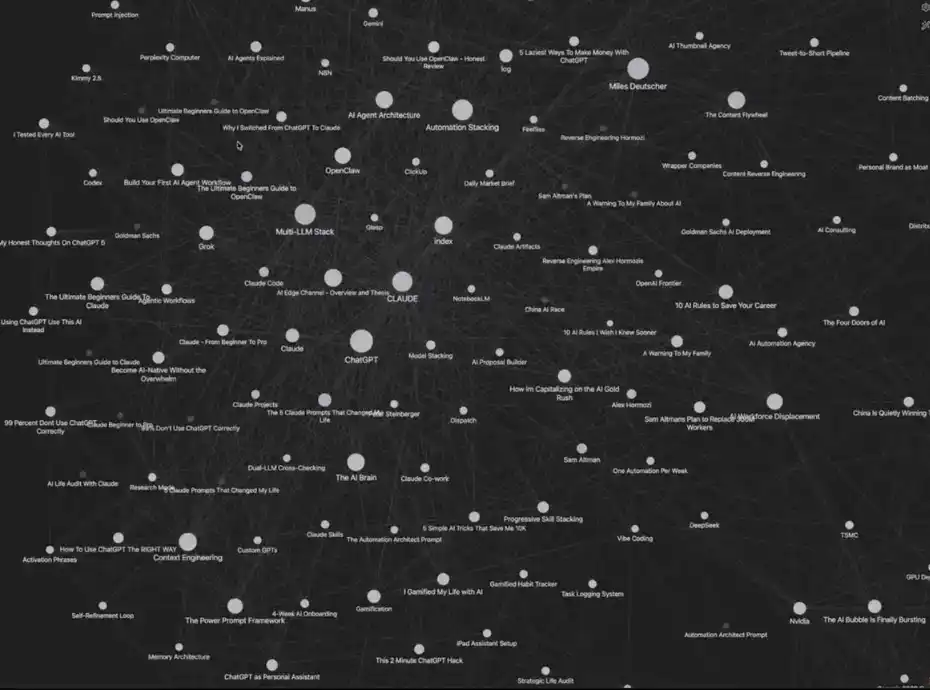
This system might look a bit complex, but it actually only takes 5 minutes to set up. More importantly, it has a built-in memory mechanism and continuously optimizes itself with use.

Next, I will guide you step-by-step to replicate this "AI second brain" system, which can tangibly improve your efficiency.

I recommend reading to the end of the article—I will include a complete Claude Code + Obsidian quick reference guide and all the resources mentioned (all free).

Before You Start

This system is not entirely my original creation; its inspiration came from a viral tweet by Andrej Karpathy a few days ago about an "LLM knowledge base."
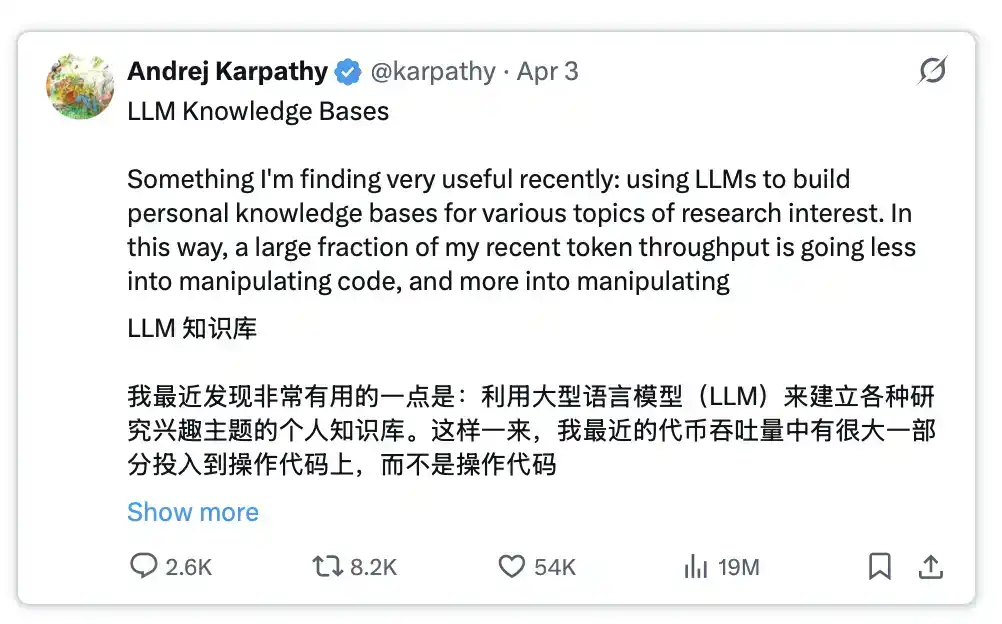
Related reading: https://x.com/karpathy/status/2039805659525644595

This tweet went viral quickly because it offered an idea to solve a key pain point in current AI development.

That problem is: every time you start a new conversation or switch to a new AI tool, you have to repeatedly re-enter prompts and provide context, almost starting from scratch each time.

By combining this system prompt with Obsidian and Claude Code, this problem can be completely solved, while also significantly improving the quality of AI output.

How Does This System Work?

The entire system consists of four core modules:

1. Your Data: Includes articles, notes, transcripts, ideas, etc.

2. Organization: Automated organization in Obsidian by Claude Code

3. Instant Access: You can query this "database" at any time for answers

4. Evolving Memory: The system continuously becomes smarter with use
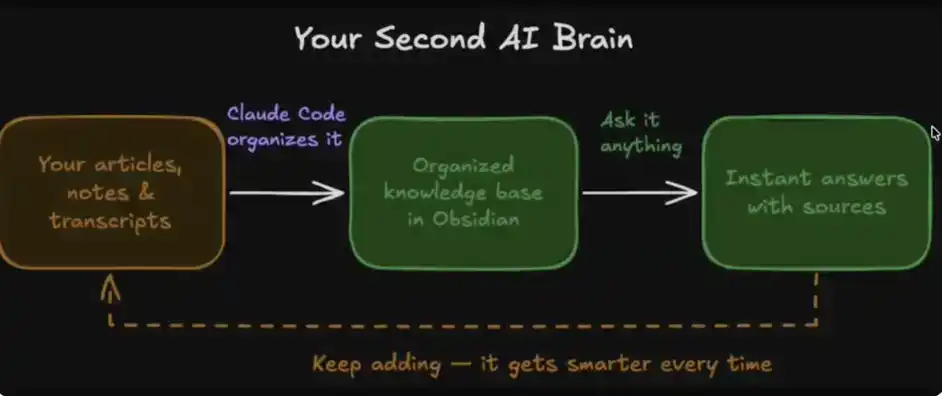
What is the real power of this system?

As humans, our cognitive bandwidth is limited. We forget, sometimes struggle to connect different ideas, and there's ultimately a limit to the amount of information we can track and process simultaneously.

With this four-module system, you are essentially offloading your cognitive burden, handing over the work of "connecting, organizing, and understanding information" to Obsidian and Claude Code.

Your ideas begin to be systematically linked; one note can automatically connect to another, and you can always extract, combine, and call upon these contents through Claude.

In this structure, your knowledge is no longer fragmented but a network that can be constantly called upon and reorganized—with almost no upper limit.

How to Build Your AI Brain in 5 Minutes

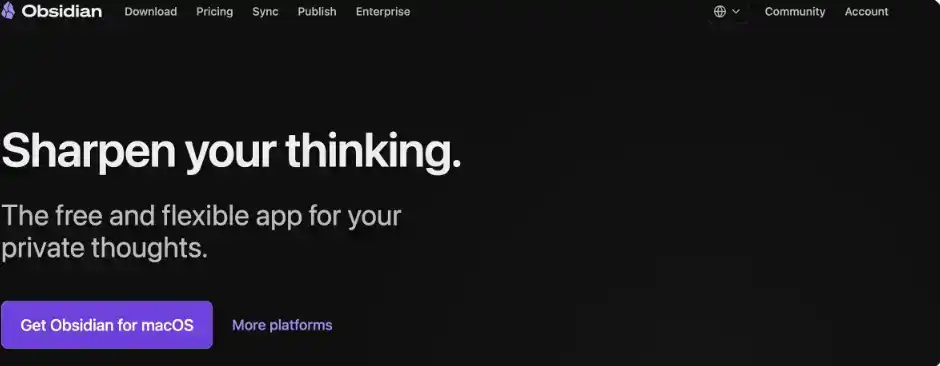
1. Download Obsidian


Official website: https://obsidian.md/
2. Create Your Vault

After downloading, Obsidian will prompt you to create a "Vault".

You can think of it as a folder on your computer where we will store everything and allow Claude Code to access and manage this data.

You can name this Vault whatever you like—I simply called mine "Obsidian Vault".
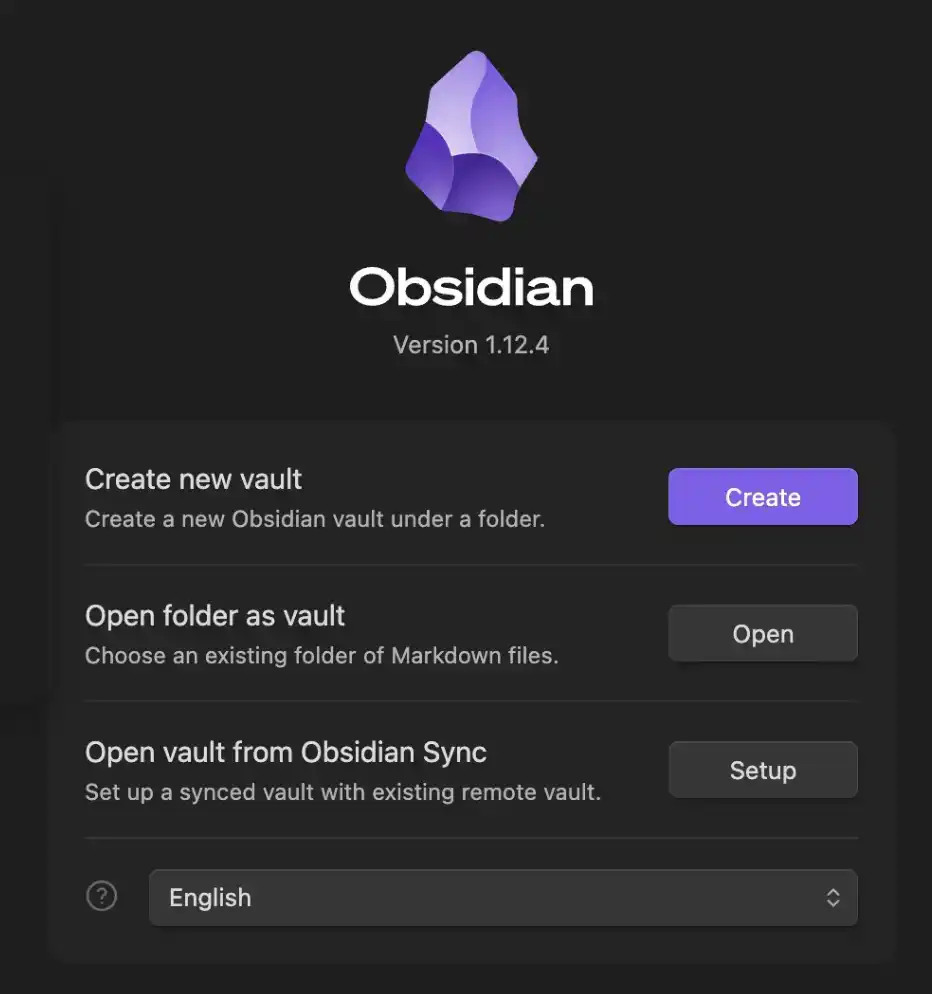
This Vault is where Obsidian stores all your data and notes; everything will be saved as MD (Markdown) files.

3. Set Up Claude Code

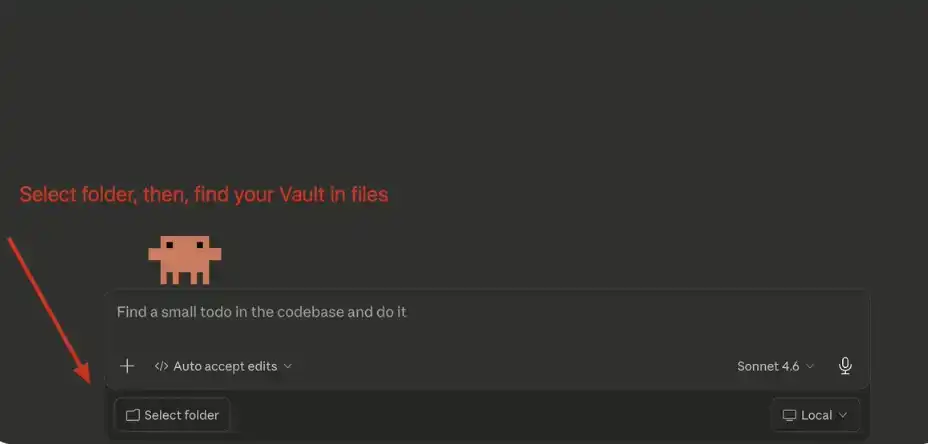
Next, you need to configure a way to access Claude Code. For me (and likely for most people), the simplest method is to use the desktop client directly.

In the main chat interface, click "Select Folder," then find and select the Obsidian Vault you just created.
4. Set the System Prompt

After selecting the folder, the next step is to paste Andrej Karpathy's system prompt into the main chat box.

You can copy the prompt here: https://gist.github.com/karpathy/442a6bf555914893e9891c11519de94f
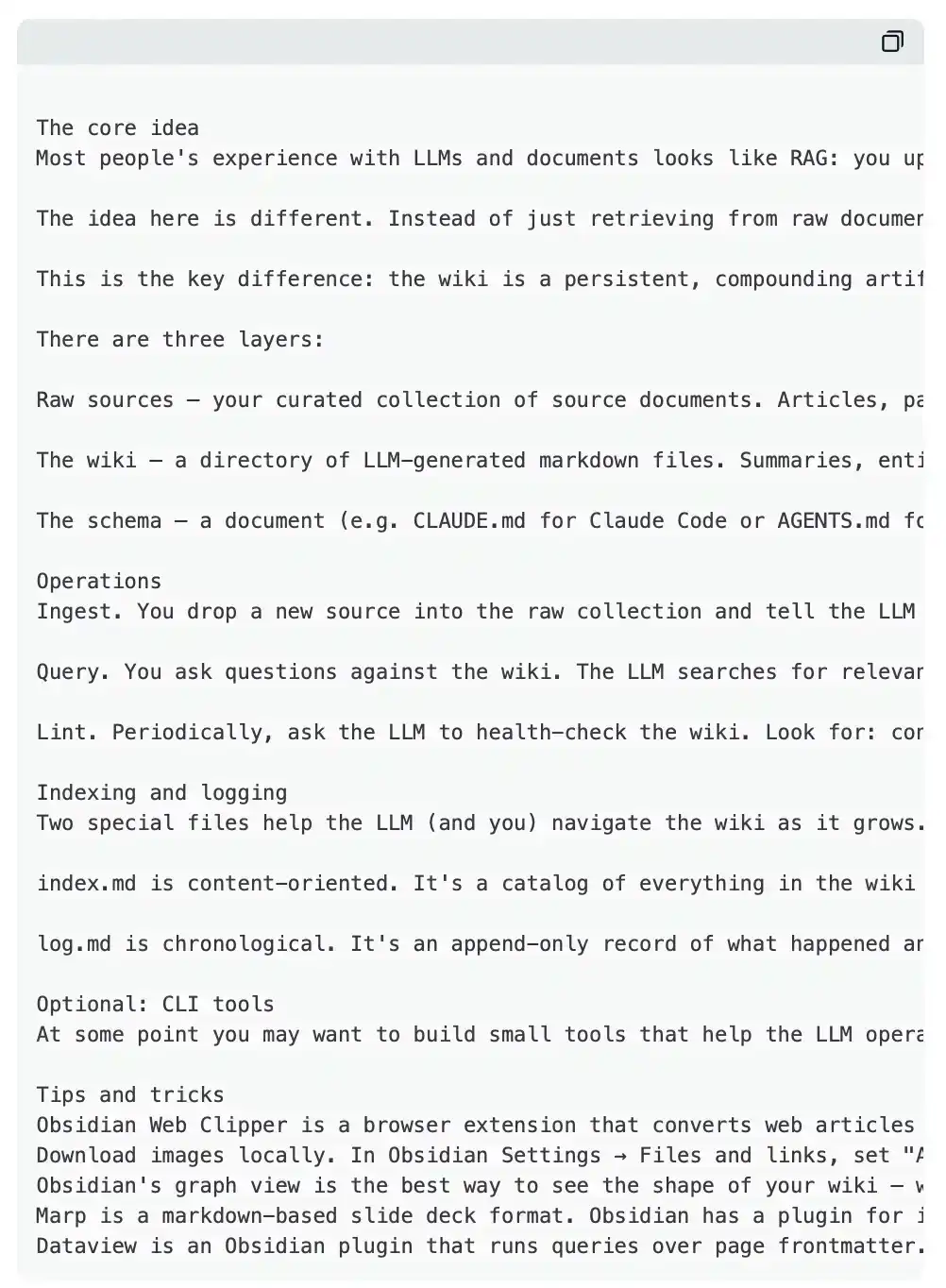
Your input should look like this:
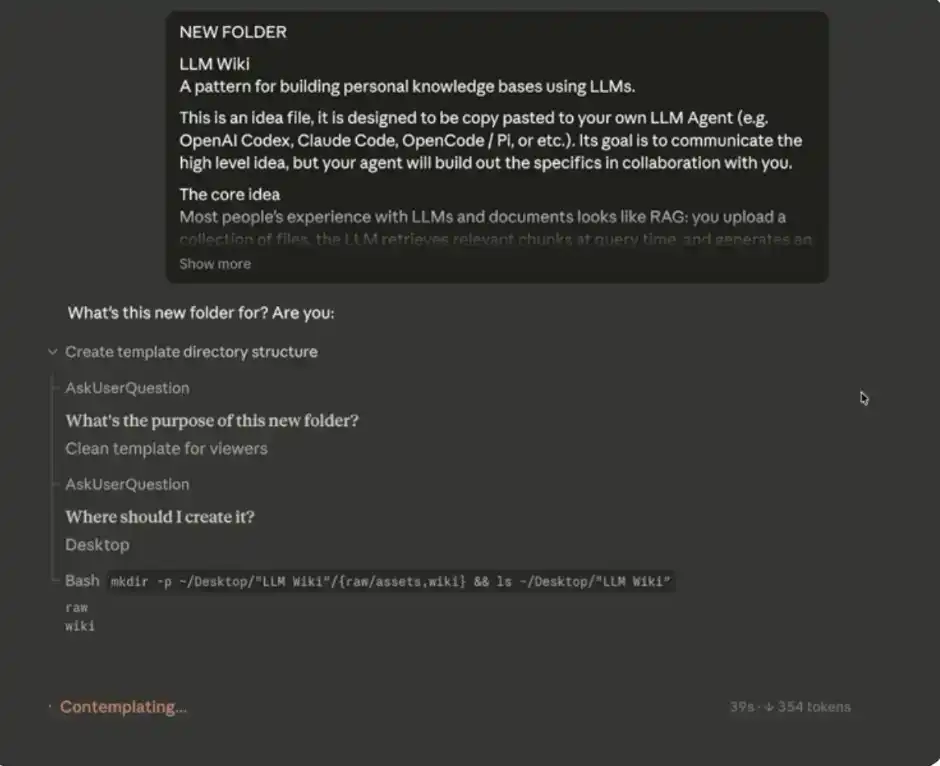
Tip: You don't necessarily have to open Obsidian manually if you don't want to. Simply give the MD folder (your Vault) and related data to Claude Code, and it can directly read, write, and modify these files—and these changes will automatically sync to your Obsidian "second brain."

5. Build Your Database

After you enter the system prompt, Claude Code will start asking you for some data sources to initialize and gradually populate your "second brain."
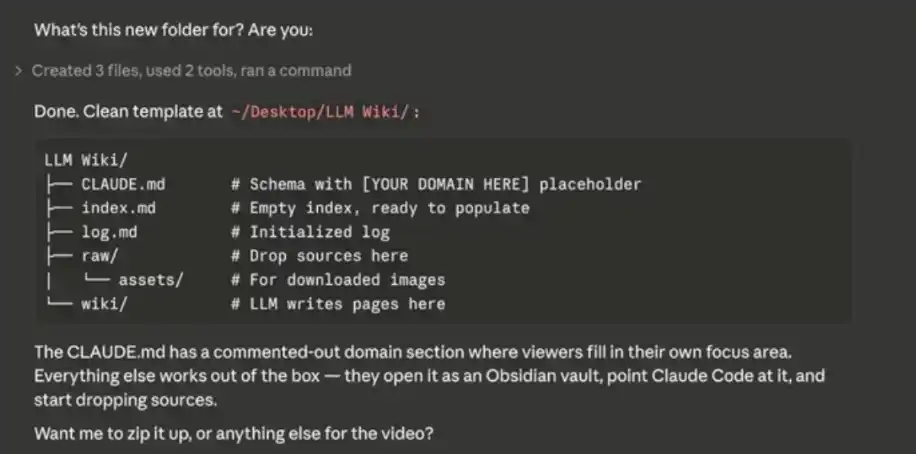
Think of Obsidian as a "blank notebook"—you need to actively input content at first for the database to gradually build up. Importable content includes: notes, CSV files, Markdown/text files, etc.

Some practical suggestions:

· Export data from your existing note-taking tools

· If you use Notion, you can export as CSV files

· Have Claude (or another LLM) organize information about you to initialize your "second brain"

· Import your existing writings, bookmarks, ideas, etc., all at once—this is the best time to establish initial data, and you can always add more later

Note that a database with a large amount of data, like mine, isn't built overnight but is accumulated over time through continuous input.
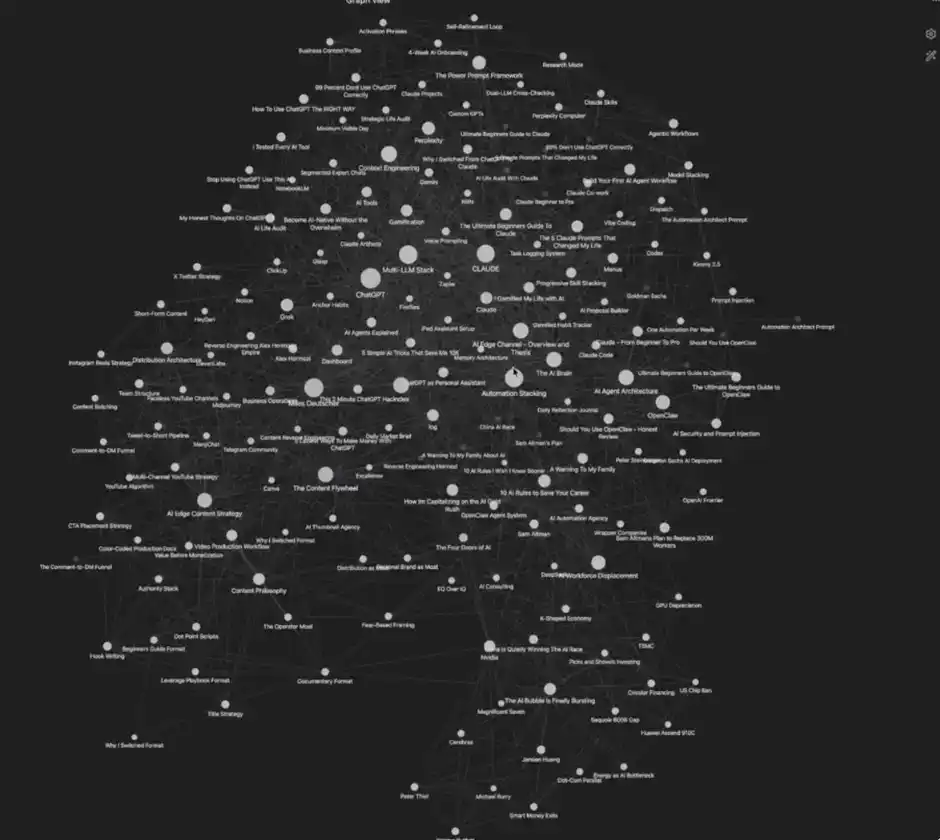
That's it, your "AI second brain" is set up and ready to run. Next, I'll share some pro tips to help you use it more efficiently.

Pro Tips

1. Obsidian Chrome Extension

If you want to add data to the system more easily, just install the Obsidian Chrome extension. It allows you to click "Add to Obsidian" while browsing the web to save content directly into your knowledge base. This makes the process of building your "second brain" very smooth.

I often use this feature myself to collect articles, web data, research materials, etc.
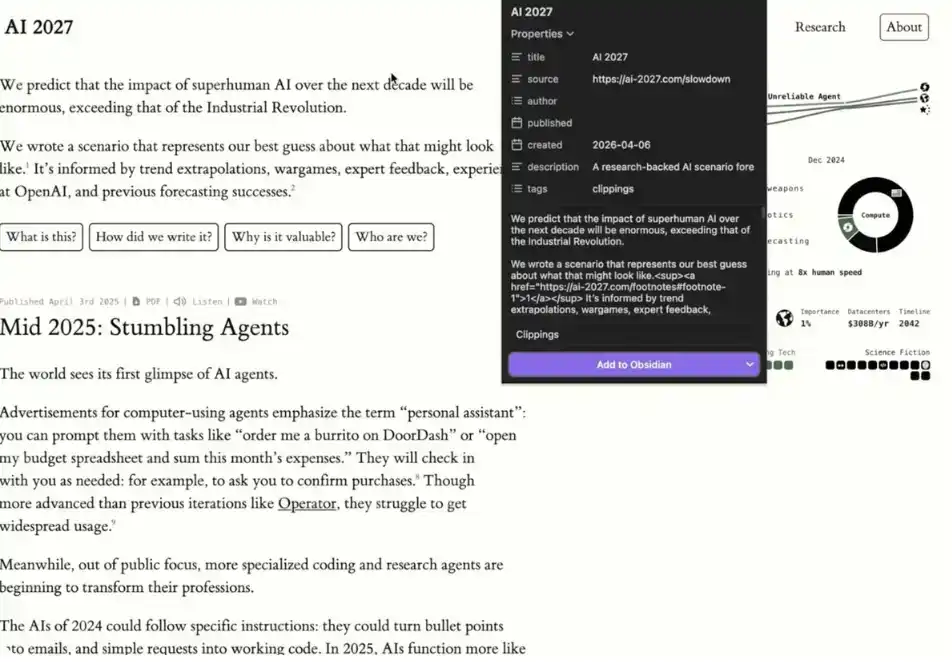
Note that data added via the extension is initially just an "isolated data source."

You can then tell Claude Code: "I just added [x] to Obsidian, please help me integrate this content into my Wiki."

Claude Code will automatically create links between this new data and existing content, truly integrating it into your "second brain." This is also why this tool combination is so powerful.

2. Use Separate Vaults

Andrej Karpathy recommends using two separate Vaults:

· One for work/business content

· One for personal life/goal management

My own experience is also that this structure is the clearest and most effective.

3. Practicality

I find one of the most valuable uses of this system is actually very simple: making your LLM prompts more precise.

When the model has access to your complete personal information, business plans, writing context, etc., it can generate more "customized," higher-quality prompts (even "super Prompts") that are closer to the real situation.

Of course, the uses of this system go far beyond this, but if you want to start with just one most practical scenario, I would strongly recommend starting with "improving prompt quality."

4. Orphans

In Obsidian, "Orphans" refer to data points that are not connected to other notes.

This feature is useful because it can help you:

· Find ideas that haven't been integrated yet

· Discover "weak areas" in your database

· Determine which content is worth further expansion or deepening

In other words, it's not just an organizational tool but also a mechanism to help you discover blind spots in your thinking.
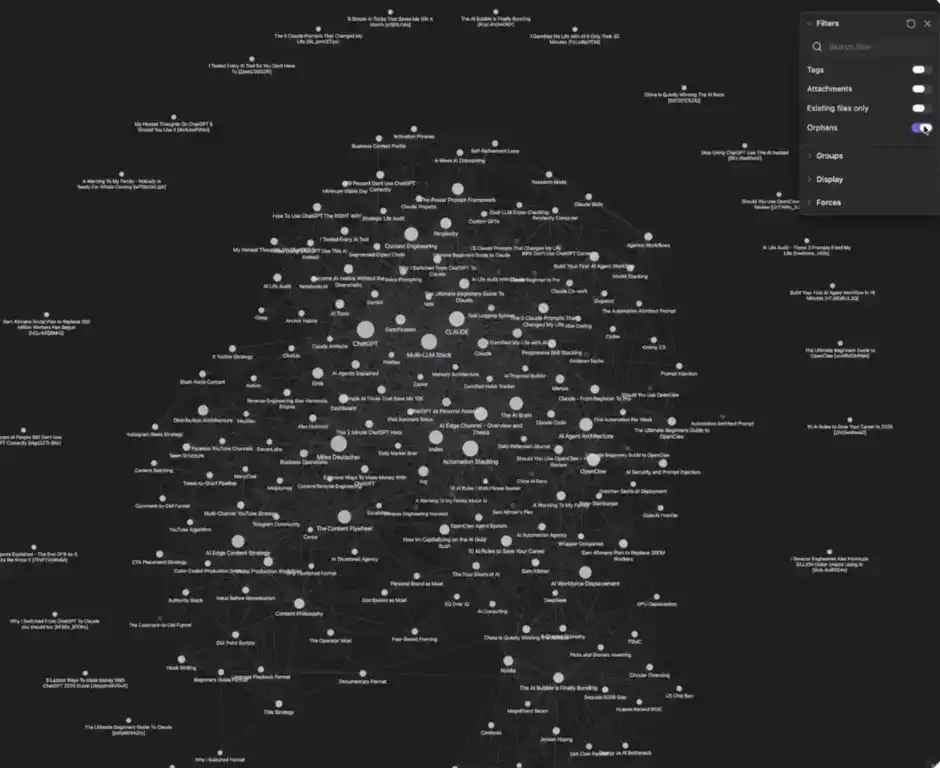
You can click the "three dots" in the upper right corner to find and turn on the Orphans switch to see which content hasn't been linked yet.

Potential Drawbacks of This System

We've covered many advantages, use cases, and optimization methods. So what are its shortcomings? Under what circumstances might this system not be suitable for you?

1. For those not accustomed to visualization

A core advantage of this system is the ability to visualize data. If you don't rely on or are not accustomed to this approach, its benefits for you might be limited.

2. Requires some maintenance cost

If you are unwilling to continuously maintain a database, this system might not be for you. Although the maintenance cost is not high, without continuously inputting data into the "second brain," it's difficult for it to provide value.

3. Storage usage

All content is stored locally as Markdown files, which will occupy some device space. This also needs to be considered in advance.


Domande pertinenti

QWhat is the core idea behind the AI second brain system described in the article?

AThe core idea is to move beyond the traditional RAG model of temporary retrieval for each query. Instead, it uses AI (Claude Code) to continuously build and maintain an evolving, structured knowledge base (Wiki) within Obsidian, creating a reusable long-term asset.

QWhat are the three main layers that make up the structure of this knowledge system?

AThe three layers are: 1) The raw data layer, which includes unmodifiable input sources like notes and articles. 2) The structured knowledge base, maintained by AI, which is updated with cross-references and relationship building. 3) The Schema rule layer, which standardizes the organization of knowledge and system logic.

QWhat are the three core operations that allow the system to function?

AThe three core operations are: Ingest (to continuously incorporate external information into the system), Query (to enable instant access and retrieval of knowledge), and Lint (to check for structural consistency and fix potential issues).

QWhat is one major prerequisite for this 'second brain' system to work effectively?

AThe system requires continuous input and maintenance. A steady flow of data injection and structural updates is essential. Without it, the 'second brain' cannot form a true compounding effect, and its advantages will diminish.

QAccording to the article, what is a key practical use for getting started with this system to see immediate value?

AA key practical use is to significantly improve the quality and precision of your LLM prompts. When the model has access to your full personal information, business plans, and writing context, it can generate highly customized, realistic, and high-quality prompts.

Letture associate

Coinbase Vice President: The Wars Over Cryptocurrency Regulation Are Over

Coinbase's new Vice President, Ryan VanGrak, declared that regulatory wars in the cryptocurrency sector are over. Since taking office on July 9, 2026, he has shifted the company's approach from litigation and sanctions to focusing on growth and innovation. The industry can now concentrate on development rather than fighting for its right to exist. He highlighted that the Digital Asset Market Clarity Act (CLARITY Act), which aims to establish a clear federal regulatory framework dividing oversight between the SEC and CFTC, has gained significant momentum. This framework is intended to provide proper supervision, investor protection, and maintain U.S. leadership in digital assets. VanGrak's appointment marks a strategic shift from a "wartime" to a "peacetime" advisor, replacing former Chief Legal Officer Paul Grewal, who oversaw major litigation, including a dismissed 2023 SEC lawsuit. With his background at Citadel Securities and the SEC, VanGrak brings deep regulatory and institutional finance expertise as Coinbase expands beyond a simple exchange into a broader financial services provider, offering stocks, futures, prediction markets, and AI tools. For investors, bipartisan support for crypto legislation like the CLARITY Act represents a major shift from the enforcement-focused environment of 2023-2024. Lawmakers are now focused on *how* to regulate crypto, not *if* it should exist. However, risks remain, as the bill's passage is not yet guaranteed.

cryptonews.ru8 min fa

Coinbase Vice President: The Wars Over Cryptocurrency Regulation Are Over

cryptonews.ru8 min fa

Deep Dive into FWA: An Intriguing Experiment Turning NFTs into "On-Chain Gachapon"

A Deep Dive into FWA: The “On-Chain Gacha” Experiment for NFTs Fake World Assets (FWA), created by TokenWorks, introduces an innovative “NFT gacha machine” fully operating on-chain. Users can deposit eligible NFTs paired with ETH (called Backing) to create a Position, acting as a prize pool. Others can then pay a uniform Acquisition Price for a chance to win a random NFT from the pool. The core mechanism features a reverse probability system: Positions with lower Backing have a higher chance of being selected, serving as common prizes, while high-Backing Positions are rare “jackpots.” The acquisition price is calculated based on the harmonic mean of all Backings, keeping entry costs low. When a Position is won, the purchaser must choose: keep the NFT or accept the Standing Bid (85% of the Backing, claimable in ETH or $FWA tokens), returning the NFT to the original depositor. The protocol involves two main roles. Depositors provide liquidity (NFT + ETH), earning a share of fees from each draw, distributed equally per active Position, plus potential $FWA rewards. Purchasers pay to spin the gacha, receiving $FWA rewards for participation. A special “Crown” reward goes to the Position with the highest Backing. The $FWA token has a fixed supply and is initially obtainable only through protocol participation (depositing or purchasing), with external buying disabled early on to reduce sell pressure. Its value is supported by a built-in buy pressure: when purchasers opt for the $FWA settlement on a Standing Bid, the protocol uses the backing ETH to buy $FWA from the market. Revenue for the protocol comes from a 1% fee on each draw, a 1% settlement fee when an NFT is kept, and the 15% discount from Standing Bid settlements (currently allocated to the protocol). The design cleverly blends Uniswap-style liquidity provision, gacha mechanics, and tokenomics to create a novel, self-regulating marketplace for NFT liquidity and engagement.

marsbit22 min fa

Deep Dive into FWA: An Intriguing Experiment Turning NFTs into "On-Chain Gachapon"

marsbit22 min fa

10,000 Scientists Get 1 Year of Free Access: OpenAI Brings the Scientific Research Pipeline into ChatGPT

OpenAI has launched the "ChatGPT for Academic Researchers" program, offering free one-year access to its flagship models for 100,000 university researchers globally, with 10,000 spots available this summer. Selected institutions include prestigious centers like ENS Paris and the IAS at Princeton. The initiative provides an integrated research workspace within ChatGPT, bundling tools like ChatGPT, ChatGPT Work, and Codex, along with expanded Deep Research capabilities, higher usage limits, and specialized tools for life sciences. The suite connects to platforms like Zotero and GitHub, aiming to streamline the entire research workflow from literature review and coding to data analysis and manuscript drafting. OpenAI notes that about 1.3 million people already use ChatGPT weekly for advanced science and math. The program targets building long-term user dependency by embedding these tools into daily research habits. However, access comes with limitations: it does not include API credits or model weights, and eligibility is restricted to verified academic researchers from supported countries. This approach contrasts with Anthropic's "AI for Science" program, which offers API credits but not an integrated workspace. Both companies emphasize preventing misuse by withholding model weights, a point of contention for AI researchers seeking transparency. The core strategy remains clear: provide a powerful, integrated environment to foster user reliance ahead of the post-free period.

marsbit27 min fa

10,000 Scientists Get 1 Year of Free Access: OpenAI Brings the Scientific Research Pipeline into ChatGPT

marsbit27 min fa

What's Going On with Gigadevice? Major Shareholder Cashes Out 44 Billion, Then Announces 20 Billion Buyback

Gigadevice Innovation, a leading Chinese memory chip company, has executed a controversial financial maneuver. The company's controlling shareholder and chairman, Zhu Yiming, sold approximately 44 billion RMB worth of his shares between early May and mid-June 2026, capitalizing on a soaring stock price that peaked at 846.66 RMB on June 29th. Following a subsequent stock crash—plummeting to around 350 RMB in 22 trading days and erasing over 330 billion RMB in market value—Zhu announced a combined "market rescue" plan on July 29th. This plan includes his personal commitment to buy back at least 1 billion RMB in shares and a company proposal to repurchase 1 to 2 billion RMB worth of stock. This sequence of high-selling followed by a low-buying plan has confused and unsettled many of the company's 240,000 retail investors. The stock's dramatic decline was attributed to several factors: the successful IPO of its sister company, Changxin Technologies, which ended Gigadevice's status as a primary investment proxy for the domestic memory sector; a Morgan Stanley report warning of a potential peak in the memory chip cycle; and a severe loss of market confidence triggered by the chairman's massive sell-off. While the sell-off was procedurally compliant, its timing has been criticized. The company's fundamentals appear strong, with preliminary H1 2026 results showing revenue up 177% year-on-year to 11.5 billion RMB and net profit skyrocketing 1099% to 6.9 billion RMB, driven by a boom in memory chips and MCU demand. However, a significant portion (2.05 billion RMB) of this profit came from non-recurring gains like securities investment, and the memory industry is notoriously cyclical. Analysts highlight the company's role in the domestic substitution of niche DRAM and NOR Flash memory, with some maintaining bullish price targets. Yet, the recent events underscore key risks: its fabless model creates dependency on foundries like Changxin, and the chairman's actions have raised serious questions about management's alignment with minority shareholders. The promised buybacks cannot commence until December 13th due to a mandatory six-month cooling-off period following an insider sale, leaving the stock vulnerable in the interim.

marsbit27 min fa

What's Going On with Gigadevice? Major Shareholder Cashes Out 44 Billion, Then Announces 20 Billion Buyback

marsbit27 min fa

Trading

Spot
活动图片