Institutions and On-Chain Capital Are Bullish on CXMT's Continued Surge, Except for South Koreans

Odaily星球日报Pubblicato 2026-07-27Pubblicato ultima volta 2026-07-27

Introduzione

Changxin Technology, China's leading memory chip manufacturer, made its debut on the STAR Market, closing up 465.8% with a market cap of 3.28 trillion yuan. Its record-breaking first day included over 140 billion yuan in turnover. Market opinions on its future trajectory diverge. Nomura issued a "buy" rating with a 116 yuan target (implying ~1239.5% upside), citing rapid growth projections, expansion into HBM, and the "crown jewel" status of its DRAM business. Northeast Securities offered a more conservative 10-15x PE valuation range, implying significant but lower upside. While the stock's surge reflects optimism, analysis suggests Changxin's current capacity remains below giants like Samsung and SK Hynix. U.S. equipment export restrictions may limit near-term expansion, and the company is not yet competitive in the high-margin HBM segment crucial for AI. On-chain data from Hyperliquid showed pre-listing positioning was net long by wallets tagged to the U.S., Hong Kong, and mainland China, while Korean-tagged wallets were heavily net short. Other bullish factors noted include a low initial float (6.63%), the ongoing memory "super cycle," and the stock's unique status as a domestic industry leader. Founder Zhu Yiming's plan to distribute 40% of his increased wealth to employees may also slow share sales. Multiple ETF issuers warned that fund net asset values might deviate from displayed reference values on the first day due to the large gap between Changxin's IPO price a...

Original|Odaily Planet Daily(@OdailyChina)

Author|Wenser(@wenser 2010 )
The esteemed "China's top storage stock," CXMT (ChangXin Memory Technologies), finally landed on the STAR Market today, closing up 465.8% on its debut, with a full-day turnover exceeding 140 billion yuan and a total market capitalization reaching 3.28 trillion yuan.

Simultaneously, it broke multiple thresholds on its first trading day, setting several A-share historical records including "first tech stock with an opening market cap exceeding 3 trillion yuan," "top market cap on the STAR Market," "first stock with a single-day turnover breaking 100 billion yuan," and "first IPO with over 100 billion turnover combined with a >50% turnover rate."

With the market performance on its debut day settled, the next question arises—can CXMT's stock price continue to rise? What is its target price? Currently, the market still holds some divergence on this matter.

Heated Debate on CXMT's Future Price Direction: Nomura Bullish to 116 Yuan, Northeast Securities Gives 10-15x PE Judgment

As the currently "world's fourth, China's first" storage giant, CXMT's market position is unquestionable.

According to data disclosed in CXMT's IPO press release, the company expects revenue of 110-120 billion yuan for the first half of 2026, a year-on-year increase of 612.53% to 677.31%; it expects net profit attributable to shareholders of 50-57 billion yuan, a year-on-year increase of 2244.03% to 2544.19%. In light of this, many institutions have given their own judgments on its future prospects.

Viewpoint One: Nomura Securities Gives a Buy Rating, Bullish to 116 Yuan, Market Cap Exceeds 7.7 Trillion RMB

This morning, international investment bank Nomura Securities issued a report, giving CXMT a "buy" rating with a target price of 116 yuan, corresponding to a 20x P/E ratio, implying an upside of 1239.5%. This valuation is double that of US storage giant Micron (MU), meaning CXMT's stock price would rise about 13.4 times from its IPO price, corresponding to a market cap of approximately 7.76 trillion yuan.

Notably, in the report title, Nomura likened the industrial value of CXMT's DRAM chips to "the jewel in the crown of China." According to its model projections, CXMT's revenue will rapidly increase from 61.8 billion yuan in 2025 to 290.7 billion yuan in 2026, 560.8 billion yuan in 2027, and 773.3 billion yuan in 2028; Nomura also expects CXMT's net profit attributable to shareholders to climb from less than 1.9 billion yuan to 130.3 billion yuan in 2026, 277.2 billion yuan in 2027, and 393.1 billion yuan in 2028. The compound annual growth rates for these two indicators are projected at 63% for revenue and 74% for net profit.
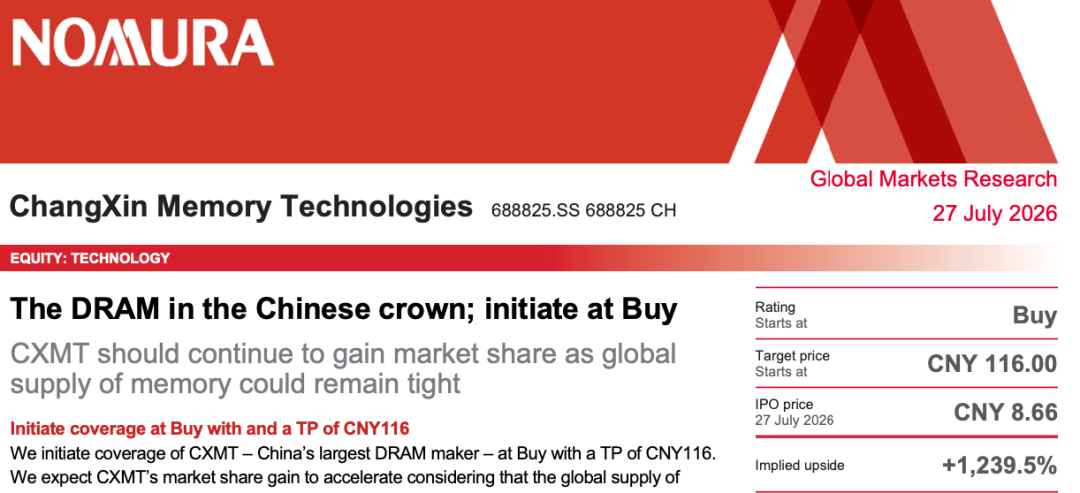
It is worth noting that Nomura's judgment, which is nearly 2.4 times the current market cap, is not unfounded. It is based on a comprehensive assessment of dimensions such as capacity expansion, technology upgrades, and price increases, and is also related to factors such as CXMT's current product mix, the storage super-cycle, and the subsequent use of IPO proceeds. For more on the underlying logic, recommended reading: "Thirteen Times Bullish on CXMT?"

According to information from CXMT's IPO prospectus, out of the 57.9 billion yuan raised, 7.5 billion yuan will be used for technology upgrade and transformation of the mass production line for memory wafer manufacturing, 13 billion yuan will be used for core DRAM memory process technology upgrades, and 9 billion yuan will be used for forward-looking technology research and development. The market generally believes the final 9 billion yuan will be allocated to HBM (High Bandwidth Memory) direction R&D, which is the core business of current memory giants like SK Hynix and Micron—AI chip high-bandwidth memory.

In other words, CXMT is not content with its current mainline DRAM business but is also striving to expand into high-profit, high-demand sectors like HBM.

Viewpoint Two: Northeast Securities Judges Valuation Range Converges to 3.2-5.7 Trillion RMB

Compared to the extremely optimistic Nomura, Northeast Securities offers a relatively conservative bullish range, but it still implies over 42% upside from the current market cap.

To provide a reasonable valuation for CXMT, Northeast Securities gives a market cap reference from the following three aspects:

  • Market Share Relative Valuation Perspective: Using US stocks as a valuation reference, by comparing and analyzing the market shares of Micron Technology, SK Hynix, Samsung Electronics, SanDisk, etc., in the DRAM and NAND markets, and splitting their market caps by different businesses, considering CXMT's future market share, the target market cap is 3.49 trillion yuan.
  • Profitability Breakdown Perspective: By decomposing CXMT's historical revenue and cost structure, using price and capacity as core variables to forecast profits for this year and next, with 2027 net profit attributable to shareholders at 284.8 billion yuan, a 10—15x P/E ratio corresponds to a target market cap of 2.85—4.27 trillion yuan.
  • Market Cap Per Unit Capacity Perspective: Calculating the market cap per unit capacity for overseas listed storage companies in the DRAM business and using this as a basis, a target market cap of 3.22—3.99 trillion yuan is calculated.

For detailed calculations and reasoning, recommended reading: "A-Share's New 'Stock King' is Born, How to Reasonably Value CXMT?"

Viewpoint Three: Multiple ETF Funds Warn ETF NAV May Deviate from IOPV on CXMT's Debut Day

This morning, prior to CXMT's listing, ETF fund managers such as ChinaAMC and Harvest Fund issued announcements warning that some of their ETFs participated in the IPO subscription for CXMT and valued it at the issue price. However, the ETF's Indicative Optimized Portfolio Value (IOPV) only includes CXMT's issue price and does not reflect its market price fluctuations. Therefore, on CXMT's debut day, the IOPV of these ETFs may differ from the actual net asset value per fund share, and investors are advised to pay attention to related investment risks.

In this regard, an ETF fund manager explained that currently, ETF participation in IPOs is generally done together with active equity funds. The IOPV for ETFs is strictly calculated based on the PCF (Portfolio Composition File) list, and restricted shares like new stocks not yet included as constituents are not counted. CXMT's sharp rise on its debut will cause the actual net asset value per share of ETFs that participated in the IPO to be slightly higher than the IOPV, creating a deviation. In such cases, potential arbitrage strategies could include buying the ETF while hedging with derivatives, retaining only the excess exposure from the deviation.

In simpler terms, the IOPV (reference net value) seen by investors is calculated based on CXMT's issue price of 8.66 yuan, but the fund's actual NAV is calculated based on the market price. Therefore, the IOPV severely "undervalues" the fund's true worth, appearing as a discount. Essentially, this is because CXMT's opening price surged, but there's a lag in the display on investment systems, aiming to prevent investors from buying ETF funds at inflated prices due to market volatility and incurring losses.

Viewpoint Four: Analyst Believes CXMT's Listing Surge Still Hard to Change Global DRAM Shortage Situation

Today, Milk Road AI analyst Melvin posted an analysis on CXMT's stock price surge.

He stated that in less than a year, CXMT's global DRAM market share increased from less than 4% to about 7.7%-8%, with Q1 revenue this year growing 719% year-on-year to 50.8 billion yuan. This growth primarily benefited from Samsung, SK Hynix, and Micron shifting more capacity to AI server storage (especially HBM), creating a supply gap in the traditional DDR5, LPDDR5 market, which CXMT filled by addressing mid-to-low-end DRAM demand.

However, CXMT's current capacity is far from sufficient to meet global demand. Its current monthly wafer capacity is about 290,000-320,000 pieces, lower than Samsung's approximately 630,000 pieces and SK Hynix's about 500,000 pieces. Furthermore, U.S. export restrictions on advanced lithography equipment are limiting the pace of CXMT's further expansion.

He believes that CXMT will find it difficult to enter the HBM market in the short term and therefore will not change the supply-demand dynamics of AI storage. Samsung, SK Hynix, and Micron will likely maintain their advantage in high-margin products like HBM, server DRAM, and LPDDR5X, and the global storage shortage cycle may persist.

In simpler terms, the analyst believes that CXMT's listing surge will not directly translate into a linear increase in market share or a massive surge in storage industry supply, offering a relatively neutral expectation for market cap and price performance from a rational perspective.

Viewpoint Five: On-Chain Sentiment Divided, US & China Addresses Bullish, South Korean Addresses Bearish

Apart from institutions and analysts, the pre-listing long-short divergence for CXMT on-chain is also quite distinct.

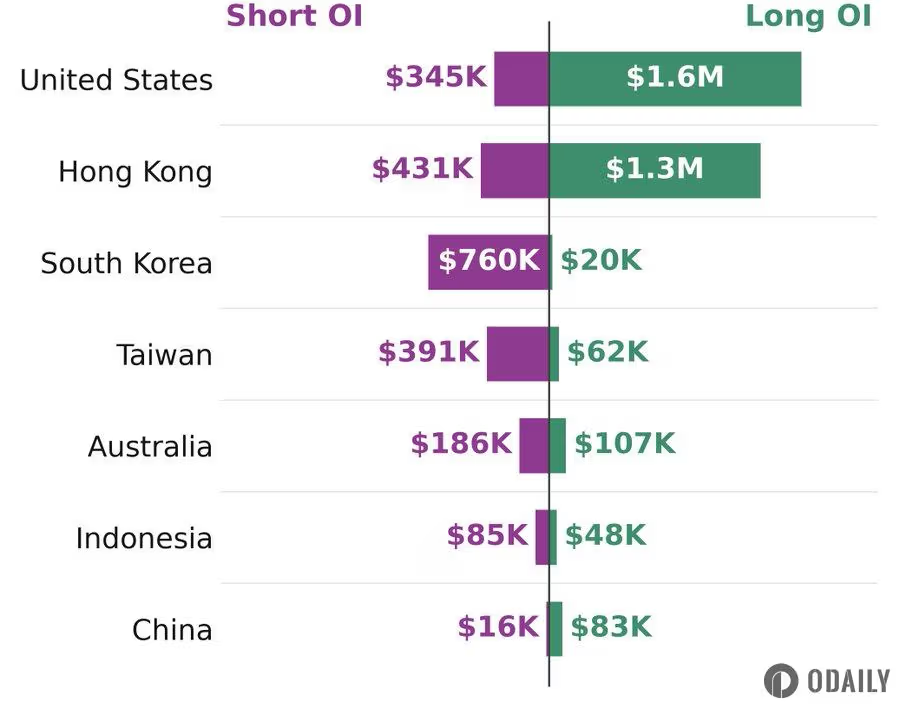
According to HyperInsight monitoring, on the eve of CXMT's listing, wallets attributable to CXMT on Hyperliquid showed: US, Hong Kong, and Mainland China wallets were overall bullish, while South Korean-labeled wallets became the main shorting force in this sample.

Among them, South Korean wallets held about $760,000 in short positions, a scale approximately 38 times that of their long positions; Taiwan-labeled wallets were also slightly bearish, with a net short of about $329,000.

On the long side:

  • US-labeled wallets held $1.6 million in long positions and $345,000 in short positions, net long about $1.255 million;
  • Hong Kong-labeled wallets held $1.3 million in long positions and $431,000 in short positions, net long about $869,000;
  • Mainland China-labeled wallets held only $83,000 in long positions and $16,000 in short positions, net long about $67,000.

Assuming the $760,000 in short positions from South Korean wallets were all opened before the opening bell at a unified price of $6.48 with no subsequent adjustments and all at 1x leverage, the theoretical floating loss on these short positions would be about $48,500, a loss rate of approximately 6.4%. Combined with today's closing data, the long side returned home with full pockets.
Viewpoint Six: CXMT's Upside Expected to Last Several Days, Low Float High Market Cap to Continue Fueling FOMO

Aside from the above information, mainstream views within the crypto market still maintain some confidence in CXMT's subsequent upward trend.

Their main points include:

First, the current freely tradable shares of CXMT account for only 6.63%, highly similar to the initial performance of SpaceX (SPCX) post-listing;

Second, the memory super-cycle remains the main theme in capital markets. Coupled with memory manufacturers like SK Hynix, Samsung Electronics, and Micron Technology continuing to expand production, advance chip partnerships, and build new factories, and with analysts expecting SK Hynix's Q2 earnings to far exceed market expectations, industry tailwinds directly fuel bullish sentiment for CXMT;

Third, CXMT's unique status as the "domestic storage industry leader" makes it a highly watched speculative target within the A-share market and even across multiple capital markets. Combined with the previous "A-share premium effect," a 15-20x P/E ratio expectation is not unrealistic;

Fourth, despite "rumored internal memos" claiming brokerages have banned hype around CXMT, market performance shows institutions maintain some restraint while still paying close attention. This suggests institutional buying interest for CXMT still exists, thereby storing some momentum for future gains.

Finally, as an aside, according to the Bloomberg Billionaires Index, since CXMT's listing, the wealth of its founder Zhu Yiming's family has surged nearly 300%, reaching $13.9 billion. Currently, he is reportedly preparing to distribute 40% of this as bonuses to employees. This move might emulate SK Hynix's practice of distributing 10% of its annual net profit to all employees and may also, to some extent, delay the pace of equity monetization.

Recommended Reading

More Accurate Than Brokers? TradeXYZ Pre-Priced CXMT

Crypto di tendenza

Domande pertinenti

QWhat were the key reasons for CXMT's strong debut and record-breaking performance on its first trading day?

AChangxin Memory Technologies (CXMT) had a strong debut due to its position as a leading domestic memory chip maker, significant year-on-year growth in projected revenue and net profit, and massive market interest. It set records including becoming the first tech stock to open with a market cap exceeding 3 trillion RMB, the highest market cap on the STAR Market, the first stock with single-day turnover exceeding 100 billion RMB, and the first new stock to combine 100 billion RMB turnover with over 50% turnover rate.

QWhat are the differing target price and valuation outlooks for CXMT from Nomura Securities and Northeast Securities?

ANomura Securities is extremely bullish, giving CXMT a 'Buy' rating with a target price of 116 RMB (implying a 1239.5% gain from the IPO price) and a market cap of approximately 7.76 trillion RMB, based on a 20x P/E ratio. In contrast, Northeast Securities provides a more conservative valuation range of 3.2 to 5.7 trillion RMB, using methods like relative market share valuation, profitability analysis (10-15x P/E on 2027 profits), and unit capacity valuation.

QAccording to the Milk Road AI analyst, why won't CXMT's listing immediately solve the global DRAM shortage?

AThe analyst states that while CXMT has grown its DRAM market share, its current monthly wafer capacity (290k-320k) is still much lower than competitors like Samsung (630k) and SK Hynix (500k). Furthermore, U.S. restrictions on advanced lithography equipment limit its expansion speed. Crucially, CXMT is not yet in the high-margin HBM (High Bandwidth Memory) market, which is dominated by Samsung, SK Hynix, and Micron for AI servers. Therefore, CXMT's growth primarily fills gaps in mid-to-low-end DRAM, not the high-end segments driving the shortage.

QHow did on-chain wallet activity on Hyperliquid show a geographical split in sentiment towards CXMT before its IPO?

AOn-chain data from Hyperliquid showed a clear geographical split in sentiment. Wallets tagged to the United States, Hong Kong (China), and mainland China were predominantly long (net buyers). In contrast, wallets tagged to South Korea were the main short-sellers in the sample, holding about $760k in short positions—38 times the size of their long positions. Wallets tagged to Taiwan (China) also showed a net short position.

QWhat are some of the arguments within the crypto market for why CXMT's price rise might continue?

ACrypto market participants are optimistic for several reasons: 1) Low free float (only 6.63% of shares), similar to SpaceX's (SPCX) early performance, which can amplify price moves. 2) The ongoing memory 'super cycle' and strong industry fundamentals, with peers like SK Hynix expecting strong earnings. 3) CXMT's unique status as the 'domestic memory leader' could command an 'A-share premium' with P/E ratios of 15-20x seen as realistic. 4) Despite rumors of broker restrictions on speculation, institutional interest remains high, suggesting potential for continued buying support.

Letture associate

US Calls for Restrictions on Sports Prediction Markets

The National Football League (NFL) has urged the U.S. Commodity Futures Trading Commission (CFTC) to tighten rules for prediction markets on sports events. In a July letter, the NFL argued that current proposals fail to adequately protect the integrity of games and market participants. Key demands include banning contracts on events easily manipulated by individuals (e.g., a kicker missing a field goal), clarifying definitions to prevent gambling-like contracts, and explicitly prohibiting trading based on non-public insider information. The league also called for restricted person lists, a ban on margin trading, advertising limits, stronger user protections, and a minimum age of 21. This push coincides with an ongoing jurisdictional dispute between the CFTC and several states. The CFTC claims exclusive federal oversight, classifying event contracts as swaps, while states argue these platforms violate local gambling laws. Recent legal actions in Michigan and Minnesota highlight the conflict, with a federal court temporarily blocking Minnesota from applying a new law to CFTC-registered platforms like Kalshi and Polymarket. Meanwhile, prediction markets are experiencing significant growth. In June, driven by events like the World Cup, Kalshi's trading volume exceeded $31 billion (85% from sports contracts), while Polymarket's global platform hit a monthly record of $10.8 billion. However, platforms face legal challenges, such as lawsuits from Kentucky accusing them of operating unlicensed sports betting disguised as prediction markets.

cryptonews.ru7 min fa

US Calls for Restrictions on Sports Prediction Markets

cryptonews.ru7 min fa

Peskov Says Russia Is Among Top Five Leaders in AI Race. What Do Global Rankings Say?

On July 27, 2026, Kremlin spokesman Dmitry Peskov stated that Russia remains among the top five countries in the global AI development race. He acknowledged Russian models still lag behind leading U.S. counterparts but claimed they have reached a "very high level," aiming to close the gap with "superhuman efforts." He highlighted the differing approaches of Russia's GigaChat, built from scratch, and Yandex, which initially used foreign technology. However, this claim is not supported by major international AI rankings. Stanford University's Global AI Vibrancy Tool (2024-25) ranks Russia 28th out of 36 countries. The top five are the U.S., China, India, South Korea, and the UK. The Stanford AI Index Report 2026 does not mention Russia's position, focusing instead on U.S. and Chinese leadership across various metrics like investments and model performance. In benchmarks, GigaChat ranks 25th on the Russian-language LM Arena. While it passed a financial analyst exam in December 2025, its business usage costs are reportedly tens to hundreds of times higher than China's DeepSeek. In related developments, President Putin signed a law on July 26, 2026, establishing a legal framework for sovereign AI models and granting developers access to state data. Previously, Russia joined 28 other nations, including China, to establish the World AI Cooperation Organization (WAICO) in Shanghai. The article notes that rankings vary due to different criteria, such as research, investment, infrastructure, or responsible AI governance. While Russian authorities are bolstering AI through legislation and international cooperation, independent analyses suggest the country faces significant challenges, including a hardware deficit for training models, which legal frameworks alone cannot resolve.

cryptonews.ru8 min fa

Peskov Says Russia Is Among Top Five Leaders in AI Race. What Do Global Rankings Say?

cryptonews.ru8 min fa

From Sand to Chips: Hefei's Semiconductor Alchemy

From Sand to Chips: Hefei's Semiconductor "Alchemy" On July 27, 2026, a memory chip maker from Hefei made history by surpassing the market capitalization of Industrial and Commercial Bank of China on its Shanghai Stock Exchange debut. This marks the culmination of Hefei's two-decade industrial transformation, often summarized in three strategic leaps: "Screen, Chip, Vehicle." The journey began in 2008 with a bold investment in BOE, establishing China's first 6th-generation LCD panel line. The second leap was the "Project 506" in 2016, which gave birth to ChangXin Memory Technologies (CXMT). With initial backing of 14.4 billion RMB from Hefei's state-owned investment platform, CXMT aimed to break into the global DRAM market, then over 95% controlled by three overseas giants. CXMT achieved a breakthrough in 2019 by producing China's first 8GB DDR4 DRAM chip, employing "generational leapfrog" R&D to catch up. After years of significant losses, the company turned profitable in 2025. A dramatic surge followed in 2026, driven by AI-driven demand and full capacity utilization, propelling CXMT to become the world's fourth-largest DRAM manufacturer. CXMT's success is not isolated. It anchors a dense, localized semiconductor ecosystem in Hefei. Within its vicinity are numerous supporting companies for equipment, materials, and packaging & testing. This cluster has fueled the regional economy, with Hefei's integrated circuit industry output growing over sevenfold between 2016 and 2025. The ripple effects extend beyond high-tech, revitalizing local communities with new businesses and services catering to the influx of workers. For individuals, Hefei offers competitive tech salaries at a significantly lower cost of living compared to major coastal cities, along with improved amenities and shorter commutes. Hefei's story demonstrates two decades of focused, long-term industrial policy, transforming the city from a provincial capital into a trillion-RMB GDP "Double Ten-Thousand" city (10 million people, 1 trillion RMB GDP). It shows how persistence in strategic sectors—turning sand into chips—can redefine a city's economic destiny.

marsbit37 min fa

From Sand to Chips: Hefei's Semiconductor Alchemy

marsbit37 min fa

Trading

Spot

Articoli Popolari

Cosa è $S$

Comprendere SPERO: Una Panoramica Completa Introduzione a SPERO Mentre il panorama dell'innovazione continua a evolversi, l'emergere delle tecnologie web3 e dei progetti di criptovaluta gioca un ruolo fondamentale nel plasmare il futuro digitale. Un progetto che ha attirato l'attenzione in questo campo dinamico è SPERO, denotato come SPERO,$$s$. Questo articolo mira a raccogliere e presentare informazioni dettagliate su SPERO, per aiutare gli appassionati e gli investitori a comprendere le sue basi, obiettivi e innovazioni nei domini web3 e crypto. Che cos'è SPERO,$$s$? SPERO,$$s$ è un progetto unico all'interno dello spazio crypto che cerca di sfruttare i principi della decentralizzazione e della tecnologia blockchain per creare un ecosistema che promuove l'impegno, l'utilità e l'inclusione finanziaria. Il progetto è progettato per facilitare interazioni peer-to-peer in modi nuovi, fornendo agli utenti soluzioni e servizi finanziari innovativi. Al suo interno, SPERO,$$s$ mira a responsabilizzare gli individui fornendo strumenti e piattaforme che migliorano l'esperienza dell'utente nello spazio delle criptovalute. Questo include la possibilità di metodi di transazione più flessibili, la promozione di iniziative guidate dalla comunità e la creazione di percorsi per opportunità finanziarie attraverso applicazioni decentralizzate (dApps). La visione sottostante di SPERO,$$s$ ruota attorno all'inclusività, cercando di colmare le lacune all'interno della finanza tradizionale mentre sfrutta i vantaggi della tecnologia blockchain. Chi è il Creatore di SPERO,$$s$? L'identità del creatore di SPERO,$$s$ rimane piuttosto oscura, poiché ci sono risorse pubblicamente disponibili limitate che forniscono informazioni dettagliate sul suo fondatore o fondatori. Questa mancanza di trasparenza può derivare dall'impegno del progetto per la decentralizzazione—un ethos che molti progetti web3 condividono, dando priorità ai contributi collettivi rispetto al riconoscimento individuale. Centrando le discussioni attorno alla comunità e ai suoi obiettivi collettivi, SPERO,$$s$ incarna l'essenza dell'empowerment senza mettere in evidenza individui specifici. Pertanto, comprendere l'etica e la missione di SPERO rimane più importante che identificare un creatore singolo. Chi sono gli Investitori di SPERO,$$s$? SPERO,$$s$ è supportato da una varietà di investitori che vanno dai capitalisti di rischio agli investitori angelici dedicati a promuovere l'innovazione nel settore crypto. Il focus di questi investitori generalmente si allinea con la missione di SPERO—dando priorità a progetti che promettono avanzamenti tecnologici sociali, inclusività finanziaria e governance decentralizzata. Queste fondazioni di investitori sono tipicamente interessate a progetti che non solo offrono prodotti innovativi, ma contribuiscono anche positivamente alla comunità blockchain e ai suoi ecosistemi. Il supporto di questi investitori rafforza SPERO,$$s$ come un concorrente degno di nota nel dominio in rapida evoluzione dei progetti crypto. Come Funziona SPERO,$$s$? SPERO,$$s$ impiega un framework multifunzionale che lo distingue dai progetti di criptovaluta convenzionali. Ecco alcune delle caratteristiche chiave che sottolineano la sua unicità e innovazione: Governance Decentralizzata: SPERO,$$s$ integra modelli di governance decentralizzati, responsabilizzando gli utenti a partecipare attivamente ai processi decisionali riguardanti il futuro del progetto. Questo approccio favorisce un senso di proprietà e responsabilità tra i membri della comunità. Utilità del Token: SPERO,$$s$ utilizza il proprio token di criptovaluta, progettato per servire varie funzioni all'interno dell'ecosistema. Questi token abilitano transazioni, premi e la facilitazione dei servizi offerti sulla piattaforma, migliorando l'impegno e l'utilità complessivi. Architettura Stratificata: L'architettura tecnica di SPERO,$$s$ supporta la modularità e la scalabilità, consentendo un'integrazione fluida di funzionalità e applicazioni aggiuntive man mano che il progetto evolve. Questa adattabilità è fondamentale per mantenere la rilevanza nel panorama crypto in continua evoluzione. Coinvolgimento della Comunità: Il progetto enfatizza iniziative guidate dalla comunità, impiegando meccanismi che incentivano la collaborazione e il feedback. Nutrendo una comunità forte, SPERO,$$s$ può affrontare meglio le esigenze degli utenti e adattarsi alle tendenze di mercato. Focus sull'Inclusione: Offrendo basse commissioni di transazione e interfacce user-friendly, SPERO,$$s$ mira ad attrarre una base utenti diversificata, inclusi individui che potrebbero non aver precedentemente interagito nello spazio crypto. Questo impegno per l'inclusione si allinea con la sua missione generale di empowerment attraverso l'accessibilità. Cronologia di SPERO,$$s$ Comprendere la storia di un progetto fornisce preziose intuizioni sulla sua traiettoria di sviluppo e sui traguardi. Di seguito è riportata una cronologia suggerita che mappa eventi significativi nell'evoluzione di SPERO,$$s$: Fase di Concettualizzazione e Ideazione: Le idee iniziali che formano la base di SPERO,$$s$ sono state concepite, allineandosi strettamente con i principi di decentralizzazione e focus sulla comunità all'interno dell'industria blockchain. Lancio del Whitepaper del Progetto: Dopo la fase concettuale, è stato rilasciato un whitepaper completo che dettaglia la visione, gli obiettivi e l'infrastruttura tecnologica di SPERO,$$s$ per suscitare interesse e feedback dalla comunità. Costruzione della Comunità e Prime Interazioni: Sono stati effettuati sforzi attivi di outreach per costruire una comunità di early adopters e potenziali investitori, facilitando discussioni attorno agli obiettivi del progetto e ottenendo supporto. Evento di Generazione del Token: SPERO,$$s$ ha condotto un evento di generazione del token (TGE) per distribuire i propri token nativi ai primi sostenitori e stabilire una liquidità iniziale all'interno dell'ecosistema. Lancio della Prima dApp: La prima applicazione decentralizzata (dApp) associata a SPERO,$$s$ è stata attivata, consentendo agli utenti di interagire con le funzionalità principali della piattaforma. Sviluppo Continuo e Partnership: Aggiornamenti e miglioramenti continui alle offerte del progetto, inclusi partnership strategiche con altri attori nello spazio blockchain, hanno plasmato SPERO,$$s$ in un concorrente competitivo e in evoluzione nel mercato crypto. Conclusione SPERO,$$s$ rappresenta una testimonianza del potenziale del web3 e delle criptovalute di rivoluzionare i sistemi finanziari e responsabilizzare gli individui. Con un impegno per la governance decentralizzata, il coinvolgimento della comunità e funzionalità progettate in modo innovativo, apre la strada verso un panorama finanziario più inclusivo. Come per qualsiasi investimento nello spazio crypto in rapida evoluzione, si incoraggiano potenziali investitori e utenti a ricercare approfonditamente e a impegnarsi in modo riflessivo con gli sviluppi in corso all'interno di SPERO,$$s$. Il progetto mostra lo spirito innovativo dell'industria crypto, invitando a ulteriori esplorazioni delle sue innumerevoli possibilità. Mentre il percorso di SPERO,$$s$ è ancora in fase di sviluppo, i suoi principi fondamentali potrebbero effettivamente influenzare il futuro di come interagiamo con la tecnologia, la finanza e tra di noi in ecosistemi digitali interconnessi.

159 Totale visualizzazioniPubblicato il 2024.12.17Aggiornato il 2024.12.17

Cosa è $S$

Cosa è AGENT S

Agent S: Il Futuro dell'Interazione Autonoma in Web3 Introduzione Nel panorama in continua evoluzione di Web3 e criptovalute, le innovazioni stanno costantemente ridefinendo il modo in cui gli individui interagiscono con le piattaforme digitali. Uno di questi progetti pionieristici, Agent S, promette di rivoluzionare l'interazione uomo-computer attraverso il suo framework agentico aperto. Aprendo la strada a interazioni autonome, Agent S mira a semplificare compiti complessi, offrendo applicazioni trasformative nell'intelligenza artificiale (AI). Questa esplorazione dettagliata approfondirà le complessità del progetto, le sue caratteristiche uniche e le implicazioni per il dominio delle criptovalute. Cos'è Agent S? Agent S si presenta come un innovativo framework agentico aperto, progettato specificamente per affrontare tre sfide fondamentali nell'automazione dei compiti informatici: Acquisizione di Conoscenze Specifiche del Dominio: Il framework apprende in modo intelligente da varie fonti di conoscenza esterne ed esperienze interne. Questo approccio duale gli consente di costruire un ricco repository di conoscenze specifiche del dominio, migliorando le sue prestazioni nell'esecuzione dei compiti. Pianificazione su Lungo Orizzonte di Compiti: Agent S impiega una pianificazione gerarchica potenziata dall'esperienza, un approccio strategico che facilita la suddivisione e l'esecuzione efficiente di compiti complessi. Questa caratteristica migliora significativamente la sua capacità di gestire più sottocompiti in modo efficiente ed efficace. Gestione di Interfacce Dinamiche e Non Uniformi: Il progetto introduce l'Interfaccia Agente-Computer (ACI), una soluzione innovativa che migliora l'interazione tra agenti e utenti. Utilizzando Modelli Linguistici Multimodali di Grandi Dimensioni (MLLM), Agent S può navigare e manipolare senza sforzo diverse interfacce grafiche utente. Attraverso queste caratteristiche pionieristiche, Agent S fornisce un framework robusto che affronta le complessità coinvolte nell'automazione dell'interazione umana con le macchine, preparando il terreno per innumerevoli applicazioni nell'AI e oltre. Chi è il Creatore di Agent S? Sebbene il concetto di Agent S sia fondamentalmente innovativo, informazioni specifiche sul suo creatore rimangono elusive. Il creatore è attualmente sconosciuto, il che evidenzia sia la fase embrionale del progetto sia la scelta strategica di mantenere i membri fondatori sotto anonimato. Indipendentemente dall'anonimato, l'attenzione rimane sulle capacità e sul potenziale del framework. Chi sono gli Investitori di Agent S? Poiché Agent S è relativamente nuovo nell'ecosistema crittografico, informazioni dettagliate riguardanti i suoi investitori e sostenitori finanziari non sono documentate esplicitamente. La mancanza di approfondimenti pubblicamente disponibili sulle fondazioni di investimento o sulle organizzazioni che supportano il progetto solleva interrogativi sulla sua struttura di finanziamento e sulla roadmap di sviluppo. Comprendere il supporto è cruciale per valutare la sostenibilità del progetto e il suo potenziale impatto sul mercato. Come Funziona Agent S? Al centro di Agent S si trova una tecnologia all'avanguardia che gli consente di funzionare efficacemente in contesti diversi. Il suo modello operativo è costruito attorno a diverse caratteristiche chiave: Interazione Uomo-Computer Simile a Quella Umana: Il framework offre una pianificazione AI avanzata, cercando di rendere le interazioni con i computer più intuitive. Mimando il comportamento umano nell'esecuzione dei compiti, promette di elevare le esperienze degli utenti. Memoria Narrativa: Utilizzata per sfruttare esperienze di alto livello, Agent S utilizza la memoria narrativa per tenere traccia delle storie dei compiti, migliorando così i suoi processi decisionali. Memoria Episodica: Questa caratteristica fornisce agli utenti una guida passo-passo, consentendo al framework di offrire supporto contestuale mentre i compiti si sviluppano. Supporto per OpenACI: Con la capacità di funzionare localmente, Agent S consente agli utenti di mantenere il controllo sulle proprie interazioni e flussi di lavoro, allineandosi con l'etica decentralizzata di Web3. Facile Integrazione con API Esterne: La sua versatilità e compatibilità con varie piattaforme AI garantiscono che Agent S possa adattarsi senza problemi agli ecosistemi tecnologici esistenti, rendendolo una scelta attraente per sviluppatori e organizzazioni. Queste funzionalità contribuiscono collettivamente alla posizione unica di Agent S all'interno dello spazio crittografico, poiché automatizza compiti complessi e multi-fase con un intervento umano minimo. Man mano che il progetto evolve, le sue potenziali applicazioni in Web3 potrebbero ridefinire il modo in cui si svolgono le interazioni digitali. Cronologia di Agent S Lo sviluppo e le tappe di Agent S possono essere riassunti in una cronologia che evidenzia i suoi eventi significativi: 27 Settembre 2024: Il concetto di Agent S è stato lanciato in un documento di ricerca completo intitolato “Un Framework Agentico Aperto che Usa i Computer Come un Umano”, mostrando le basi per il progetto. 10 Ottobre 2024: Il documento di ricerca è stato reso pubblicamente disponibile su arXiv, offrendo un'esplorazione approfondita del framework e della sua valutazione delle prestazioni basata sul benchmark OSWorld. 12 Ottobre 2024: È stata rilasciata una presentazione video, fornendo un'idea visiva delle capacità e delle caratteristiche di Agent S, coinvolgendo ulteriormente potenziali utenti e investitori. Questi indicatori nella cronologia non solo illustrano i progressi di Agent S, ma indicano anche il suo impegno per la trasparenza e il coinvolgimento della comunità. Punti Chiave su Agent S Man mano che il framework Agent S continua a evolversi, diversi attributi chiave si distinguono, sottolineando la sua natura innovativa e il potenziale: Framework Innovativo: Progettato per fornire un uso intuitivo dei computer simile all'interazione umana, Agent S porta un approccio nuovo all'automazione dei compiti. Interazione Autonoma: La capacità di interagire autonomamente con i computer attraverso GUI segna un passo avanti verso soluzioni informatiche più intelligenti ed efficienti. Automazione di Compiti Complessi: Con la sua metodologia robusta, può automatizzare compiti complessi e multi-fase, rendendo i processi più veloci e meno soggetti a errori. Miglioramento Continuo: I meccanismi di apprendimento consentono ad Agent S di migliorare dalle esperienze passate, migliorando continuamente le sue prestazioni e la sua efficacia. Versatilità: La sua adattabilità attraverso diversi ambienti operativi come OSWorld e WindowsAgentArena garantisce che possa servire un'ampia gamma di applicazioni. Man mano che Agent S si posiziona nel panorama di Web3 e delle criptovalute, il suo potenziale per migliorare le capacità di interazione e automatizzare i processi segna un significativo avanzamento nelle tecnologie AI. Attraverso il suo framework innovativo, Agent S esemplifica il futuro delle interazioni digitali, promettendo un'esperienza più fluida ed efficiente per gli utenti in vari settori. Conclusione Agent S rappresenta un audace passo avanti nell'unione tra AI e Web3, con la capacità di ridefinire il modo in cui interagiamo con la tecnologia. Sebbene sia ancora nelle sue fasi iniziali, le possibilità per la sua applicazione sono vaste e coinvolgenti. Attraverso il suo framework completo che affronta sfide critiche, Agent S mira a portare le interazioni autonome al centro dell'esperienza digitale. Man mano che ci addentriamo nei regni delle criptovalute e della decentralizzazione, progetti come Agent S giocheranno senza dubbio un ruolo cruciale nel plasmare il futuro della tecnologia e della collaborazione uomo-computer.

615 Totale visualizzazioniPubblicato il 2025.01.14Aggiornato il 2025.01.14

Cosa è AGENT S

Come comprare S

Benvenuto in HTX.com! Abbiamo reso l'acquisto di Sonic (S) semplice e conveniente. Segui la nostra guida passo passo per intraprendere il tuo viaggio nel mondo delle criptovalute.Step 1: Crea il tuo Account HTXUsa la tua email o numero di telefono per registrarti il tuo account gratuito su HTX. Vivi un'esperienza facile e sblocca tutte le funzionalità,Crea il mio accountStep 2: Vai in Acquista crypto e seleziona il tuo metodo di pagamentoCarta di credito/debito: utilizza la tua Visa o Mastercard per acquistare immediatamente SonicS.Bilancio: Usa i fondi dal bilancio del tuo account HTX per fare trading senza problemi.Terze parti: abbiamo aggiunto metodi di pagamento molto utilizzati come Google Pay e Apple Pay per maggiore comodità.P2P: Fai trading direttamente con altri utenti HTX.Over-the-Counter (OTC): Offriamo servizi su misura e tassi di cambio competitivi per i trader.Step 3: Conserva Sonic (S)Dopo aver acquistato Sonic (S), conserva nel tuo account HTX. In alternativa, puoi inviare tramite trasferimento blockchain o scambiare per altre criptovalute.Step 4: Scambia Sonic (S)Scambia facilmente Sonic (S) nel mercato spot di HTX. Accedi al tuo account, seleziona la tua coppia di trading, esegui le tue operazioni e monitora in tempo reale. Offriamo un'esperienza user-friendly sia per chi ha appena iniziato che per i trader più esperti.

1.2k Totale visualizzazioniPubblicato il 2025.01.15Aggiornato il 2026.06.02

Come comprare S

Discussioni

Benvenuto nella Community HTX. Qui puoi rimanere informato sugli ultimi sviluppi della piattaforma e accedere ad approfondimenti esperti sul mercato. Le opinioni degli utenti sul prezzo di S S sono presentate come di seguito.

活动图片