Just One Step Away, Where Is the Clarity Act Stuck?

Odaily星球日报Pubblicato 2026-07-28Pubblicato ultima volta 2026-07-28

Introduzione

The U.S. Digital Asset Market Structure Act, or Clarity Act, faces a critical, time-sensitive hurdle in the Senate despite recent progress. While the White House added an "ethics provision" to the bill—seen as a compromise with Republicans—significant disagreements persist, particularly regarding the details of this clause. Democrats oppose key elements: they object to granting enforcement authority solely to the Department of Justice, citing potential conflicts due to the Attorney General's past role as Trump's lawyer; they criticize a sunset clause that would void the provision after Trump's potential term ends in 2029; and they argue the restrictions on officials and their families are insufficient. With the Senate's summer recess approaching, the bill's timeline is severely constrained. It must compete for floor time with other contentious legislation, and procedural rules could further delay a vote. Analysts, noting strong Democratic resistance and limited negotiation time, have significantly lowered the probability of the bill passing in 2026. The final obstacle remains bridging the gap on the ethics provision's specifics, determining whether the long-awaited regulatory framework will be enacted imminently or postponed indefinitely.

Original | Odaily Planet Daily (@OdailyChina)

Author | Azuma (@azuma_eth)

With only a few workdays left before the U.S. Congress enters its summer recess (scheduled to begin on August 7th), time is running out for the "Digital Asset Market Structure Act" (hereinafter referred to as the Clarity Act) to pass through the Senate.

Last week, the White House agreed to include an "ethics provision" in the Clarity Act aimed at restricting the President, Vice President, members of Congress, and other federal officials from profiting from digital assets during their terms. This move was widely interpreted by the market as an indication that Trump and the Republicans had expressed a willingness to compromise and reach a consensus with Democratic senators on this remaining major point of contention.

However, as details of the Clarity Act amendments were revealed, the market discovered that the situation is far more complex than imagined.

Alex Thorn, Head of Research at Galaxy, posted over the weekend, stating that the Clarity Act is now on the final "one-yard line." Like in American football, this last yard might be the toughest yard on the field; in politics, it is a game of fierce, inch-by-inch contention...... Considering the limited time remaining and the strong opposition from the Democratic senators involved in negotiations to the current wording of the ethics provision, the probability of the bill being enacted by 2026 has been lowered to 30%.

The Biggest Disagreement Lies in the Details of the Ethics Provision

Alex Thorn summarized in his post that there are still varying degrees of disagreement on multiple aspects of the Clarity Act, including developer protections, DeFi regulatory boundaries, stablecoin yield restrictions, CFTC registration mechanisms, and newly added enforcement provisions.

However, the current broad consensus in the market is that the greatest obstacle preventing further progress of the bill remains the ethics provision, which was previously interpreted as an area where Trump and the Republicans were willing to concede.

According to the latest consolidated Senate text, the Clarity Act spans 616 pages. The newly added content related to the ethics provision is primarily used to restrict the President, Vice President, members of Congress, and other senior federal officials from engaging in digital asset-related activities. This includes prohibiting the issuance or promotion of digital assets by such officials and their spouses during their terms, restricting the listing of related assets on regulated platforms, requiring disclosure of interests, and introducing a blind trust mechanism. At the same time, the provision stipulates that enforcement authority lies with the Department of Justice (DOJ) and that it will automatically expire on January 20, 2029, after the end of Trump's current term.

The problem is that Democrats believe the current version of the ethics provision still has significant shortcomings.

  • First, Democrats believe that granting enforcement authority solely to the Department of Justice lacks sufficient independence. Since the DOJ is part of the executive branch, and the current Acting Attorney General, Todd Blanche, is also Trump's former personal lawyer, there are doubts about the effectiveness of internal oversight when the restrictions involve the President or senior administrative officials. Therefore, Democrats demand that enforcement authority be given to various Inspectors General.
  • Secondly, the provision for automatic expiration in 2029 has also drawn strong criticism and opposition from Democrats. This timing coincides exactly with the end of Trump's current presidential term, meaning that after Trump leaves office, there will be no legal basis for successors to investigate Trump's past actions. Democrats argue that if the goal of the Clarity Act is to establish a long-term digital asset regulatory framework, then ethical norms should also become a permanent institution, not one that terminates with the end of Trump's term.
  • Furthermore, Democrats are also concerned that the current scope of restrictions is still limited. The current version primarily targets direct actions like issuing or promoting digital assets but does not explicitly restrict involvement in crypto profits through affiliated businesses, family members, or other indirect means, especially considering that several of Trump's sons are deeply involved in the cryptocurrency industry. The adequacy of the current version's coverage remains questionable.

Democratic Senator Elizabeth Warren, a consistent strong critic of the bill, issued a formal statement last week criticizing the "DOJ-only enforcement" mechanism in the ethics provisions, calling the bill something that "should be dead on arrival."

More impactful for the vote count is that the seven Democrats who have been negotiating with Republicans (Sens. Mark Warner, Angela Alsobrooks, Cory Booker, Catherine Cortez Masto, Ruben Gallego, John Hickenlooper, Raphael Warnock) also issued a joint statement saying the current text "falls short."

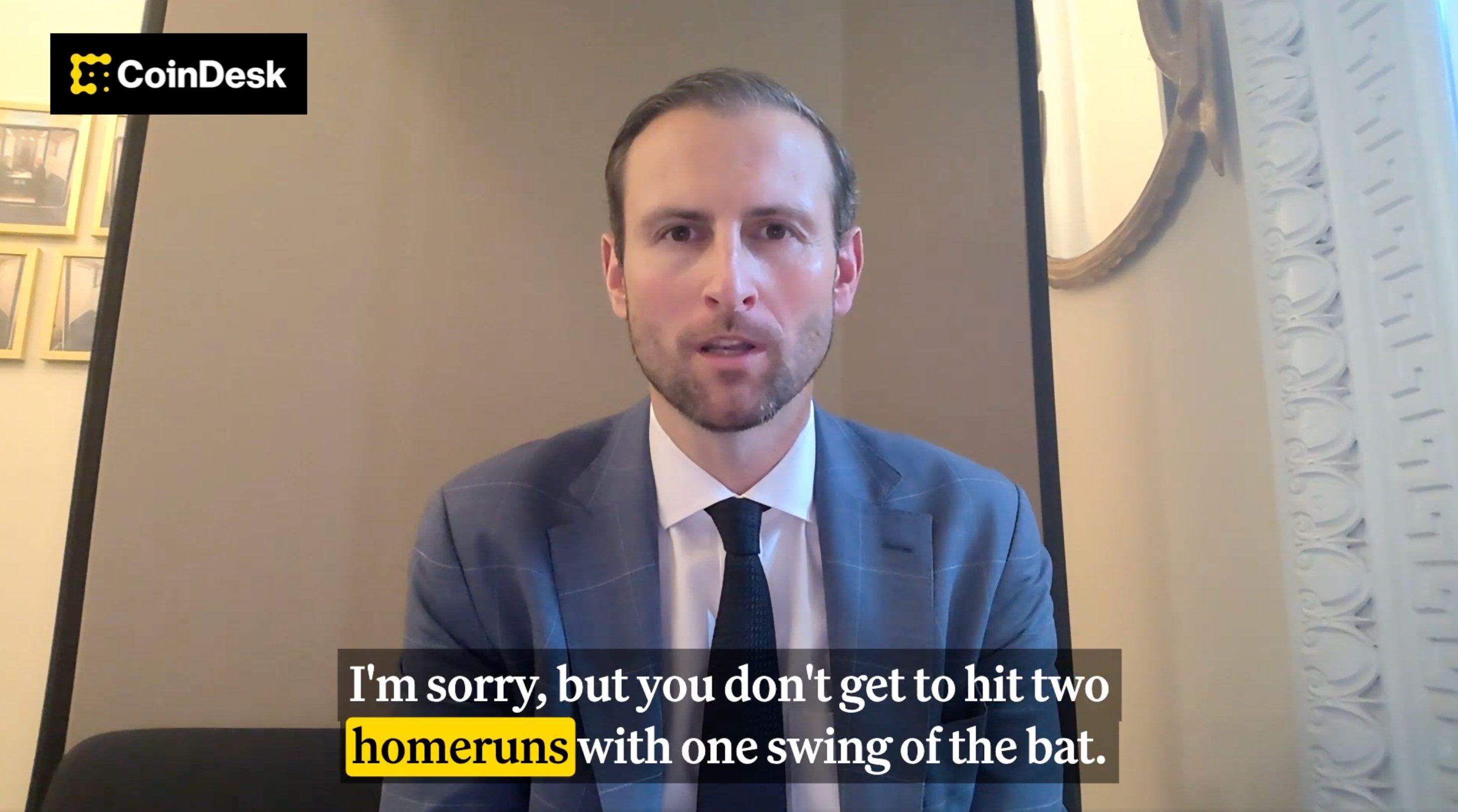
As for the Republican side, they appear, for now, to show no signs of further concessions in response to the Democrats' strong resistance. Patrick Witt, Executive Director of the White House Digital Asset Advisory Committee, stated firmly that the President has made historic concessions, yet Democrats remain unsatisfied — "you can't hit a home run, hit two home runs."
How Much Time Window Remains?

Early this morning, Senate Majority Leader John Thune stated that he would temporarily set aside the Clarity Act to prioritize advancing government official nomination confirmations and the Russian sanctions bill. Additionally, the Senate will be occupied on Tuesday and Wednesday this week due to the funeral of the late Senator Lindsey Graham.

This means that the already limited time available for the Clarity Act to advance before the summer recess has been further compressed. Current market expectations are that the Clarity Act may not enter the voting process until next week at the earliest, the final few days before the Senate recess.

Former Senate staffer Anne Kelley also posted on X today, stating that according to Senate rules, once the cloture process is initiated on a major, controversial bill, that bill becomes the Senate's primary agenda — until the completion of amendment consideration, a second cloture vote, and up to 30 hours of formal debate, it is difficult for the Senate to simultaneously advance another major, contentious bill.

This means that the Clarity Act not only has to face the question of whether it can resolve its own differences in time but also must compete for the already limited Senate voting time with other contentious bills like the Russian sanctions bill, the budget bill, and the SAVE Act.

This is why, although the market once hoped the Clarity Act could pass before the recess, more and more Washington observers are lowering their expectations.

For the cryptocurrency industry, this prolonged legislative battle has now entered its final stage. The regulatory framework is just "one step away" from implementation, but whether that step will be taken in the coming days or will be deferred to an uncertain future will soon be revealed.


Crypto di tendenza

Domande pertinenti

QWhat is the main obstacle currently preventing the Clarity Act from moving forward?

AThe main obstacle is the disagreement over the details of the newly added 'ethics provision'. Democrats have significant concerns about its enforcement mechanism, expiration date, and scope of coverage.

QWhat are the three key objections raised by Democrats regarding the current 'ethics provision' text?

AFirst, they object to the Department of Justice (DOJ) having sole enforcement power, questioning its independence, especially given the DOJ's current leadership. Second, they strongly oppose the clause that automatically sunsets the provision in January 2029, which coincides with the end of Trump's potential term. Third, they believe the restriction scope is too limited and may not cover indirect participation by family members or associates.

QWhy has Galaxy's head of research, Alex Thorn, lowered the probability of the Clarity Act passing in 2026 to 30%?

AAlex Thorn lowered the probability to 30% due to the very limited time left before the summer recess and the strong opposition from Democratic negotiators to the current wording of the ethics provision, indicating significant unresolved political hurdles.

QWhat logistical challenges does the Clarity Act face in the Senate regarding its timeline before the summer recess?

AThe Senate has limited working days left. The schedule is further compressed by the need to prioritize other matters like government nominations, a Russian sanctions bill, and Senator Graham's funeral. The bill must also compete for floor time with other controversial legislation.

QAccording to the article, what action did the White House take that was initially seen as a compromise on the ethics issue?

AThe White House agreed to include an 'ethics provision' in the Clarity Act, which was initially interpreted as a sign of compromise from Trump and the Republicans, suggesting they were willing to reach a consensus with Democrats on this key remaining issue.

Letture associate

Has the Crypto Utopia Collapsed? The Industry Reaches an Inflection Point After the Frenzy Subsides

Has the crypto utopia collapsed? The industry is at an inflection point as the hype fades. The prevailing view is that crypto has become an outlet for excess liquidity, with many participants leaving as financial returns have fallen short of past-decade expectations. The 2021 boom has been revealed as an illusion, placing the industry in the "trough of disillusionment" on Gartner's Hype Cycle. This forces a return to first principles: re-evaluating token value, securing DeFi protocols, and finding real-world applications. The core failure is a repetitive cycle of reflexive speculation, driven by the premature liquidity of tokens. The industry's incentives prioritized short-term gains over genuine innovation. While curiosity drives invention, recent DeFi hacks signal a need for engineering and iteration, including token models. The culture is shifting; the industry is no longer in its early stages. Positioned at a turning point on the technology adoption curve, crypto faces the immense challenge of rebuilding finance from scratch, a process of inevitable iteration and failure. Regarding crypto VC, claims of its death are overstated. The exceptional returns of 2016-2021 were an anomaly. The initial crypto-anarchist ethos has largely been co-opted by Wall Street and regulators. The utopian vision is over; the industry is being assimilated into the existing system, becoming a business. Current viable project categories include stablecoins, prediction markets, tokenized assets/RWA, perpetual contracts, and AI/agent integration. Crypto is converging with fintech, far from the envisioned DeFi revolution, and must find killer apps within regulatory boundaries. A reconciliation is possible: cryptocurrency may change value storage and transfer in subtle, imperceptible ways that integrate into existing systems, rather than through revolutionary fanfare. True creativity often emerges from adversity. There remains much to build for those driven by genuine curiosity.

marsbit13 min fa

Has the Crypto Utopia Collapsed? The Industry Reaches an Inflection Point After the Frenzy Subsides

marsbit13 min fa

Lei Jun Earns 7 Billion in One Day from CXMT's IPO? Xiaomi Executive Responds

On July 28th, Changxin Technology's stock price on the Sci-Tech Innovation Board experienced minor fluctuations. The company had made a historic market debut the previous day, becoming the first A-share stock to record a single-day trading volume exceeding 1 trillion yuan. This led to significant paper gains for its strategic investors. Among them, Xiaomi's wholly-owned subsidiary was allocated 18.24 million shares with an initial investment of approximately 158 million yuan. Reports estimated a paper profit of 717 million yuan for Xiaomi founder Lei Jun based on his shareholding structure. However, a Xiaomi executive clarified that this was a corporate investment and should not be conflated with personal wealth. Other major beneficiaries included Alibaba and Nio. Alibaba, an early investor, held nearly a 5% stake through two entities, with an estimated paper gain exceeding 160 billion yuan. Nio, participating in the strategic placement, also saw substantial paper returns. Additionally, state-owned banks and insurance institutions that invested in Changxin recorded potential gains in the hundreds of billions. Conversely, companies like Country Garden reportedly missed out on nearly 50 billion yuan in potential gains after divesting their stakes before the IPO due to liquidity pressures. The article notes that these are paper profits based on the listing price, as the allocated shares are subject to lock-up periods, and final realized gains will depend on future stock performance. An employee from Changxin Technology commented that ordinary staff remain focused on their salaries and benefits rather than the market hype.

marsbit22 min fa

Lei Jun Earns 7 Billion in One Day from CXMT's IPO? Xiaomi Executive Responds

marsbit22 min fa

Selling Tokens or Selling Outcomes: Several Paradoxes of the AI Business Model

"The Token vs. Outcome Sale: Key Paradoxes in the AI Business Model By mid-2026, the AI industry shows rapid growth in revenue and token usage, yet the underlying business models differ significantly. This article analyzes four structural paradoxes defining the current landscape, all pointing to the commoditization of intelligence and the concentration of profits in few segments. **The Cost Paradox: Cheaper Tokens, Heavier Bills** Despite a >95% price drop for equivalent AI capability since 2023, total spending has skyrocketed due to the Jevons Paradox: lower prices expand usage into previously uneconomical tasks. Furthermore, the shift to autonomous agents operating 24/7 multiplies consumption. However, efficiency gains often remain unrealized due to unchanged organizational workflows (the Solow Paradox). The focus is shifting from optimizing token price to optimizing the task itself. **The Hierarchy Paradox: The App is King vs. The App is Dead** While conventional wisdom holds that value accrues at the application layer, the AI stack is inverted. Infrastructure (chips) captures ~70% of industry revenue and ~80% of gross profit, while application-layer margins are thin (0-30%). Fast-evolving base models threaten "thin" apps. Sustainable applications are those that embed intelligence into specific contexts, possessing private data, workflows, or delivery capabilities that become more valuable as the base model improves. **The Responsibility Paradox: Profit Follows Accountability** Growth rates alone don't guarantee profit. A key differentiator is a company's willingness and ability to take responsibility for specific outcomes. Selling by the token competes for IT budgets; selling by the outcome (e.g., a resolved support ticket) taps into larger human labor budgets. Low-responsibility, high-volume tasks (e.g., generic客服) face commoditization. High-stakes, regulated domains (e.g., law, healthcare) where vendors assume heavier liability for results command higher margins, as seen with companies like Harvey in legal tech. **The Open-Source Paradox: Open Wins Traffic, Closed Wins Revenue** Open-source models dominate in usage share and developer adoption, often being 5-20x cheaper. However, closed-source models still capture the majority of enterprise spending (~89%). Enterprises pay a premium for closed-source reliability, support, compliance, and accountability. The total cost of ownership (TCO) is converging as closed-source prices fall faster than open-source builds trust, leading to hybrid deployments. Profit is migrating from the model layer itself to upstream (compute) and downstream (orchestration, data, services)."

marsbit23 min fa

Selling Tokens or Selling Outcomes: Several Paradoxes of the AI Business Model

marsbit23 min fa

Trading

Spot

Articoli Popolari

Come comprare ONE

Benvenuto in HTX.com! Abbiamo reso l'acquisto di Harmony (ONE) semplice e conveniente. Segui la nostra guida passo passo per intraprendere il tuo viaggio nel mondo delle criptovalute.Step 1: Crea il tuo Account HTXUsa la tua email o numero di telefono per registrarti il tuo account gratuito su HTX. Vivi un'esperienza facile e sblocca tutte le funzionalità,Crea il mio accountStep 2: Vai in Acquista crypto e seleziona il tuo metodo di pagamentoCarta di credito/debito: utilizza la tua Visa o Mastercard per acquistare immediatamente HarmonyONE.Bilancio: Usa i fondi dal bilancio del tuo account HTX per fare trading senza problemi.Terze parti: abbiamo aggiunto metodi di pagamento molto utilizzati come Google Pay e Apple Pay per maggiore comodità.P2P: Fai trading direttamente con altri utenti HTX.Over-the-Counter (OTC): Offriamo servizi su misura e tassi di cambio competitivi per i trader.Step 3: Conserva Harmony (ONE)Dopo aver acquistato Harmony (ONE), conserva nel tuo account HTX. In alternativa, puoi inviare tramite trasferimento blockchain o scambiare per altre criptovalute.Step 4: Scambia Harmony (ONE)Scambia facilmente Harmony (ONE) nel mercato spot di HTX. Accedi al tuo account, seleziona la tua coppia di trading, esegui le tue operazioni e monitora in tempo reale. Offriamo un'esperienza user-friendly sia per chi ha appena iniziato che per i trader più esperti.

362 Totale visualizzazioniPubblicato il 2024.12.12Aggiornato il 2026.06.02

Come comprare ONE

Discussioni

Benvenuto nella Community HTX. Qui puoi rimanere informato sugli ultimi sviluppi della piattaforma e accedere ad approfondimenti esperti sul mercato. Le opinioni degli utenti sul prezzo di ONE ONE sono presentate come di seguito.

活动图片