Source: Jiazi Guangnian
437 days.
That is the length of Chen Hang's second tenure leading DingTalk.
From March 31, 2025, when Alibaba announced the acquisition of Liangqing Yiyang, and the founder returned to the helm after four years, to June 11 of this year when he stepped down as CEO. A total of 437 days.
In those 437 days, DingTalk held 2 major product launch events, launched "Wukong," the world's first enterprise-grade AI-native work platform. There were also 2 viral long-form resignation letters, rare and severe criticism from an Alibaba Partner in 27 years, and the handover to Chen Yusen, born in 1992.
Three questions weave through the entire 437-day story:
What did Chen Hang do wrong? What price did Alibaba pay for this return? When the '92-born Chen Yusen took over, what was left on DingTalk's chessboard?
The story might start from that apartment called Lakeside Garden in 2014.
1. Back to Lakeside Garden
In 2014, in an old apartment at No. 176 Wenyi West Road, Xihu District, Hangzhou, six Alibaba employees held a weekly meeting around a table.
They had just experienced a failure. Their previous product was called "Laiwang"—Alibaba had once bet 10 billion, mobilized a massive push, required every employee to recruit 100 external users, had Jack Ma personally endorse it, and invited Liu Chuanzhi, Shi Yuzhu, and Jet Li to join. Ultimately, it didn't shake WeChat one bit.
After that failure, Chen Hang (nickname "Wuzhao") took a few people and "burrowed" back into this apartment—Lakeside Garden. This place had previously incubated Alipay, Tmall, and Cainiao, and was considered Alibaba's lucky ground.
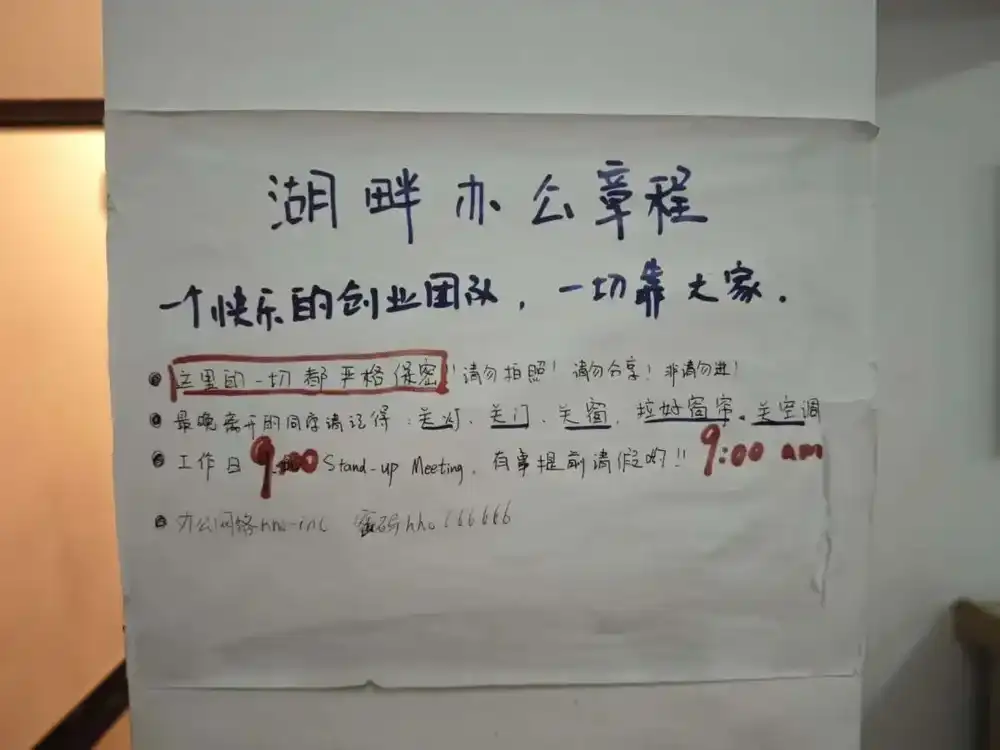
The interior of the replica Lakeside Garden at Alibaba's Xixi office area. Image credit: "Jiazi Guangnian"
In January 2015, the first generation of DingTalk was launched. Its core insight was: designing features by starting from the needs of business owners. Functions like "Ding" (nudge), read/unread status, corporate directory, and approval—later criticized by many as "strong management, strong control"—answered the most basic yet anxious questions in Chinese companies at the time: Has the other person seen what I said? Is the task I assigned moving forward?
This insight was clearly a sharp breakthrough. DingTalk reached 100 million users in its first year and 300 million in three years.
In DingTalk recruitment ads, Chen Hang called the team the "Madhouse," with T-shirts printed with "BE CRAZY." He himself worked over 15 hours a day, often from 8 AM to past midnight.
His statement at a 2018 mobilization meeting, "I don't know what you all do going home before 10 PM," remains a frequently quoted anecdote in the internet industry.
In 2020, things changed. Alibaba announced the "Cloud-Ding Integration" strategy, upgrading DingTalk into the "Greater DingTalk Business Unit" and merging it into the Alibaba Cloud Intelligence Business Group, directly managed by then Alibaba Cloud Intelligence President Zhang Jianfeng. Chen Hang's DingTalk was required to deeply integrate with Alibaba Cloud's dedicated cloud architecture, creating a rift between its original independent, standardized product roadmap and the customized demands of large clients.
In 2021, Chen Hang was moved from his role as DingTalk CEO and transferred to become an assistant to Alibaba Group CEO Daniel Zhang. Ye Jun succeeded him as head of DingTalk. That same year, Chen Hang officially left Alibaba and founded "Liangqing Yiyang" (HHO) company, focusing on cross-border e-commerce and launching some small smart hardware products.
During his years at HHO, external evaluations were not high. It was a startup with stories but lacked funding and didn't achieve any impressive results. He later told media that his time at HHO taught him "strict cost control, mandating only 1 of 3 elevators could be used." These details were things top executives at large companies didn't need to consider.
But in the years he was away from DingTalk, DingTalk's situation also became increasingly awkward.
By 2024, it was still China's largest enterprise office application: 700 million users, 26 million enterprise organizations, but its commercialization progress was surpassed by Feishu. During Ye Jun's era, DingTalk allocated 60% of R&D resources to large client customization, with its ISV ecosystem complaining the "platform became just a sales channel."
In February 2025, Alibaba announced a 380 billion RMB investment to launch a three-year AI Long March. That same month, Group CEO Wu Yongming explicitly positioned DingTalk as "Alibaba's most important AI application in the toB field" during an earnings call.
A detail is worth pondering: Wu Yongming's connection with Chen Hang dates back to 1999. That year, Chen Hang first joined Alibaba as an intern, and his mentor was Wu Yongming. Later, he left Alibaba twice and returned twice at Wu Yongming's invitation.
On the evening of March 31, 2025, news broke that Alibaba had acquired HHO's investor shares. After the transaction was completed, Chen Hang became the CEO of DingTalk.
Mentor and protege. This story has been told too many times within Alibaba. But few ask: When a founder is invited back to the company they built, are they there to put out a fire, or to rewrite the script?
2. April's "Tightening Grip"
Last April, just days after Chen Hang's return, DingTalk's internal circles erupted.
A series of measures were successively leaked: clocking in at 9 AM, shortened lunch breaks, required to be in work mode by 13:15, evening summaries, bans on social apps like WeChat, Weibo, and Xiaohongshu, and standardized external communication: "Sorry, I only have DingTalk."
Even harsher measures: the tech team was required to review lines of code; programmers with zero code in the past three months would be let go; even all management positions had to learn Python to reduce pure managerial roles; product managers had to visit 3 companies weekly for co-creation.
Chen Hang himself would patrol the building every night at 10 PM, giving thumbs-up to those working overtime.
On social media at the time, "DingTalk refugee" became a new label. Some employees changed their profiles to "DingTalk started the grind," asking if rival companies were hiring. Someone joked anonymously: "Rejected after asking for WeChat for a blind date; the other person walked away immediately upon hearing I only use DingTalk."
Teng Yaxin (nickname "Yousu"), the core product manager of DingTalk's ONE project and author of the viral 75,000-word long article "Inside DingTalk" posted on June 4th, recounted in the article her interview experience with the "pledge of allegiance" style questioning.
Chen Hang repeatedly asked: "Why can't it be done? Are there still people in your father's family? In your mother's family? Are your grandparents still alive? Really can't find anyone? Really can't gather six family members who can use DingTalk?"
Although these questions seemed absurd, Chen Hang used exactly this logic to screen like-minded individuals when incubating DingTalk in 2014. But in 2025, candidates' first reaction to this interview culture was that of a toxic work environment.
The same action, with a different target, changed its meaning.
At that time, Chen Hang also launched a "Go to the Front Lines" campaign: requiring product, R&D, and operations team members to each serve as customer support for two hours daily.
This move was later confirmed as key to Chen Hang discovering DingTalk's "data illusion." Previously, the customer support team reported "only 15% transfer-to-human rate, all five-star reviews." But Chen Hang's on-site visits found many users complaining that consultations were "off-topic," "requests unanswered for over a year," "couldn't find the human support entry."
Chen Hang soon updated this data: DingTalk's true customer satisfaction rate was only 30%.
3. AI DingTalk 1.0, The Birth of DingTalk ONE
The iron-fisted Chen Hang quickly delivered results.
On August 25th last year, the DingTalk 10th Anniversary launch event, also the AI DingTalk 1.0 launch.
On stage, Chen Hang launched five products in one breath:
-
DingTalk ONE: A new-generation interaction portal that can automatically identify "the most important thing right now."
-
DingTalk A1: A 3.8mm-thick AI recording card, magnetically attaches to the back of a phone, equipped with BES 6nm chip.
-
AI Tables: Enables enterprises to generate AI applications with zero code.
-
AI Meeting Notes: Supports cross-language meeting transcription in 72 languages.
-
AI Search & Ask: A search engine that can search, ask, and get work done.
Chen Hang said, "DingTalk in the AI era must serve real work scenarios." This was one of his most public appearances. But the night before the launch, he was spotted by netizens still patrolling the DingTalk campus past midnight, trending as the "Most Grind CEO."
On launch day, DingTalk also disclosed a set of key data:
The number of enterprise organizations on DingTalk exceeded 26 million. Among them, paid organizations exceeded 190,000. Among the 5,191 A-share listed companies, 79% were using DingTalk. The number of AI applications on DingTalk had reached 1.41 million.
DingTalk's customer satisfaction rate, which Chen Hang uncovered as 30% in April with the "Go to the Front Lines" campaign, had been raised to 80% after he reorganized the support team and established three core teams for data engineering, model training, and effectiveness evaluation. Costs simultaneously dropped by 90%.
Besides this data, the most notable was DingTalk ONE.
DingTalk ONE was positioned as "the new entry point for DingTalk in the AI era" and was seen as the core of AI DingTalk 1.0. Within DingTalk at the time, ONE was the flagship product carrying high hopes.
This was a project Chen Hang started incubating in April. From April to August, DingTalk ONE went from inception to launch in less than half a year.
However, this spotlight didn't last long.
4. ONE's Summer and Autumn
ONE was not a product slowly refined over time.
"Inside DingTalk" has a review of ONE's lifecycle: ONE's lifecycle began incubation in April 2025, was first publicly revealed at the August 25th launch, with peak DAU stabilizing around 3 million. It was the first major "AI-native" project Chen Hang pushed after his return.
But ONE was also a project with extremely high personnel turnover. Yousu's design leader left in the second week; the senior who contacted and recommended her for the team was transferred to another department by the fourth week. Only 3 people stayed on ONE for over 3 months; Yousu was one of them.
ONE had a heavy design gene; its first person-in-charge was the head of the design center. But as the project moved towards the operational phase, the initial "card" format gradually evolved into "one screen displaying all important content."
This was clearly a failed attempt.
After reaching 3 million DAU, the retention rate plummeted.
In early 2026, ONE was disbanded.
It's worth considering: The rise and fall of ONE is not a simple story of a product failure.
Its "summer" corresponded to the urgency of Alibaba's AI-to-B strategy—Alibaba needed a new entry point to carry the narrative of the Agent era. But its "autumn" also stemmed from this; it was destined from birth to meet the dual standards set by the group: it had to launch quickly to prove AI strategic resolve, yet also accept the physical laws of retention rates for AI-native products.
When these two curves intersected, the product always lost.
A sentence in "Inside DingTalk" accurately describes the cost of this efficiency: It was in a hurry to become the new entry point, in a hurry to prove that DingTalk wasn't aging.
DingTalk wasn't aging. 800 million users, 26 million enterprises, 1.41 million AI applications, 190,000 paid organizations... These numbers still made it the number one in China's office collaboration sector.
But Chen Hang didn't want number one; he wanted "number one in the AI era."
5. The Day DingTalk Was Shattered
March 16, 2026.
Wu Yongming sent an all-staff internal letter announcing the establishment of the Alibaba Token Hub (ATH) Business Group. This group, with the core goal of "creating Tokens, delivering Tokens, applying Tokens," was led personally by Wu Yongming.
It integrated five major business units: Tongyi Lab (Qwen large model), MaaS business line (Bailian), Qianwen Business Unit (C-end AI assistant), Wukong Business Unit (B-end AI-native work platform), and AI Innovation Business Unit.
Among them, the "Wukong Business Unit" made its debut.
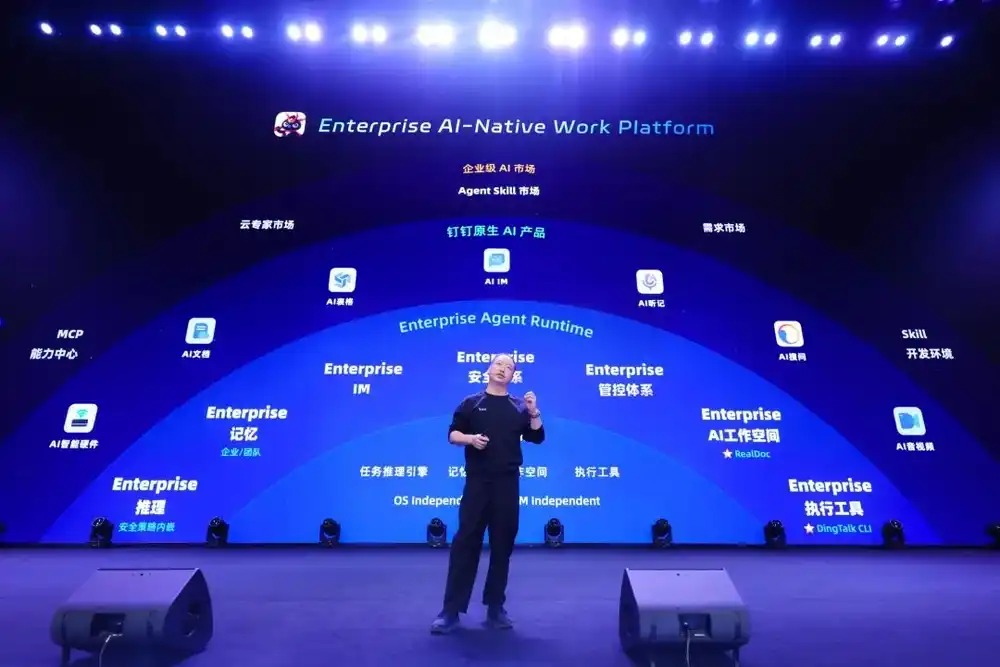
24 hours later. On the morning of March 17th, the AI DingTalk 2.0 Annual New Product Launch.
On this day, Chen Hang launched "Wukong," the world's first enterprise-grade AI-native work platform. Its promotional image was a cartoon version of the Monkey King holding a staff, standing among a crowd of shrimp soldiers—a picture full of metaphor.
Chen Hang said on stage: "Today, we shatter DingTalk, rebuild it with AI, and forge 'Wukong.' In the past, people used DingTalk to work; in the future, AI will use DingTalk to work."
"Shatter" was not a metaphor.
DingTalk rewrote its underlying code, fully CLI-ized (Command-line Interface), making all capabilities callable and operable by AI, rather than being simulated clicks;
"Communication is Execution"—in a DingTalk group chat, typing "Generate last week's sales report and sync it with management" could have Wukong automatically pull approval flows, attendance, CRM data, generate the report, and push it, all without human interface operation.
Wukong simultaneously released OPT (One Person Team) solutions for ten industries. This was the world's first solution to land AI Skills from a technical concept into industry-level, out-of-the-box products, covering ten scenarios like e-commerce, cross-border e-commerce, design, development, and retail stores.
A detail worth noting: Alibaba named the AI DingTalk 1.0 launched on August 25th last year "Jue" (fern), the 1.1 version launched on December 23rd "Mulan" (magnolia), and the 2.0 version "Wukong" (Monkey King).
"Fern" is breaking ground. "Magnolia" is nascent. And "Monkey King" is forged.
These three version names essentially represent Alibaba's three-stage assessment of AI DingTalk's maturity. From "breaking ground" to "forged," DingTalk took less than 7 months.
Thus, "Wukong" became the new entry point carrying Alibaba's AI-to-B strategy.
It's worth pointing out: The generational transition of Alibaba's to-B entry points has never been smooth. Every iteration of the entry point is accompanied by the repositioning or marginalization of the original business.
The primary C-end entry point promoted in 2025 was Quark. The primary C-end entry point promoted in 2026 was the Qianwen App. The primary B-end entry point promoted in 2026 was Wukong. DingTalk was no longer mentioned as the "primary to-B entry point," but became the carrier for Wukong.
Chen Hang's role shifted from "the one who reshaped DingTalk" to "the one who shattered DingTalk."
This is an extremely dramatic transformation within an organization.
6. These Seven Days in June
On June 4th this year, the viral long article "Inside DingTalk" appeared on Alibaba's intranet.
This wasn't an ordinary emotional rant. It was well-structured, logically rigorous—an organizational critique report. Using the full lifecycle of the strategic AI project ONE from inception to hasty scaling back as the thread, the article systematically exposed deep-seated problems within DingTalk: vicious internal competition, one-person decision-making, meaningless overtime, mechanical evaluations.
Then, on June 8th, a second long article appeared. Former DingTalk Vice President Ma Ruila (Wang Jiamin) posted "Outside DingTalk" on his personal public account.
He wrote in the article: "In my heart, I hoped Wuzhao could lead DingTalk back to glory, but the cost shouldn't be everyone trading working hours for burnout. Diligence and hard work are important in this era, but flashes of creative inspiration are equally important."
These two articles, one internal and one external, completely exposed DingTalk's internal problems and became a key trigger for the Alibaba Partner Committee's post.
Then came June 10th. The Alibaba Partner Committee posted on the company intranet titled "Affection, Righteousness, and Growth—That is the Alibaba Culture." The post, in severe language, criticized DingTalk's team management style, directly stating it was "not what Alibaba culture should look like."
"Under no circumstances, no matter how urgent the task, should the management style mentioned in the post appear within the DingTalk team. This approach has never been the direction advocated by Alibaba culture, not what Alibaba culture should look like," the Alibaba Partner Committee wrote.
This was a rare public statement by the Partner Committee in Alibaba's 27-year history on the internal management issues of a single business line.
24 hours after the post was published. On June 11th, Alibaba announced adjustments to DingTalk's management: Chen Hang stepped down as CEO, succeeded by Chen Yusen, the '92-born tech geek.
Notably, when Chen Hang was an intern at Alibaba in 1999, Chen Yusen, born in 1992, was just 7 years old.
7. The '92-born Successor
Chen Yusen was born in 1992.
A tech geek who achieved fame young. Champion in top domestic and international computer competitions. At age 22, the cybersecurity company he founded, Changting Technology, was acquired by Alibaba Cloud.
In 2025, he started an internal venture within Alibaba Cloud, leading the development of the AI Agent product MuleRun.
'92-born, Forbes Asia "30 Under 30," Changting Tech acquired by Alibaba Cloud, founder of MuleRun—these labels sketch out a successor with a style drastically different from Chen Hang's.
Chen Hang's labels are "Madhouse Dean," "Wuzhao," "BE CRAZY."
Chen Yusen's labels are "tech geek." Although his management style isn't yet defined, the products incubated concurrently within the ATH Business Group already signal a direction: Happy Horse, Happy Oyster, MuleRun, Qoder—these names are new footnotes for Alibaba's organizational paradigm of "small teams, young talent, respect for the individual."
The Alibaba Partner Committee emphasized in the previous day's post: "People are Alibaba's most precious asset; nurturing and inspiring people is the responsibility of every Leader. In the AI era, when machines can replace many things humans do, people become our most valuable asset. In the AI era, we need to insist even more on affection and righteousness, and need to collectively cultivate an open, inclusive, diverse work culture."
DingTalk's true position within Alibaba's AI-to-B strategy will not change because of Chen Hang's departure. The strategic importance of the Wukong Business Unit will not change. It remains one of the five core sectors of the ATH Business Group, the application link in Alibaba's full chain of "creating Tokens, delivering Tokens, applying Tokens."
Alibaba's complete matrix for AI-to-B—Qwen (base model) + Alibaba Cloud (computing infrastructure) + Wukong Business Unit (B-end application entry) + T-Head (self-developed GPU)—is already formed.
Chen Hang's 437 days of effort were not in vain: the "Agent OS / CLI-ization / Wukong Platform" he left behind is the true foundation of Alibaba's B-end AI entry point.
But the price he paid for this upgrade wasn't just technical and commercialization costs, but also organizational costs, morale costs, cultural costs.
Clearly, next, DingTalk's script will be written by someone else.
And the entrepreneurial spirit of Lakeside Garden was never the private property of any single individual. It will return repeatedly in different names, different products, different organizations—as long as the organization is willing to leave a door open for it.
In 2014, Chen Hang started with six people from Lakeside Garden.
In 2026, DingTalk needs to find its own Lakeside Garden again.